



Customized plastic float valveswater valvesmini water level switchesplastic float sensorswater dispenser level sensors
FEATURES
Hard Power Foundation — Building Customer Trust Through Infrastructure Excellence
1.1 Precision Mold Manufacturing Equipment
Five-Axis High-Speed Machining Centers
Ansix Tech maintains advanced five-axis CNC machining centers from MORISEIKI and Makino, delivering machining accuracy up to 0.002mm with surface roughness achieving Ra < 0.15μm on hardened steel up to 60HRC. This capability enables single-clamping precision for complex three-dimensional geometries, eliminating tolerance accumulation from multiple setups.
Customer Value Translation: For float valves and sensor housings, this means smoother parting lines, zero burrs on finished parts, and elimination of manual finishing—reducing secondary processing costs by up to 40%. The smooth surface finish reduces stress concentrations that could lead to premature failure in fluid environments, and ensures perfect sealing interfaces for water valves.
-
Mold Description
Product Materials:
PP FOAM
Mold Material:
S136ESR
Number of Cavities:
8
Glue Feeding Method:
COLD runner
Cooling Method:
Water cooling
Molding Cycle
12.5s

- The mold manufacturing process and product material selection
Slow Wire EDM (Electrical Discharge Machining)
Premium wire EDM systems from AgieCharmilles and Sodick achieve 0.002mm accuracy with surface finish Ra 0.05μm. This technology is critical for machining fine micro-holes down to 0.03mm diameter, narrow slots, and sharp internal corners that milling cannot reach. For thin-walled float components, this precision prevents deformation during ejection and ensures consistent wall thickness throughout production.
Customer Value Translation: For level switches requiring precise sensor mounting holes or float valve stems with tight clearance requirements, this capability ensures every feature meets print dimensions from the very first shot—eliminating costly rework and assembly fit issues.
Sink EDM (Die-Sinking)
Sink EDM capabilities from AgieCharmilles and Makino deliver ±0.002mm accuracy with mirror surface finishes (Ra < 0.1μm). Deep cavities, narrow slits, and complex geometric features are machined with micron-level precision—essential for high-performance sensor parts requiring tight tolerances on internal surfaces.
Precision Grinding
Surface grinding from OKAMOTO and profile grinding from WAIDA achieve ±0.001mm accuracy. This is critical for finishing hardened steel mold components, ensuring perfectly flat parting surfaces and precise slide fits that eliminate flash and maintain dimensional consistency across millions of cycles.
-
Large-Gantry CNC Milling
Supports mold bases up to 2,000mm × 1,200mm, enabling large multi-cavity float valve frames in a single mold base—no splitting required—reducing per-part molding cost by 15–25%.
1.2 Injection Molding Machine Fleet
Ansix Tech operates 260 injection molding machines with clamping forces from 30 tons to 2,800 tons. Key brands include Japanese Fanuc, Sumitomo, Toshiba, Nissei, Engel, and German Arburg (primarily for liquid silicone rubber two-component molding). Domestic machines include Haitian and Victor Taichung.
All-Electric Servo Drive Technology
Every machine is powered by precision servo motors that reduce energy consumption by 50 to 80% compared to hydraulic systems while maintaining repeatable cycle precision superior to traditional machines. Machines achieve repeatability accuracy of ±0.1%, ensuring part-to-part consistency across entire production runs.
Customer Value Translation: For water level sensor customers requiring consistent float buoyancy or valve sealing performance across millions of units, ±0.1% repeatability means every part performs identically—eliminating sorting, gaging, or reworking before assembly.
Real-Time Process Monitoring
Each machine is equipped with ultrasonic thickness sensors that monitor wall thickness fluctuations in real-time, automatically compensating injection and packing pressure to ensure dimensional consistency. For ultra-precision applications, in-mold temperature and pressure sensors provide closed-loop control with response times under 50 milliseconds.
Cleanroom Compatibility
All-electric machines are cleanroom ready with no hydraulic oil contamination risk, ideal for ISO 13485-certified medical device manufacturing and semiconductor component production where particulate control is critical.
1.3 Quality Inspection Equipment
Coordinate Measuring Machines (CMM)
Full mold base inspection prior to sampling; full lot sampling per AQL plan. Every mold ships with a full dimensional report showing all critical feature measurements.
Optical Measurement Systems
Automated non-contact measurement of delicate ribs and harness slots eliminates contact deformation; measurement time reduced by 70% compared to manual methods.
Portable White-Light Scanner
Rapid 100% part-to-CAD best-fit comparison to spot potential assembly mismatches before batch production begins.
Customer Value Translation: Every critical dimension must achieve CPK ≥ 1.33 before a single part ships. For customers, this means components can be installed directly into assembly lines without sorting, gaging, or reworking.
Part Two: Mold Manufacturing — The Core of Longevity, Precision, and Speed
2.1 Mold Life Expectancy — Direct Commitments
Mold Component Material Grade Hardness (HRC) Guaranteed Life (Unfilled) Guaranteed Life (GF/CF Reinforced)
Mold Base P20 / 45# 30-35 1,000,000 500,000
Cavity/Core S136 / STAVA 52-56 1,000,000+ 500,000
Wear-Intensive Inserts H13 / 2344 48-52 800,000 -
Additional Tool Steel Options:
Material Hardness (HRC) Key Properties Best Fit Application
S136 / S136H Pre-hard: 35 / Quench: 48-54 Superior corrosion resistance, ultra-high mirror polishability (Ra < 0.05μm), excellent wear resistance Transparent PC/ABS sensor housings, optical-grade surfaces, corrosive fluid environments
2344 / 8407 / H13 48-52 High hot hardness at 550-600°C, excellent toughness, superior thermal fatigue resistance High-temperature engineering plastics (PPS+40%GF, PEEK), high-thermal-load injection molds
NAK80 37-43 Super mirror polish (up to #15000), excellent EDM machinability High-gloss surfaces, cosmetic-grade appearances, fine-textured finishes
SKD11 / DC53 58-62 High wear resistance, high compression strength Wear inserts, sliders, shear edges subjected to abrasive filled materials
2343 48-52 Impact resistance superior to H13, good thermal conductivity Complex geometries with extreme mechanical shock loads
M340 / 4Cr13 / 9Cr18 48-53 Stainless martensitic, excellent corrosion resistance FDA-grade applications, acidic plastic compounds, humid environments
Customer Value Translation: Each mold undergoes strict heat treatment protocols with documented time-temperature curves. For float valve components exposed to water and chemicals, S136 corrosion resistance ensures mold longevity even in humid environments. For high-temperature sensor applications (automotive or industrial heating systems), H13 maintains hardness at 550-600°C.
2.2 Gate and Runner Solutions — Optimized for Efficiency
Gate Configuration Benefit Delivered to Customer
Hot runner with valve-gate sequencing Zero runner waste → 8–12% reduction in material cost per part. Suitable for thin-wall designs near heater zones
Sprue or edge gating (cold runner) Quick mold validation and lower upfront tool cost; ideal for mid-volume production
Multi-point gating via mold flow analysis Optimized fill balance eliminates weld lines at critical sealing surfaces—preventing potential leak paths from the start
2.3 Cooling System Design — The Hidden Driver of Cycle Time and Quality
Proper cooling channel design directly impacts:
Cycle time reduction — Faster cooling = higher output
Dimensional stability — Uniform cooling prevents warpage and shrinkage
Part quality — Eliminates sink marks and internal stresses
Ansix Tech employs mold temperature zone control with core and cavity temperature differentials maintained within 2°C to reduce warpage and deformation. For float valve components, this ensures consistent buoyancy characteristics across entire production runs.
2.4 Mold Delivery Standards
Mold Complexity Standard Delivery Rush Option
Simple molds 10 days —
Medium-difficulty projects 25-45 days As low as 20 days
Complex projects Negotiated With approval—never shortcuts DFM validation
Customer Value Translation: Ansix Tech maintains in-house electrode machining centers and EDM workshops—mold repairs typically completed within 24 hours without leaving the facility. Conventional welding/insert replacement restores production within 24 hours.
Part Three: Injection Molding Process Control — Eliminating Quality Anxiety
3.1 Process Standardization
All molding machines are connected via MES (Manufacturing Execution System) . Parameters such as temperature, pressure, speed, and time are locked in the system and accessible only by authorized engineers. Every batch undergoes first-article and last-article comparison.
Customer Value Translation: For customers, this means no unauthorized parameter adjustments, no batch-to-batch variation, and complete traceability. If a quality issue arises, the digital fingerprint from in-mold pressure sensors provides immediate root cause identification.
3.2 Dimensional Stability Control
Temperature zone control with core and cavity differentials within 2°C minimizes warpage. For comparable support components, key hole spacing fluctuation ≤ 0.02mm across three consecutive production batches within one week.
3.3 Appearance Quality Grades
Requirement Ansix Tech Capability
Transparent parts No bubbles, no flow marks
Plated parts No gas streaks
High-gloss parts Surface roughness Ra ≤ 0.2μm
Painted/printed parts Pre-compensation for deformation; print registration accuracy ±0.1mm
3.4 Special Material Processing Capabilities
Ansix Tech has extensive production experience with:
Material Category Specific Grades Application in Float Valves/Sensors
Standard Engineering Plastics PC, PC/ABS, PA6+GF30, PBT Sensor housings, valve bodies
High-Performance Plastics PPS+40%GF, PEEK, PEI, LCP High-temperature float components, chemical-resistant sensors
Fluoropolymers PTFE, PFA, PVDF Corrosive chemical environments; PVDF withstands strong acids/bases up to 105°C continuous
Specialty Materials Liquid Silicone Rubber (LSR) Seals, gaskets, overmolded components
Foamed Materials PP micro-foaming Precision buoyancy control for floats
Flame Retardancy: UL94 V-0 rated materials available for applications requiring fire safety.
Weathering Resistance: UV testing up to 3,000 hours with no color change.
Part Four: Full-Service Lifecycle Management — Reducing Customer Management Costs
4.1 Early-Stage DFM (Design for Manufacturability) Engagement
Before any steel is cut, Ansix Tech provides a comprehensive DFM (Design for Manufacturability) report. This analysis examines:
Draft angle recommendations for all vertical walls
Wall thickness optimization to prevent sink marks and ensure uniform cooling
Gate location optimization via mold flow analysis
Ejector pin mark location allowances
Shrinkage and warpage prediction—especially critical for large flat surfaces where anisotropic shrinkage can cause potato-chip-like warpage
Customer Value Translation: DFM analysis typically reduces injection molding costs by 10% by identifying and resolving producibility issues before tooling investment. For float sensor customers, this means no costly design changes after the mold is built—saving weeks of development time and tens of thousands of dollars in rework.
4.2 Mold Flow Analysis (MFA)
Advanced Moldflow simulation predicts melt behavior to identify:
Weld line formation locations
Air trap positions
Pressure distribution
Optimal gate placement
Customer Value Translation: For water level sensors requiring leak-proof sealing, re-routing the gate ensures weld lines do not form at critical sealing areas—preventing potential leak paths from the start.
4.3 Trial Molding and Sample Validation
T0 to T3 Trial Samples: Every new mold provides T0 through T3 trial samples, with improvement reports for each round. Quick-change inserts allow verification of different design variants without rebuilding the entire mold.
First Article Inspection (FAI): Complete FAI report with every new mold, documenting CPK values for each critical dimension. For medical-grade applications, CPK ≥ 1.67 is standard—exceeding the typical CPK ≥ 1.33 requirement.
4.4 Small-Batch Validation
Before full production release, Ansix Tech provides 100-500 shot trial production runs, with yield rate and CPK statistics to confirm stability before mass production.
4.5 Maintenance and Spare Parts
Spare parts (ejector pins, core inserts) delivered with the mold
Mold maintenance every 200,000 cycles
Lifetime repair at cost price
4.6 Integrated End-to-End Service Model
Unlike fragmented service providers that outsource critical functions, Ansix Tech offers a unified platform integrating every stage: from product design and prototyping to mold manufacturing, high-volume production, secondary processing, and assembly. This integration eliminates communication gaps, accelerates project timelines, and ensures consistency from concept to delivery.
Customer Value Translation: Single point of accountability throughout the entire product lifecycle. One partner, one quality standard, one delivery schedule—reducing management overhead by 30-50% compared to managing multiple suppliers.
Part Five: Differentiated Commitments — Addressing Common Industry Pain Points
Common Customer Complaint Ansix Tech's Professional Response
"Molds require frequent repairs, disrupting orders" "We conduct 2,000-cycle aging tests before delivery with wear reports. We provide three-year mold structure warranty (excluding normal wear of consumable parts)."
"Excessive flash, high secondary finishing costs" "We machine parting surfaces to 0.005mm fit precision and employ self-locking clamp force compensation, ensuring flash is controlled within 0.03mm per batch—eliminating manual deburring."
"Dimensions vary batch to batch" "All machines equipped with ultrasonic thickness sensors providing real-time wall thickness feedback with automatic packing pressure compensation. In-mold temperature and pressure sensors enable closed-loop control."
"Mold repair takes too long" "We maintain in-house electrode machining centers and EDM workshops—mold repairs typically completed without leaving the facility. Conventional welding/insert replacement restores production within 24 hours."
Part Six: Product Introduction — Customized Plastic Float Valves, Water Valves, Level Switches, and Sensors
6.1 Product Portfolio
Customized Plastic Float Valves
Mechanical float valves for tank fill control
Available in multiple materials (PP, PVDF, PPS, PA6+GF30)
Operating temperature range: -40°C to 200°C+ (material dependent)
Customizable float size, buoyancy, and actuation force
Customized Water Valves
Diaphragm valves, solenoid valve bodies, check valves
Food-grade materials available (FDA compliant)
UL94 V-0 flame retardant options
Mini Water Level Switches
Compact form factor for space-constrained applications
Reed switch or Hall effect sensor integration
Customizable mounting configurations (top, bottom, side)
Plastic Float Sensors
Continuous level sensing or point-level detection
Micro-foamed PP floats for precision buoyancy control
Overmolded magnet designs available
Water Dispenser Level Sensors
NSF/ANSI 42 and 58 compliant materials
Optical or mechanical sensing options
High-cycle-life designs (>1,000,000 cycles)
6.2 Material Selection Guide for Float and Sensor Components
Material Key Properties Typical Applications
PP (Polypropylene) Excellent chemical resistance, low density, good processability. Available with physical/chemical foaming agents for micro-foaming to achieve precise buoyancy control. Standard foam floats for water and mild chemical environments; PP micro-foamed floats for higher buoyancy requirements
PVDF (Polyvinylidene Fluoride) Superior resistance to strong acids, strong bases, and solvents; continuous operating temperature up to 105°C; high purity, low moisture absorption. Floats and switch housings for corrosive chemical environments (semiconductor, pharmaceutical)
PPS (Polyphenylene Sulfide) Excellent heat resistance (200°C+), good dimensional stability, chemical resistance. High-temperature applications such as automotive or industrial heating systems
PC (Polycarbonate) and Blends High impact strength, good dimensional stability, signal transparency for optical sensors. Special grades (e.g., Covestro Makrolon Ai) prevent signal interference. Complex sensor housings, especially for LiDAR or optical liquid level detection systems
PEEK (Polyetheretherketone) Exceptional mechanical properties, chemical resistance, and thermal stability up to 250°C+. Biocompatible. High-performance medical and aerospace sensor applications
PA6+GF30 (Nylon 6 with 30% Glass Fiber) High strength, good wear resistance, improved dimensional stability. Valve bodies, structural sensor components
PBT (Polybutylene Terephthalate) Good electrical properties, chemical resistance, dimensional stability. Electrical sensor housings, connector bodies
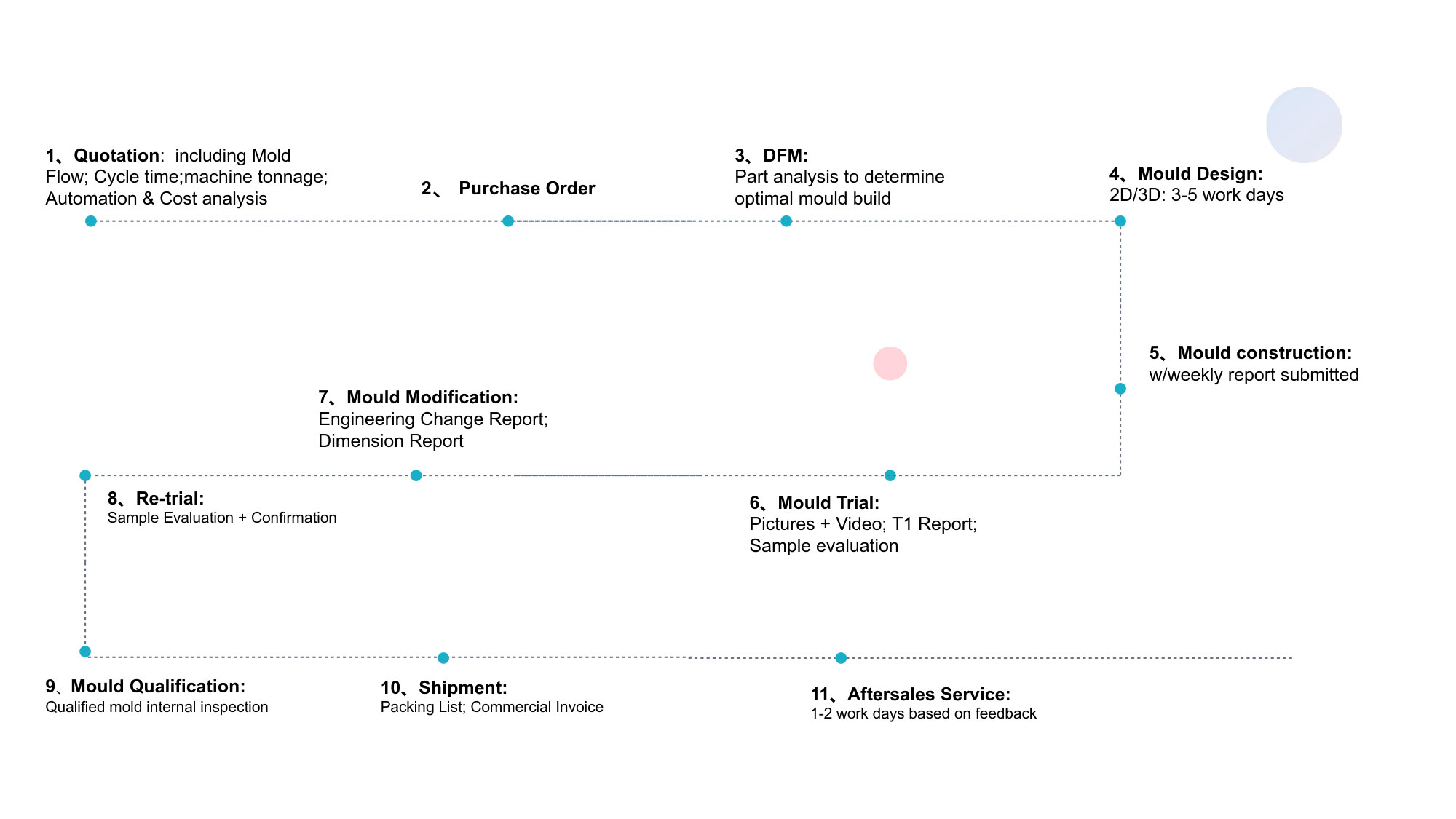
6.3 Manufacturing Process Overview
Step 1: Project Initiation & DFM Analysis
3D digital model creation and review
DFM analysis identifying potential producibility issues
Mold flow analysis for gate placement optimization
Step 2: Mold Design & Manufacturing
CAD design using Solidworks, Pro/Engineer
Precision machining (5-axis CNC, wire EDM, sink EDM)
Heat treatment with documented time-temperature curves
Quality inspection (CMM, optical measurement)
Step 3: Trial Molding & Validation
T0 to T3 trial samples with improvement reports
First Article Inspection (FAI) with CPK documentation
100-500 shot small-batch validation
Step 4: Mass Production
MES-connected all-electric servo machines
Real-time process monitoring with closed-loop control
Statistical Process Control (SPC) tracking critical dimensions
Step 5: Quality Assurance & Packaging
100% critical dimension verification
CPK ≥ 1.33 minimum on every critical dimension
Custom packaging solutions to prevent damage during transit
Step 6: Delivery & After-Sales Support
On-time delivery guarantee
Spare parts delivered with mold
Lifetime maintenance support at cost price
Part Seven: Quality Assurance — From Material to Finished Product
7.1 Quality Management System
Ansix Tech maintains a complete quality control system certified to:
ISO9001 — Quality management
IATF16949 — Automotive industry's strictest quality standard
ISO13485 — Medical device quality management
ISO14001 — Environmental management
7.2 Multi-Layer Inspection Mechanism
In-Mold Pressure Sensors: Provide a digital fingerprint for every shot, enabling real-time monitoring and automatic rejection of any part outside ideal parameters.
Statistical Process Control (SPC): Tracks critical dimensions throughout production runs.
First Article Inspection (FAI): Complete dimensional report with every new mold, documenting CPK values for each critical dimension.
Customer Value Translation: CPK ≥ 1.33 is not an engineering statistic—it is a regulatory passport. For customers facing regulatory audits, CPK data provides objective evidence that regulators require.
7.3 Quality Guarantee Commitments
Quality Metric Ansix Tech Standard Industry Typical
Critical Dimension CPK ≥ 1.33 (minimum); ≥ 1.67 for medical ≥ 1.0-1.33
Parting Surface Fit Precision 0.005mm 0.02-0.05mm
Flash Control ≤ 0.03mm per batch 0.05-0.10mm
Shot-to-Shot Weight Repeatability ±0.1% ±0.3-0.5%
Mold Life (GF materials) 500,000+ cycles 200,000-300,000 cycles
Part Eight: Cost Control — Systematic Reduction of Hard Costs
8.1 Material Cost Optimization
Value Engineering: Ansix Tech's expertise lies in guiding customers to select the most cost-effective materials that meet all performance standards without over-engineering. This material optimization is a primary means of reducing product "hard costs" from the start.
Material Substitution: For example, recommending PP micro-foaming for float applications instead of more expensive engineering plastics when chemical resistance requirements permit.
Hot Runner Systems: Reduce runner waste by 8-12% material cost per part.
8.2 Process Efficiency Optimization
All-Electric Servo Machines: Reduce energy consumption by 50-80% compared to hydraulic systems.
Multi-Cavity Tooling: Large-gantry CNC milling supports mold bases up to 2,000mm × 1,200mm, enabling large multi-cavity molds in a single base—reducing per-part molding cost by 15-25%.
Cycle Time Reduction: Optimized cooling channel design minimizes cycle time, increasing output per machine-hour.
Secondary Operation Elimination: Precision machining eliminates manual finishing—reducing secondary processing costs by up to 40%. Flash controlled within 0.03mm eliminates manual deburring.
8.3 Risk Cost Reduction
DFM Prevention: Identifying and resolving producibility issues before tooling investment prevents costly design changes after mold build—saving weeks of development time and tens of thousands of dollars in rework.
Mold Life Guarantee: 500,000+ cycle guarantee for GF materials means no mid-project mold rebuild costs—maximizing return on tooling investment.
Process Stability: ±0.1% shot-to-shot repeatability means no sorting, gaging, or reworking before assembly—eliminating hidden quality costs.
Part Nine: Capacity and Delivery — Scaling Without Compromise
9.1 Production Capacity
260 injection molding machines from 30 tons to 2,800 tons
Four production bases in China and Vietnam
Over 200,000 m² of production space
Over 1,200 employees including more than 200 designers
30,000+ mold sets built to date
70% automated machining ratio
Average of just two mold trials before production readiness
9.2 Scalability
Capacity scales from prototyping to millions of units per month without re-tooling or capacity bottlenecks.
Customer Value Translation: No need to requalify a new supplier when volumes increase. Ansix Tech grows with you.
9.3 Delivery Performance
Mold Type Standard Lead Time
Simple molds 10 days
Medium-difficulty 25-45 days
Rush (with approval) As low as 20 days—but never shortcuts DFM validation
Mold Repair: In-house EDM and electrode machining centers enable mold repairs typically completed within 24 hours.
Part Ten: Customer Value Summary — What Ansix Tech Delivers
10.1 Problems Solved
Customer Problem Ansix Tech Solution
Design not optimized for manufacturability Pre-tooling DFM analysis with mold flow simulation
Inconsistent part quality MES-locked parameters, real-time closed-loop monitoring, CPK ≥ 1.33
Mold failures disrupting production 500,000+ cycle guarantee, 2,000-cycle aging test before delivery
High secondary processing costs 0.005mm parting fit, flash ≤ 0.03mm eliminates deburring
Long mold repair times In-house EDM/electrode workshop, 24-hour repair capability
Multiple suppliers = management overhead Single integrated provider—design, mold, molding, assembly
10.2 Cost Savings Delivered
Cost Category Savings
Secondary processing Up to 40% reduction
Material cost (hot runner) 8-12% reduction
Per-part molding (multi-cavity) 15-25% reduction
Energy consumption 50-80% reduction
Development rework 10%+ reduction via DFM
Supplier management 30-50% reduction (single vs. multiple suppliers)
10.3 Risk Reduction
Risk Mitigation
Design flaws discovered after tooling Pre-tooling DFM and mold flow analysis
Regulatory compliance failure ISO9001, IATF16949, ISO13485, ISO14001 certified
Production quality variation MES-locked parameters, SPC tracking, CPK ≥ 1.33
Supply chain disruption Four production bases in two countries
Mold failure 500,000+ cycle guarantee, spare parts delivered with mold
10.4 Core Value Proposition
"For us, the mold is not a piece of steel—it is a money-printing machine. When we design the mold, we simultaneously plan the mold's steel retention, exhaust paths, and temperature balance—ensuring that when it reaches your production line, it requires no debugging, produces minimal flash, and delivers maximum lifespan."
Ansix Tech's systematic approach—from digital concept through material science, precision mold manufacturing, and intelligent production—redefines value in the injection molding industry through smarter engineering, not cost-cutting shortcuts.
Conclusion
Ansix Tech's 28 years of manufacturing experience, 260 injection molding machines, 30,000+ mold sets built, and ISO9001/IATF16949/ISO13485/ISO14001 certifications provide the foundation for delivering customized plastic float valves, water valves, level switches, and sensors that meet the most demanding quality, cost, and delivery requirements.
From DFM analysis and material selection through precision mold manufacturing, process-optimized mass production, and lifecycle after-sales support, Ansix Tech systematically translates technical excellence into measurable customer value: reduced costs, mitigated risks, accelerated time-to-market, and uncompromised quality.
For customers requiring customized plastic float valves, water valves, mini water level switches, plastic float sensors, or water dispenser level sensors, Ansix Tech offers a single, integrated partner capable of managing the entire product lifecycle—from concept to delivery—with the scale, precision, and commitment required to succeed in today's competitive global markets.
Ansix Tech Co Ltd
If you have any plans related to Customized plastic float valveswater valvesmini water level switchesplastic float sensorswater dispenser level sensors , you can contact us at any time. We will turn your ideas into reality, let you realize your dreams, and obtain large orders from the market. Our contact information is info@ansixtech.com. Or contact our CTO, mail: stephen@ansixtech.com
#www.ansixtech.com #ansixtech.com #Customized plastic float valveswater valvesmini water level switch #Customized plastic float valveswater valvesmini water level switch #Customized plastic float valveswater valvesmini water level switch Canopy Mold injection mold companies #Ansix #Ansix moulds #Ansix china #Ansix tech china #Ansix tech company #Ansix facotry #Customized plastic float valveswater valvesmini water level switch injection molding #Customized plastic float valveswater valvesmini water level switch injection tools #Customized plastic float valveswater valvesmini water level switch injection moulds #Customized plastic float valveswater valvesmini water level switch plastic mould #Customized plastic float valveswater valvesmini water level switch plastic tools #Ansix Tech #Ansix molds #Ansix injection molding #Ansix mold factory #injection molding Customized plastic float valveswater valvesmini water level switch#Ansix mold factory #Customized plastic float valveswater valvesmini water level switch china #Customized plastic float valveswater valvesmini water level switch molds #injection factory #Customized plastic float valveswater valvesmini water level switch injection molding #Customized plastic float valveswater valvesmini water level switch injection molding factory #injection molding company #Customized plastic float valveswater valvesmini water level switch injection mold companies #Customized plastic float valveswater valvesmini water level switch Tooling #Customized plastic float valveswater valvesmini water level switch mold limited #Ansix mold china #Ansix companies #Ansix company China #Customized plastic float valveswater valvesmini water level switch facotry #Ansix Tech #Ansix Tech mould #Customized plastic float valveswater valvesmini water level switch injection moulding #injection moulding company #Ansix Customized plastic float valveswater valvesmini water level switch parts injection mold companies #medical injection molding companieschina #Customized plastic float valveswater valvesmini water level switch china factory #Ansix moulding companies #Ansix molding company #Customized plastic float valveswater valvesmini water level switch injection moulding facotry #Ansix Tech mold #Customized plastic float valveswater valvesmini water level switch mould #Customized plastic float valveswater valvesmini water level switch plastic injection molding #ansix plastic mold #Mold manufacturing #Customized plastic float valveswater valvesmini water level switch parts manufacturing #Customized plastic float valveswater valvesmini water level switch plastic parts factory #Customized plastic float valveswater valvesmini water level switch injection parts mold #Customized plastic float valveswater valvesmini water level switch PRECISION MANUFACTURING #Customized plastic float valveswater valvesmini water level switch #China mold #Customized plastic float valveswater valvesmini water level switch injection moulding china #Customized plastic float valveswater valvesmini water level switch mould china #china precision mold #mold in china #Customized plastic float valveswater valvesmini water level switch mold china #Precision molds #High-precision molds #Customized plastic float valveswater valvesmini water level switch #Injection molds #Customized plastic float valveswater valvesmini water level switch Factory #Customized plastic float valveswater valvesmini water level switch Company #Super Large Injection Mold Factory #Large Tonnage Injection Molding Factory #Customized plastic float valveswater valvesmini water level switch Company #Customized plastic float valveswater valvesmini water level switch Factory #2800T Injection Molding Factory #3000 Ton Injection Molding #4500 Ton Injection Molding Factory #Large Mold Injection Molding #Large Plastic Mold Injection Molding Factory #Large Injection Mold Manufacturer #Plastic Mold Factory #Injection Mold #Plastic Mold