



Three-Color Plastic Handle Precision Mold
FEATURES
This proposal presents a comprehensive, customer-centric framework organized into five strategic pillars that connect our engineering capability directly to your business outcomes.
Section I: Hardware Capabilities — The Foundation of Customer Trust
Before a single piece of steel is cut, the foundation of precision manufacturing begins with the equipment that shapes your mold. At Ansix Tech, our facility is purpose-built to deliver the accuracy, stability, and scalability your three-color plastic handle project demands — and every piece of equipment is selected based on one criterion: how it benefits you, our customer.
-
Mold Description
Product Materials:
ABS/PC / PMMA
Soft rubber: TPE
Mold Material:
S136ESR
Number of Cavities:
2+2+2
Glue Feeding Method:
Hot runner
Cooling Method:
Water cooling
Molding Cycle
32.5s
- The mold manufacturing process and product material selection
Precision Mold Machining Equipment
Technical Capability Customer-Translated Value
Five-axis high-speed machining centers capable of machining complex contoured surfaces with ±0.002 mm positioning accuracy Your three-color handle requires smooth, seamless transitions between color zones and consistent parting lines. Our five-axis precision ensures your product emerges from the mold with no visible step marks, no flash at color boundaries, and zero hand-finishing work required — eliminating secondary post-processing costs
Slow-speed wire EDM (Electrical Discharge Machining) with capability for micro-features down to 0.03 mm diameter (fine cores, narrow slots, and thin-walled sections) For handle designs with intricate grip textures, fine ribs, or delicate geometric features, our EDM capability prevents thin-wall deformation, corner cracking, or core pin breakage — saving you from costly mold repairs and production interruptions
Advanced CNC electrical discharge machining (EDM) cell with automated electrode change and in-process spark gap control The invisible details of your three-color handle — such as the chemical bonding interface between the first and second shot materials — require flawless cavity surfaces that only high-precision EDM can produce. Our automated EDM system eliminates manual finish variation, ensuring every handle produced meets your cosmetic and functional standards from the very first shot to the millionth
High-speed milling with automated tool changers and 70% automated machining ratio Reducing manual intervention reduces variation. Our 70% automated machining ratio [7†L26-L26] means your mold cavities are cut consistently by pre-programmed toolpaths rather than operator judgment — yielding repeatable mold geometry across every cavity in the family tool and ensuring color zone registration accuracy that meets even the tightest customer specifications
Key validation deliverable: Prior to mold shipment, we provide a full dimensional inspection report with CMM-certified measurements of every critical feature, with Cpk ≥ 1.33 on all customer-designated critical dimensions. This is not an option — it is our standard.
-
Injection Molding Machine Fleet
Technical Capability Customer-Translated Value
260 injection molding machines with clamping force range from 30 tons to 2,800 tons Whether your three-color handle is a compact hand tool component or a large ergonomic palm grip, we have the right machine capacity for your production volume. Our fleet includes Japanese Fanuc, Sumitomo, Toshiba, Nissei; German Arburg (specializing in LSR), Austrian Engel; and domestic Haitian and Victor Taichung machinery [8†L12-L15] — ensuring you never wait for machine availability and your production scales seamlessly with demand
All-servo-electric and hybrid drive systems with repeatable precision of ±0.1% across cycle-to-cycle operation Loose tolerances cause failed parts. Full-servo-electric drive locks in injection pressure, screw position, and shot volume repeatability at a level that conventional hydraulic machines cannot match. For your three-color handle, this means every shot matches the first shot — color blocks align precisely, fill boundaries are consistent, and reject rates are minimized batch after batch after batch
Multi-shot injection molding machine configurations specifically designed for three-color/triple-shot molding, equipped with independently controlled injection units and rotary platen or core-rotation systems Three-color molding is not simply running three injection units simultaneously — it requires precise synchronization of material delivery, melt temperature management across materials with different processing windows, and perfect registration of each overmold layer. Our multi-shot machines and core-rotation indexing systems handle the complexity so you don't have to [6†L20-L22]. The result: a fully integrated handle in one molding cycle, eliminating assembly operations and their associated cost
Key customer assurance: Every injection molding machine is connected to our Manufacturing Execution System (MES), which records, monitors, and locks down every process parameter. Only authorized engineers can change temperature, pressure, speed, or timing profiles — meaning your production process is protected from unauthorized or accidental variation.
1.3 Metrology and Quality Inspection Equipment
Technical Capability Customer-Translated Value
Coordinate Measuring Machines (CMM) with full-program automated measurement We do not guess whether your handle fits. Our CMM measures every critical dimension against your print, generating a full dimensional report that either validates compliance or triggers immediate corrective action — with no subjective pass/fail decisions made on the shop floor
Optical measurement systems with vision inspection for non-contact verification of fine features and edge geometry For intricate color boundaries, fine grip textures, and micro-ribs where physical probing is impractical, our optical inspection captures geometry with sub-pixel accuracy, ensuring that even the smallest aesthetic feature meets your standard
Surface roughness measurement equipment (contact and non-contact) A three-color handle must look and feel right. We certify surface finish to Ra ≤ 0.2 μm on cosmetic surfaces and document surface roughness on all critical mating and sealing surfaces — no assumptions, only data
Customer deliverable: Every mold shipped from Ansix Tech is accompanied by a complete inspection package including material certifications (alloy composition and heat treatment reports), dimensional measurement reports, surface finish measurements, and any customer-specified first article inspection (FAI) documentation.
Section II: Core Mold Manufacturing Competencies — Speaking Your Language Through Metrics
You care about production uptime, part quality consistency, and cost-per-part. The table below translates our mold engineering specifications directly into the business outcomes that matter to you.
2.1 Mold Life Expectancy
Customer’s Concern Our Technical Commitment The Customer Value
“How many shots will I get before the mold needs major repair?” Mold base: P20 (pre-hardened, 1.2311/1.2312 grade), 1.2738 (718H enhanced grade) for dimensional stability and wear resistance under repeated clamping cycles. Cavity and core inserts: Material selection based on your plastic material, fillers, and production volume — S136 (1.2083, corrosion-resistant stainless for medical/food contact applications), H13 (1.2344, high hot hardness for filled materials), 8407, 2344, 2343, SKD11, SKD61, DC53 (high wear resistance for abrasive materials), M340 (corrosion-resistant for acidic polymers), 4Cr13 (general-purpose corrosion resistance), 9Cr18 (high carbon stainless), NAK80 (pre-hardened mirror-finish for cosmetic appearances) [3†L10-L15][3†L5-L7] For standard unfilled thermoplastics (ABS, PC/ABS, PP, PS, HDPE): guaranteed 1,000,000+ shots before major mold maintenance. For abrasive glass-fiber-reinforced materials (PA66+30%GF, PPS+40%GF, PC+20%GF) and carbon-fiber-filled grades: guaranteed 500,000+ shots before cavity/insert replacement [3†L25-L26]. We back this with material certification: every cavity insert comes with documented alloy composition and validated heat treatment curve — no guesswork on steel quality
2.2 Dimensional Tolerance Capability
Customer’s Concern Our Technical Commitment The Customer Value
“Will my parts fit consistently in downstream assembly?” Standard structural components (handles, housings, enclosures): Hold to ±0.05 mm (±0.002 inches) across all critical dimensions. Precision features (color zone boundaries, precision engagement features, sealing surfaces): Hold to ±0.005 mm (±0.0002 inches). Registration features (between first, second, and third color shots in three-color overmolding): Hold color boundary registration variation ≤ 0.02 mm A tighter tolerance band means fewer assembly failures, fewer customer complaints, and rework cost close to zero. For multi-material handles, precise registration across color shots eliminates visible misalignment at material boundaries — your product looks premium because every color sits exactly where your design intended. Every mold includes compensated geometry anticipating shrinkage and warpage from our Moldflow analysis, meaning the plastic part comes out correct — not the mold cavity
2.3 Mold Types and Configurations
Technical Capability Customer-Translated Value
Three-color sequential injection molds with rotary platen or core-rotation system technology (stationary core + rotating platen / rotating core system) [9†L4-L8] Three distinct materials or colors are integrated into one complete part without secondary assembly. This eliminates the cost and complexity of post-molding assembly, bonding, or fastening operations — saving you assembly labor, floor space, inventory, and quality inspection steps. For a high-volume handle product, consolidating three components into one can reduce total part cost by 30–50%
Multi-cavity and family molds (2-cavity, 4-cavity, 8-cavity, 16-cavity, and higher configurations) Higher cavity count = higher output per hour = lower part cost. We analyze your annual volume requirements and design the optimal cavity count that balances initial tooling investment against long-unit cost — we do not overbuild or underbuild, we right-build
Stack molds (dual-platen, multilayer configurations) For very high-volume programs, stack molds effectively double or triple output per molding cycle without increasing machine clamping tonnage — dramatically lowering cost-per-part while using the same floor space
Hot runner systems (multi-shot compatible, thermally isolated for each material stream, pin-point valve gate and open gate configurations) Hot runner systems eliminate runner waste from every shot — no scrap sprue, no reprocessing or brokering of regrind material. For three-color molding where material costs vary between colors, hot runners applied strategically can reduce total raw material consumption by 15–35%, directly lowering your per-part material cost
High-gloss / mirror-finish molds achieving Ra ≤ 0.05 μm for transparent or high-cosmetic applications For handles with transparent segments (such as light pipes, indicators, or liquid level views) or high-gloss aesthetic surfaces, mirror-polished cavity surfaces produce parts that require zero secondary polishing or coating — reducing cosmetic finishing cost to zero
2.4 Gate and Runner System Optimization
Technical Capability Customer-Translated Value
Moldflow CAE simulation before steel cutting using industry-standard software (Autodesk Moldflow, Moldex3D) to predict melt flow behavior [12†L11-L18] We simulate the entire injection process on a computer before we cut the first piece of steel. This predicts exactly where weld lines (where two melt fronts meet — particularly critical in three-color molding between color layers), gas traps (air pockets that cause surface voids), and flow hesitation (uneven filling) will occur [12†L6-L7][6†L17-L19]. We then reposition gates, adjust wall thickness distribution, re-sequence injection timing between shots, and modify venting locations — all in software — to prevent defects from ever appearing. The result: fewer trial shots, faster mold qualification, reduced customer sample turnaround, and lower total project cost
Balanced runner system design with shear-heat management, thermal gate separation for multi-shot applications, and valve-gate sequencing control for color boundary definition Unbalanced filling means some cavities finish before others, leading to part-to-part variation — the worst outcome for a production mold. Our runner systems are calculated and flow-balanced so that every cavity in your multi-cavity mold fills simultaneously and uniformly, ensuring that the handle from cavity 1 is identical to the handle from cavity 8. In three-color molds, gating is sequenced to enhance material interlayer adhesion and prevent delamination [4†L22-L28]
Key deliverable: You receive a complete Design for Manufacturability (DFM) report before any tooling purchase commitment — including gate location recommendations, material shrinkage data, fill and pack simulations, cooling analysis, and a risk assessment of your current design. Adjustments made here cost pennies; adjustments made after steel is cut cost thousands.
2.5 Mold Delivery Lead Times
Customer’s Concern Our Technical Commitment The Customer Value
“When can I start production?” Simple molds (single-cavity, basic geometry): 10 calendar days. Medium-complexity molds (multi-cavity with slides/lifters): 25–45 calendar days. Complex high-precision molds (three-color sequential with rotary platen technology, precision cooling, core-pulling slides for color boundary definition): 45–60 calendar days. Expedited services available with guaranteed timelines (subject to design freeze status and resource availability) — we commit to expedited schedules only after validating that design is frozen and simulation reviews are complete, because truncating DFM costs customers more in trials and rework than it saves on the calendar We do not sacrifice validation to meet a date. If we expedite, we build extra capacity into the plan — not skip steps. Every mold, regardless of project urgency, still receives full DFM review, Moldflow simulation, and in-process inspection before delivery. Our average mold trials per project is 2.0 [7†L25-L26] — we design it right the first time, test it once to confirm, and deliver it ready to run
Section III: Injection Molding Process Control — Eliminating Quality Anxiety
Your three-color handle goes into a product that your brand name is attached to. You cannot afford appearance defects, inconsistent dimensions, or process stability problems. Ansix Tech’s process control systems are specifically designed to eliminate the quality concerns that keep production managers awake at night.
3.1 Eliminating Common Molding Defects
Customer’s Fear Our Technical Prevention Strategy Quantified Customer Value
Sink marks and voids (surface depressions or internal cavities caused by insufficient packing/cooling) Our Moldflow simulation predicts thick-section shrinkage and identifies areas where sink marks will form before tooling is built. We then design packing-optimized runner and gate layouts that direct holding pressure to thick-section areas precisely when needed. For three-color handles, we also optimize shot sequencing to prevent sink at material interfaces Sink-free parts require no secondary putty filling, sanding, or painting — eliminating cosmetic repair costs entirely
Flash (excess plastic extruding between parting lines, slides, or ejector pins) We finish mold parting lines with 0.005 mm gap control tolerance (that is 5 microns — half the thickness of a human hair) using precision grinding and optical verification. For multi-shot molds, we characterize thermal expansion differentials between materials to maintain fit across temperature cycles. We also utilize self-locking mold clamp force compensation [tooling strategy] that ensures consistent sealing across tens of thousands of cycles Flash-free parts mean zero hand-trimming or de-flashing labor before assembly. That alone can save hundreds of labor hours per million parts produced. Flash also does not accumulate in downstream assembly equipment — preventing jams and unplanned downtime
Warpage and dimensional instability (parts that twist or change dimensions between production runs or environmental conditions) We implement scientific molding protocols — each mold incorporates zoned temperature control using mold-temperature controllers (water or oil) with independent zones for cavity and core to keep thermal gradients ≤ 2°C across both mold halves — minimizing differential shrinkage that causes warp [5†L7-L10][4†L46-L51]. Our molding machines are equipped with ultrasonic wall thickness sensors providing real-time feedback, and we can integrate in-mold cavity pressure and temperature sensors that connect directly to our closed-loop process controller, automatically adjusting packing pressure to compensate for raw material viscosity drift Parts stay stable across shift changes, across seasons, across raw material lots. For your three-color handle, consistent dimensions mean consistent assembly fit — every time. In a recent bracket project for a medical device customer, we demonstrated < 0.02 mm variation in key hole-to-hole spacing across three production runs spanning one week — with multiple operators, multiple machine shifts, and varying ambient factory conditions — giving that customer the confidence to approve fully automated assembly
Aesthetic defects (flow lines, splay marks, jetting, burn marks, color inconsistency between color shots in three-color parts) For three-color handles with high-visibility cosmetic surfaces, we incorporate optimized fill velocity profiles (slow fill through gates to avoid jetting, acceleration through cavity to maintain fill without freeze-off). Transition zones between colors are managed with melt-front velocity control at the interface. For high-gloss and transparent applications, we certify cavity surface finish ≤ Ra 0.2 μm and adopt stainless mold steels (S136, NAK80, or comparable) with documented heat treatment for glass-level transparency [3†L10-L12]. For coated/painted handles, we provide part-specific deformation compensation modeling to achieve printing registration accuracy ≤ ±0.1 mm Your handle leaves our facility looking like your design rendering — not like a compromise. For transparent handle components, clarity is certified; for textured handles, gloss level is held to specification; for multi-color handles, color boundaries are sharp and clean at every inspection
Material adhesion failure / interlayer delamination (in three-color/multi-material molding, the bond between first and subsequent materials fails over time or temperature cycles) Three-color handle success depends on chemical compatibility between materials. Our material engineering team selects material pairs with known interfacial bonding compatibility (e.g., PC base with TPE overmold; ABS base with PMMA second shot for transparent windows; PBT/PET base with silicone top layer for soft-touch). We run material compatibility testing before tooling fabrication where required by application. For incompatible material pairs, we design mechanical interlocking features (undercuts, dovetails, micro-texture) at the junction to enhance adhesion irrespective of chemical bonding Your three-color handle stays permanently bonded — no peeling at the grip, no delamination between color segments, no warranty claims arising from layer separation
3.2 Process Standardization and Digital Manufacturing Execution
Technical Capability Customer-Translated Value
MES (Manufacturing Execution System) connecting every injection molding machine on our production floor Continuous monitoring of temperature, injection speed, packing pressure/time, cooling time, screw position, peak cavity pressure, and cycle time across every production run. The system locks in validated parameters — only engineer-authorized changes are permitted [13†L18-L29]. You get a full digital audit trail of your part’s production history. Out-of-spec conditions trigger immediate alarms and automatic machine holds, preventing defective parts from ever reaching your shipment
Statistical Process Control (SPC) with real-time CPK calculation for all customer-critical dimensions [5†L37-L41] Your product documentation may specify CPK targets (typically ≥ 1.33 for high-assurance where six-sigma equivalent is desired, or ≥ 1.0 for general use). We do not just track to target — we track continuously at the press to ensure that the process does not drift out of spec across shifts, days, or months of production. When CPK trends decline toward the limit, we schedule preventative intervention before you receive a single out-of-spec part
First-article and last-article comparison per production batch Every production batch is validated by measuring the very first part off the press against the very last part off the press. If dimensional change is detected between start and end of batch, we investigate and adjust. We do not wait for your quality team to find the problem — we find it first
Vision inspection systems at press (in-line automation) integrated with MES, with high-speed cameras and edge-detection algorithms [13†L46-L57] AI-assisted optical detection of flash, short shots, surface defects, and dimensional variation at full production speed — sorting out non-conforming parts without slowing production, sending only good parts to downstream operations. This protects your automated assembly line from jam-causing rejects
Quality certifications: Ansix Tech operates under ISO 9001 (Quality Management), ISO 14001 (Environmental Management), IATF 16949 (Automotive Quality Management — the gold standard for high-volume production with zero-defect expectations), ISO 13485 (Medical Device Quality Management), and maintains ISO 8 Cleanroom and GMP-certified facilities, fully FDA 510K compliant standards for medical-grade products [7†L13-L14][8†L6-L6][8†L42-L44].
3.3 Advanced Material Processing Capabilities
Your three-color handle may incorporate a combination of hard structural materials, soft-touch overmolds, and decorative color layers. The following table shows which materials we have successfully processed and proven — and the implications for your handle design.
Material Family Specific Grades / Types Key Application for Three-Color Handles Processing Considerations We Already Manage
ABS / PC-ABS blends Standard, flame-retardant (UL94 V-0/V-2), UV-stabilized grades Structural core of handle — excellent impact strength and surface finish at moderate cost. Common base material for high-gloss cosmetic handles Excellent dimensional stability, good adhesion to TPE/TPU overmolds, easy flow. We have processed millions of handles in ABS and PC-ABS for electronics, medical devices, and automotive interiors
PC (Polycarbonate) General-purpose PC, medical-grade PC (ISO 10993 biocompatible), high-heat PC (up to 130°C continuous service), UV-stabilized outdoor PC Transparent handle components, decorative windows, light-pipe segments. Highest clarity among engineering thermoplastics for applied cosmetic applications High melt temperature (280–320°C) requires tool steel capable of sustained thermal cycling without heat checking — confirmed in our steel selection criteria. We have PC molding experience across millions of shots for optical components
PMMA / Acrylic General-purpose, UV-transmitting (for light guides), impact-modified grades High-clarity transparent components where chemical resistance or UV stability is critical Dries and flows similarly to PC but has more brittle behavior in thin sections. We optimize gate placement carefully to avoid visible gate marks on decorative surfaces
Nylon / Polyamide (PA6, PA66) Unfilled (PA6, PA66), glass-reinforced (PA6+30%GF, PA66+30%GF, PA66+50%GF), heat-stabilized, impact-modified High-strength handle cores for industrial tools, automotive handles, power tool grips, and appliance handles requiring mechanical load capacity or chemical/oil resistance Glass fiber reinforcement significantly increases material strength but also increases mold wear. In three-color handles, we typically use glass-filled PA for the structural skeleton and then overmold a softer material (TPE or TPU) for the grip surface. We guarantee 500,000+ shots on glass-filled PA molds using H13 or DC53 inserts with wear-resistant coatings
PBT / PET Unfilled, glass-reinforced (PBT+30%GF, PET+30%GF), flame-retardant (UL94 V-0), food-contact grades High-heat handle components (automotive under-hood applications), electrical tool handles requiring dielectric properties, appliance handles in hot/humid environments Fast crystallization, low warpage when processed correctly. High flowability fills thin-walled sections easily. We have produced PBT handles for automotive and consumer goods applications with consistent dimensional control proven across many thousands of production cycles
PPS (Polyphenylene Sulfide) PPS+40%GF high-performance grade, PPS+65% mineral/glass (low-warpage formulations) Handles requiring extreme heat resistance (200–240°C continuous service), chemical resistance to fuels/solvents/acids, or UL94 V-0 flammability rating with no flame retardant additives. Common in industrial fluid handling handles and high-reliability automotive applications High processing temperature (320–350°C), requires corrosion-resistant tool steels (S136, 420) and robust venting due to outgassing. We design injection screw and barrel configurations matched to PPS processing to ensure consistent melt quality across long production runs
PEEK (Polyetheretherketone) Unfilled, 30%GF carbon-fiber-reinforced, bearing-grade (PTFE/graphite modified) Aerospace-grade handles, high-performance medical instrument handles (reusable surgical instruments requiring autoclave sterilization), high-end industrial handles requiring temperature resistance to 260°C+ and exceptional chemical resistance Extremely high processing temperature (380–400°C), requires specialized equipment and nickel-based alloy tool steels. Material cost is high, so our hot runner designs are engineered to minimize runner waste. We have processed PEEK for aerospace and medical components with documented quality control at every cycle
PEEK applications PEEK+30%GF, PEEK+CA30 (carbon fiber), PEEK with PTFE modification For high-end three-color handles incorporating soft elastomeric overmolds on a PEEK structural base — common in surgical instrument handles and ultra-high-reliability industrial applications Requires multi-shot molding with thermal isolation between PEEK and soft-material injection units due to wide melt temperature differences (380°C vs. 200°C). We have engineered three-color tools for this exact material combination; processing is proven
LSR (Liquid Silicone Rubber) General-purpose LSR, medical-grade LSR (ISO 10993, USP Class VI), high-tear-strength LSR, optically clear LSR Soft-touch grip overmold on three-color handles — particularly for hand tools where shock absorption is required, for medical instruments requiring sterilizability, and for food-contact handles requiring FDA compliance Cold runner systems required for LSR (LSR cures at elevated mold temperature; cannot run through a hot runner). Ansix runs German Arburg injection molding machines specifically configured for LSR [8†L13-L15]. We have processed LSR overmolds onto PC, PA, PBT, and PPS structural bases in multi-shot applications
LSR (continued) Self-lubricating LSR (for moving contact applications), high-clarity LSR for light-guide applications, conductive LSR for ESD-sensitive consumer electronics applications Overmold LSR onto a hard plastic handle substrate to produce a comfortable, slip-resistant, chemically inert grip that withstands repeated sterilization cycles (autoclave, EtO, gamma). For medical and food equipment, our LSR molding is FDA 21 CFR Part 820 validated [9†L22-L24] Cold runner system design is customized to each LSR grade to avoid premature cross-linking. Our process parameters are characterized for each material — temperature curve, injection speed profile, curing time — documented in MES for consistent repeatability across production runs
PPSU / PES (Polysulfone) PPSU (amber transparent high-impact medical grade), PES (higher-temperature amber-transparent grade) Medical instrument handles requiring autoclave sterilization without degradation; handles on diagnostic equipment requiring chemical resistance to cleaning agents and bodily fluids High processing temperature (350–380°C) comparable to PEEK but with higher ductility and transparency. Requires S136 or stainless cavity steels for corrosion resistance. We have processed PPSU for Class II and Class III medical device components for high-volume applications with full ISO 13485 quality documentation
POM / Acetal (Delrin) Homopolymer and copolymer, glass-reinforced, lubricated grades (internally lubricated for moving-contact applications) Moving handles with integral pivots, latch handles, locking mechanisms, snap-fit assembly features requiring wear resistance, dimensional stability, and low friction Fast-filling material with high shrinkage, requiring specific gate placement to avoid visible flow marks or gate blush on decorative surfaces. Mold must be cooler than for other materials to control warpage, but we have characterized POM processing carefully for dimensional performance across production runs
PMMA for lighting integration Clear-cast PMMA equivalents, light-diffusing grades, UV-blocking grades Transparent handle components designed to transmit or diffuse LED indicator light through the handle body Requires mirror-finish cavities (Ra ≤ 0.05 μm) and specific surface polishing direction relative to light transmission requirements. Gate placement is optimized to avoid visible witness marks on light-path surfaces. Mold flow analysis includes light propagation modeling for integral indicator applications
PBT / PET for precision Glass-filled and mineral-filled grades with defined shrinkage characteristics For handles requiring precision threaded inserts, snap-fit latches, high-load clips assembled onto PCBs, or other high-tolerance features where PBT’s low shrinkage and fast cycle time are advantages Material lot-to-lot consistency is important — we qualify each incoming material shipment and adjust process parameters to maintain dimensional performance across production runs even with natural polymer property variation
PPS+40%GF for high-performance under-hood PPS+40%GF (standard high-flow), PPS+65% mineral/glass (low-warpage) Under-hood automotive handles, industrial fluid-handling handles, pump and valve handles requiring chemical resistance to oils, fuels, and solvents at elevated temperatures (200–240°C continuous) High-temperature processing (320–340°C) with significant glass content. We design gate locations to avoid glass fiber orientation that could cause anisotropic warpage — ensuring your handle remains dimensionally stable regardless of flow direction. Tool steel selection for PPS+GF is S136 or H13 with full heat treatment certification
Additional Materials — Proven Experience Specific Applications / Handle Types
TPE / TPU (Thermoplastic Elastomers) — soft-touch overmold compounds with hardness range Shore A 30 to Shore D 50 Overmold soft grips on three-color handles, providing ergonomic comfort, slip resistance, vibration damping, sealing functions, and chemical resistance (skin-contact safe formulations available)
PEEK to LSR — two extreme materials bonded in a single handle (PEEK structural core + LSR overmold) High-end surgical instrument handles, aerospace handles, oil-and-gas handles requiring both extreme mechanical strength and soft sealing layer; we have validated the bond interface
PC / ABS + TPE — the classic soft-grip handle material combination Consumer electronics handles, power tool handles, medical device hand controllers, and wearable device cases; we have optimized material interface adhesion and documented processing conditions across high-volume runs
Flame-retardant grades (UL94 V-0, V-1, V-2, 5VA, 5VB) Handles used in electrical enclosures (V-0), appliance handles (V-2 typically sufficient), data center equipment handles (halogen-free formulations); various base materials available including PC-ABS, PC, PBT, PPS, and PA
Biocompatible grades (ISO 10993, USP Class VI, FDA 21 CFR 177 compliance) Medical device handles, surgical grips, skin-contact wellness devices, diagnostic instrument handles; biocompatible PC, PU, TPE, LSR, and PPSU grades available
UV-stabilized outdoor grades (Weatherable formulations) Outdoor tool handles, garden equipment handles, marine handles, automotive exterior handles requiring ≥ 3,000 hours UV stability documented (color change ≤ ΔE 2.0 after 3,000-hour QUV accelerated weathering chamber exposure)
Food-contact grades (FDA 21 CFR and EU (EC) 1935/2004 compliance) Kitchen utensil handles, food processing equipment handles, restaurant equipment handles, appliance handles; available in PP, PC, ABS, TPE, LSR, and clear PMMA formulations
Electrically conductive / ESD-safe grades Handles on electronic test equipment, ESD-sensitive assembly fixtures, semiconductor handling tools; surface resistivity guaranteed at ≤ 10⁶ ohms/sq across the handle body after molding
Medical-grade sterilizable materials (autoclave, EtO, gamma, e-beam) Reusable medical instrument handles, surgical tool grips, medical device enclosures requiring ethylene oxide (EtO), gamma radiation, electron beam (e-beam), and steam autoclave (121°C/134°C) compatibility without mechanical degradation or surface corrosion
PMMA/PC light-guide / light-diffusing grades Handles with integral indicator lights, device handles with light-pipe illumination, appliance handles with edge-lit LEDs, and diagnostic handles requiring light transmission for operator visual feedback
Section IV: Full-Service Lifecycle Support — Reducing Your Total Management Cost
Your cost of doing business with an injection molding partner includes far more than the price of the mold and the cost per part. It includes the engineering hours you spend answering DFM questions, the meeting time spent aligning on quality standards, the downtime cost when mold repair is needed, and the overhead of managing multiple vendors (mold shop, molding house, secondary services, quality inspection). Ansix Tech eliminates these hidden costs by integrating design, tooling, production, and logistics under one roof — and by offering services designed specifically to reduce your management burden.
4.1 Early Engineering Engagement — Design for Manufacturability (DFM) and Collaborative Engineering
Service Offering How It Reduces Customer Cost and Risk
Pre-contract DFM feasibility analysis — We evaluate your three-color handle print or CAD file and return a technical feasibility report that identifies potential molding issues BEFORE any tooling commitment Finding a moldability problem after steel is cut costs 10–100× more than finding it during design review. Our DFM report includes quantitative analysis of draft angles, wall thickness distribution uniformity, gate location, expected shrinkage values, ejection pin placement, and risk assessment of undercuts requiring slides or lifters. You can make design adjustments on CAD at near-zero cost or accept identified risks with full awareness — no surprises at T1
Material recommendation matrix — Based on your application requirements (mechanical loads, temperature ratings, chemical exposure, regulatory approvals, cosmetic finish, cost target), we provide a ranked matrix of material options with rationale and cost implications Material selection determines most of your part cost and performance outcomes, but many molders offer no guidance beyond “tell me what resin you want.” We partner with material suppliers (including BASF, SABIC, Celanese, DuPont, Solvay, Covestro, and regional equivalent producers) to provide comparative data on strength, toughness, heat resistance, chemical compatibility, flow behavior, and cost per kilogram. We help you select the cheapest material that meets requirements — not the most expensive, and not a material that will fail qualification testing later
Draft angle and wall thickness optimization suggestions — We recommend specific draft angles per feature type (0.5°–3° depending on texture depth) and wall thickness modifications that improve fill, reduce sink, and minimize residual stress Parts designed without manufacturing input often have features that cannot be ejected without damage, or walls so thick that cooling time dominates cycle time — unnecessarily increasing per-part cost. We show you where to add draft to facilitate ejection while preserving functional surfaces
Parting line and gate witness mark location planning — We identify where molds will part, where gates will enter the part, and where ejector pins will mark the part — and we locate these in non-cosmetic areas whenever possible A handle that works perfectly but shows ugly witness marks on the most visible surface looks like a cheap product. We collaborate early to locate art, text, logos, and visual high-priority surfaces in areas unaffected by parting lines, gate vestiges, and ejector marks
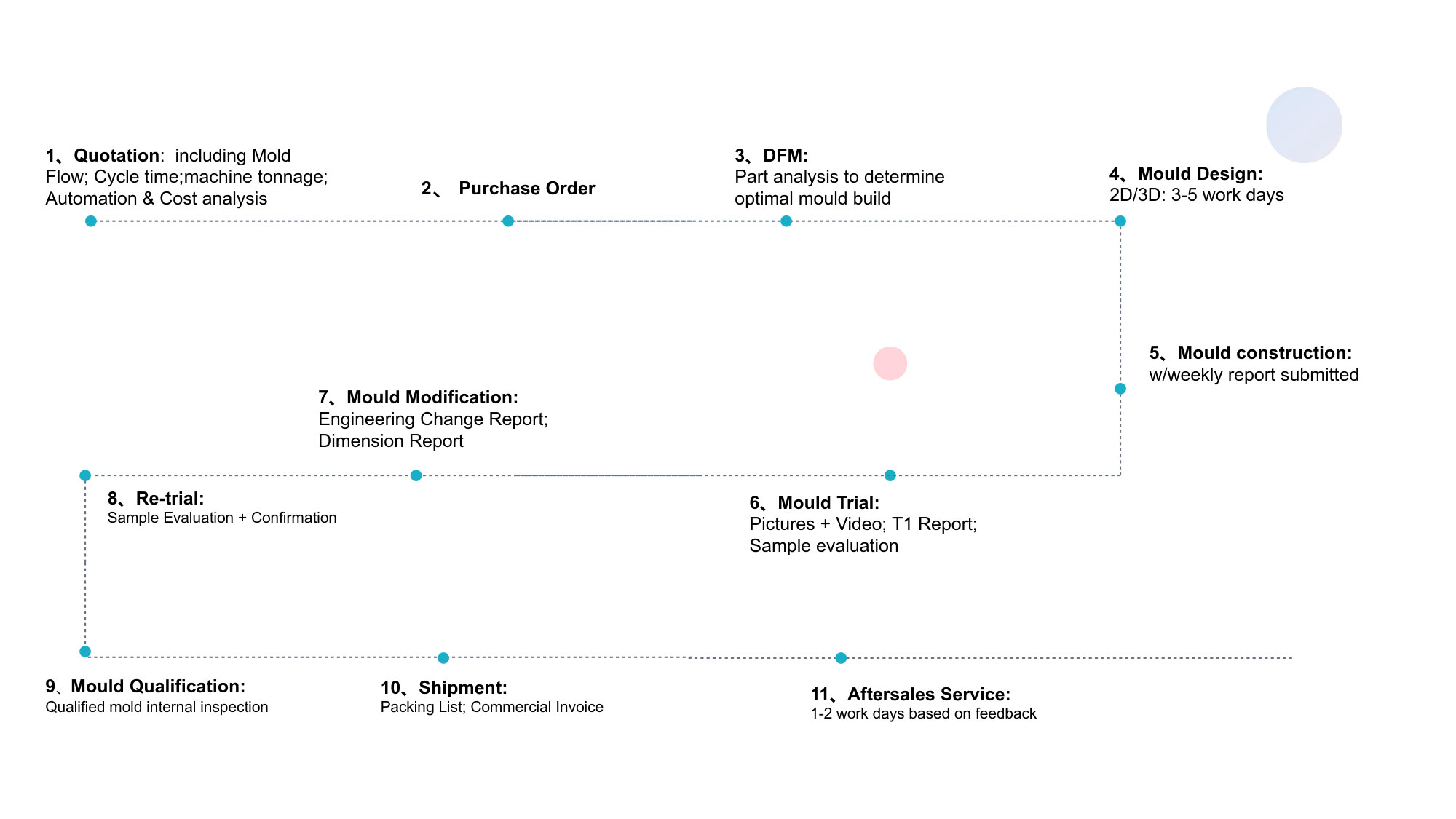
4.2 Sample Development and Iterative Validation — Molding Trials T1 through T3
Service Offering How It Reduces Customer Cost and Risk
T1 (First shot) sampling — Initial mold trial producing first parts from newly completed tooling You see parts immediately and validate basic form, fit, and function. We measure all critical dimensions, inspect for defects, and document results. At T1, we expect minor refinements — gate sizing adjustments, ejector tuning, cooling balance tweaks. We build these adjustments into the project plan so T1 leads to T2 quickly
T2 (First engineering adjustment) sampling — After we implement corrections identified at T1 T2 parts represent the mold operating at full intended functionality. Dimensional reports, defect logs, and cycle time data are provided. For most molds, we achieve production readiness at T2 [7†L26-L26]
T3 (Final qualification) sampling — Final validation run prior to production release Full process capability study showing CPK on all critical dimensions, cycle time optimized, yield documented. Mold is released to production after T3 customer approval
Fast-change insert strategy — For three-color molds where multiple variations of a feature are required (different grip patterns, different surface textures, different color placements), we design replaceable inserts that can be swapped without remanufacturing the entire mold Validating multiple design variations traditionally requires multiple molds — an expensive approach. With quick-change inserts, you run T1–T3 on one design, swap inserts in the press, and run T1 for the alternate design in hours rather than weeks — saving tooling cost and months of development time
Part dimensional and cosmetic comparison reports — T1 vs. T2 vs. T3 You receive clear documentation of each iteration’s improvements — dimension tables comparing every feature from sample to sample, defect photos showing correction progress, and dimensional tolerance verification against original print. No ambiguity, no request for “just one more sample for review.” You know where we started and where we ended
4.3 Low-Volume Pre-Production Validation — Trial Runs of 100–500 Parts
Service Offering How It Reduces Customer Cost and Risk
Run 100–500 parts under full production conditions with no increment to piece price prior to full-scale production commitment Before you commit to a million-part purchase order, we validate that the mold and process deliver consistent quality over an extended run. We run at full anticipated cycle speed, using your specified raw material, on the machine type designated for production, with typical shift operators — not engineers. This reveals run-in issues (gate wear, ejector pin sticking, cooling inconsistency at speed, material handling problems) that short T1–T3 trials might miss. You receive a run log showing yield rates, dimensional Cpk across the run, any defects and their root causes, and corrective actions implemented
Process capability documentation (CPK/PPK) from pre-production run Statistical process capability metrics for every customer-critical dimension, calculated from over 100 consecutive shots. If CPK < 1.33 on any dimension, we work with you to adjust specification or modify process/tooling before full production begins — not after 50,000 parts are in your warehouse
First production-run part submission — PPAP-level documentation (Production Part Approval Process) per industry standards For automotive (IATF 16949) and medical (ISO 13485) customers, we provide Level 3 PPAP package including dimensional report, material certifications, process flow diagram, control plan, capability study results, and appearance approval report (if required) — all aligned to your specific customer requirements
4.4 Mold Maintenance, Spare Parts, and Repair Program
Service Offering How It Reduces Customer Cost and Risk
Spare parts kit included with every mold — Standard spares: ejector pins (2× each size and length), core pins (1× each configuration), sprue bushings, heater bands, thermocouples, seals/O-rings, and customer-specified critical wear components Mold stops production when a broken ejector pin cannot be replaced locally. We prevent this by sending spares with your mold from day one — so your maintenance technician replaces the part immediately, instead of ordering from us and waiting days for delivery
Scheduled mold maintenance agreement — Every 200,000 production cycles, we provide factory-authorized mold cleaning, inspection, and preventive maintenance per an agreed schedule at a fixed cost per visit A well-maintained mold lasts its full rated life (1,000,000+ shots for standard materials, 500,000+ shots for glass-filled materials). A neglected mold wears prematurely, causing flash, part dimensional drift, and unexpected downtime. Our scheduled maintenance program removes the “we’ll get to it when we have time” risk — you get consistent quality across the entire tool life
Lifetime repair services — Repair labor charged at cost (no margin) for the life of the mold When unexpected damage occurs (collapsed core pin, cracked insert, damaged parting line), we repair in our facility at our in-house material and labor cost. You pay no markup. This encourages customers to send molds to us for repair rather than going to an alternate source; we prefer to keep our own tooling within our own ecosystem for quality control and data continuity across die lifecycles
In-house repair capability — Internal electrode manufacturing facility and EDM cell, internal welding and heat treatment capabilities, vertical machining center, and surface grinding equipment Mold repair does not leave our facility. A broken core pin is re-machined and installed same-day. A worn parting line is re-ground same-day. A cracked insert is replaced from in-house stock or re-fabricated same-day or within 24 hours. You do not wait for third-party shops that prioritize their own customers over ours
Section V: Differentiating Value Proposition — Direct Answers to Common Customer Complaints
We know that not every injection molding project meets customer expectations. Below, we address the most frequent complaints customers bring to us about their previous suppliers — and show exactly how Ansix Tech’s approach is different.
Common Customer Complaint from Prior Suppliers Our Direct Response and Guarantee The Measurable Customer Benefit
“The mold keeps needing repair after only a few thousand shots — it interrupts our production and delays shipments — and the supplier tells me it’s normal wear and I should have expected it.” We guarantee mold structural integrity for 3 years (excluding normal wear components such as ejector pins, core pins subject to direct melt flow, and slide components — these are budgeted normal consumption items provided in your spares kit). We run 2,000+ shot mold wear-in test prior to shipment and provide documented wear measurements (parting line gap progression, critical dimension shift, core pin edge radius wear, and surface finish degradation progression and rates). You are not buying a prototype — you are buying a production mold validated to survive its warranty term You know before mold shipment if wear will be acceptable within specification — because we measured it. You plan spare parts based on actual wear data — not guesses. If mold structural failure occurs within warranty, we repair at no charge because we design to survive that long
“Flash requires hand-trimming after every production run — it adds huge labor cost and often damages the part during trimming — and my supplier says flash is unavoidable in multi-cavity or multi-shot molds.” We commit to flash ≤ 0.03 mm maximum at all parting lines, slide shut-offs, and ejection pins for the life of the mold subject to normal wear rates as documented in our wear-in test baseline. We achieve this by: (1) precision grinding of parting line surfaces maintaining a total gap tolerance of 0.005 mm before first shot — verified by CMM, (2) modulus-of-elasticity analysis and thermal expansion modeling during injection pressure and temperature cycles to understand deflection at high temperatures, (3) use of self-locking clamp force compensation features in mold design, and (4) specification of mold steels with consistent heat treatment throughout the working cavity areas Zero hand-trimming labor cost per cycle. No downstream automated assembly jams caused by floating flash flakes. Your quality inspectors do not spend 15 seconds per part measuring/rejecting for flash. It is gone or within tolerance you accept
“Parts come out dimensionally different every time I run the mold. It costs me rejected parts and schedule slip when first-shot dimensions drift out of spec. My customer rejects the batch.” Our MES captures temperature, speed, pressure, position, and cavity pressure trace on every shot. We provide closed-loop process control integrating in-mold cavity pressure sensors — if cavity pressure at the end of fill deviates from target by more than your setpoint, the controller automatically increases or decreases packing pressure to compensate for material property drift (melt flow index variation between resin lots is the most common cause of such drift). Ultrasonic wall thickness sensors mounted inside the tool provide real-time dimension tracking. All adjustments and their reasons are logged for complete traceability. Your parts come out dimensionally stable not by luck but by process control You stop guessing whether parts will pass inspection. You scrap fewer parts. Your customer assembly station stops jamming. You sleep better because the process is not “maybe good” — it is “demonstrated good” with a CPK document to prove it
“When my mold needs repair, my supplier takes weeks because they outsource electrode manufacturing and EDM to third parties and my mold is not their priority. I lose production time waiting.” We operate internal electrode manufacturing (electrode milling and grinding) and EDM cell within our mold manufacturing facility. Routine repair operations: weld repair of damaged cavity/core with subsequent surface finishing: 24-hour turnaround from receipt of damaged component. Core pin replacement re-machined from bar stock and installed: 24-hour turnaround or same-day manufacturing processing with minimal additional cost. Parting line re-grind and optical re-verification: 24-hour turnaround. Complete slide mechanism rebuild including worn gibs replaced: 48-hour turnaround Your mold is repaired in our internal shop in days, not weeks, because we have the people and equipment in-house. You plan downtime for repair, not wait for unknown delivery dates. This matters most when your customer has a production commitment that ties your delivery schedule
“My supplier sells me the mold and disappears. When I have questions about optimizing cycle time, or trouble-shooting process problems, or changing packaging for a new customer requirement, they are not interested unless I pay a consulting fee.” Each mold ships with a complete technical package: mold steel certification (alloy and heat treatment), cavity and core material composition, gate dimensions and locations used during validation, recommended process parameters per validated standard process sheet, full dimensional report of last validation shot, maintenance schedule with checkpoints and expected wear replacement intervals, and recommended spare parts list with manufacturer part numbers for each component. We provide ongoing process optimization support as part of the sale, not an extra service — because we are the manufacturer of the mold and also the production shop. If your cycle time can be reduced, we find the way and help set it You have everything you need to operate and maintain your mold without relying on us. And when you need advice because something unexpected happens, we answer the phone and listen. Because a customer who stays in production is a customer who orders more molds
Cost Reduction Framework — How Ansix Tech Lowers Your Total Cost of Ownership
The true cost of an injection molded part is not the piece price — it is the sum of tooling amortization, labor, material, overhead, quality, logistics, and warranty across the entire product lifecycle. Ansix Tech reduces cost in three integrated dimensions:
5.1 Material Cost Reduction
Strategy Mechanism Typical Savings Realized for Customers
Material substitution engineering — We analyze your application requirements, identify over-specified properties (unnecessarily high temperature rating, strength well beyond requirements, excessive cosmetic grade formulation), and propose lower-cost resins that still satisfy requirements Many customers inherit their material selection from legacy designs or receive recommendations from distributors with limited product lines. We source from all major suppliers (BASF, SABIC, Celanese, DuPont, Covestro, Solvay, and regional equivalent suppliers) and provide side-by-side data for validation by your engineering team before committing to production 10–30% reduction in raw material cost without compromising functional or regulatory requirements
Hot runner systems to eliminate sprue and runner waste Standard three-plate cold runner molds generate 15–35% waste by shot weight — material purchased but not retained in the part. Hot runners inject directly into the cavity with zero waste — every pellet purchased ends up in your handle 15–35% reduction in material consumption per part — direct bill-of-materials savings that compounds over millions of parts. For a 50 g three-color handle with runner waste eliminated, that is 8–18 g of material saved per part — tens of tons of resin saved per year
Short-runner cold runner design — Where hot-runner cost cannot be justified, we minimize runner length, reduce runner diameter to the absolute minimum that still achieves acceptable fill, and optimize runner cross-sections for maximum material efficiency Not every project needs a hot runner — but every project can benefit from an efficient runner layout. Our Moldflow analysis predicts the smallest functional runner diameters and shortest runner distances before fill imbalance or pressure drop becomes unacceptable 5–15% material savings compared to default/oversized runner designs
Regrind and material reuse strategy (where application permits) — We help customers qualify regrind percentages (15–25% typically, up to 50% in non-critical applications) blended with virgin material, process-validated independently for each mold/material combination Runner scrap is not waste — it can be re-ground and reused in the same part if process-validated. For many handles and non-critical structural components, regrind up to 25% does not affect mechanical properties or surface appearance Additional 5–15% effective raw material cost reduction beyond runner elimination — because material purchased is material used
5.2 Process Efficiency and Labor Cost Reduction
Strategy Mechanism Typical Savings Realized for Customers
Cycle time optimization through cooling system design — Cooling represents 70–80% of total injection molding cycle time. Our conformal cooling channel design and optimized independent zone temperature control reduces cooling time to the absolute minimum while maintaining dimensional stability and preventing part distortion through uniform thermal control A faster cycle means more parts per hour on the same capital equipment. For high-volume programs, shaving 5 seconds off a 45-second cycle increases capacity by 12.5% with zero capital investment — just better mold design 15–25% faster cycle time = 15–25% more parts per hour from the same machine allocation = proportionally lower piece price
Automated part handling and sorting — Robots integrated with injection molding machines unload finished handles from the press, inspect for flash and defects (vision), sort good parts into packaging, and stack/dunnage as required. No operator intervention Manual part handling requires labor cost. Automated handling eliminates labor cost, reduces product damage, and improves consistency by removing operator variability from handling practice Labor elimination on high-volume automated cells reduces piece cost by 2–5 cents per part (depending on local labor rate at your geography). Over 5 million parts, that is
100
,
000
t
o
100,000to250,000 in savings
SMED (Single Minute Exchange of Die) changeover protocols — We design molds and document changeover procedures to minimize mold changeover time, incorporating standardized clamping arrangements, quick-disconnect water and electrical fittings, and pre-positioned changeover carts When mold changeovers take an hour, you lose an hour of production. When they take 10 minutes, you can run smaller batches more frequency, reducing work-in-process inventory and improving customer responsiveness 50–80% reduction in changeover time — more machine uptime, less WIP, faster response to customer pull signals
In-mold labeling and in-mold decorating integration (for handle applications requiring logos, graphics, or functional markings) Eliminates post-molding labeling or pad-printing step. The label is placed into the mold cavity and fused to the part surface during molding. If your handle requires color-brand identification and regulatory marking, we can integrate marking into the molding process instead of post-molding secondary operation Post-molding assembly and marking elimination reduces cost by eliminating a secondary operation line and associated labor, quality inspection, and inventory
5.3 Downstream Assembly Cost Reduction
Strategy Mechanism Typical Savings Realized for Customers
Three-color molding eliminates discrete assembly operations — A handle that previously required three separately molded components, four adhesives/mechanical fasteners, a robot assembly cell, and two manual screwdrivers can be molded as one integrated part in a single molding cycle using a properly designed three-color mold with rotary platen core-rotation technology [2†L28-L32] Each eliminated component is a part number to purchase, inventory to stock, quality inspection to perform, assembly station to operate, and potential failure point at product use. Moving from three components to one integrated part eliminates assembly cost at multiple levels 30–50% total part cost reduction (depending on complexity of the original assembly) — this is the single largest cost-saving lever for many multi-component programs
Fast Delivery and Logistics Enablement — From Production to Your Doorstep
Your production schedule depends on reliable, predictable delivery. Ansix Tech structures its manufacturing and logistics operations around on-time delivery performance as a core metric — integrated with our production planning systems and logistics partner network to provide full visibility and shipment reliability.
Delivery Enabler How It Benefits You Performance Metrics
Four production bases (China — Shenzhen, Dongguan, Hunan; and Vietnam) with 200,000+ m² total building area [8†L8-L9][7†L16-L16] Proximity to your destination market reduces shipping distance and associated lead time. Multiple sites provide production redundancy against single-site disruptions (power outages, natural events, labor availability, local regulatory issues). We can shift production volume between sites as demand requires — you are not locked to one factory that may face constraints at critical moments. Vietnam facility provides cost-competitive manufacturing and favorable trade access to certain markets relative to China direct shipments Average on-time delivery >98% across all active customer programs maintained since our 1998 founding
260 injection molding machines (ranging 30–2,800 tons clamping force) with high machine availability and standard spare capacity for production scale-up [8†L10-L14] You never wait for machine availability. We maintain spare machine capacity for volume ramps, bridging production during scheduled mold maintenance, and emergency surge requirements. For growing programs, we scale production by adding shifts and/or adding machines — not by redirecting capacity away from other customers who would be impacted by your growth Dedicated capacity reserves allow rapid ramp-up: volume increases of 50–100% accommodated within 2–4 weeks depending on cavity configuration constraints
In-house secondary operations and assembly We can assemble, package, label, and palletize your finished parts before shipping — eliminating your need to receive components, store them, then schedule assembly. From the press to your assembly line in one shipment, we manage it all: part handling, visual inspection, packaging per your specifications (bulk pack, dunnage trays, individual packaging), labeling applying barcode traceability or co-packing with other components if you assemble multiple parts from your product bill-of-materials at a single third-party location Single shipment to your final point of use — not multiple shipments for subcomponents
Conclusion: Ansix Tech — Your Integrated Partner in Three-Color Precision Molding
For more than 28 years, Ansix Tech has delivered precision injection molding solutions to customers across automotive, medical, consumer electronics, industrial equipment, and smart home applications [7†L20-L22]. Our three-color handle project framework is not a template — it is the result of thousands of mold builds, millions of engineering decisions, and a continuous process of learning and improvement.
We are not the cheapest supplier. But we are the supplier who:
Validates your design before steel is cut — saving you from expensive late-stage changes
Builds molds that run 1,000,000+ shots — amortizing tooling cost over longer life
Monitors and stabilizes your process digitally — eliminating dimensional variation
Supports you through the full lifecycle of the program — not just until the first shipment
Reduces your total cost through design, material, and process optimization — not just quoting a low piece price without explaining how
We invite you to provide your three-color handle print or CAD model for a no-cost, no-obligation DFM feasibility review. We will return a comprehensive report showing gate location optimized for material flow and appearance, draft angle recommendations for ejectability, material selection matrix with cost and performance comparisons, moldflow simulation outputs (fill pattern, weld line location prediction, gas trap locations, warpage prediction), and an initial tolerance analysis of your critical dimensions. This report costs us engineering time — and we provide it for free because we believe that once you see how we approach your project, you will choose to partner with Ansix Tech for the long term.
Because at Ansix Tech, we succeed when you succeed. And your three-color plastic handle project is too important to leave to chance or risk with a supplier who builds molds — not partnerships.
Ansix Tech Limited
Founded 1998 | Hong Kong
Four Global Production Bases | Over 1,200 Employees | 260 Injection Molding Machines
ISO 9001 · ISO 14001 · IATF 16949 · ISO 13485
30,000+ Molds Built Since Inception | Serving Customers Across Six Continents
Your partner in precision — from concept to cost-effective mass production.
Ansix Tech Co Ltd
If you have any plans related to Three-Color Plastic Handle Precision Mold , you can contact us at any time. We will turn your ideas into reality, let you realize your dreams, and obtain large orders from the market. Our contact information is info@ansixtech.com. Or contact our CTO, mail: stephen@ansixtech.com
#www.ansixtech.com #ansixtech.com #Three-Color Plastic Handle Precision Mold #Three-Color Plastic Handle Precision Mold moulds #Three-Color Plastic Handle Precision Mold molds #Three-Color Plastic Handle Precision Mold injection molding companies #Three-Color Plastic Handle Precision Mold Canopy Mold injection mold companies #Ansix #Ansix moulds #Ansix china #Ansix tech china #Ansix tech company #Ansix facotry #Three-Color Plastic Handle Precision Mold injection molding #Three-Color Plastic Handle Precision Mold injection tools #Three-Color Plastic Handle Precision Mold injection moulds #Three-Color Plastic Handle Precision Mold plastic mould #Three-Color Plastic Handle Precision Mold plastic tools #Ansix Tech #Ansix molds #Ansix injection molding #Ansix mold factory #injection molding Three-Color Plastic Handle Precision Mold #Ansix mold factory #Three-Color Plastic Handle Precision Mold china #Three-Color Plastic Handle Precision Mold molds #injection factory #Three-Color Plastic Handle Precision Mold injection molding #Three-Color Plastic Handle Precision Mold injection molding factory #injection molding company #Three-Color Plastic Handle Precision Mold injection mold companies #Three-Color Plastic Handle Precision Mold#Three-Color Plastic Handle Precision Mold mold limited #Ansix mold china #Ansix companies #Ansix company China #Three-Color Plastic Handle Precision Mold facotry #Ansix Tech #Ansix Tech mould #Three-Color Plastic Handle Precision Mold injection moulding #injection moulding company #Ansix Three-Color Plastic Handle Precision Mold parts injection mold companies #medical injection molding companieschina #Three-Color Plastic Handle Precision Mold china factory #Ansix moulding companies #Ansix molding company #Three-Color Plastic Handle Precision Mold injection moulding facotry #Ansix Tech mold #Three-Color Plastic Handle Precision Mold mould #Three-Color Plastic Handle Precision Mold plastic injection molding #ansix plastic mold #Mold manufacturing #Three-Color Plastic Handle Precision Mold parts manufacturing #Three-Color Plastic Handle Precision Mold plastic parts factory #Three-Color Plastic Handle Precision Mold injection parts mold #Three-Color Plastic Handle Precision Mold PRECISION MANUFACTURING #Three-Color Plastic Handle Precision Mold #China mold #Three-Color Plastic Handle Precision Mold injection moulding china #Three-Color Plastic Handle Precision Mold mould china #china precision mold #mold in china #Three-Color Plastic Handle Precision Mold mold china #Precision molds #High-precision molds #Three-Color Plastic Handle Precision Mold #Injection molds #Three-Color Plastic Handle Precision Mold Factory #Three-Color Plastic Handle Precision Mold Company #Super Large Injection Mold Factory #Large Tonnage Injection Molding Factory #Three-Color Plastic Handle Precision Mold Company #Three-Color Plastic Handle Precision Mold Factory #2800T Injection Molding Factory #3000 Ton Injection Molding #4500 Ton Injection Molding Factory #Large Mold Injection Molding #Large Plastic Mold Injection Molding Factory #Large Injection Mold Manufacturer #Plastic Mold Factory #Injection Mold #Plastic Mold