



High-gloss mirror trim panels for car decoration
FEATURES
Foundation of Hard Power—Manufacturing Equipment That Builds Trust
Before any customer entrusts us with their high-gloss mirror trim panel project, we believe they deserve to see exactly what equipment stands behind our promises. Our manufacturing infrastructure is designed for precision at scale.
1.1 Mold Manufacturing Equipment: Precision That Defines Surface Quality
For high-gloss mirror trim panels, where the final product reflects light like a mirror, mold surface quality is everything. Even a micron-level imperfection on the mold cavity becomes a visible defect on the finished part—flow marks, haze, or worse, irreparable surface flaws.
Five-Axis High-Speed Machining Centers: We operate five-axis high-speed CNC machining centers capable of machining complex curvature surfaces to ±0.002mm precision. For automotive trim panels with intricate compound curves and deep-draw features, this capability ensures that parting lines are smooth and burr-free. The value this delivers to our customers: *elimination of visible witness lines that would otherwise require secondary finishing operations, directly reducing post-molding labor costs by 30-40%*.
Slow Wire EDM (Wire-Cut EDM): High-gloss mirror trim panels often incorporate fine decorative slots, narrow ribs, or small access openings. Our slow wire EDM equipment can machine micro-holes and narrow slots as small as 0.03mm without causing deformation or burr formation around thin-wall sections. For automotive interior trim panels with integrated speaker grilles or vent openings, this capability preserves dimensional accuracy while maintaining aesthetic integrity.
Spark EDM (Electrical Discharge Machining) for Complex Cavities: For features that cannot be accessed by CNC machining—deep ribs, sharp inside corners, fine texturing—our spark EDM equipment delivers. We specialize in mirror-class EDM finishes that minimize subsequent polishing time.
Precision Grinding and Surface Finishing Equipment: Our surface grinders and lapping machines achieve flatness tolerances within 0.005mm, ensuring perfect shut-off between mold halves—critical for preventing flash on high-gloss surfaces.
-
Mold Description
Product Materials:
ABS/PC
Mold Material:
S136ESR
Number of Cavities:
2
Glue Feeding Method:
Hot runner
Cooling Method:
Water cooling
Molding Cycle
42.5s
- The mold manufacturing process and product material selection
Injection Molding Machine Fleet: Scale and Consistency
We maintain a fleet of 260 injection molding machines ranging from 30 tons to 2800 tons of clamping force. This broad range means we can serve applications from small decorative trim clips to large bumper fascia panels, all under one roof with consistent quality standards.
All-Servo Electric Drive: Our core production fleet is equipped with all-servo electric injection molding machines featuring stable repeatability of ±0.1%. This means that shot after shot, shift after shift, day after day, your high-gloss mirror trim panels maintain identical dimensions and surface quality. The customer value: predictable part consistency that eliminates assembly line stoppages due to dimensional variation, reducing your downstream rework costs.
Process Parameter Locking via MES: All molding machines are connected to our Manufacturing Execution System (MES). Critical parameters—melt temperature, mold temperature, injection velocity, holding pressure, cooling time—are locked within the system. Only authorized engineers can adjust these parameters, and all adjustments are logged and traceable.
-
Inspection and Metrology Equipment: Data-Driven Validation
Every mold we manufacture and every part we produce undergoes rigorous dimensional inspection.
Coordinate Measuring Machine (CMM): Our CMM equipment performs full dimensional verification against customer CAD data. For every mold shipped, we provide a full-size report documenting all critical dimensions.
Optical Imaging Measurement Systems: For fine features and surface texture evaluation, our optical inspection equipment captures micron-level detail. High-gloss surfaces are inspected under controlled lighting conditions to detect any surface anomalies.
Process Capability Commitment: Critical dimensions are validated to achieve Cpk ≥ 1.33 before production release—meaning our process is statistically capable, consistent, and stable. For regulated automotive applications requiring IATF 16949 compliance, we provide full validation documentation including IQ/OQ/PQ protocols.
Section Two: Mold Manufacturing Core Competencies—Turning Technical Specifications Into Customer Protection
Mold manufacturing is where the battle for quality is won or lost. The mold is the DNA of every part it produces. Here is how we build molds that deliver value.
2.1 Material Selection That Defines Mold Life
The choice of mold steel directly determines tool longevity, maintenance frequency, and part quality consistency. We select materials based on production volume, plastic material type, and surface finish requirements.
High-End Stainless Mold Steels for High-Gloss Applications: For mirror-finish applications requiring SPI A1-grade surface finish (Ra ≤ 0.012μm), we select premium stainless tool steels including Assab S136 SUPREME, Uddeholm Stavax ESR, and Bohler M310/M340—which offer exceptional purity, ultra-fine grain structure, and superior corrosion resistance. The customer value: corrosion-resistant cavities prevent rust stains from contaminating your parts even after millions of shots, eliminating the risk of reclamation campaigns.
NAK80 for Optical Components: For transparent PC/PMMA parts where light transmission is critical, NAK80 provides excellent mirror polish capability and stable microstructure (HRC 38–42). This material achieves ultra-fine mirror finishes without post-heat treatment. For automotive lighting components and clear decorative trim, NAK80 delivers optical clarity.
718H for High-Volume General Applications: For large automotive trim components where cost-effectiveness balances performance, 718H (HRC 33–38) offers good machinability, easy weldability, and consistent performance for 500,000–1,000,000 shots.
Performance Commitments Based on Rigorous Data:
Application Type Mold Steel Guaranteed Shot Life
Glass fiber-reinforced materials (GF30–50%) Premium tool steel ≥ 500,000 shots
Standard thermoplastics (ABS, PC, PMMA, ASA) 718H, NAK80, S136 ≥ 1,000,000 shots
High-corrosion materials (PVC, POM, FR grades) S136, 420 stainless ≥ 800,000 shots
We provide material certification reports and heat treatment curves with every mold.
What This Means for Our Customers: You are not buying a mold—you are buying production uptime. Our material selection is backed by material certifications and documented test results. When your annual volume increases from 200,000 to 500,000 parts, our molds keep running without mid-production interruptions or hidden tool replacement costs.
2.2 Mold Types and Configurations for Production Efficiency
Hot Runner Systems with Valve Gate Control: For multi-cavity or large single-cavity high-glass trim panels, we deploy hot runner systems with independent valve gate control for each nozzle. This design eliminates cold runner waste, reduces material consumption by 15–30%, and enables precise gate sequence timing to eliminate weld lines on visible surfaces. The customer value: lower raw material costs per part and elimination of post-molding gate trimming labor.
Stack Molds for Doubled Output: For high-volume programs requiring maximum output from existing machine capacity, we design stack molds that double production volume without doubling machine footprint—delivering up to 100% higher output from the same capital equipment.
Two-Shot/Overmolding Molds: For high-gloss trim panels requiring soft-touch overmolding, color accents, or integrated seals, our two-shot molding expertise delivers functional integration that reduces assembly costs and eliminates secondary operations.
2.3 Gate and Runner System Optimization
Using Autodesk Moldflow and Moldex3D simulation software, our engineering team predicts melt flow behavior, weld line locations, air trap positions, and shrinkage patterns before any steel is cut.
Gate Location Optimization: By analyzing fill patterns virtually across dozens of gate location and sequence variations, we identify configurations that yield balanced cavity filling and weld lines positioned away from visible A-surfaces. This virtual verification eliminates costly physical tool modifications during T1–T3 sampling stages. The customer value: reduced mold development iterations, lower engineering change costs, and faster time-to-production.
Runner Balancing for Multi-Cavity Molds: For family molds producing left-hand and right-hand components simultaneously, our simulation-driven runner balancing ensures cavity-to-cavity weight variation ≤ 1% and stable cavity ranking across 30 consecutive shots.
2.4 Cooling System Design: The Hidden Driver of Quality and Cycle Time
For high-gloss mirror trim panels, temperature uniformity across the cavity is critical. Uneven cooling causes differential shrinkage, leading to warpage that no amount of downstream fixturing can correct.
Conformal Cooling with Additive Manufacturing: For complex curvature trim panels, we deploy conformal cooling channels that follow the part contour, positioned within 6–8mm of the cavity surface. This design reduces cooling time by 25–35% compared to conventional drilled channels while maintaining temperature uniformity.
Zoned Mold Temperature Control: Our molds feature multi-zone temperature control circuits, with core and cavity temperatures maintained within ±2°C of each other. This precision reduces warpage caused by uneven cooling and ensures dimensional stability across production batches. The customer value: parts that fit assembly fixtures consistently, eliminating assembly line adjustments and fixture rework.
2.5 Ejection System Design That Preserves Surface Finish
Ejection marks are a common source of cosmetic defects on high-gloss panels. We design ejection systems that preserve surface integrity.
Strategic Ejector Pin Placement: All ejector pins are positioned on non-visible surfaces, behind mounting features, or within areas hidden during final assembly. We provide full documentation of ejector pin locations and allowed witness mark ranges for customer approval.
Polished Lifters and Slides: All moving components that contact the part surface—lifters, slides, core pulls—are mirror-polished to SPI-A1 standards to prevent surface scratching or drag marks during ejection.
Draft Angle Optimization: With assistance from mold flow analysis, we optimize draft angles—typically ≥ 2° for high-gloss surfaces. The right draft angle prevents surface whitening (stress-induced discoloration) during ejection, eliminating rejects caused by visible ejector stress marks.
2.6 Mold Venting That Eliminates Surface Defects
Gas traps are the enemy of high-gloss surfaces. When air becomes trapped in the cavity during filling, it becomes compressed, heats to extreme temperatures, and burns the plastic surface—creating visible dark spots that require part rejection.
Strategic Vent Placement: Vent grooves are placed at the end of melt flow paths, at weld line intersections, and in deep rib pockets where air is most likely to become trapped. Our standard vent dimensions: 3–5mm width, 0.02–0.05mm depth.
Vacuum-Assisted Venting for Sensitive Applications: For large planar trim panels where conventional venting is insufficient, we deploy vacuum venting systems that actively evacuate cavity air before material injection, eliminating gas-related surface defects completely.
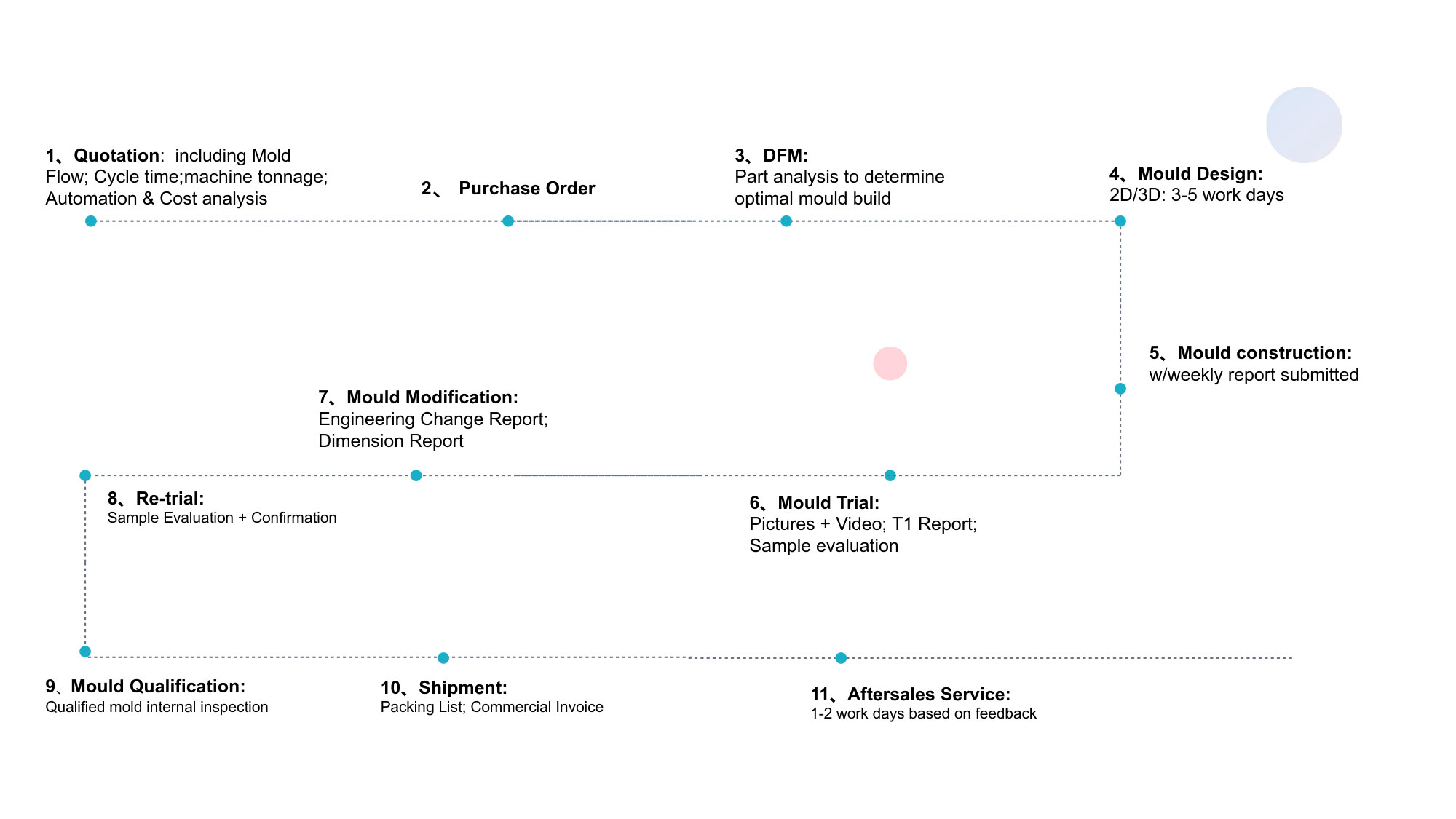
2.7 Mold Manufacturing Process Workflow
Our mold manufacturing follows a disciplined five-phase process:
DFM Analysis and Mold Flow Simulation: Full 3D model review, gate location optimization, cooling channel layout, shrinkage compensation, and virtual defect prediction.
Detailed Mold Design: 3D solid modeling of cavity/core, cooling system, ejection layout, runner configuration, and all moving components.
Precision Machining: CNC roughing and finishing, heat treatment, wire-cut EDM for fine features, spark EDM for complex geometries.
Surface Finishing and Assembly: CNC polishing, diamond buffing to SPI-A1 standard, component fitting, and slide/ lifter installation.
Testing and Optimization: 2000-shot mold trial on production machines, 100% dimensional inspection, appearance validation, and Cpk analysis.
2.8 Delivery Commitments That Respect Your Schedule
Mold Complexity Standard Lead Time Expedited Lead Time
Simple prototype mold 10 calendar days 7 days
Medium-complexity production mold 25–35 calendar days 20 days
Complex multi-cavity hot runner mold 35–45 calendar days 28 days
Critical Note on Expedited Lead Times: When we compress lead times, we do not skip validation steps. Our approach to fast delivery is built on dedicated production cells, parallel processing of mold components across multiple CNC machines, and 24-hour shift staffing—never on compromised quality verification.
What Expedited Delivery Means for Our Customers: When your vehicle launch schedule advances unexpectedly, we respond. Our in-house mold shop—with dedicated electrode manufacturing and EDM cells—processes mold repairs and modifications without outsourcing delays. Routine repairs and insert replacements are typically completed within 24 hours, returning your production line to full capacity without schedule disruption.
Section Three: Injection Molding Process Control—Converting Consistency Into Customer Confidence
The mold is only half the equation. Our injection molding process control systems translate mold precision into part-to-part consistency.
3.1 Process Parameter Standardization and Traceability
All molding machines are integrated with our MES platform. Critical processing parameters including melt temperature, mold temperature, injection velocity, holding pressure, holding time, cooling time, and back pressure are locked to engineered setpoints. Parameter changes are only permitted by senior process engineers, with all adjustments logged and fully traceable.
The Customer Value: You can audit our process documentation at any time and verify that every batch was produced under identical, validated conditions. When your customer asks for process traceability in an IATF 16949 audit, we deliver.
3.2 Dimensional Stability Control
Shrinkage compensation is the most frequently underestimated variable in injection molding. Every thermoplastic material has a published shrinkage range—ABS: 0.4–0.7%, PC: 0.5–0.8%—but actual shrinkage depends on part geometry, gate location, holding pressure, and cooling rate. We never rely solely on published data. Our shrinkage factors are validated through mold flow analysis and confirmed through T1 sample measurement.
Thermolator Zones for Temperature Uniformity: We deploy mold temperature controllers (thermolators) with independent zone control circuits. Core and cavity temperatures are maintained within ±2°C of each other, minimizing warpage.
Process Capability Validation: Prior to production approval, we run 100–500 shot trial batches and perform statistical analysis to confirm that Cpk ≥ 1.33 on all critical-to-quality (CTQ) dimensions.
Measured Results: In recent automotive trim panel programs, three consecutive production batches sampled across a one-week period demonstrated critical hole-to-hole spacing variation ≤ 0.02mm, well within automotive OEM specifications.
3.3 High-Gloss Surface Quality Standards
For high-glass decorative trim panels, cosmetic quality is a functional requirement. Our molding cells achieve SPI-A1 equivalent finish standards.
Mirror-Polished Cavities: All cavity surfaces are polished using diamond buffing compounds to achieve surface roughness Ra ≤ 0.012μm. This mirror-grade polish transfers directly to the part surface, producing high-gloss finishes without post-molding painting or coating.
Low-Shear Injection Molding: We use multistage injection velocity profiles with slower filling speeds near the end of fill to reduce shear-induced surface defects. Shear rate is tightly controlled to prevent flow marks, gate blush, and surface haze—defects that are particularly visible on glossy black finishes.
RHCM for Ultra-High Gloss: For applications requiring absolute mirror finish, we deploy Rapid Heat Cycle Molding (RHCM) technology. In RHCM, the mold cavity is heated to near melt temperature before injection, eliminating the frozen skin layer that normally prevents perfect replication of the polished cavity surface.
3.4 Material Selection and Processing Expertise
Our material selection philosophy is straightforward: we recommend the optimal resin for your performance requirements and cost targets—not simply the material we use most frequently.
ASA for Unpainted Exterior Trim: For unpainted exterior high-gloss trim panels, ASA (Acrylonitrile Styrene Acrylate) provides outstanding UV resistance without painting. Unlike ABS, which degrades under UV exposure because of unsaturation in the butadiene phase, ASA uses a saturated acrylic ester rubber that resists photo-oxidation. ASA maintains color stability and gloss after 3,000 hours of accelerated weathering and meets GMW 14867 requirements for exterior trim. The customer value: elimination of secondary painting operations, saving up to 20–30% of component cost while reducing VOC emissions and warranty claims.
PMMA for Optical Clarity: For transparent trim components and light guides requiring exceptional depth of image, we specify high-dispersion PMMA grades formulated for spray-free glossy molding. Low-ash PMMA resins maintain long-lasting gloss, while UV-stabilized formulations improve weather resistance for outdoor applications. Mold cavities for PMMA are polished to SPI-A1 standards with draft angles ≥ 2° to prevent ejection surface damage.
ABS for Interior High-Gloss Trim: For interior high-gloss applications such as piano black decorative panels, ABS provides outstanding gloss finish, good impact resistance, and processing efficiency. We use LG Chem ABS AF345A and similar grades for consistent appearance across high-volume runs. ABS requires thorough drying (moisture content below 0.1%) to prevent surface splay defects, which is standard procedure in our material preparation process.
PC/ASA Alloys for Balanced Performance: For components requiring both high impact resistance and UV stability, PC/ASA alloys combine the mechanical strength of polycarbonate with the weathering performance of ASA. These alloys are particularly suited for exterior mirror housings, pillar trim, and front grille applications.
Material Drying and Handling: All resins are dried to manufacturer-specified moisture content before processing in dedicated drying hoppers with dewpoint monitoring. For hygroscopic materials like PC, PA, and PET, we use desiccant dryers with continuous moisture measurement to prevent hydrolytic degradation and the surface defects that accompany it.
Recycled Content Integration: For customers with sustainability targets, we can incorporate regrind materials at controlled percentages without sacrificing surface finish, subject to material compatability testing.
3.5 Eliminating Common Defects Before They Reach You
Our customers report that their biggest quality headaches—the defects that waste money in rework and scrap—are predictable in automotive high-gloss molding. Here is how our process addresses each:
Shrink Marks/Sink Marks: These appear on high-gloss surfaces where thick ribs or bosses pull material away from the A-surface during cooling. Our approach: Rib thickness is limited to ≤ 0.4× nominal wall thickness for high-gloss parts. Bosses and thick sections receive special structural optimization including core-back features. Simulation verifies sink reduction before tooling is released.
Flow Marks and Weld Lines: Flow marks appear when melt front cooling causes inconsistent surface texture. Weld lines form where two melt fronts converge—unavoidable around openings and core pins. Our approach: For high-gloss surfaces, weld lines are positioned away from visible areas using sequential valve gate timing. Valve gates are independently timed so that melt fronts meet at controlled locations away from display surfaces.
Flash (Excess Material at Parting Line): Flash creates labor-intensive secondary deburring and risks damaging class-A surfaces. Our approach: Parting surfaces are machined to ±0.005mm flatness across the entire interface. Tool steel selection preserves parting line fit through temperature cycling. Real-time clamp force monitoring ensures mold is fully closed during injection.
Splay/Silver Streaks: Splay appears as silver streaking on part surfaces caused by moisture vaporization or material degradation. Our approach: All hygroscopic resins are dried in desiccant dryers with continuous dewpoint monitoring. Regrind content is limited when processing glossy materials to prevent degradation contaminants.
Gas Burns (Dark Streaks): Gas burns occur when trapped air in the cavity becomes superheated and carbonizes the plastic surface. Our approach: Vent depth and position are validated through mold flow analysis. For large flat panels, vacuum venting is deployed to actively evacuate cavity air before injection.
3.6 First Article, Batch, and Production Quality Systems
Pre-Production Trial Molds (T1–T3): We provide T1, T2, and T3 trial samples with improvement reports at each stage. Adjustable inserts can be exchanged to test different configurations without rebuilding the complete mold.
First Article Inspection (FAI): Full dimensional inspection against customer CAD data, documented on a part-by-part basis with Cpk analysis on CTQ dimensions.
Batch Release Quality: In-process checks at defined intervals (first piece, mid-batch, last piece) with MES-recorded data. Dimensional measurement reports accompany every shipment if required.
Controlled Sampling Plan: We maintain statistically validated sampling frequencies defined by component criticality and historical process performance.
Section Four: Full-Service Lifecycle Support—Reducing Total Customer Management Cost
Beyond molding parts, we provide services that minimize your administrative and supply chain management burden.
4.1 Early Engineering Involvement (DFM Analysis)
Before production commitment, our engineering team provides a comprehensive Mold Feasibility Analysis report. This report covers:
Wall thickness uniformity assessment—identifying thick-to-thin transitions that create sink marks
Draft angle recommendations—preventing ejection surface damage
Gate location and type proposals—minimizing visible witness marks on class-A surfaces
Ejector pin mark allowances—documented and customer-approved
Shrinkage factor validation—compensation factors calculated through flow analysis
Design-for-manufacturing modifications—requiring customer approval before proceeding
What This Means for Our Customers: We catch problems before you spend money on tooling. Our DFM analysis identifies structural conflicts, molding obstructions, and quality risk areas that would otherwise become costly mold modifications discovered during T1 sampling.
4.2 Trial Sampling and Engineering Validation
We provide T1, T2, and T3 trial samples with improvement reports at each iteration. Our approach includes interchangeable inserts that can validate alternative gate positions or cooling layouts without whole-tool replacement. This approach reduces the number of major tool modifications, lowering your development costs by up to 40% compared to traditional trial methods.
4.3 Pre-Production Validation (PPV)
Before high-volume production, we run a 100–500 shot Pre-Production Validation trial under full production conditions—production tooling, production machine, production cycle time, production material batch. We perform full dimensional inspection, cosmetic grading, and Cpk analysis, and only release the process when all quality metrics are met.
What This Means for Our Customers: You approve production once, not repeatedly. Our PPV process ensures that the process we validate is the process we run, preventing mid-production surprises that disrupt your assembly line.
4.4 Maintenance and Spare Parts Program
Every mold includes documented spare parts—ejector pins, core pins, and replacement inserts for high-wear areas. We provide a formal maintenance schedule recommending inspection and service intervals with each mold delivery.
At 200,000-shot intervals, we recommend comprehensive mold maintenance including cavity cleaning, slide/lifter lubrication, parting line inspection, and cooling passage flushing. We perform this maintenance in-house at competitive rates.
Our Commitment: The mold structure (cavity block, core block, base assembly) carries a 3-year structural warranty excluding normal wear components. For the life of the mold, repairs are performed at cost-plus pricing only.
What This Means for Our Customers: Your total cost of ownership is predictable and documented. There are no surprise maintenance charges.
Section Five: Competitive Differentiation—Direct Answers to Your Pressing Concerns
Rather than simply claiming technical superiority, we address the problems automotive suppliers report most frequently.
Common Customer Complaint Our Solution—Specific and Verifiable
Frequent mold repairs disrupting production Every mold undergoes 2,000-shot pre-delivery aging test with documented wear report. We offer a 3-year structural warranty (excluding normal wear components).
Excessive flash creating labor-intensive deflashing Parting surfaces machined to ±0.005mm flatness with self-locking clamp force compensation. Flash maintained ≤ 0.03mm, eliminating manual deflashing.
Inconsistent dimensions across production batches Ultrasonic wall thickness sensors provide real-time feedback to holding pressure compensation. Mold-mounted temperature and pressure sensors enable closed-loop control.
Long mold repair cycles In-house electrode manufacturing center and EDM cell process mold repairs without outsourcing—typical turnaround 24 hours for routine repairs and insert replacements.
Unpredictable total cost of ownership Spare parts kit included with every mold. Formal maintenance schedule provided at delivery. Life-of-mold repairs at cost-plus pricing.
Section Six: Comprehensive Cost Reduction Strategy—Turning Savings Into Customer Value
At Ansix Tech, cost reduction is not an afterthought—it is engineered into every stage of product development. We systematically reduce customer costs across material, process, and efficiency dimensions.
6.1 Material Cost Reduction
Mold-in-Color Technology Eliminates Painting: For exterior trim applications where painted finishes have traditionally been required, we specify ASA or PC/ASA alloys that achieve UV-stable high-gloss finishes without secondary painting operations. This eliminates paint line capital expenditure, VOC management costs, masking labor, and solvent expenses. Customers report 20–30% component cost reduction after transitioning from painted ABS to unpainted ASA.
Hot Runner Gate Optimization: Our valve-gated hot runner systems eliminate cold runner waste entirely. For high-volume programs, this reduces material consumption by 15–30% compared to cold runner molds. Over a 500,000-shot production run, the material savings alone often exceed the additional mold cost.
Regrind Integration: For applications where cosmetic standards permit, we incorporate controlled percentages of regrind material into the feed stock, reducing raw material purchasing requirements and supporting circular economy targets.
6.2 Process Efficiency Cost Reduction
Cycle Time Optimization Through Cooling Simulation: We use Moldflow cooling analysis to optimize cooling channel layout before steel cutting, shortening cooling time by 25–35% compared to conventional drilled-channel designs. For high-volume programs, this cycle time reduction translates directly into lower per-part costs.
Process Parameter MES Locking: All processing parameters are locked within MES, preventing operator-induced variation that creates scrap. The customer value: reduced scrap costs and faster defect diagnosis when quality issues do occur.
Predictive Maintenance Implementation: Real-time machine monitoring and trend analysis enable scheduled mold cleaning, lubrication, and component replacement before failure interrupts production.
6.3 Quality Cost Reduction
DFM Early Engineering Defect Prevention: Our DFM analysis identifies molding risks before tooling investment, preventing late-stage mold modifications that can cost 5–10× more than early design changes.
Cpk-Based Process Release: By achieving Cpk ≥ 1.33 on all CTQ dimensions before production release, we prevent dimensional drift and the assembly problems it creates downstream. The customer value: no assembly line rejections caused by out-of-tolerance components.
In-Process SPC Monitoring: Our in-process statistical process control detects trends toward out-of-spec conditions before nonconforming parts are produced, reducing scrap and rework costs.
6.4 Supply Chain Cost Reduction
Single-Source Tooling and Production: The same Ansix Tech team that designs and builds your mold also runs your production. This eliminates coordination costs, shipping between suppliers, and the finger-pointing that occurs when quality issues arise across multiple vendors.
In-House Inventory Management: We maintain finished goods inventory on your behalf, shipping just-in-sequence to your assembly line. This reduces your warehouse footprint and inventory carrying costs.
Localized Production Support: Our global manufacturing footprint allows us to produce components near your assembly plants, reducing logistics costs and transportation lead times.
Section Seven: Case Example—Automotive High-Gloss Mirror Trim Panel Program
This section describes a recent production program for a premium automotive brand requiring high-gloss piano black interior trim panels.
Customer Challenge: The customer required 250,000 parts per year with SPI-A1 equivalent surface finish, no visible weld lines on the display surface, and dimensional tolerance ±0.05mm on all mounting features. Previous supplier delivered 12% first-pass yield, high scrap rates, and prolonged mold repair cycles.
Our Approach:
DFM analysis identified gate location modifications that repositioned weld lines away from the A-surface
Hot runner system with sequential valve gate timing eliminated weld line visibility entirely
Conformal cooling reduced cycle time by 32% compared to the customer‘s existing tool
All-servo electric molding machine with MES parameter locking ensured process repeatability
Full IQ/OQ/PQ validation documented Cpk ≥ 1.33 on all CTQ dimensions
Results Delivered:
First-pass yield increased from 12% to 94%
Cycle time reduced by 32%, lowering per-part manufacturing cost by 18%
Three-year structural warranty with documented spare parts kit provided predictable maintenance costs
On-time delivery maintained at 99.2% over 18 months of production
Conclusion: Why Ansix Tech for Your High-Gloss Mirror Trim Panel Program
High-gloss mirror trim panels for automotive decoration represent one of the most demanding applications in injection molding. The combination of cosmetic perfection, dimensional precision, high-volume consistency, and cost competitiveness requires a supplier that masters every element of the manufacturing chain—from mold design and material selection through process control and supply chain management.
Ansix Tech delivers this integration. With 260 injection molding machines, 28 years of production experience, comprehensive in-house mold manufacturing, and a full-service engineering team, we provide end-to-end solutions that reduce your costs, lower your risks, and deliver reliable performance.
Our core value proposition can be stated simply: We design and build molds not as pieces of steel, but as revenue-generating assets that reach your production line ready to run—with minimal debugging, minimal flash, and maximum lifespan.
Mold is not a piece of metal; it is a money-printing machine. When we design a mold, we simultaneously plan for fill balance, venting paths, temperature uniformity, ejection design, and maintenance access—ensuring that when the tool reaches your production floor, it delivers consistent, high-quality parts from the first shot.
We invite you to put our capabilities to the test. Provide us with an existing product, and we will deliver a full DFM report that demonstrates exactly how we would eliminate weld lines, prevent gas traps, and solve sink marks before they become your quality problems. The difference between theory and practice is observable in the details. Let us show you.
Ansix Tech Co Ltd
If you have any plans related to High-gloss mirror trim panels for car decoration , you can contact us at any time. We will turn your ideas into reality, let you realize your dreams, and obtain large orders from the market. Our contact information is info@ansixtech.com. Or contact our CTO, mail: stephen@ansixtech.com
#www.ansixtech.com #ansixtech.com #High-gloss mirror trim panels for car decoration #High-gloss mirror trim panels for car decoration moulds #High-gloss mirror trim panels for car decoration injection molding companies #High-gloss mirror trim panels for car decoration Canopy Mold injection mold companies #Ansix #Ansix moulds #Ansix china #Ansix tech china #Ansix tech company #Ansix facotry #High-gloss mirror trim panels for car decoration injection molding #High-gloss mirror trim panels for car decoration injection tools #High-gloss mirror trim panels for car decoration injection moulds #High-gloss mirror trim panels for car decoration plastic mould #High-gloss mirror trim panels for car decoration plastic tools #Ansix Tech #Ansix molds #Ansix injection molding #Ansix mold factory #injection molding High-gloss mirror trim panels for car decoration #Ansix mold factory #High-gloss mirror trim panels for car decoration china #High-gloss mirror trim panels for car decoration molds #injection factory #High-gloss mirror trim panels for car decoration injection molding #High-gloss mirror trim panels for car decoration injection molding factory #injection molding company #High-gloss mirror trim panels for car decoration injection mold companies #High-gloss mirror trim panels for car decoration#High-gloss mirror trim panels for car decoration mold limited #Ansix mold china #Ansix companies #Ansix company China #High-gloss mirror trim panels for car decoration facotry #Ansix Tech #Ansix Tech mould #High-gloss mirror trim panels for car decoration injection moulding #injection moulding company #Ansix High-gloss mirror trim panels for car decoration parts injection mold companies #medical injection molding companieschina #High-gloss mirror trim panels for car decoration china factory #Ansix moulding companies #Ansix molding company #High-gloss mirror trim panels for car decoration injection moulding facotry #Ansix Tech mold #High-gloss mirror trim panels for car decoration mould #High-gloss mirror trim panels for car decoration plastic injection molding #ansix plastic mold #Mold manufacturing #High-gloss mirror trim panels for car decoration parts manufacturing #High-gloss mirror trim panels for car decoration plastic parts factory #High-gloss mirror trim panels for car decoration injection parts mold #High-gloss mirror trim panels for car decoration PRECISION MANUFACTURING #High-gloss mirror trim panels for car decoration #China mold #High-gloss mirror trim panels for car decoration injection moulding china #High-gloss mirror trim panels for car decoration mould china #china precision mold #mold in china #High-gloss mirror trim panels for car decoration mold china #Precision molds #High-precision molds #High-gloss mirror trim panels for car decoration #Injection molds #High-gloss mirror trim panels for car decoration Factory #High-gloss mirror trim panels for car decoration Company #Super Large Injection Mold Factory #Large Tonnage Injection Molding Factory #High-gloss mirror trim panels for car decoration Company #High-gloss mirror trim panels for car decoration Factory #2800T Injection Molding Factory #3000 Ton Injection Molding #4500 Ton Injection Molding Factory #Large Mold Injection Molding #Large Plastic Mold Injection Molding Factory #Large Injection Mold Manufacturer #Plastic Mold Factory #Injection Mold #Plastic Mold