



High-temperature resistant side-mounted elbow float switch, water shortage alarm, water level switch, water tank double float valve, liquid level alarm
FEATURES
Injection Molding Machine Fleet
Ansix Tech operates 260 injection molding machines with clamping forces ranging from 30 tons to 4,000 tons, covering product sizes from miniature precision components to large industrial parts. The fleet includes world-class brands: Japan's Fanuc, Sumitomo, Toshiba, Nissei, Engel, Germany's Arburg, and China's Haitian.
All-Servo Electric Drives: All machines are equipped with all-electric servo drives, delivering stable process repeatability of ±0.1% variation from shot to shot. This means from the first shot to the millionth, every unit is identical.
Machine Optimization for High-Temperature Materials: For high-temperature engineering resins such as PPS+40%GF or PEEK, Ansix maintains drying systems and mold temperature control systems that keep each cavity within narrow temperature bands. The machine fleet is optimized specifically for demanding applications requiring precise temperature control and melt flow management.
Quality Inspection Equipment
"Blind trust is not a strategy; verifying is". Ansix utilizes CMM (Coordinate Measuring Machines) and Optical Imaging Systems capable of sub-micron resolution.
Every mold undergoes a full dimensional report before leaving the shop, with Critical-to-Quality dimensions (CPK) maintained at ≥ 1.33. A CPK of 1.33 represents a Six Sigma-equivalent capability, statistically ensuring that 99.9937% of production parts will conform to specifications. For medical devices and precision mechanical assemblies, CPK ≥ 1.33 is the threshold for regulatory approval and OEM contract compliance.
-
Mold Description
Product Materials:
SUS304+NBR FOAM
Mold Material:
S136ESR
Number of Cavities:
16
Glue Feeding Method:
Hot runner
Cooling Method:
Water cooling
Molding Cycle
42.5s
- The mold manufacturing process and product material selection
Mold Manufacturing — The Core of Longevity, Precision, and Speed
"The mold is the heart of your production line. If it fails, your business stops". Ansix Tech approaches mold manufacturing not as a commodity service but as an engineering discipline where every design decision translates directly into measurable customer value.
2.1 Steel Selection and Material Science
Ansix maintains a strategic inventory of premium tool steels specific to each application, ensuring material properties match the product's exact service conditions:
Steel Grade Hardness (HRC) Key Properties Best Fit Application
S136 / S136H Pre-hard: 35-35 / Quench: 48-54 Superior corrosion resistance, ultra-high mirror polishability (Ra < 0.05μm), excellent wear resistance Transparent PC/ABS parts, optical-grade surfaces, corrosive plastic materials
2344 / 8407 / H13 48-52 (Quench & temper) High hot hardness at 550-600°C, excellent toughness, superior thermal fatigue resistance High-temperature engineering plastics (PPS+40%GF, PEEK) , high-thermal-load injection molds
NAK80 37-43 (Pre-hard) Super mirror polish (up to #15000), excellent electrical discharge machinability High-gloss surfaces, cosmetic-grade appearances, fine-textured finishes
SKD11 / DC53 58-62 High wear resistance, high compression strength Wear inserts, sliders, shear edges subjected to abrasive filled materials
2343 48-52 Impact resistance superior to H13, good thermal conductivity Complex geometries with extreme mechanical shock loads
M340 / 4Cr13 / 9Cr18 48-53 Stainless martensitic, excellent corrosion resistance FDA-grade applications, acidic plastic compounds, humid environments
P20 28-32 (Pre-hard) Good machinability, cost-effective Mold bases, support plates, non-critical core/cavity applications
Each mold undergoes strict heat treatment protocols with documented time-temperature curves. For S136, Ansix follows a precise quench at 1000-1050°C, oil-cooled to 50-100°C, then tempered at 200+°C to achieve 48-54HRC while preventing cracking. Customers receive full material certificates and heat treatment curves with every mold delivery.
-
Mold Life Commitments
Material Type Guaranteed Mold Life Customer Value
Glass-fiber reinforced materials 500,000 cycles Extended production runs without mold replacement
Standard plastics 1,000,000 cycles Maximum ROI on mold investment
2.3 Achievable Tolerances
Standard structural components: ±0.05mm
Precision gears / medical components: ±0.005mm
2.4 Mold Types and Capabilities
Ansix Tech manufactures a comprehensive range of mold types:
Hot Runner Systems with Valve Gates: Reduces material waste and ensures clean gate quality across millions of cycles
Conformal Cooling Channels: Additively manufactured cooling channels that follow part geometry, delivering cooling directly where heat concentrates. Cooling accounts for 60-80% of total injection molding cycle time—conformal cooling can reduce cycle times by up to 20% compared to traditional straight-line cooling layouts
High-Cavity Molds: Capable of running molds with up to 96 cavities
Two-Color / Multi-Material Molds
High-Gloss / Mirror-Finish Molds: Ra < 0.05μm for transparent and optical-grade applications
2.5 Gating System Optimization
Through comprehensive mold flow analysis, Ansix engineers predict weld line and air trap locations before steel is cut, optimizing gate数量和位置 to ensure balanced filling. For float switch components, this is critical—weld lines in sealing areas can be catastrophic. By simulating fill patterns, pressure requirements, and cooling efficiency in advance, Ansix optimizes part geometry, gate placement, and cooling layouts, avoiding costly mold rework.
2.6 Standard Lead Times
Mold Complexity Standard Lead Time Express Option
Simple molds 10 days —
Medium-difficulty molds 25-45 days Compressed to 20 days
Complex / high-cavity molds Negotiated based on scope Validation steps never skipped
Part Three: Injection Molding — Process Control Excellence
Customers fear: sink marks, flash, dimensional instability, and batch-to-batch color variation. Ansix Tech addresses each concern with systematic process control.
3.1 Process Standardization
All molding machines are connected via MES (Manufacturing Execution System). Parameters such as temperature, pressure, speed, and time are locked into the MES system—only authorized engineers can make adjustments. Every batch undergoes first-article and last-article inspection to verify consistency.
3.2 Dimensional Stability Control
Molds are equipped with zone-controlled mold temperature controllers, maintaining core and cavity temperature differences within 2°C to reduce warpage and distortion. For similar bracket products, Ansix has demonstrated that key hole-to-hole spacing fluctuates by ≤0.02mm across three consecutive production batches within one week.
For high-temperature materials such as PPS+40%GF or PEEK, which have melting points of 300-400°C and require precise temperature control, Ansix's expertise in thermal management ensures consistent part quality.
3.3 Surface Finish Capabilities
Requirement Achievable Standard
Transparent parts No bubbles, no flow lines
Plating-grade parts No gas marks
High-gloss parts Surface roughness Ra ≤ 0.2μm
Printing / painting applications Deformation compensation预留, print registration accuracy ±0.1mm
3.4 Special Material Processing Capabilities
Ansix Tech has extensive production experience with a wide range of engineering plastics:
PC / ABS — High impact strength, dimensional stability
PC — Optical transparency, signal transparency for sensor applications
PPS + 40% GF — Excellent heat resistance (>200°C), dimensional stability, chemical resistance
PEEK — High continuous operating temperature up to 150°C, exceptional mechanical strength
PTFE / PFA — Superior chemical resistance, low friction
PA6 + GF30 — High strength, good thermal stability
PBT — Excellent electrical properties, dimensional stability
PEI / PPS / LCP — High-temperature performance, flame retardancy
Liquid Silicone Rubber (LSR) — Flexible, durable sealing applications
PP (Polypropylene) — Excellent chemical resistance, low density, micro-foaming capability for precise buoyancy control
PVDF — Superior acid, alkali, and solvent resistance; continuous operating temperature up to 105°C
Flame Retardancy: UL94 V-0 rated components available for housings and critical parts.
Weather Resistance: UV testing validated for 3,000 hours without discoloration.
Part Four: Material Selection Science — Environmental and Economic Engineering
4.1 Strategic Material Selection Approach
The performance and service life of liquid level sensors fundamentally depend on their material composition. Ansix Tech's deep expertise in polymer science guides a rigorous material selection process that balances demanding application requirements with cost-effectiveness.
The company's philosophy is rooted in value engineering—often guiding customers to select the most cost-effective materials that meet all performance criteria without over-engineering. This material optimization is a primary means of reducing product "hard costs" from the very beginning.
4.2 Material Selection for Float Switch Components
Material Key Properties & Grades Typical Float Switch Application
PP (Polypropylene) Excellent chemical resistance, low density, good processability. Can be used with physical/chemical foaming agents for micro-foaming to achieve precise buoyancy control Standard foam floats for water and mild chemical environments; PP micro-foam floats for higher buoyancy requirements
PVDF Superior resistance to strong acids, alkalis, and solvents; continuous operating temperature up to 105°C; high purity, low water absorption Floats and switch housings for corrosive chemical environments (e.g., semiconductor, pharmaceutical industries)
PPS Excellent heat resistance (>200°C), good dimensional stability, chemical resistance High-temperature applications such as automotive or industrial heating systems
PC High impact strength, good dimensional stability, signal transparency for optical sensors Complex sensor housings, particularly for LiDAR or optical level detection systems
Stainless Steel (304/316) Excellent corrosion resistance, high-temperature resistance, long service life High-temperature, high-pressure, or corrosive fluid applications
4.3 Micro-Foaming Technology for Float Components
For standard float components requiring stable buoyancy, PP is often the material of choice. Ansix Tech employs a specialized micro-foaming process that uses foaming agents to create a closed-cell foam structure with precise density control. The resulting floats are waterproof, durable, and reliably buoyant.
4.4 Specialized Material Formulations
Ansix frequently utilizes specialized material formulations such as Covestro's Makrolon Ai ST series, designed specifically for LiDAR sensor components to effectively prevent signal interference, or materials compatible with PVD (Physical Vapor Deposition) processes for radar applications. This scientific approach ensures material performance is not over-optimized, providing precisely the required performance at the optimal cost.
With a portfolio of over 50 polymers to meet the precise needs of each component, Ansix's material selection capability spans from standard engineering plastics to high-performance specialty materials for extreme environments.
Part Five: Digital Engineering — DFM and Mold Flow Analysis
5.1 The Digital-First Philosophy
Ansix Tech's journey to creating reliable liquid level sensors does not begin on the factory floor—it begins in the digital realm. The company's philosophy holds that up to 70% of a component's final manufacturing cost is determined during the initial design phase. To capture this critical opportunity, Ansix conducts rigorous, collaborative Design for Manufacturability (DFM) analysis at the start of every project.
5.2 Comprehensive DFM Analysis
DFM Element Customer Value
Draft angle recommendations Ensures clean ejection without part damage
Wall thickness optimization Prevents sink marks, reduces material usage, minimizes cycle time
Gate location and type Ensures balanced filling, eliminates weld lines in critical areas
Ejector pin mark location limits Prevents cosmetic defects on visible surfaces
Material shrinkage compensation Guarantees final dimensions within tolerance
5.3 Advanced Mold Flow Analysis (MFA)
Advanced mold flow analysis serves as a virtual test run. Engineers load 3D models and specific material data (viscosity, PVT (Pressure-Volume-Temperature) relationships) into simulation software. This enables them to foresee issues long before steel is cut:
Weld line prediction — For sensor housings, weld lines in critical sealing areas can be catastrophic
Air trap identification — Prevents gas entrapment that causes voids and surface defects
Uneven cooling / warpage prediction — Identifies areas requiring conformal cooling channels
Fill time and pressure optimization — In a recent float component analysis, simulation predicted a fill time of 2.8 seconds and peak injection pressure of 56.34 MPa, validating design feasibility and avoiding costly mold rework
5.4 Functional Prototyping
Following digital validation, functional prototypes are produced using rapid prototyping techniques for physical verification. These undergo rigorous validation including pressure decay tests for housings and buoyancy tests in fluids of varying specific gravities. This stage solidifies the design intent and provides tangible proof of concept to customers, significantly reducing project risk before investing in high-cost production tooling.
Part Six: Full-Service Lifecycle Support — Reducing Customer Management Costs
6.1 Early Intervention (DFM Report)
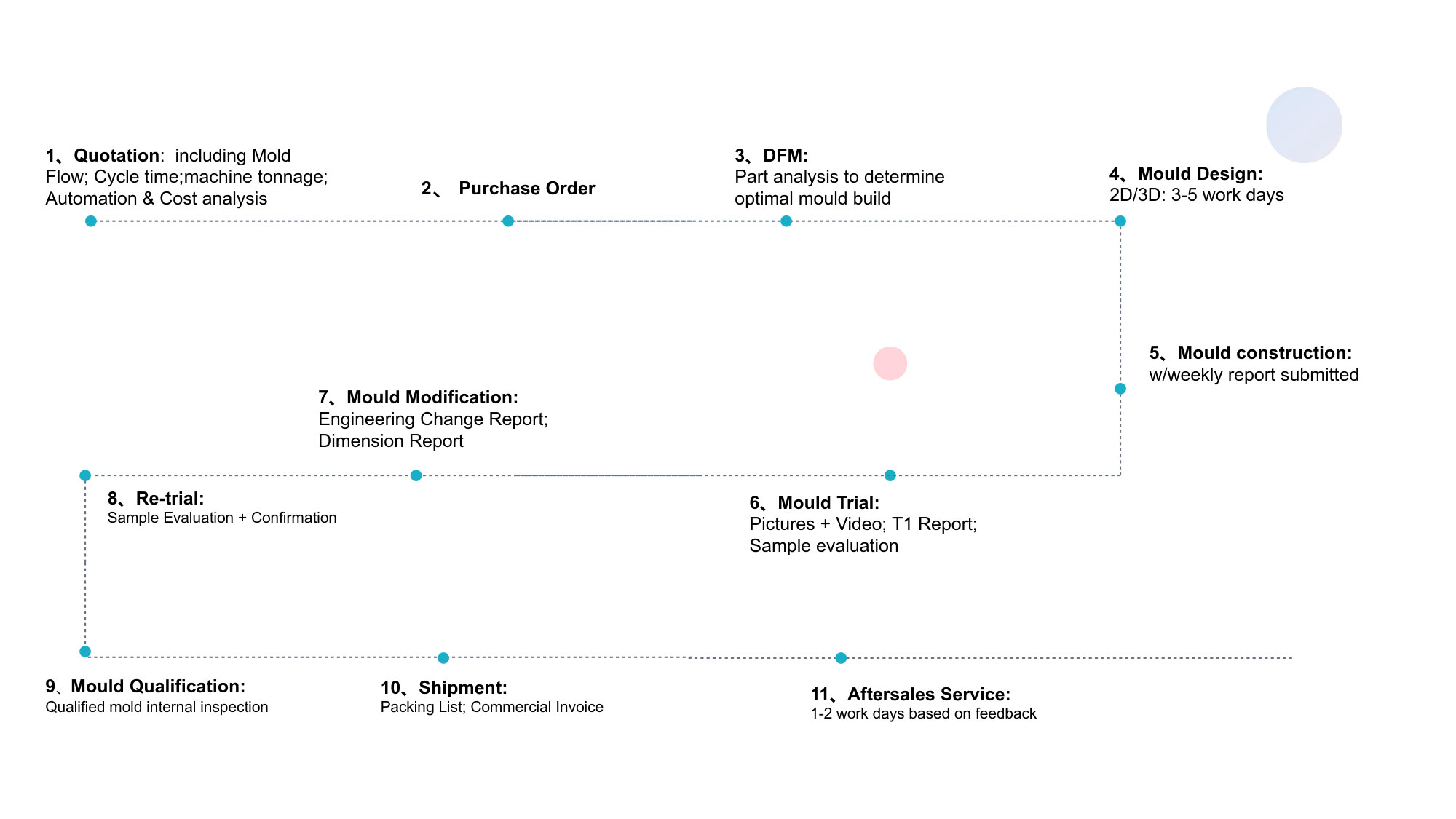
Before contract signing, Ansix provides a comprehensive mold feasibility analysis report including draft angle recommendations, wall thickness optimization, gate placement, and ejector pin mark location limits—ensuring customers avoid discovering structural issues only after mold manufacturing begins.
6.2 Mold Trials and Samples
Ansix provides T0 through T3 trial samples, each accompanied by improvement reports. With an average of just two mold trials before production readiness, Ansix dramatically compresses development cycles, enabling clients to bring products to market faster.
6.3 Small-Batch Validation
Before full-scale production, Ansix provides 100-500 shot trial runs to statistically verify yield rates and CPK, confirming process stability before mass production commences.
6.4 Maintenance and Spare Parts
Spare parts (ejector pins, core pins) delivered with the mold
Maintenance service provided every 200,000 cycles
Lifetime repair at cost price
Three-year mold structure warranty (excluding normal wear of consumable parts)
6.5 In-House Repair Capability
With an in-house electrode production center and EDM workshop, mold repairs are completed without leaving the facility. Standard weld repair / insert replacement is restored to production within 24 hours.
Part Seven: Differentiation — Direct Solutions to Common Industry Pain Points
Common Customer Complaint Ansix Tech's Professional Response
Molds require frequent repairs, disrupting orders "We perform 2,000-cycle aging tests before delivery with wear reports. We provide a three-year mold structure warranty (excluding normal wear of consumable parts)."
Excessive flash, high post-processing costs "We machine parting surfaces to 0.005mm fit precision and employ self-locking clamp force compensation, ensuring flash is controlled to ≤0.03mm per batch—eliminating manual deburring."
Dimensions vary from batch to batch "Injection machines are equipped with ultrasonic wall thickness sensors providing real-time feedback and automatic compensation of holding pressure. Additionally, in-mold temperature and pressure sensors enable closed-loop control."
Mold repair lead times too long "We maintain an in-house electrode production center and EDM workshop. Mold repairs are completed without leaving the facility. Standard weld repair / insert replacement is restored to production within 24 hours."
Part Eight: Delivery Efficiency and Capacity
8.1 Production Capacity
With 260 injection molding machines and 200,000 m² of production space, Ansix Tech has the installed capacity to scale from prototyping to millions of units per month without re-tooling or capacity bottlenecks.
8.2 Accelerated Time-to-Market
70% automated machining ratio
Average of just two mold trials before production readiness
48-hour electrode lead time (industry standard: 10-14 days)
8.3 Smart Manufacturing Integration
Ansix Tech has implemented a fully integrated Industry 4.0 intelligent manufacturing ecosystem:
All machines connected via MES with locked parameters
Real-time process monitoring and feedback
Ultrasonic wall thickness sensors for automatic compensation
In-mold temperature and pressure sensors for closed-loop control
Automated quality inspection with CMM and optical imaging systems
Part Nine: Quality Assurance — The Gold Standard
9.1 Quality Certifications
Ansix Tech holds ISO9001, ISO14001, IATF16949, and ISO13485 certifications.
9.2 Dimensional Verification
Every mold undergoes full dimensional inspection before shipment, with critical dimensions validated to CPK ≥ 1.33. This rigorous protocol eliminates the risk of receiving non-conforming tooling, protecting production schedules from day one.
9.3 Process Capability
A CPK of 1.33 represents a Six Sigma-equivalent capability, statistically ensuring that 99.9937% of production parts conform to specifications.
9.4 Final Functional Testing
Every sensor or float switch undergoes performance verification, including validation of precise actuation points and pressure seals.
Part Ten: Cost Control — Driving Down Total Cost of Ownership
10.1 Design-Phase Cost Optimization
With up to 70% of manufacturing costs determined during initial design, Ansix's early DFM intervention captures the greatest cost-saving opportunity. Value engineering guides customers toward the most cost-effective materials that meet all performance criteria without over-engineering.
10.2 Process Efficiency
Conformal cooling reduces cycle times by up to 20%
Hot runner systems eliminate runner waste
High-cavity molds (up to 96 cavities) maximize output per machine hour
All-servo electric drives reduce energy consumption
10.3 Material Optimization
Ansix's material selection expertise ensures the right polymer is selected for each application—neither under-specified (risking failure) nor over-specified (adding unnecessary cost). With over 50 polymers in the portfolio, customers benefit from optimized material cost without compromising performance.
10.4 Reduced Rework and Scrap
CPK ≥ 1.33 ensures 99.9937% of parts conform to specifications
Flash controlled to ≤0.03mm eliminates manual deburring
First-time-right DFM analysis eliminates costly mold rework
10.5 Extended Tool Life
500,000 cycles for glass-fiber reinforced materials
1,000,000 cycles for standard plastics
Reduced mold replacement frequency = lower amortized cost per part
Conclusion
For Ansix Tech, a mold is not just a piece of steel—it is a revenue-generating asset. Every mold is designed with production profitability as the primary objective: ensuring plug-and-play performance on the customer's production line, minimal flash, balanced thermal behavior, and extended service life.
The company's integrated ecosystem—from material selection and digital DFM analysis through precision mold manufacturing, high-volume injection molding, and full lifecycle support—delivers measurable customer value at every stage:
Reduced risk through digital validation and functional prototyping before tooling investment
Lower costs through design-phase optimization, process efficiency, and material value engineering
Faster time-to-market through 70% automated machining and average of just two mold trials
Consistent quality through CPK ≥ 1.33 process capability and full dimensional verification
Reliable delivery through 260 machines and 200,000 m² of production capacity
Long-term partnership through maintenance programs, spare parts, and lifetime repair support
Ansix Tech's 28 years of manufacturing experience, combined with its commitment to precision engineering and cost innovation, makes it a trusted strategic engineering partner for high-temperature resistant liquid level control products—from concept validation through high-volume production and beyond.
For a detailed DFM report walkthrough on your specific product, Ansix Tech invites you to schedule a consultation where you can see firsthand how weld lines, air traps, and sink marks are predicted and eliminated before a single piece of steel is cut.
Ansix Tech Co Ltd
If you have any plans related to High-temperature resistant side-mounted elbow float switch, water shortage alarm, water level switch, water tank double float valve, liquid level alarm , you can contact us at any time. We will turn your ideas into reality, let you realize your dreams, and obtain large orders from the market. Our contact information is info@ansixtech.com. Or contact our CTO, mail: stephen@ansixtech.com
#www.ansixtech.com #ansixtech.com #High-temperature resistant side-mounted elbow float switch #High-temperature resistant side-mounted elbow float switch #High-temperature resistant side-mounted elbow float switch Canopy Mold injection mold companies #Ansix #Ansix moulds #Ansix china #Ansix tech china #Ansix tech company #Ansix facotry #High-temperature resistant side-mounted elbow float switch injection molding #High-temperature resistant side-mounted elbow float switch injection tools #High-temperature resistant side-mounted elbow float switch injection moulds #High-temperature resistant side-mounted elbow float switch plastic mould #High-temperature resistant side-mounted elbow float switch plastic tools #Ansix Tech #Ansix molds #Ansix injection molding #Ansix mold factory #injection molding High-temperature resistant side-mounted elbow float switch#Ansix mold factory #High-temperature resistant side-mounted elbow float switch china #High-temperature resistant side-mounted elbow float switch molds #injection factory #High-temperature resistant side-mounted elbow float switch injection molding #High-temperature resistant side-mounted elbow float switch injection molding factory #injection molding company #High-temperature resistant side-mounted elbow float switch injection mold companies #High-temperature resistant side-mounted elbow float switch Tooling #High-temperature resistant side-mounted elbow float switch mold limited #Ansix mold china #Ansix companies #Ansix company China #High-temperature resistant side-mounted elbow float switch facotry #Ansix Tech #Ansix Tech mould #High-temperature resistant side-mounted elbow float switch injection moulding #injection moulding company #Ansix High-temperature resistant side-mounted elbow float switch parts injection mold companies #medical injection molding companieschina #High-temperature resistant side-mounted elbow float switch china factory #Ansix moulding companies #Ansix molding company #High-temperature resistant side-mounted elbow float switch injection moulding facotry #Ansix Tech mold #High-temperature resistant side-mounted elbow float switch mould #High-temperature resistant side-mounted elbow float switch plastic injection molding #ansix plastic mold #Mold manufacturing #High-temperature resistant side-mounted elbow float switch parts manufacturing #High-temperature resistant side-mounted elbow float switch plastic parts factory #High-temperature resistant side-mounted elbow float switch injection parts mold #High-temperature resistant side-mounted elbow float switch PRECISION MANUFACTURING #High-temperature resistant side-mounted elbow float switch #China mold #High-temperature resistant side-mounted elbow float switch injection moulding china #High-temperature resistant side-mounted elbow float switch mould china #china precision mold #mold in china #High-temperature resistant side-mounted elbow float switch mold china #Precision molds #High-precision molds #High-temperature resistant side-mounted elbow float switch #Injection molds #High-temperature resistant side-mounted elbow float switch Factory #High-temperature resistant side-mounted elbow float switch Company #Super Large Injection Mold Factory #Large Tonnage Injection Molding Factory #High-temperature resistant side-mounted elbow float switch Company #High-temperature resistant side-mounted elbow float switch Factory #2800T Injection Molding Factory #3000 Ton Injection Molding #4500 Ton Injection Molding Factory #Large Mold Injection Molding #Large Plastic Mold Injection Molding Factory #Large Injection Mold Manufacturer #Plastic Mold Factory #Injection Mold #Plastic Mold