



Stainless steel float switch reed switch float level switch bend side-mounted liquid level sensor float level gauge
FEATURES
Foundation of Hard Power – The Equipment Infrastructure That Builds Trust
Mold Manufacturing Equipment
Ansix's mold workshop is equipped with advanced machining centers capable of delivering micron-level precision. The company utilizes five-axis high-speed machining centers that can machine complex curved surfaces to 0.002mm accuracy, ensuring smooth, burr-free parting lines on every product. For fine features such as micro-holes and narrow slots as small as 0.03mm, Ansix employs slow wire EDM (electrical discharge machining) that prevents thin-wall deformation—a critical requirement for precision sensor components that must maintain dimensional integrity under operational stress.
Customer Value Translation: When a sensor housing requires a 0.03mm vent hole for pressure equalization, or a float component needs a perfectly smooth sealing surface, Ansix's equipment capability means the part is manufactured right the first time—eliminating costly secondary operations and reducing scrap rates.
-
Mold Description
Product Materials:
SUS304+NBR FOAM
Mold Material:
S136ESR
Number of Cavities:
16
Glue Feeding Method:
Hot runner
Cooling Method:
Water cooling
Molding Cycle
42.5s
Injection Molding Machine Fleet
Ansix operates 260 injection molding machines across its four production bases, with clamping forces ranging from 30 tons to 2,800 tons. This range covers everything from miniature sensor components to large industrial housing assemblies. Major machine brands include Japanese manufacturers (Fanuc, Sumitomo, Toshiba, Nissei), European leaders (Engel), and German Arburg machines dedicated to liquid silicone rubber (LSR) two-component molding. Chinese Haitian machines complement the fleet for standard production runs.
All machines feature all-servo motor drives with repeatable precision of ±0.1%, ensuring that every shot in a mass production run is consistent with the first. This is not merely a specification—it is a guarantee that parts produced on Monday will be identical to those produced on Friday, across shifts, across weeks.
Customer Value Translation: For a customer ordering 500,000 float switches annually, ±0.1% repeatability means that parts remain within tolerance throughout the entire production run. No mid-run adjustments. No unexpected dimensional drift. No rejected batches. This consistency translates directly into assembly line reliability and reduced warranty claims.
Inspection and Metrology Equipment
Quality validation begins with precision measurement. Ansix maintains a full suite of inspection equipment including CMM (coordinate measuring machines) and optical imaging systems. Every mold, before leaving the workshop, undergoes a full dimensional report comparison, with critical dimensions held to CPK ≥ 1.33.
Customer Value Translation: CPK ≥ 1.33 means the process is statistically capable—fewer than 63 parts per million fall outside specification. For a high-volume sensor program, this translates to predictable yield, predictable delivery, and predictable cost.
-
Mold Manufacturing Core Competencies – Where Precision Meets Durability
Mold Steel Selection: The Foundation of Tool Life
The selection of mold steel determines approximately 70% of total tooling cost and directly impacts production uptime and maintenance frequency. Ansix applies a science-based material selection framework that aligns steel properties with production volume, polymer type, and cosmetic requirements.
Mold Steel Portfolio:
Steel Grade Properties Application
P20 Pre-hardened, good polishability Mold bases, standard cavities
S136 Stainless, corrosion-resistant, high polishability Medical, food-contact, corrosive polymers
2344 / 2343 Hot-work tool steel, excellent toughness High-temperature molding
8407 Premium hot-work steel, superior fatigue resistance High-cycle production
SKD11 / SKD61 / DC53 High wear resistance Glass-fiber reinforced materials
M340 / 4Cr13 / 9Cr18 Corrosion-resistant stainless Aggressive polymer environments
NAK80 Pre-hardened, excellent polishability, uniform hardness High-gloss cosmetic surfaces
H13 Hot-work steel, thermal shock resistance High-temperature engineering plastics
All mold steels are sourced from premium suppliers in Sweden, Germany, and the US, with full material certification and documented heat treatment curves provided with every mold delivery.
Customer Value Translation: For a float switch housing molded in PPS+40%GF, Ansix specifies S136 or H13 tool steel with specific heat treatment to resist abrasion from glass fibers. The result: 50万模次 (500,000 shots) with glass-filled materials, and 100万模次 (1,000,000 shots) with standard thermoplastics. This is not a theoretical claim—it is a documented guarantee backed by material certifications.
Mold Type Capabilities
Ansix manufactures a comprehensive range of mold types:
Hot Runner Molds: Reduce material waste by eliminating runner systems; ideal for high-volume production where material cost is a significant factor
Stack Molds: Double production efficiency by molding two layers of parts simultaneously
Two-Color / Multi-Material Molds: Enable over-molding of different materials (e.g., soft-touch seals on rigid sensor housings)
High-Gloss Molds: Surface roughness Ra < 0.05μm, suitable for transparent or cosmetic components
Insert Molding: Encapsulates metal inserts (stainless steel tubes, magnetic components, threaded inserts) within plastic—critical for float switch assemblies where metal stems must be hermetically sealed
Gating and Feed System Design
Through advanced Moldflow analysis, Ansix predicts weld line positions, gas trap locations, and cooling imbalances before steel is cut. This allows engineers to optimize gate location and quantity to ensure balanced filling and minimize material waste.
Customer Value Translation: Poor gate design causes weld lines that compromise structural integrity, gas traps that create surface defects, and unbalanced filling that leads to dimensional variation. Ansix's upfront simulation eliminates these issues before they become problems. A customer receives a mold that produces good parts from the first shot—not after weeks of trial-and-error adjustments.
Mold Delivery Standards
Mold Complexity Standard Lead Time Expedited Lead Time
Simple molds 10 days —
Medium complexity 25–45 days 20 days (with accelerated validation)
High complexity 45–60 days 35 days
Even under expedited schedules, validation steps are never skipped—digital simulation and accelerated testing protocols ensure quality is not compromised for speed.
Customer Value Translation: A customer facing a production ramp-up knows exactly when the mold will arrive. No surprises. No "we're working on it." Predictable delivery means predictable production scheduling and inventory planning.
Part Three: Injection Molding Process Control – Eliminating Quality Anxiety
What Customers Fear
Every customer who has experienced poor molding quality knows the list: sink marks, flash, dimensional instability, batch-to-batch color variation, warpage, short shots, and stress cracking. Ansix has systematically engineered solutions for each.
Process Standardization and MES Integration
All molding machines are networked and integrated with a MES (Manufacturing Execution System) . Molding parameters—temperature, pressure, speed, and time—are locked in the system and can only be modified by authorized engineers. Each batch undergoes first-article and last-article inspection, with dimensional data recorded and archived for full traceability.
Customer Value Translation: When a regulatory audit requires proof of process control, Ansix provides complete parameter histories, inspection records, and traceability documentation. The customer doesn't need to reconstruct data—it's already there.
Dimensional Stability Control
Temperature control is the key to dimensional stability. Ansix employs mold temperature controllers with zoned control, maintaining core and cavity temperature differentials within 2°C to minimize warpage and distortion. In documented cases, for similar bracket products produced over three consecutive weeks, critical hole spacing variation was maintained within ±0.02mm.
Customer Value Translation: For a float level gauge that must slide smoothly along a guide tube, ±0.02mm dimensional stability means the float never binds, never sticks, and provides consistent, reliable switching every time. The customer doesn't receive complaints from the field about erratic level readings.
Surface Finish and Cosmetic Quality
Ansix achieves surface quality levels that meet the most demanding applications:
Transparent parts: No bubbles, no flow marks—optical clarity suitable for visual inspection applications
Plated parts: No gas marks that would compromise adhesion
High-gloss parts: Surface roughness Ra ≤ 0.2μm
For products requiring painting or printing, Ansix incorporates compensation allowances into the mold design, achieving print registration accuracy within ±0.1mm.
Customer Value Translation: A sensor housing with a laser-etched part number must be legible and durable. Ansix ensures the surface is perfect before marking, so the marking is perfect after. No rework. No scrap.
Specialty Material Processing Capabilities
Ansix has extensive production experience with a wide range of engineering thermoplastics:
Float and Buoyancy Materials:
Polypropylene (PP): Excellent chemical resistance, low density. Ansix uses a specialized micro-foaming process with chemical blowing agents to create closed-cell foam structures with precisely controlled density—producing floats that are waterproof, durable, and reliably buoyant
Polyvinylidene Fluoride (PVDF): Superior chemical resistance to strong acids, bases, and solvents; continuous service temperature up to 105°C; exceptionally pure with low moisture absorption. Ideal for corrosive chemical environments in semiconductor and pharmaceutical applications
High-Temperature and Structural Materials:
Polyphenylene Sulfide (PPS): Exceptional heat resistance (exceeding 200°C), excellent dimensional stability, chemical resistance. Used for automotive and industrial heating system sensor housings
PPS+40%GF: Glass-fiber reinforced for maximum structural rigidity in high-temperature, high-stress applications
PA6+GF30: Glass-reinforced nylon balancing cost, strength, and heat resistance
Advanced Engineering Polymers:
PEEK (Polyether Ether Ketone): Ultra-high temperature resistance, chemical resistance, and mechanical strength for demanding applications
PEI (Polyetherimide): High heat resistance, dimensional stability; glass-fiber content can be optimized for thin-wall rigidity
PC (Polycarbonate) / PC-ABS blends: High impact strength, dimensional stability; specialty grades like Covestro's Makrolon Ai ST prevent signal interference for LiDAR and optical sensing applications
PBT: Good electrical properties and chemical resistance
LCP (Liquid Crystal Polymer): Exceptional flow, high-temperature stability, thin-wall capability
PTFE / PFA: Ultra-high chemical resistance, non-stick properties
Flame Retardancy: Ansix achieves UL94 V-0 ratings for products requiring flame retardance, with UV stability verified through 3,000-hour testing for outdoor and automotive applications.
Customer Value Translation: A customer specifying a float for a chemical storage tank doesn't need to worry about material compatibility. Ansix's material science team selects the right polymer for the specific chemical environment—PP for water and mild chemicals, PVDF for aggressive acids, PPS for high-temperature hydrocarbons. No premature failure. No costly field replacements.
Part Four: Full-Process Service – Reducing Customer Management Overhead
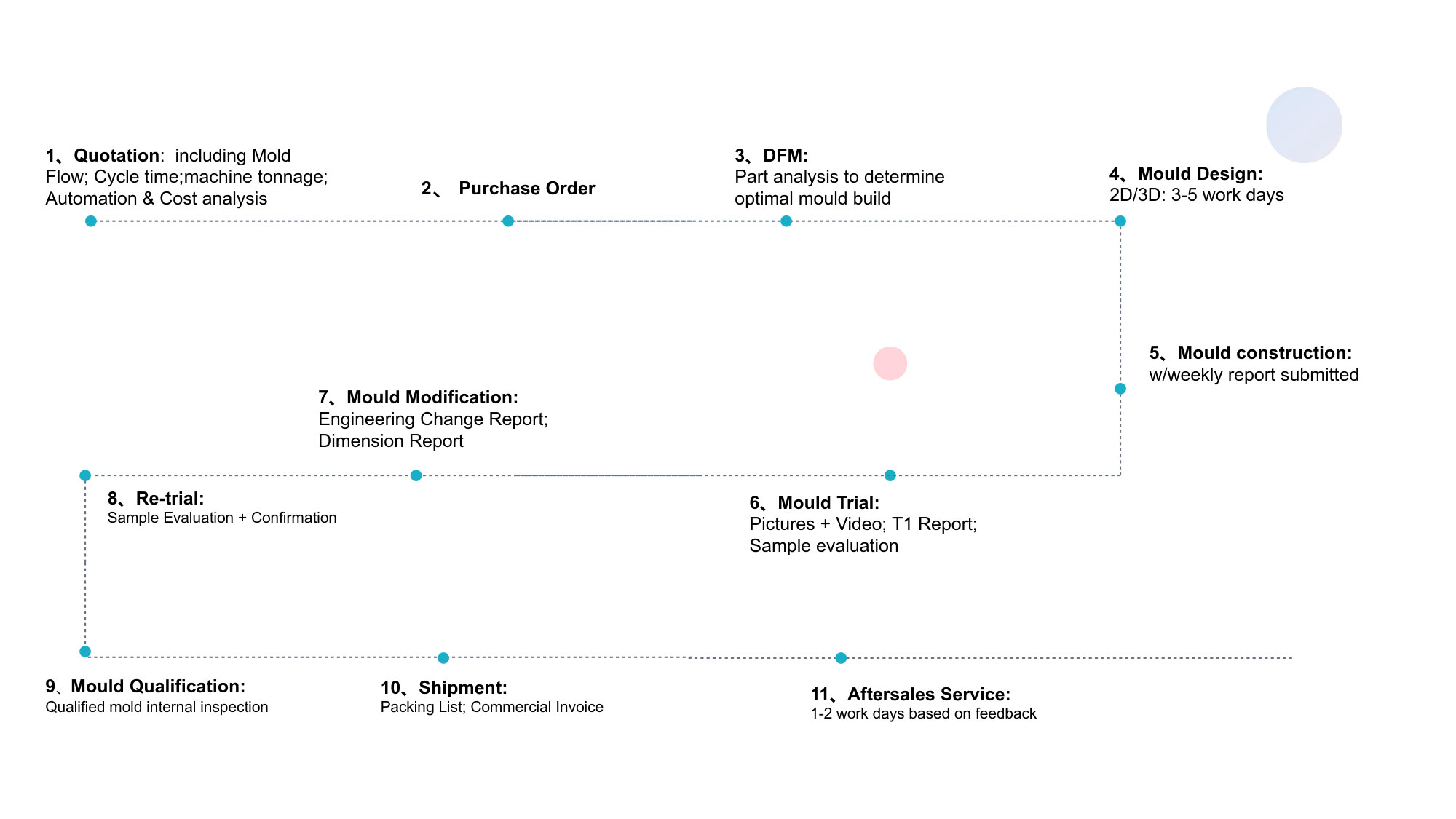
Early-Stage Engineering Support (DFM Reports)
Before any contract is signed, Ansix provides a comprehensive Design for Manufacturability (DFM) analysis. This report includes:
Draft angle recommendations
Wall thickness optimization
Gate location and type recommendations
Ejector pin mark location allowances
Identification of potential manufacturing challenges (undercuts, excessive wall thickness variations, stress concentration areas)
The philosophy: Up to 70% of a component's final manufacturing cost is determined during the initial design stage. By addressing manufacturability issues in the design phase, Ansix prevents costly mold modifications after steel has been cut.
Customer Value Translation: A customer brings a CAD model that looks perfect on screen. Ansix's DFM analysis reveals that a thin wall section will warp, or a sharp internal corner will cause stress cracking. The design is modified before the mold is built. The customer saves weeks of delay and tens of thousands of dollars in mold rework.
Trial Molding and Iterative Validation
Ansix provides T0 through T3 trial samples, with improvement reports after each round. The company can rapidly change inserts to validate different design variations without rebuilding the entire mold. This iterative approach ensures the final production mold delivers optimal results.
Customer Value Translation: The customer sees actual parts early in the process, not just simulations. If adjustments are needed, they happen quickly and cost-effectively. The customer doesn't pay for a complete mold rebuild because a feature didn't work as expected.
Small-Batch Validation
Before full-scale production release, Ansix provides a 100- to 500-shot trial run to validate yield rates and CPK statistics. Only after process stability is confirmed does mass production commence.
Customer Value Translation: The customer doesn't discover quality issues after ordering 100,000 parts. The small-batch trial catches problems early, when they are cheap to fix.
Maintenance and Spare Parts
Each mold is delivered with a complete set of spare wear parts (ejector pins, core pins, and other consumables). Ansix provides mold maintenance every 200,000 shots and offers lifetime repair services at cost.
Customer Value Translation: When a customer's production line depends on a mold running 24/7, downtime is measured in dollars per minute. Ansix's proactive maintenance program and readily available spare parts mean the customer's line stays running.
Part Five: Differentiated Advantages – Addressing Industry Pain Points
The 2000-Shot Aging Test
Every mold undergoes a 2,000-shot aging test before delivery, with a wear report documenting the results. Ansix provides a three-year structural warranty on every mold (excluding normal wear on consumable parts).
Industry Pain Point: Molds that fail prematurely, requiring frequent repairs and disrupting production schedules.
Ansix Solution: The aging test validates the mold's durability before it reaches the customer's factory. The wear report provides quantitative evidence of expected life. The warranty provides financial protection.
Flash Control at 0.03mm
Ansix machines parting surfaces to 0.005mm fit precision and employs self-locking clamp force compensation to ensure flash is controlled within 0.03mm on every batch.
Industry Pain Point: Excessive flash requires manual deflashing, adding labor cost and risking damage to the part.
Ansix Solution: Parts come off the machine ready to use. No deflashing labor. No scratched parts. No rework.
Real-Time Dimensional Feedback
Ansix installs ultrasonic wall thickness sensors on molding machines to provide real-time feedback on wall thickness variation, automatically compensating packing pressure to maintain dimensional stability. In-mold temperature and pressure sensors enable closed-loop control.
Industry Pain Point: Dimensional variation from batch to batch creates assembly problems and scrap.
Ansix Solution: The machine adjusts itself in real time. Every part is dimensionally stable. The customer's assembly line runs smoothly.
In-House Mold Repair
Ansix maintains its own electrode machining center and EDM workshop. Mold repairs are performed in-house, with standard repair welding and insert replacement completed within 24 hours.
Industry Pain Point: Mold repairs at external shops take weeks, causing production stoppages.
Ansix Solution: Repairs happen fast because the capability is in-house. Production resumes quickly.
Part Six: Comprehensive Manufacturing Workflow for Stainless Steel Float Switches and Level Sensors
Project Initiation and Feasibility Analysis
The journey begins with the customer's 3D CAD model and performance specifications. Ansix's engineering team conducts a comprehensive DFM analysis, evaluating:
Part geometry: Identification of undercuts, thin walls, thick sections, and stress concentration areas
Material selection: Matching polymer properties to the application environment (temperature, chemical exposure, mechanical load, regulatory requirements)
Tolerance analysis: Establishing achievable tolerances based on material, geometry, and production volume
Gate and runner design: Optimizing fill patterns to minimize weld lines and gas traps
Cooling system design: Ensuring uniform cooling to minimize warpage and cycle time
Advanced Mold Flow Analysis (MFA)
Using sophisticated simulation software (Autodesk Moldflow and equivalent), Ansix creates a digital twin of the entire injection molding process. This simulation predicts:
How molten plastic fills the cavity
Weld line locations and severity
Gas trap locations
Sink mark formation
Warpage and shrinkage patterns
Cooling uniformity
In a recent float component analysis, the simulation predicted a fill time of 2.8 seconds with a peak injection pressure of 56.34 MPa—validating the design's feasibility before steel was cut. This upfront validation reduces physical prototyping costs and time by over 50%.
Customer Value Translation: The customer doesn't pay for trial-and-error on expensive steel. The mold is right the first time.
Mold Design
Based on DFM and MFA results, Ansix's design team develops the complete mold design, including:
Cavity and core design: Optimized for the specific polymer's shrinkage characteristics
Cooling channel layout: Conformal cooling where possible to minimize cycle time and warpage
Ejection system: Strategic placement of ejector pins to avoid cosmetic surfaces and functional features
Gating system: Hot runner or cold runner design optimized for fill balance and minimal material waste
Venting: Strategic vent placement to prevent gas traps and burn marks
Mold Manufacturing Process
1. Rough Machining: CNC milling removes the bulk of material from the steel block.
2. Heat Treatment: The steel undergoes precise heat treatment to achieve target hardness (typically HRC 48-52 for cavity steels). Full heat treatment curves are documented for traceability.
3. Precision Machining: Five-axis CNC machining achieves final dimensions with 0.002mm accuracy.
4. EDM (Electrical Discharge Machining): Wire EDM creates fine features such as 0.03mm slots and micro-holes. Sinker EDM creates complex cavity details that cannot be achieved with conventional machining.
5. Polishing: High-gloss surfaces are polished to Ra < 0.05μm for transparent or cosmetic applications.
6. Assembly: The completed mold is assembled, with all moving parts verified for smooth operation.
7. Tryout and Validation: The mold is installed on an injection molding machine for trial runs. T0 through T3 samples are produced and measured. Any issues are addressed through insert changes or adjustments.
Injection Molding Process Optimization
Once the mold is qualified, the focus shifts to process optimization. Ansix employs decoupled molding® principles, separating fill, pack, and cooling phases for precise control over each stage.
Key Optimization Parameters:
Parameter Control Method Customer Benefit
Melt temperature Closed-loop control (±1°C) Consistent viscosity, stable dimensions
Mold temperature Zoned control (±2°C) Minimal warpage, optimal surface finish
Injection speed Profiled control Balanced fill, reduced stress
Pack pressure Closed-loop control Minimized shrinkage, reduced sink marks
Cooling time Optimized for material Minimum cycle time, consistent dimensions
In documented cases, Ansix's optimization efforts have reduced cycle time by 28%, increasing daily production from 1,300 to 1,670 parts on the same equipment.
Customer Value Translation: Shorter cycle time means more parts per day. More parts per day means lower cost per part. The customer gets better pricing without compromising quality.
Quality Control Throughout Production
Incoming Material Inspection: All raw materials are verified against specifications, with certificates of analysis maintained.
In-Process Inspection: Automated inspection systems monitor critical dimensions on every shot. Parameters are locked in the MES system.
First-Article and Last-Article Inspection: Every batch begins and ends with full dimensional inspection.
Statistical Process Control: CPK is monitored continuously. If CPK trends downward, corrective action is taken before parts go out of specification.
Final Inspection: 100% inspection of critical functional characteristics (float movement, switch actuation, sealing integrity).
Packaging and Delivery
Parts are packaged according to customer requirements—bulk packaging, tray packaging, or individual packaging—with ESD protection where required. Ansix's four production facilities (three in China, one in Vietnam) provide geographic flexibility for supply chain resilience.
Customer Value Translation: The customer receives parts on time, in the right quantity, in the right packaging, ready for their assembly line.
Part Seven: Cost Reduction – Systematic Value Engineering
Material Cost Optimization
Ansix's material science expertise enables value engineering—selecting the most cost-effective material that meets all performance requirements without over-engineering. In documented cases, this approach has reduced sensor housing costs by up to 16%.
How It Works: A customer specifies an expensive high-temperature polymer because "that's what we've always used." Ansix's analysis shows that a lower-cost material with specific additives will meet all performance requirements at significantly lower cost. The customer saves money without compromising quality.
Process Efficiency Optimization
Through Moldflow simulation and process optimization, Ansix reduces cycle time, scrap rate, and energy consumption. In one documented project, a four-cavity hot runner mold achieved cycle time under 30 seconds with a first-pass yield above 99.5%, and component cost reduced by at least 15% compared to the customer's previous supplier.
Tool Life Extension
By specifying the right mold steel for the application and implementing proper maintenance, Ansix extends mold life to 500,000 shots for glass-filled materials and 1,000,000 shots for standard thermoplastics. Longer mold life means lower amortized tooling cost per part.
Reduced Scrap and Rework
Through process control and real-time monitoring, Ansix maintains scrap rates well below industry averages. Less scrap means more good parts from the same raw material—direct cost savings.
Reduced Management Overhead
By providing end-to-end service (DFM through delivery), Ansix reduces the customer's supplier management burden. The customer deals with one supplier, not separate design, mold-making, molding, and assembly vendors.
Part Eight: Quality Assurance and Reliability
ISO 9001 Certification
Ansix's entire manufacturing process is ISO 9001 certified, from design through mold manufacturing, engineering, injection molding, and parts assembly.
Full Traceability
Every mold is delivered with material certification reports and heat treatment curves. Full traceability is maintained from raw material receipt through final assembly.
Process Capability
Critical dimensions are maintained at CPK ≥ 1.33, ensuring statistical process capability that translates to predictable quality and yield.
Environmental and Reliability Testing
Ansix validates products against real-world conditions:
Temperature cycling: -40°C to 150°C for automotive applications
Chemical resistance: Extended exposure to coolants, oils, and aggressive chemicals
UV stability: 3,000-hour UV testing for outdoor applications
Flame retardance: UL94 V-0 ratings where required
Conclusion: The Ansix Value Proposition
For customers requiring stainless steel float switches, reed switch float level switches, bend side-mounted liquid level sensors, and float level gauges, Ansix Tech delivers:
Reliability: 28 years of experience, ISO 9001 certification, full traceability, and process capability that ensures consistent quality.
Cost Savings: Systematic value engineering, process optimization, extended tool life, and reduced scrap translate to lower total cost of ownership.
Speed: Digital simulation reduces development time. In-house manufacturing capability enables rapid iteration. Four production facilities provide geographic flexibility.
Risk Reduction: DFM analysis catches problems before steel is cut. Small-batch validation confirms process stability before mass production. Full traceability supports regulatory compliance.
Peace of Mind: A single partner handles everything from design through delivery. The customer doesn't manage multiple vendors or coordinate handoffs between design, mold-making, and production.
As Ansix's philosophy states: "A mold is not just a piece of steel—it's a money-printing machine." Every design decision, every material selection, every process parameter is optimized to ensure that when the mold reaches the customer's production line, it delivers zero tuning, minimal flash, maximum life, and predictable, profitable production.
For customers who want to see this capability in action, Ansix offers a full DFM report walkthrough on an existing product—demonstrating in real time how weld lines, gas traps, and sink marks are identified and eliminated before the mold is ever built.
Ansix Tech Co Ltd
If you have any plans related to Stainless steel float switch reed switch float level switch bend side-mounted liquid level sensor float level gauge , you can contact us at any time. We will turn your ideas into reality, let you realize your dreams, and obtain large orders from the market. Our contact information is info@ansixtech.com. Or contact our CTO, mail: stephen@ansixtech.com
#www.ansixtech.com #ansixtech.com #Stainless steel float switch reed switch float level switch bend side-mounted #Stainless steel float switch reed switch float level switch bend side-mounted #Stainless steel float switch reed switch float level switch bend side-mounted Canopy Mold injection mold companies #Ansix #Ansix moulds #Ansix china #Ansix tech china #Ansix tech company #Ansix facotry #Stainless steel float switch reed switch float level switch bend side-mounted injection molding #Stainless steel float switch reed switch float level switch bend side-mounted injection tools #Stainless steel float switch reed switch float level switch bend side-mounted injection moulds #Stainless steel float switch reed switch float level switch bend side-mounted plastic mould #Stainless steel float switch reed switch float level switch bend side-mounted plastic tools #Ansix Tech #Ansix molds #Ansix injection molding #Ansix mold factory #injection molding Stainless steel float switch reed switch float level switch bend side-mounted#Ansix mold factory #Stainless steel float switch reed switch float level switch bend side-mounted china #Stainless steel float switch reed switch float level switch bend side-mounted molds #injection factory #Stainless steel float switch reed switch float level switch bend side-mounted injection molding #Stainless steel float switch reed switch float level switch bend side-mounted injection molding factory #injection molding company #Stainless steel float switch reed switch float level switch bend side-mounted injection mold companies #Stainless steel float switch reed switch float level switch bend side-mounted Tooling #Stainless steel float switch reed switch float level switch bend side-mounted mold limited #Ansix mold china #Ansix companies #Ansix company China #Stainless steel float switch reed switch float level switch bend side-mounted facotry #Ansix Tech #Ansix Tech mould #Stainless steel float switch reed switch float level switch bend side-mounted injection moulding #injection moulding company #Ansix Stainless steel float switch reed switch float level switch bend side-mounted parts injection mold companies #medical injection molding companieschina #Stainless steel float switch reed switch float level switch bend side-mounted china factory #Ansix moulding companies #Ansix molding company #Stainless steel float switch reed switch float level switch bend side-mounted injection moulding facotry #Ansix Tech mold #Stainless steel float switch reed switch float level switch bend side-mounted mould #Stainless steel float switch reed switch float level switch bend side-mounted plastic injection molding #ansix plastic mold #Mold manufacturing #Stainless steel float switch reed switch float level switch bend side-mounted parts manufacturing #Stainless steel float switch reed switch float level switch bend side-mounted plastic parts factory #Stainless steel float switch reed switch float level switch bend side-mounted injection parts mold #Stainless steel float switch reed switch float level switch bend side-mounted PRECISION MANUFACTURING #Stainless steel float switch reed switch float level switch bend side-mounted #China mold #Stainless steel float switch reed switch float level switch bend side-mounted injection moulding china #Stainless steel float switch reed switch float level switch bend side-mounted mould china #china precision mold #mold in china #Stainless steel float switch reed switch float level switch bend side-mounted mold china #Precision molds #High-precision molds #Stainless steel float switch reed switch float level switch bend side-mounted #Injection molds #Stainless steel float switch reed switch float level switch bend side-mounted Factory #Stainless steel float switch reed switch float level switch bend side-mounted Company #Super Large Injection Mold Factory #Large Tonnage Injection Molding Factory #Stainless steel float switch reed switch float level switch bend side-mounted Company #Stainless steel float switch reed switch float level switch bend side-mounted Factory #2800T Injection Molding Factory #3000 Ton Injection Molding #4500 Ton Injection Molding Factory #Large Mold Injection Molding #Large Plastic Mold Injection Molding Factory #Large Injection Mold Manufacturer #Plastic Mold Factory #Injection Mold #Plastic Mold