



Magnetic float switch, low water level and high water level alarm, liquid level, water tank sensor, electronic intelligent, corrosion resistant
FEATURES
Hard Infrastructure — Building Customer Trust Through Equipment Excellence
Mold Processing Equipment: The Foundation of Precision
At Ansix Tech, the equipment portfolio is not merely a list of machines—it is a guarantee of zero-defect production. Every piece of equipment is selected to eliminate variables that could jeopardize product quality.
5-Axis High-Speed Machining Centers: Ansix employs 5-axis high-speed machining centers capable of machining complex curves with ±0.002mm precision. For magnetic float switches and liquid level sensor components, this ensures that parting lines remain smooth and burr-free. When a float switch housing has a visible parting line or sharp edge, it can compromise the seal integrity or create turbulence that affects the float's movement. By maintaining such tight tolerances, Ansix ensures that every product's mating surfaces are flawless, directly translating to reliable switch operation and extended service life.
Slow-Wire EDM (Electrical Discharge Machining): The company's slow-wire EDM technology handles 0.03mm micro-hole and narrow-slot processing, effectively eliminating thin-wall deformation common in competitive solutions. For liquid level sensors that require precise vent holes or narrow guide slots for the float stem, this capability ensures dimensional accuracy without compromising structural integrity.
Comprehensive Machine Portfolio: Ansix operates 260 injection molding machines with clamping forces ranging from 30 tons to 4,000 tons. This breadth covers the entire spectrum of production—from small, single-cavity molds for prototyping running on 30- to 90-ton machines with high-efficiency servo drives, up to large-scale industrial components. The fleet includes top-tier brands: Japan's Fanuc, Sumitomo, Toshiba, Nissei, Engel, Germany's Arburg, and China's Haitian.
All-Servo Electric Drives: Every machine is equipped with all-servo electric drives, guaranteeing repeatability accuracy of ±0.1%. This means from the first shot to the millionth, every unit is identical. For magnetic float switches, where the float's buoyancy depends on precise density and volume, this consistency is non-negotiable.
Quality Inspection Equipment: Verification Over Assumption
Ansix utilizes Coordinate Measuring Machines (CMM) and Optical Imaging Systems for comprehensive quality verification. Every mold undergoes a full dimensional report before leaving the shop, with Critical-to-Quality dimensions maintained at CPK ≥ 1.33. This statistical process control ensures that customers receive products that not only meet specifications but do so with remarkable consistency.
Customer Value Translation: When a customer asks, "How do I know my parts will be consistent?" Ansix's answer is: CMM verification with CPK ≥ 1.33 means that for every 1,000,000 parts produced, fewer than 63 will fall outside specification—a level of reliability that directly reduces field failures, warranty claims, and reputational damage.
-
Mold Description
Product Materials:
SUS304+NBR FOAM
Mold Material:
S136ESR
Number of Cavities:
32
Glue Feeding Method:
Hot runner
Cooling Method:
Water cooling
Molding Cycle
42.5s
- The mold manufacturing process and product material selection
Mold Manufacturing — The Core of Longevity and Speed
Steel Selection and Material Science
The mold is the heart of the production line. If it fails, the business stops. Ansix maintains a strategic inventory of premium tool steels matched to specific applications:
Material Hardness (HRC) Key Properties Application
S136 / S136H 48-54 Superior corrosion resistance, ultra-high mirror polishability (Ra < 0.05μm) Transparent PC/ABS parts, optical-grade surfaces, corrosive plastic materials
2344 / 8407 / H13 48-52 High hot hardness at 550-600°C, excellent toughness, thermal fatigue resistance High-temperature engineering plastics (PPS+40%GF, PEEK)
NAK80 37-43 Super mirror polish, excellent EDM machinability High-gloss surfaces, cosmetic-grade appearances
SKD11 / DC53 58-62 High wear resistance, high compression strength Wear inserts, sliders, shear edges for abrasive filled materials
2343 48-52 Impact resistance superior to H13, good thermal conductivity Complex geometries with extreme mechanical shock loads
M340 / 4Cr13 / 9Cr18 48-53 Stainless martensitic, excellent corrosion resistance FDA-grade applications, acidic plastic compounds
P20 28-32 Good machinability, cost-effective Mold bases, support plates
Every material selection decision is documented in a formal steel certification, accompanied by the full heat-treatment curve for complete traceability. For S136, Ansix follows a precise quench at 1000-1050°C, oil-cooled to 50-100°C, then tempered at 200+°C to achieve 48-54HRC while preventing cracking.
-
Customer Value Translation: A mold built with the wrong steel for the application will fail prematurely—cracking, wearing, or corroding. When Ansix specifies S136 for transparent sensor housings, it's not just about polishability; it's about ensuring optical clarity for light-based level detection systems. When 8407 is chosen for PPS+40%GF applications, it's about preventing thermal fatigue cracks that would shut down production. These material choices directly translate to extended mold life, fewer maintenance stops, and lower total cost of ownership.
Mold Life and Performance Guarantees
Ansix delivers clear, measurable commitments on mold performance:
Mold Life: For glass-reinforced materials, Ansix guarantees 500,000 cycles; for standard plastics, 1,000,000 cycles. This is achieved through proper steel selection, precision heat treatment, and robust cooling design.
Achievable Tolerances: Standard structural components achieve ±0.05mm; precision gears and medical components achieve ±0.005mm. Every mold is delivered with full material certification and heat treatment documentation.
Mold Types: Ansix manufactures a comprehensive range including hot runner molds (reducing material waste), stack molds (doubling efficiency), two-shot/multi-material molds, and high-mirror finish molds (Ra < 0.05μm for transparent components).
Lead Time Standards: Simple molds in 10 days; medium-complexity in 25-45 days; expedited options available in 20 days (with verification steps maintained).
Gate and Cooling System Design
Using Moldflow simulation software, Ansix predicts fill patterns, identifies weld-line locations, exposes air-trapping risks, and optimizes gate placement to ensure balanced flow across complex geometries. The company simulates cooling performance to design conformal cooling channels that follow complex contours, reducing cycle times by up to 20% compared to traditional straight-line cooling layouts.
Customer Value Translation: For a magnetic float switch, the float must be perfectly spherical or cylindrical with consistent wall thickness. Uneven filling creates density variations that affect buoyancy. By optimizing gate placement and cooling, Ansix ensures that every float has uniform density, consistent buoyancy, and reliable switching performance—eliminating the costly problem of field calibration failures.
Part Three: Injection Molding — Process Control That Eliminates Quality Anxiety
Process Standardization and MES Integration
All injection molding machines are connected through Ansix's Manufacturing Execution System (MES). Every processing parameter—melt temperature profile, injection pressure, holding pressure, injection speed, screw rotation speed, cooling time, mold temperature, back pressure—is locked into the system. Access is restricted to engineering approval only. Each batch undergoes first-article and last-article comparison to ensure consistency throughout production runs.
Customer Value Translation: When a customer asks, "How do I know batch #2 will be the same as batch #1?" Ansix's answer is: MES-controlled parameters mean the machine settings are locked. No operator can "adjust" the process on a whim. Every shot is identical to the one before it. This eliminates the common problem of batch-to-batch variation that plagues less sophisticated manufacturers.
Dimensional Stability Control
Ansix maintains mold temperature with multi-zone controllers that keep core-cavity temperature differences within 2°C, directly minimizing post-mold warpage and distortion. For demanding applications, the company embeds real-time cavity pressure sensors that feed closed-loop process corrections during every shot, delivering long-term dimensional stability even when resin lots vary.
Real-World Results: For a liquid level sensor float project, simulation predicted a fill time of 2.8 seconds with peak injection pressure of 56.34 MPa, validating the design feasibility and avoiding costly mold rework. In documented automotive sensor housing projects, Ansix's optimization reduced production cycle time by 28%, increasing daily output from 1,300 to 1,670 units on the same equipment.
Surface Finish Quality
Ansix achieves surface finishes appropriate to each application:
Transparent components: No bubbles, no flow marks, optical clarity maintained
Plated components: No gas marks, consistent surface quality
High-gloss components: Surface roughness Ra ≤ 0.2μm
Printed/coated components: Deformation compensation预留, print registration accuracy within ±0.1mm
Specialty Material Capabilities
Ansix has extensive practical experience with a wide range of engineering materials: PC/ABS, PC, PPS+40%GF, PEEK, PTFE/PFA, PA6+GF30, PBT, PEI/PPS/LCP, and Liquid Silicone Rubber (LSR). The company emphasizes fire ratings (UL94 V-0 for coil housings) and weatherability (UV testing up to 3,000 hours without discoloration).
Customer Value Translation: For a magnetic float switch used in a chemical storage tank, the float material must withstand specific chemicals at specific temperatures. PP works for water and mild chemicals; PVDF is required for aggressive acids and solvents (continuous service up to 105°C); PPS handles temperatures exceeding 200°C for automotive or industrial heating systems. Ansix's expertise in material science ensures the right material is selected for the application—not over-specified (wasting money) or under-specified (risking failure).
Part Four: Full-Process Services — Reducing Customer Management Costs
Early Intervention Through DFM Reports
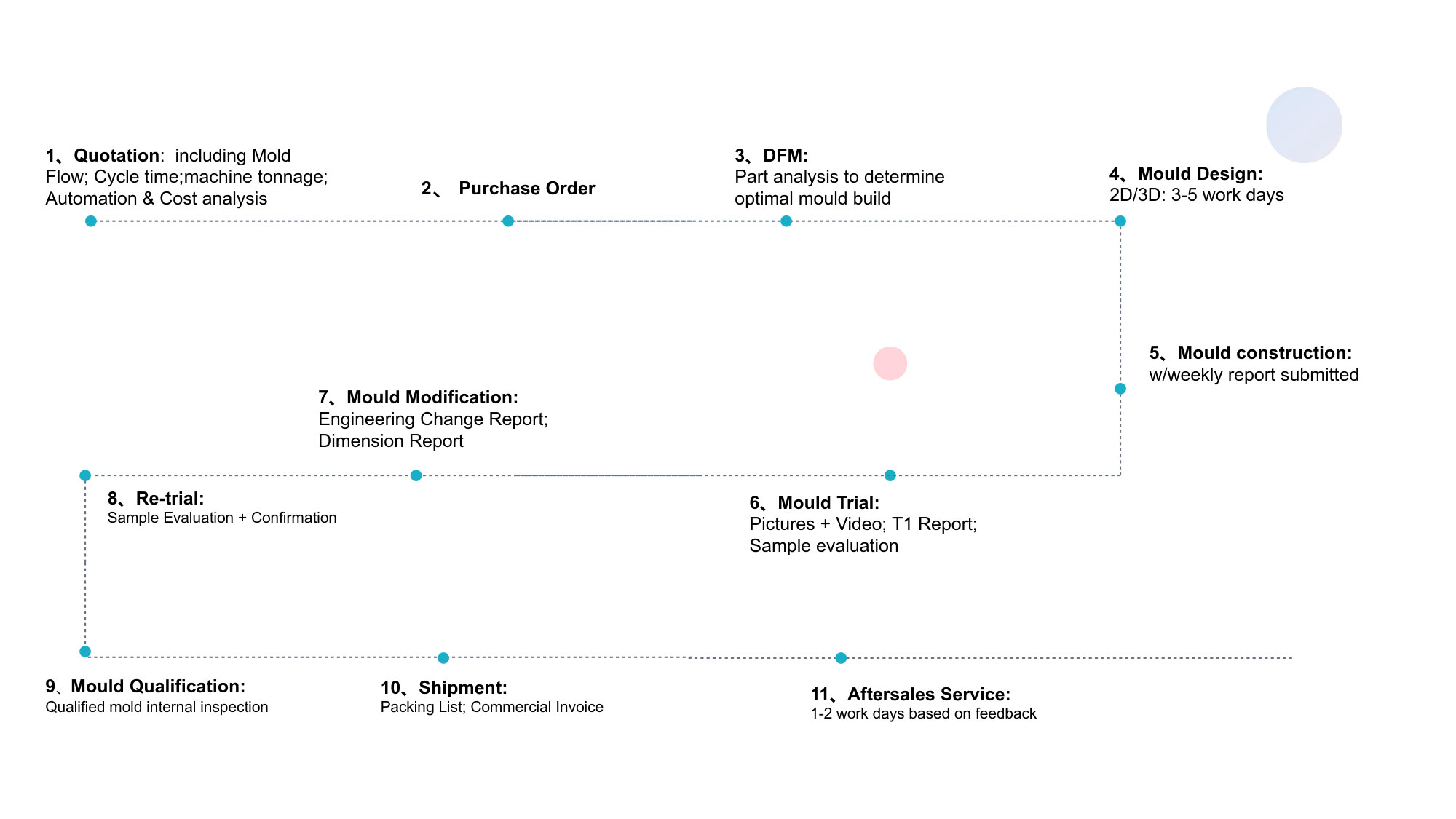
Before any steel is cut, Ansix delivers a comprehensive Design for Manufacturability (DFM) report. This report includes:
Draft angle recommendations
Wall thickness optimization
Gate location and type recommendations
Ejector pin mark location allowances
Identification of potential manufacturing challenges (undercuts, wall thickness variations, stress concentration areas)
Customer Value Translation: Up to 70% of a component's final manufacturing cost is determined during the initial design phase. By catching manufacturability issues before tooling begins, Ansix saves customers from the nightmare of discovering after mold cut that the part cannot be produced as designed. This early intervention typically saves 15-30% of total project cost.
Trial Shots and Sample Verification
Ansix provides T0 through T3 trial samples, each accompanied by improvement reports. The company can quickly exchange inserts to verify different design approaches without rebuilding the entire mold. This iterative approach ensures that by the time production begins, the mold is fully optimized.
Small-Batch Validation
Before full-scale production, Ansix offers 100-500 shot pilot runs to verify yield rates and CPK statistics, confirming stable production before mass production begins.
Maintenance and Spare Parts
Ansix delivers spare wear parts (ejector pins, core inserts) with every mold. The company provides mold maintenance every 200,000 cycles and offers lifetime repair service at cost.
Part Five: Differentiated Commitments — Addressing Common Industry Pain Points
Common Customer Complaint Ansix's Commitment (Delivered Value)
Molds frequently require repairs, disrupting orders "We perform 2,000-cycle aging tests before delivery and provide wear reports. We offer a three-year mold structural warranty (excluding normal wear on consumable parts)."
Excessive flash requires costly secondary finishing "We machine parting surfaces to 0.005mm fit precision and use self-locking clamp force compensation. Flash is controlled to within 0.03mm per batch, eliminating manual deburring."
Dimensions vary between batches "We install ultrasonic wall thickness sensors for real-time feedback and automatic compensation of holding pressure. We can also embed in-mold temperature and pressure sensors for closed-loop control."
Mold repair takes too long "We maintain in-house electrode machining centers and EDM workshops. Mold repairs typically stay within the facility; routine weld repair/insert replacement restores production within 24 hours."
Part Six: Material Selection Science for Float Switches and Sensors
The performance and service life of liquid level sensors fundamentally depend on their material composition. Ansix's deep expertise in polymer science guides a rigorous material selection process that balances demanding application requirements with cost-effectiveness.
Common Materials for Float Switch Components
Material Key Properties & Grades Typical Applications
Polypropylene (PP) Excellent chemical resistance, low density, good processability. Can be micro-foamed with physical/chemical blowing agents for precise buoyancy control Standard foam floats for water and mild chemical environments; PP micro-foam floats for higher buoyancy requirements
Polyvinylidene Fluoride (PVDF) Exceptional resistance to strong acids, bases, and solvents; continuous service up to 105°C; high purity, low moisture absorption Floats and switch housings for corrosive chemical environments (semiconductor, pharmaceutical)
Polyphenylene Sulfide (PPS) Excellent heat resistance (exceeding 200°C), good dimensional stability, chemical resistance High-temperature applications, automotive or industrial heating systems
Polycarbonate (PC) & Blends High impact strength, good dimensional stability, signal transparency for optical sensors. Special grades (e.g., Covestro's Makrolon Ai) prevent signal interference Complex sensor housings, LiDAR or optical liquid level detection systems
PEI/PPS/LCP High-temperature resistance, dimensional stability, chemical resistance High-performance sensor housings requiring extreme reliability
Value Engineering Approach
Ansix's expertise lies in value engineering—typically guiding customers toward the most cost-effective materials that meet all performance standards without over-engineering. This material optimization is the primary means of reducing product "hard costs" from the very beginning. When off-the-shelf materials don't meet requirements, Ansix engineers can adjust compound properties—optimizing glass fiber content in PEI materials to enhance thin-wall housing rigidity, or adding specific additives to improve fluid resistance.
Customer Value Translation: A customer might specify an expensive, high-performance material because they don't know what else will work. Ansix's material scientists evaluate the actual service conditions—temperature range, chemical exposure, mechanical loads, regulatory requirements—and identify whether a lower-cost material can perform equally well. This typically saves 10-30% on raw material costs without compromising performance.
Part Seven: Digital Engineering and Design Validation
Design for Manufacturability (DFM) Analysis
Ansix's journey to creating reliable liquid level sensors doesn't begin on the factory floor—it begins in the digital realm. Every project begins with a rigorous, collaborative DFM analysis. Engineers examine part geometry to identify potential manufacturing challenges such as difficult undercuts, excessive wall thickness variations, or stress concentration areas. This collaborative phase often results in design improvements that make parts easier, faster, and less expensive to produce without compromising functionality.
Advanced Mold Flow Analysis (MFA)
Advanced Mold Flow Analysis serves as a virtual trial run. Engineers load 3D models and specific material data (viscosity and PVT—Pressure-Volume-Temperature—relationships) into simulation software. This allows them to foresee issues long before steel is cut—weld line formation, air traps, or non-uniform cooling leading to warpage.
Digital Twin Technology: Ansix uses sophisticated software to create a digital twin of the entire injection molding process. This simulation predicts how molten plastic fills the cavity, enabling engineers to:
Identify and eliminate defects like weld lines, air traps, and sink marks before they occur in production
Optimize gate positions and runner systems to ensure balanced filling and minimize material waste
Simulate cooling performance to design optimal cooling channel layouts
Prototype Validation
Following digital validation, Ansix produces functional prototypes using rapid technologies for physical verification, de-risking the project before investing in costly production tooling.
Customer Value Translation: When a customer asks, "How do I know this design will work before we spend $50,000 on a mold?" Ansix's answer is: DFM analysis, Moldflow simulation, and functional prototypes. We identify problems in the virtual world where changes cost nothing, not in the physical world where changes cost everything.
Part Eight: Cost Reduction Through Systematic Optimization
Material Cost Optimization
Through value engineering, Ansix typically guides customers toward material selections that save 10-30% on raw material costs while meeting all performance requirements. This is achieved by matching material properties to actual service conditions rather than over-specifying.
Process Efficiency Optimization
In documented automotive sensor housing projects, Ansix reduced production cycle time by 28%, increasing daily output from 1,300 to 1,670 units on the same equipment. This efficiency gain directly reduces per-unit manufacturing costs.
Tooling Cost Reduction
By catching manufacturability issues during the DFM phase, Ansix prevents expensive mold modifications after steel is cut. The company's average of just two mold trials before production readiness significantly reduces development costs compared to industry norms.
Scale Economics
With 260 injection molding machines and the ability to run high-cavity molds (up to 96 cavities for some products), Ansix achieves economies of scale that smaller manufacturers cannot match. For Y-type tee fitting molds, Ansix has achieved 32.5-second cycle times with 48-cavity configurations—a level of efficiency that dramatically reduces per-part costs.
Waste Reduction
Hot runner systems eliminate runner waste. MES-controlled processes minimize scrap. Conformal cooling reduces cycle times. Every efficiency improvement directly reduces the customer's per-unit cost.
Part Nine: Quality Assurance and Delivery
Quality Certifications
Ansix holds ISO9001, ISO14001, IATF16949, and ISO13485 certifications, demonstrating commitment to quality management, environmental responsibility, automotive industry standards, and medical device manufacturing requirements.
Quality Verification Process
Incoming Material Inspection: All raw materials are verified against specifications
In-Process Inspection: Real-time monitoring through MES with automated parameter control
First-Article Inspection: Comprehensive dimensional verification at start of each production run
In-Process Sampling: Regular sampling throughout production runs
Final Inspection: Complete dimensional reporting with CPK ≥ 1.33 for critical dimensions
Packaging and Shipment: Protective packaging designed for the specific product to prevent damage during transit
Delivery Capabilities
With four production bases in China and Vietnam, Ansix offers manufacturing redundancy and geographic flexibility. The company's integrated supply chain—from mold manufacturing through injection molding to secondary operations and assembly—eliminates the delays caused by outsourcing.
Customer Value Translation: When a customer asks, "What happens if one factory has a problem?" Ansix's answer is: We have multiple production bases. Production can be shifted. Your supply chain is protected. And because we control everything in-house, we control the timeline.
Conclusion: Turning Technical Expertise into Customer Value
For Ansix Tech, a mold is not a piece of steel—it is a revenue generator. The company's 28 years of experience in designing, building, and validating injection molds transforms traditionally difficult geometries into production-ready assets that deliver consistent parts, predictable costs, and minimal downtime.
When a customer engages Ansix for a magnetic float switch, low water level alarm, high water level alarm, liquid level sensor, water tank sensor, or corrosion-resistant component project, they gain access to:
Low-Risk Product Development: DFM analysis catches design issues before tooling begins
Material Science Expertise: The right material for the application—not over-specified, not under-specified
Precision Manufacturing: 0.002mm machining precision, CPK ≥ 1.33 quality assurance
Process Control: MES-locked parameters, closed-loop cavity pressure control
Scale Economics: 260 machines, 4 factories, 30,000+ mold sets delivered
Cost Optimization: Material savings, cycle time reductions, waste elimination
On-Time Delivery: Integrated supply chain, multiple production bases, proven delivery record
Lifetime Support: Spare parts, maintenance schedules, repair services at cost
The company's systematic approach to liquid level sensor production demonstrates how advanced engineering can simultaneously achieve superior reliability and significant cost savings. For customers, this means fewer revisions, lower scrap, predictable lead times, and a mold that runs true for one million cycles—not just the first hundred thousand. This is how Ansix Tech turns manufacturing expertise into customer competitive advantage.
Ansix Tech Co Ltd
If you have any plans related to Magnetic float switch, low water level and high water level alarm, liquid level, water tank sensor, electronic intelligent, corrosion resistant , you can contact us at any time. We will turn your ideas into reality, let you realize your dreams, and obtain large orders from the market. Our contact information is info@ansixtech.com. Or contact our CTO, mail: stephen@ansixtech.com
#www.ansixtech.com #ansixtech.com #Magnetic float switch, low water level and high water level alarm, liquid level #Magnetic float switch, low water level and high water level alarm, liquid level #Magnetic float switch, low water level and high water level alarm, liquid level Canopy Mold injection mold companies #Ansix #Ansix moulds #Ansix china #Ansix tech china #Ansix tech company #Ansix facotry #Magnetic float switch, low water level and high water level alarm, liquid level injection molding #Magnetic float switch, low water level and high water level alarm, liquid level injection tools #Magnetic float switch, low water level and high water level alarm, liquid level injection moulds #Magnetic float switch, low water level and high water level alarm, liquid level plastic mould #Magnetic float switch, low water level and high water level alarm, liquid level plastic tools #Ansix Tech #Ansix molds #Ansix injection molding #Ansix mold factory #injection molding Magnetic float switch, low water level and high water level alarm, liquid level#Ansix mold factory #Magnetic float switch, low water level and high water level alarm, liquid level china #Magnetic float switch, low water level and high water level alarm, liquid level molds #injection factory #Magnetic float switch, low water level and high water level alarm, liquid level injection molding #Magnetic float switch, low water level and high water level alarm, liquid level injection molding factory #injection molding company #Magnetic float switch, low water level and high water level alarm, liquid level injection mold companies #Magnetic float switch, low water level and high water level alarm, liquid level Tooling #Magnetic float switch, low water level and high water level alarm, liquid level mold limited #Ansix mold china #Ansix companies #Ansix company China #Magnetic float switch, low water level and high water level alarm, liquid level facotry #Ansix Tech #Ansix Tech mould #Magnetic float switch, low water level and high water level alarm, liquid level injection moulding #injection moulding company #Ansix Magnetic float switch, low water level and high water level alarm, liquid level parts injection mold companies #medical injection molding companieschina #Magnetic float switch, low water level and high water level alarm, liquid level china factory #Ansix moulding companies #Ansix molding company #Magnetic float switch, low water level and high water level alarm, liquid level injection moulding facotry #Ansix Tech mold #Magnetic float switch, low water level and high water level alarm, liquid level mould #Magnetic float switch, low water level and high water level alarm, liquid level plastic injection molding #ansix plastic mold #Mold manufacturing #Magnetic float switch, low water level and high water level alarm, liquid level parts manufacturing #Magnetic float switch, low water level and high water level alarm, liquid level plastic parts factory #Magnetic float switch, low water level and high water level alarm, liquid level injection parts mold #Magnetic float switch, low water level and high water level alarm, liquid level PRECISION MANUFACTURING #Magnetic float switch, low water level and high water level alarm, liquid level #China mold #Magnetic float switch, low water level and high water level alarm, liquid level injection moulding china #Magnetic float switch, low water level and high water level alarm, liquid level mould china #china precision mold #mold in china #Magnetic float switch, low water level and high water level alarm, liquid level mold china #Precision molds #High-precision molds #Magnetic float switch, low water level and high water level alarm, liquid level #Injection molds #Magnetic float switch, low water level and high water level alarm, liquid level Factory #Magnetic float switch, low water level and high water level alarm, liquid level Company #Super Large Injection Mold Factory #Large Tonnage Injection Molding Factory #Magnetic float switch, low water level and high water level alarm, liquid level Company #Magnetic float switch, low water level and high water level alarm, liquid level Factory #2800T Injection Molding Factory #3000 Ton Injection Molding #4500 Ton Injection Molding Factory #Large Mold Injection Molding #Large Plastic Mold Injection Molding Factory #Large Injection Mold Manufacturer #Plastic Mold Factory #Injection Mold #Plastic Mold