



Injection molding of dental molds
FEATURES
Mass Production: A fleet of 260 injection molding machines with clamping forces from 30 to 2,800 tons, all equipped with full servo motor drive systems delivering repeatable precision of ±0.1%—ensuring the 10,000th part is identical to the first .
Quality Assurance: In-house coordinate measuring machines (CMMs) and optical imaging systems with sub-micron resolution; full dimensional reports for every mold before shipment; critical dimension Cpk ≥ 1.33 guaranteed.
Delivery & After-Sales: Spare wear parts (ejector pins, core inserts) delivered with the mold; maintenance service every 200,000 cycles; lifetime repair at cost price.
What Makes Ansix Industry-Leading:
260 injection molding machines with closed-loop control ensuring batch-to-batch consistency
ISO 8 high-cleanliness production environment for medical-grade molding
Full-service QMS aligned with ISO 13485:2016 and FDA 21 CFR Part 820 requirements
Strategy of translating technical capabilities into customer value rather than simply selling tooling
-
Mold Description
Product Materials:
PMMA
Mold Material:
S136ESR
Number of Cavities:
2
Glue Feeding Method:
Hot runner
Cooling Method:
Water cooling
Molding Cycle
42.5s
- The mold manufacturing process and product material selection
Cost Savings: Eliminates manual flash removal through precision-matched parting lines; family molds reduce tooling investment; cycle time optimization lowers per-part cost.
Risk Reduction: Pre-delivery 2000-shot mold wear test with detailed wear report; three-year structural warranty on mold frames; 24-hour in-house repair service.
Increased Efficiency: Servo-driven machines reduce energy consumption by 40–80% while improving repeatability.
Faster Time-to-Market: Simple molds in 10 days; expedited service compresses medium-complexity molds to 20 days without compromising validation protocols.
PART TWO: Product Introduction, Production Process, Delivery Efficiency, Quality Assurance, and Competitive Advantages
Product Introduction: Injection Molding of Dental Molds
-
Injection molding for dental applications demands micron‑level precision, zero defects, and full regulatory compliance . Ansix Tech manufactures dental molds for products including:
Dental consumables: saliva ejectors, suction tips, disposable dental mirrors, impression trays
Dental instrument handles: precision‑molded grips for scalers, explorers, mirrors
Orthodontic components: aligner trays, bracket positioning tools
Dental prosthetic components: temporary crown forms, denture base templates
Dental device housings: for intraoral scanners, curing lights, handpieces
Dental parts manufactured from medical-grade thermoplastics including PC, ABS, PC/ABS, PEEK, PEI (Ultem), PPSU, LCP, PA6+GF30, and liquid silicone rubber (LSR) for biocompatible applications.
Production Process
Stage 1: Mold Design and Mold Flow Analysis
Comprehensive DFM reports include weld‑line and gas trap prediction through mold flow analysis, gate number and position optimization for balanced cavity filling, shrinkage compensation based on material‑specific data, and cooling system design for uniform temperature distribution—reducing warp‑age and residual stress.
Stage 2: Precision Mold Manufacturing
Five‑axis high‑speed machining centers achieving 0.002 mm accuracy for complex curved surfaces and critical parting lines ; slow‑speed wire EDM capable of producing 0.03 mm micro‑holes and narrow slots without thin‑wall deformation .
Stage 3: Injection Molding
260 all‑servo electric injection molding machines with clamping forces from 30 to 2,800 tons, stable repeatable process accuracy of ±0.1%, closed‑loop monitoring of melt temperature, injection pressure, and holding pressure, and real‑time adjustment through MES‑integrated process controls.
Stage 4: Quality Inspection
CMM dimensional inspection with sub‑micron resolution; optical imaging systems for surface finish verification; process capability analysis with Cpk ≥ 1.33 on all CTQ dimensions; full dimensional report for every mold before shipment.
Delivery Efficiency
Simple molds (1–4 cavities, standard materials): 10 days. Medium‑complexity molds (multi‑cavity, hot runner systems): 25–45 days. Expedited service: medium‑complexity molds delivered in 20 days. 260 machines ensure ample production capacity for high‑volume orders. In‑house EDM and electrode manufacturing eliminate external dependencies—mold repairs typically restored within 24 hours.
Quality Assurance
ISO 13485:2016 certified QMS governing document control, supplier quality, traceability, change control, and CAPA . Pre‑delivery 2000‑shot mold wear test with detailed wear report. Three‑year structural warranty on mold frame. Cpk ≥ 1.33 on all CTQ dimensions. MES system locks and records all molding parameters (temperature, pressure, speed, time) for full traceability.
Competitive Advantages
Cost Control: Flash controlled within 0.03 mm eliminates secondary trimming; family molds produce multiple components in one cycle reducing per‑part tooling cost by 40–60%; energy‑efficient servo drives lower utility costs; in‑house mold repair eliminates outsourcing expenses.
After-Sales Service: Spare wear parts (ejector pins, core inserts) delivered with the mold; scheduled maintenance visits; lifetime repair at cost price; engineering support available 24/7 for urgent technical issues.
PART THREE: Core Customer Value — Mold Manufacturing, Material Selection, Smart Manufacturing, and Process Quality
Mold Manufacturing and Precision Machining
Five‑axis high‑speed machining centers achieving 0.002 mm precision deliver seamless parting lines—eliminating flash and manual deburring. Slow‑speed wire EDM capability for 0.03 mm micro‑holes ensures precise fine feature machining without deformation. In‑house EDM and electrode manufacturing enable repairs within 24 hours without outsourcing delays. Self‑locking mold clamp force compensation holds flash within 0.03 mm.
Mold Tool Steel Selection:
Mold base: P20 (standard) or 718H (high‑wear)
Cavities/cores: S136/S136H (stainless, corrosion‑resistant), H13 (high‑temperature), 2344/2343, 8407, SKD11/SKD61, DC53
High‑polish applications: NAK80 (mirror finish)
Medical grade: M340, 4Cr13, 9Cr18
Mold Life Warranty: 500,000 cycles for glass‑fiber reinforced materials; 1,000,000 cycles for standard thermoplastics. Full mold steel material certificates and heat‑treatment curves provided.
Material Selection and Characteristics
Medical-Grade Thermoplastics:
PC, ABS, PC/ABS (general dental housings)
PEEK, PEI (Ultem), PPSU (high‑temperature sterilization)
PPS with 40% GF (high‑stiffness components)
LCP (thin‑wall, high‑flow applications)
PA6 with 30% GF (structural dental parts)
PBT, PTFE, PFA, PVDF (chemical‑resistant applications)
Liquid Silicone Rubber (LSR) (soft‑touch, biocompatible components)
Polyolefins: PP, PE (disposable dental consumables)
Key Material Properties: UL94 V‑0 flame rating for electrical housings; UV stability (3,000+ hours exposure without discoloration); ISO 10993‑1 biocompatibility certification; USP Class VI compliance for patient‑contacting devices.
Thermal property validation: materials withstand intended sterilization methods including autoclave (121–134°C), EtO, and gamma irradiation. Compatibility validation documentation provided for each sterilization method.
Smart Manufacturing and Efficiency
260 all‑servo electric injection molding machines with real‑time MES process monitoring. Closed‑loop injection systems maintain melt temperature within ±2°C, back pressure with ±2% stability, and shot weight consistency at ±0.1%. Ultrasonic wall‑thickness sensors provide real‑time feedback for pressure compensation. In‑mold temperature and pressure sensors enable closed‑loop process control.
Efficiency improvements include family molds (multiple components in one cycle reduces per‑assembly cycle time), hot runner systems (eliminates cold runner waste, reduces cycle time by 15–30%), and conformal cooling channels (3D‑printed cooling curves reduce cooling time by 20–40%).
Process Quality Assurance
Every machine connected to MES system with all parameters locked and recorded, accessible only by authorized engineers. First‑article and last‑article part inspection for each batch ensures consistency. Automatic optical inspection (AOI) for 100% visual defect detection. Process validation follows IQ (Installation Qualification), OQ (Operational Qualification), and PQ (Performance Qualification) protocols.
Critical Quality Metrics: Parting line flash ≤ 0.03 mm; Cpk ≥ 1.33 on all CTQ dimensions; Aesthetic surface finish Ra ≤ 0.2 μm for high‑gloss components; ±0.005 mm for precision gears/medical micro‑features ±0.05 mm for standard structural components; warp‑age minimized to ≤ 0.05 mm across 50 mm span (material‑dependent).
PART FOUR: Dental Injection Molding Manufacturing Solutions — Comprehensive 2000+ Word Analysis
The following provides a comprehensive end-to-end manufacturing solution framework for dental injection molding projects, with every technical capability translated directly into customer value.
Section One: Hard Capability Foundation
1.1 Mold Machining Equipment
Five‑Axis High‑Speed Machining Centers — 0.002 mm machining accuracy. For dental consumables, this translates to seamless parting lines = no flash on finished parts = elimination of manual flash removal as a hidden cost .
Slow‑Speed Wire EDM — 0.03 mm micro‑holes and narrow slots. Traditional machining of 0.5 mm suction tips risks wall deflection and inconsistent holes. EDM maintains precision across every cavity even after millions of cycles .
Precision Surface Grinding — Mold plates ground to sub‑micron flatness ensures mold closure uniformity—directly preventing short shots or flash on thin‑wall dental components.
EDM (Electrical Discharge Machining) — In‑house EDM department allows 24‑hour repair turnaround without outsourcing delays.
1.2 Injection Molding Machine Fleet
260 injection molding machines with clamping forces 30 to 2,800 tons. Every machine equipped with full servo motor drive systems delivering repeatable process accuracy of ±0.1% .
Tonnage Range Breakdown: 30–90 tons for single‑cavity molds and prototype runs; 90–160 tons for small dental consumables (saliva ejectors, suction tips, mirror handles); 160–280 tons for multi‑cavity high‑volume dental disposables; 280–500 tons for larger dental instrument housings; 500–2,800 tons for oversized components (dental chair parts, large device enclosures).
Customer Value: Servo drive technology ensures batch‑to‑batch consistency. When a dental OEM validates a part design, the 10,000th part is identical to the first .
1.3 Inspection and Metrology Equipment
Coordinate Measuring Machines (CMMs) — Sub‑micron resolution; full dimensional report generated before mold shipment with critical dimension CPK ≥ 1.33 baseline.
Optical Imaging Systems — Surface finish verification for aesthetic dental components; automated defect detection.
Key Quality Commitment: Gage R&R ≤ 10% ensures measurement system capable of verifying tight tolerances.
Section Two: Core Mold Manufacturing Competitiveness
Dimension Technical Statement
Mold Life Mold base P20, cores/cavities S136, 2344, H13, SKD61, NAK80, M340. 500,000 cycles for GF‑reinforced materials; 1,000,000 cycles for standard resins. Material certificates and heat‑treatment curves provided.
Achievable Tolerances Standard structure ±0.05 mm; precision gears/medical features ±0.005 mm.
Mold Types Hot runner (waste reduction), family molds (200% cycle efficiency), overmolding, high‑gloss (Ra < 0.05 μm for transparent parts), multi‑material (2K/3K injection).
Gate & Runner Design Mold flow analysis predicts weld‑lines and gas trap locations. Balanced filling across all cavities; advanced simulation for micro‑features (dental clips, small hinges).
Lead Time Simple molds 10 days; medium‑complexity molds 25–45 days; expedited 20 days for medium‑complexity; trials and documentation uncompromised.
Section Three: Injection Molding Process Control
3.1 Process Standardization
All molding machines connected to MES — parameters locked → engineer access only. Each batch completes first‑article and last‑article inspection.
3.2 Dimensional Stability Control
Mold temperature zones controlled within ±2°C between core and cavity → warp‑age minimized. Three consecutive batches show ≤ 0.02 mm variation on critical hole spacing.
3.3 Aesthetic Quality Levels
Class A — no visual defects (medical device housings); Class B — minor but acceptable cosmetic variation (internal components); transparent parts — bubble‑free, flow‑mark‑free; high‑gloss medical components — Ra ≤ 0.2 μm.
3.4 Special Material Capabilities
Material Category Example Grades Dental Applications
Standard Medical PC, ABS, PC/ABS Instrument housings, handles
High‑Temperature Medical PEEK, PEI (Ultem), PPSU Sterilizable components
Glass‑Fiber Reinforced PPS+40%GF, PA6+GF30 High‑stiffness parts
High‑Flow/Low‑Viscosity LCP, PPS Thin‑wall consumables, micro‑features
Chemical Resistant PTFE, PFA, PVDF Fluid‑handling components
Elastomer LSR Soft‑touch overmolding, seals
Safety Certifications: UL94 V‑0; ISO 10993‑1 biocompatibility (cytotoxicity, sensitization, systemic toxicity); USP Class VI.
3.5 Rejection Prevention
Flash ≤ 0.03 mm → eliminates deburring. Three validation batches prove Cpk ≥ 1.33 before production release. MES‑controlled parameters ensure no unapproved changes.
Section Four: Full‑Service Value Chain
4.1 Early DFM Engagement (Pre‑contract Deliverable)
Before contract signing, Ansix provides mold feasibility analysis including draft angle suggestions for smooth ejection, wall thickness recommendations for warp‑age prevention, gate locations and ejector pin mark zones, material shrinkage compensation, and weld‑line/gas trap identification through mold flow analysis—preventing post‑mold structural failures.
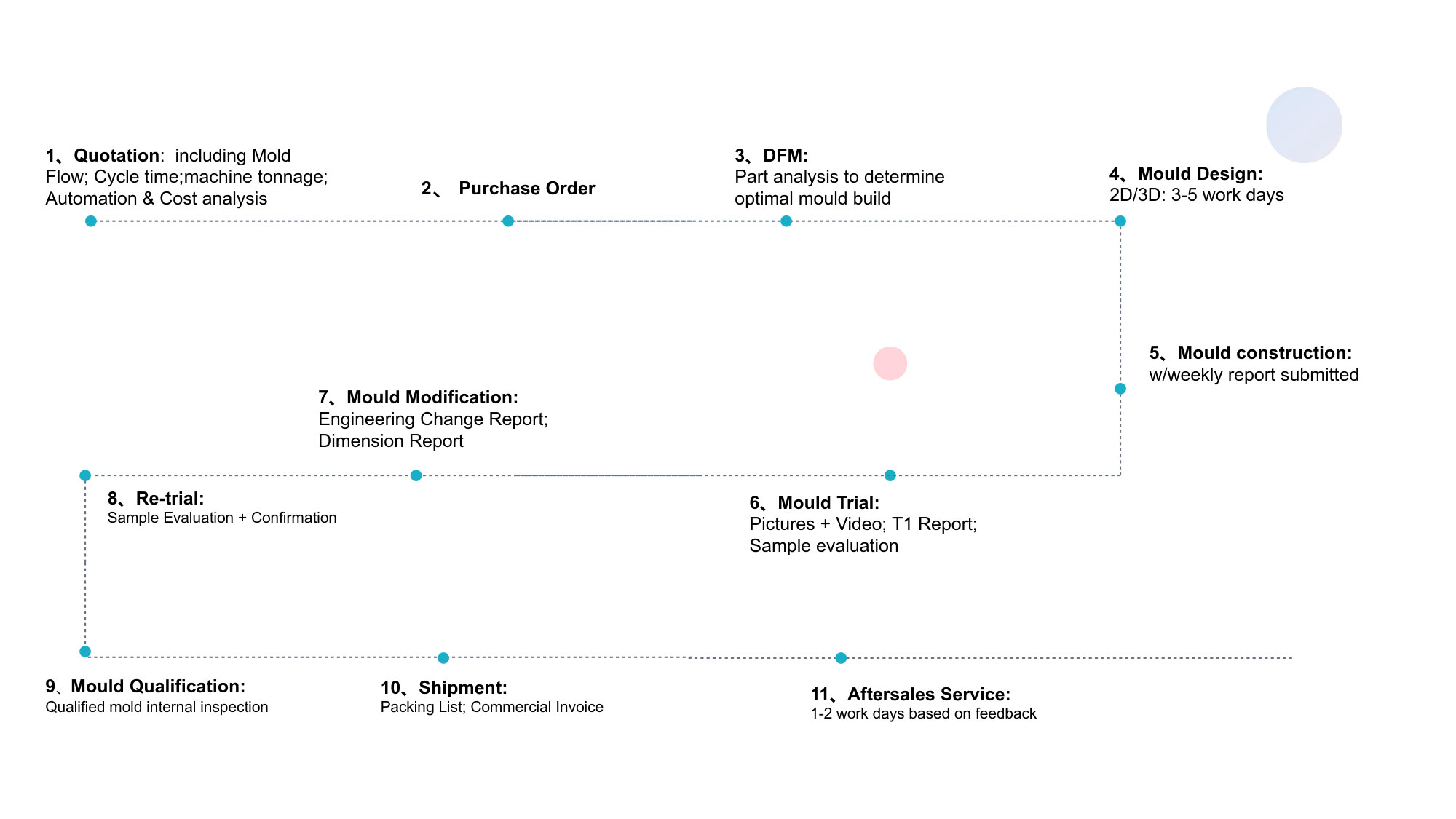
4.2 Trial Molding (T0–T3)
T0 (first shot) results and dimensional report; T1 modifications and re‑validation; T2 fine‑tuning of surface finish and cycle time; T3 customer sign‑off. Interchangeable inserts allow multiple design variations from single mold base.
4.3 Pilot Production (Pre‑Mass Validation)
100–500 shot pilot run; yield rate and CPK validation; final process parameter lock with customer approval.
4.4 Mass Production
Continuous SPC monitoring (X‑bar and R charts); automated optical inspection for 100% visual defect detection; batch sample retention for traceability; packaging and labeling per customer specifications.
4.5 Delivery
24–48 hour international express delivery; bulk orders via air or sea freight with commercial invoice and packing list; FDA Prior Notice for US‑bound shipments.
4.6 After‑Sales Service
Spare wear parts (ejector pins, core inserts) delivered with mold; scheduled maintenance visits; lifetime repair at cost.
Section Five: Competitive Differentiators
Customer Concern Ansix Response
Frequent mold repairs disrupt orders Pre‑delivery 2000‑shot wear test with detailed report; three‑year structural warranty (excluding consumable wear parts).
Flash requires costly trimming 0.005 mm parting line matching tolerance; self‑locking mold clamp compensation → flash ≤ 0.03 mm; no manual deburring needed.
Inconsistent part dimensions Real‑time ultrasonic wall thickness monitoring; optional in‑mold sensors for closed‑loop control.
Long mold repair lead time In‑house EDM and electrode departments; 24‑hour repair restoration.
Parting Message (in Ansix philosophy): A mold is not just a block of steel—it is a revenue‑generating asset. Design integrates flow balance, venting paths, and temperature equilibrium to ensure plug‑and‑play performance on the production line—low flash, high lifespan, zero debugging.
PART FIVE: Customer Value — Problem-Solving, Validation, Cost Reduction, Capacity, and Delivery
Customer Value Delivered by Ansix Tech
Problems Solved and Value Provided
Problem 1: Poor mold design causes production delays.
Solution: Early DFM (design for manufacturability) analysis before contract; draft angle optimization ensures clean ejection; wall thickness design prevents warp‑age; gate location planning eliminates weld‑line and gas trap defects; ejector pin placement marks minimized.
Customer Value: Eliminates post‑mold rework; reduces time‑to‑market by 3–6 weeks; prevents mold modification costs.
Problem 2: Quality validation is time‑consuming and uncertain.
Solution: Structured 3‑stage FDA‑aligned validation (IQ, OQ, PQ); CPK ≥ 1.33 on all CTQ dimensions; master validation plan for regulatory documentation; real‑time SPC (X‑bar and R charts); full dimensional report with each batch.
Customer Value: Reduces FDA and ISO audit risk; ensures regulatory compliance; accelerates regulatory submission by providing pre‑validated documentation.
Problem 3: Mold failures increase production cost.
Solution: Pre‑delivery 2000‑shot wear test; in‑house repair within 24 hours; spare wear parts included; three‑year structural warranty.
Customer Value: Avoids unplanned downtime (3–10 days per failure); extends mold life by 200% with proper maintenance; reduces annual mold maintenance budget.
Problem 4: Capacity planning fails during demand surges.
Solution: 260 machines with 30–2,800 ton range; 24/7 production capability; 4 production bases; 200+ engineers; rapid supplier onboarding.
Customer Value: Handles 500% volume spikes within 2 weeks; no secondary supplier needed; reduces dual‑sourcing management overhead.
Problem 5: Inconsistent part dimensions cause assembly failure.
Solution: Servo‑driven ±0.1% repeatable precision; MES‑locked parameters; conformal cooling minimizes warp‑age; ultrasonic wall thickness monitoring; CPK ≥ 1.33 guaranteed.
Customer Value: Eliminates assembly line adjustments; reduces scrap rate from 5% to <0.5%; prevents field failures due to dimensional drift.
How Ansix Reduces Costs
Cost Area Cost Reduction Approach
Tooling Investment Family molds produce multiple components in one cycle → 40–60% lower tooling cost per component
Energy Cost All‑servo electric drives → 40–80% lower energy vs hydraulic machines
Secondary Operations Flash ≤ 0.03 mm → eliminates deburring/tumbling; consistent molding → eliminates part sorting
Material Waste Hot runner systems → reduces cold runner waste by 30–50%; precision shot control → reduces material overuse
Downtime Cost 24‑hour in‑house repair → 3‑10 days saved per repair; spare wear parts included → eliminates rush shipping
Shipping Cost Multiple production bases in Asia → lower shipping from nearest facility; Vietnam base for EU/US tariff reduction
Material and Process Optimization Cost Savings: Shrinkage compensation reduces material overfill by 5–10%; optimized cooling reduces cycle time by 20–30% increasing throughput; low‑pressure molding reduces clamp tonnage requirements; proactive mold flow analysis prevents 3–5 design revisions per project.
How Ansix Ensures Quality Validation
Process Validation (IQ/OQ/PQ) : IQ verifies correct installation, calibration, environmental conditions, and material handling systems. OQ defines operational limits for melt temperature, mold temperature, injection pressure, and cycle time. PQ confirms consistent output across multiple runs with CPK ≥ 1.33 per cavity .
Material Validation: ISO 10993‑1 biocompatibility certificate; USP Class VI certified; raw material certificates and lot traceability.
In-Process Quality: Automated optical inspection for 100% defect detection; CPK monitoring on CTQ dimensions; MES‑locked parameters; documented change control.
How Ansix Improves Capacity and Delivery
Capacity Scalability: 260 machines from 30–2,800 tons → 0.1 million to 50+ million parts annually. 24/7 production → 2–3× capacity expansion without additional capital investment. Vietnam base provides 15% additional capacity for regional distribution. Supplier‑managed inventory (SMI) for 30–90 day demand buffers.
Delivery Assurance: In‑house EDM and electrode manufacturing → 24‑hour repair without outsourcing. Raw material strategic inventory → 2‑week supply buffer for critical medical resins. Weekly production status reports with real‑time tracking. Standard delivery 2–4 weeks (depending on volume); expedite available for urgent orders.
Summary: What Ansix Tech Provides
Reliability: 28+ years in precision medical injection molding
Documentation: ISO 13485, FDA 21 CFR 820‑ready QMS; complete validation master plan (VMP)
Risk Management: ISO 14971 risk management; FMEA throughout design; proactive mitigation of failure modes
Cost Advantage: Lower tooling investment, reduced per‑part cost, energy efficient
Speed: Rapid mold delivery; 24‑hour repair; responsive engineering support
Peace of Mind: Three‑year structural warranty; spare parts included; full regulatory compliance
For any dental injection molding project, contact Ansix Tech to receive a full DFM report — walking through weld‑line prevention, gas trap elimination, and shrink‑age compensation — before committing to tooling investment.
Ansix Tech Co Ltd
If you have any plans related to Injection molding of dental molds , you can contact us at any time. We will turn your ideas into reality, let you realize your dreams, and obtain large orders from the market. Our contact information is info@ansixtech.com. Or contact our CTO, mail: stephen@ansixtech.com
#www.ansixtech.com #ansixtech.com #Injection molding of dental molds #Injection molding of dental molds injection molding companies #Injection molding of dental molds Canopy Mold injection mold companies #Ansix #Ansix moulds #Ansix china #Ansix tech china #Ansix tech company #Ansix facotry #Injection molding of dental molds injection molding #Injection molding of dental molds injection tools #Injection molding of dental molds injection moulds #Injection molding of dental molds plastic mould #Injection molding of dental molds plastic tools #Ansix Tech #Ansix molds #Ansix injection molding #Ansix mold factory #injection molding Injection molding of dental molds#Ansix mold factory #Injection molding of dental molds china #Injection molding of dental molds molds #injection factory #Injection molding of dental molds injection molding #Injection molding of dental molds injection molding factory #injection molding company #Injection molding of dental molds injection mold companies #Injection molding of dental molds Tooling #Injection molding of dental molds mold limited #Ansix mold china #Ansix companies #Ansix company China #Injection molding of dental molds facotry #Ansix Tech #Ansix Tech mould #Injection molding of dental molds injection moulding #injection moulding company #Ansix Injection molding of dental molds parts injection mold companies #medical injection molding companieschina #Injection molding of dental molds china factory #Ansix moulding companies #Ansix molding company #Injection molding of dental molds injection moulding facotry #Ansix Tech mold #Injection molding of dental molds mould #Injection molding of dental molds plastic injection molding #ansix plastic mold #Mold manufacturing #Injection molding of dental molds parts manufacturing #Injection molding of dental molds plastic parts factory #Injection molding of dental molds injection parts mold #Injection molding of dental molds PRECISION MANUFACTURING #Injection molding of dental molds #China mold #Injection molding of dental molds injection moulding china #Injection molding of dental molds mould china #china precision mold #mold in china #Injection molding of dental molds mold china #Precision molds #High-precision molds #Injection molding of dental molds #Injection molds #Injection molding of dental molds Factory #Injection molding of dental molds Company #Super Large Injection Mold Factory #Large Tonnage Injection Molding Factory #Injection molding of dental molds Company #Injection molding of dental molds Factory #2800T Injection Molding Factory #3000 Ton Injection Molding #4500 Ton Injection Molding Factory #Large Mold Injection Molding #Large Plastic Mold Injection Molding Factory #Large Injection Mold Manufacturer #Plastic Mold Factory #Injection Mold #Plastic Mold