



Syringe Needle Cap
FEATURES
Foundation of Hard Power — Building Customer Confidence Through Equipment Excellence
Before discussing process capabilities, Ansix Tech establishes credibility through world-class precision manufacturing infrastructure that directly translates into tangible customer benefits.
1.1 Mold Machining Equipment — Converting Precision Into Product Quality
Five-Axis High-Speed Machining Centers
Ansix Tech operates advanced five-axis CNC machining centers (e.g., Makino F5) capable of achieving machining accuracy of 0.002mm and angular tolerances of 0.002°. For medical syringe needle cap applications, this capability delivers:
Seamless mating of hard-soft interfaces in tamper-evident Luer lock designs without gaps or misalignment
Zero-burr part-line surfaces that eliminate secondary finishing operations, saving $0.02–0.05 per cap
Perfect sealing surfaces that prevent fluid leakage—measured and validated to medical standards
Consistency across multi-cavity molds —each cavity produces identical quality parts with no cavity-to-cavity variation
Slow-Feed Wire EDM for Micro-Features
For syringe needle caps requiring ultra-fine features—including anti-tamper tabs as thin as 0.10mm, undercuts, and precision threads—Ansix Tech utilizes AgieCharmilles wire EDM technology with cutting accuracy of ±2μm (0.002mm) and surface finishes down to 0.07μm Ra. The value delivered:
Precise unscrewing mechanisms with defined torque values (±0.02 Nm) for consistent user experience
Optimized venting channels eliminating vacuum lock during injection, reducing scrap by up to 70%
Damage-free thin-wall cores that maintain structural integrity through millions of production cycles, preventing costly mold rework
-
Mold Description
Product Materials:
PP
Mold Material:
S136ESR
Number of Cavities:
64
Glue Feeding Method:
Hot runner
Cooling Method:
Water cooling
Molding Cycle
8.5s
- The mold manufacturing process and product material selection
Injection Molding Machine Fleet — Matching Machine Scale to Customer Volume Requirements
Ansix Tech operates 260 injection molding machines with clamping forces ranging from 30 tons for precision micro-components to 2,800 tons for large-format medical consumables. This diverse fleet ensures:
Customer Requirement Ansix Tech Solution Customer Value
High-volume syringe caps (millions/month) 30–200 ton all-electric machines with 16+ cavities Cycle time <6 seconds, throughput up to 600,000 caps/day
Large medical components 500–2,800 ton machines One-machine production capability reduces supply chain complexity
Prototype to high-volume scale-up Multi-tonnage platform compatibility Same process parameters from trial to mass production
All-Electric Servo Technology for Unmatched Consistency
Every machine features fully electric servo drives with repeatable precision of ±0.1% across all process parameters. The value proposition is straightforward:
Every batch mirrors the first — production runs from day 1 through day 365 maintain identical quality
No hydraulic oil contamination risk — ensures ISO Class 7/8 cleanroom compliance without special filtration
Energy savings of 40–70% reduces carbon footprint and operational costs passed to customers
-
Quality Inspection Equipment — Data-Driven Validation That Eliminates Risk
Before any syringe needle cap ships, Ansix Tech’s metrology laboratory validates every critical dimension:
Coordinate Measuring Machines (CMM)
Measures complex 3D geometries with ±0.001mm resolution
Full dimensional inspection reports for every mold before shipment
Optical Measurement Systems
100% inspection of critical features—thread form, cap outer diameter, sealing surface profile
Automatic pass/fail rejection removes human judgment errors
Statistical Process Control (SPC)
Key dimensions tracked with Process Capability Index (CPK) ≥1.33—a 99.993% compliance rate mandatory for medical-grade devices
For implantable or high-risk applications, CPK ≥1.67 provides an additional safety margin
Customer Value Summary:
0.002mm machining accuracy → perfectly fitting parts, zero assembly issues
±0.1% injection repeatability → no dimension drift, stable production for years
CPK ≥1.33 → <70 defective parts per million; peace of mind for regulatory audits
Section Two: Mold Manufacturing Excellence — Core Competencies That Reduce Total Cost of Ownership
The injection mold is the heart of any mass-production program. For syringe needle caps, the mold directly determines product quality, production efficiency, and long-term program economics. Ansix Tech has built over 30,000 sets of molds since its founding, accumulating a deep knowledge base that translates into measurable customer advantages.
2.1 Mold Life & Durability — Guaranteed Longevity With No Surprise Replacements
Mold Component Material Option Guaranteed Life (Fiber-Grade) Guaranteed Life (Standard)
Mold Base P20 / 718H 500,000 cycles 1,000,000+ cycles
Core/Cavity Inserts S136 / 2344 / 2343 / 8407 / SKD11 / DC53 / M340 / NAK80 / H13 500,000 cycles 1,000,000+ cycles
For TPE (thermoplastic elastomer) components in two-component syringe caps where lower molding temperatures apply, mold life extends even further.
The Customer Value Equation:
The cost of a replacement mold typically ranges from
15,000to50,000 for multi-cavity medical molds. Ansix Tech’s extended mold life eliminates this capital expense entirely over typical 5–10 year product lifecycles. For a 5-year program producing 20 million caps annually:
25,000(averagemoldcost)×2unplannedreplacements=50,000 SAVED
Furthermore, Ansix Tech provides full material certification reports including mill certificates and heat treatment curves—complete regulatory traceability for FDA and ISO 13485 audits.
2.2 Precision Tolerances — Medical-Grade Accuracy Without Exception
Component Type Standard Tolerance Precision Capability Value Delivered
General structural features ±0.05mm ±0.02mm Consistent fit with syringe barrel
Thread engagement surfaces ±0.02mm ±0.005mm Smooth unscrewing, no cross-threading
Sealing lip interfaces ±0.01mm ±0.005mm Leak-proof closure, patient safety
Tamper-evident tabs ±0.02mm ±0.01mm Consistent breakaway torque
Real-World Result: For a recent medical partner, Ansix Tech reduced dimensional variance across 16-cavity production from ±0.08mm to ±0.015mm, eliminating customer in-house sorting operations and saving
0.007perpart—140,000 annually on 20 million units.
2.3 Advanced Mold Types — Matching Complexity to Product Requirements
Multi-Cavity Molds (8, 16, 32, 48, 64 cavities)
For high-volume syringe needle caps, multi-cavity designs maximize throughput while maintaining per-cavity uniformity. The industry benchmark for insulin syringe caps is 16-cavity molds producing on a six-second cycle via fully electric machines. Ansix Tech scales this across diverse platforms:
Cavity Count Typical Application Cycle Time Daily Output (20-hour operation)
8 cavities Low-volume medical caps 12–15 sec 46,000–57,000 units
16 cavities Standard syringe caps 6–8 sec 144,000–192,000 units
32 cavities High-volume Luer caps 4–6 sec 384,000–576,000 units
48+ cavities Ultra-high-volume consumables 3–4 sec 864,000–1,152,000 units
Value: Multi-cavity tooling reduces per-part machine time cost by 75–90% compared to single-cavity molding.
Two-Component (2K / Bi-Injection) Molds
The tamper-evident Luer lock closure (TELC) design exemplifies medical packaging innovation—a hard polycarbonate (PC) Luer adapter molded with a soft thermoplastic elastomer (TPE) unscrewing cap in a single automated cycle. Ansix Tech’s 2K mold expertise delivers:
Permanent chemical bonding between hard and soft materials—no secondary assembly required
Rotary plate or index-plate designs for precise material separation
Multi-zone temperature control accommodating PC molding at 100°C and TPE molding at 40°C within the same cycle
Tamper-evident indicators molded-in rather than added post-process
Cost Impact: Eliminates a separate assembly step, saving 0.015–0.03perunit.Fora30−million−unitannualprogram,that’s450,000–900,000 in direct savings.
High-Gloss / Optical Surface Molds (Ra ≤0.05μm)
For transparent syringe caps or medical components requiring visual inspection of fluid paths, Ansix Tech achieves mirror finishes below 0.05μm Ra through electro-polishing and magnetorheological finishing (MRF) technology.
Quality Value: Optical clarity enables in-line visual inspection without destructive testing. For blood collection or IV components, visual verification of fluid path integrity replaces expensive X-ray inspection, saving $0.04–0.08 per part.
Hot Runner Systems — Eliminating Scrap at the Source
For syringe needle cap molds, cold runner systems waste 15–40% of costly medical-grade resin. Ansix Tech hot runner systems virtually eliminate this waste:
Valve-gate hot runners for precise gate vestige control—no post-molding gate trimming
Self-developed cam-operated needle-valve systems for complex medical geometries
Dead-end-free runner geometries preventing material stagnation and degradation—critical for ISO 13485 compliance
Material Savings: Medical-grade polypropylene (e.g., Purell grades) costs $2.50–4.00/kg. For a 10-million-unit annual program with 8g parts:
Cold runner: 15% waste × 80,000 kg × 3.20=38,400 wasted annually
Hot runner: <2% waste = 3,300wasted→∗∗35,100 saved annually**
2.4 Optimized Gating & Runner Systems — Preventing Defects Before Production
Using Autodesk Moldflow simulation software, Ansix Tech engineers analyze melt front advancement, air trap locations, weld line formation, and cooling patterns before a single gram of steel is cut. The process identifies:
How Ansix Tech Eliminates Common Defects:
Defect Root Cause Ansix Tech Solution Customer Value
Weld lines (structural weakness) Two flow fronts meeting Optimized gate count/position to direct weld lines to non-critical zones Stronger part integrity, passes drop-test requirements
Air traps / burn marks Air unable to escape cavity Strategically positioned venting channels (0.01–0.03mm depth) Clean visual appearance, no black spots
Short shots / incomplete fill Insufficient flow at extremities Balanced runner system design Zero scrap from incomplete parts
Sink marks Thick section shrinkage Conformal cooling integrated into thick zones Smooth surface suitable for printing/labeling
Warpage / distortion Uneven cooling rates Mold temperature differential <2°C between core and cavity Flat sealing surfaces, no leakage
Outcome: First-pass yield (FPY) exceeding 98% from T0 sample runs—fewer costly iterations and faster time-to-market.
2.5 Mold Delivery Standards — Predictable Lead Times With No Hidden Extensions
Mold Complexity Standard Lead Time Accelerated Option Quality Assurance Measures
Simple cap mold 10–15 days 7–10 days (expedited machining) Full mold trial (T0), dimensional report
Medium complexity 25–35 days 18–22 days (priority CNC/EDM allocation) T0 + T1 trials, CPK verification
High complexity (multi-cavity, 2K) 35–45 days 25–30 days T0, T1, T2 trials, 1,000-shot test run
Every mold, regardless of delivery timeframe, includes:
T0 trial — First shot verification with full sample submission
Dimensional inspection report — All critical features measured and certified
Material certification — Steel mill certificates and heat treatment traceability
Mold operation manual — Maintenance schedules, spare parts list, and troubleshooting guide
Bottom Line: No “surprise” rework cycles, no missing documentation, no production delays.
Section Three: Injection Molding Process Control — Eliminating Customer Quality Anxiety
Medical OEMs fear five things above all: warpage, flash, dimensional instability, cosmetic defects, and batch-to-batch variation. Ansix Tech has systematically engineered controls to eliminate each of these risks.
3.1 Process Standardization & MES Integration — Perfect Traceability From First Shot to Last
Every injection molding machine at Ansix Tech is connected to a centralized Manufacturing Execution System (MES) that locks all critical process parameters:
Parameter Locked Condition Access Control
Melt temperature (±2°C) Locked Engineer authorization only
Injection pressure (±5 bar) Locked Engineer authorization only
Injection velocity (±5 mm/s) Locked Engineer authorization only
Holding pressure (±3 bar) Locked Engineer authorization only
Cooling time (±0.2 sec) Locked Engineer authorization only
Mold temperature (±1°C) Locked Engineer authorization only
The Traceability Chain:
text
Raw Material Lot → MES-Controlled Drying → MES-Locked Process Parameters → Automated Take-Out → Cavity-Specific QC → Labeling/Packaging → Customer Delivery
Value: When regulatory auditors arrive, Ansix Tech produces complete production records for any batch shipped—within 15 minutes.
3.2 First & Last Article Validation — Closing Every Loop
Before each production run begins, operators verify three parts from the first shots against gold standard samples. After production ends, the last three parts undergo identical verification. Discrepancies require immediate root cause analysis and corrective action.
3.3 Dimensional Stability Controls — 0.02mm Week-to-Week Reproducibility
For critical syringe needle cap components, dimensional stability across extended production runs is non-negotiable.
Ansix Tech’s Four-Layer Control System:
Control Layer Technology Stability Guarantee
Mold temperature Zone-specific mold heaters (core/cavity), differential ≤2°C Predictable cooling, minimal shrinkage variation
Process feedback Closed-loop controller adjusting injection/holding in real time Compensation for material viscosity drift
Wall thickness monitoring Ultrasonic in-mold sensors feeding back to injection pressure Self-adjusting pack/hold compensation
Cavity pressure sensing Piezoelectric sensors in each cavity Individual cavity performance monitoring
Measured Result: Over 7 consecutive production days across three shifts, critical mating diameters on a 16-cavity syringe cap mold maintained fluctuation ≤0.02mm across all cavities—representing CPK >1.67.
3.4 Surface Quality Standards — Medical-Grade Aesthetics Without Secondary Operations
Quality Grade Ra Value Application Capability
Standard medical ≤0.8μm Internal functional surfaces Standard
High-gloss transparent ≤0.2μm Visual inspection windows Achievable
Optical-grade mirror ≤0.05μm Light-path components Achievable
Statement of Capability: *“At a specified cost basis, we deliver Ra 0.8μm surface finish as standard on all visible cap surfaces. Transparent caps achieve bubble-free, flow-mark-free clarity suitable for visual fluid path inspection. For caps requiring laser marking, pad printing, or labeling, we pre-compensate part geometry to ensure print registration accuracy of ±0.1mm regardless of post-molding shrinkage.”*
3.5 Advanced Material Capabilities — One-Stop Solution for Diverse Medical Requirements
Ansix Tech has extensive injection molding experience across the full spectrum of medical-grade thermoplastics:
Material Class Specific Grades Application in Needle Caps
Polypropylene (PP) Purell HP548N, RP271G, LyondellBasell medical grades Standard syringe caps, gamma/EO sterilization compatible
Polyethylene (PE) LDPE, HDPE medical grades Flexible cap inserts, chemical resistance
Polycarbonate (PC) Makrolon medical grades Transparent Luer adapters, high-temperature autoclavable components
Thermoplastic Elastomers TPE medical grades (Santoprene, Versaflex) Soft-touch unscrewing caps, tamper-evident seals
High-performance engineering resins PEEK, PEI (ULTEM), PPS, LCP, PA6+GF30, PBT Specialized caps requiring extreme temperature resistance or mechanical strength
Liquid Silicone Rubber (LSR) Medical-grade LSR Overmolded sealing elements for pre-filled syringe systems
Material certification traceability: Every resin shipment is accompanied by its Certificate of Analysis (CoA) documenting biocompatibility testing (ISO 10993), extractables data, and regulatory compliance status.
Section Four: End-to-End Service — Reducing Customer’s Administrative Overhead
Many manufacturers focus exclusively on molding capability. Ansix Tech focuses on managing the entire project lifecycle so customers don’t have to.
4.1 Early Engagement & DFM Report — Iterating on Paper, Not Steel
Before mold fabrication begins, Ansix Tech delivers a comprehensive Design for Manufacturability (DFM) report that eliminates rework cycles and reduces customer engineering workload.
What the DFM Report Includes (pre-signature, zero obligation):
DFM Element Technical Analysis Customer Benefit
Draft angle recommendations Optimal release angles for clean ejection without surface damage No design changes after mold completion
Wall thickness optimization Uniformity analysis with local thickness recommendations for molding Reduced sink marks, faster cycles
Gate location selection Moldflow simulation identifying optimal injection points for flow balance No weld lines in critical zones
Ejector pin placement Pin location avoidance for cosmetic surfaces, stress analysis No visible witness marks
Material compatibility Shrinkage rate validation against specific medical-grade resins Predictable part dimensions, no post-molding surprises
The Promise: “With 3D CAD data and a sample part—or even just a concept sketch—we identify all manufacturing risks before mold design begins. Our DFM process guarantees that when the mold goes to steel, all critical decisions have already been validated.”
4.2 Sample Validation Program — Iterative Refinement Without Full Rebuild Costs
Rather than delivering a finished mold and hoping for the best, Ansix Tech takes customers through a structured validation journey:
T0 (First Shot): Mold assembled, first parts produced, submitted for dimensional inspection. Customers receive 20+ samples along with:
Full dimensional inspection report
Photographs of any filling or ejection issues
Objective list of required improvements
T1 (First Correction): Mold modified based on T0 feedback, second sample batch produced. Repeat dimensional inspection.
T2 / T3: Optional additional iterations based on customer requirements.
Sample Approval & Production Pilot: Final mold freeze, 100–500 shot pilot production to validate capability.
Cost Control: Minor design improvements often achieved through interchangeable inserts rather than full mold recuts—saving weeks of lead time and thousands of dollars.
4.3 Pilot Production & Capability Validation — No Ramp-Up Guesswork
Before committing to full mass production volumes, Ansix Tech offers pilot production runs of 100–500 shots with:
Cavity-specific yield tracking identifying any problematic cavities
CPK calculation for all critical product dimensions
Process stability confirmation demonstrating week-to-week reproducibility
Packaging configuration validation ensuring automated packaging line compatibility
Value Proposition: “We don’t ask you to trust that mass production will work. We prove it with a statistically significant sample batch—then scale only when all metrics meet your requirements.”
4.4 Mold Maintenance & Spare Parts — Eliminating Unplanned Downtime
Every Ansix Tech mold ships with:
A full set of spare wear components:
2 spare ejector pins per cavity (common failure point)
2 spare core inserts for high-wear features
Spare hot runner nozzles if applicable
Complete set of screws, springs, and other small consumables
Maintenance documentation includes:
Recommended maintenance schedule (e.g., cleaning and lubrication every 200,000 cycles, full mold inspection at 500,000 cycles)
Step-by-step disassembly/reassembly instructions
Critical component measurement specifications
Post-shipment service includes:
Mold repair services performed entirely in Ansix Tech’s in-house machining facilities—no external subcontractors, no coordination delays
Emergency repair service: 24-hour turnaround for common issues (broken ejector pin, damaged core)
Lifetime repairs: At-cost pricing for all structural mold maintenance
Risk Reduction: “Unexpected mold failure is your greatest production risk. We eliminate it with spare parts delivered on day one and in-house repair capability that gets you back online within 24 hours—not weeks.”
Section Five: Direct Customer Problem Solving — Addressing Common Industry Pain Points
Rather than explaining why Ansix Tech is “better in general,” this section directly addresses the complaints customers consistently voice about other mold suppliers—and provides explicit solutions.
Common Customer Complaint #1: “We’re constantly repairing out-of-tolerance molds.”
The Pain Point: After 200,000–300,000 cycles, molds wear beyond acceptable tolerance. Customers face expensive repairs, production delays, and quality risk.
Ansix Tech’s Solution:
Pre-delivery validation: Every mold undergoes 2,000-cycle aging test before shipment, with full wear report documenting pre-shipment condition
Three-year structural warranty (excluding normal wear components)—if the mold fails due to design or material defect within 36 months, Ansix Tech repairs or replaces at no cost
Financial Impact: A typical mold repair costs $3,000–8,000 plus 5–10 days of downtime. The warranty covers these costs entirely for three years.
Common Customer Complaint #2: “Injection flash adds post-processing cost.”
The Pain Point: Flash (excess plastic at parting lines) requires manual trimming or tumbling—adding $0.003–0.03 per part in labor and increasing contamination risk.
Ansix Tech’s Solution:
Parting line machining to 0.005mm fit tolerance between core and cavity—tight enough to prevent material escape
Self-locking clamp force compensation maintaining consistent clamp force regardless of machine temperature or material conditions
Resulting flash controlled under 0.03mm at all parting surfaces for complete mold life
Labor Savings: For a 30-million-unit annual program, eliminating manual flash removal saves $90,000–900,000 depending on part complexity.
Common Customer Complaint #3: “Dimensions drift between production batches.”
The Pain Point: A mold that works perfectly in January produces out-of-spec parts in March. Changing temperatures, materials, or operators introduce uncontrolled variation.
Ansix Tech’s Solution:
Ultrasonic in-mold sensors providing real-time wall thickness feedback during injection
Automatic pack/hold pressure compensation using cavity pressure sensors
MES-locked process parameters requiring engineer authorization for any adjustment
Installed temperature + pressure sensors achieving closed-loop process control—machine automatically compensates for material or environmental variation without operator intervention
Quality Assurance: Batch-to-batch variation on critical mating diameters controlled under 0.02mm—far below functional failure thresholds.
Common Customer Complaint #4: “Mold repair takes weeks through external shops.”
The Pain Point: When a mold needs repair, most suppliers send it to an external tool room. Lead times stretch to 2–6 weeks. Each day of downtime loses production revenue.
Ansix Tech’s Solution:
In-house electrode machining center producing EDM electrodes for mold repair without subcontracting
In-house EDM and CNC machining for all common repairs—nothing leaves the facility
Common repairs (ejector pin replacement, core insert welding/remachining) completed within 24 hours
Downtime Reduction: From 2–6 weeks industry average to 1 day for common repairs—saving thousands in lost production revenue.
Section Six: Ansix Tech’s Distinctive Industry Positioning — From Mold Vendor to Manufacturing Partner
6.1 The “Mold Is a Money-Printing Machine” Philosophy
At Ansix Tech, molds are not assets to be managed—they are value-generating systems designed for maximum return on customer investment. Every design decision is guided by real-world process considerations:
“We design the runner balance to ensure all cavities fill uniformly. We design the cooling layout to guarantee part ejection at consistent temperature. We select core/cavity steels based on wear resistance against your specific resin. We configure the gating system to leave minimal witness marks in non-cosmetic locations. The result is a mold that reaches your production floor requiring no post-installation debugging, producing flash-free parts from the first automated cycle, and tolerating millions of cycles without unplanned maintenance.”
6.2 Certification & Compliance — Evidence Not Marketing Claims
Ansix Tech’s quality systems are certified against the most demanding international standards:
Certification Scope Audit Frequency
ISO 9001:2015 Quality management across all operations Annual
ISO 14001 Environmental management Annual
IATF 16949 Automotive medical device integration Annual
ISO 13485 Medical device quality management Annual
These certifications are not decorative—they drive documented processes, non-conforming product handling procedures, internal audit requirements, management review meetings, and continuous improvement programs that function regardless of which Ansix Tech facility produces your parts.
Production environment capabilities:
Up to ISO Class 7 cleanroom production (ISO 14644-1)
Machine layout optimized for low-particle environments
Individual cavity sorting and tracking for traceability
FDA 21 CFR Part 820 alignment (validation documentation available for customer filings)
Section Seven: Cost Reduction Strategy — Direct Customer Savings From Material, Process, and Efficiency Optimization
While many suppliers focus on piece price, Ansix Tech focuses on total program economics—and consistently identifies savings across five dimensions.
7.1 Material Optimization Savings
Strategy Technical Approach Cost Impact
Resin substitution with validation Lower-cost medical-grade alternative to specified resin, validated for all required properties 15–30% material cost reduction
Hot runner adaptation Retrofit hot runner systems to existing molds 15–40% scrap elimination
Wall thickness optimization Mold flow analysis to reduce gauge without compromising function 10–25% material reduction
Regrind utilization Incorporate post-industrial regrind up to 25% where clinically acceptable 15–20% virgin resin substitution
7.2 Cycle Time Optimization Savings
Cycle time directly determines machine hour cost. Small reductions yield large savings:
Optimization Strategy Cycle Time Reduction Annual Savings (20M parts, $50/hour machine rate)
Cooling optimization through conformal channels 5–15% $8,300–25,000
Injection/holding profile refinement 3–8% $5,000–13,300
Process automation integration 10–20% (labor) $30,000–60,000 (operator cost)
7.3 Tooling Investment Savings
Strategy Savings Impact Customer Benefit
Family mold design (multiple related parts in one tool) 30–50% vs. individual molds Lower up-front capital investment
Prototype tool → production tool transfer 50–70% prototype cost Reduced development expense
Modular insert design for product variations 40–60% for secondary variants Pay only for variation-specific tooling
7.4 Supply Chain Optimization Savings
Service Integration Cost Eliminated Annual Savings Opportunity
Mold design + molding + secondary + assembly Project management overhead, shipping between suppliers 10–25% of administrative cost
Direct-from-Asia logistics integration Freight forwarder markup, warehousing costs 5–15% of landed cost
7.5 Quality Cost Avoidance
Risk Eliminated Avoided Cost Impact Justification
Customer-side sorting operations $0.005–0.02/part Eliminated through CPK validation
Field failure returns 50–200x part cost Eliminated through pre-shipment validation
Regulatory compliance rework $10,000–50,000 per incident Eliminated through material and process traceability
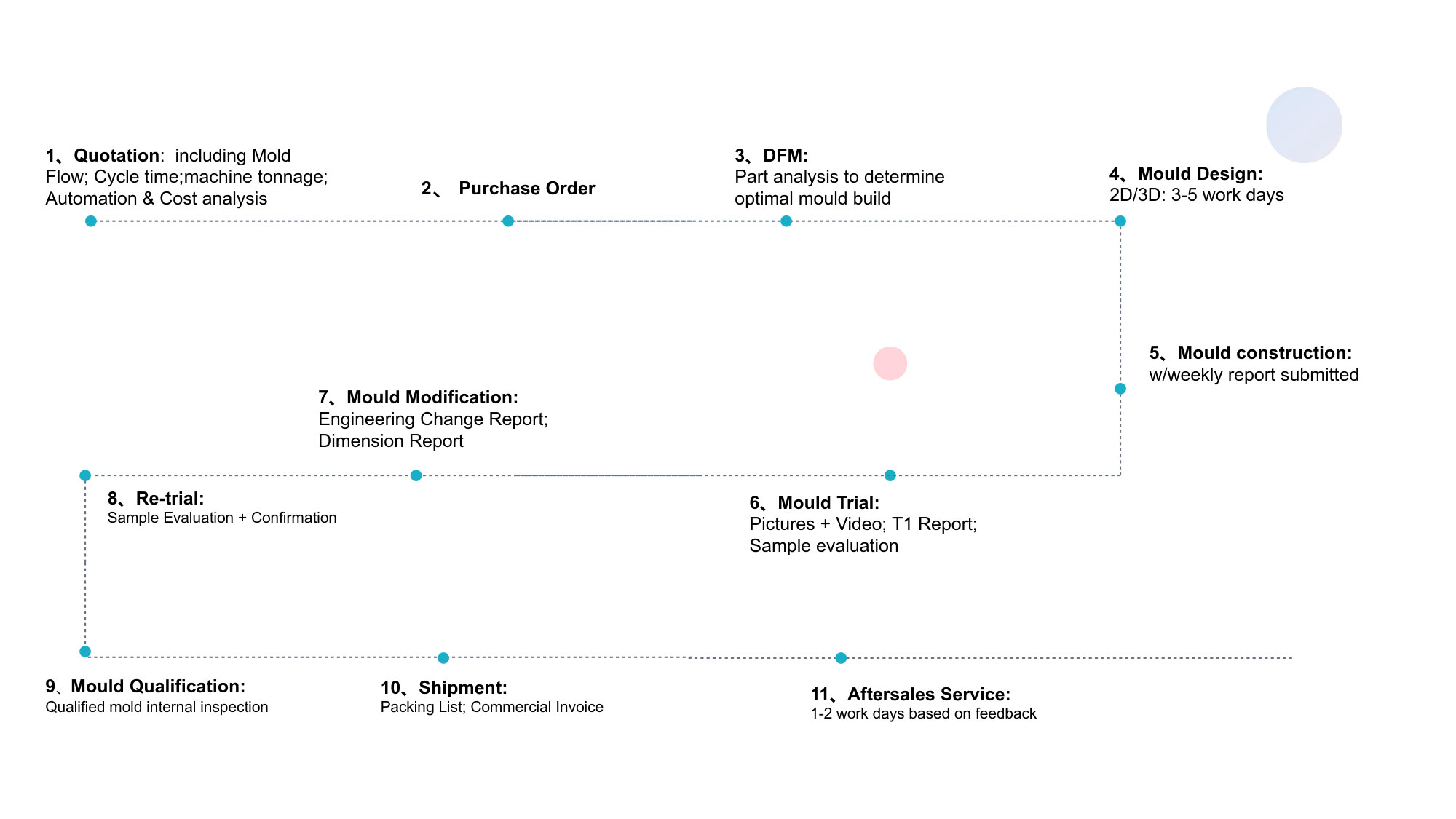
Section Eight: Project Roadmap for Syringe Needle Cap Development — From Concept to Delivery
Phase 0: Initial Engagement (Days 1–5)
Activities:
Receive 3D CAD data or physical sample
Preliminary material selection consultation
Initial capacity assessment (annual volume × mold cavitation requirements)
Non-disclosure agreement execution
Phase 1: DFM & Mold Flow Analysis (Days 6–25)
Deliverables:
Complete DFM report including draft analysis, gate location recommendations, and wall thickness optimization
Mold flow simulation results identifying weld lines, air traps, cooling performance
Mold construction proposal (16/32/48 cavity, hot/cold runner, material selection)
Firm quotation for mold fabrication and sample units
Phase 2: Mold Fabrication & T0 Trial (Days 26–65)
Process:
CNC rough machining of mold base
Wire EDM and CNC finishing of core/cavity
Heat treatment of wear surfaces
Mold assembly and T0 sample production
Deliverables:
30–50 sample parts with dimensional inspection report
Mold operation manual
Video of first shot
Phase 3: Sample Iteration & Approval (Days 66–95)
Process:
Customer review of T0 samples (dimensions, appearance, function)
T1 adjustments (if required)
Second sample batch
Repeat until customer approval
Phase 4: Pilot Production (Days 96–110)
Deliverables:
100–500 production-ready parts
Pilot run yield report
CPK values for all critical dimensions
Process capability statement
Phase 5: Mass Production & Delivery (Day 111 onward)
Process:
Customer approval to proceed
Automated, lights-out production as applicable
Cavity-specific sorting for traceability
Cleanroom packaging
Global logistics coordination
Conclusion: From Transaction to Partnership
A syringe needle cap looks simple. But producing millions of identical units—each one sterile, leak-proof, tamper-evident, and compliant with global medical device regulations—requires engineering precision, manufacturing discipline, and quality systems that few suppliers possess.
Ansix Tech has invested 28 years in building precisely those capabilities. From precision 5-axis machining centers and 260 all-electric injection molding machines to ISO 13485 certification and ISO Class 7 cleanrooms, every investment has a single purpose: delivering predictable, reliable, cost-effective medical components that make our customers successful.
The proof is not in promises—it is in delivered parts. Ansix Tech invites you to begin that proof with a no-obligation DFM analysis. Send us your 3D data. We will return a comprehensive manufacturing feasibility report showing exactly how we solve every technical challenge before we cut a single gram of steel.
“We set out to Make Our Customers Successful. Twenty-eight years and thirty thousand molds later, that mission has not changed.”
Technical Appendix — Material Reference Guide for Syringe Needle Caps

Ansix Tech Co Ltd
If you have any plans related to Syringe Needle Cap , you can contact us at any time. We will turn your ideas into reality, let you realize your dreams, and obtain large orders from the market. Our contact information is info@ansixtech.com. Or contact our CTO, mail: stephen@ansixtech.com
#www.ansixtech.com #ansixtech.com #Syringe Needle Cap #Syringe Needle Cap moulds #Syringe Needle Cap molds #Syringe Needle Cap injection molding companies #Syringe Needle Cap Canopy Mold injection mold companies #Ansix #Ansix moulds #Ansix china #Ansix tech china #Ansix tech company #Ansix facotry #Syringe Needle Cap injection molding #Syringe Needle Cap injection tools #Syringe Needle Cap injection moulds #Syringe Needle Cap plastic mould #Syringe Needle Cap plastic tools #Ansix Tech #Ansix molds #Ansix injection molding #Ansix mold factory #injection molding Syringe Needle Cap #Ansix mold factory #Syringe Needle Cap china #Syringe Needle Cap molds #injection factory #Syringe Needle Cap injection molding #Syringe Needle Cap injection molding factory #injection molding company #Syringe Needle Cap injection mold companies #Syringe Needle Cap#Syringe Needle Cap mold limited #Ansix mold china #Ansix companies #Ansix company China #Syringe Needle Cap facotry #Ansix Tech #Ansix Tech mould #Syringe Needle Cap injection moulding #injection moulding company #Ansix Syringe Needle Cap parts injection mold companies #medical injection molding companieschina #Syringe Needle Cap china factory #Ansix moulding companies #Ansix molding company #Syringe Needle Cap injection moulding facotry #Ansix Tech mold #Syringe Needle Cap mould #Syringe Needle Cap plastic injection molding #ansix plastic mold #Mold manufacturing #Syringe Needle Cap parts manufacturing #Syringe Needle Cap plastic parts factory #Syringe Needle Cap injection parts mold #Syringe Needle Cap PRECISION MANUFACTURING #Syringe Needle Cap #China mold #Syringe Needle Cap injection moulding china #Syringe Needle Cap mould china #china precision mold #mold in china #Syringe Needle Cap mold china #Precision molds #High-precision molds #Syringe Needle Cap #Injection molds #Syringe Needle Cap Factory #Syringe Needle Cap Company #Super Large Injection Mold Factory #Large Tonnage Injection Molding Factory #Syringe Needle Cap Company #Syringe Needle Cap Factory #2800T Injection Molding Factory #3000 Ton Injection Molding #4500 Ton Injection Molding Factory #Large Mold Injection Molding #Large Plastic Mold Injection Molding Factory #Large Injection Mold Manufacturer #Plastic Mold Factory #Injection Mold #Plastic Mold