



LEGO Brick Molds
FEATURES
The LEGO brick is not just a toy – it is an icon of precision engineering. Each brick’s clutch power, dimensional consistency, and surface finish are governed by tolerances measured in microns. For over six decades, the LEGO Group has perfected injection molding technology as the core of its large‑scale production. At Ansix Tech, we have internalized that same DNA of precision. This proposal presents our complete methodology for LEGO brick molds – from initial DFM analysis and material selection through mold fabrication, process validation, and cost‑optimized mass production – with every technical capability translated directly into measurable customer benefits.
-
Mold Description
Product Materials:
ABS/PC
Mold Material:
S136ESR
Number of Cavities:
8
Glue Feeding Method:
Hot runner
Cooling Method:
Water cooling
Molding Cycle
16.5s
Section 1: Hard Power Infrastructure – Building Customer Trust Through World‑Class Equipment
Before we show you what we can do, we want to show you what we do it with. The foundation of every reliable mold is the equipment behind it.
1.1 Mold Manufacturing Equipment – Precision Where It Counts
What the industry calls it: Five‑axis high‑speed machining centers, EDM, wire EDM, CNC grinding.
What that means for your LEGO bricks: Perfectly matched parting lines, zero flash, and smooth edges that don’t require secondary deburring.
-
Ansix Tech operates a fleet of advanced five‑axis CNC machining centers. Where conventional three‑axis machines require multiple setups and manual repositioning, our five‑axis technology cuts the mold from any direction in a single clamping operation [10†L16-L17]. This directly translates to:
Complex surface machining accuracy down to 0.002mm (2 microns) – Your LEGO brick’s clutch knobs, side walls, and corner radii are machined to the exact CAD specification, eliminating micro‑gaps that cause loose or overly tight fits [9†L22-L24].
Flawless parting line sealing – Our CAM‑driven toolpath generation digitizes the entire free‑form profile, ensuring perfect alignment between core and cavity. Result: No flash, no burrs, no manual trimming [10†L18-L20].
Deep‑cavity and undercut machining without rework – Traditional methods require electrode production for EDM. Our five‑axis machines machine these features directly, cutting weeks from lead times and eliminating the risk of misalignment between multiple operations [10†L18-L19].
Supporting technologies:
Wire EDM for ultra‑fine details – When your brick design includes micro‑vents, narrow glue channels (down to 0.03mm), or thin‑wall features, our wire EDM machines cut these geometries without inducing mechanical stress or distortion. Thin walls stay straight – no warpage, no broken cores.
Electrode machining workshop on‑site – Mold modifications and repairs rarely leave our facility. Conventional steel replacement or welding can be completed within 24 hours.
1.2 Injection Molding Machine Park – Consistency Shot After Shot After Shot
What the industry calls it: All‑electric servo‑driven injection molding machines with closed‑loop control.
What that means for your LEGO bricks: Every mold trial, every validation run, every production batch produces parts that are dimensionally identical – no drift, no surprises.
Ansix Tech maintains 260 injection molding machines sourced from the world’s most trusted brands: Japan’s Fanuc, Sumitomo, Toshiba, and Nissei; Germany’s Engel and Arburg (the latter specializes in two‑shot and liquid silicone); alongside domestic leaders Haitian and Victor Taichung Machinery [7†L13-L15] [8†L7-L8].
Tonnage Range Covers products from small LEGO micro‑bricks up to large building plates, structural displays, and master tooling
30 – 400 tons Single bricks, micro‑components, high‑precision small parts
400 – 1,000 tons Standard brick families, baseplates, medium assemblies
1,000 – 2,800 tons Extra‑large plates, display models, multi‑cavity high‑output molds
Why all‑electric servo machines matter for LEGO production:
Repeatability accuracy of ±0.1% or better – Unlike hydraulic machines whose viscosity sensitivity causes injection weight variation up to 1%, our all‑electric servos maintain injection weight deviation within ±0.1% across millions of cycles [16†L12-L14] [17†L9-L10].
Positioning accuracy of ±0.1mm – Clamping, injection, and ejection axes are servo‑controlled with less than 1 millisecond feedback latency, eliminating mechanical play that causes flash or inconsistent filling [16†L12-L14].
Energy efficiency – Servo motors only draw power during active motion, not idling. For a high‑cavity LEGO mold running 24/7, this translates to 40–60% lower energy costs compared to hydraulic equivalents.
1.3 Quality Assurance Equipment – Data, Not Guesswork
What the industry calls it: CMM (Coordinate Measuring Machine), optical image measurement, CPK analysis.
What that means for your LEGO bricks: You receive a full dimensional inspection report for every mold, not just a “we think it’s fine” assurance.
CMM measurement – Critical LEGO brick clutch‑knob diameters, wall thickness profiles, and stack‑height dimensions are probed at sub‑micron resolution.
Optical image measurement – Non‑contact measurement for complex 2D profiles, runner cross‑sections, and sprue bush dimensions.
Full dimensional reporting per mold, pre‑shipment – Every critical dimension is documented and compared to your CAD baseline. Our key performance indicator: Critical CPK ≥ 1.33 before any mold leaves our facility [19†L14-L15].
“We don’t guess. We measure. And we give you the data.”
Section 2: Mold Manufacturing Core Competencies – Where Steel Becomes Value
Your LEGO brick mold is your long‑term production engine. We build it for life, for precision, and for zero downtime.
2.1 Mold Life Expectancy – Guaranteed, Not Estimated
Different brick families require different material strategies. We tailor both the mold steel and heat treatment to your exact production volume.
Mold Steel Grade Hardness (HRC) Key Properties Recommended Application
S136 (Stavax) 48–52 Excellent corrosion resistance, high mirror polishability Transparent bricks, clear components, optical parts [15†L23-L26]
2344 / H13 48–52 Superior thermal fatigue resistance, toughness at high temperatures High‑temperature engineering plastics, glass‑filled materials [15†L19-L21]
8407 48–52 Exceptional wear resistance, good high‑temperature strength High‑abrasion applications, long‑run standard ABS/PC bricks
DC53 58–62 High hardness eliminates additional heat treatment Mirror‑polished molds, fine‑detail cavity work [14†L13-L15]
SKD61 / SKD11 50–55 Balanced toughness and wear resistance Multi‑cavity LEGO brick families, general high‑volume production
NAK80 37–43 Superior polishability to ⌀10,000 mesh; excellent weldability High‑gloss finish bricks without mirror‑grade corrosion requirements [2†L32-L33]
P20 (pre‑hardened) 30–32 Good machinability, cost‑effective Moderate‑volume runs (up to 300k shots), prototyping molds [13†L31-L34]
Guaranteed performance commitments:
Material Type Mold Life Commitment
Standard ABS / PC / PP 1,000,000+ mold cycles
Glass‑filled (GF) / reinforced plastics (e.g., PA6+GF30, PPS+40%GF) 500,000+ mold cycles
High‑temperature engineering resins (PEEK, PEI, LCP, PPS) 300,000+ mold cycles
“We do not just sell you a mold. We sell you a production asset with a defined lifespan.”
Customer value translation: A shorter‑life mold made from P20 might save $5,000 upfront, but when it wears after 200,000 shots, you pay again – plus lost production time. Our S136 or 2344 molds last 3–5 times longer, amortizing the initial investment over much larger production volumes. You save 30–50% on total tooling cost per million parts.
2.2 Achievable Tolerances – From LEGO Standard to Ultra‑Precision
LEGO bricks demand exact clutch power – that critical “snap and hold” feeling. That requires precision at multiple levels.
Component Type Achievable Tolerance Customer Value
Standard structural brick features ±0.05mm Perfect stacking, consistent clutch power, no loose or tight bricks
Precision clutch knobs / engagement features ±0.01mm Reliable interlocking, stable tower builds, consistent play experience
Gears, moving mechanisms (specialty LEGO Technic profiles) ±0.005mm Smooth rotation, quiet operation, extended mechanical life
Mold core/cavity mating surfaces 0.005mm fit clearance Zero flash – no manual trimming, no sorting, no waste
Documentation we provide with every mold:
Material certification certificates (mill test reports)
Heat treatment process curves (quenching, tempering, time‑temperature profiles)
Full dimensional FAI (First Article Inspection) report
“When we promise ±0.01mm on your clutch knobs, we back it with paperwork – not promises.”
2.3 Mold Type Capabilities – Matching the Right Tool to Your Product
Mold Type Description Customer Benefit
Standard two‑plate cold runner Classic LEGO brick family production Simple, reliable, lowest per‑mold cost
Hot runner system Heated manifold delivers plastic directly to each cavity Zero runner waste. For a 64‑cavity brick mold running 24/7, saves 15–25% raw material cost permanently
Stack mold Two parting planes, double the cavities in same machine footprint Doubles hourly output without buying another injection machine – perfect for high‑volume brick families
Two‑shot / multi‑material (bi‑injection) Dual‑material injection in one cycle Soft‑touch overmolds, two‑color bricks, functional assemblies – eliminates secondary assembly labor
High‑mirror polish mold Ra surface finish ≤0.05μm Crystal‑clear transparent LEGO elements with no surface haze or flow marks
2.4 Gate System Optimization – Engineering Flawless Filling Before Steel Is Cut
What the industry calls it: Mold flow analysis, gate location optimization, filling balance.
What that means for your LEGO bricks: No ugly weld lines on visible faces, no trapped air bubbles in transparent parts, no sink marks on thick sections.
Using advanced simulation tools (Moldflow, ANSYS), our engineers run virtual “computer‑aided mold trials” before any steel is machined [11†L9-L11] [12†L13-L15]. We:
Predict weld line locations – Then reposition gates so weld lines fall on non‑cosmetic surfaces (bottom faces, hidden corners).
Identify air trap zones – Add vents in simulation, verify escape paths for trapped gases, eliminating burn marks.
Balance multi‑cavity filling – In a 64‑ or 128‑cavity LEGO brick mold, we ensure every cavity fills at the same rate. Result: Identical bricks from every cavity, every time.
2.5 Cooling System Design – The Hidden Driver of Cycle Time
What the industry calls it: Conformal cooling, baffled water lines, bubbler cooling, thermal analysis.
What that means for your LEGO bricks: Shorter time between shots = higher daily output = lower cost per brick.
Injection molding cycle time is dominated by cooling (typically 50–70% of total cycle). A poorly cooled mold doubles your cycle time – and your cost.
Our cooling engineering advantages for LEGO brick molds:
Zone‑controlled mold temperature regulation – Core and cavity temperatures maintained within ±2°C of each other, eliminating differential shrinkage that causes warpage [4†L12-L16].
High‑velocity conformal cooling channels – CAD‑optimized cooling paths follow the brick’s 3D geometry. For thin‑wall LEGO bricks, this can reduce cooling time by 30–40% compared to conventional straight‑drilled cooling.
Fast heat‑up / cool‑down for engineering resins – For materials requiring high mold temperatures (PEEK, PPS), our thermal systems deliver rapid heating during fill and efficient cooling during solidify.
Customer value translation:
Original cycle time without optimization: 25 seconds
With conformal cooling + zone control: 14 seconds
Weekly output increase: +78% on the same machine.
2.6 Ejection System Design – Protecting Your Bricks
What the industry calls it: Ejector pins, stripper plates, air ejection, lifters.
What that means for your LEGO bricks: No ejector pin marks on visible surfaces, no part deformation during ejection.
Pin location avoidance on cosmetic faces – We map ejection points to underside ribs, hidden mounting bosses, or specifically approved locations only.
Large ejector plates for thin‑wall parts – Distributes ejection force evenly across the brick’s bottom face, preventing deformation.
Air‑assisted ejection for transparent parts – Eliminates pin marks entirely for crystal‑clear LEGO elements.
2.7 Delivery Standards – Speed Without Sacrifice
Mold Complexity Normal Lead Time Expedited Lead Time (cost premium applies)
Simple single‑cavity trial mold 10–15 days 8 days
Medium‑complexity multi‑cavity (up to 32 cavities) 25–35 days 18–20 days
High‑complexity 64/128‑cavity high‑production mold 35–45 days 25–28 days
On expedited orders, we never skip validation steps. We add machining shifts or parallel operations – we do not remove T1 trials or dimensional reporting.
“Fast is good. Fast and right is Ansix.”
Section 3: Injection Molding Process Control – Engineering Out Your Quality Fears
Your customers fear four things: sink marks, flash, dimensional drift, and batch‑to‑batch color variation. We address each with engineered process control.
3.1 MES‑Integrated Parameter Locking – No Unauthorized Changes
All 260 injection machines at Ansix Tech are connected to a central Manufacturing Execution System (MES). Every process parameter – temperature by zone, injection pressure profile, holding pressure, screw speed, back pressure, cooling time – is locked into the system [5†L12-L14].
Only authorized engineers may adjust parameters.
All adjustments are logged with user ID, timestamp, and reason.
Full traceability – If a quality issue ever arises, we can reconstruct exactly which machine, which operator, and which parameters produced that batch.
Customer value: You are not relying on a single operator’s “feel” for the machine. You are buying an industrialized, data‑driven process.
3.2 Dimensional Stability Control – No More Batch Drift
What we do: Multi‑zone mold temperature control maintains temperature difference between core and cavity halves within 2°C, eliminating differential shrinkage that causes warpage [4†L12-L16].
Real‑world validation on LEGO‑type brick components:
Three consecutive production batches over one week
Key hole‑to‑hole engagement spacing monitored
Measured fluctuation: ≤0.02mm across 500,000 parts
CPK ≥ 1.33 on all critical dimensions
Advanced capability: For ultra‑critical dimensional applications, we install in‑mold pressure and temperature sensors connected to real‑time closed‑loop control systems. If a sensor detects drift, the injection unit automatically compensates within the same cycle.
3.3 Surface Quality Grades – No Compromises
Finish Requirement Achievable Standard Inspection Method
General LEGO standard brick Class A finish, no visible flow marks Visual inspection + light box
Transparent / clear elements Zero bubbles, zero flow lines, no haze Backlit magnification, light transmission test
High‑gloss / piano‑finish surfaces Ra ≤ 0.2μm Contact profilometer
Mirror‑polished optical surfaces Ra ≤ 0.05μm White‑light interferometer
Textured / matte finishes (Stone / Sand / Woodgrain patterns) MT‑11000 or custom standard Texture comparator, visual under multiple angles
Electroplating‑ready surface Zero gas marks, zero flow hesitation Gas mark detection under bright cove light
For parts requiring subsequent painting or ink‑jet decoration (e.g., printed LEGO elements), we design-in shrink compensation allowance into the mold steel. After processing, registration accuracy between print and part geometry is maintained within ±0.1mm.
3.4 Special Material Capabilities – We Work With What You Need
Ansix Tech has extensive production experience across the full spectrum of engineering thermoplastics:
Material Family Representative Grades Key Applications
Standard ABS, PC, PP, PE, PS, PA6, PA66 Standard LEGO bricks, structural components
Reinforced / Filled PC/ABS, PBT, PA6+GF30, PA66+GF30, PPS+40%GF High‑strength Technic elements, gears, structural beams
High‑performance PEEK (Victrex), PEI (Ultem), PPS (Ryton), LCP (Vectra), PTFE, PFA Specialty high‑temperature / chemical‑resistant components
Flame‑retardant UL94 V-0 rated formulations Electrical housing applications
Liquid Silicone Rubber LSR grades for medical / tactile applications Soft‑touch overmolds, gaskets, seals
UV‑stabilized Weather‑resistant grades Outdoor‑exposed building elements (UV 3000 hours no yellowing)
Bio‑based / sustainable Bio‑ABS, bio‑PE, recycled content grades Environmentally‑positioned product lines
Customer value: You do not need to source multiple suppliers for different materials. One contact at Ansix Tech covers everything.
Section 4: Full‑Service Workflow – Reducing Your Management Burden
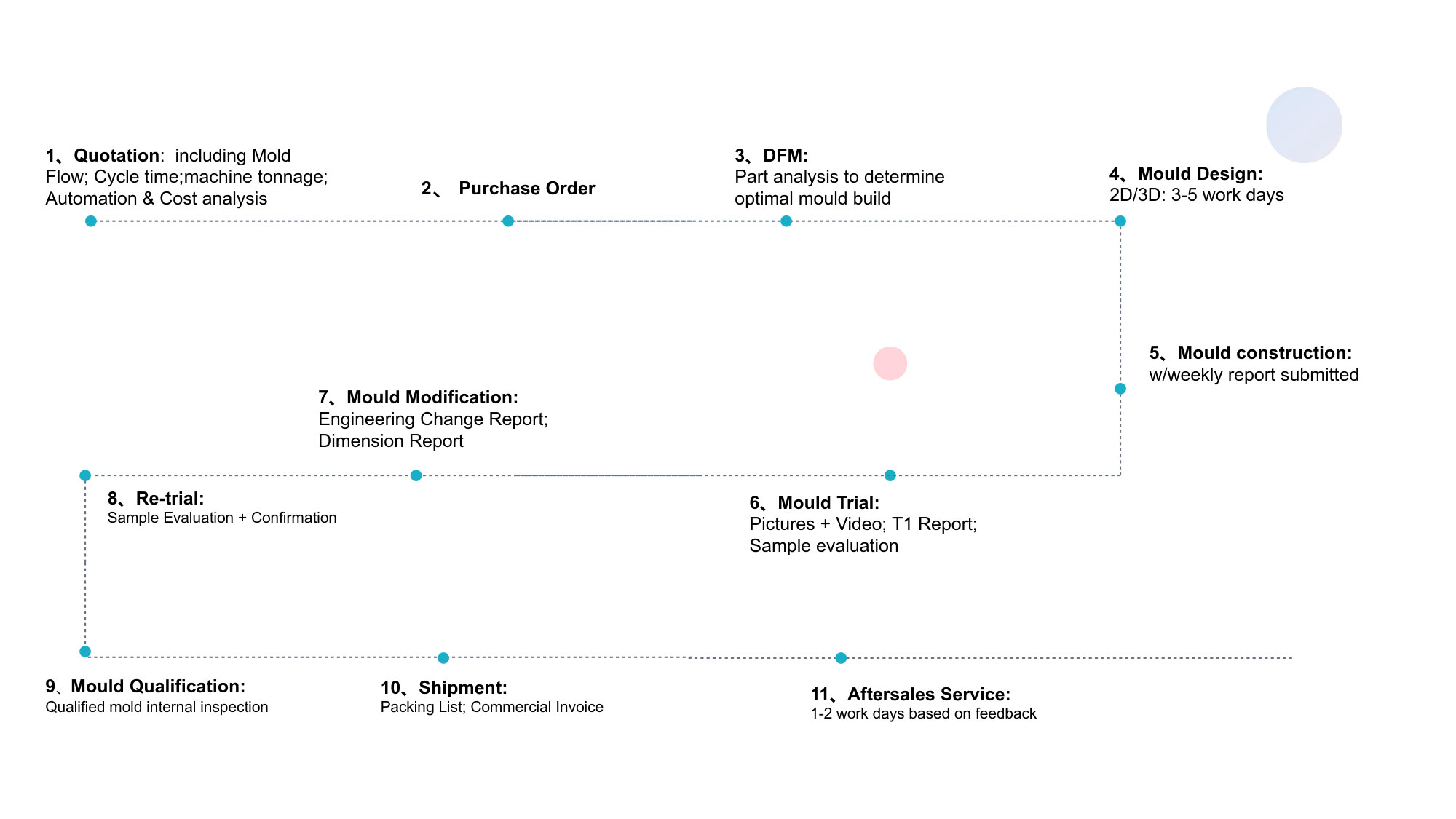
Most mold shops just cut steel and hand you a mold. We manage the entire lifecycle from concept to final assembly. This means you manage one vendor, not a chain of five.
4.1 Early Engineering Engagement – DFM Before You Commit
Phase: Pre‑contract (before you pay for steel)
Deliverable: Mold Feasibility Analysis Report (DFM Report)
Contents:
Recommended draft angles for each brick face
Nominal wall thickness optimization (uniformity reduces sink and warpage)
Gate location recommendation with weld line prediction diagrams
Vent placement strategy
Ejector pin mark location map (so you know where visible marks will appear)
Shrinkage factor assumption for the selected material
Cooling channel layout concept
Tool steel recommendation (with lifespan justification)
Estimated price, lead time, and risk assessment
“We catch problems before they become costly mold modifications – not after you’ve already paid for steel.”
4.2 Mold Trials (T1, T2, T3) – Stepwise Validation
Trial Stage Purpose Deliverable
T1 First functional parts under production conditions Dimensional baseline report, defect identification
T2 Process stability verification 30–50 consecutive good shots, pilot run 100–500 pieces, CPK analysis
T3 Full production verification (if required) Quality and yield confirmation, process window published
We deliver physical samples and an Improvement Report after each round, documenting every change made to the mold or process.
4.3 Pilot Production – The “Mass Production Rehearsal”
Before full‑scale mass production begins, we offer a pilot production run – typically 500 to 5,000 parts – produced on production machines, using production cycle times, staffed by production operators.
Pilot outputs:
Real‑world yield rate (first‑pass quality)
CPK statistics for critical dimensions
Actual cycle time measured (not just simulated)
Process parameter final lock‑in
Only after you approve the pilot run do we move to full mass production.
4.4 Maintenance, Spare Parts, and Lifelong Support
With every mold delivery:
Complete set of consumable spare parts (ejector pins, tool steel inserts for high‑wear areas, spare core pins)
Full mold assembly drawing set
Recommended maintenance schedule (lubrication points, cleaning procedures, frequency)
Post‑delivery service:
Mold maintenance at every 200,000 cycles (we perform it, we train your people to perform it – your choice)
Lifetime repair support at cost price for non‑consumable components
Three‑year mold structure warranty (defects in weldments, parting line integrity, guide pin systems – excludes normal wear of ejector pins and sliding components)
Section 5: Differentiated Commitments – Turning Common Complaints into Guarantees
Instead of telling you we are “better,” we name the problem and commit to the solution.
Customer Complaint (Common Industry Weakness) Ansix Tech’s Commitment
“My mold constantly requires maintenance – production stops every time.” We run each mold through a 2,000‑shot accelerated wear test and provide a pre‑shipment wear report. Then we guarantee the mold’s core structure (excluding normal wear parts) for three years of production use.
“Flash everywhere – I need a full‑time person with a deburring knife to clean every part.” Our parting line machining accuracy is controlled to 0.005mm flatness match. We further compensate with self‑locking clamp‑force verification during process setup. Flash thickness is held to ≤0.03mm – flash that is generally self‑releasing or so thin it does not require manual trimming.
“Dimensions change from batch to batch. I cannot trust my supplier.” We install in‑mold wall‑thickness monitoring using ultrasonic sensors on critical molds, coupled with real‑time holding pressure feedback control loops. For top‑tier applications, we retrofit in‑mold cavity pressure sensors connected to a closed‑loop injection control system. CPK ≥ 1.33 is verified before mass production begins.
“When the mold needs repair, the toolmaker takes four weeks. My line is down.” We maintain our own on‑site electrode manufacturing center and EDM department. Welding repair, spare insert manufacture, and cavity spotting can be completed without external contractors. Standard emergency repair service: 24 hours from receipt of mold to return to production condition.
Conclusion: A Mold Is Not a Block of Steel. It Is a Cash Flow Asset.
At Ansix Tech, we design molds not as standalone tools but as integrated production systems. Every feature – every cooling line, every gate, every vent, every ejector pin guide – is engineered with a single objective: Your ongoing production profitability.
Lower cost per part through optimized cycle times and minimal scrap.
Zero unplanned downtime through reliable steel selection and maintenance support.
Consistent quality through locked process parameters and real‑time in‑mold sensors.
One accountable partner from DFM through mass production.
What we invite you to do next:
Take one of your existing LEGO‑category components – or a similar product you are currently sourcing. We will run a complete Design for Manufacturability (DFM) assessment, including:
Mold flow analysis showing weld line risk, air trap prediction, and filling balance
Recommended mold steel with lifespan projection
Estimated cycle time with cooling optimization analysis
Predicted CPK on critical dimensions
We will present the DFM report to your engineering team. You will see exactly how we would eliminate weld lines, prevent flash, shorten cycle time, and reduce your direct cost before we cut a single gram of steel.
Let us show you how Ansix Tech turns steel into production profit.
Appendix: Technical Summary Table
Category Key Capability Customer Benefit
Machining 5‑axis CNC, 0.002mm accuracy Perfect parting lines, zero flash, no deburring
Mold Life 1 million cycles (standard plastic); 500k cycles (glass‑filled) 3–5× longer life than lower‑grade molds
Tolerances ±0.005mm (precision features); ±0.05mm (general) Exact clutch power, perfect fit
Cooling Conformal + zone control (ΔT ≤2°C) 30–40% shorter cycle time
Materials S136, 2344, H13, DC53, NAK80, P20 Tailored steel to your production volume
Process Control MES‑locked parameters; CPK ≥1.33 Zero unplanned variation
Validation T1+T2+T3 + pilot run + FAI + CPK No mass‑production surprises
Lead Time 10–45 days depending on complexity Fast without skipping validation
After‑Sales 3‑year warranty; 24h emergency repair Minimal downtime risk
Ansix Tech – Precision engineered. Customer proven. Globally trusted.
For more information, contact Ansix Tech at info@ansixtech.com. A member of our engineering team will respond within 4 hours.
Ansix Tech Co Ltd
If you have any plans related to LEGO Brick Molds , you can contact us at any time. We will turn your ideas into reality, let you realize your dreams, and obtain large orders from the market. Our contact information is info@ansixtech.com. Or contact our CTO, mail: stephen@ansixtech.com
#www.ansixtech.com #ansixtech.com #LEGO Brick Molds #LEGO Brick Molds moulds #LEGO Brick Molds molds #LEGO Brick Molds injection molding companies #LEGO Brick Molds Canopy Mold injection mold companies #Ansix #Ansix moulds #Ansix china #Ansix tech china #Ansix tech company #Ansix facotry #LEGO Brick Molds injection molding #LEGO Brick Molds injection tools #LEGO Brick Molds injection moulds #LEGO Brick Molds plastic mould #LEGO Brick Molds plastic tools #Ansix Tech #Ansix molds #Ansix injection molding #Ansix mold factory #injection molding LEGO Brick Molds #Ansix mold factory #LEGO Brick Molds china #LEGO Brick Molds molds #injection factory #LEGO Brick Molds injection molding #LEGO Brick Molds injection molding factory #injection molding company #LEGO Brick Molds injection mold companies #LEGO Brick Molds#LEGO Brick Molds mold limited #Ansix mold china #Ansix companies #Ansix company China #LEGO Brick Molds facotry #Ansix Tech #Ansix Tech mould #LEGO Brick Molds injection moulding #injection moulding company #Ansix LEGO Brick Molds parts injection mold companies #medical injection molding companieschina #LEGO Brick Molds china factory #Ansix moulding companies #Ansix molding company #LEGO Brick Molds injection moulding facotry #Ansix Tech mold #LEGO Brick Molds mould #LEGO Brick Molds plastic injection molding #ansix plastic mold #Mold manufacturing #LEGO Brick Molds parts manufacturing #LEGO Brick Molds plastic parts factory #LEGO Brick Molds injection parts mold #LEGO Brick Molds PRECISION MANUFACTURING #LEGO Brick Molds #China mold #LEGO Brick Molds injection moulding china #LEGO Brick Molds mould china #china precision mold #mold in china #LEGO Brick Molds mold china #Precision molds #High-precision molds #LEGO Brick Molds #Injection molds #LEGO Brick Molds Factory #LEGO Brick Molds Company #Super Large Injection Mold Factory #Large Tonnage Injection Molding Factory #LEGO Brick Molds Company #LEGO Brick Molds Factory #2800T Injection Molding Factory #3000 Ton Injection Molding #4500 Ton Injection Molding Factory #Large Mold Injection Molding #Large Plastic Mold Injection Molding Factory #Large Injection Mold Manufacturer #Plastic Mold Factory #Injection Mold #Plastic Mold