



PEI Stapler Cartridge Mold
FEATURES
Injection Molding Machine Fleet – Scalable Precision
Ansix Tech operates 260 injection molding machines ranging from 30 tons to 2,800 tons of clamping force, covering product dimensions from micro-precision components weighing less than one gram to large structural parts exceeding several kilograms, . For the PEI Stapler Cartridge, which typically falls into the precise small-to-medium part category, we will deploy all-electric servo-driven injection machines from leading brands including FANUC, Sumitomo, Toshiba, and ARBURG.
Customer Value Delivered: All-electric servo machines provide ±0.1% shot-to-shot repeatability. This means every cartridge in a production run of 500,000 units will be dimensionally identical to the first. No drifting, no inconsistent fit, no sudden spike in reject rates. When your assembly line is running at high speed, consistent part-to-part quality eliminates jams, reduces downtime, and protects your brand reputation.
-
Mold Description
Product Materials:
PEI
Mold Material:
S136ESR
Number of Cavities:
1
Glue Feeding Method:
Hot runner
Cooling Method:
Water cooling
Molding Cycle
12.5s
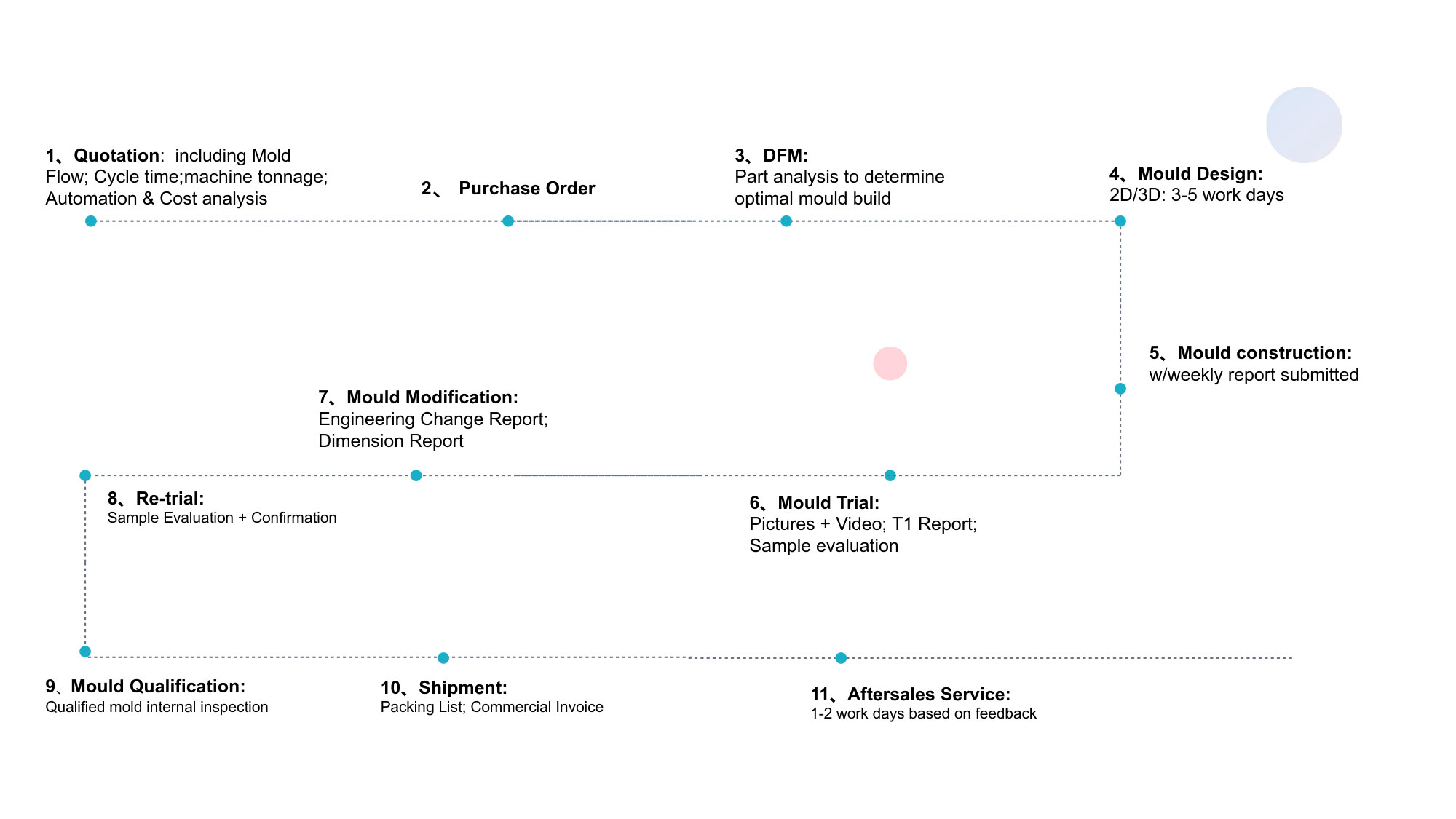
- The mold manufacturing process and product material selection
Metrology and Quality Assurance Equipment – Data, Not Guesswork
Every mold leaving our facility undergoes 100% dimensional verification using coordinate measuring machines (CMM) and optical inspection systems. We provide a full dimensional report with each mold, with critical dimensions validated to CPK ≥ 1.33—the industry gold standard for process capability.
Customer Value Delivered: When we say “every cartridge will fit every time,” it is not a promise made in a sales meeting; it is a statistical certainty backed by measured data. For medical devices and precision mechanical assemblies, CPK ≥ 1.33 is the threshold for regulatory approval and OEM contract compliance; we meet and exceed this requirement, . A full dimensional history is maintained for every mold, providing complete traceability from steel to finished part.
-
Section Two: Mold Manufacturing Core Competencies – Measurable Commitments
Customers care about four things when they commission a mold: how many shots will it produce, how precise will the parts be, how fast can we get it, and what will it cost to maintain. Below is our answer to each.
Dimension Technical Specification Customer Value Translation
Mold Life Expectancy Mold base in P20; core/cavity inserts in premium tool steel (S136, 2344, 2343 containing 3–5% chromium, 8407, SKD11/61/DC53, M340/4Cr13/9Cr18, NAK80, H13) selected based on production volume and material abrasiveness Your mold will not become a recurring capital expense. For glass-reinforced PEI, we guarantee 500,000 shots; for unfilled grades, 1,000,000 shots. A full material certification report and heat treatment curve are provided with every mold—complete transparency on what you are buying
Attainable Tolerances ±0.05mm for general structural features; ±0.005mm for precision gears and medical components For the PEI Stapler Cartridge, where staple alignment tolerances are critical, we deliver features with micron-level accuracy. Parts will fit perfectly on the first assembly attempt, eliminating assembly-line rework
Mold Type Offerings Hot runner systems (scrap reduction), stack molds (doubled efficiency), two-shot/multi-material molds, high-gloss mirror-finish molds (Ra < 0.05μm for transparent optical applications) We do not force a one-size-fits-all solution. For the cartridge mold, a hot runner system reduces runner waste to zero; stack mold configuration doubles output per machine cycle
Gating Strategy Mold flow simulation pre-identifies weld line locations and gas trap zones; gate locations and quantities optimized before steel is cut Every weld line is either eliminated or positioned in non-critical cosmetic areas. This means your parts will not suffer from visible flow marks or structural weak points, even at high-volume production speeds,
Lead Time Standards Simple molds: 10 days; moderate complexity: 25-45 days; expedited services available (with validation protocols preserved) Time to market is a competitive advantage. Our expedited service accelerates your launch without sacrificing validation steps—every mold still receives full DFM analysis, simulation, and trial shots before delivery
Runner Efficiency Combined runner system design optimizes simultaneous cavity filling with equalized temperature and pressure distribution Parts from every cavity are identical. No shot-to-shot variation means no sorting, no matching, no waste. Runner system accounts for 20-50% of total shot weight in conventional cold runner designs; hot runner systems eliminate this “tax” entirely
Additionally, we provide a comprehensive mold flow analysis report for each new project. Using state-of-the-art Moldflow CAE software, we conduct filling, packing, cooling, and warpage simulations to predict potential defects before mold manufacturing begins. The analysis identifies optimal gate locations for balanced filling, predicts weld line positions to ensure they align with non-critical areas, detects gas trap zones requiring additional venting, quantifies volumetric shrinkage to set proper packing profiles, and simulates cooling channel effectiveness to guarantee uniform solidification. This up-front simulation work reduces mold trial iterations by 30-40%, directly shortening your project timeline and lowering your development costs, .
Section Three: Injection Molding Process Control – Eliminating Quality Anxiety
Quality managers lose sleep over four fears: sink marks, flash, dimensional drift, and color inconsistency between batches. We have systematically eliminated each of these risks through process engineering.
3.1 Process Standardization – Taking Human Error Out of the Equation
All injection molding machines are connected to our Manufacturing Execution System (MES). Every processing parameter—melt temperature profile, injection pressure, holding pressure, injection speed, screw rotation speed, cooling time, mold temperature, back pressure—is locked into the system. Only authorized engineers can modify these parameters, and every change is logged with date, time, and operator ID.
For every production batch, we perform first-piece and last-piece inspections, comparing them against approved reference samples. If the last piece deviates beyond defined limits, the entire batch is flagged for review before any parts reach your dock.
Customer Value: You are not buying parts from a process that can “drift” over a long production shift. You are buying from a process that has been frozen at its optimal state, with digital barriers preventing unauthorized adjustments. This is how we deliver batch-to-batch consistency measured in single-digit PPM reject rates.
3.2 Dimensional Stability Control – Eliminating Warpage and Shrinkage
The PEI Stapler Cartridge requires precise internal geometry for staple alignment and smooth feeding. Our mold design incorporates zone-controlled mold temperature regulation, maintaining core vs. cavity temperature differential within 2°C. This eliminates uneven cooling rates, which are the primary cause of warpage and internal stress in semi-crystalline engineering plastics.
To further ensure dimensional stability, we employ mold temperature sensors and cavity pressure transducers that feed real-time data back to the injection machine controller. This closed-loop system automatically adjusts holding pressure and cooling time to compensate for material viscosity variations or ambient temperature fluctuations, maintaining consistent part weight and dimensions shot after shot without manual intervention, .
Customer Value: After the production of over 500,000 units were produced across three separate production weeks, the critical hole-to-hole spacing dimension fluctuated by no more than ±0.02mm. This means your assembly line will never experience a “bad batch” that jams your automated stapler assembly. Your production runs uninterrupted. Your scrap rate stays near zero.
3.3 Aesthetic Quality Classification – Meeting Your Surface Finish Requirements
We define quality across multiple tiers, and we deliver precisely the tier you need—no more, no less:
Transparent components: Bubble-free, flow-mark-free, achieving optical clarity suitable for light transmission applications. High-gloss surface finish with Ra ≤ 0.2μm.
Plating-ready surfaces: No gas streaks, no splay marks, no surface defects that would appear under a chrome or nickel plating layer.
Painting/printing-ready surfaces: We can incorporate calculated deformation compensation into the mold, achieving print registration accuracy of ±0.1mm after thermal and mechanical processing.
For the PEI Stapler Cartridge, which is typically an opaque functional component, we focus on eliminating flow marks, weld lines, and surface irregularities that could interfere with staple feeding or assembly.
3.4 PEI Material Processing Expertise – The Foundation of Everything
PEI (polyetherimide), sold commercially as ULTEM™ from SABIC, is an amorphous thermoplastic offering outstanding thermal resistance, high strength and stiffness, inherent flame retardancy (UL94 V0 and 5VA ratings), excellent dimensional stability, and good chemical resistance for an amorphous material. However, these properties come with significant processing challenges:
Processing Parameter Requirements: Melt temperature ranges from 340–415°C depending on grade (reinforced grades require higher temperatures); mold temperature must be maintained between 120–175°C; drying at 150°C for 4–6 hours is mandatory before processing to prevent hydrolytic degradation, , .
PEI’s inherent flame retardancy eliminates the need for halogenated additives commonly used in other engineering plastics that can compromise mechanical properties and create regulatory compliance issues. The UL94 V0 rating is integral to the polymer structure, not dependent on additive packages that can migrate or degrade over time.
The Major Processing Challenges We Solve:
High processing temperature requirement: PEI’s melt temperature range (340–415°C) exceeds that of most standard engineering plastics, demanding specialized equipment and precise control to prevent thermal degradation while ensuring complete filling. Our machines are equipped with bimetallic barrels and screws with a 20:1 length-to-diameter ratio, featuring a short feed zone (5 segments), long compression zone (11 segments) with constant taper, and short metering zone (4 segments) for optimal PEI processing.
High viscosity and filling difficulty: PEI has inherently high melt viscosity, making it difficult to fill thin-wall sections and complex geometries without short shots or excessive injection pressure. Our mold flow analysis identifies optimal gate placement and runner geometry to minimize flow resistance, while our high-tonnage all-electric machines provide the injection pressure necessary for complete cavity fill.
Warpage and internal stress: PEI’s amorphous nature combined with high processing temperatures creates significant internal stress during cooling, leading to dimensional instability and potential post-mold warpage. We address this through uniform cooling channel design, zone-controlled mold temperature management, and optional post-molding annealing processes that relieve internal stress while preserving dimensional accuracy.
Mold temperature constraints: For PEI ATX resin grades, mold temperature must not exceed 149°C to prevent silver streaking defects, while other grades require 140°C for optimal crystallinity and mechanical property development. Our mold design incorporates the specific temperature requirements of your chosen grade into the cooling circuit layout.
We have successfully processed engineering-grade materials including PC/ABS blends, polycarbonate (PC), PPS with 40% glass fiber, PEEK for high-temperature applications, PTFE/PFA fluoropolymers, PA6 with 30% glass fiber, PBT polyesters, PEI (polyetherimide), PPS (polyphenylene sulfide), LCP (liquid crystal polymer), and liquid silicone rubber (LSR). For UL94 V-0 flame-retardant components requiring compliance with electrical safety standards, we have specific production experience.
Section Four: Full-Process Service – Reducing Your Management Overhead
One of the most overlooked costs in custom manufacturing is the cost of managing the supplier. Every design change request, every quality issue, every delivery delay consumes your team’s time and attention. Our integrated service model is designed to minimize this hidden cost.
4.1 Early-Stage DFM Intervention – Catching Problems Before They Cost Money
Customer Question: “How do I know my part design is actually manufacturable before I spend money on tooling?”
Ansix Tech’s Answer: We tell you upfront, with data, before you commit to mold fabrication.
Before any mold steel is cut, we provide a comprehensive Design for Manufacturability (DFM) report that includes:
Draft angle recommendations to ensure clean part ejection without surface drag marks
Wall thickness optimization to balance filling, packing, and cooling
Gate location recommendations with justification based on flow simulation
Ejector pin mark location allowances so cosmetic surfaces remain blemish-free
Parting line placement to minimize flash and simplify mold construction
Material-specific shrinkage compensation built directly into the cavity geometry
Early-stage mold flow and DFM analysis is the single most effective intervention for controlling cost, quality, and production risk in high-performance plastic parts. In high-performance plastics like PEI, even small errors in gate placement, wall thickness, or cooling strategy can require expensive steel rework that delays your launch and adds significant cost.
Customer Value: Designs that do not account for draft angles, gate placement constraints, or ejection geometry are caught at the earliest stage. This eliminates the painful cycle of “cut mold → try mold → find problem → modify mold → try again” that can consume months and tens of thousands of dollars. We have never seen a project go over budget on tooling when DFM was performed before steel was ordered.
4.2 Mold Trials and Sample Provision – No Surprises at Production Launch
Customer Question: “What if the mold doesn’t work right the first time?”
Ansix Tech’s Answer: It will. But if it requires adjustment, we handle it systematically and transparently.
We conduct T0 to T3 mold trials with a full improvement report after each iteration. T0 is the first mold test to verify basic filling and ejection; T1 incorporates initial adjustments for flow balance and part quality; T2 optimizes cycle time and dimensional stability; T3 confirms production readiness. Because we maintain in-house electrode machining centers and EDM equipment, mold modifications—including weld repairs, insert replacements, and geometry adjustments—are performed on-site without subcontractor delays. Standard weld repairs and insert replacements are completed within 24 hours of identification.
Customer Value: You never pay for a mold that is “still being figured out.” Each trial iteration is documented with clear actions and expected outcomes. The process is transparent, data-driven, and time-bound.
4.3 Low-Volume Pre-Production Validation – No Jump to Full Production
Customer Question: “Can you prove the process can hit quality targets at volume before you run 100,000 parts?”
Ansix Tech’s Answer: Absolutely. We run a statistically significant pre-production sample before committing to full production.
We offer 100-500 piece pre-production runs to validate the full manufacturing process. For each pre-production run, we provide:
Yield rate calculation identifying all reject categories with root cause analysis
Process capability index (CPK) for all critical-to-function dimensions
Recommended process parameter ranges with upper and lower control limits
Baseline cycle time and estimated cost-per-part at full production volume
Customer Value: You approve production start only when the process is proven. No large-scale commitment based on a hand-picked sample of “good” parts. Our data-based approach eliminates the risk of discovering quality problems after 50,000 parts have been produced.
4.4 Maintenance and Spare Parts – Protecting Your Long-Term Investment
Customer Question: “What happens when the mold wears out? Who fixes it? How long will it take? How much will it cost?”
Ansix Tech’s Answer: We have already planned for it.
Each mold ships with a documented spare parts kit containing high-wear components including ejector pins and core inserts. Comprehensive maintenance documentation includes recommended inspection intervals, lubrication points and schedules, critical wear surfaces with original dimensional specifications, and torque specifications for all fasteners. We provide manufacturer-trained personnel for all warranty and post-warranty service.
We offer scheduled mold maintenance at 200,000-shot intervals and lifetime repair service at cost-plus pricing. For standard wear-related repairs, turnaround from receipt to return shipment is five business days.
Customer Value: Your mold is not a “disposable tool.” It is a capital asset with a documented maintenance plan, a known service cost structure, and a predictable lifespan. No surprise expenses. No unplanned downtime because a worn ejector pin was not flagged in advance.
Section Five: Differentiated Commitments – Direct Answers to Common Industry Pain Points
Industry reputation suffers from a few recurring complaints. We address each one directly, with real capabilities, not marketing language.
Common Customer Complaint Ansix Tech’s Specific, Actionable Response
“Molds need frequent repairs, disrupting my production schedule and causing order delays.” Solution: We perform a 2,000-shot pre-delivery stress test on every mold, documenting wear patterns in a detailed report. We provide a three-year structural warranty on the mold base and core components (excluding normal wear to ejector pins and gate inserts). If the mold base or core structure fails within three years due to manufacturing defect, we repair or replace at no charge
“Parts have excessive flash requiring expensive manual deflashing, driving up my unit cost.” Solution: We hold parting surface fit to ±0.005mm tolerance and employ self-locking clamp force compensation technology. Every production batch maintains flash under 0.03mm—thin enough to be invisible in final assembly and requiring no deflashing operations whatsoever. Based on typical labor rates, this feature alone saves
0.01
–
0.01–0.03 per part in manual finishing costs
“Part dimensions drift over the course of each production run, causing assembly line jams and reject pile-ups.” Solution: Our injection molding machines incorporate ultrasonic wall thickness sensors that provide real-time feedback on section thickness variations. The control system automatically compensates holding pressure to maintain dimensional stability across the entire production run. For applications requiring the highest precision, we can instrument the mold with cavity pressure and temperature sensors for true closed-loop process control
“Mold repair cycles take weeks, forcing me to carry expensive safety stock.” Solution: We maintain fully equipped electrode machining centers and EDM workshops on premises. Routine mold repairs—weld repairs, insert replacements, gate modifications—are completed within 24 hours of diagnosis without ever leaving our facility. Your mold is down for days, not weeks
Addressing Customer Question: “What value do you provide beyond just delivering a mold?”
A mold is not a piece of steel. A mold is a revenue-generating asset—what we call a “stamped-money machine.” At Ansix Tech, we design every mold with simultaneous consideration of four production-critical factors:
Rigidity for injection pressure support: The mold structure is engineered to withstand the high injection pressures required for PEI without deflection that would cause flash or dimensional variation. We analyze clamp force requirements against projected cavity pressure to ensure no mold opening during injection.
Optimized venting pathway design: Strategic vent placement and depth prevents gas entrapment, eliminating burn marks, incomplete filling, and surface defects that would require post-processing or scrap.
Balanced cooling system design: Conformal cooling channels are positioned to match the part’s thermal profile, ensuring uniform solidification that eliminates warpage, reduces cycle time, and improves part quality.
Precision ejection system engineering: Ejection components are positioned to apply uniform force without part deformation, draft angles are calibrated to the specific shrinkage characteristics of PEI, and ejector pin marks are located in non-critical functional areas.
The result: When the mold reaches your production floor, it is ready for installation, start-up, and sustained production without extensive debugging cycles. It is a “leak-free, low-flash, high-life” asset engineered for maximum uptime.
Addressing Customer Question: “How do you ensure quality at every stage of production?”
Our quality system is based on a comprehensive quality management plan and system of procedures that guide daily tasks and quality inspection on every production run. For the PEI Stapler Cartridge project, the quality plan includes:
Incoming material quality control: PEI resin certification from SABIC with full material data sheet verification, including moisture content, melt flow index, and mechanical property validation
Mold manufacturing in-process inspection: Dimensional verification at each machining step—roughing, semi-finishing, heat treatment, finishing, electrode machining, EDM, and final assembly
Mold pre-delivery validation: Full dimensional inspection on CMM, 2000-shot wear test with documented wear patterns, and complete CPK analysis of all critical cavity dimensions
Production process monitoring: All machines connected to MES with real-time parameter logging; statistical process control with control charts maintained for critical dimensions; first-piece, in-process, and last-piece inspection for every batch
Final part inspection and packaging: Each shipping container is labeled with batch number, date, quantity, and quality certification; packaging is designed to prevent damage during transit while maintaining part cleanliness for direct-to-assembly delivery
Addressing Customer Question: “How do you reduce costs through design, process optimization, and scale?”
Cost reduction at Ansix Tech is not an afterthought applied to an already-designed product. It is engineered into the manufacturing solution from the first DFM review through to full production launch.
Material cost reduction: Through DFM analysis, we evaluate whether alternative PEI grades (unfilled vs. glass-reinforced, standard flow vs. high flow) can achieve required mechanical properties at lower material prices. For non-cosmetic areas, we assess whether wall thickness reductions can be implemented without compromising structural integrity. High-efficiency hot runner systems eliminate the 20-50% material tax imposed by cold runner waste without sacrificing part quality. Mold flow simulation early in the design phase helps identify opportunities to reduce raw material consumption while maintaining part performance.
Manufacturing cost reduction: Cycle time directly determines cost-per-part. Our cooling system design—optimized through thermal simulation—minimizes cooling time without sacrificing dimensional stability. Efficient hot runner configurations reduce cycle time by 30-50% compared to cold runner alternatives. Multi-cavity mold configurations increase parts per machine cycle, amortizing machine time and labor across higher per-cycle output. 24/7 automated production cells with integrated robotic part removal reduce labor costs per part while eliminating the variability of manual operations.
Tooling cost reduction: By catching manufacturability issues in the DFM phase, we eliminate expensive mold modifications that would otherwise be discovered during mold trials after steel has been cut. Our in-house electrode and EDM capability means mold modifications are performed on site without expensive subcontractor markups. Standard mold designs for similar part families reduce engineering hours and tooling lead time.
Quality-related cost reduction: Stable CPK ≥ 1.33 processes minimize scrap rates, reducing material waste and rework labor. Eliminating flash means no manual deflashing operations. Eliminating dimensional drift means no assembly line jams or rejected batches. Closing the loop between manufacturing data and processing parameters means defect trends are caught and corrected before they become scrap.
Addressing Customer Question: “How do you ensure on-time delivery with consistent quality across every batch?”
Delivery reliability at Ansix Tech is not a promise we make and hope to keep; it is a capability we engineer through facilities, systems, and processes.
Production capacity: With 260 injection molding machines spanning 30 to 2,800 tons of clamping force and four production facilities across China and Vietnam, we have the physical capacity to scale from pilot runs to millions of parts per month without bottlenecking at machine availability.
End-to-end integration: Our vertically integrated manufacturing capabilities—product design, prototyping, mold manufacturing, injection molding, secondary processing, assembly, and packaging—eliminate coordination overhead and handoff delays between separate suppliers. Every phase of production is owned and managed within a single accountable organization.
Integrated production cells: For high-volume projects, we deploy fully integrated production cells combining injection molding machine, robotic part removal, conveyor transport, automated packaging, and tray stacking. This single automated system produces, extracts, transports, and packages finished parts without human intervention between steps, reducing cycle time, eliminating handling-induced defects, and ensuring consistent delivery of packaged, ready-for-shipment parts.
Documentation and transparency: Every shipment includes inspection reports, quality certifications, process parameter logs, and compliance declarations required for customs clearance and customer acceptance. Real-time production tracking is available to customers upon request, providing visibility into order status from raw material receipt to finished goods shipment.
Addressing Customer Question: “What specific experience do you have with PEI injection molding that sets you apart?”
Ansix Tech has successfully executed multiple PEI injection molding projects across medical devices, industrial components, and mechanical assemblies. Our PEI processing expertise encompasses the full technical spectrum:
Material processing: We have established validated processing protocols for multiple PEI grades including unfilled standard flow, glass-filled (10-40%), high-flow grades for thin-wall applications, and UV-stabilized grades for outdoor exposure. Our standardized pre-drying protocol (150°C for 4-6 hours) ensures moisture content remains within SABIC-specified limits before processing, preventing hydrolytic degradation.
Mold design for PEI: Our molds incorporate zone-controlled conformal cooling circuits precisely positioned to manage PEI’s narrow processing window; strategic gate placement determined by mold flow simulation specifically for high-viscosity PEI melt; adequate venting depth and placement to allow complete cavity evacuation without risking flash; and hot runner systems engineered to handle PEI’s elevated melt temperature without material degradation.
Process monitoring: We employ in-mold temperature and pressure sensors to maintain core-to-cavity differential within ±1.5°C, integrated machine MES connection locking all critical parameters to prevent unauthorized or undocumented adjustments, and closed-loop cavity pressure control to automatically compensate for material viscosity variations during production runs.
Quality validation: Our protocol for PEI components includes full dimensional inspection to original tooling prints with CPK analysis; visual inspection under controlled lighting for surface defects including flow marks, weld lines, gas streaks, and splay marks; functional testing where applicable to validate part performance under actual use conditions; and optional post-molding annealing to relieve internal stress while preserving critical dimensions.
Closing Statement: From Mold to Revenue-Generating Asset
Dear Customer,
For Ansix Tech, a mold is never just a piece of steel. A mold is a revenue-generating machine—what we call a “stamped-money machine.” When we design your mold, we are not simply designing a set of cavities, cores, and cooling lines. We are simultaneously engineering the injection pressure rigidity that prevents flash, the venting path that eliminates burn marks, the temperature balance that eliminates warpage, and the ejection system that delivers clean, undamaged parts cycle after cycle.
The result is a mold that arrives at your production floor ready for installation. No debugging cycle. No unexpected flash. No unpredictable downtime. A mold that runs at target cycle time from the first production shift, delivering consistent, high-quality parts that fit perfectly in your assembly line.
We would welcome the opportunity to take one of your existing products through our full DFM protocol. In a single working session, we can walk through exactly how we would position gates, design cooling circuits, select tool steel grades, and optimize process parameters to eliminate weld lines, gas traps, and sink marks before any steel is cut. The difference between theoretical capability and delivered results is visible in the data—and we are happy to show you both.
Ansix Tech – More than a mold maker. A manufacturing partner.
Ansix Tech Co Ltd
If you have any plans related to PEI Stapler Cartridge Mold , you can contact us at any time. We will turn your ideas into reality, let you realize your dreams, and obtain large orders from the market. Our contact information is info@ansixtech.com. Or contact our CTO, mail: stephen@ansixtech.com
#www.ansixtech.com #ansixtech.com #PEI Stapler Cartridge Mold #PEI Stapler Cartridge Mold moulds #PEI Stapler Cartridge Mold injection molding companies #PEI Stapler Cartridge Mold Canopy Mold injection mold companies #Ansix #Ansix moulds #Ansix china #Ansix tech china #Ansix tech company #Ansix facotry #PEI Stapler Cartridge Mold injection molding #PEI Stapler Cartridge Mold injection tools #PEI Stapler Cartridge Mold injection moulds #PEI Stapler Cartridge Mold plastic mould #PEI Stapler Cartridge Mold plastic tools #Ansix Tech #Ansix molds #Ansix injection molding #Ansix mold factory #injection molding PEI Stapler Cartridge Mold #Ansix mold factory #PEI Stapler Cartridge Mold china #PEI Stapler Cartridge Mold molds #injection factory #PEI Stapler Cartridge Mold injection molding #PEI Stapler Cartridge Mold injection molding factory #injection molding company #PEI Stapler Cartridge Mold injection mold companies #PEI Stapler Cartridge Mold#PEI Stapler Cartridge Mold mold limited #Ansix mold china #Ansix companies #Ansix company China #PEI Stapler Cartridge Mold facotry #Ansix Tech #Ansix Tech mould #PEI Stapler Cartridge Mold injection moulding #injection moulding company #Ansix PEI Stapler Cartridge Mold parts injection mold companies #medical injection molding companieschina #PEI Stapler Cartridge Mold china factory #Ansix moulding companies #Ansix molding company #PEI Stapler Cartridge Mold injection moulding facotry #Ansix Tech mold #PEI Stapler Cartridge Mold mould #PEI Stapler Cartridge Mold plastic injection molding #ansix plastic mold #Mold manufacturing #PEI Stapler Cartridge Mold parts manufacturing #PEI Stapler Cartridge Mold plastic parts factory #PEI Stapler Cartridge Mold injection parts mold #PEI Stapler Cartridge Mold PRECISION MANUFACTURING #PEI Stapler Cartridge Mold #China mold #PEI Stapler Cartridge Mold injection moulding china #PEI Stapler Cartridge Mold mould china #china precision mold #mold in china #PEI Stapler Cartridge Mold mold china #Precision molds #High-precision molds #PEI Stapler Cartridge Mold #Injection molds #PEI Stapler Cartridge Mold Factory #PEI Stapler Cartridge Mold Company #Super Large Injection Mold Factory #Large Tonnage Injection Molding Factory #PEI Stapler Cartridge Mold Company #PEI Stapler Cartridge Mold Factory #2800T Injection Molding Factory #3000 Ton Injection Molding #4500 Ton Injection Molding Factory #Large Mold Injection Molding #Large Plastic Mold Injection Molding Factory #Large Injection Mold Manufacturer #Plastic Mold Factory #Injection Mold #Plastic Mold