



LSR Liquid Silicone Nose Cover
FEATURES
At Ansix Tech, the LSR nose cover production begins with precision mold design and fabrication. The process employs a cold runner system, where the entire runner network (sprue, runners, and gates) is independently cooled to low temperatures (15-20°C), preventing premature curing of the LSR within the runner system while only the material injected into the heated cavity (150-200°C) undergoes vulcanization [8†L8-L11]. This unique configuration saves 30-80% of raw material compared to conventional hot runner systems [8†L8-L9]. The injection molding process utilizes a two-component LSR material that is precisely metered at a 1:1 mixing ratio using servo-driven dosing systems, mixed through a static mixer just prior to injection, then injected into the closed, heated mold cavity where platinum-catalyzed addition-curing cross-linking occurs within seconds [14†L32-L41]. Curing times typically range from 5 to 60 seconds per millimeter of wall thickness, with optimal mold temperatures maintained between 170°C and 190°C to achieve complete vulcanization without post-curing for technical grades
-
Mold Description
Product Materials:
LSR SILICONE
Soft rubber: LSR
Mold Material:
S136ESR
Number of Cavities:
2
Glue Feeding Method:
Hot runner
Cooling Method:
Water cooling
Molding Cycle
12.5s
- The mold manufacturing process and product material selection
Ansix Tech maintains an extensive fleet of 260 injection molding machines covering locking force capacities from 30 tons to 2,800 tons, enabling production of nose cover components ranging from micro-sized medical sealing parts to larger respiratory cushions [19†L17-L19]. Standard delivery lead times for prototype tooling are 10-15 days for simple molds, 25-45 days for production-class tooling with complex multi-cavity configurations, with expedited service capable of compressing delivery to 20 days under negotiated rush conditions without compromising validation protocols. Multi-cavity molds (16-cavity, 32-cavity, and up to 64-cavity configurations) dramatically increase output per machine cycle, with cycle times ranging from 10 to 90 seconds per complete molding cycle depending on part geometry and LSR material grade
-
Quality control at Ansix Tech is systematic and data-driven. Every mold undergoes full dimensional inspection using coordinate measuring machines (CMM) and optical measurement systems, with comprehensive full-dimension reports provided prior to mold shipment. Key dimensional capabilities achieve CPk ≥ 1.33, ensuring statistical process capability for high-volume production [18†L39-L43]. All injection molding machines are networked to our Manufacturing Execution System (MES), where all process parameters — temperature, pressure, injection speed, and curing time — are locked into the system and can only be modified by authorized engineers [19†L13-L14]. Statistical Process Control (SPC) monitors critical dimensions at defined sampling intervals, with X̄-R control charts used to track process stability trends. Each batch undergoes first-article and last-article comparison inspections. Flash is controlled within 0.03mm through precision mold fit-up (0.005mm parting line tolerance) and self-locking clamp force compensation mechanisms [16†L5-L8]. Vision inspection systems integrated into automated production cells perform real-time defect detection (bubbles, short shots, surface imperfections) with automatic sorting of non-conforming parts.
Competitive Cost Control
Ansix Tech achieves competitive cost advantages through multiple strategic levers: (1) Cold runner systems eliminate cured runner waste, saving 30-60% of raw material consumption compared to conventional molding [16†L6-L8]; (2) Highly automated production processes with robotic part extraction and packaging reduce direct labor requirements and associated overhead; (3) Ultra-fast-curing LSR grades reduce vulcanization time by 20-50% compared to standard materials, increasing machine output per unit time [6†L26-L29]; (4) Multi-cavity mold designs (32-64 cavities) spread tooling investment across exponentially higher part volumes, reducing per-part tooling cost allocation; (5) In-house mold manufacturing and maintenance eliminates outsourced repair expenses and reduces mold turnaround time for modifications; (6) Statistical process control minimizes scrap rates through early detection of process deviations. These cost optimization methods translate directly into 15-30% total unit cost reduction for medium-to-high volume programs compared to traditional LSR processing approaches.
Part 2: Core Customer Value — Mold Manufacturing, Material Selection, Smart Manufacturing & Quality Assurance
Mold Manufacturing: Precision Engineering with Customer Value Translation
For LSR nose cover applications, mold manufacturing is not merely about machining steel — it is about delivering predictable, repeatable, and reliable production outcomes. Ansix Tech’s mold manufacturing capabilities translate technical precision into direct customer benefits: 0.002mm five-axis machining accuracy translates to visibly smooth parting lines with no flash burrs requiring secondary trimming operations — saving manual labor costs and eliminating potential quality risks. Slow wire EDM technology capable of producing 0.03mm micro-holes and narrow slots translates into thin-wall feature integrity without material distortion or deformation-induced part failure. Mold steel selection — S136 for mirror-polish optical surfaces, NAK80 for pre-hardened wear resistance, H13 for thermal stability, 2344/2343/8407/SKD11/61/DC53/M340/9Cr18 for abrasion and corrosion resistance — is matched to specific LSR material characteristics and production volume expectations, with mold life guaranteed at 500,000 cycles for glass-filled materials and 1,000,000+ cycles for standard engineering thermoplastics and unfilled LSR [8†L12-L14]. Each mold is accompanied by material certification reports and documented heat treatment curves providing full traceability.
Injection Molding Material Selection — LSR for Nose Cover Applications
Material selection drives product performance and manufacturing efficiency. For LSR nose covers, Ansix Tech works with leading global LSR suppliers including Wacker (ELASTOSIL® series), Dow (SILASTIC™, XIAMETER™), Momentive (LIM™ series), and Shin-Etsu. Key selection criteria include: Shore A hardness matched to comfort requirements (soft grades 10-20 Shore A for skin-contact applications, medium grades 30-50 Shore A for sealing and structural applications), compression set values typically ≤30% for long-term shape retention, tensile strength ranging from 8.3 MPa to 9.2 MPa for durability [0†L17-L20], and elongation at break of 650% or higher enabling flexible deformation without cracking [0†L36-L38]. Fast-curing LSR grades achieve t90 values 20-50% shorter than standard grades, reducing cycle times and directly lowering per-part production costs [6†L26-L29]. Medical-grade LSR materials provide biocompatibility documentation including ISO 10993 test reports and USP Class VI certification, eliminating customer compliance validation burden.
Smart Manufacturing Integration & Efficiency Enhancement
Ansix Tech deploys Industry 4.0 smart manufacturing capabilities across the entire LSR nose cover production workflow. All 260 injection molding machines are connected to a central MES, providing real-time monitoring of production status, cycle times, scrap rates, and machine utilization [19†L13-L14]. Smart assistance systems continuously analyze injection profiles and automatically readjust quality-relevant process parameters to compensate for environmental variations and material batch differences [17†L40-L45]. Automated robotic cells handle part extraction from the mold, flash inspection via high-resolution cameras, and direct transfer to automated packaging stations. Fully closed-loop dosing systems ensure air-free LSR metering and mixing, eliminating material aeration defects. Energy-efficient all-electric servo-driven injection machines provide consistent clamping force repeatability at ±0.1%, ensuring every molded part maintains identical dimensions across million-part production runs. Automated vision inspection immediately after molding detects defects including bubbles, short shots, dimensional deviations, and surface imperfections, with real-time rejection of non-conforming parts before they enter downstream packaging or assembly operations. This automation ecosystem reduces labor costs by up to 60% compared to semi-manual LSR production approaches.
Process Quality Assurance — Data-Driven, Customer-Focused
Quality assurance at Ansix Tech is engineered to eliminate customer quality anxiety. Statistical Process Control monitors injection pressure, mold temperature, cure time, and part weight in real-time, with automated alerts triggered when parameters drift outside control limits [18†L44-L47]. First-article inspections are conducted at every production batch start, with complete dimensional validation against CAD specifications using CMM and optical measurement systems (measurement accuracy ±0.001mm). Capability studies demonstrate CPk ≥1.33 for critical dimensions, providing statistical assurance of process capability. Each shipment is accompanied by a Certificate of Conformance (CoC) documenting material traceability, production batch information, and dimensional compliance. For medical-grade nose covers, full ISO 13485-compliant validation protocols including IQ/OQ/PQ documentation can be provided, supporting customer regulatory submissions. Traceability systems maintain material-to-part genealogical records enabling recall traceability if required. Ansix Tech maintains ISO 9001 certification as the quality management foundation, with additional industry-specific certifications available upon request [19†L20-L22].
Part 3: Comprehensive LSR Liquid Silicone Nose Cover Mold Manufacturing and Injection Molding Production Solution
Project Overview — Ansix Tech LSR Liquid Silicone Nose Cover Initiative
Ansix Tech, a specialist in advanced injection molding and mold manufacturing with over 28 years of industry experience, has dedicated significant engineering and manufacturing resources to the LSR liquid silicone nose cover product segment. The company provides complete turnkey solutions from product concept and prototyping through high-volume production, assembly validation, and just-in-time delivery [19†L15-L18]. Ansix Tech serves customers ranging from CPAP mask and respiratory device manufacturers to protective eyewear OEMs, industrial safety equipment producers, and wearable electronics brands who demand precision-molded LSR components with strict quality tolerances, regulatory compliance, and cost-competitive pricing.
Section 1: Hard-Power Foundation — Equipment Infrastructure That Builds Customer Confidence
Precision Mold Machining Equipment
Ansix Tech operates a comprehensive in-house mold manufacturing facility equipped with five-axis high-speed CNC machining centers capable of machining complex 3D surfaces to ±0.002mm accuracy. This precision directly translates to smooth, flash-free parting lines on every molded nose cover — eliminating post-molding trimming operations that add labor cost and risk surface damage. The facility also maintains slow wire electrical discharge machining (EDM) systems for fabricating micro-features including 0.03mm diameter micro-holes and narrow slots for thin-wall silicone structures, ensuring delicate features are precisely formed without deformation or tearing during demolding. High-speed graphite milling centers produce EDM electrodes with mirror-finish surface quality, critical for achieving optical-grade cavity surface finishes (Ra ≤0.05μm) for transparent nose cover applications. Electrical discharge machining (spark EDM) handles intricate cavity details including undercuts and complex gate geometries. All machining operations are supported by CAD/CAM integration with CATIA and Siemens NX software platforms, enabling full digital workflow from customer CAD model to CNC machine code [19†L19-L21].
Customer Value Translation: Five-axis precision ±0.002mm eliminates secondary flash-trimming operations (saving $0.02–0.05 per part labor cost). Sub-0.05μm cavity finishes produce transparent nose covers with light transmission >90%, eliminating additional polishing or coating steps.
Injection Molding Machine Fleet
Ansix Tech operates 260 injection molding machines covering a locking force range from 30 tons (for micro-precision single-cavity nose pads) to 2,800 tons (for multi-cavity large-component respiratory cushions and high-volume production cells) [19†L17-L19]. All machines utilize all-electric servo-drive technology, delivering clamping force repeatability within ±0.1% and injection speed control accuracy within ±0.5%. This repeatability ensures that part 1 and part 1,000,000 are dimensionally identical — eliminating customer concerns about batch-to-batch variation. High-speed injection units capable of injection rates up to 300mm/sec enable complete cavity filling before LSR material begins to cure, preventing short shots and flow-related defects. Dedicated LSR injection packages include precision metering pumps, static mixing systems, and cold runner deck integration, delivering mixing ratio accuracy within ±0.5% for consistent material properties. 2K (two-shot) injection molding machines enable LSR overmolding directly onto rigid thermoplastic substrates (PC, ABS, PBT, or PPSU) within the same production cycle, eliminating secondary assembly operations for components requiring soft-touch LSR surfaces bonded to structural plastic frames [19†L10-L13].
Customer Value Translation: All-electric servo drives ±0.1% repeatability means customer assembly lines never experience dimensional variation-driven stoppages or rework. 2K overmolding eliminates separate assembly steps (saving $0.10–0.25 per part and eliminating adhesive-related failure risks).
Inspection & Quality Control Equipment
Quality validation infrastructure includes coordinate measuring machines (CMMs) with measurement accuracy ±0.001mm, non-contact optical measurement systems for rapid dimensional verification of complex nose cover geometries, profilometers for surface roughness measurement (Ra detection down to 0.01μm), and hardness testers (Shore A durometers) for material property validation. Every mold manufactured at Ansix Tech undergoes 100% dimensional inspection prior to shipment, with full-dimension reports provided to customers documenting all critical and reference dimensions. Key dimension capability is validated with CPk ≥1.33, providing statistical proof that the mold will produce parts within specification limits across high-volume production runs [18†L39-L43].
Customer Value Translation: CPk ≥1.33 statistical validation means zero customer in-process quality surprises — component dimensions remain centered within tolerance bands across million-part runs. Full-dimension inspection reports eliminate customer inbound inspection requirements (saving 1-2 hours of customer QA labor per mold acceptance).
Section 2: Mold Manufacturing Core Competitiveness — Customer Value Through Performance Guarantees
Mold Steel Selection & Life Expectancy
Mold longevity is engineered through strategic material selection matched to LSR characteristics. For LSR nose cover molds, Ansix Tech utilizes hardened tool steels including S136 for mirror-polished cavity surfaces essential for high-transparency optical grades (achieving surface roughness Ra ≤0.05μm), H13 for high-temperature thermal stability required for fast-curing LSR grades, 2344/2343/8407/SKD11/61/DC53/M340/4Cr13/9Cr18 for abrasion and corrosion resistance when processing filled LSR grades, and NAK80 for pre-hardened applications requiring cost-effective performance. Heat treatment protocols including vacuum hardening, quenching, and multi-stage tempering achieve material hardness ranging from HRC 48 to HRC 54, providing wear resistance for million-cycle production while preventing galling or scoring on parting lines [8†L12-L14]. All molds are supplied with material certifications and documented heat treatment curves confirming processing parameters and achieved hardness values.
Performance Guarantees — Customer Value:
Performance Dimension Technical Specification Customer Value Translated
Mold life for standard unfilled LSR 1,000,000+ cycles No mid-program tool replacement costs — tooling investment amortized over full product lifecycle
Mold life for glass/LSR composite 500,000 guaranteed cycles Consistent quality across high-volume programs without interruption for repair
Achievable dimensional tolerance (general) ±0.05mm Drop-in compatibility with existing assembly lines — no selective fitting required
Achievable dimensional tolerance (precision/medical) ±0.005mm Enables sub-millimeter assembly stacking accuracy for multi-component devices
Cavity surface finish (optical grade) Ra ≤0.05μm Transparent components meet optical clarity requirements without secondary polishing
Parting line flash control ≤0.03mm Eliminates manual flash removal — parts go directly to packaging from molding
Mold fit-up precision 0.005mm Distributes clamp force evenly across entire parting surface, preventing localized flash
Customer Risk Reduction: Each mold receives a 2,000-cycle accelerated wear test prior to shipment, with a detailed wear assessment report documenting parting line condition, cavity surface integrity, and ejector system performance. Ansix Tech provides a three-year mold structural warranty (excluding normal wear of ejector pins, core pins, and slide components), ensuring customers have recourse for unexpected tooling failures unrelated to normal production wear.
Mold Type Capabilities
Mold Type Application for Nose Cover Customer Benefit
Cold runner system Standard single-material LSR nose covers Saves 30-60% raw material — no cured runner waste [7†L8-L9]
Hot tip gating Optical/transparent nose covers Eliminates gate vestige marks — clean cosmetic appearance
Multi-cavity mold (16/32/64) High-volume CPAP and respiratory applications 16x-64x output per machine cycle — exponential capacity scaling
Stack molds Ultra-high-volume (>5M/year) programs Doubles output per machine footprint — reduces capital equipment requirements
2K/two-shot mold LSR/plastic hybrid assemblies Eliminates separate assembly — one molding cycle completes bonded component
Insert mold Integrated rigid frame + LSR cushion Enables precise mechanical bonding without secondary adhesive
Cold Runner System Critical Details: The cold runner is the defining technology for LSR mold success. Pin valve cold runner systems use individual cooling circuits for each nozzle with separate temperature control to balance thermal profiles across multi-cavity layouts [9†L8-L11]. Thermal insulation layers separate the cooled runner plate from heated cavity plates, preventing heat migration. Nozzle tips are manufactured from high-grade alloy steel for wear resistance and thermal insulation performance [9†L9-L10]. Gate diameters are typically designed between 0.5-0.8mm for small nose cover components, with precision needle valve systems controlling injection timing to prevent drool (material leakage) and premature gate freezing [9†L14-L15]. Micro-metering control systems (turbine screw or linear actuator mechanisms) enable precise shot volume control for nose covers weighing less than 1 gram.
Gating Strategy Optimization via Mold Flow Analysis: Before any machining begins, Ansix Tech performs comprehensive mold flow analysis using Autodesk Moldflow or SigmaSoft simulation platforms specifically configured with LSR material rheological data (viscosity vs. shear rate curves, curing kinetics parameters, thermal conductivity values). The simulation predicts filling patterns, identifies air trap locations, visualizes weld line formation (highly critical for optical clarity in transparent nose covers), calculates injection pressure requirements, and validates cavity-to-cavity fill balance for multi-cavity molds [15†L23-L27]. Through this upfront simulation, gate locations and quantities are optimized to achieve simultaneous fill completion across all flow fronts, avoid air entrapment that would create visible bubbles, position weld lines in non-critical cosmetic areas, and minimize injection pressure requirements (reducing machine wear). This upfront engineering eliminates trial-and-error mold revisions, saving 2-3 weeks of typical development time.
Customer Value: Mold flow analysis before machining means weld lines are positioned in non-visible areas, air traps are eliminated through venting design, and fill balance across multi-cavity molds ensures each cavity produces identical parts — no cavity-to-cavity variation that would require customer sorting or selective assembly. Gate vestiges are positioned and sized to be invisible in final assemblies.
Mold Manufacturing Process Flow
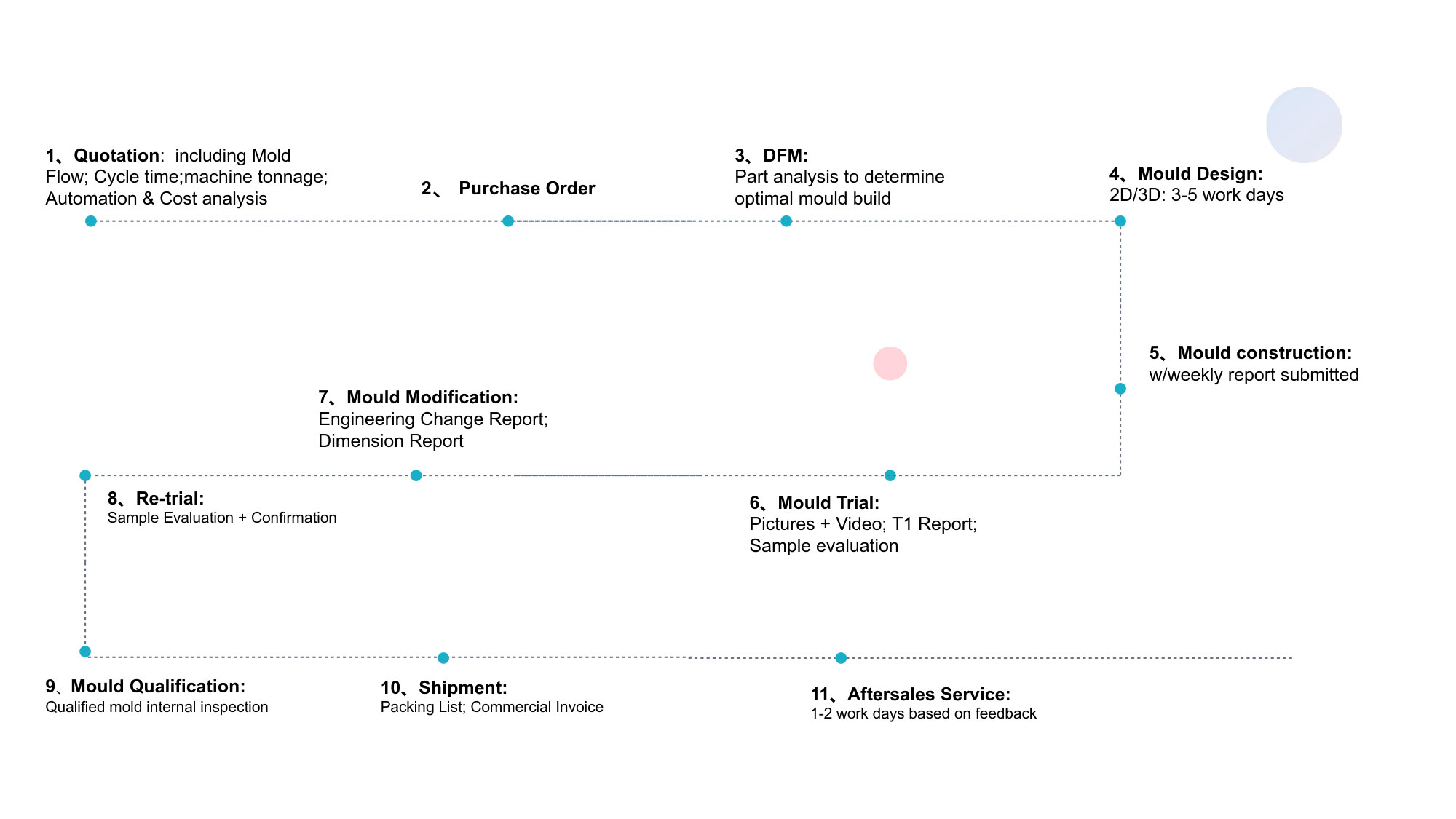
Step 1 – CAD Design & DFM Study (Week 1-2): Customer 3D CAD model is reviewed for manufacturability. DFM (Design for Manufacturing) study evaluates wall thickness distribution, draft angle requirements (minimum 1.5° for LSR release, 3° preferred for automatic part ejection), rib-to-wall ratios (0.5x wall thickness maximum to prevent sink marks), undercut detection (identifying slide or lifter requirements), and gate location proposals. DFM report is provided to customer for approval prior to steel cutting.
Step 2 – Steel Procurement & Machining Preparation (Week 2-3): Tool steels are procured from certified suppliers with material certificates (EN 10204 3.1). Material hardness is verified, and ultrasonic inspection confirms internal integrity. Steel blanks are stress-relieved through heat treatment cycles to prevent distortion during subsequent machining operations.
Step 3 – CNC Rough Machining (Week 3-4): High-speed roughing removes bulk material while leaving 0.5-1.0mm stock for finishing. Thermal management during roughing (coolant application, optimized toolpaths) prevents heat-induced material property changes.
Step 4 – Heat Treatment (Week 4): Plates and cavity inserts undergo vacuum hardening to achieve specified hardness (HRC 48-54) followed by tempering to relieve residual stresses.
Step 5 – Precision CNC Finishing (Week 4-6): Five-axis finishing achieves final cavity geometry with surface finish Ra 0.2-0.5μm. Electrode manufacturing for EDM of fine features.
Step 6 – EDM (Week 5-7): Wire EDM creates cooling channels, ejector pin holes, and slide mechanisms. Sinker EDM forms intricate cavity details and gate geometries.
Step 7 – Polishing & Surface Treatment (Week 6-8): Manual and automated polishing achieves Ra ≤0.05μm for optical cavities. Nickel-PTFE coating applied to runner surfaces to reduce LSR adhesion and facilitate cleaning [7†L10-L11].
Step 8 – Assembly & Cold Runner Integration (Week 8-9): Mold base assembly, insertion of cavity cores, installation of ejector system (ejector pins, return pins, ejector plate), cold runner deck assembly with needle valve installation, and cooling circuit pressure testing.
Step 9 – Mold Flow Verification & Samplings (Week 9-11): Mold installed on injection machine for T0, T1, T2 sampling runs. Each sampling round accompanied by detailed improvement report (defect analysis, root cause identification, recommended corrective actions). Quick-change insert capability enables different gate or venting configurations to be tested without rebuilding entire mold.
Step 10 – Full Dimensional Inspection & Shipment (Week 11-12): CMM inspection generates full-dimension report. CPk capability study performed on key dimensions using 30-part sampling. Mold preservation packaging for shipment.
Mold Cooling / Water Channel / Runner / Gating / Ejection System Design for High-Volume Production
Cooling System (Critical for Cycle Time Optimization): Conformal cooling channels (conforming to cavity contours, machined via deep-hole drilling or 3D-printed cooling inserts) follow the exact geometry of the nose cover cavity, providing uniform heat extraction across varying wall thickness profiles. Inserts incorporate spiraling cooling channel patterns for efficient heat dissipation. Thermally conductive copper-beryllium alloys are used for localized sections requiring rapid heat removal. The mold temperature control system maintains cavity surface temperature within ±2°C across the entire molding surface, directly preventing localized premature curing (which causes short shots) or incomplete curing (which causes sticky parts and demolding damage). Thermal imaging verifies temperature uniformity during mold qualification.
Runner System: Balanced runner layout for multi-cavity molds ensures equal flow path length and hydraulic diameter from sprue to each cavity gate. Runner diameters are optimized through mold flow simulation (typically 3-8mm diameter for LSR applications) to minimize pressure drop while preventing premature shear-induced curing [7†L6-L7]. Runner surface is polished to Ra ≤0.1μm and coated with nickel-PTFE to prevent LSR adhesion and enable easy purging between color/material changes.
Gating System: Gate locations are positioned at thickest cross-sections to promote flow to thinner distal sections. Pinpoint gates (0.5-1.0mm diameter) are standard for cosmetic surfaces requiring minimal gate vestige. Submarine gates (tunnel gates) are used for automatic degating during part ejection, eliminating manual gate removal. Multiple gates are used for large or complex nose cover geometries to ensure complete filling before cure completion.
Ejection System for Automatic Demolding: Silicone parts require careful ejection system design due to their high friction coefficient and tendency to stretch. Ansix Tech utilizes precision-ground ejector pins (1.5-4.0mm diameter) positioned strategically at rigid features (gussets, ribs, thick sections) to prevent part deformation. Air-assisted ejection (bursts of compressed air released through cavity surface) assists demolding of thin-wall delicate nose cover structures. Synchronized ejector plate stroke control ensures simultaneous pin movement across all contact points, preventing uneven lift-off and part twisting. Demolding draft angles are incorporated into all vertical walls (≥3° for LSR) to minimize extraction forces [7†L20-L21].
Customer Value: Well-designed cooling reduces cycle time by 20-40% → directly translates to higher daily output and lower per-part cost. Balanced runner and gate design ensures all cavities in multi-cavity mold fill simultaneously → all parts identical, no selective sorting required. Precision ejection system prevents part sticking → eliminating operator intervention for part removal reduces labor cost and prevents contamination risk.
Section 3: LSR Nose Cover Validation and Injection Molding Challenges
Key Injection Molding Challenges for LSR Nose Covers
Challenge 1 – Short Shots (Incomplete Filling): LSR has extremely low viscosity (as low as 5,000-50,000 mPa·s depending on shear rate), but the addition-curing reaction begins immediately upon reaching mold temperature. If injection speed is too low, the flow front cures before thin-wall section filling is complete, resulting in incomplete parts with missing sections.
Challenge 2 – Flash (Material Leakage Beyond Cavity): The low viscosity of LSR makes it prone to leaking through micro-gaps between parting surfaces, ejector pin clearances, and slide interfaces. Flash appears as thin membranes of cured silicone extending from the nominal part geometry, requiring manual trimming that adds labor cost and risks damaging the finished part.
Challenge 3 – Air Traps & Bubbles: LSR injection involves gas entrainment from incomplete evacuation of cavity air ahead of the advancing flow front. Trapped bubbles manifest as voids visible in transparent parts and structural defects in opaque parts.
Challenge 4 – Weld Lines (Knit Lines): When two or more flow fronts converge within the cavity, the meeting interface may not fully cross-link due to partially cured surfaces, creating a visible line with reduced mechanical strength — particularly problematic for optical/nose contact areas where both aesthetics and durability are critical.
Challenge 5 – Dimensional Variation (Shrinkage, Warpage): LSR material shrinkage after cure ranges from 1.5% to 4% depending on material grade, mold temperature, injection pressure, and packing parameters. If these variables are not tightly controlled, part dimensions shift across production batches, causing assembly fit issues in customer downstream processes.
Challenge 6 – Sticking & Demolding Damage: Cured LSR has high coefficient of friction and excellent elastic recovery, meaning it can tightly grip mold surfaces. Inadequate draft angles, insufficient ejection force, or poor surface finish of cavities will cause parts to stick in the mold or tear during ejection.
Ansix Tech Solutions to LSR Molding Challenges (Customer Value Translation)
Problem Ansix Solution Customer Value
Short shots Mold flow analysis pre-identifies fill-critical sections. High-speed injection (300mm/sec capability) fills cavity before cure initiation. Multi-stage injection profile: slow initial flow to prevent jetting, fast mid-fill to outrun cure front, final low-speed pack to compensate shrinkage. Eliminates scrap from incomplete parts → improves yield by 8-12%. Prevents customer production interruptions due to undersized parts.
Flash 0.005mm mold fit-up tolerance across entire parting surface. Self-locking clamp force compensation (hydraulic clamping system automatically adjusts for thermal expansion). Ejector pins ground to +0/-0.005mm clearance tolerance in pin bushings. Vacuum-assisted molding pulls flash inward into cavity rather than outward. Zero manual flash trimming required → saves $0.03-0.08 per part in secondary labor. Eliminates risk of cosmetic damage from trimming operations.
Air traps/bubbles Vacuum-assisted mold evacuation (−0.095 MPa absolute pressure) removes air before LSR injection. Venting channels (depth 0.01-0.03mm, width 6-10mm) positioned at flow-front terminal locations. Mold flow simulation predicts air trap locations for proactive vent placement. Void-free transparent parts meet medical device clarity requirements. Eliminates bubble-induced mechanical failure in sealing applications.
Weld lines Gate location optimization to position weld lines in non-cosmetic areas (typically at bottom flange or non-contact surfaces). Elevated mold temperatures (175-190°C) maintain flow front activity until complete convergence. Sequential valve gate opening controls flow front timing for synchronized convergence. Weld lines invisible in final assembly. No strength-reduced zones in load-bearing or sealing surfaces.
Dimensional variation MES-monitored process parameters (injection pressure ±0.5MPa, mold temperature ±1.5°C, cure time ±0.5 sec). Real-time part weight monitoring (each shot weighed to ±0.01g). In-mold temperature sensors and pressure transducers provide closed-loop feedback to injection controller. Batch-to-batch dimensional variation <0.02mm across million-part production → customer assembly lines run without adjustment. Eliminates selective sorting cost.
Sticking/demolding damage Ejection simulation (Moldflow) predicts required ejection force and optimal pin placement. Air-assist ejection provides demolding force without mechanical contact. Mirror-polished cavity surfaces (Ra ≤0.05μm) with nickel-PTFE coating reduces demolding friction by 60%. Zero operator intervention for part removal → automated lights-out production. No torn or damaged parts from manual extraction.
Validation Protocol: Each LSR nose cover program undergoes systematic process validation: (1) Initial sample submission (IS) from T0 mold delivers 25 parts for customer dimensional and functional evaluation, (2) Pilot run validation (100-500 parts) with full capability study (CPk ≥1.33 verification), (3) Production process qualification (PPQ) confirming documented process parameters produce in-spec parts across minimum 3 consecutive production shifts, (4) Ongoing continuous monitoring with SPC control charts tracking key dimensions, part weight, and visual quality metrics.
LSR Injection Molding Process Optimization — Efficiency Improvement & Cost Control
Optimized Process Parameters for LSR Nose Covers:
Parameter Typical Range Optimization Method for Cost Reduction
Mold temperature 170°C-190°C Zone-specific heating: runner side 15-20°C cooler than cavity side to prevent premature cure
Injection speed 50-200 mm/sec Multi-stage profile — slow (20 mm/sec) until gate, fast (150-200 mm/sec) during mid-fill, slow (10-20 mm/sec) for final pack
Cure time 5-60 sec/mm thickness Optimized using dynamic DSC (Differential Scanning Calorimetry) cure kinetics data — minimum time for 95% cross-linking
Injection pressure 50-120 bar Minimized through optimized gate sizing (reduces pressure drop) — lowers machine energy consumption
Back pressure 5-15 bar Minimized for LSR to prevent air entrainment from excessive shear
Shot size Part volume + cold runner volume Precision metering within ±0.5% to prevent over-packing waste
Cooling time 5-15 sec Conformal cooling channels reduce cooling time by 25-40% vs. traditional cooling layouts
Efficiency Improvement Strategies:
Multi-Cavity Productivity Scaling: 32-cavity molds produce 32 parts per machine cycle. For a 30-second cycle time (fill + cure + cooling + ejection), output reaches 3,840 parts per machine hour, or 92,160 parts per 24-hour production day. Scaling to 64-cavity molds doubles output with no additional machine, labor, or floor space.
Automated Production Cell Integration: Production cells integrate injection molding machine, robotic part extraction arm, high-resolution vision inspection camera, and automated packaging station. The robot extracts finished parts from the mold, transfers to vision station where camera inspects for defects (bubbles, shorts, dimensional deviations) at 60 parts/minute throughput, and verified parts are direct-loaded into customer-specified packaging (bulk bags, trays, or individual pouches). This fully automated approach reduces direct labor requirement to near-zero for the molding operation.
Smart Process Control (Industry 4.0): Injection machines equipped with iQ weight control smart assistance systems continuously analyze injection profiles (pressure curve, temperature profile, screw position) and automatically compensate for material viscosity variations between batches, ambient temperature changes, and machine wear [17†L40-L45]. Results: shot weight variation reduced to ±0.2% vs. ±1.0% for non-adaptive systems, directly reducing scrap from over-filled or under-filled parts.
Changeover Reduction (SMED — Single Minute Exchange of Die): Standardized mold clamping dimensions across LSR nose cover tools enable mold changes in 12-15 minutes vs. 60-90 minutes for conventional setups (utilizing hydraulic/ magnetic clamping, preheated molds in staging racks, and quick-disconnect cooling and electrical connections). 15-minute changeovers enable shorter production runs for multiple nose cover variants without excessive downtime.
Cure Time Reduction via Fast-Curing LSR Grades: Fast-curing LSR formulations reduce t90 (90% cure) by 20-50% compared to standard grades [6†L26-L28]. Using Wacker ELASTOSIL® LR 3005 series or equivalent fast-cure materials, 2mm wall-thickness nose covers cure in 10-15 seconds rather than 20-25 seconds with standard grades, representing 30-40% cycle time reduction at no additional machine cost.
Energy & Raw Material Cost Control:
Cost Category Standard LSR Molding Ansix Tech Optimized Approach % Savings
Material waste Hot runner creates 20-35% runner waste Cold runner with zero cured waste 30-80% material savings
Electricity per part Conventional hydraulic press All-electric servo drive with regenerative braking 40-60% energy reduction
Secondary labor Manual flash removal + inspection + packaging Automation cell: robotic handling + vision + packaging 60-85% labor reduction
Tooling maintenance Reactive repair after failures Predictive maintenance using cycle counters + proactive wear inspection 30-40% maintenance cost reduction
Scrap & rework 3-8% scrap typical SPC + closed-loop control = 1-2% scrap 60-75% scrap reduction
Total Unit Cost Impact: The combination of cold runner material savings, automation labor reduction, fast-cure cycle time reduction, and yield improvement through SPC reduces per-part manufacturing cost by 15-30% compared to traditional LSR processing approaches, depending on annual volume. For a 1-million-part/year program, this translates to 15,000−50,000annualcostsavingsversusconventionalmethods(assuming0.10-0.15 baseline unit cost).
Section 4: Full-Process Service — Reducing Customer Management Costs
Early Engagement: Design for Manufacturing (DFM) Report (Pre-signing Service)
Prior to any contract commitment, Ansix Tech provides a comprehensive DFM (Design for Manufacturing) feasibility analysis report. The DFM evaluates the customer’s 3D part file and provides recommendations on draft angle requirements (minimum 1.5° for LSR, 3° recommended for automatic ejection), wall thickness uniformity (suggested modifications to prevent thick-thin transitions that cause sink marks), gate location suggestions (positioned for minimal cosmetic impact and balanced flow), weld line location prediction (identifying potential knit line positions from mold flow analysis), ejector pin mark locations (proposing positions that avoid functional surfaces and cosmetic areas), and venting requirements (determining if vacuum assistance is needed). By identifying and resolving manufacturability issues before mold design begins, the DFM prevents costly design changes after steel has been cut — saving customers thousands of dollars in rework costs and 2-4 weeks of schedule delay.
Customer Value: DFM before commitment means no “surprise” mold modifications after order placement. Design changes made in CAD (costing hours) rather than steel rework (costing weeks and thousands of dollars). The DFM report serves as contract document — customers approve the exact mold design concept before any cutting begins.
Trial Molding & Sample Provision — T0 to T3 with Improvement Reports
Ansix Tech provides up to four sampling rounds (T0, T1, T2, T3) as part of the mold development process. T0 (First Trial) produces initial parts from finished mold, with full defect analysis identifying any quality issues. T1 incorporates corrections from T0 findings — new parts produced and re-analyzed. T2 and T3 continue iterative improvement until customer quality targets achieved [19†L10-L13]. Each sampling round is accompanied by a detailed Improvement Report documenting defect identification (photographs, measurement data, Cpk analysis), root cause analysis (mold design, process parameters, material properties, or handling issues), corrective action description (mold modifications, process changes, or material substitution), and corrective validation results (measurements confirming defect eliminated). Quick-change insert capability allows different gate designs or venting configurations to be tested without rebuilding entire mold — saving 2-3 weeks and thousands of dollars versus typical mold revision cycles.
Customer Value: T0-T3 sampling with detailed reports ensures customers understand exactly what issues were found and how they were resolved — no mysteries, no finger-pointing. Customers approve each improvement step before final mold shipment. Quick-change inserts enable design iteration without full mold rebuild → saves weeks of development time and reduces mold development cost by 20-30%.
Pilot Production Validation — Confirming Stability Before Full Production
Before committing to full-volume mass production, Ansix Tech performs pilot production runs of 100-500 parts. This pilot run uses the same process parameters, materials, tooling, and operators planned for high-volume production, validating that quality targets are consistently achieved under normal production conditions. Key outcomes from pilot production include: capability studies (CPk ≥1.33 for all critical dimensions, documented and reported), yield analysis (first-pass yield ≥98% demonstrated), process stability (SPC control charts show no out-of-control signals), and packaging validation (customer-specified packaging methods tested with pilot parts). Only after pilot production meets all quality and capability criteria does Ansix Tech transition to full production.
Customer Value: Pilot production eliminates the risk of scaling up to full production only to discover process instability or quality issues. Customers receive CPk data proving process capability before committing to full purchase orders. If pilot reveals issues, they are fixed on a small scale (low cost) rather than during full production (high cost, customer line interruptions).
Maintenance & Spare Parts Management
Each mold delivered to customers includes a comprehensive spare parts kit containing critical wear components: ejector pins (complete set for all cavity positions), core pins for each cavity, slide components for any side-action mechanisms, O-rings and seals for cold runner systems, and valve pins for needle gate systems. Molds are designed with standardized, off-the-shelf components wherever possible to simplify spare parts sourcing. Ansix Tech offers two maintenance programs: (1) Customer-performed: mold maintenance manual provided with detailed inspection checklists (recommended at 200,000-cycle intervals), and (2) Ansix-performed: return-to-factory maintenance service including complete disassembly, inspection of all components, replacement of worn ejector pins and seals, surface re-polishing to restore original finish, and full dimensional recertification. Lifetime repair service is available at cost-based pricing (no markup), ensuring customers have affordable access to repairs for the life of the mold.
Customer Value: Spare parts delivered with the mold means no downtime waiting for spare parts procurement — repairs can be performed immediately using on-hand components. Lifetime repair at cost eliminates customer concern about “captive” repair pricing from mold supplier. Standardized components reduce long-term spare parts costs.
Section 5: Ansix Tech Industry Experience — Proven Reliability and Customer Value
28 Years of Injection Molding Expertise
With over 28 years of experience in mold manufacturing and injection molding, Ansix Tech has developed deep expertise across a wide range of materials including LSR, engineering thermoplastics (PC, ABS, PC/ABS, PBT, PA6, PA66, PPS+GF, LCP, PEEK, PEI, PTFE, PFA), and rubber materials. The company has successfully delivered LSR molding projects across medical devices (CPAP masks, respiratory valves, septums, nasal cannulas, laparoscopic trocar seals), protective eyewear (goggle nose pads, face shield cushions), industrial seals (automotive gaskets, fluid handling diaphragms), and consumer wearables (watch bands, fitness tracker cushions) [19†L4-L7]. This cross-industry experience enables Ansix Tech to bring best practices from one application segment to another — solving challenges that may be new to a specific customer but have been successfully addressed in other industries.
Material Selection Expertise — Customer Value Through Proper Specification
Selecting the correct LSR material for a nose cover application directly impacts performance, manufacturability, and cost. Ansix Tech maintains documented material selection criteria:
Material Selection Factor Consideration for Nose Cover Applications
Hardness (Shore A) Soft (10-20A): maximum comfort, minimal pressure points. Medium (30-50A): balanced comfort and durability. Firm (60-80A): structural components
Transparency High-transparency grades (>90% light transmission) for optical clarity applications (e.g., protective face shields where visibility through nose cover is required)
Tear strength Minimum 12 kN/m for durability against repeated handling, cleaning, and stretching during donning/doffing
Compression set ≤30% @ 22h/175°C for shape retention — ensures nose cover returns to original geometry after compression during storage
Biocompatibility ISO 10993 and USP Class VI for medical/CPAP mask applications
Cure speed Fast-cure grades reduce cycle time — directly lowers per-part cost
Colorability Ease of pigment incorporation for custom color requirements
Material Grades for Nose Cover Applications:
Supplier Grade Series Key Properties Typical Application
Wacker ELASTOSIL® LR 3005 Fast curing, excellent mechanical properties, low compression set [6†L3-L7] General-purpose nose covers
Dow SILASTIC™ Self-lubricating grades, low viscosity CPAP masks, repeated assembly/disassembly
Momentive LIM™ 6010 Clear, low durometer (10-20A), excellent processability Soft nose pads for sensitive skin
Shin-Etsu KE-2000 series High tear strength, good heat resistance Durable industrial nose covers
Customer Value: Ansix Tech provides material recommendations based on application requirements, not just availability. Material certification documentation (ISO 10993 test reports, USP Class VI certificates, RoHS compliance) is provided with every shipment, saving customers the cost of performing these tests themselves.
Regulatory Compliance Support
For medical-grade LSR nose covers, Ansix Tech can provide full documentation supporting regulatory submissions: material biocompatibility test reports (ISO 10993 series covering cytotoxicity, sensitization, irritation, systemic toxicity), full material traceability (batch numbers linking raw material certificates to finished components), process validation documentation (IQ/OQ/PQ protocol and results), and device history records (DHR) for each production batch. Quality management systems operate under ISO 9001 certification, with ISO 13485 and ISO 14001 certifications maintained for medical device customers [19†L20-L22].
Customer Value: Regulatory documentation provided as standard service — not a costly add-on. Customers avoid 4-8 weeks of internal testing and documentation effort for each new material introduction.
Section 6: Cost Reduction — Systematic Approach Across Materials, Processes, and Efficiency
Material Cost Reduction
Cold runner technology: Traditional LSR hot runner systems generate 20-35% cured runner waste that must be discarded. Cold runner systems maintain runner material in liquid state between cycles, allowing reuse for the next shot. Material savings of 30-80% are achieved depending on part size-to-runner ratio [8†L8-L9]. For nose cover applications where runner volume often exceeds part volume (small parts with long flow paths), cold runner savings reach 60-80% of raw material cost.
Precision metering systems: Servo-driven metering pumps maintain mixing ratio accuracy within ±0.5%, preventing material property variations that cause scrap. Each nose cover receives exactly the calculated shot volume — no over-packing waste.
Scrap reduction through SPC: Real-time process monitoring with automated alerts when parameters drift reduces scrap rates from typical industry 3-8% to 1-2% for Ansix Tech LSR molding.
Process Efficiency Cost Reduction
Cycle time optimization: Mold flow analysis validates gate locations, runner diameters, and venting configurations before steel cutting, eliminating the 3-6 week trial-and-error period typical for mold qualification. Cure time is minimized using dynamic DSC data to determine the exact time required for 95% cross-linking at specific mold temperatures — no over-curing that wastes machine time.
Changeover reduction: Standardized mold dimensions across LSR nose cover families enables mold changes in 12-15 minutes using hydraulic/magnetic clamping and quick-disconnect cooling/electrical connections. Short changeovers enable production of multiple nose cover variants on same machine without excessive downtime.
Direct automation: Fully automated production cells reduce direct labor cost to near-zero for molding operations. Vision inspection at 60 parts/minute replaces manual inspection at 10-15 parts/minute with 100% consistent detection accuracy (no operator fatigue).
Tooling Investment Optimization
Modular mold design: Common mold bases accept interchangeable cavity inserts for different nose cover geometries. Customers launching product families pay for one mold base and individual cavity sets for each variant — reducing tooling investment by 40-60% compared to building entirely separate molds for each part number.
Quick-change inserts: Allows mold design iteration without building complete new mold. A revised gate location or venting design can be tested by replacing a single insert (costing
500−1,000)ratherthanrebuildingentiremold(5,000-15,000).
Pilot validation before full production: Running 100-500 pilot parts identifies and resolves process issues before high-volume production begins. Issues caught in pilot cost hundreds of dollars in analysis and tooling adjustments; issues caught after full production launch cost thousands in customer returns, emergency rework, and production line downtime.
Customer-Side Value Summary: Cost Reduction Quantified
Cost Category Typical Industry Baseline Ansix Tech Achieved Customer Savings
Raw material consumption 30-35% runner waste 0-5% runner waste (cold runner) 25-30% material cost reduction
Direct labor per part $0.08-0.12 $0.01-0.02 (fully automated cell) 75-85% labor cost reduction
Scrap rate 5-8% 1-2% 60-75% scrap reduction
Mold development time 6-10 weeks typical 4-7 weeks (DFM + quick-change inserts) 20-30% time-to-market reduction
Energy consumption 100 kWh baseline 60 kWh (all-electric servo) 40% energy cost reduction
Tooling investment 100% baseline 40-60% (modular mold design) 40-60% multi-part program savings
Total unit cost impact Baseline 15-30% lower per-part Direct to customer bottom line
Closing Customer Value Statement
For Ansix Tech, a mold is not just a block of steel — it is a customer’s revenue-generating production asset. Every mold designed and manufactured by Ansix Tech is engineered with the complete production ecosystem in mind: material flow characteristics, thermal balance across the molding surface, venting and ejection requirements, and automation integration compatibility. The result is a mold that arrives at the customer’s facility ready for reliable, repeatable, low-maintenance production — not a prototype requiring weeks of debug and adjustment. From upfront DFM analysis that prevents costly design changes, through precision mold manufacturing with documented quality validation, to pilot production confirmation and ongoing maintenance support, Ansix Tech delivers the complete solution for LSR liquid silicone nose cover production. Customers are invited to submit a current product for a full DFM report demonstration — seeing firsthand how weld lines, air traps, shrinkage, and other risks are identified and eliminated before a single dollar is invested in mold manufacturing.
Ansix Tech — Over 28 Years of Excellence in LSR Injection Molding
Mold is not just a tool. It is your production engine. We design it to run.
Ansix Tech Co Ltd
If you have any plans related to LSR Liquid Silicone Nose Cover , you can contact us at any time. We will turn your ideas into reality, let you realize your dreams, and obtain large orders from the market. Our contact information is info@ansixtech.com. Or contact our CTO, mail: stephen@ansixtech.com
#www.ansixtech.com #ansixtech.com #LSR Liquid Silicone Nose Cover #LSR Liquid Silicone Nose Cover injection molding companies #LSR Liquid Silicone Nose Cover Canopy Mold injection mold companies #Ansix #Ansix moulds #Ansix china #Ansix tech china #Ansix tech company #Ansix facotry #LSR Liquid Silicone Nose Cover injection molding #LSR Liquid Silicone Nose Cover injection tools #LSR Liquid Silicone Nose Cover injection moulds #LSR Liquid Silicone Nose Cover plastic mould #LSR Liquid Silicone Nose Cover plastic tools #Ansix Tech #Ansix molds #Ansix injection molding #Ansix mold factory #injection molding LSR Liquid Silicone Nose Cover#Ansix mold factory #LSR Liquid Silicone Nose Cover china #LSR Liquid Silicone Nose Cover molds #injection factory #LSR Liquid Silicone Nose Cover injection molding #LSR Liquid Silicone Nose Cover injection molding factory #injection molding company #LSR Liquid Silicone Nose Cover injection mold companies #LSR Liquid Silicone Nose Cover Tooling #LSR Liquid Silicone Nose Cover mold limited #Ansix mold china #Ansix companies #Ansix company China #LSR Liquid Silicone Nose Cover facotry #Ansix Tech #Ansix Tech mould #LSR Liquid Silicone Nose Cover injection moulding #injection moulding company #Ansix LSR Liquid Silicone Nose Cover parts injection mold companies #medical injection molding companieschina #LSR Liquid Silicone Nose Cover china factory #Ansix moulding companies #Ansix molding company #LSR Liquid Silicone Nose Cover injection moulding facotry #Ansix Tech mold #LSR Liquid Silicone Nose Cover mould #LSR Liquid Silicone Nose Cover plastic injection molding #ansix plastic mold #Mold manufacturing #LSR Liquid Silicone Nose Cover parts manufacturing #LSR Liquid Silicone Nose Cover plastic parts factory #LSR Liquid Silicone Nose Cover injection parts mold #LSR Liquid Silicone Nose Cover PRECISION MANUFACTURING #LSR Liquid Silicone Nose Cover #China mold #LSR Liquid Silicone Nose Cover injection moulding china #LSR Liquid Silicone Nose Cover mould china #china precision mold #mold in china #LSR Liquid Silicone Nose Cover mold china #Precision molds #High-precision molds #LSR Liquid Silicone Nose Cover #Injection molds #LSR Liquid Silicone Nose Cover Factory #LSR Liquid Silicone Nose Cover Company #Super Large Injection Mold Factory #Large Tonnage Injection Molding Factory #LSR Liquid Silicone Nose Cover Company #LSR Liquid Silicone Nose Cover Factory #2800T Injection Molding Factory #3000 Ton Injection Molding #4500 Ton Injection Molding Factory #Large Mold Injection Molding #Large Plastic Mold Injection Molding Factory #Large Injection Mold Manufacturer #Plastic Mold Factory #Injection Mold #Plastic Mold