



LSR Liquid Silicone Lens
FEATURES
Product Introduction and Technical Value Proposition
What Is LSR Liquid Silicone Lens?
LSR liquid silicone lenses represent a breakthrough in optical component manufacturing. Unlike traditional glass or thermoplastic lenses, LSR lenses are produced through a liquid injection molding process where two-component addition-cure silicone rubber (Part A and Part B mixed in precise 1:1 ratio) is injected into a heated mold cavity and cured within seconds through a vulcanization reaction at mold temperatures of 110°C to 200°C. The resulting material is a thermoset elastomer that offers exceptional optical clarity, thermal stability, and design flexibility.
Optical Performance That Exceeds Industry Standards
LSR lens materials achieve up to 95% light transmission with minimal haze, comparable to premium optical glass. The Abbe number of approximately 50 provides excellent dispersion control, while UV and blue light stability ensure long-term optical performance even under high-intensity LED exposure. These properties make LSR lenses the preferred choice for adaptive driving beam (ADB) headlights, sensing lenses for autonomous driving systems, and precision optics for consumer electronics.
-
Mold Description
Product Materials:
LSR SILICONE
Soft rubber: LSR
Mold Material:
S136ESR
Number of Cavities:
2
Glue Feeding Method:
Hot runner
Cooling Method:
Water cooling
Molding Cycle
33.5s
- The mold manufacturing process and product material selection
Customer Value: Solving Real Problems
When we present LSR lens solutions to customers, we address five critical problems that traditional materials cannot solve effectively:
High-Temperature Degradation: Traditional PC and PMMA lenses yellow and crack when exposed to 150°C heat combined with blue light radiation, limiting LED system lifespan to only a few thousand hours. Our LSR lenses maintain optical stability above 150°C, enabling next-generation high-power LED systems with expected lifespans exceeding 50,000 hours.
Assembly Complexity and Cost: By integrating optical and sealing functions into a single LSR component, we reduce bill of materials, eliminate assembly seams, and cut inventory costs.
Fragility and Impact Resistance: Glass lenses break easily and require complex mounting systems. LSR lenses offer exceptional impact resistance across temperatures from -40°C to +230°C while maintaining optical precision.
Design Constraints: Thermoplastics cannot mold undercuts or complex microstructures without secondary operations. LSR flows into the smallest features with viscosity as low as 38 Pa·s, enabling geometries impossible with rigid materials.
Weight Reduction: LSR density of 1.01 g/cm³ offers approximately 50% weight savings compared to glass without compromising optical performance.
-
Hard Power Infrastructure—The Foundation of Reliability
Precision Mold Manufacturing Equipment
Customer trust begins with capability. Ansix Tech operates a complete, state-of-the-art mold manufacturing facility where we transform engineering concepts into production-ready tooling with uncompromising precision.
Five-Axis High-Speed Machining Centers: Our five-axis machining centers achieve positional accuracy of 0.002mm, enabling us to machine complex curved optical surfaces with mirror-finish quality. This precision directly translates to lens surfaces that require no post-polishing, parting lines that are smooth and flash-free, and optical geometries that meet the most demanding light distribution specifications. For micro-structured optical surfaces used in ADB headlight matrices, our machining capability can reproduce features smaller than 0.01mm with exceptional surface finish.
Wire EDM with Slow Wire Technology: Our slow wire EDM machines enable precision cutting of 0.03mm micro-holes and narrow slots. This capability is essential for manufacturing the intricate venting channels and thin-wall sections characteristic of LSR optical molds. Rather than struggling with part deformation or incomplete filling, our customers receive molds that vent air efficiently and fill completely on every cycle.
CNC Grinding and Sinker EDM: Complementing our machining and EDM capabilities, our precision grinding and sinker EDM equipment allows us to achieve surface finishes below Ra 0.05μm on critical optical surfaces, eliminating the need for manual polishing that could alter complex geometries.
What This Means for Customers: When we say we can meet your tolerance requirements, we are not making promises—we are describing daily operations on equipment validated to produce consistent, repeatable results. A complex optical surface that requires 0.002mm profile accuracy is not a challenge for us; it is routine.
Injection Molding Machine Fleet
Ansix Tech maintains a diversified fleet of all-electric and hybrid LSR injection molding machines spanning clamping force ranges from 30 tons to 400 tons, covering lens sizes from micro-optics under 1mm diameter to full-size automotive headlamp lenses exceeding 150mm.
All-Servo Electric Drive Technology: All our primary LSR molding machines are equipped with all-servo electric drive systems, delivering injection repeatability of ±0.1%. This means that when we start production, the thousandth lens is dimensionally identical to the first. For customers producing lenses for ADB systems where light pattern alignment tolerances are measured in fractions of a degree, this repeatability is not a luxury—it is a requirement.
Closed-Loop Process Control: Each machine integrates closed-loop control systems that continuously monitor injection pressure, melt temperature, screw position, and mold temperature. Real-time adjustments maintain process parameters within specified ranges, preventing drift that could compromise lens quality over long production runs. The APCplus function continuously analyzes the injection molding process and quickly compensates for material and environmental fluctuations in melt viscosity, ensuring consistently high component quality and reducing rejects to a minimum.
Dedicated LSR Metering and Mixing Systems: Each press integrates precision dosing units designed specifically for LSR. These systems maintain accurate 1:1 mixing ratios of Part A and Part B components, with real-time flow monitoring ensuring every shot receives the correct material blend. For optical-grade lenses where impurities or incomplete mixing would cause visible defects, this precision is non-negotiable.
What This Means for Customers: Our machine specifications directly address your concerns about part-to-part consistency. Whether you need 10,000 lenses or 10 million, each lens will perform identically to the sample you approved. We eliminate the variability that drives quality control costs and field failures.
Metrology and Inspection Equipment
Every mold and every lens we produce undergoes rigorous dimensional verification before leaving our facility.
Coordinate Measuring Machines (CMM): Our CMMs provide dimensional validation to ±0.001mm accuracy. Each mold cavity is measured comprehensively, and we deliver a full dimensional report with every mold shipment.
Optical Measurement Systems: Non-contact optical measurement systems inspect lens surface profiles, radii, and optical center positions without risk of surface damage. These systems are essential for validating the complex freeform optical surfaces used in modern LED lens systems.
Optical Performance Testing: For completed lenses, we conduct transmittance measurement using spectrophotometers (with pass/fail criteria of ±1% transmission deviation), haze measurement (reject threshold >1% haze), and light distribution testing using goniophotometers that evaluate actual optical performance against design specifications. Every optical parameter is verified before shipment.
What This Means for Customers: When we ship a mold or a production batch, it arrives with documented evidence that every critical dimension and optical parameter has been verified. You do not need to re-inspect our work or worry about out-of-spec components reaching your assembly line.
Cleanroom Manufacturing Environment
LSR optical lenses demand contamination-free manufacturing. Ansix Tech operates Class 10,000 certified cleanroom facilities for all LSR lens production and inspection activities. Molded lenses are de-molded, inspected, and packaged entirely within cleanroom environments, preventing particle contamination that would create visible defects in finished optics. All personnel wear cleanroom garments and follow strict contamination control protocols.
Section Three: Mold Manufacturing Core Competencies
Material Selection: Building for Lifespan
The longevity of an LSR optical mold depends entirely on material selection matched to production volume requirements. Ansix Tech selects mold materials based on your specific needs, providing clear guarantees tied to material choices.
Mold Base Steel—P20: Our standard P20 mold bases provide excellent stability for production runs up to 500,000 shots. For customers who require longer service life or are molding abrasive optical-grade LSR formulations, we upgrade to harder, more wear-resistant materials.
Cavity and Core Materials: For optical-grade LSR lens production, we specify premium tool steels including:
S136 (Stainless): Superior corrosion resistance and polishability to Ra <0.05μm mirror finish, essential for high-transparency lens surfaces
2343 / 2344 (Hot Work Steels): Exceptional thermal stability and wear resistance for extended production runs
8407 / H13: High toughness and thermal fatigue resistance for molds subjected to continuous high-temperature cycling
SKD11 / DC53: Premium wear resistance for high-volume production
NAK80: Pre-hardened steel offering excellent polishability and dimensional stability
M340 / 4Cr13 / 9Cr18: Corrosion-resistant stainless grades for medical and cleanroom applications
Material Performance Commitments: We provide full material certification documentation with every mold, including heat treatment curves and hardness test results. For standard LSR optical lens production (non-abrasive materials), we guarantee 500,000 shots minimum tool life. For premium tool steel specifications, we guarantee 1,000,000 shots or more. Customers can rely on these guarantees because we build them into our material selection and processing protocols.
Achievable Tolerances: Precision You Can Trust
Different lens applications require different precision levels, and Ansix Tech delivers appropriate tolerances for every requirement.
Application Category Achievable Tolerance What This Means
General Optical Lenses ±0.05mm Suitable for lighting, indicator lenses, and general illumination applications
Precision Automotive Lenses ±0.02mm - ±0.03mm ADB headlamp lenses, matrix LED optics requiring pattern accuracy
High-Precision Optical Components ±0.005mm Medical optics, precision sensing lenses, micro-optical arrays
For high-precision applications, every lens is validated through CMM measurement and CPK statistical analysis. Key optical dimensions are maintained at CPK ≥1.33, meaning only 3.2 defects per 10,000 parts—statistically validated quality that you can document for your own quality systems.
Mold Configuration Types: Matching Production Needs
Ansix Tech designs and manufactures multiple mold configurations to match your specific production requirements:
Cold Runner Systems (Cold Deck): For LSR processing, we employ sophisticated cold runner systems where the runner remains cooled below curing temperature while the cavity is heated for vulcanization. This design eliminates runner and sprue waste entirely, as no material cures in the delivery system. All injected LSR becomes a finished product, achieving near-zero material waste. For optical lenses where material purity is critical and LSR cannot be reground, cold runner technology is essential for economical production.
Valve Gate Systems: For optical lenses where gate vestige must be minimized, we implement precision valve gate systems with servo-driven needle control. Electric valve-gate systems allow minute control of valve-pin movements and the ability to rapidly balance LSR cavity filling, eliminating gate marks while maintaining fill balance across multiple cavities.
Multi-Cavity Molds: For high-volume lens production, we manufacture multi-cavity molds with 2, 4, 8, 16, or more cavities. Each cavity is flow-balanced through design verification and iterative optimization, ensuring all lenses produced in the same shot are dimensionally and optically identical. We address the challenge of filling imbalances in multi-cavity LSR molds through runner balancing and strategic gate placement, using open nozzle systems where appropriate to allow material to flow back into the cold runner during vulcanization as a natural equalization mechanism.
Family Molds: For customers requiring multiple lens types, we design family molds with multiple cavity geometries in the same mold base, reducing total tooling investment and enabling production flexibility.
Gate and Runner Design Optimization
The gate and runner system directly determines lens quality, waste generation, and cycle efficiency.
Gate Location Strategy: We use Moldex3D mold flow simulation to analyze LSR flow behavior, identify weld line locations, pinpoint trapped air zones, and optimize filling balance before cutting any steel. This upfront simulation identifies the exact number of gates required (single-point or multi-point) and their optimal locations before tooling begins. By resolving flow issues in the simulation phase, we eliminate weld lines in the optical zone, remove trapped air that would cause bubbles, and ensure complete filling of complex geometries on the first production try.
Cold Runner Design: Our cold runner systems maintain the LSR in a liquid state until the exact moment of injection. We carefully design the thermal transition area between the cooled runner block and the heated mold cavity to prevent premature curing while maintaining efficient heat transfer to the cavity. For multi-cavity applications, we evaluate balanced runner geometry to ensure each cavity receives identical flow characteristics.
What This Means for Customers: When we deliver a mold to your production floor, it is ready to run from the first shot. Our gate and runner designs eliminate the trial-and-error testing that consumes weeks of production time and generates tons of scrap material. You do not need to discover filling problems—we solve them before they exist.
Cooling System Engineering
Temperature control is critical in LSR processing. Unlike thermoplastic molding where cooling solidifies the part, LSR requires precise heating to trigger the vulcanization reaction. Ansix Tech designs sophisticated thermal management systems that maintain uniform temperature distribution across all mold surfaces.
Multi-Zone Heating: Our molds incorporate multi-zone cartridge heating systems with independent temperature controllers for each critical region. Optical zone temperatures are maintained within ±2°C across the entire cavity surface, eliminating uneven curing that causes optical distortion.
Cooling Channels for Runner Systems: While the cavity is heated, the cold runner system must be actively cooled to prevent premature curing of LSR in the delivery channels. We design isolated cooling channels within the runner plate that maintain temperatures below 40°C while the cavity operates at 170°C. Thermal isolation between hot and cold zones is achieved through careful material selection and thermal gap design.
What This Means for Customers: Consistent temperature across the cavity means consistent cure rates across all lenses produced. No lens cures faster or slower than another. Thermal management eliminates the variability that causes batch-to-batch differences in optical clarity and mechanical properties.
Ejection System Design
LSR lenses are soft, flexible, and sticky immediately after curing. Conventional ejector pins would damage optical surfaces or fail to release the part cleanly.
Custom Ejection Solutions: We design ejection systems specifically for LSR, including air ejectors that use compressed air to float lenses off cavity surfaces without contact, robotic pickers with soft-touch gripping surfaces, and stripper plate systems for lens geometries that require uniform ejection force distribution.
Automated De-molding Integration: Our molds are designed for integration with automated demolding systems, including linear robots and six-axis pick-and-place units that remove lenses immediately after mold opening, transfer them to inspection stations, and package them without human contact that could introduce contamination or damage.
Section Four: Injection Molding Process Excellence
Process Standardization and Digital Control
Customer anxiety about production variability drives our commitment to standardized, digitally controlled processes.
MES-Integrated Process Lockdown: All injection molding parameters—including melt temperature, injection pressure profile, injection speed profile, holding pressure time and magnitude, cure time, mold temperature profile, and open/close speeds—are captured in our MES (Manufacturing Execution System) and locked with multi-level authorization controls. Only qualified engineers can modify parameters, and every change is logged, audited, and time-stamped.
Parameter Validation Protocol: Before any production run begins, we validate that every parameter matches the master recipe established during process qualification. If a machine deviates outside specified limits, the MES automatically halts production and notifies quality personnel.
First-Piece and Last-Piece Inspection: Every production batch undergoes first-piece dimensional and optical inspection before the run begins, with the first valid part measured against all critical specifications. Last-piece inspection confirms that process stability was maintained through the entire run. Batch release requires both inspections to be within specification limits.
What This Means for Customers: Your production is not subject to operator decisions or daily variability. The process that produced your approval samples is locked, controlled, and validated. The thousandth lens will match the first lens, and you have documented evidence of every parameter setting to prove it.
Dimensional Stability Control
Lens geometry directly determines optical performance. Dimensional variation of even 0.01mm can shift light patterns, reduce efficiency, or cause field failures.
Mold Temperature Zone Control: We implement mold temperature zone control systems that maintain independent temperature regulation for each critical region, with core and cavity temperature differences maintained below 2°C to minimize warpage and shrinkage variation. For optical lenses where uniform geometry is essential, tight temperature control prevents the localized shrinkage differences that cause optical distortion.
Closed-Loop Process Adaptation: Modern injection molding control systems like APCplus analyze the injection process and compensate for material and environmental fluctuations in melt viscosity in real time. For LSR lenses, this adaptive control ensures consistent filling and curing regardless of variations in raw material lot or ambient conditions.
Statistical Validation: For qualification and ongoing production monitoring, we provide CPK analysis for critical dimensions. Our documented performance for similar lens products includes dimensional fluctuations below 0.02mm on critical optical center positions and mounting features across three consecutive production batches with thousands of parts per batch.
Optical Surface Quality Standards
LSR lenses are judged primarily by optical appearance. We define and achieve explicit surface quality standards that eliminate customer inspection uncertainty.
Quality Level Surface Roughness Optical Requirements
Standard Optical Ra ≤0.1μm No visible flow marks, no entrapped bubbles >0.1mm
Premium Optical Ra ≤0.05μm Bubble-free surfaces, no flow lines through optical zone
Micro-Optics Ra ≤0.02μm Mirror finish suitable for high-precision beam shaping
For bubble-free lens production, we combine careful venting design in the mold, degassed LSR material, and optimized injection profiles that minimize air entrapment during filling. Vacuum venting systems remove air from the cavity before and during injection, preventing the trapped air pockets that would appear as visible bubbles in the finished lens.
Special Material Handling Capabilities
While LSR lens materials are our specialty, Ansix Tech has extensive experience across the full spectrum of engineering thermoplastics and advanced materials, enabling us to serve customers who require overmolding or multi-component assemblies:
PC and PC/ABS: Automotive interior optics, high-impact applications
PPS + 40% GF: High-heat electronic housings
PEEK, PTFE/PFA, PAI: Extreme-temperature applications, chemical resistance
PA6 + GF30: Structural components with glass reinforcement
LCP, PEI, PES, PSU: High-performance electrical and electronic components
PBT, PET, POM: General engineering applications
PMMA: Optical-grade clarity for non-silicone applications
PVC, TPE, TPU: Overmolding and soft-touch components
For each material system, we maintain documented processing protocols that optimize flow characteristics, reduce cycle times, and prevent degradation.
Flame Rating and Environmental Compliance
Automotive and lighting customers require verified material certifications:
UL94 V-0 flammability rating for electrical enclosures and housings, documented with material certifications
UV stability certification confirming 3,000-hour accelerated aging test results with no measurable yellowing
150°C continuous operating temperature capability for high-power LED proximity applications
Biocompatibility compliance for medical optical applications, meeting ISO 10993 standards
Section Five: Full-Process Service Integration
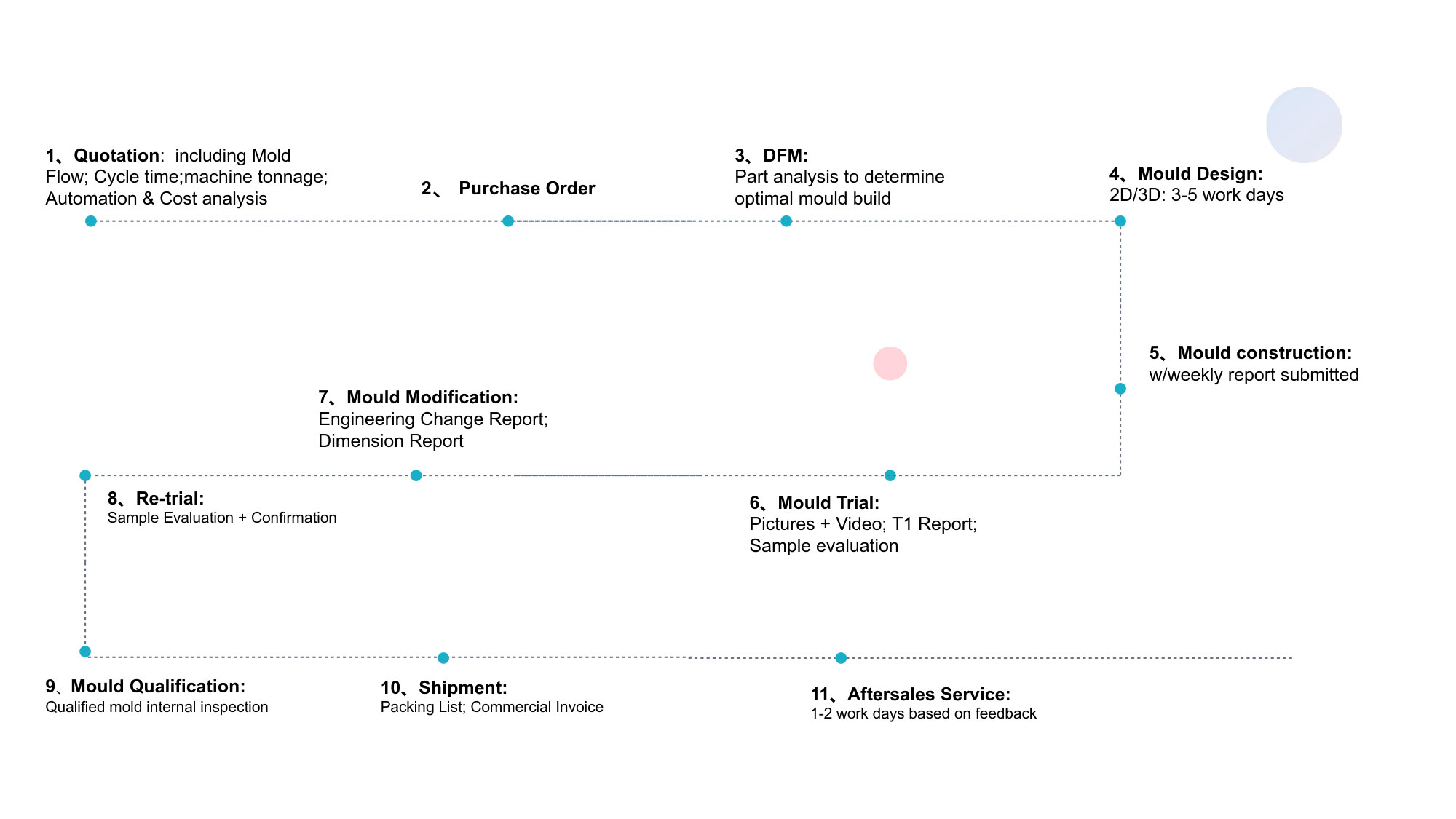
Early Engagement: DFM Reports Before Tooling
Customer complaints about post-tooling rework cost time and money. Ansix Tech prevents these problems through disciplined early engagement.
Design for Manufacturability (DFM) Analysis: Before we quote tooling costs or cut any steel, we provide a comprehensive DFM report that evaluates your lens design for manufacturability. Our DFM includes draft angle recommendations that ensure clean demolding without surface drag marks, wall thickness optimization that balances filling speed against cure time, gate location analysis that prevents weld lines in the optical zone, and ejector pin location mapping that avoids marring optical surfaces.
Mold Flow Simulation: For every lens project, we run full mold flow simulation using Moldex3D software to visualize material behavior before we build hardware. We analyze filling patterns to predict and eliminate weld lines and trapped air locations, evaluate gate locations to ensure complete fill balance across all cavities, predict curing behavior to optimize cycle time and part consistency, and validate the complete design before committing to tooling.
Risk Assessment and Mitigation: Our DFM includes a formal risk assessment identifying potential molding challenges and our proposed mitigation strategies. Customers sign off on the DFM before we begin tooling, creating documented alignment that prevents scope creep and unexpected costs.
What This Means for Customers: We discover and solve manufacturing problems in CAD and simulation, not after your tooling is built. The DFM process typically saves 2–4 weeks of post-tooling debugging and eliminates the discovery that “this geometry cannot be molded” after you have already committed significant investment.
Sampling and Validation Protocol
ANSIX Tech follows a structured sampling protocol that builds confidence gradually:
T0 through T3 Sampling: We provide samples from trial shots as we refine the process:
T0 (First Trial): Unoptimized sample demonstrating cavity fill capability
T1 (First Optimization): Refined sample after gate and venting adjustments
T2 (Second Optimization): Process-optimized sample near production conditions
T3 (Qualification): Production-ready sample meeting all specifications
Each trial round includes a detailed improvement report showing how we addressed each issue discovered in the previous trial. For optical lenses where fine-tuning may require multiple iterations, we maintain fast-change insert capabilities that allow cavity geometry modifications without rebuilding entire molds.
Accelerated Production Verification: Before initiating full-volume production, we conduct 100 to 500 pre-production shots under final process conditions, documenting yield rates and providing CPK analysis for all critical dimensions. We release the production line only when statistical evidence confirms stable, repeatable performance.
Flexible Insert Replacement: When design changes are required after tooling is complete, our mold design incorporates modular insert systems for rapid cavity geometry changes without scrapping entire mold bases.
Maintenance and Spare Parts Management
Tooling lifespan depends on maintenance quality. Ansix Tech delivers comprehensive support beyond initial delivery.
Spare Parts Package: Every mold ships with a comprehensive spare parts kit containing critical consumable components: ejector pins for all ejection positions, core pins for wear-prone features, fast-change cavity inserts for high-wear locations, and venting inserts for cleanable air evacuation channels.
Scheduled Maintenance Support: We provide documented maintenance procedures at 200,000 shot intervals. These procedures clean accumulated residue from venting channels, inspect critical dimensions for wear, and replace worn components before they cause quality issues. Following these schedules extends mold life to 1,000,000+ shots.
Lifetime Repair Service: Repairs are completed at cost plus labor without profit markup, reflecting our commitment to long-term partnership rather than transactional sales.
Section Six: Delivery Efficiency
Standard Lead Times
Mold Complexity Standard Lead Time Express Lead Time
Simple single-cavity lens mold 10 working days 6–7 days
Medium-complexity 2–4 cavity mold 25–35 working days 18–25 days
Complex multi-cavity precision optical mold 40–55 working days 30–40 days
High-cavitation (8+) advanced optical mold 55–65 working days 45–55 days
Express Delivery Assurance: When customers require compressed schedules, we deploy our internal electrode manufacturing center and EDM workshop to complete most mold manufacturing operations without outsourcing delays. We never skip validation steps—express delivery is achieved through parallel processing, not reduced quality requirements.
Production Capacity
Standard daily lens output: 20,000–80,000 units depending on cavity count and cycle time
Automated 24/7 production capability for high-volume programs
Rapid response to volume increases through additional mold cavitation or duplicate tooling
Flexible capacity scaling based on customer demand forecasts
Section Seven: Customer Pain Points—Addressed Directly
Pain Point: “Molds Require Constant Repair, Disrupting Production”
Ansix Response: We conduct 2,000-shot accelerated aging tests before every mold shipment, complete with documented wear reports. We provide a three-year structural warranty on mold components (excluding normal consumable wear on ejectors and venting components). For lens molds requiring high cavitation, each cavity is independently replaceable with documented interchangeability standards.
Pain Point: “Excessive Flash Drives High Post-Processing Costs”
Ansix Response: Our parting lines are machined to 0.005mm precision using five-axis finishing passes on hardened steel. For LSR specifically, we implement self-locking clamp force compensation that maintains consistent clamping through the entire cure cycle as LSR expands during vulcanization. Flash is consistently maintained below 0.03mm, eliminating manual deflashing operations. Your lenses go directly from mold to inspection without secondary trimming.
Pain Point: “Dimensions Change Every Production Batch”
Ansix Response: All presses are equipped with ultrasonic wall thickness sensors providing real-time feedback to automatically compensate holding pressure for wall thickness variations. For critical optical applications, we can implant in-mold temperature and pressure sensors enabling true closed-loop process control with cycle-by-cycle adaptation.
Pain Point: “Mold Repair Takes Weeks”
Ansix Response: Our in-house electrode manufacturing center and EDM workshop complete the majority of mold repairs without subcontracting delays. Standard rework—including spot welding, insert replacement, and cavity touch-ups—is completed within 24 hours. The mold returns to your production line before your next shift begins.
Section Eight: Cost Reduction Strategy
Material Cost Reduction
Through cold runner system implementation, we achieve material utilization rates approaching 100%. Every gram of LSR delivered to the press becomes a finished product. Additionally, we work with customers to design integrated optical-mechanical components that combine multiple functions (lens + seal + mount) into single parts, reducing material consumption and eliminating secondary operations and assembly costs. For automotive headlamp modules, this integration typically reduces total system cost by 15–25%.
Process Efficiency Improvement
Our process optimization studies target reducing injection and curing cycle times without compromising optical quality. Through optimized mold temperature management, precision gate design, and LSR material selection with fast-cure catalysts, we achieve cycle times under 15 seconds for many lens products. For customers comparing LSR to thermoplastics, the faster cure times of LSR versus longer cooling requirements for PC or PMMA provide direct labor and machine time savings.
Tooling Cost Optimization
Rather than building full-scale production tooling for prototype and early validation phases, we deploy rapid prototyping molds and modular tooling systems that share common mold bases with interchangeable cavity inserts. This approach reduces initial investment by 40–60% while maintaining an upgrade path to full production capacity when volumes justify the investment.
Scrap Rate Reduction
Every lens that does not meet specifications represents wasted material, wasted machine time, and wasted labor. Through rigorous process validation and closed-loop control systems, we achieve first-pass yields exceeding 95% for optical-grade LSR lens production. For automotive customers requiring documented PPM performance, our typical field performance is fewer than 500 defective parts per million.
Section Nine: Ansix Tech Industry Experience
With over 28 years of continuous operation in precision molding, Ansix Tech has developed documented expertise across multiple LSR optical applications:
Automotive LED headlamp lenses and matrix light optics
Sensing lenses for autonomous driving and ADAS systems
Flash lenses for consumer electronics and mobile devices
Light guides for interior and exterior automotive lighting
Medical optical components requiring ISO 10993 biocompatibility
Solar concentrating optics and photovoltaic systems
Industrial sensing and illumination optics
Each product category has generated documented case studies, CPK data, and customer validation records demonstrating our ability to meet the most demanding industry standards.
Our quality systems align with IATF 16949 automotive certification standards for optical lens manufacturing. This means our processes, documentation, and quality control systems meet the expectations of the world‘s largest automotive manufacturers and Tier 1 suppliers. For customers who require this level of certification for their own quality systems, we provide complete documentation including material certifications, PPAP packages, and process validation records.
Conclusion: From Metal to Money
At Ansix Tech, we believe molds are not blocks of metal—they are revenue-generating assets that should earn their keep from the very first shot. Every mold we build is engineered with production moldability, optimized gas venting, balanced temperature distribution, and intuitive mounting designed to run on your equipment without debugging. The molds we deliver are not projects; they are solutions that our customers have used to produce millions of lenses reliably, profitably, and consistently.
We invite you to experience the difference that 28 years of focused expertise makes. Provide us with your lens design, and we will run a complete DFM analysis that shows you exactly how we would manufacture your part, where we would place gates, how we would balance the mold, where risk exists, and how we would mitigate it. The analysis is provided at no cost and with no obligation. You will see—before you spend a dollar on tooling—exactly how Ansix Tech translates technical expertise into measurable customer value.
A mold is not just a tool. A mold is a production asset. At Ansix Tech, we engineer every asset to maximize your return on investment, minimize your risk, and deliver consistent, repeatable quality from the first shot to the millionth.
Ansix Tech Co Ltd
If you have any plans related to LSR Liquid Silicone Lens , you can contact us at any time. We will turn your ideas into reality, let you realize your dreams, and obtain large orders from the market. Our contact information is info@ansixtech.com. Or contact our CTO, mail: stephen@ansixtech.com
#www.ansixtech.com #ansixtech.com #LSR Liquid Silicone Lens #LSR Liquid Silicone Lens injection molding companies #LSR Liquid Silicone Lens Canopy Mold injection mold companies #Ansix #Ansix moulds #Ansix china #Ansix tech china #Ansix tech company #Ansix facotry #LSR Liquid Silicone Lens injection molding #LSR Liquid Silicone Lens injection tools #LSR Liquid Silicone Lens injection moulds #LSR Liquid Silicone Lens plastic mould #LSR Liquid Silicone Lens plastic tools #Ansix Tech #Ansix molds #Ansix injection molding #Ansix mold factory #injection molding LSR Liquid Silicone Lens#Ansix mold factory #LSR Liquid Silicone Lens china #LSR Liquid Silicone Lens molds #injection factory #LSR Liquid Silicone Lens injection molding #LSR Liquid Silicone Lens injection molding factory #injection molding company #LSR Liquid Silicone Lens injection mold companies #LSR Liquid Silicone Lens Tooling #LSR Liquid Silicone Lens mold limited #Ansix mold china #Ansix companies #Ansix company China #LSR Liquid Silicone Lens facotry #Ansix Tech #Ansix Tech mould #LSR Liquid Silicone Lens injection moulding #injection moulding company #Ansix LSR Liquid Silicone Lens parts injection mold companies #medical injection molding companieschina #LSR Liquid Silicone Lens china factory #Ansix moulding companies #Ansix molding company #LSR Liquid Silicone Lens injection moulding facotry #Ansix Tech mold #LSR Liquid Silicone Lens mould #LSR Liquid Silicone Lens plastic injection molding #ansix plastic mold #Mold manufacturing #LSR Liquid Silicone Lens parts manufacturing #LSR Liquid Silicone Lens plastic parts factory #LSR Liquid Silicone Lens injection parts mold #LSR Liquid Silicone Lens PRECISION MANUFACTURING #LSR Liquid Silicone Lens #China mold #LSR Liquid Silicone Lens injection moulding china #LSR Liquid Silicone Lens mould china #china precision mold #mold in china #LSR Liquid Silicone Lens mold china #Precision molds #High-precision molds #LSR Liquid Silicone Lens #Injection molds #LSR Liquid Silicone Lens Factory #LSR Liquid Silicone Lens Company #Super Large Injection Mold Factory #Large Tonnage Injection Molding Factory #LSR Liquid Silicone Lens Company #LSR Liquid Silicone Lens Factory #2800T Injection Molding Factory #3000 Ton Injection Molding #4500 Ton Injection Molding Factory #Large Mold Injection Molding #Large Plastic Mold Injection Molding Factory #Large Injection Mold Manufacturer #Plastic Mold Factory #Injection Mold #Plastic Mold