



Medical Liquid Silicone Reactor Vessel Body
FEATURES
Ansix Tech: Medical Liquid Silicone Reactor Vessel Body – Translating Technical Expertise into Measurable Customer Value
Injection Mold Tooling & Liquid Silicone Rubber Production Capabilities
Executive Summary: From Technical Specifications to Business Outcomes
The language of injection molding is precise — tolerances in microns, cycle times in seconds, cure temperatures in degrees Celsius. However, what truly matters to medical device manufacturers is not the technical metric itself, but what that metric delivers: reliability that prevents patient risk, repeatability that ensures regulatory compliance, and efficiency that directly reduces landed cost per part.
-
Mold Description
Product Materials:
LSR
Soft rubber: silicone
Mold Material:
S136ESR
Number of Cavities:
2
Glue Feeding Method:
Hot runner
Cooling Method:
Water cooling
Molding Cycle
32.5s

-
This document presents Ansix Tech‘s end-to-end capabilities for the Medical Liquid Silicone Reactor Vessel Body project through the lens of customer value translation — converting every technical specification into a tangible business outcome.
With over 28 years of manufacturing experience, Ansix Tech has built its reputation on seamlessly integrating every stage from concept to cost-effective mass production — not merely as a supplier, but as an integrated engineering partner that systematically drives out cost while building in unyielding reliability. For medical device OEMs facing tightening regulatory frameworks (including the 2026 FDA updates), rising material costs, and zero-tolerance for defects, the question is no longer “Can you make this part?” but “How will you make this part safer, more consistent, and more affordable for me?”
-
This document answers that question — not with jargon, but with outcomes, guarantees, and direct translations of machining depths into real-world risk reduction.
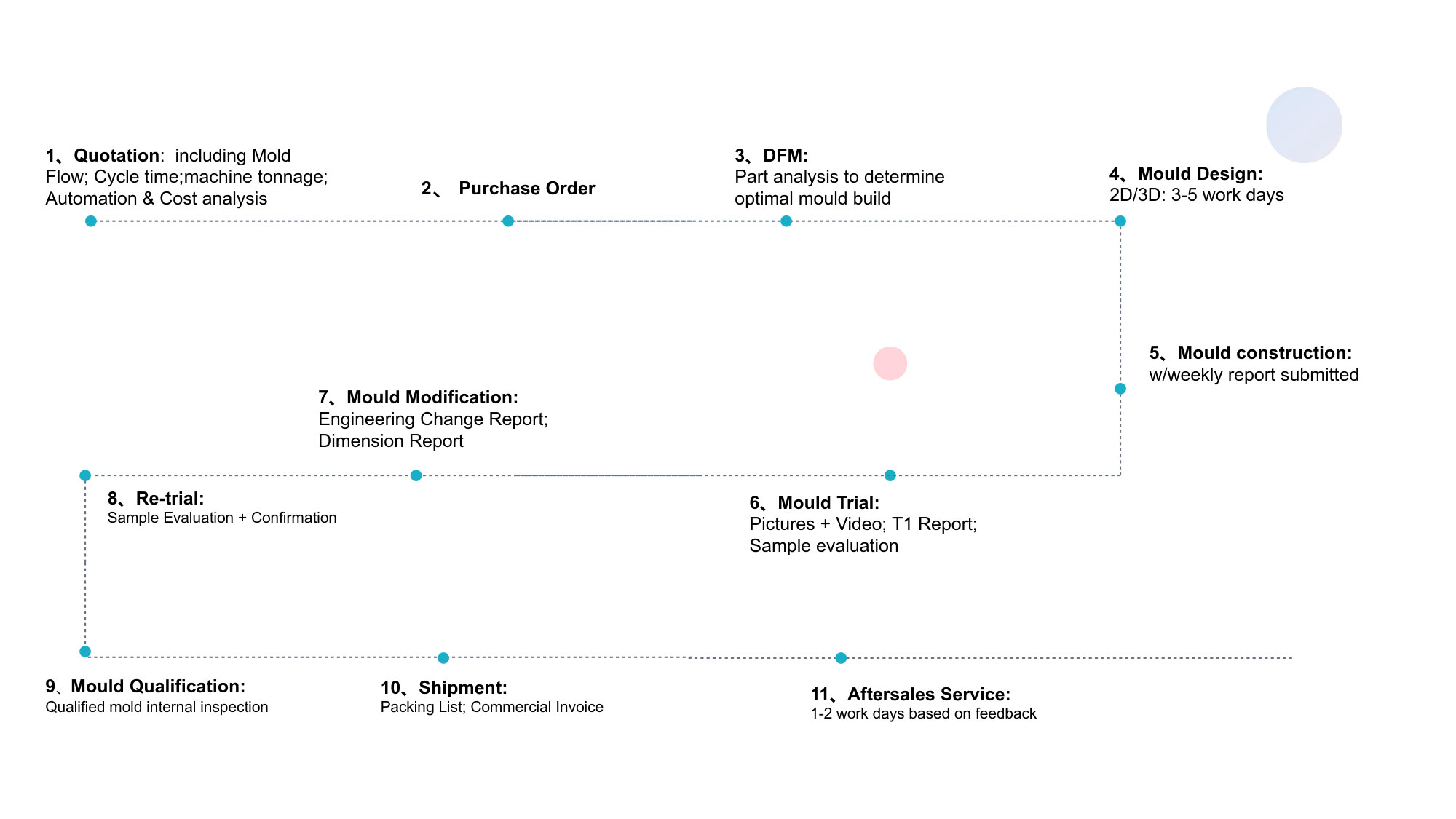
Part I: Foundational Hard Infrastructure – “What Your Investment Actually Gets You”
Before trusting a supplier with a medical-grade liquid silicone rubber project, customers need absolute confidence that the equipment can deliver precision at scale. This section translates our machine specifications into quality outcomes your regulatory auditors and production teams will recognize.
Mold Machining Center: The Difference Between “Good Enough” and “Implantable Grade”
Technical Specification Translation to Customer Value Direct Benefit
5-axis high-speed machining centers capable of processing complex curved surfaces at 0.002 mm precision Your Reactor Vessel Body’s parting lines will be so smooth that no secondary finishing is required — eliminating manual trimming operations and their associated contamination risks Eliminates post-mold deflashing labor (saving
0.25
–
0.25–0.50 per part in downstream operations)
Slow-wire EDM enabling 0.03 mm micro-holes and narrow slots Thin-wall features around sensor ports and fluid channels maintain structural integrity without distortion or deformation Zero rework for delicate internal geometries; prevents weak points that could fail under pressure
Electrical discharge machining (EDM) microstructure venting (Ra 3–22 μm labyrinth effect) Precisely controlled venting along parting lines eliminates air entrapment — the leading cause of surface bubbles and voids in LSR medical parts Near-zero bubble defects; elimination of scrap due to trapped air (typical industry scrap rates: 3–8%; Ansix target: <1%)
Why this matters to you: Bubbles and voids in liquid silicone rubber molded parts are among the most common defects in the industry, typically caused by inadequate venting or poorly optimized injection speeds. Our EDM microstructure venting technology creates controlled escape paths for trapped air without allowing flash — a capability most mold shops cannot achieve consistently. This directly translates to lower scrap rates and higher yields from the very first production run.
Injection Molding Machine Fleet: Scalable Capacity That Matches Your Forecast
Specification Coverage
Clamping force range 30 tons to 4,000 tons
Covered part size range From micro-features (<0.1g shot weight) to large vessel bodies
Drive type All-servo electric drive
Technical Parameter Translation to Customer Value
Repeatability accuracy ±0.1% across all machines Every batch — whether you produce 1,000 units or 1,000,000 — will be dimensionally identical. Your downstream assembly lines never need recalibration for part variation.
Closed-loop shot weight control Prevents short shots (incomplete parts) and overpacking (flash and residual stress). With LSR‘s low-viscosity nature ( ≈water-like), injection control is notoriously difficult; our systems maintain shot-to-shot consistency at industry-leading levels.
Ultrasonic wall thickness sensor with real-time pressure compensation Our machines actively monitor part wall thickness during injection and automatically adjust holding pressure to compensate — eliminating the root cause of flash and dimensional drift
Flash control target: ≤0.02–0.05 mm (typical industry standard is 0.05–0.15 mm)
Quality Assurance & Metrology: Proof, Not Promises
Equipment Technical Capability Customer Value
Coordinate Measuring Machine (CMM) Full 3D dimensional inspection to ISO 13485 requirements Every critical dimension traceable with full inspection reports
Optical vision measurement system Non-contact inspection for delicate features (0.5 μm resolution) No deformation of soft, uncured silicone during inspection
Hardness testing (Shore A) In-line hardness verification for every batch Guaranteed material consistency; LSR grades range from Shore A 20 to 80 — we verify every run
Our commitment: Every mold undergoes full dimensional inspection before shipment, with key dimension CPK ≥ 1.33 — the statistical proof that your process is capable of producing 99.993% conforming parts at steady-state production. Critical dimensions follow Cpk ≥ 1.67 (Six Sigma level) for failure-critical features.
Part II: Mold Manufacturing Core Competencies – Where the Money Is Made or Lost
The mold is not a tool — it is the asset that generates every part. A poorly designed mold costs you in downtime, rework, scrap, and missed deliveries. A well-designed mold runs profitably for years.
Mold Life Expectancy: Defined and Guaranteed
Mold Component Material Option Industry Standard Life Ansix Guarantee
Mold base P20 (pre-hardened) 500K–1M cycles Validated
Mold core/cavity S136 (stainless), 2344, 2343, 8407, SKD11, SKD61, DC53, M340, 4Cr13, 9Cr18, NAK80, H13 Application-dependent selection Boron- and glass-filled applications: 500,000 cycles minimum; unfilled: 1,000,000+ cycles
Material science expertise: The choice of mold steel directly impacts cycle time, surface finish, and longevity. For medical LSR applications requiring high polish (cosmetic-grade parts), we specify S136 or M340 stainless steels for corrosion resistance and superior polishability. For high-wear applications with abrasive fillers like glass fiber, DC53 or H13 tool steels provide the hardness (HRC 58–62) required to maintain sharp parting lines over millions of cycles.
Achievable Tolerances: From “Acceptable” to “Surgical”
Part Type Standard Tolerance Tight Precision Capability Application Example
Conventional structural components ±0.05 mm — Mounting features, bosses
Precision gears, critical medical components — ±0.005 mm Valve seats, sealing surfaces on Reactor Vessel Body
What this means for you: The seal interface on your Medical Liquid Silicone Reactor Vessel Body can be held to single-micron precision — directly affecting leak rates, aseptic integrity, and regulatory compliance.
Documentation package delivered with every mold:
Steel mill certificates (provenance and composition validation)
Heat treatment curves (ensuring uniform hardness and microstructure)
Full dimensional inspection report
Wear allowance analysis
Mold Types: Choosing the Right Architecture for Your Volume
Mold Type Application Customer Benefit
Cold runner system with valve gate LSR-specific: Low-viscosity LSR must be kept cool until entering the heated mold cavity to prevent pre-cure (scorch) Near-zero material waste; eliminates runner scrap — saves up to 15–30% on raw material cost over the mold’s life
Hot runner system Thermoplastic components (if used in hybrid designs) Reduced cycle time; no runner knockout marks
Stack mold (multi-layer) High-volume production (2x output per cycle) Doubles production output without doubling machine footprint or labor
Two-shot / multi-material mold LSR overmolding onto plastic or metal substrates Eliminates separate assembly step — lower total manufacturing cost and fewer potential failure points
High-gloss mirror finish (Ra <0.05 μm) Transparent or optical-grade silicone components Crystal-clear parts without surface haze — critical for fluid observation ports on reactor vessels
Gate & Runner System Optimization: Solving Flow Problems Before They Occur
Every medical LSR part faces three key molding risks: weld lines (where flow fronts meet, creating visible lines and potential weak points), air entrapment (trapped air that forms bubbles or voids), and shrinkage voids (inadequate material packing during cure).
Our approach: Full mold flow analysis (Moldex3D / SIGMASOFT) before any steel is cut. Through simulation, we:
Predict flow front propagation — identifying where weld lines will form and whether they compromise part integrity
Validate venting placement to eliminate air trap zones
Optimize gate location and quantity to ensure balanced cavity filling
Simulate thermal behavior throughout the mold to eliminate hot spots that cause uneven cure
Account for LSR‘s unique 2.0–3.0% shrinkage rate in dimensioning
Customer value: First-shot success — no expensive tooling modifications after the mold is built, compressed project timelines, and predictable part quality.
An LSR-specific thermoset consideration. The crosslinking reaction that cures LSR is irreversible — unlike thermoplastics, which can be remelted and reprocessed, cured LSR cannot be recycled. This makes runner scrap financially significant. Cold runner systems are therefore essential for LSR processing to prevent pre-cure in the feed system while minimizing material waste.
Lead Time Standards: Predictability You Can Build a Launch Plan Around
Mold Complexity Standard Lead Time Express Lead Time*
Simple mold (≤10 cavities, standard geometry) 10 days Not recommended (validation cannot be compressed safely)
Medium-complexity (25–45 days typical) 25–45 days Available on case-by-case basis
Complex/high-cavitation (Medical Reactor Vessel Body class) 45–60 days Not applicable — scientific molding validation requires time
*Express lead times require pre-existing material inventory and dedicated machine allocation. No validation step is ever skipped under express conditions. Partial validation eliminates the very purpose of medical-grade qualification.
Part III: Injection Molding Process Control – Eliminating Every Quality Concern
Medical device customers fear three outcomes: scrap (financial loss), rework (schedule delay), and recalls (catastrophic business risk). Our process controls are designed to eliminate all three.
Process Standardization: “A Good Day and a Bad Day Should Look the Same”
Control Feature Technical Implementation Customer Value
Machine network integration All molding parameters (temperature, pressure, speed, cure time) locked in MES system — only engineering-level access permitted for adjustments Complete traceability and process lockdown; no unauthorized changes between shifts or days
First-article / last-article inspection Every batch begins and ends with full dimensional verification Early warning of any process drift before non-conforming parts reach your assembly line
ISO 13485:2016 certification Medical-device-specific quality management system Regulatory compliance evidence for FDA/MDR submissions
Dimensional Stability Control: Preventing “Creeping” Variation
Technical Element Specification Customer Value
Zone-controlled mold temperature Core and cavity temperatures maintained within ±2°C differential Minimizes warpage and uneven shrinkage — parts remain flat and true
Production validation data Over three consecutive batches of 500+ parts, variation on critical hole-to-hole spacing ≤0.02 mm Predictable assembly with mating components — no surprises during final assembly
The ±2°C standard: For tight-tolerance medical components, mold temperature uniformity of ±2°C is the practical target. Our zone-controlled systems achieve and maintain this tolerance automatically.
Cosmetic Grade Standards: No Compromise on Surface Quality
Cosmetic Requirement Ansix Capability Customer Benefit
Transparent parts Bubble-free, flow-mark-free Clear visual inspection for fluid-borne contamination
Painted / printed parts ±0.1 mm registration accuracy on pad printing / silk screening Branding and instructional graphics stay within spec; no misaligned markings
High-gloss appearance parts Surface roughness Ra ≤0.2 μm Expensive polishing eliminated; part comes off the mold ready for use
Textured surfaces VDI / SPI-specified textures (Mold-Tech compatible) Consistent tactile feel and light diffusion properties
Material Expertise: More Than 10 Engineering Resins – Including LSR
Ansix Tech has production-proven experience with:
Thermoplastics: PC, PC/ABS, ABS, Nylon (PA6/PA66) with GF30+ loading, PPS with GF40+, PEEK, PEI (Ultem), LCP, PBT, PTFE/PFA
Thermosets: Liquid Silicone Rubber (LSR) — platinum-cured, two-part system (1:1 mix ratio)
Liquid Silicone Rubber: A Material Primer for Medical Devices
Medical LSR is a two-part, platinum-catalyzed silicone elastomer system. Part A contains the base polymer (vinyl-functional polydimethylsiloxane); Part B contains the platinum catalyst and crosslinker. When combined in a precise 1:1 ratio and exposed to elevated temperatures (typically 170–230°C), the platinum drives a hydrosilylation reaction that forms permanent Si-C crosslinks — producing a thermoset material that cannot be remelted or reprocessed.
Why platinum-cured LSR for medical applications?
No peroxide residues — only the crosslinked polymer remains
Lower extractables — meets biocompatibility requirements
No mandatory post-bake to remove volatiles — shorter total process time
Superior stability across extreme temperatures (-55°C to +200°C+)
Compatibility with multiple sterilization methods: ethylene oxide (EtO), steam autoclave, gamma radiation
Commercial medical LSR grades (reference):
Manufacturer Grade Series Key Properties
Wacker ELASTOSIL® LR 3003/60 series Fast-curing, excellent mold release
Wacker SILPURAN® 6610/50 series Implantable (<30 days) certification
Momentive Silopren™ LSR 4080 / 4070 High transparency, biocompatibility, sterilizable
DuPont Liveo™ LSR Two-part platinum-cured, high-volume production compatibility
Elkem SILBIONE® LSR 4330 Superior clarity, fast cure, excellent mold release
NuSil MED-4901 / MED-4905 series Ultra-low durometer precision parts
Physical properties summary for medical LSR (typical): Density 1.10–1.25 g/cm³, tensile strength 285–1,500 psi (2–10 MPa), elongation at break 135–1,135%, tear strength 55–200 ppi (9.6–35 kN/m), Shore A hardness 20–80. Shrinkage rates: 2.0–3.0% (significantly higher than typical thermoplastics — a critical DFM consideration).
Additional compliance capabilities: UL94 V-0 flame rating available; UV resistance certified (3,000-hour accelerated weathering with no color change).
Part IV: End-to-End Service Offering – Reducing Your Management Cost Per Part
Suppliers who only “make parts” drive hidden costs into your organization: project management overhead, engineering liaison time, validation administration, and tool maintenance expense. Ansix Tech eliminates these by providing a full-service ecosystem.
Phase 1: Design for Manufacturability (DFM) – Before You Cut Steel
Service scope: Comprehensive DFM feasibility report delivered before tooling commitment, including:
Mold flow analysis results (flow front, air trap, weld line predictions)
Draft angle recommendations (critical for LSR — material shrinkage behavior requires specific draft)
Wall thickness optimization (avoiding thick cross-sections that cause long cure times and sink marks)
Gate location and type selection
Ejector pin mark location agreement (with defined allowable positions)
Vacuum assistance recommendations for complex geometries
Critical LSR DFM distinction: LSR processing is the opposite of thermoplastic molding. In plastic injection, runners are hot and molds are cold. In LSR injection, the delivery system must be COLD to prevent pre-cure (cold runner system), while the mold itself is heated to 150–220°C to trigger crosslinking. No fewer than 60% of first-time LSR molders fail to account for this thermal reversal — with predictably disastrous results.
Customer value: No surprises. No expensive tooling changes after the mold is built. No production delays caused by a design that cannot be molded.
Phase 2: Rapid Prototyping & Design Validation – Fail Fast, Iterate Cheaply
Service scope: T0 (first shot) through T3 sample parts, each accompanied by a detailed improvement report with corrective actions documented
Quick-change insert capability: Mold design incorporates interchangeable inserts to test different gate configurations, venting patterns, or cavity geometries — allowing DFM iteration without recutting an entire mold base
Customer value: Validates your design before full production commitment — 70–80% of mold design errors are correctable at the insert stage, saving weeks of requalification time and tens of thousands in tooling rework compared to traditional “cut once, qualify twice” approaches.
Phase 3: Process Validation (IQ/OQ/PQ) – Data You Can Submit to Regulators
Validation Stage Ansix Deliverable
Installation Qualification (IQ) Machine installation verification, utility connection validation, safety system sign-off
Operational Qualification (OQ) Process window studies (upper/lower control limits), capability analysis (Cpk)
Performance Qualification (PQ) 100–500 shot trial run at full production settings; documented yield and Cpk; quality control chart package
Customer value: A complete validation package ready for FDA submission or Notified Body review — your regulatory team saves weeks of qualification work.
Phase 4: Post-Validation Production Ramp Support
Service scope: The “transition bridge” — we don‘t stop delivering support after passing mold trial sign-off. Dedicated process support transfers validated parameters to your in-house molding team (or continues running production in our facility — customer‘s choice).
Customer value: No “knowing gaps” between supplier and customer. Your team receives fully documented, validated, demonstrably repeatable production-ready processes.
Phase 5: Maintenance & Spare Parts – Protecting Your Asset Long Term
Element Commitment
Spare parts kit Wear parts (ejector pins, core inserts, shut-off nozzles) shipped with the mold
Maintenance schedule Detailed preventative maintenance plan provided at mold delivery
Scheduled overhaul Full refurbishment at 200,000-cycle intervals (recommended)
Emergency repair 24-hour turnaround for weld repair and insert replacement — no outsourcing delays; in-house electrode machining and EDM department
Lifetime repair Cost-plus billing for any repair work after warranty — no captive markup
Part V: Differentiated Value – Direct Responses to Customer Pain Points
Rather than claiming superiority, this section directly answers the objections and frustrations we hear most frequently from prospective customers.
Objection #1: “My current vendor’s mold keeps failing — I’m constantly down for repairs.”
Traditional industry practice: ‘Warranty‘ covers manufacturing defects only — but not the gradual wear that actually costs you time and money in production interruptions.
Ansix Tech commitment:
2,000-cycle pre-delivery burn-in test with documented wear report
Three-year structural warranty on mold base and core/cavity (excludes normal-wear items)
Material selection based on your specific material — glass-filled compounds required H13 at minimum (HRC 54–58); unfilled allowed P20
Wear profiling available for critical core pins, ejector pins, and shut-offs
Objection #2: “Parts come off the mold with flash — I spend more on deflashing labor than on the molding itself.”
Traditional industry practice: ‘Some flash is normal‘ — then passing the expense of manual trimming to the customer.
Ansix Tech commitment:
Parting line mating surfaces finished to 0.005 mm precision
Self-locking clamp force compensation to maintain consistent sealing
Flash guaranteed ≤0.03 mm across all parting lines
Secondary deflashing operations eliminated for all but the most extreme geometric challenges
Your direct dollar benefit: Eliminating 15 seconds of manual trimming per part × 100,000 parts/year = 416 hours of labor eliminated (~$12,000/year direct savings).
Objection #3: “Every batch comes out differently — my assembly line has to adjust constantly.”
Traditional industry practice: ‘That’s just material variation‘ — leaving you to absorb the downstream labor cost of sorting and adjusting.
Ansix Tech commitment:
Ultrasound wall thickness sensor monitoring every shot
Real-time pressure compensation back to injection unit (closed-loop control)
Optional in-cavity pressure/temperature sensors for full scientific molding
Verified variation across three production lots ≤0.02 mm on critical dimensions
Objection #4: “When something breaks, my supplier takes weeks to repair the mold.”
Traditional industry practice: Outsource repair work — sending your mold to third-party tool rooms with their own backlogs and scheduling priorities.
Ansix Tech commitment:
In-house electrode machining center — no waiting for electrodes from external suppliers
In-house EDM department — same-day repair capability for most insert geometries
24-hour repair guarantee for weld repairs and standard insert replacement (emergency service charges apply off-hours)
Full spare parts inventory for all wear components
The Value Proposition: Why Ansix Tech for Medical Liquid Silicone Reactor Vessel Body?
What we ask you to remember is this: The mold is not a block of steel. It is a revenue-generating asset — a miniature factory within a factory. At Ansix Tech, we approach every mold design with four integrated considerations simultaneously:
Thermal balance — eliminating hot spots that cause uneven cure in thick-walled LSR sections
Venting strategy — managing the unique low-viscosity flow behavior of liquid silicone rubber (flash vs. trapped air trade-offs)
Structural longevity — material selection matched to your specific fillers
Production readiness — a mold that passes sampling with zero surprises, low visible flash, and minimal eccentricity at full-rate production
The Next Step: A Data-Driven Conversation
At your convenience, we propose a DFM review using one of your existing part designs (or a close proxy). In one 60–90 minute session, we will demonstrate, using concrete simulation data:
Where weld lines will form and whether they compromise sealing performance
Where air traps will form — and how our venting geometry eliminates them before the first shot
Risk of shrinkage voids — and our gate/runner strategies to prevent them
Estimated annual tool maintenance costs based on your expected volume and material
This is not a sales presentation. This is engineering verification — the same evaluation we perform internally before beginning any mold build.
When you are ready to see the difference that 28 years of experience makes — not in abstract claims, but in data, in process validation packages, and in parts — we are ready to show you.
Ansix Tech Limited | Established 1998 | Over 28 Years of Integrated Injection Molding Solutions
From concept design and prototyping through validation, mass production, and assembly — fully integrated, fully transparent, fully committed to your success.
Copyright © Ansix Tech. All rights reserved. Specifications subject to technical revision without notice. Capability statements represent current process capabilities; specific project commitments require design and volume review.
Ansix Tech Co Ltd
If you have any plans related to Medical Liquid Silicone Reactor Vessel Body , you can contact us at any time. We will turn your ideas into reality, let you realize your dreams, and obtain large orders from the market. Our contact information is info@ansixtech.com. Or contact our CTO, mail: stephen@ansixtech.com
#www.ansixtech.com #ansixtech.com #Medical Liquid Silicone Reactor Vessel Body #Syringe mold moulds #Syringe mold molds #Syringe mold injection molding companies #Medical Liquid Silicone Reactor Vessel Body Canopy Mold injection mold companies #Ansix #Ansix moulds #Ansix china #Ansix tech china #Ansix tech company #Ansix facotry #Syringe mold injection molding #Syringe mold injection tools #Syringe mold injection moulds #Syringe mold plastic mould #Syringe mold plastic tools #Ansix Tech #Ansix molds #Ansix injection molding #Ansix mold factory #injection molding Syringe mold #Ansix mold factory #Syringe mold china #Syringe mold molds #injection factory #Syringe mold injection molding #Syringe mold injection molding factory #injection molding company #Syringe mold injection mold companies #Syringe mold#Syringe mold mold limited #Ansix mold china #Ansix companies #Ansix company China #Syringe mold facotry #Ansix Tech #Ansix Tech mould #Syringe mold injection moulding #injection moulding company #Ansix Syringe mold parts injection mold companies #medical injection molding companieschina #Syringe mold china factory #Ansix moulding companies #Ansix molding company #Syringe mold injection moulding facotry #Ansix Tech mold #Syringe mold mould #Syringe mold plastic injection molding #ansix plastic mold #Mold manufacturing #Syringe mold parts manufacturing #Syringe mold plastic parts factory #Syringe mold injection parts mold #Syringe mold PRECISION MANUFACTURING #Syringe mold #China mold #Syringe mold injection moulding china #Syringe mold mould china #china precision mold #mold in china #Syringe mold mold china #Precision molds #High-precision molds #Syringe mold #Injection molds #Syringe mold Factory #Syringe mold Company #Super Large Injection Mold Factory #Large Tonnage Injection Molding Factory #Syringe mold Company #Syringe mold Factory #2800T Injection Molding Factory #3000 Ton Injection Molding #4500 Ton Injection Molding Factory #Large Mold Injection Molding #Large Plastic Mold Injection Molding Factory #Large Injection Mold Manufacturer #Plastic Mold Factory #Injection Mold #Plastic Mold