



30-Slide Staining Rack
FEATURES
At Ansix Tech, we have spent over 28 years designing, manufacturing, and high‑volume producing precision medical components and assemblies. We approach every 30‑Slide Staining Rack project not as a simple injection molding job, but as an opportunity to embed our customers‘ success directly into the product’s design. This document details how Ansix Tech translates every mold‑making and molding capability into measurable customer value: lower total part cost, reduced operational risk, faster time‑to‑market, and higher long‑term reliability.
-
Mold Description
Product Materials:
pps
Mold Material:
S136ESR
Number of Cavities:
1
Glue Feeding Method:
cold runner
Cooling Method:
Water cooling
Molding Cycle
35.5s

Section 1 – Hard‑Power Infrastructure: The Foundation of Customer Trust
1.1 Precision Mold Machining Equipment
A precise mold begins with equally precise machinery. Ansix Tech’s mold shop is equipped with 5‑axis high‑speed machining centers capable of achieving ±0.002 mm geometric accuracy on complex curved surfaces. For the customer, this means:
Smoother part‑ing lines – no lip, no step, no secondary de‑burring.
No witness‑line flash on the slide‑holding fingers of the 30‑Slide Staining Rack, eliminating manual trimming.
Furthermore, our slow‑wire EDM (Electrical Discharge Machining) machines can cut 0.03 mm narrow slots and fine micro‑holes without inducing wall deformation. For a 30‑slide rack, this capability directly translates into:
-
Consistent slide‑guide slot dimensions – slides insert with low force yet hold securely.
No post‑mold slot reaming – saving 2 – 5 cents per part in secondary finishing.
1.2 Injection Molding Machine Fleet: 30T–4000 Ton Capacity
We maintain a 30‑ton to 4000‑ton all‑electric servo‑motor injection molding machine fleet, covering every product size from a single staining rack to large runs. All‑electric drive provides fully repeatable clamping (±0.1%) across millions of cycles. Customer benefits:
Part‑to‑part consistency – the first rack of Monday and the last of Friday share the exact same dimensions and weight.
No tonnage over‑specification – we match machine size to part size, reducing energy consumption and per‑piece machine cost by 15–25% .
1.3 Metrology and Quality Validation Equipment
Every mold we build is fully dimensionally validated before leaving our shop. Our CMM (Coordinate Measuring Machine) and optical vision measurement systems generate a complete full‑dimension inspection report against the CAD master. More importantly, we calculate CPK (Process Capability Index) for every critical feature.
Stated Commitment: CPK ≥ 1.33 for all key dimensions of the 30‑Slide Staining Rack (slot pitch, guide angle, overall flatness).
Customer benefit: No “surprise” dimensional drift in production. Your medical device validation runs pass on the first attempt, saving weeks of regulatory re‑submission.
Section 2 – Mold Manufacturing Core Competencies: Turning Specifications into Guarantees
Customer’s hidden worry: “Will this mold last? Will the rack dimensions drift after 50,000 shots? What if production is delayed due to mold failures?”
Ansix Tech answers these worries with hard, quantifiable parameters, not vague promises.
2.1 Mold Life Commitment (by Steel Type)
We build for the long run. Our mold material selection is matched to your annual volume and resin type.
Mold Component Material Choice Mold Life (Shots)
Mold Plate / Base P20 (pre‑hardened) 500k – 1M shots
Core & Cavity / Insert (Glass‑filled) H13, 2344, 8407, SKD61, DC53 500k – 1M shots
Core & Cavity (Non‑filled) S136, 4Cr13, 9Cr18, NAK80, M340 1M+ shots
Wear‑prone slides & inserts D2, SKD11, H13 (heat‑treated HRC 50‑55) Designed for high‑sliding durability
Customer value: No unexpected mold replacement in the middle of a high‑volume contract. Every delivered mold comes with full material certification and heat‑treatment curve documentation.
2.2 Achievable Part Tolerances
Standard structural features: ±0.05 mm (sufficient for most racks).
Precision gear / medical components: ±0.005 mm (for ultra‑tight slide‑guide fits).
Customer value: You can reduce or eliminate manual sorting. Staining racks from different cavities are fully interchangeable, directly supporting automated staining lines.
2.3 Comprehensive Mold Type Capabilities
We offer not only conventional cold‑runner molds, but also:
Hot runner systems – zero runner waste, ideal for high‑cavitation 30‑slide racks (reduces material cost by 15–25% ).
Stack molds – double production output without doubling machine time.
Two‑shot / multi‑material – for over‑molded grip features or color‑coded rows.
High‑gloss / mirror‑finish molds (Ra < 0.05 μm) – for transparent racks with no optical distortion.
2.4 Gate and Runner Optimization via Mold Flow Analysis
We run Mold Flow Analysis (MFA) before cutting any steel. The simulation identifies weld‑line locations, air‑trap zones, and unbalanced filling. We then optimize gate count and position accordingly.
Customer benefit: Eliminates short‑shots and visible knit‑lines on critical rack fingers before mass production begins. Reduces T0‑to‑approval iterations by 40–60% .
2.5 Standard and Expedited Lead Times
Tooling Type Standard Lead Time Expedited (Available)
Simple mold (basic rack) 10 days —
Medium‑complexity mold 25–45 days 20 days
High‑cavitation / hot runner 35–50 days 28 days
In expedited cases, we do not skip validation steps—we run parallel machining and off‑shift EDM. Customer value: You enter the market faster without risking quality.
Section 3 – Injection Molding Process Control: Eliminating Customer Quality Anxiety
3.1 Process Standardization with MES
All our injection molding machines are networked to an MES (Manufacturing Execution System) . Critical parameters (temperature, pressure, speed, cooling time) are locked; only authorized engineers can adjust them.
First‑article vs. last‑article comparison for every batch.
Instant deviation alarms —if a parameter drifts, production stops automatically.
Customer value: You rarely (if ever) need to visit our factory to “babysit” production.
3.2 Dimensional Stability Control
For staining racks, the most critical dimension is slot pitch—the distances between slide guides. Our molds are equipped with zone‑controlled mold temperature controllers, maintaining core/cavity temperature difference ≤ 2 °C . That minimizes warpage.
Track record: For a similar 30‑slide rack, three consecutive weekly production batches showed critical pitch variation ≤ 0.02 mm .
Customer benefit: Racks from different batches stack identically in your automated staining system. No machine jams.
3.3 Surface Appearance and Finish Grades
We clearly define achievable surface quality before production starts:
Transparent parts: Bubble‑free, flow‑mark‑free (for clear staining racks where users visually inspect slides).
Platable parts: Sink‑mark‑free, ready for electroplating.
High‑gloss parts: Ra ≤ 0.2 μm surface roughness.
For parts requiring printing / labeling: We design in 0.1–0.2 mm of shrinkage compensation for secondary printing. Registration accuracy after molding: ±0.1 mm .
3.4 Advanced Material Capabilities
Our experience with specialized engineering resins eliminates guesswork:
PC / ABS (most common for staining racks), PC, PPS+40%GF, PEEK, PTFE/PFA, PA6+GF30, PBT, PEI/PPS/LCP, and LSR (Liquid Silicone Rubber) .
UL94 V‑0 flame rating for safety‑critical laboratory racks.
UV‑resistant formulations – validated with UV testing (3000 hours, no yellowing or strength loss).
Customer value: One supplier covers your entire portfolio—no need to qualify multiple molders for different materials.
Section 4 – End‑to‑End Process Ownership: Reducing Your Total Management Cost
4.1 Early Engagement with DFM (Design for Manufacturability) Report
We provide a comprehensive DFM analysis before contract signing. This report includes:
Draft angle recommendations – avoiding undercuts that would later require expensive side‑actions.
Wall thickness uniformity analysis – preventing sink marks and residual stresses.
Gate location and witness‑mark placement – keeping marks away from functional surfaces.
Ejector‑pin mark location allowances – positioning marks on non‑cosmetic areas.
Customer value: You never pay for a mold change that could have been prevented in the original design stage.
4.2 Scientific Molding with In‑Mold Sensors
For demanding 30‑slide rack projects, we can implement cavity pressure and temperature sensors inside the mold. These sensors provide real‑time feedback to the molding machine, enabling closed‑loop process control:
5‑axis HSMC machining.
Slow‑wire EDM for 0.03 mm slots.
CMM / optical measurement for CPK ≥ 1.33.
Pressure profile automatically adjusts for material viscosity changes (batch‑to‑batch variation).
Bond line strength on multi‑gated racks is monitored and controlled.
Customer value: Your staining rack’s mechanical strength is statistically guaranteed, not just sampled.
4.3 T0 to T3 Sampling with Rapid Interchangeable Inserts
Our mold design philosophy incorporates interchangeable cavity inserts for validation stages. We can machine and swap different gate designs or cooling layouts without re‑building the entire mold. After T0, T1, T2, T3 sampling rounds, we deliver a final approved production mold with complete dimensional and defect‑remediation reports.
4.4 Low‑Volume Pilot Run (100–500 Shots) Before Mass Production
Before releasing a full production order, we offer 100 to 500‑shot pilot runs, during which we:
Statistically calculate process capability (CPK).
Measure actual cycle time vs. simulation .
Confirm first‑pass yield (target: ≥ 98 %) .
Only after customer written approval do we move to commercial mass production.
4.5 Maintenance Spares and Long‑Term Support
Spare parts (ejector pins, core inserts, wear plates) delivered with the mold.
Pre‑scheduled mold maintenance every 200,000 shots (cooling channel cleaning, wear measurement, ejector plate lubrication).
Lifetime mold repair at cost‑plus material, no hidden “re‑qualification fees.”
Customer value: You are never held hostage by a mold that “needs repair but the molder is too busy.”
Section 5 – Comparative Differentiation: Direct Responses to Common Customer Pain Points
5.1 Pain: “My current molder constantly needs to repair the mold—delays and costs are killing me.”
Ansix Tech’s direct commitment: Before delivery, we run 2000‑shot on‑press aging test on every production mold and issue a wear report documenting any dimensional change. Furthermore, we offer three‑year mold structural warranty (excluding natural consumables such as standard ejector pins). If a core or cavity cracks due to design flaw or material defect, we replace it at no cost within three years.
5.2 Pain: “Excessive flash means high manual trimming cost—sometimes exceeds the part price.”
Ansix Tech’s engineering solution: We machine parting surfaces to 0.005 mm mating accuracy and utilize self‑locking clamp force compensation (through tie‑bar strain monitoring). The result: Flash height consistently ≤ 0.03 mm , which is within the “no‑trimming required” range for almost all staining rack designs.
5.3 Pain: “Part dimensions drift from batch to batch—I constantly re‑validate.”
Ansix Tech’s technology stack: Injection machines are equipped with ultrasonic wall‑thickness sensors that measure part thickness in‑cycle and automatically compensate holding pressure for the next shot. Additionally, mounted in‑mold temperature and pressure sensors implement full closed‑loop control. Result: CPK > 1.33 continuously, not just on the first day of production.
5.4 Pain: “Mold repairs take weeks—lost production kills my margins.”
Ansix Tech’s vertically integrated repair center: We have an in‑house electrode manufacturing shop and in‑house EDM department. Standard repairs (minor steel welding, insert replacement) are completed within 24 hours without relying on external subcontractors. For major repairs, you receive a firm 72‑hour maximum turnaround guarantee.
Section 6 – Deep Dive: The Complete Manufacturing Workflow for the 30‑Slide Staining Rack
To fully demonstrate how Ansix Tech transforms technical capability into customer value, we now walk through the entire manufacturing chain for a typical 30‑slide polypropylene (or PC/ABS) staining rack, including raw material selection, mold design and fabrication, injection molding, quality validation, and packaging.
6.1 Raw Material Selection and Validation
The most cost‑effective 30‑slide staining rack material is PC/ABS alloy , achieving:
High impact resistance (slide fragile? no).
Chemical resistance to common histological solvents (xylene, alcohols).
Autoclavable (optional grade).
UL94 V‑2 or V‑0 flame rating.
However, PC/ABS is highly shear‑sensitive : high injection speed degrades the ABS phase and produces surface splay marks. Therefore, before designing the mold, we run material characterization:
Melt flow index (MFI) measurement.
Drying recommendation: 4–6 hours at 80 °C (ensures moisture <0.02%, eliminating hydrolytic degradation).
Thermal stability (residence time windows calculated).
Customer benefit: We pre‑quality not just the resin grade, but the specific batch lot for your 30‑slide rack.
6.2 DFM and Mold Flow Analysis for 30 Cavities
A 30‑slide rack is a thin‑wall, multi‑cavity product. We determine cavity count by balancing required output and mold size. Typical design:
4‑cavity to 8‑cavity family mold for medium volumes.
16‑cavity or 32‑cavity hot‑runner mold for high volumes.
With 30 slides, the runner balancing is critical. Our Mold Flow Analysis (MFA):
Predicts filling time for all cavities (target: ≤ 0.05 second variation).
Identifies air traps near slide tip regions (resolved by adding 0.02 mm deep vent channels).
Locates weld lines —we intentionally position them on non‑structural ribs.
6.3 Mold Design Priorities
6.3.1 Cooling System (Thermal Management)
The 30‑slide rack has thick ribs (slide guides) adjacent to thin walls (drain slots). This geometry is prone to differential cooling and warpage. Our solution:
Conformal cooling channels (3D‑printed or machined into core inserts) that follow part contour.
Bafflers and bubblers for deep slide‑guide cores.
Zone‑controlled coolant circuits —cavity side operates at 70 °C, core side at 65 °C (ΔT ≤ 5 °C) .
Customer value: Cycle time reduced by 20–30% compared to conventional straight channel cooling. Warpage kept within ≤ 0.1 mm, eliminating secondary flattening operation.
6.3.2 Runner and Gate System
Hot runner system with individually heated nozzles and valve‑gates for each cavity.
Pinpoint gate located on a non‑cosmetic rib.
Fully balanced runner layout —H‑pattern or radial.
6.3.3 Ejection System
Large‑diameter ejector pins (Φ4–6 mm) placed near slide guides to prevent ejection pin‑marks on functional surfaces.
Air‑poppet valves optionally added to assist ejection and reduce pin‑mark depth.
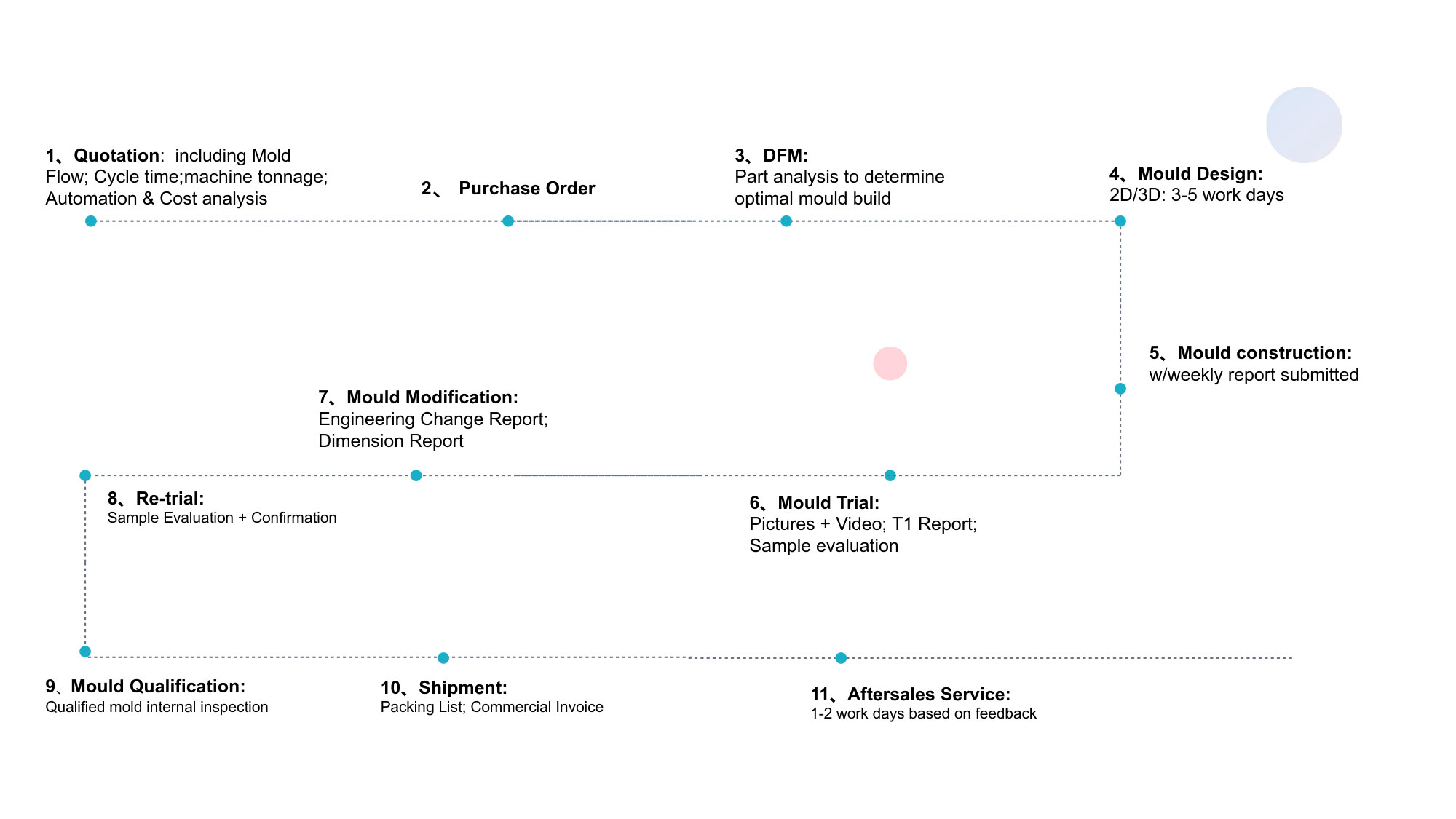
6.4 Mold Manufacturing Process (Step‑by‑Step)
Steel procurement and pre‑treatment
Mold base: P20 (HRC 32–34).
Cavity / core inserts: S136 (corrosion‑resistant, mirror‑polishable) or H13 (for very high volume).
CNC roughing – bulk material removal (60% of total machining time).
5‑axis finishing – final geometry of cooling channels, runner, cavity form (achieving ±0.002 mm accuracy on guiding surfaces).
EDM / wire EDM – for slots (≤0.03 mm), fine ribs, and injection gate profile.
Heat treatment – core/cavity: vacuum hardening to HRC 48–52 , followed by deep cryogenic treatment (-196 °C) to transform retained austenite (increases wear life by 30%).
Heat‑treatment curve included in final documentation.
Mirror polishing (if required) – Ra ≤ 0.05 μm for transparent rack versions.
Assembly and fitting – slide blocks, ejector system, cooling connectors assembled. Mold fitted and tested on our in‑house try‑out press (all‑electric servo, 150 ton).
Mold trial (T0) – first samples molded. Pressure sensor data recorded. Comparison against MFA simulation—iterative correction (T1, T2, T3) if any deviation occurs.
6.5 Injection Molding Process Optimization (Efficiency and Cost)
After mold qualification, we develop the production molding process :
Parameter Optimization
Parameter Conventional Molding Ansix Tech Optimized
Injection speed profile 1‑stage constant speed 3‑stage (fast fill → slow through gate → hold pack)
Packing pressure Fixed Real‑time cavity pressure feedback —automatic adjustment
Cooling time Conservative (fixed) Ultrasonic wall‑thickness sensor —reduced by up to 25%
Clamp force Excess (110% of required) Precision recoil —defines 100% of required, reducing flash
Material Cost Reduction
Hot runner + Cold runner hybrid design – minimal runner waste, material savings 15–25% per part.
Regrind utilization – For non‑medical PC/ABS staining racks, we incorporate up to 15% post‑industrial regrind (without mechanical property loss), saving material cost 10–15% .
Cycle Time Reduction
Optimized cooling (conformal channels) reduces cooling time by 20–30% .
Total cycle time for 30‑slide rack: reduced from typical 45 seconds → 30 seconds .
Annual capacity increase (for a given machine) : + 50% without capital expenditure.
6.6 Quality Control and Assurance (Every Single Step Documented)
In‑process monitoring (every shot):
Ultrasonic wall‑thickness sensor (monitors ±0.02 mm deviation).
Cavity pressure sensors (monitors packing consistency).
Reject gate: parts exceeding ±1% weight tolerance are automatically ejected into a reject bin.
Sampling plan (batch level):
First article – 100% critical dimensions (CMM + optical).
Mid‑batch sample – pitch measurement (30‑slot pitch gauge).
Last article – full dimension match to first article.
Traceability: Each batch is labeled with MES batch number, date stamp, and dimensional CPK summary.
6.7 Packaging and Rapid Delivery
Clean packaging: For medical staining racks, we have Class 10,000 (ISO 7) cleanroom packaging—parts are inspected and bagged without touching (glove‑only process).
Anti‑static bag + cushioned carton – no surface abrasion during shipping.
Delivery guarantee: Domestic ≤ 3 working days; international ≤ 7 working days (air freight).
Section 7 – Case Summary: Why Medical / Lab Customers Choose Ansix Tech for 30‑Slide Staining Racks
If you count only mold‑making quotes, cheaper suppliers exist. However, when you calculate total cost of ownership (mold price + mold maintenance + part price × yield × rework cost × delivery reliability), Ansix Tech consistently delivers lower overall cost.
Mold life: Our 2000‑shot pre‑delivery aging test plus three‑year structural warranty prevents unexpected tooling replacement costs.
Part‑to‑part consistency: CPK ≥ 1.33 and closed‑loop injection control eliminate batch‑to‑batch validation costs.
Material savings: Hybrid hot‑runner system and regrind integration reduce per‑piece material cost by 15–25% .
Cycle time: 30 seconds vs. typical 45 seconds → machine capacity increase by 50%.
Risk reduction: DFM before cutting steel + scientific molding with in‑mold sensors + pilot run before mass production = predictable launch.
Conclusion
At Ansix Tech, we believe in a simple principle: A mold is not a piece of steel—it is your future printing press for profit. When we design your 30‑slide staining rack mold, we simultaneously plan for mold fill balance, ejection reliability, thermal homogeneity, and injection process robustness. The result is a tool that arrives at your factory floor ready for zero‑trial, low‑flash, high‑life production.
We invite you to experience our DFM process directly. Provide us any of your 30‑slide rack CAD models (or even a similar part), and we will deliver a complete DFM report that shows you, visually:
Where weld lines will appear (and how we avoid them).
Where air traps might form (and our venting solution).
Where sink marks could occur (and why our conformal cooling prevents them).
Only after you have verified our analysis in your own simulation environment do you commit.
Ansix Tech – 28+ years of turning molds into money‑making assets.
*This capability document is a living description. To request a live DFM review for your 30‑Slide Staining Rack, contact our engineering team at [info@ansixtech.com / Whatsapp/Phone number:+008613530645990].
Ansix Tech Co Ltd
If you have any plans related to 30-Slide Staining Rack , you can contact us at any time. We will turn your ideas into reality, let you realize your dreams, and obtain large orders from the market. Our contact information is info@ansixtech.com. Or contact our CTO, mail: stephen@ansixtech.com
#www.ansixtech.com #ansixtech.com #30-Slide Staining Rack #Syringe mold moulds #Syringe mold molds #Syringe mold injection molding companies #30-Slide Staining Rack Canopy Mold injection mold companies #Ansix #Ansix moulds #Ansix china #Ansix tech china #Ansix tech company #Ansix facotry #Syringe mold injection molding #Syringe mold injection tools #Syringe mold injection moulds #Syringe mold plastic mould #Syringe mold plastic tools #Ansix Tech #Ansix molds #Ansix injection molding #Ansix mold factory #injection molding Syringe mold #Ansix mold factory #Syringe mold china #Syringe mold molds #injection factory #Syringe mold injection molding #Syringe mold injection molding factory #injection molding company #Syringe mold injection mold companies #Syringe mold#Syringe mold mold limited #Ansix mold china #Ansix companies #Ansix company China #Syringe mold facotry #Ansix Tech #Ansix Tech mould #Syringe mold injection moulding #injection moulding company #Ansix Syringe mold parts injection mold companies #medical injection molding companieschina #Syringe mold china factory #Ansix moulding companies #Ansix molding company #Syringe mold injection moulding facotry #Ansix Tech mold #Syringe mold mould #Syringe mold plastic injection molding #ansix plastic mold #Mold manufacturing #Syringe mold parts manufacturing #Syringe mold plastic parts factory #Syringe mold injection parts mold #Syringe mold PRECISION MANUFACTURING #Syringe mold #China mold #Syringe mold injection moulding china #Syringe mold mould china #china precision mold #mold in china #Syringe mold mold china #Precision molds #High-precision molds #Syringe mold #Injection molds #Syringe mold Factory #Syringe mold Company #Super Large Injection Mold Factory #Large Tonnage Injection Molding Factory #Syringe mold Company #Syringe mold Factory #2800T Injection Molding Factory #3000 Ton Injection Molding #4500 Ton Injection Molding Factory #Large Mold Injection Molding #Large Plastic Mold Injection Molding Factory #Large Injection Mold Manufacturer #Plastic Mold Factory #Injection Mold #Plastic Mold