




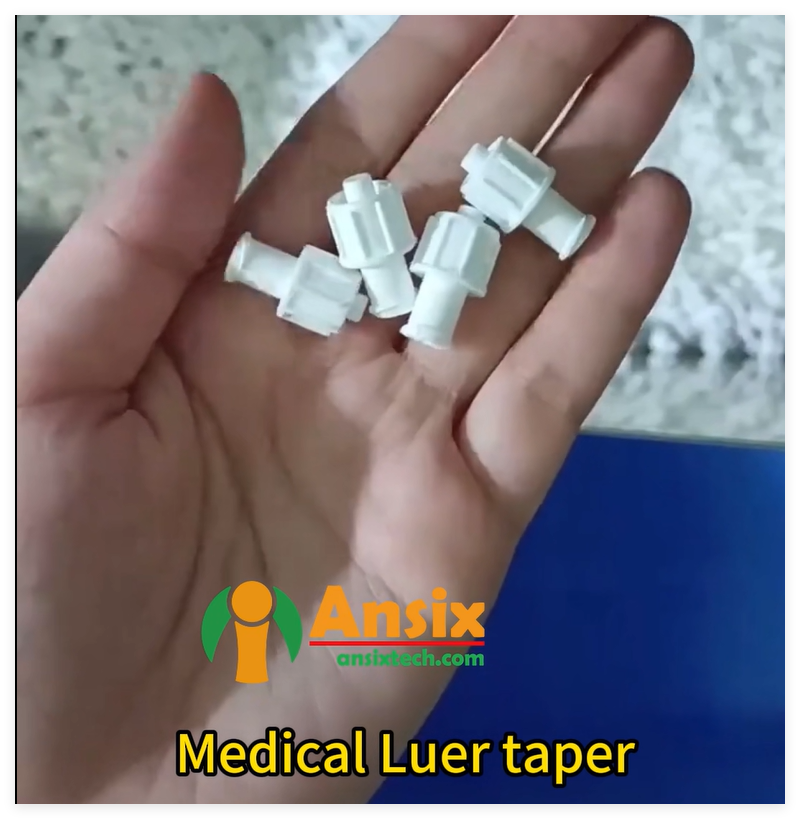
Medical Luer taper
Medical Luer taper

Precision Meets Safety: How Ansix Tech Masters Medical Luer Taper Manufacturing
The global healthcare system relies on countless small, unassuming components to function safely. Among the most critical are Medical Luer taper connectors—the universal, leak-free interfaces that join syringes to needles, IV lines to catheters, and countless other fluid pathways in diagnostics and treatment. As demand surges for single-use medical devices and home healthcare solutions, manufacturers face the immense challenge of producing these life-critical parts at scale with unwavering precision, absolute reliability, and controlled costs.
Standing at the forefront of this challenge is Ansix Tech, an ISO 13485:2016 certified specialist in medical injection molding . Through a recent, in-depth project for manufacturing Medical Luer connectors, the company has demonstrated a complete, vertically integrated mastery of the process—from interpreting international standards to delivering cost-optimized, high-volume production. This article explores the technical journey of bringing a Medical Luer connector from concept to clinic, highlighting the engineering rigor and innovative strategies that ensure both patient safety and project viability.
- Design Imperatives and Market Demand
Medical Luer connectors are not merely plastic parts; they are safety-critical components whose failure can lead to medication error, infection, or treatment interruption. Their design is governed by the non-negotiable ISO 594-1 and ISO 594-2 standards, which specify the exact 6% taper (approximately) and dimensional tolerances required for universal, leak-proof compatibility between all Luer slip and Luer lock accessories worldwide .
The market demand is driven by several powerful trends: the global shift toward single-use medical devices to prevent cross-contamination, the growth of biopharmaceuticals and complex drug delivery systems, and the expansion of point-of-care and home-based diagnostics. Ansix Tech addresses this demand by offering a complete fluid management product line, including luers, caps, valves, and complex assemblies, all manufactured under stringent cleanroom conditions (ISO Class 8) .
- From Prototype to Certified Production: A Phased Validation
Ansix Tech employs a rigorous, multi-stage testing protocol to de-risk development, mirroring industry best practices for high-stakes medical components .
Prototype Design & Verification: Before any metal is cut, the part design undergoes validation via 3D printing or CNC machining. This phase, costing only 5-15% of full tooling, allows for rapid iteration on form, fit, and basic function. It is crucial for verifying assembly with mating parts and identifying fundamental design flaws .
Mold Testing (Trial Molding): Once the production mold is fabricated, the first trial shots (T1) are taken. This stage is pivotal for validating the mold's structural integrity, cavity precision, and the initial injection molding process parameters. Technicians meticulously adjust temperature, pressure, and speed to produce samples that reflect the final material and appearance. Critical metrics like dimensional accuracy (often within ±0.05mm for key features), surface finish, and the absence of flash are verified .
Mass Production Validation: The final gate before full-scale release is a small-batch production run (typically 500-5,000 pieces). This simulates real production conditions to validate the stability of the process, the effectiveness of quality controls, and the packaging system. A key output is the statistical process capability (CPK) data, ensuring critical dimensions are consistently produced with a CPK ≥ 1.33 . For medical devices, this phase often includes sterilization compatibility testing to ensure material and dimensional stability post-sterilization .
Table: Phases of Injection Molding Validation for Medical Components
Phase Primary Goal Key Activities Outcome
Prototype Testing Design Validation 3D printing/CNC machining; assembly & fit checks. Verified design; approved for tooling.
Mold Testing (T1, T2) Tool & Process Validation Trial shots on injection machine; parameter optimization; dimensional inspection. Qualified mold; baseline process settings.
Production Validation System & Stability Validation Small-batch continuous run; statistical process control (SPC); packaging tests. Proven production stability; CPK data; released for mass production.
- The Foundation: Strategic Material Selection
The choice of polymer is a cornerstone of performance, compliance, and cost. Medical Luer connectors require materials with excellent biocompatibility, chemical resistance to drugs and cleaning agents, clarity for visual inspection, and the ability to withstand sterilization (gamma, ETO, or autoclave) .
Ansix Tech's expertise lies in selecting and validating the optimal material from a vast library of medical-grade resins:
Medical PVC: Widely used for its flexibility and cost-effectiveness. Modern formulations use non-DEHP plasticizers like TOTM (trimellitate) or ATBC (citrate-based) for enhanced safety and regulatory compliance .
Polycarbonate (PC) & PC/ABS Blends: Prized for exceptional clarity, rigidity, and impact resistance. Grades like Makrolon® are common for rigid connectors and transparent components .
Polypropylene (PP): A cost-effective choice for caps and simple connectors, offering good chemical resistance and processability .
Specialty Grades: For unique chemical resistance needs, materials like Kynar® (PVDF) or Acetal may be employed .
Ansix Tech adds significant value through cost-optimized material strategy. This includes analyzing the feasibility of using lower-cost polymers that meet all performance criteria, implementing validated regrind protocols for non-critical portions of the material stream, and designing for material efficiency to minimize part weight without compromising strength .
- Engineering the Tool: Mold Design & Analysis
The mold is the heart of the process. For a Medical Luer connector, which features precise internal tapers and often external locking threads, mold design is exceptionally demanding.
Design for Manufacturability (DFM): Ansix Tech engineers begin with a thorough DFM review of the part design. They analyze draft angles, wall thickness uniformity, and parting line location to ensure the part can be cleanly ejected and will meet cosmetic standards. A well-executed DFM can reduce cycle times by up to 50% and drastically improve yield .
Mold Flow Analysis: Using advanced simulation software (e.g., Autodesk Moldflow), engineers create a virtual Design of Experiments (DOE). This predicts how molten plastic will fill the cavity, identifying potential defects like air traps, weld lines, and sink marks before the mold is built . It allows for optimization of the gate location—critical for a round, tapered part to ensure balanced filling and minimize cosmetic defects.
Core Mold Design Elements:
Steel Selection: High-wear areas like cores forming the precise taper are often made from hardened, corrosion-resistant steels like ASSAB 136 or H13 to maintain accuracy over hundreds of thousands of cycles .
Cooling System: An optimized cooling channel layout, potentially following the contour of the part (conformal cooling), is vital. It ensures uniform cooling, reduces cycle time (a 15% reduction is achievable), and minimizes part warpage .
Ejection System: Given the tapered shape, a perfectly balanced ejector pin system is designed to push the part off the core without causing distortion or marks on critical sealing surfaces.
Venting: Microscopic vents are strategically placed to allow air to escape as plastic enters, preventing burn marks or short shots.
- Mastering the Process: Injection Molding & Quality Assurance
The transition from a perfect mold to perfect parts hinges on process control.
Process Challenges & Optimization: Key challenges in molding Luer connectors include maintaining the precise taper diameter, preventing flash on parting lines, and avoiding sink marks or voids in thick sections. Ansix Tech employs Scientific Molding methodologies, where process parameters (melt temperature, injection speed, packing pressure, cooling time) are set based on material data and mold characteristics rather than operator intuition. This ensures repeatability and consistency .
Comprehensive Quality Assurance: Every batch is subject to a multi-layered quality protocol. This includes:
In-Process Inspection: Dimensional checks of critical features using calipers, gauges, or optical comparators.
Material Traceability: Full Certificate of Analysis (COA) documentation for all resin lots, ensuring compliance with USP Class VI or ISO 10993 biocompatibility standards .
Final Quality Control: Aesthetic inspection, functional testing (e.g., leak testing under pressure), and statistical review of dimensional data .
Packaging for Purity: Finished Luer connectors are handled and packaged in a cleanroom environment. They are often bagged in sterile barrier systems or sealed in clean poly bags to protect them from contamination during shipment .
- Applications and Delivering Customer Value
Medical Luer connectors are ubiquitous, found in syringes, IV sets, stopcocks, enteral feeding systems, respiratory equipment, and diagnostic device fluid paths.
Ansix Tech's ultimate commitment is to provide reliability and exceptional value. The company reduces total component cost for customers through a holistic approach:
Design & Material Optimization: Recommending design tweaks or alternative, compliant materials that perform equally at a lower cost .
Manufacturing Efficiency: Engineering molds for fast cycle times and high yield, directly reducing per-part cost.
Integrated Service: Providing end-to-end solutions from design support to molding, assembly, and packaging, eliminating supply chain complexities for clients .
Table: Ansix Tech's Cost-Reduction Strategy for Medical Luer Components

- Conclusion: A Partner for Critical Manufacturing
The journey of a Medical Luer connector from a standard specification to a box of ready-to-use components encapsulates the immense technical challenge of medical device manufacturing. It requires more than just an injection molding machine; it demands deep regulatory knowledge, advanced engineering capabilities, fanatical attention to quality, and a relentless drive for efficiency.
Ansix Tech’s project in this realm demonstrates that these elements are not mutually exclusive. By leveraging a structured development process, cutting-edge simulation tools, strategic material science, and a culture of precision, the company delivers components that meet the highest standards of the medical industry while providing a competitive, value-driven partnership to its customers. In a sector where quality is synonymous with safety, this comprehensive, expertise-driven approach is not just good business—it's essential for patient care.


Ansix Tech Co Ltd
If you have any plans related to Medical Luer taper , you can contact us at any time. We will turn your ideas into reality, let you realize your dreams, and obtain large orders from the market. Our contact information is info@ansixtech.com. Or contact our CTO, mail: stephen@ansixtech.com
#www.ansixtech.com #ansixtech.com #Medical Luer taper #Medical Luer taper injection molding factory #Ansix injection mould #Medical Luer taper factory #Medical Luer taper injection molding company #Medical Luer taper injection mold companies #Ansix #Ansix moulds #Ansix china #Ansix tech china #Ansix tech company #Ansix facotry #Ansix Tech #Ansix molds #Ansix injection molding #Ansix mold factory #injection molding Medical Luer taper # Ansix mold factory #Medical Luer taper china #Medical Luer taper precision molds #injection factory #Medical Luer taper precision injection molding #Medical Luer taper injection molding factory #injection molding company #Medical Luer taper injection mold companies #Medical Luer taper factory #Medical Luer taper mold limited #Ansix mold china #Ansix companies #Ansix company China #Medical Luer taper facotry #Ansix Tech #Ansix Tech mould #Medical Luer taper injection moulding #injection moulding company #Ansix Medical Luer taper parts injection mold companies #Medical Luer taper #Medical Luer taper china #Medical Luer taper china factory #Ansix moulding companies #Ansix molding company #Medical Luer taper injection moulding facotry #Ansix Tech mold #Medical Luer taper precision mould #Medical Luer taper plastic injection molding #ansix plastic mold #Mold manufacturing #Medical Luer taper parts manufacturing #Medical Luer taper plastic parts factory #Medical Luer taper injection parts mold #Medical Luer taper PRECISION MANUFACTURING #Medical Luer taper precision #China mold #Medical Luer taper injection moulding china #Medical Luer taper mould china #china precision mold #mold in china #Medical Luer taper precision mold china #Precision molds #High-precision molds #Medical Luer taper #Injection molds #Medical Luer taper Factory #Medical Luer taper Company #Super Large Injection Mold Factory #Large Tonnage Injection Molding Factory #Medical Luer taper Company #Medical Luer taper Factory #2800T Injection Molding Factory #3000 Ton Injection Molding #4500 Ton Injection Molding Factory #Large Mold Injection Molding #Large Plastic Mold Injection Molding Factory #Large Injection Mold Manufacturer #Plastic Mold Factory #Injection Mold #Plastic Mold