




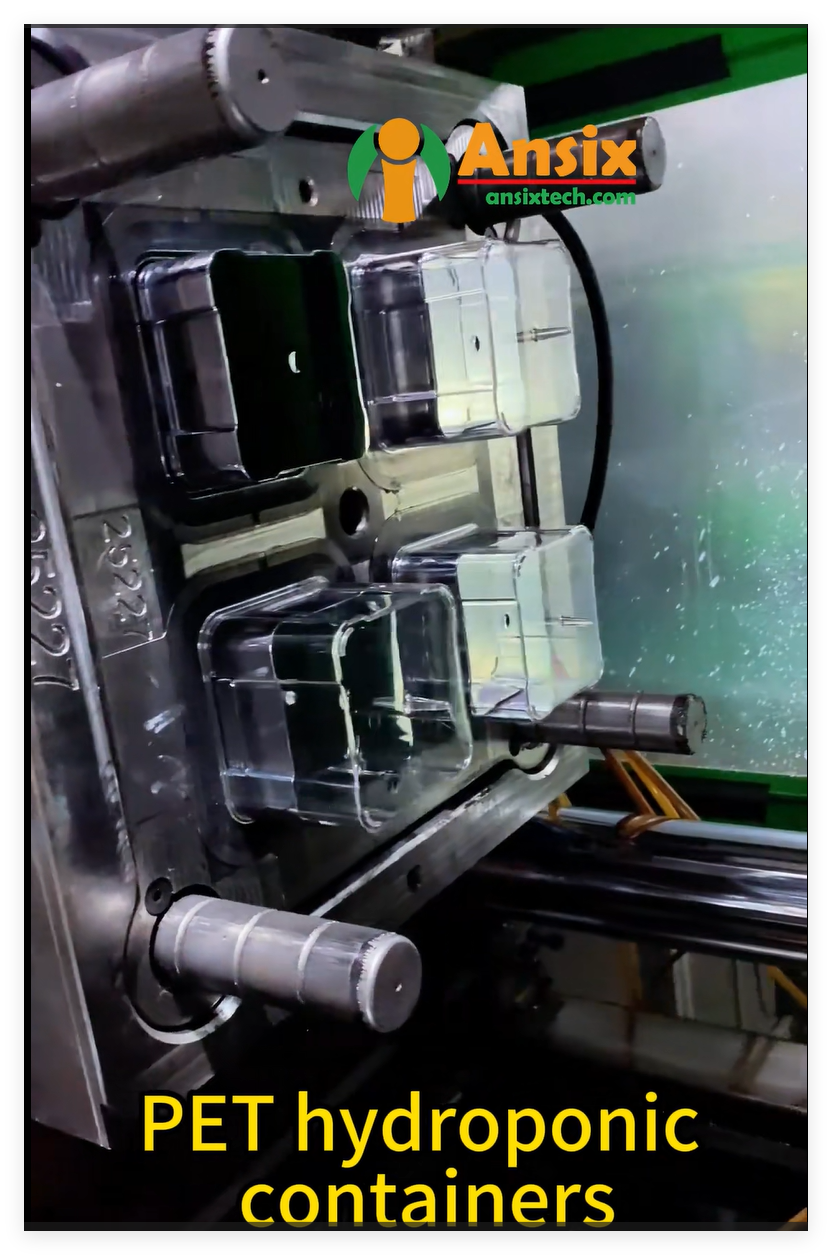
PET hydroponic containers
PET hydroponic containers

Ansix Tech Leads the Hydroponic Revolution with Innovative, Cost-Effective PET Container Solutions
Industry Context: A Growing Market Demands Advanced Solutions
The hydroponic container industry is in the midst of a significant expansion. Recent analysis indicates that the global hydroponic container market is on a steady growth trajectory, with expectations to reach a multi-billion-dollar valuation by 2031. This growth is fueled by the rising adoption of controlled-environment agriculture (CEA), urban farming initiatives, and the global push for sustainable food systems. As the market expands, key players like Freight Farms, GrowPod, and an increasing number of Chinese manufacturers are driving competition and innovation.
In this dynamic landscape, manufacturers face a critical challenge: balancing the high performance and durability required for agricultural applications with the relentless pressure to control costs. Traditional manufacturing approaches often force a compromise. However, Ansix Tech, with its deep specialization in injection molding, is redefining this balance. By leveraging advanced engineering, strategic material science, and process optimization, Ansix Tech is delivering high-performance PET (Polyethylene Terephthalate) hydroponic containers at significantly reduced costs, providing its customers with a decisive competitive edge.
The Case for PET: Superior Material for Demanding Applications
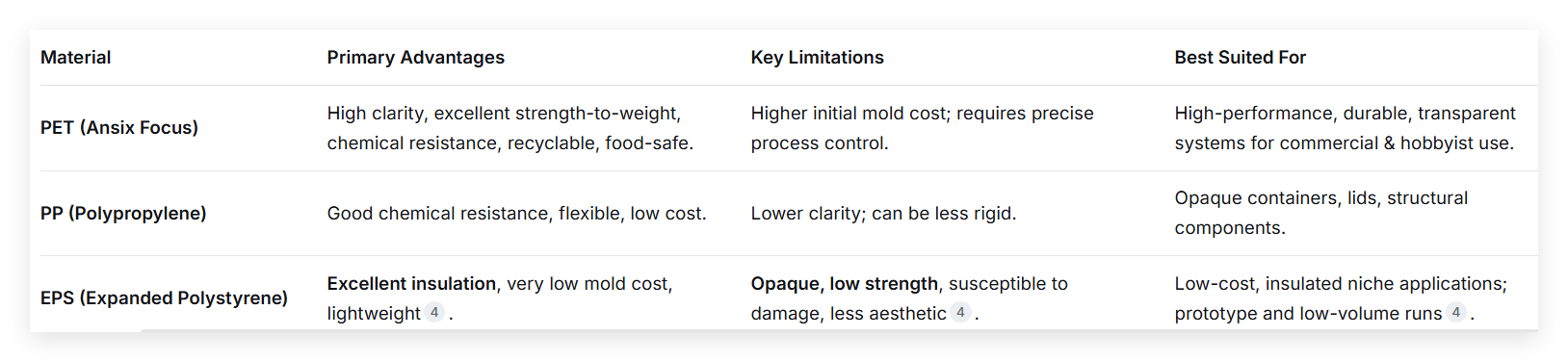
Selecting the right material is the foundational step in creating a successful hydroponic container. While materials like PVC, PP, and PE are common, and alternatives like EPS foam are chosen for their low initial Mold Cost, PET stands out for its unique combination of properties ideal for hydroponics.
Clarity and Monitoring: PET offers excellent transparency, allowing growers to easily monitor root health, nutrient solution levels, and potential blockages without disturbing the plants.
Chemical Resistance: It exhibits high resistance to the fertilizers, nutrients, and mild acidic or alkaline solutions commonly used in hydroponic systems, ensuring long-term integrity.
Strength and Durability: PET provides a superior strength-to-weight ratio compared to many other plastics, resulting in lightweight yet robust containers that can withstand stacking and handling.
Food-Contact Safety: PET is universally recognized as safe for food contact, a crucial factor for edible crop production, and is fully recyclable, aligning with sustainability goals.
While other plastics may be suitable, and foam offers advantages in thermal insulation and low-volume tooling cost, PET’s overall performance profile makes it the material of choice for durable, high-quality, and transparent hydroponic systems. Ansix Tech’s expertise begins with guiding clients through this critical selection process, often demonstrating how the long-term value of PET outweighs the initial investment.
Ansix Tech’s Product Development & Manufacturing Mastery
Bringing a PET hydroponic container from concept to mass production is a complex, multi-stage journey. Ansix Tech has systematized this process to ensure reliability, quality, and cost efficiency at every step.
Phase 1: Strategic Design & Feasibility
The process initiates with a collaborative design phase focused on manufacturability (DFM). Ansix engineers analyze part geometry, wall thickness (critical for avoiding defects in thin-walled containers), and assembly requirements. They conduct Advanced Mold Flow Analysis (DFM) to simulate the injection molding process virtually. This predicts how molten PET will fill the mold, identifying potential issues like air traps, weld lines, or uneven cooling that could lead to warping or weakness. Resolving these issues digitally before cutting steel prevents costly mold rework.
Phase 2: Precision Tooling & Mold Fabrication
The mold is the heart of the operation. Ansix Tech’s mold design addresses key systems:
Cooling Channels: Optimally placed to ensure uniform and rapid cooling, which is the longest phase of the cycle and directly impacts production speed.
Gating System: Designed to allow material to enter the cavity efficiently, minimizing stress and visible marks. For containers, hot runner systems are often employed to reduce waste.
Ejection System: Engineered to release the finished part smoothly without causing damage or deformation.
Steel Selection: Molds are crafted from high-grade, hardened tool steels to withstand the abrasive nature of PET and ensure a long production life, even under high-volume pressure.
Phase 3: Process Optimization & Validation
Once the mold is installed in a precision injection molding machine, the rigorous work of process optimization begins. Ansix Tech employs a scientific molding approach, moving beyond trial-and-error to data-driven control. Key parameters are meticulously dialed in, often guided by research-validated ranges for parameters like packing pressure and mold temperature.
A primary challenge in container molding is controlling warpage and dimensional stability, especially in large, thin-walled parts. Ansix tackles this by fine-tuning the packing phase—injecting additional material to compensate for shrinkage as the plastic cools. Advanced techniques, potentially involving real-time monitoring systems similar to those referenced in industry solutions, are used to maintain consistent cavity pressure, ensuring every part is identical.
Phase 4: Quality Assurance & Rapid Delivery
Quality is engineered into the process. Statistical Process Control (SPC) monitors critical dimensions in real-time. Finished containers undergo checks for clarity, weight, wall thickness, and leak integrity. Compliance with relevant international standards for plastics and containers, such as those pertaining to dimensions and materials, is verified. Once approved, parts are packaged using automated systems designed to prevent scratching or damage during transit. Ansix Tech’s integrated workflow from mold design to final packaging enables a rapid delivery process, accelerating customers’ time-to-market.
The Ansix Advantage: A Blueprint for Cost Reduction
What truly sets Ansix Tech apart is its unwavering commitment to driving down the total cost of ownership for its clients without compromising quality. This is achieved through a multi-faceted strategy:
- Material Efficiency & Innovation:
Reduced Part Weight: Through sophisticated mold flow analysis and design optimization, Ansix engineers containers to use the minimum material required for strength (a process called "light-weighting"), directly reducing per-part material cost.
Regrind Management: Ansix implements closed-loop systems to responsibly manage and reintegrate clean production scrap (regrind) back into the process, further lowering virgin material consumption.
- Process Optimization for Maximum Efficiency:
Cycle Time Reduction: As cooling is the largest portion of the cycle time, Ansix’s optimized cooling channel design and precise temperature control can shave critical seconds off each cycle. This increases the output per machine per day, spreading fixed costs over more units.
Scrap and Reject Minimization: By establishing a stable, data-controlled process and using technologies that automatically compensate for material viscosity variations, Ansix virtually eliminates the costly waste from short shots, warpage, and dimensional inconsistencies.
- Tooling for Longevity and Performance:
Investing in high-quality mold construction from the outset prevents costly downtime for repairs and extends the tool’s life over hundreds of thousands of cycles. This reduces the amortized mold cost per part significantly over the product’s lifetime.
Table: Comparative Analysis of Common Hydroponic Container Materials
Navigating Standards and Future Trends
Operating in a global market requires awareness of evolving regulations. Ansix Tech designs its PET containers to meet applicable international standards for dimensions and performance. Furthermore, the company is attuned to emerging trends, such as the development of standards for biodegradable polymer materials in plant cultivation. This forward-looking approach allows Ansix to advise clients on sustainable material alternatives and prepare for future regulatory shifts, ensuring their products remain market-ready.
Conclusion: Partnering for Growth in a Green Future
The hydroponic industry represents a vital component of the future of agriculture. Success in this field requires partners who provide not just components, but reliable, high-value manufacturing solutions. Ansix Tech has positioned itself as such a partner through its engineering excellence, command of the injection molding process, and relentless focus on cost optimization.
By transforming the inherent challenges of producing high-quality PET containers—thin-wall molding, dimensional stability, cycle time—into opportunities for innovation and efficiency, Ansix Tech delivers unparalleled value. It enables its customers, from ambitious startups to established agricultural brands, to bring superior hydroponic products to market at a competitive price point. In doing so, Ansix Tech is not just manufacturing containers; it is helping to cultivate the growth of sustainable agriculture worldwide.








Ansix Tech Co Ltd
If you have any plans related to PET hydroponic containers , you can contact us at any time. We will turn your ideas into reality, let you realize your dreams, and obtain large orders from the market. Our contact information is info@ansixtech.com. Or contact our CTO, mail: stephen@ansixtech.com
#www.ansixtech.com #ansixtech.com #PET hydroponic containers #Ansix mold factory #Ansix injection molding #Ansix mould Ltd #PET hydroponic containers injection molding factory #Ansix injection mould #PET hydroponic containers factory #PET hydroponic containers injection molding company #PET hydroponic containers injection mold companies #Ansix #Ansix moulds #Ansix china #Ansix tech china #Ansix tech company #Ansix facotry #Ansix Tech #Ansix molds #Ansix injection molding #Ansix mold factory #injection molding PET hydroponic containers # Ansix mold factory #PET hydroponic containers china #PET hydroponic containers precision molds #injection factory #PET hydroponic containers precision injection molding #L-shaped medical tumold injection molding factory #injection molding company #PET hydroponic containers injection mold companies #PET hydroponic containers factory #PET hydroponic containers mold limited #Ansix mold china #Ansix companies #Ansix company China #PET hydroponic containers facotry #Ansix Tech #Ansix Tech mould #PET hydroponic containers injection moulding #injection moulding company #Ansix PET hydroponic containers parts injection mold companies #PET hydroponic containers #PET hydroponic containers china #PET hydroponic containers china factory #Ansix moulding companies #Ansix molding company #PET hydroponic containers injection moulding facotry #Ansix Tech mold #PET hydroponic containers precision mould #PET hydroponic containers plastic injection molding #ansix plastic mold #Mold manufacturing #PET hydroponic containers parts manufacturing #PET hydroponic containers plastic parts factory #PET hydroponic containers injection parts mold #PET hydroponic containers PRECISION MANUFACTURING #PET hydroponic containers precision #China mold #PET hydroponic containers injection moulding china #PET hydroponic containers mould china #china precision mold #mold in china #PET hydroponic containers precision mold china #Precision molds #High-precision molds #PET hydroponic containers #Injection molds #PET hydroponic containers Factory #PET hydroponic containers Company #Super Large Injection Mold Factory #Large Tonnage Injection Molding Factory #PET hydroponic containers Company #Super PET hydroponic containers Factory #2800T Injection Molding Factory #3000 Ton Injection Molding #4500 Ton Injection Molding Factory #Large Mold Injection Molding #Large Plastic Mold Injection Molding Factory #Large Injection Mold Manufacturer #Plastic Mold Factory #Injection Mold #Plastic Mold