



Pacifier LSR Liquid Silicone Molding
FEATURES
Once mixed, the LSR is injected into a heated mold cavity under controlled pressure. Unlike thermoplastic molding, LSR undergoes vulcanization — a chemical cross-linking reaction triggered by heat — curing within the mold in 30 to 60 seconds depending on wall thickness and mold temperature. The mold is typically maintained at temperatures ranging from 150°C to 200°C, with the precise temperature profile optimized for the specific LSR formulation.
After curing, the part is ejected, trimmed if necessary, and subjected to post-curing in a convection oven to complete the cross-linking reaction and stabilize dimensional and mechanical properties. Post-curing ensures that volatile residues are eliminated, meeting stringent food-contact and biocompatibility requirements. The entire process can be fully automated, with robotic arms removing finished parts, loading inserts for overmolding applications, and transferring components through secondary operations.
-
Mold Description
Product Materials:
LSR SILICONE
Soft rubber: SILICONE
Mold Material:
S136ESR
Number of Cavities:
4
Glue Feeding Method:
Hot runner
Cooling Method:
Water cooling
Molding Cycle
22.5s
- The mold manufacturing process and product material selection
Quality Assurance
Quality assurance is integrated at every stage. Raw materials are tested for compliance with FDA 21 CFR 177.2600, EN 1400, and ISO 10993 standards. During production, statistical process control (SPC) monitors key parameters including injection pressure, mold temperature, and shot weight. Finished parts undergo visual inspection, dimensional verification, and functional testing (e.g., pull strength for shields, tear resistance for nipples). Automated optical inspection systems detect surface imperfections down to micron-level resolution.
For multi-cavity molds, cavity pressure sensors monitor fill balance, ensuring that each cavity produces identical parts with Cpk ≥ 1.33 capability. Lot traceability is maintained from raw material receipt through final packaging, enabling rapid root-cause analysis if quality issues arise.
Delivery Efficiency
Ansix Tech delivers LSR pacifier tooling in 35-45 days from design approval for standard complexity molds, with expedited options available in as few as 25 days for urgent projects. Sample parts can be delivered within 10-15 working days after tooling completion for customer approval.
For mass production, Ansix Tech operates a fleet of injection molding machines ranging from 30 to 400 tons, with dedicated production cells for high-volume pacifier programs. An 8-cavity cold runner mold running on a 130-ton press can produce thousands of finished pacifiers per hour. Production capacity is scalable through parallel cell operation and multi-shift scheduling, allowing rapid ramp-up to meet peak seasonal demand.
-
Ansix Tech achieves competitive cost advantages through multiple levers. Cold runner systems eliminate runner material waste entirely, achieving 100% material utilization — unlike hot runner or conventional runner systems that generate 15-30% scrap from cured runners. Cold runners also reduce cycle times by maintaining LSR in an uncured state until it enters the cavity, minimizing pre-cure waste.
Process optimization further drives efficiency. Ansix’s engineering team analyzes each design to optimize cycle time through balanced heating and cooling channel layouts, reducing cure time without compromising crosslink density. For high-volume programs, multi-cavity molds (up to 16 or 32 cavities) amortize tooling costs across larger per-shot output, reducing per-part cost.
Volume leverage plays a significant role. Ansix’s purchasing power with leading LSR suppliers — including Wacker, Dow (XIAMETER), Momentive (Silopren), and Elkem (Bluestar) — secures favorable material pricing, with savings passed directly to customers. Consolidated procurement across multiple customer programs further reduces unit material cost.
Lean manufacturing principles guide every operation. Single-piece flow, quick mold changeover systems, and automated part handling minimize non-value-added time and direct labor costs. Cellular manufacturing layouts locate inspection stations adjacent to presses, enabling instant feedback and defect containment.
By integrating these cost-control mechanisms, Ansix Tech typically reduces total landed cost for LSR pacifier programs by 15-30% compared to fragmented supplier arrangements, while maintaining or improving quality standards.
Part Two: Core Value in Mold Manufacturing, Material Selection, Smart Manufacturing, and Process Quality
Translating Technical Excellence into Measurable Customer Value
Mold Manufacturing: Precision That Protects Your Brand
Ansix Tech‘s mold manufacturing capability begins with industry-leading equipment. Five-axis high-speed machining centers achieve cavity tolerances within ±0.002 mm, ensuring that parting lines are imperceptibly smooth and flash-free — critical for pacifiers that contact an infant’s delicate oral mucosa. For customers, this means zero secondary deburring operations, eliminating both labor cost and the risk of sharp edges that could compromise safety.
Wire EDM systems cut features as fine as 0.03 mm, enabling intricate venting slots and narrow grooves without inducing burrs or deformation. Combined with mirror EDM for high-gloss surface finishes (Ra ≤ 0.05 μm), Ansix produces molds that yield transparent LSR parts with optical clarity, free from surface blemishes or texture transfer defects.
Every mold undergoes comprehensive quality validation before shipment. Coordinate Measuring Machines (CMMs) and optical inspection systems verify every critical dimension, with key features subjected to process capability analysis requiring Cpk ≥ 1.33. A full dimensional report accompanies every mold, providing auditable proof of conformance.
Material Selection: Safety by Design, Performance by Engineering
Ansix’s material selection protocol begins with regulatory compliance — the non-negotiable baseline for any pacifier product. Food-grade LSR materials are certified to FDA 21 CFR 177.2600 (US) and EU 10/2011 (Europe), while medical-grade options provide ISO 10993 biocompatibility certification for extended oral contact applications.
Beyond certification, material properties determine real-world performance. Ansix works with leading LSR suppliers including Wacker (ELASTOSIL series), Dow (XIAMETER), Momentive (Silopren), and Elkem (SILBIONE). Each material family offers distinct property profiles:
Property Typical Range Customer Value
Hardness (Shore A) 20-70 (±3 tolerance) Customizable tactile feel — softer for newborns, firmer for teething toddlers
Tear Strength ≥27 kN/m Prevents nipple tearing during aggressive biting
Tensile Strength ≥8 MPa Maintains shape integrity through repeated sterilization
Light Transmittance ≥78% (transparent grades) Clear appearance for visual appeal and hygiene monitoring
Shrinkage (post-cure) 2.5-3% Predictable final dimensions — compensated in mold design
Material Selection Guidance by Regulatory Pathway
Regulatory Standard Applicable Region Key Requirements Ansix’s Material Validation
FDA 21 CFR 177.2600 USA Rubber articles intended for repeated food contact Raw material COA + validated cure process
EN 1400 Europe Chemical migration limits (BPA ≤0.01 mg/L, nitrosamines ≤0.01 mg/kg) Third-party testing + lot traceability
LFGB Germany/Germany-specific Food-grade compliance beyond EU baseline Supplier certification + batch testing
REACH EU SVHC restrictions (phthalates <0.1%, lead, cadmium) Full material declaration + compliance documentation
ISO 10993 Global (medical-grade) Cytotoxicity, sensitization, irritation testing Biocompatibility report for oral-mucosal contact
Ansix guides customers through this selection process, balancing cost against performance requirements. For high-volume consumer pacifiers, a certified food-grade LSR from an established Tier-1 supplier provides optimal value. For medical applications or premium export markets requiring full certification packages, medical-grade options add appropriate documentation without unnecessary over-specification.
Smart Manufacturing Integration: Efficiency Powered by Technology
Ansix’s manufacturing floor reflects Industry 4.0 principles. All injection molding machines are connected to a Manufacturing Execution System (MES) that locks processing parameters — temperatures, pressures, injection speeds, and cure times — at engineer-authorized setpoints. Unauthorized adjustments are impossible; every parameter change is logged with timestamp and operator ID, providing full production traceability.
Remote monitoring capabilities allow customers to view real-time production status, quality metrics, and projected completion dates through secure web portals. For critical programs, automated alerts notify both Ansix and customer quality teams if process parameters drift outside control limits, enabling preventive intervention before non-conforming parts are produced.
Cold runner systems with servo-actuated needle valves provide automated startup and cavity-specific fill control. In learning mode, the system automatically detects optimal fill volumes for each cavity, compensating for variations in material viscosity or ambient conditions. This self-optimizing capability reduces setup time by up to 60% and eliminates manual trial-and-error adjustments.
Process Quality: Eliminating Customer Quality Anxiety
Customer quality concerns center on four predictable failure modes: flash (excess material at parting lines), dimensional instability, surface defects (flow marks, bubbles, incomplete fill), and batch-to-batch inconsistency. Ansix addresses each through systematic controls.
Flash elimination: Mold fitting tolerances at parting lines are held to ±0.005 mm, combined with self-locking clamp force compensation that adapts to thermal expansion during the molding cycle. This ensures flash is contained within 0.03 mm — barely perceptible to touch and well below typical safety thresholds for infant products.
Dimensional stability: Mold temperature controllers partition the core and cavity zones, maintaining temperature differentials within 2°C to minimize warpage from uneven cooling. In-mold pressure sensors provide real-time feedback, automatically adjusting pack and hold parameters to compensate for material viscosity drift. Independent testing demonstrates that critical dimensions on multi-cavity tools maintain ±0.02 mm stability across three consecutive production runs — even with week-long intervals between runs.
Surface quality: Transparent LSR parts achieve bubble-free, streak-free appearance through optimized gate placement identified during mold flow analysis. Venting channels positioned at fill endpoints allow trapped air to escape before material arrival, eliminating burn marks and incomplete fills.
Batch consistency: Recipe-based parameter management ties every production batch to a specific material lot, machine, and operator team. First-article inspections compare each new batch against retained samples; last-article inspections provide bookend verification before mold changeover.
Part Three: Comprehensive Production Solution for Pacifier LSR Liquid Silicone Molding
Full-Process Manufacturing Solutions from Ansix Tech
Project Initiation – Defining the Customer Value Proposition
At Ansix Tech, we recognize that molds are not pieces of steel — they are revenue-generating assets for our customers. Every pacifier LSR project begins with a fundamental question: What problem does this product solve for the end user, and what risk does it create for the brand owner if poorly executed?
Our engineering team translates this question into technical requirements: What hardness delivers optimal comfort without compromising bite resistance? Which gate location minimizes visible witness marks on the nipple’s functional surface? How many cavities balance tooling cost against per-part economics for the forecasted annual volume? These trade-offs — always customer-specific — are documented in our Design for Manufacturing (DFM) report, delivered before any metal is cut.
Customer Need How Ansix Delivers Measured Outcome
Faster time-to-market Expedited tooling path (parallel engineering + machining) 35-45 day standard; 25 days expedited
Lower per-part cost High-cavity cold runner molds + automation 8-32 cavities; zero runner waste
Regulatory confidence ISO 13485-compliant QMS + full material traceability Audit-ready documentation from first sample
Supply chain simplification One-stop solution: mold + molding + assembly + packaging Single purchase order, single quality contact
Risk reduction DFM review + T0-T3 sampling + 1000-shot aging test Predictable production launch, no surprises
Hard Power Infrastructure – Building Customer Confidence Through Equipment Excellence
Precision Mold Manufacturing Equipment
Ansix‘s mold shop is equipped to execute the tightest tolerances required for LSR pacifier applications. Five-axis high-speed machining centers with spindle speeds up to 40,000 RPM achieve complex 3D contours with surface finishes requiring no hand polishing — critical for transparent nipple sections where polishing marks would be visible. Parting lines are finished to Ra ≤ 0.2 μm, producing flash-free interfaces that require no manual trimming.
Our wire EDM capability features sub-micron positioning accuracy, capable of cutting features as fine as 0.03 mm in width — essential for the narrow venting slots that allow air escape during injection without creating surface blemishes. Unlike conventional machining, EDM produces no burrs, eliminating secondary finishing operations that add cost and risk part damage.
Coordinate Measuring Machines (CMMs) with scanning probes verify every critical feature against the CAD master. Optical comparators provide rapid verification of 2D profiles — nipple wall thickness consistency, guard diameter, and shield contour. Every mold is supplied with a full dimensional inspection report, and for regulated applications, key dimensions are validated to Cpk ≥ 1.33 before shipment.
Injection Molding Machine Fleet
Ansix operates a comprehensive fleet of injection molding machines ranging from 30 to 400 tons of clamping force, covering the full spectrum of pacifier sizes — from small orthodontic nipples to full-sized shields. For LSR pacifier production, our primary platforms include all-electric servo-driven machines from Fanuc and Engel, supported by German Arburg systems dedicated to liquid silicone processing.
Machine Platform Clamping Force (Tons) Target Application Key Capability
All-Electric LSR (Fanuc/Engel) 30-100 Single-cavity to 4-cavity nipple molds ±0.1% shot repeatability
All-Electric LSR (Fanuc/Engel) 100-200 4 to 8-cavity pacifier molds High-speed, high-precision production
Hydraulic/Servo LSR 200-400 8 to 32-cavity high-volume molds Large platen for multi-cavity cold runners
2-Component Hybrid (Arburg) 80-200 Soft LSR nipple overmolded onto hard plastic shield Single-cycle production of composite pacifiers
All-electric servo-driven machines deliver shot weight repeatability within ±0.1% of target, ensuring that every cycle — whether the first or the hundred-thousandth — produces parts within the same narrow tolerance band. Closed-loop process control continuously monitors injection pressure, mold temperature, and cure time, adjusting parameters in real time to maintain optimal conditions as ambient temperature or material lot varies.
Quality and Metrology Systems
Every part produced — whether sample or production — is subject to documented quality controls. In-process checks are performed at defined intervals, with the frequency determined by statistical process control (SPC) rules; when trends approach control limits, inspection frequency increases automatically until stability is restored.
Dimensional verification uses both contact (CMM) and non-contact (optical) measurement systems depending on feature geometry. For fragile or flexible LSR parts, optical measurement prevents measurement-induced distortion. For hard plastic shield components, touch-probe CMMs deliver maximum accuracy.
Mold Manufacturing – Core Competitive Differentiation
Mold Life and Durability
LSR molds are high-wear assets; unlike thermoplastics, LSR is chemically reactive and can accelerate erosion of unprotected steel surfaces over high-cycle production. Ansix specifies mold materials based on expected production volume and runner configuration.
| Mold Component | Material Selection | Hardness | Expected Life (Normal Operation) |
|----------------|--------------------|----------|------------------------------ ------|
| Mold Base | P20 / 1.2311 (pre-hardened) | 28-32 HRC | Indefinite (replaceable components) |
| Cavity/Core Inserts (Standard) | S136 / 1.2083 (stainless) | 48-52 HRC | 500,000+ cycles |
| Cavity/Core Inserts (High-Volume) | 420 stainless / 1.4034 | 52-56 HRC | 1,000,000+ cycles |
| Cavity/Core Inserts (Wear-Resistant) | DC53 / SKD11 | 58-62 HRC | 2,000,000+ cycles |
| Gate Valves / Slides | H13 / 1.2344 (hot work) | 50-54 HRC | 500,000+ cycles |
| Ejector Pins | SKH51 / M2 HSS | 58-62 HRC | Replaceable wear parts |
For glass-fiber-reinforced materials or abrasive filler applications, Ansix specifies 2344 or DC53 with TiN coating to extend tool life beyond 2 million cycles. For standard unfilled LSR pacifier applications, S136 (420 stainless) provides optimal balance of corrosion resistance, polishability, and wear resistance at 500,000-plus cycle life. Full material certifications including heat treatment curves are supplied with every mold.
Achievable Tolerances
Precision capability is specified by feature type and application criticality:
Feature Type Standard Tolerance Precision Capability Measurement Method
Linear dimensions (general) ±0.05 mm ±0.02 mm Optical / CMM
Linear dimensions (critical) ±0.02 mm ±0.01 mm CMM
Concentricity / roundness 0.02 mm 0.01 mm CMM circular scan
Parting line fit 0.005 mm gap 0.002 mm gap Feeler gauge / optical
Surface finish (mold steel) Ra 0.4 μm Ra 0.1 μm Profilometer
Surface finish (part – transparent) Ra 0.2 μm Ra 0.05 μm Visual + optical
For cosmetic surfaces on transparent pacifiers, mirror-grade finishes (Ra ≤ 0.05 μm) are achieved through a combination of high-speed milling, manual polishing, and — for the highest requirements — diamond turning or EDM with fine-finish parameters.
Mold Types and Configurations
Cold runner systems are standard for LSR pacifiers, as they eliminate material waste entirely. The runner is maintained at low temperature (typically 20-40°C), keeping LSR fluid and reusable, while the cavity is heated to vulcanization temperature. After part ejection, uncured runner material is recycled into the next shot, achieving 99%+ material utilization.
Hot runner systems — rare for LSR due to thermal curing — are only specified when gate location constraints cannot accommodate cold runner geometries.
For composite pacifiers requiring both a soft LSR nipple and a rigid plastic shield (usually PP, PC, or ABS), Ansix produces two-component overmolding molds. The rigid substrate is either injection molded in a first cavity or manually loaded as an insert before LSR injection. Proper bonding between the two materials requires careful management of surface treatment (primer or plasma activation) and process parameters.
Gate and Venting Strategy
Gate placement is determined through mold flow analysis (MFA) to minimize cosmetic witness marks while ensuring complete cavity fill. Key gate design principles for LSR pacifiers:
Single-cavity vs multi-cavity balancing — For multi-cavity tools (8, 16, or 32 cavities), runner lengths are geometrically balanced to equalize flow resistance. When geometric balancing is impossible, flow restrictors in individual runner legs provide tunable flow control.
Gate location — For pacifier nipples, the preferred gate location is at the nipple tip (visible, but positioned at a non-oral-contact location). For shields, gate location is at the outer perimeter, concealed behind trim surfaces.
Venting — LSR is low-viscosity (10,000-100,000 cP at injection) and will fill every crevice including those that should remain unfilled. Proper venting channels — typically 0.01-0.03 mm deep x 1-5 mm wide — allow trapped air to escape without creating flash. For pacifiers, vents are placed at the last point of cavity fill (the nipple tip center).
Cooling System Design for High-Volume Production
Cooling system design directly determines cycle time. Inadequate cooling extends cure time; non-uniform cooling causes part warpage. Ansix designs conformal cooling channels where practical — following the part contour rather than straight-drilled lines — to achieve uniform temperature distribution across the cavity.
Key cooling design parameters for pacifier molds:
Core vs cavity temperature control — Separate thermolator units for core and cavity allow independent temperature setting (often cavity slightly cooler to promote faster cure without sacrificing surface finish)
Flow rate optimization — Turbulent flow achieved at Reynolds >4,000 ensures efficient heat transfer
Gate-area cooling — Highest heat concentration at the gate requires targeted cooling channels
Gating System Selection
Gate sizing is critical: too small restricts flow and generates shear heat that accelerates premature cure; too large leaves a visible vestige requiring manual trimming. Typical gate dimensions for LSR pacifiers: 1.5-3.0 mm diameter for nipple-tip gates; 0.8-2.0 mm x 2-5 mm for edge gates on shield components.
Valve-gate cold runners provide cavity-specific fill control: each cavity‘s gate is opened individually by a solenoid valve, allowing precise fill balancing even with varying cavity geometries (e.g., family molds containing both left-side and right-side parts).
Ejection System Design
LSR has low stiffness in the just-cured state and will tear or stretch if ejection forces are concentrated. Ejection system design for pacifier molds requires:
Large-diameter ejector pins (4-6 mm) or flat blades to distribute ejection force over larger area
Air-assist ejection (compressed air burst behind part) to break vacuum adhesion without mechanical contact
Stripper plates for parts with large projected areas (full pacifier shields)
Surface treatments (e.g., PTFE impregnation or chromium plating) on core surfaces to reduce adhesion
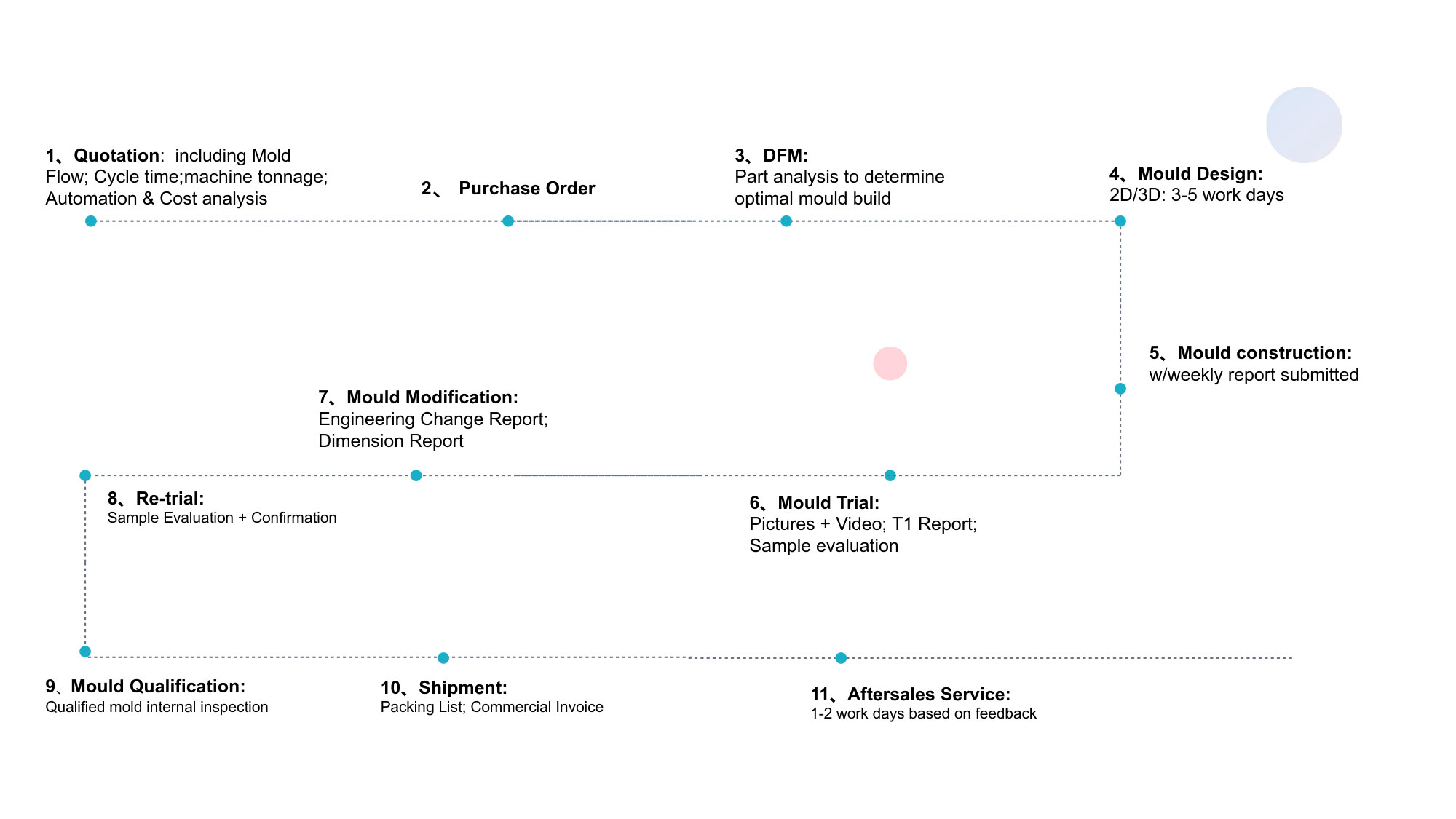
Mold Manufacturing Process Flow
Each mold follows a structured manufacturing sequence:
Phase 1 – Digital design review (2-5 days) — Customer 3D CAD file received; DFM analysis performed; gate location, runner layout, vent placement, and draft angles verified; shrinkage compensation applied (2.5-3% for LSR, material-specific for thermoplastics); customer approval required before proceeding to steel
Phase 2 – Rough machining (3-7 days) — High-speed roughing operations remove bulk material; stress-relief heat treatment applied if needed
Phase 3 – Precision finishing (5-10 days) — Finish machining, CNC milling of complex contours, wire EDM of narrow slots/grooves, mirror EDM for high-gloss surfaces
Phase 4 – Assembly and fitting (2-5 days) — Mold base assembly, component fitting, parting line verification, ejection system installation
Phase 5 – Samplings (T0, T1, T2, T3) (5-10 days) — T0: first shots on test press; T1: dimensional verification and adjustments; T2: process optimization; T3: final validation and customer sample submission; minor tool adjustments (e.g., vent depth, gate size) often occur between trials
Total lead time from design approval to T3 sample approval: 35-45 days standard. For simple single-cavity or 2-cavity molds, 25-day expedited schedules are possible.
Material Selection in Depth
Material Property Framework
Hardness — Measured in Shore A (20A very soft, 70A firm). Pacifiers typically specify 30-50A: lower hardness for newborn comfort, higher hardness for teething toddlers or shield components. Narrow-range specifications (e.g., 40±2A) require premium materials from Tier-1 suppliers.
Tear Strength — Critical for nipple integrity under biting and stretching. Minimum acceptable: ≥27 kN/m for infant pacifiers.
Tensile Strength — Minimum acceptable: ≥8 MPa.
Elongation at break — Minimum acceptable: ≥400% for nipple sections that will be repeatedly stretched.
Light transmittance — For transparent designs, ≥75% at 2mm thickness.
Shrinkage — LSR shrinks 2.5-3% after demolding and cooling. Compensation is applied during mold design (enlarging cavity dimensions accordingly). Shrinkage varies by material formulation, so final compensations are verified during T0 sampling.
Volatile content — Low-volatility grades (ELASTOSIL LR 3003 R series) meet EN 1400 limits for volatile compounds without requiring extended post-cure.
Material Grade Selection Guide
Application Scenario Recommended Material Grade Key Properties Certification Status
Standard pacifier (global market) Wacker ELASTOSIL LR 3003 series Volatile-reduced, food contact approved FDA 21 CFR 177.2600, BfR XV, LFGB
Premium/European market Wacker ELASTOSIL eco LR 5040 Carbon-neutral production, food contact FDA, BfR XV, meets eco-label criteria
Medical/clinical grade Wacker ELASTOSIL LR 3003/xx US USP Class VI, ISO 10993 biocompatibility FDA 21 CFR 177.2600
High clarity/transparent Momentive Silopren LSR 2630 Low viscosity, high reactivity, excellent clarity FDA 21 CFR 177.2600
High tear resistance Dow XIAMETER RBL-2004 Series Enhanced tear strength (16 kN/m typical) Food contact approved
All Tier-1 materials are delivered as two-component kits (A+B) with certificates of analysis for each lot. For customers with specific certification requirements (e.g., EN 1400 compliance for EU distribution), Ansix provides full material compliance documentation, including migration testing results.
DFM and Design Optimization
The Design for Manufacturing (DFM) process begins before mold design — often before customer design is finalized. Ansix provides early feedback that reduces downstream risk:
Wall thickness optimization — LSR will fill thin walls (down to 0.5 mm) but may trap air or flash if wall transitions are too abrupt. DFM suggests tapered transitions and minimum draft angles (2-3° recommended).
Draft angle specification — Insufficient draft (less than 1°) makes part ejection difficult, leading to torn parts or damaged molds. DFM recommends 2-3° draft for LSR.
Undercut evaluation — External undercuts require slides (adding cost); internal undercuts require collapsible cores (complex, higher cost). DFM suggests design alternatives when possible.
Gate witness location — DFM recommends gate locations that place witness marks on non-cosmetic surfaces or locations that will be hidden (e.g., inside the shield center, not the nipple surface).
Venting strategy — DFM identifies fill endpoints (where trapped air will accumulate) and specifies vent dimensions (depth, width, location) before mold machining begins.
Mold flow analysis confirms the design. For multi-cavity tools, fill balance is optimized — each cavity fills at the same rate, with the same temperature profile, eliminating short shots or overpacked conditions. Flow leaders and restrictors balance runner geometry when cavity locations vary.
The DFM report includes full 3D simulation results, wall thickness contour maps (identifying thick sections that may cause sink), and a risk matrix highlighting features requiring special attention.
Injection Molding – Process and Production
Production Cell Configuration
An 8-cavity cold runner mold running on a 130-ton horizontal LSR press represents a typical production cell for medium- to high-volume pacifier programs. The complete cell includes:
LSR dosing system — Metering pumps accurately proportion A and B components at 1:1 ratio, with accuracy up to 0.15%; static mixer ensures thorough blending; color injection capability for tinted pacifier shields.
Injection molding machine — All-electric or servo-hydraulic press with direct barrel connection to dosing system; screw or plunger injection depending on shot size; temperature-controlled barrel (20-40°C) to prevent pre-cure.
Mold — Cold runner system maintained at 20-40°C; cavity region heated to 160-200°C via cartridge heaters or heated oil circulation; temperature control zones typically independent for core vs cavity.
Automation — Pick-and-place robot removes finished parts, places them onto conveyor; for overmolding applications, robot loads plastic inserts before LSR injection.
Secondary operations — Automated trimming stations remove any flash or gate vestige; vision inspection stations check for surface defects and dimensional conformance; packaging stations count and pack parts into bags or clamshells.
Process Optimization for Efficiency and Cost Reduction
Ansix’s process engineering team methodically optimizes every parameter:
Parameter Optimization Goal Impact on Cost/Efficiency
Injection speed Fill cavity without air entrapment or premature cure initiation Faster cycle → higher output
Mold temperature Achieve full cure in minimum time without scorching Lower temp → slower cure; higher temp → risk of burn marks
Cure time Minimum time achieving fully crosslinked (95%+ cured) part Time reduction directly increases throughput
Injection pressure Minimum required for complete fill (prevents flash) Lower pressure → less tool wear, less flash
Cooling efficiency Balanced cooling prevents warpage, allows early ejection Faster cooling → shorter cycle
For pacifier applications, typical cure times range from 30-90 seconds depending on wall thickness. 2 mm thick sections cure in approximately 45 seconds at 150°C. Thin-wall sections (under 1 mm) may cure in 20-30 seconds. The engineer‘s challenge: shorter cycles reduce cost but may increase reject rate if cure is incomplete. Ansix documents optimized parameters for each material-grade combination, validated through 100-shot runs with post-cure physical property verification.
Productivity Enhancement Through Automation
Ansix has eliminated manual intervention from the production floor wherever possible:
Automated mold change systems allow tool swaps in under 10 minutes, reducing downtime between production runs.
Centralized material distribution uses sealed lines from bulk storage directly to each press, minimizing dust contamination and reducing operator handling time.
Robotic part handling uses servo-driven pick-and-place units synchronized with the press; parts are transferred to secondary operations (trimming, inspection, packaging) without intermediate manual steps.
Vision inspection systems at the production line exit detect dimensional deviations, surface defects, and color variations in real time, automatically rejecting non-conforming parts and logging defect categories for SPC trending.
Quality Control Process
Incoming material inspection: Each LSR lot is tested for viscosity, pot life, and cure rate; certificates of analysis are retained.
In-process monitoring: Shot weight, injection pressure, and mold temperature are continuously logged and trended.
First-article inspection: At production run start, parts from each cavity are measured dimensionally and visually inspected.
Periodic sampling: Visual inspection every 100 shots verifies process consistency; dimensional inspection every 500 shots.
Last-article inspection: End-of-run inspection confirms process remained stable throughout.
Statistical process control: Cpk analysis for critical dimensions requires ≥1.33 for production release.
For regulated medical-grade pacifiers, Ansix maintains ISO 13485-certified quality management system protocols, including full lot traceability, validated cleaning procedures, and documented change control.
Packaging and Delivery
Packaging is customized to customer requirements:
Bulk packaging: Untrimmed parts bagged and boxed (lowest cost)
Basic retail packaging: Blister pack + printed card
Medical/pharmaceutical packaging: Sterile pouch (gamma or EO sterilized)
Premium retail: Custom clamshell + printed sleeve
Lead times for production orders:
Order Volume Typical Lead Time (after sample approval)
5,000-25,000 pieces 7-10 business days
25,001-100,000 pieces 10-15 business days
100,001-500,000 pieces 15-20 business days
500,000+ pieces 20-25 business days (scheduled production)
Expedited delivery — up to 30% faster — available for premium service level.
Experience, Reliability, and Customer Value
Industry Experience
Ansix Tech brings over 28 years of injection molding expertise, with specialized depth in medical-grade LSR and baby care products. Our facility operates ISO 9001-certified quality systems, with medical production cells following ISO 13485 protocols.
Key credentials:
In-house mold manufacturing — no outsourcing of tooling, no third-party quality gaps
Tier-1 LSR material partnerships — Wacker, Dow, Momentive, Elkem
Automated LSR production cells — Fanuc, Engel, Arburg, Sumitomo
Full-service capabilities — mold design, molding, assembly, packaging, sterilization
Cost Reduction Strategies
Ansix reduces total program cost through multiple channels:
Cost Driver Ansix’s Approach Typical Savings
Material cost Tier-1 materials at volume pricing; pass-through to customer 10-15% vs buying direct
Runner scrap Cold runner systems achieve near-100% material utilization 20-30% material savings
Cycle time Optimized cooling and rapid-cure materials 15-25% cycle reduction
Secondary operations Automated trimming, in-line inspection, robotic handling 30-50% labor reduction
Tool amortization Multi-cavity tools up to 32 cavities reduce per-part burden 40-60% tool cost per part
Supply chain consolidation Single source for mold + molding + assembly + packaging 15-25% logistics reduction
Risk Mitigation
Quality risk: DFM reviews identify potential defects before steel is cut, preventing costly downstream rework.
Regulatory risk: Material certifications, process validation protocols, and lot traceability ensure audit readiness.
Supply chain risk: In-house manufacturing eliminates dependency on external tool shops; material safety stock buffers against supply disruptions.
Production risk: Process capability validation (1000-shot aging tests) confirms stability before full production release.
Closing Statement
At Ansix Tech, we view each pacifier LSR molding program as a partnership. Our role extends beyond part production to include design guidance, process validation, and continuous improvement. The objective is not merely to meet specifications but to deliver predictable, repeatable quality that protects the brand reputation of our customers.
We invite prospective partners to review a DFM report on an existing product. Our engineers will demonstrate how we identify and eliminate fill balance issues, venting deficiencies, and cosmetic risks before they become field failures. The gap between theoretical design and producible reality is where inferior suppliers lose time and money — it is where Ansix Tech delivers measurable, verifiable value.
Ansix Tech Co Ltd
If you have any plans related to Pacifier LSR Liquid Silicone Molding , you can contact us at any time. We will turn your ideas into reality, let you realize your dreams, and obtain large orders from the market. Our contact information is info@ansixtech.com. Or contact our CTO, mail: stephen@ansixtech.com
#www.ansixtech.com #ansixtech.com #Pacifier LSR Liquid Silicone Molding #Pacifier LSR Liquid Silicone Molding injection molding companies #Pacifier LSR Liquid Silicone Molding Canopy Mold injection mold companies #Ansix #Ansix moulds #Ansix china #Ansix tech china #Ansix tech company #Ansix facotry #Pacifier LSR Liquid Silicone Molding injection molding #Pacifier LSR Liquid Silicone Molding injection tools #Pacifier LSR Liquid Silicone Molding injection moulds #Pacifier LSR Liquid Silicone Molding plastic mould #Pacifier LSR Liquid Silicone Molding plastic tools #Ansix Tech #Ansix molds #Ansix injection molding #Ansix mold factory #injection molding Pacifier LSR Liquid Silicone Molding#Ansix mold factory #Pacifier LSR Liquid Silicone Molding china #Pacifier LSR Liquid Silicone Molding molds #injection factory #Pacifier LSR Liquid Silicone Molding injection molding #Pacifier LSR Liquid Silicone Molding injection molding factory #injection molding company #Pacifier LSR Liquid Silicone Molding injection mold companies #Pacifier LSR Liquid Silicone Molding Tooling #Pacifier LSR Liquid Silicone Molding mold limited #Ansix mold china #Ansix companies #Ansix company China #Pacifier LSR Liquid Silicone Molding facotry #Ansix Tech #Ansix Tech mould #Pacifier LSR Liquid Silicone Molding injection moulding #injection moulding company #Ansix Pacifier LSR Liquid Silicone Molding parts injection mold companies #medical injection molding companieschina #Pacifier LSR Liquid Silicone Molding china factory #Ansix moulding companies #Ansix molding company #Pacifier LSR Liquid Silicone Molding injection moulding facotry #Ansix Tech mold #Pacifier LSR Liquid Silicone Molding mould #Pacifier LSR Liquid Silicone Molding plastic injection molding #ansix plastic mold #Mold manufacturing #Pacifier LSR Liquid Silicone Molding parts manufacturing #Pacifier LSR Liquid Silicone Molding plastic parts factory #Pacifier LSR Liquid Silicone Molding injection parts mold #Pacifier LSR Liquid Silicone Molding PRECISION MANUFACTURING #Pacifier LSR Liquid Silicone Molding #China mold #Pacifier LSR Liquid Silicone Molding injection moulding china #Pacifier LSR Liquid Silicone Molding mould china #china precision mold #mold in china #Pacifier LSR Liquid Silicone Molding mold china #Precision molds #High-precision molds #Pacifier LSR Liquid Silicone Molding #Injection molds #Pacifier LSR Liquid Silicone Molding Factory #Pacifier LSR Liquid Silicone Molding Company #Super Large Injection Mold Factory #Large Tonnage Injection Molding Factory #Pacifier LSR Liquid Silicone Molding Company #Pacifier LSR Liquid Silicone Molding Factory #2800T Injection Molding Factory #3000 Ton Injection Molding #4500 Ton Injection Molding Factory #Large Mold Injection Molding #Large Plastic Mold Injection Molding Factory #Large Injection Mold Manufacturer #Plastic Mold Factory #Injection Mold #Plastic Mold