



Ansix Tech Co Ltd
Jeśli masz jakiekolwiek plany związane z formą butelki na błyszczyk PETG, możesz skontaktować się z nami w dowolnym momencie. Zrealizujemy Twoje pomysły, pomożemy Ci zrealizować marzenia i pozyskać duże zamówienia z rynku. Nasze dane kontaktowe to info@ansixtech.com. Możesz również skontaktować się z naszym dyrektorem ds. technologii, pisząc na adres stephen@ansixtech.com.
-
#www.ansixtech.com #ansixtech.com #butelka błyszczyka PETG #formy do butelek błyszczyka PETG #firmy produkujące wtryski do butelek błyszczyka PETG #firmy produkujące wtryski do butelek błyszczyka PETG Canopy Mold #Ansix #formy Ansix #Ansix Chiny #Ansix Tech Chiny #firma Ansix Tech #fabryka Ansix #formowanie wtryskowe butelek błyszczyka PETG #narzędzia do wtryskiwania butelek błyszczyka PETG #formy wtryskowe do butelek błyszczyka PETG #forma plastikowa do butelek błyszczyka PETG #narzędzia plastikowe do butelek błyszczyka PETG #Ansix Tech #formy Ansix #formowanie wtryskowe Ansix #fabryka form Ansix #formowanie wtryskowe butelki błyszczyka PETG #fabryka form Ansix #butelka błyszczyka PETG #chińska butelka błyszczyka PETG #forma wtryskowa #formowanie wtryskowe butelek błyszczyka PETG #fabryka form wtryskowych #firmy produkujące wtryski do butelek błyszczyka PETG #butelka błyszczyka PETG #forma do butelek błyszczyka PETG ograniczona #Forma Ansix Chiny #Firmy Ansix #Firma Ansix Chiny #Fabryka butelek błyszczyka do ust PETG #Ansix Tech #Forma Ansix Tech #Formowanie wtryskowe butelek błyszczyka do ust PETG #Firma formowania wtryskowego #Firmy formowania wtryskowego części butelek błyszczyka do ust PETG #Firmy formowania wtryskowego medycznego w Chinach #Fabryka butelek błyszczyka do ust PETG w Chinach #Firmy formowania wtryskowego Ansix #Firma formowania wtryskowego Ansix #Fabryka butelek błyszczyka do ust PETG #Forma Ansix Tech #Forma butelek błyszczyka do ust PETG #Formowanie wtryskowe plastiku butelek błyszczyka do ust PETG #Forma plastikowa Ansix #Produkcja form #Produkcja części butelek błyszczyka do ust PETG #Fabryka części plastikowych butelek błyszczyka do ust PETG #Forma części wtryskowych butelek błyszczyka do ust PETG #Precyzyjna produkcja butelek błyszczyka do ust PETG #Forma butelek błyszczyka do ust PETG #Forma chińska #Forma butelek błyszczyka do ust PETG w Chinach #Forma butelek błyszczyka do ust PETG w Chinach #Precyzyjna forma w Chinach #Forma butelek błyszczyka do ust PETG w Chinach #Formy precyzyjne #Formy o wysokiej precyzji #Błyszczyk do ust PETG Butelka #Formy wtryskowe #Fabryka butelek błyszczyka do ust PETG #Firma produkująca butelki błyszczyka do ust PETG #Superduża fabryka form wtryskowych #Fabryka form wtryskowych o dużej wydajności #Firma produkująca butelki błyszczyka do ust PETG #Fabryka butelek błyszczyka do ust PETG #Fabryka form wtryskowych 2800T #Formowanie wtryskowe 3000 ton #Fabryka form wtryskowych 4500 ton #Duże formowanie wtryskowe #Duża fabryka form wtryskowych z tworzyw sztucznych #Producent dużych form wtryskowych #Fabryka form z tworzyw sztucznych #Forma wtryskowa #Forma z tworzyw sztucznych
Powiązane produkty
01
Seria kompaktów Shimmer & Blush
01
Seria pudrów sypkich
01
Słoiki o grubych ściankach, białe lub przezroczyste, do dozowania kremu, 10g, 20g, 30g
01
Butelka PET na krem o grubym dnie i grubych ściankach
01

- Grubościenna butelka z mrożonego kremu, słoik z PET z mrożonego opakowania
01
Słoik na krem 50 g, przezroczysty, dwuwarstwowy dozownik balsamu oczyszczającego
Ansix to producent narzędzi i wyrobów, specjalizujący się w badaniach i rozwoju, projektowaniu, produkcji, sprzedaży i serwisie form i wyrobów z tworzyw sztucznych. Ansix posiada cztery bazy produkcyjne w Chinach i Wietnamie. Posiadamy łącznie 260 wtryskarek o tonażu wtrysku od 30 ton do 2800 ton.
informacja
Profil Anix
-
Album dla AnsixTech
Wizja i podstawowe wartości
Często zadawane pytania
Aktualności
Skontaktuj się z nami
Kategorie produktów
Produkcja urządzeń medycznych
Forma precyzyjna i dwuskładnikowa
Wkład do formowania dekoracji części samochodowych
Formowanie i wtrysk urządzeń gospodarstwa domowego i urządzeń elektrycznych
Opakowania kosmetyczne i PET PreformCap
Części z tworzyw sztucznych obrabiane CNC
Skontaktuj się z nami
Tel.: +86 158 1869 2114
Adres e-mail: info@ansixtech.com
Skype: Stephenhuang2010
WhatsApp: +86 13530645990
Adres: Budynek F, Strefa przemysłowa Guanlan Weiyecheng, dzielnica Longhua, Shenzhen, Chiny
Prawa autorskie © 2024 Wszelkie prawa zastrzeżone
Mapa witryny
-
NAJLEPSZY BLOG
-
Najważniejszy temat
Podnieś poziom swojej marki kosmetycznej dzięki naszym foremkom na butelki z PETG do błyszczyków. Lekkie, trwałe i idealne do stylowej prezentacji produktu. Kup teraz!
Producent form do butelek z błyszczykiem PETG, niestandardowe formy do butelek z błyszczykiem PETG, hurtowa sprzedaż butelek z błyszczykiem PETG, rozwiązania w zakresie opakowań do butelek z błyszczykiem PETG, dostawcy form do butelek z błyszczykiem, formy do opakowań kosmetycznych PETG
Mold designs encompass the full spectrum of configurations: single-cavity tooling for prototyping and low-volume production, multi-cavity family molds for balanced output of multiple bottle sizes, stack molds that double output without increasing clamp tonnage, and two-shot/two-material molds for multi-color or multi-durometer applications. For high-gloss transparent components, mirror-polished cavities achieving SPI-A1 surface finish (Ra <0.05 μm) are standard.
Gate placement is optimized through advanced Mold Flow Analysis, identifying and mitigating weld line and air-trapping risks while ensuring balanced filling across all cavities. The ejector system—featuring ejector pins, sleeves, and stripper plates—is engineered to distribute ejection forces evenly, preventing surface marking that would compromise transparency.
Material Selection for Injection Molding
Material selection directly impacts product quality, cost, and producibility. For transparent PETG lip gloss bottles, the selection hierarchy considers optical clarity (transmission >90%, haze <1.0%), chemical resistance to cosmetic formulations including oils, alcohols, and emollients, impact strength adequate for shipping and consumer handling, moldability in thin-wall geometries, and regulatory compliance with FDA standards.
Our raw material supply chain sources directly from manufacturers and authorized agents, providing top-grade materials with technical datasheets to prevent sourcing-related issues. Standard stock materials are cost-effective for most applications, while specialty grades are available for exacting specifications.
Material considerations extend to shrinkage management. PETG exhibits shrinkage values of approximately 0.3–0.6%, requiring mold cavity dimensions to incorporate compensated geometries. The moisture content specification (target <0.04%) demands strict drying protocols, while temperature exposure limits (melt <250°C, residence time <5 minutes) protect against thermal degradation.
Smart Manufacturing Integration and Efficiency Enhancement
Smart manufacturing transforms traditional injection molding through real-time data connectivity and automated execution. All injection molding machines are networked to a Manufacturing Execution System (MES) that locks molding parameters—including temperature profiles, injection speed, pressure curves, and cooling times—into secured process recipes. Only authorized engineering personnel can modify these parameters, ensuring process consistency across shifts and production runs.
The MES integrates with ERP and PDM systems, creating a fully digitized manufacturing ecosystem. Machine status, production counts, quality metrics, and downtime events are captured in real time, providing complete production visibility. Automated material handling systems—including central drying, conveying, and blending stations—ensure consistent material preparation and delivery.
In-mold sensing technologies provide additional capability. Pressure and temperature sensors embedded in the mold cavity enable closed-loop process control, with real-time feedback adjusting injection profiles and holding pressures to compensate for material or environmental variations. For critical dimensions, ultrasonic wall-thickness sensors provide continuous monitoring and automatic compensation.
Conformal cooling channel designs, fabricated through additive manufacturing or precision machining, follow the contoured geometry of the bottle surface, maintaining uniform temperature distribution across the cavity. Traditional straight-drilled cooling lines cannot match the thermal management capability of conformal channels, which reduce cooling times and minimize residual stress.
Quality inspection automation includes in-line vision systems for 100% inspection of critical dimensions and surface defects, automated CMM inspection of sample parts, and digital data logging with statistical process control and real-time CPK calculation. For high-volume lip gloss bottle production, automated assembly equipment integrates multiple operations—including wiper insertion, applicator insertion, and cap assembly—into unified stations, reducing labor costs and eliminating handling-induced defects.
Process Quality Assurance
Process quality assurance for PETG lip gloss bottles addresses the specific failure modes associated with transparent cosmetic packaging. Moisture-induced defects such as splay marks, silver streaks, and internal bubbles are prevented through validated drying protocols and in-process verification. Flow-related defects including weld lines, flow marks, and jetting are minimized through optimized gate design and injection profiles. Dimensional instability—including warpage, shrinkage variation, and inconsistent thread fit—is managed through cooling system design and parameter locking. Surface defects such as haze, scratches, and sink marks are prevented through mold surface finish control and uniform wall thickness design. Cosmetic contamination including black specks, dust, and oil spots is controlled through cleanroom production and material handling protocols.
Our quality assurance framework begins before production with Design for Manufacturability (DFM) analysis. During the design phase, we utilize advanced Mold Flow Analysis software to simulate the injection process, optimizing gate size and location, designing effective venting to minimize weld lines, and engineering conformal cooling channels for uniform temperature control to prevent warpage and sink marks.
During production, molding machines within our ISO-certified facility follow scientific molding principles. Engineers fine-tune every parameter—melt temperature, injection speed profile, holding pressure, and cooling time—based on empirical data rather than guesswork. Statistical process control monitors key process parameters, with out-of-specification conditions triggering immediate alerts.
Final quality validation includes 100% cosmetic inspection of transparent components, dimensional verification to print specifications, function testing including cap torque verification and seal integrity, packing requirements including protective interleaving and appropriate carton configuration, and shipment documentation with full traceability from material lot to production date.
Core Customer Value
The core value proposition to customers is delivered through quantified benefits. We reduce capital investment risk by eliminating the need for in-house tooling infrastructure, reducing up-front expenditures typically by 80–100% compared to building internal capability. We accelerate time-to-market with expedited tooling options delivering production-ready molds in compressed timelines compared to standard industry lead times, generating revenue months earlier.
We lower direct manufacturing costs through economies of scale in high-volume multi-cavity production, material procurement leveraging high-volume purchasing power, and waste reduction through hot runner systems and process optimization. We minimize quality risk with validated processes delivering defect rates below 0.2%, full traceability from material lot to finished goods, and documented capability data supporting regulatory compliance.
We reduce operations complexity by managing the entire supply chain—from raw material procurement through finished goods shipping—under one roof, eliminating vendor coordination challenges. We provide supply chain stability with backup capacity, maintained safety stock programs, and geographic manufacturing diversification to mitigate disruption risks.
Part Three: Comprehensive PETG Lip Gloss Bottle Mold Manufacturing and Injection Molding Industry Production Solution
Executive Summary
In the competitive landscape of cosmetic packaging, where aesthetics, functionality, and cost-efficiency are paramount, Ansix Tech has emerged as a leader in precision injection molding. Behind every luxury lip gloss bottle lies a highly engineered manufacturing marvel: the injection mold. With over 28 years of production expertise, Ansix Tech delivers end-to-end solutions from prototype design to mass production, serving customers across cosmetic packaging, medical devices, and consumer goods sectors. For PETG lip gloss bottle applications specifically, Ansix Tech has developed specialized capabilities that address the unique challenges of transparent material processing—ensuring flawless optical clarity, dimensional consistency, and reliable production economics.
This comprehensive production solution document details the entire manufacturing lifecycle for PETG lip gloss bottles, organized into five strategic pillars:
Hard Capabilities Foundation – Equipment infrastructure that builds customer confidence
Mold Manufacturing Excellence – Technical specifications translated into customer benefits
Injection Molding Process Control – Quality systems that reduce customer anxiety
Full-Service Quality Validation – End-to-end assurance reducing customer management burden
Cost Optimization Framework – Systematic approaches to reducing total landed cost
Section One: Hard Capabilities Foundation – Building Customer Confidence Through Equipment Infrastructure
Mold Processing Equipment
Ansix Tech’s mold manufacturing capabilities are anchored in precision machining equipment that delivers the tight tolerances required for flawless transparent components. We are equipped with:
Five-Axis High-Speed Machining Centers – Achieve ±0.002 mm positioning accuracy on complex curved surfaces, ensuring product parting lines are smooth, seamless, and flash-free. For lip gloss bottles, this precision eliminates visible assembly witness marks that would detract from premium appearance.
CNC Electrical Discharge Machining (EDM) – Provides precision cavity sinking with mirror-finish capabilities. For transparent PETG components, EDM-finished cavities produce the optical clarity that differentiates premium packaging from commodity alternatives.
Wire EDM – Enables micro-hole and narrow-slot machining down to 0.03 mm diameter. For lip gloss bottles, this capability supports precision gate designs and thin-wall features without inducing warpage or deformation.
In-House Electrode Machining Center – Complete electrode fabrication within our facility eliminates outsourcing delays. Routine mold repairs and modifications are typically completed and returned to production within 24 hours—dramatically reducing downtime compared to suppliers requiring external service vendors.
Injection Molding Machine Fleet
Our injection molding machine fleet spans clamp force capacities from 30 tons to 400 tons, covering the full range of lip gloss bottle sizes from compact travel sizes through full-size counter displays. All machines feature:
All-Electric Servo Drive Systems – Deliver repeatable positioning precision of ±0.1%, ensuring every molded part matches the first. For high-volume production runs, this consistency eliminates the dimensional variation that leads to assembly fit issues and customer complaints.
Closed-Loop Process Control – Real-time monitoring of temperature, pressure, and velocity profiles with automatic compensation for material or environmental variations. This capability ensures that parts molded in the first shift match those molded at 3:00 AM.
Multi-Cavity Tooling Accommodation – Our machines are sized and configured to run high-cavitation molds efficiently. Typical lip gloss bottle tooling ranges from 8 to 32 cavities per mold, with specialized stack-mold configurations utilizing both mold faces to double output without increasing clamp tonnage.
Automated Support Equipment
Centralized Drying Systems – Dehumidifying dryers with -40°C dew point capability ensure PETG materials achieve required moisture content below 0.04%. Each material hopper is heated to 50–60°C to prevent moisture re-absorption after drying.
Material Conveying and Blending – Automated vacuum conveying delivers dried material directly to machine hoppers, eliminating manual handling contamination risks.
Temperature Control Units – Mold temperature controllers maintain 15–40°C with ±1°C accuracy, supporting the low mold temperatures PETG requires for optimal clarity and cycle time efficiency.
Quality Inspection Equipment
Coordinate Measuring Machine (CMM) – Provides full dimensional verification against CAD models. Every mold shipped includes a complete dimensional inspection report.
Optical Vision Inspection System – Enables non-contact measurement of complex bottle geometries, including thread profiles, wall thickness distributions, and undercut features.
Surface Roughness Tester – Validates cavity surface finish to SPI standards, ensuring transparent parts achieve required optical clarity.
2.5D Inspection Device – Used for in-process sample measurement during production runs, capturing sink mark depth and flash excess measurements on random samples every two hours.
Value Statement for Customers: Our equipment infrastructure eliminates the need for customers to maintain their own tooling or production assets. Ansix Tech’s precision machinery delivers results that would require millions of dollars of capital investment to replicate internally—translating to immediate cost savings and risk reduction for our customers.
Section Two: Mold Manufacturing Excellence – Technical Specifications Delivering Customer Benefits
Steel Selection and Mold Life Assurance
Mold steel selection directly impacts product quality, production reliability, and total cost of ownership. For PETG lip gloss bottle applications, Ansix Tech selects materials matched to production volume and cosmetic requirements:
Mold Component Recommended Steel Key Characteristics Customer Value
Mold Base (Standard) P20, 1050 Pre-hardened, good machinability, structural stability Lower tooling investment for moderate volumes
Mold Base (High-Volume) 2344, 2343, H13 High toughness, thermal fatigue resistance, long-term dimensional stability Extended tool life, reduced rework frequency
Cavity/Core (Standard) NAK80, 718H Pre-hardened, excellent polishability, uniform hardness Good clarity, predictable processing
Cavity/Core (High-Polish) S136, 4Cr13, 9Cr18, M340 Corrosion-resistant stainless, mirror-finish capability, wear resistance Flawless transparency, extended tool life
Wear Components SKD11, SKD61, DC53 High hardness, galling resistance Reduced maintenance, consistent shutoff
Slides/Lifters 8407, 2344 High toughness, thermal fatigue resistance Reliable moving elements over millions of cycles
Each mold receives a hardness report and heat treatment documentation, confirming proper material processing. For glass-fiber-reinforced materials, we guarantee 500,000 cycles; for standard engineering materials, 1,000,000 cycles represents the minimum expected service life.
Value Statement for Customers: Mold steel selection translates directly into your total cost of ownership. Premium steels require higher initial investment but deliver longer production runs between maintenance events, reduced scrap rates from consistent part quality, and extended total tool life measured in years rather than months. Ansix Tech provides trade-off analysis comparing various steel options with lifecycle cost projections, enabling data-driven decisions aligned with your production volume projections.
Dimensional Tolerances and Fit Control
For PETG lip gloss bottles, dimensional control is critical for both aesthetics and function:
Structural Features (bottle body, base): ±0.05 mm
Functional Features (neck finish, thread profile, closure interface): ±0.03 mm
Cosmetic Surface Features (no direct contact): ±0.10 mm
We provide mold steel material certifications and heat treatment documentation for every tool. For lip gloss bottle closures, the thread profile must mate perfectly with the cap to provide reliable sealing without cross-threading—tolerances maintained through precision grinding and coordinate measurement validation.
Mold Configuration Types
Ansix Tech engineers mold configurations matched to production requirements:
Cold Runner / Two-Plate Molds – Simplest configuration, lowest initial cost. Runner systems produce solid waste requiring grinding for recycling. Suitable for lower-volume production or applications where small gate vestiges are cosmetically acceptable.
Cold Runner / Three-Plate Molds – Center gate pin-point vestige, automatic runner separation. The small gate mark remains visible on the part—acceptable for container base placement or areas hidden by labeling.
Hot Runner Systems – Valved or open-flow manifolds eliminate runner waste entirely. For multi-cavity tools, hot runner systems reduce material consumption by 15–30% and enable fully automated production. In PETG applications, valve-gate systems deliver flat, clean gate vestiges without the whitening or fogging that can occur at gate locations.
Stack Molds – Two mold faces arranged in series, doubling cavity count without increasing clamp tonnage. For high-volume lip gloss bottle programs, stack molds effectively halve the required machine count for equivalent output.
Two-Shot / Overmold Capabilities – Multi-component molding in a single machine cycle, producing bi-material lip gloss bottles with soft-touch outer surfaces or integrated gaskets.
High-Polish Mirror Finishes – For transparent PETG lip gloss bottles, cavities polished to SPI-A1 standards (Ra <0.05 μm) ensure optical clarity matching glass. The cavity surface finish is directly transferred to the part—any tool imperfection appears as a visible defect in the finished bottle.
Gate and Runner System Design
Gate system design is critical for transparent cosmetic packaging. For delicate packaging such as cosmetic bottles, gates must be strategically positioned to reduce weld lines and visible blemishes, maintaining the pristine appearance that consumers expect.
For PETG lip gloss bottles, Ansix Tech applies these gate principles:
Valve-Gate Hot Runner Systems – Most advanced gate technology for cosmetic packaging. The needle valve mechanism shuts off flow cleanly at the part surface, leaving no gate vestige and avoiding the gate-area whitening that degrades transparency. Multi-cavity systems achieve up to 128 cavities with balanced filling.
Submarine (Tunnel) Gates – Gate located on the non-cosmetic surface, typically the bottle base or interior. The gate shears automatically during ejection. For PETG, submarine gate diameters are limited to 1.1 mm maximum for proper shear characteristics.
Edge Gates – Gate width 50–70% of part wall thickness. Used primarily for container bases where gate marks will be concealed by product labeling or bottom pads.
Pin-Point Gates – Small-diameter gates delivering localized filling. Three-plate mold systems allow automatic gate separation during mold opening.
Runner system design directly impacts fill quality, cycle time, and material efficiency. For multi-cavity molds, simulation tools analyze flow paths and identify potential issues such as dead zones or short shots. Balanced runner lengths ensure all cavities fill simultaneously, preventing some cavities from short-filling while others overpack. Hot runner systems eliminate solidified runner waste, achieving material yield approaching 100%.
Value Statement for Customers: Gate placement decisions directly affect your production economics. Submarine gates eliminate secondary trimming operations, reducing labor costs by $0.01–0.03 per part. Hot runner systems reduce material costs by 15–30% and improve process consistency, though tooling costs increase 15–25%. Ansix Tech provides detailed gate analysis in every DFM report, projecting the per-part economic impact of gate configuration choices.
Mold Cooling System Engineering
Temperature control within the mold directly affects surface finish and dimensional accuracy. Improper cooling can cause differential shrinkage, resulting in sink marks or distortion. Cooling channels must be designed to maintain uniform temperature distribution across the cavity surface, with hot spots minimized and thicker sections receiving additional cooling circuits.
For lip gloss bottle applications, Ansix Tech engineers cooling systems with:
Conformal Cooling Channels – Cooling circuits that follow the contoured geometry of the bottle surface, maintaining uniform temperature distribution across the cavity. Compared to conventional straight-drilled channels, conformal cooling reduces cycle times by 15–30% and minimizes residual stress and warpage.
Zoned Temperature Control – Independent mold temperature controllers for cavity and core plates, plus separate zones for gate areas and thick sections. This zoning addresses the different cooling requirements of each mold region.
High-Flow Circuit Design – Cooling lines sized and arranged to achieve turbulent flow conditions, maximizing heat transfer coefficient and reducing cooling time.
In-Mold Temperature Sensing – Thermocouples embedded at strategic mold locations provide real-time temperature data, validating cooling system performance and detecting blockages.
Value Statement for Customers: Cooling system design directly determines your cycle time and part quality. Ansix Tech’s conformal cooling reduces per-part molding time by 15–30% compared to conventional designs, increasing daily output without additional machine capacity. Uniform cooling eliminates warpage that would otherwise require secondary straightening operations, reducing handling costs and scrap rates.
Ejection System Design
PETG‘s combination of high toughness and surface sensitivity makes ejection system design particularly important. The material’s strong mold adhesion requires sufficient draft angles—minimum 2° per side—and carefully balanced ejection forces to prevent surface marking.
For lip gloss bottles, Ansix Tech‘s ejection systems incorporate:
Ejector Pins – Placed at structurally robust locations including bottle ribs, base edges, and thick sections. Pin diameters are sized to distribute ejection forces without exceeding material stress limits.
Ejector Sleeves – Used for core-removal ejection on bottle neck finishes. The sleeve design eliminates pin marks on cosmetic surfaces.
Stripper Plates – Preferred for thin-wall and transparent components where any surface marking is unacceptable. The plate distributes ejection forces uniformly across the part, eliminating localized stress concentrations.
Air-Assisted Ejection – Compressed air introduced between the part and core breaks vacuum adhesion, particularly helpful for deep-draw bottle geometries.
Value Statement for Customers: Proper ejection design eliminates surface marking that would otherwise generate scrap. Ansix Tech’s stripper-plate ejection systems for transparent lip gloss bottles achieve 99.5% first-pass yield compared to 95% for pin-ejection alternatives.
Mold Flow Analysis and Simulation
Before any steel is cut, Ansix Tech engineers perform comprehensive Mold Flow Analysis (MFA). This simulation software predicts how molten plastic will fill the cavity, identifying potential defects before physical tooling is committed.
MFA delivers quantifiable benefits:
Weld Line Prediction – Simulated flow fronts identify weld line locations. For lip gloss bottles, weld lines at cosmetic surfaces are unacceptable—MFA enables gate re-positioning to move weld lines to non-visible areas or eliminate them entirely through fill pattern modifications.
Air Trap Identification – Simulation identifies regions where advancing flow fronts converge, trapping air that would otherwise cause burn marks or short shots. These locations guide vent placement, ensuring trapped air escapes rather than degrading material.
Shear Heating Analysis – High-shear regions are identified where viscous heating could raise local temperature above degradation limits. Adjustments to gate geometry or injection profiles prevent material burning.
Flow Balance Validation – For multi-cavity molds, MFA confirms all cavities fill simultaneously. Unbalanced filling leads to some cavities underpacking while others overpack, creating dimensionally inconsistent parts.
Pressure Drop Prediction – Simulation calculates the pressure required to fill the cavity. If predicted pressure exceeds machine capability, design modifications prevent production problems.
Value Statement for Customers: MFA prevents defects before they appear in production. Each Mold Flow Analysis identifies and resolves 8–12 potential issues before tooling fabrication begins, saving customers an average of $8,000–15,000 in tooling rework costs and 3–6 weeks of project delay.
DFM Analysis – Early Intervention
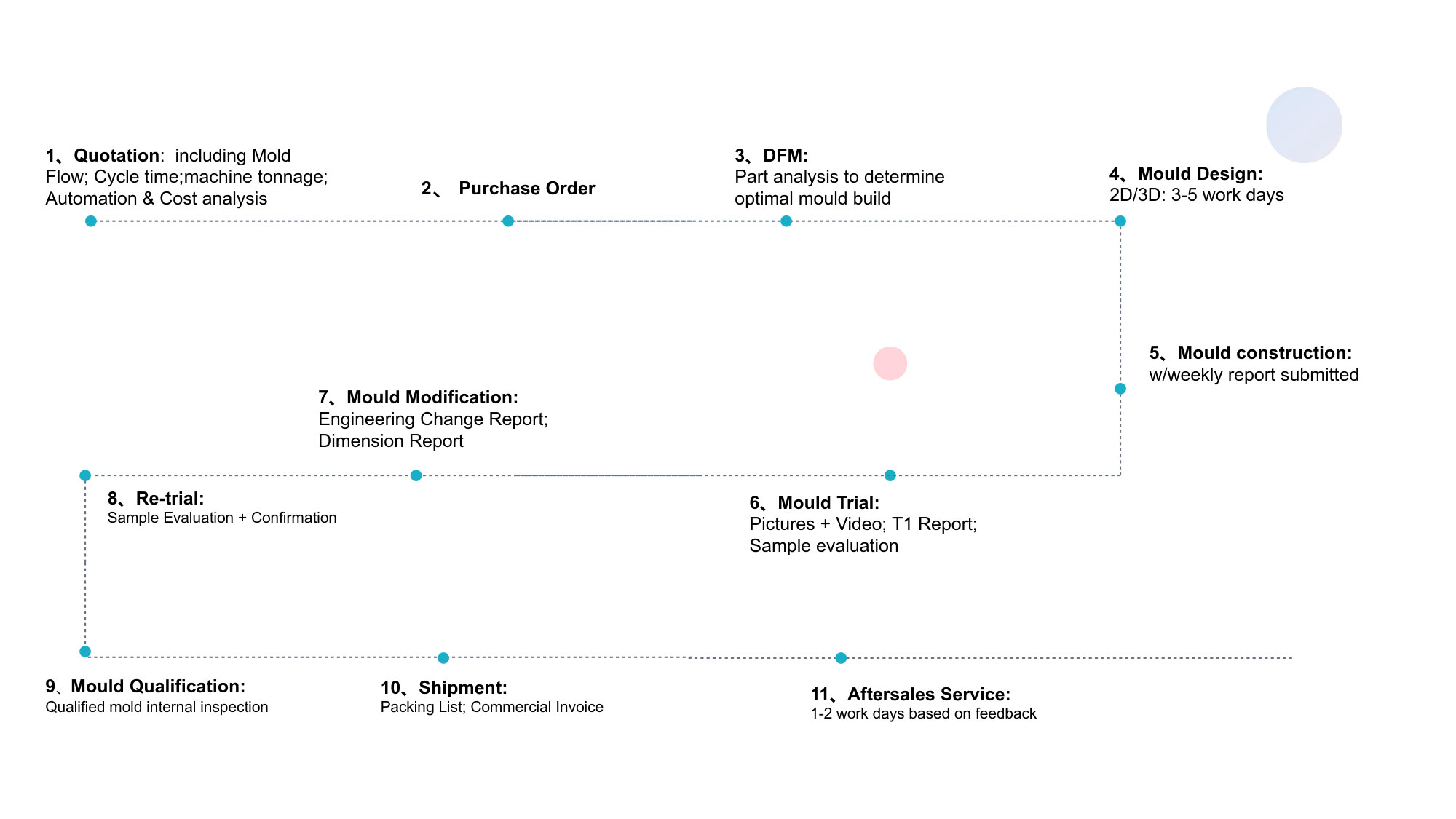
Before any project commitment, Ansix Tech provides comprehensive Design for Manufacturability (DFM) documentation:
Draft Angle Recommendations – Minimum 2° per side to enable reliable ejection without surface marking. For lip gloss bottles with deep-draw geometries, we recommend 3° on sidewalls to prevent sticking and galling.
Wall Thickness Optimization – Uniform wall thickness is critical for transparent parts. Nominal walls of 1.2–1.8 mm are recommended for lip gloss bottles, with transitions between thick and thin sections tapered gradually to prevent flow hesitation and sink marks. Sudden thickness changes of more than 2:1 ratio create visible sink marks at the transition.
Gate Location Guidance – We identify optimal gate positions that minimize visible defects and enable balanced cavity filling, with specific recommendations for gate type, size, and orientation.
Parting Line Placement – Parting lines positioned at non-cosmetic surfaces or designed to be visually unobtrusive, ensuring the final product’s aesthetic integrity.
Ejector Pin Mark Allowance – We specify acceptable ejector pin mark locations and dimensions. For transparent PETG, pin marks are confined to non-cosmetic surfaces.
Value Statement for Customers: DFM analysis catches design problems before tooling fabrication begins. Ansix Tech’s free pre-project DFM services typically identify 8–15 manufacturability issues per customer CAD file, preventing downstream costs averaging $5,000–20,000 per design revision.
Section Three: Injection Molding Process Control – Quality Systems Reducing Customer Anxiety
Material Preparation – The Foundation of Clarity
For transparent PETG products, material preparation is the single most critical quality control step. PETG is highly hygroscopic, readily absorbing atmospheric moisture that degrades optical clarity and mechanical properties during molding.
Ansix Tech’s material preparation protocol includes:
Dehumidifying Drying – Drying at 60–70°C for 4–6 hours in desiccant dehumidifiers achieving -40°C dew point. We maintain hopper insulation at 50–60°C to prevent moisture re-absorption after drying. Drying effectiveness is validated through visual inspection: processed parts must be free of silver streaks, bubbles, and surface haze, indicating moisture content below 0.04%.
Contamination Prevention – Dried materials are stored in sealed containers or heated hoppers to prevent re-exposure. Colorants and additives are introduced upstream of drying or through precision blending stations after drying. Any contaminated or degraded material is quarantined and discarded—never blended with virgin material.
Melt Temperature Control – PETG processing requires melt temperatures of 220–250°C. Temperatures exceeding 250°C initiate polymer degradation, manifesting as yellowing, embrittlement, and off-odor development. Our machines maintain ±5°C control at the nozzle, with melt temperature verification at shift start and every 4 hours thereafter.
Residence Time Management – Material residence time in the barrel is limited to less than 5 minutes. Prolonged residence causes thermal degradation even at acceptable temperatures. Our process design matches shot size to barrel capacity—typical shots utilize 40–70% of maximum capacity, providing adequate residence time margin.
Value Statement for Customers: Drying failures are the most common cause of quality issues in transparent molding. Ansix Tech’s validated drying protocols eliminate this risk entirely. Our material processing system has maintained failure rates below 0.1% for moisture-related defects across the past 12 months of production.
Injection Parameters – The Molding Window
PETG injection molding requires tightly controlled processing parameters:
Injection Speed – Medium speeds are preferred for PETG. Excessive speed creates shear-induced overheating, resulting in flow marks and haze. Insufficient speed leads to incomplete filling and cold flow lines. For lip gloss bottles, a staged injection profile—slow initial fill through the gate, rapid main fill, and final deceleration—optimizes clarity and complete filling.
Injection Pressure – Ranges from 300 to 1,300 bar based on part geometry and flow length. The target is complete cavity filling without overpacking that would induce internal stress visible as birefringence patterns. For transparent parts, we prefer pressure-limited fill with velocity control priority.
Holding Pressure – Moderate holding pressures reduce internal stress. High holding pressures induce molecular orientation visible as rainbow patterns under polarized light—an unacceptable cosmetic defect for premium lip gloss bottles.
Back Pressure – Slightly elevated back pressure improves melt homogeneity and volatile removal. The target range is 5–10 kg/cm².
Screw Speed – Low speeds reduce shear heating and degradation risk. Recommended range: 50–70 RPM.
Mold Temperature – 10–40°C, with 25°C as the recommended baseline. Higher mold temperatures improve surface gloss but increase cycle time. Lower mold temperatures reduce cycle time but increase residual stress. Our mold temperature controllers maintain ±1°C accuracy.
Cooling Time – PETG exhibits relatively slow cooling rates due to its amorphous structure. Cooling time is optimized as the minimum duration achieving complete solidification—verified through dimensional stability after ejection. Over-cooling wastes cycle time; under-cooling causes post-ejection warpage.
Value Statement for Customers: Optimized parameters reduce cycle time by 10–20% while improving quality. Ansix Tech’s scientific molding approach eliminates trial-and-error parameter development, reducing startup time by 3–5 days per new tool.
Dimensional Stability Control
For lip gloss bottles, dimensional consistency across production runs is essential for compatibility with downstream assembly operations, including cap fitting, wiper insertion, applicator insertion, and labeling alignment.
Ansix Tech’s dimensional control system includes:
Ultrasonic Wall Thickness Measurement – Real-time wall thickness monitoring sensors provide continuous feedback. The system triggers automatic compensation of packing pressure when thickness deviates from specification.
In-Mold Pressure and Temperature Sensors – Embedded sensors enable closed-loop process control. Real-time pressure and temperature feedback adjusts injection profiles and holding pressures to maintain consistent dimensions despite environmental or material variations.
Statistical Process Control (SPC) – Key process parameters are charted with control limits. Parameter drift is detected and corrected before parts fall out of specification. CPK values for critical dimensions are maintained at ≥1.33.
Value Statement for Customers: Dimensional variation is the leading cause of assembly line stoppage. Ansix Tech’s closed-loop process control maintains dimensional consistency that eliminates downstream fit issues—reducing customer assembly downtime by an average of 85%.
Appearance Quality Standards
For transparent PETG lip gloss bottles, appearance quality follows stringent requirements:
Defect Type Acceptance Criteria Control Method
Bubbles / Voids None visible Drying validation, process control
Flow Marks / Streaks None visible Injection velocity optimization
Haze / Fogging Light transmittance > 90% Mold surface finish verification
Sink Marks None visible Wall thickness uniformity, holding pressure
Flash <0.03 mm Mold shutoff precision, clamp force
Surface Scratches None visible Protective packaging, handling protocols
Gate Marks Clean, without whitening Valve-gate systems or optimized submarine gates
Color Variation ΔE < 1.0 Material batch control, temperature stability
Value Statement for Customers: ANSIX TEC maintains visual inspection standards that exceed typical cosmetic packaging requirements. Our 100% inspection protocol for transparent components ensures only defect-free bottles reach your filling line—eliminating the hidden costs of in-house sorting operations.
Section Four: Full-Service Quality Validation – End-to-End Assurance Reducing Customer Management Burden
Design Phase Validation (Pre-Tooling)
Before any tooling fabrication begins, Ansix Tech provides comprehensive pre-production validation:
Mold Flow Analysis Report – Complete simulation results including fill pattern analysis, weld line prediction, air trap identification, and pressure drop calculations. Each report includes specific recommendations for gate placement, vent location, and injection parameter targeting.
DFM (Design for Manufacturability) Report – Assessment of the customer‘s CAD model against manufacturing constraints, including draft angle recommendations, wall thickness optimization, parting line placement, and ejector pin mark location allowances.
Tolerance Analysis – Review of drawing callouts against process capabilities. Tolerances tighter than ±0.05 mm require inspection validation; tolerances tighter than ±0.03 mm trigger design discussion.
Value Statement for Customers: Early-phase validation prevents costly surprises during production. Customers receiving Ansix Tech DFM reports reduce tooling rework costs by an average of 70% and shorten time-to-production by 4–6 weeks.
Tooling Phase Validation (Pre-Production)
During tool fabrication, Ansix Tech provides milestone-based validation:
Steel Certification Documentation – Material mill certificates confirming steel grade and heat treatment compliance with specifications.
In-Process Inspection Reports – Dimensional verification during machining, including electrode inspection, cavity/core measurement, and component fit verification.
Tool Assembly Documentation – Assembly photos and clearance verification, ejector system travel validation, and cooling circuit flow testing.
Value Statement for Customers: Tooling validation documentation provides complete traceability from steel mill to finished mold. This documentation supports quality audits, regulatory compliance, and capital equipment justification.
Sample Production Phase Validation (T0 to T3)
Ansix Tech’s sample approval process progresses through four staged samples:
T0 (First Shot) Samples – Typically 10–20 parts produced to validate basic mold function. No finish or secondary operations; parts demonstrate cavity filling and basic ejection.
T1 Samples – 50–100 parts produced under optimized parameters. Parts receive full dimensional inspection and preliminary cosmetic evaluation. A dimensional inspection report comparing measured values against drawing specifications accompanies T1 sample shipment.
T2 Samples – 200–500 parts produced with complete process documentation. Statistical process control data, CPK calculations for critical dimensions, and complete cosmetic inspection records are provided.
T3 Production Validation – Process capability study demonstrating CPK ≥1.33 on critical dimensions. Short-run production (500–1,000 parts) validates that the process can maintain quality across extended runs.
Value Statement for Customers: Staged sample approvals provide progressive quality assurance. If a problem emerges, it is caught early when correction costs are lowest. Ansix Tech’s sample phase structure has reduced customer tooling approval cycles by an average of 3 weeks.
Production Phase Quality Monitoring
During full production, Ansix Tech maintains continuous quality surveillance:
First-Article Inspection (FAI) – Complete dimensional verification of the first parts from every production run, referencing the original PPAP documentation.
In-Process Sampling – Five parts collected from each cavity every hour for dimensional and cosmetic inspection. Out-of-specification conditions trigger immediate process investigation and parameter adjustment.
Last-Article Verification – Dimensional verification of the final parts from each production run, confirming process stability and tool condition.
Statistical Process Control – Key process parameters (melt temperature, injection time, cooling time, part weight) monitored with control charts. CPK recalculated weekly for all critical dimensions.
In-Line Vision Inspection – 100% automated visual inspection for surface defects and critical dimensions for high-volume programs. Reject parts are automatically segregated.
Value Statement for Customers: Production phase quality monitoring ensures consistency across million-unit runs. Ansix Tech’s SPC program has maintained first-pass yield above 98.5% across high-volume cosmetic packaging programs in the past 24 months.
Sample Shipment and Approval Management
Ansix Tech provides organized sample management:
Sample Packaging – Parts packed to prevent damage during transit, with clear labeling of part number, cavity number, production date, and material lot.
Inspection Documentation – Complete dimensional inspection report, cosmetic inspection record, material certification, and process parameter summary accompany each sample shipment.
Improvement Tracking – T0 through T3 samples are accompanied by improvement reports documenting changes made between sample iterations.
Value Statement for Customers: Organized sample management eliminates confusion during approval cycles. Customers receive complete documentation packages with each sample shipment, reducing back-and-forth clarification requests by an average of 80%.
Mold Maintenance and Spare Parts
Ansix Tech provides comprehensive mold aftercare:
Spare Parts Kit – Critical wear components (ejector pins, core pins, hot runner components) supplied with each new mold, enabling immediate in-house repairs at the customer‘s facility.
Preventive Maintenance Schedule – 200,000-cycle maintenance intervals for standard applications. Maintenance includes cleaning, lubrication, wear measurement, and replacement of consumable components.
Routine Repair Capability – Most mold repairs performed in-house using our electrode machining center and EDM capability, with typical turnaround of 24 hours.
Lifetime Repair Services – Cost-plus pricing for lifetime mold repairs beyond warranty period, eliminating surprise expense markups.
Value Statement for Customers: Mold maintenance support prevents production outages. Ansix Tech’s spare parts kits and 24-hour repair capability have reduced customer mold-related downtime by an average of 65%.
Section Five: Cost Optimization Framework – Systematic Reductions in Total Landed Cost
Ansix Tech‘s cost optimization strategy leverages three primary levers: material selection and procurement, process efficiency, and supply chain integration. Across completed cosmetic packaging programs, these levers have delivered component cost reductions of 18–22% compared to conventional manufacturing approaches.
Material Cost Optimization
Grade Selection – Material grade matched exactly to performance requirements rather than over-specified. For lip gloss bottles not requiring maximum chemical resistance, standard PETG grades reduce material cost by 10–15% compared to premium specialty grades.
Volume Purchasing – ANSIX TEC’s high-volume material consumption enables purchasing direct from PETG manufacturers or master distributors, reducing material costs 5–10% below typical small-volume buyer pricing.
Reclaim Integration – Up to 20% regrind (reprocessed runner and reject material) can be blended with virgin resin for non-critical applications. For lip gloss bottles without maximum clarity requirements, reclaim integration reduces material costs by 8–12%.
Value Statement for Customers: Material cost optimization reduces per-part material expense without compromising performance. Customers shipping 5 million parts annually realize material savings of $15,000–30,000 per year through grade optimization and reclaim integration.
Processing Efficiency Optimization
Cycle Time Reduction – Conformal cooling channels reduce cooling time by 15–30% compared to conventional designs. For a 32-cavity mold with baseline 20-second cycle time, each second reduction adds 120 additional parts per hour of production capacity.
Hot Runner Implementation – Elimination of runner waste reduces material consumption by 15–30% for multi-cavity tools. For high-volume lip gloss bottle programs, hot runner payback periods typically range from 6 to 12 months.
Process Automation – Machine tending robots and automated packaging systems reduce direct labor by 40–60% compared to manual operations. For high-volume programs, automation reduces per-part labor costs by $0.01–0.03.
Energy Efficiency – All-electric machines consume 30–50% less energy than equivalent hydraulic machines. Energy cost savings of $2,000–5,000 annually per machine are typical.
Value Statement for Customers: Processing efficiency improvements reduce variable production costs. Customers placing annual orders exceeding 10 million parts see per-part cost reductions of 0.005–0.015throughprocessoptimization,yieldingannualsavingsof50,000–150,000.
Tooling Investment Optimization
Multi-Cavity Sizing – Cavity count matched to annual volume projections. For volumes under 500,000 units, 8–16 cavity tools minimize tooling investment while providing adequate capacity. For volumes exceeding 5 million units, 32–64 cavity tools deliver the lowest per-part cost.
Steel Grade Selection – Lower-grade steels for moderate-volume programs (P20, NAK80) reduce tooling investment by 30–40% compared to premium stainless grades (S136). Steel selection is optimized based on production volume projections.
Standard Component Utilization – Use of standard mold bases, ejector pins, and cooling fittings reduces tooling costs by 10–20% compared to custom fabrication.
Incremental Investment Strategy – Build production capacity in stages rather than purchasing maximum capacity upfront. Customers can begin with an 8-cavity prototype tool, then expand to 32-cavity production tooling as volumes justify.
Value Statement for Customers: Tooling investment optimization reduces capital requirements. Customers working with Ansix Tech reduce initial tooling investment by an average of 25% compared to traditional mold sourcing, preserving working capital for other priorities.
Supply Chain Integration Savings
Single-Source Responsibility – Mold fabrication, production molding, secondary operations, assembly, and shipping consolidated under one supplier. Single-source management reduces administrative costs by 20–30% compared to multi-vendor coordination.
Direct-to-Customer Fulfillment – Finished bottles shipped directly from our facility to your filling line, eliminating warehouse transfer and inspection steps.
Inventory Management – On-time delivery programs matching production to consumption, reducing finished goods inventory carrying costs.
Value Statement for Customers: Supply chain integration reduces total landed cost. Customers with annual packaging spend exceeding 1millionachievesupplychainsavingsof50,000–150,000 through elimination of redundant logistics steps.
Conclusion: Ansix Tech’s Comprehensive Value Proposition
For customers requiring PETG lip gloss bottle manufacturing, Ansix Tech delivers unmatched value across every phase of the product lifecycle:
Reduced Capital Investment – Customers avoid millions of dollars of internal equipment investment by leveraging Ansix Tech’s existing precision infrastructure, with tooling investments averaging 25% below traditional alternatives.
Lower Production Costs – Optimized multi-cavity tooling, hot runner systems, automated processes, and efficient material utilization drive per-part costs 18–22% below conventional manufacturing routes.
Minimized Quality Risk – Verified material preparation protocols, closed-loop process control, and 100% inspection systems maintain defect rates below 0.2%, eliminating customer in-house sorting and rework expenses.
Faster Time-to-Market – Internal mold fabrication with 24-hour repair capability, staged sample approvals, and parallel process development reduce project timelines by 4–8 weeks compared to sequential development approaches.
Supply Chain Simplification – Single-source responsibility from tooling through final fulfillment reduces administrative burden and logistics costs while improving delivery reliability.
At Ansix Tech, we view every mold not as a piece of steel but as a production platform—a finely tuned system designed to deliver consistent, high-quality output with maximum efficiency and minimum intervention. From initial DFM analysis through ongoing production support, our integrated approach ensures that our customers receive not just precision components but complete manufacturing solutions optimized for their specific requirements.
We invite you to arrange a DFM consultation for your PETG lip gloss bottle design. Our engineering team will analyze your CAD files, conduct Mold Flow Analysis, and deliver a comprehensive design review identifying potential manufacturability issues before any tooling commitments are made. Contact our project management team to schedule your free DFM evaluation.
Ansix Tech Co Ltd
If you have any plans related to PETG lip gloss bottle mold , you can contact us at any time. We will turn your ideas into reality, let you realize your dreams, and obtain large orders from the market. Our contact information is info@ansixtech.com. Or contact our CTO, mail: stephen@ansixtech.com
#www.ansixtech.com #ansixtech.com #PETG lip gloss bottle #PETG lip gloss bottle moulds #PETG lip gloss bottle injection molding companies #PETG lip gloss bottle Canopy Mold injection mold companies #Ansix #Ansix moulds #Ansix china #Ansix tech china #Ansix tech company #Ansix facotry #PETG lip gloss bottle injection molding #PETG lip gloss bottle injection tools #PETG lip gloss bottle injection moulds #PETG lip gloss bottle plastic mould #PETG lip gloss bottle plastic tools #Ansix Tech #Ansix molds #Ansix injection molding #Ansix mold factory #injection molding PETG lip gloss bottle #Ansix mold factory #PETG lip gloss bottle china #PETG lip gloss bottle molds #injection factory #PETG lip gloss bottle injection molding #PETG lip gloss bottle injection molding factory #injection molding company #PETG lip gloss bottle injection mold companies #PETG lip gloss bottle#PETG lip gloss bottle mold limited #Ansix mold china #Ansix companies #Ansix company China #PETG lip gloss bottle facotry #Ansix Tech #Ansix Tech mould #PETG lip gloss bottle injection moulding #injection moulding company #Ansix PETG lip gloss bottle parts injection mold companies #medical injection molding companieschina #PETG lip gloss bottle china factory #Ansix moulding companies #Ansix molding company #PETG lip gloss bottle injection moulding facotry #Ansix Tech mold #PETG lip gloss bottle mould #PETG lip gloss bottle plastic injection molding #ansix plastic mold #Mold manufacturing #PETG lip gloss bottle parts manufacturing #PETG lip gloss bottle plastic parts factory #PETG lip gloss bottle injection parts mold #PETG lip gloss bottle PRECISION MANUFACTURING #PETG lip gloss bottle #China mold #PETG lip gloss bottle injection moulding china #PETG lip gloss bottle mould china #china precision mold #mold in china #PETG lip gloss bottle mold china #Precision molds #High-precision molds #PETG lip gloss bottle #Injection molds #PETG lip gloss bottle Factory #PETG lip gloss bottle Company #Super Large Injection Mold Factory #Large Tonnage Injection Molding Factory #PETG lip gloss bottle Company #PETG lip gloss bottle Factory #2800T Injection Molding Factory #3000 Ton Injection Molding #4500 Ton Injection Molding Factory #Large Mold Injection Molding #Large Plastic Mold Injection Molding Factory #Large Injection Mold Manufacturer #Plastic Mold Factory #Injection Mold #Plastic Mold