



PMMA ceiling light cover mold
FEATURES
The Five Core Values Ansix Tech Delivers to Customers
1. Reducing Production Costs (15–35% Savings)
Every design decision we make is evaluated through a cost-optimization lens. For a typical medium-volume lighting project (200,000–500,000 units annually), Ansix Tech reduces total landed cost by 15–35% through three mechanisms:
Material Cost Optimization — We analyze the specific PMMA grade required for your application and select the optimal formulation, avoiding unnecessary premium-grade specifications. Our sourcing relationships with Trinseo PLEXIGLAS® and Röhm supply chains enable competitive raw material pricing with full traceability.
-
Mold Description
Product Materials:
PMMA
Mold Material:
S136ESR
Number of Cavities:
1
Glue Feeding Method:
Hot runner
Cooling Method:
Water cooling
Molding Cycle
42.5s
- The mold manufacturing process and product material selection
Process Efficiency Gains — Conformal cooling channels reduce cycle time by 20–35% compared to conventional cooling designs. For a typical 250g pendant lamp shade, we reduce cycle time from 65 seconds to 45 seconds, translating to approximately 30% more parts per hour from the same machine.
Secondary Operation Elimination — Our precision mold construction produces parts with flash controlled under 0.03mm, directly eliminating manual deflashing labor. Transparency to SPI-A1 eliminates polishing operations entirely.
2. Reducing Project Risks
Customers fear: mold modifications after steel cutting, rejected production batches, and missed launch dates. Ansix Tech systematically eliminates these risks:
Pre-Design Risk Elimination via DFM — Before cutting any steel, we provide a complete Design for Manufacturability (DFM) report. Using Mold Flow Analysis (MFA) software, we predict melt flow patterns, optimize gate placement to minimize weld lines and air traps, and simulate cooling to pre-eliminate warpage. Our DFM process has prevented over 1,200 potential design issues across 28 years of operation.
-
Risk Transfer — Mold Performance Guarantee — Every mold is subjected to a 2,000-cycle pre-delivery aging test with comprehensive wear report documentation. We provide a 36-month structural warranty on the mold (excluding standard consumables like ejector pins).
Supply Chain Continuity — Spare parts (critical inserts, ejector pins, hot runner components) are delivered with each mold. In the event of unexpected wear, replacement parts can be manufactured and shipped within 48 hours from our in-house electrode and EDM workshop.
3. Accelerating Time-to-Market (15–30 Days Faster)
Ansix Tech shortens the entire development-to-volume timeline by 15–30 days versus industry averages:
Parallel Processing — While mold steel is being machined, our engineering team simultaneously finalizes molding parameters and packaging specifications.
In-House Toolroom — All mold manufacturing, from 5-axis CNC machining to sinker EDM and wire EDM, is performed under one roof. Our rapid-response toolroom completes most repairs and modifications within 24 hours.
T0 to Volume in Four Weeks — First samples (T1) delivered 4–5 weeks after design approval, followed by small-batch validation, then full production release.
4. Quality Assurance Without Compromise
Our quality system ensures every transparent pendant lamp shade meets retail-grade standards:
Machine-Controlled Consistency — All injection molding machines are connected to our MES (Manufacturing Execution System), which locks and monitors every molding parameter. Key parameters (temperature, pressure, injection speed, cooling time) can only be adjusted with engineering authorization.
Statistical Process Control (SPC) — Each production batch undergoes first-article and last-article inspection per mold cavity. We maintain CPK ≥1.33 on critical dimensions validated via Mitutoyo CMM equipment.
Full Traceability — Every production batch is documented with material certification, process parameter logs, and dimensional inspection reports—traceable across the entire supply chain.
5. Production Capacity That Scales with You
Our 30-ton to 4,000-ton all-servo-electric injection molding machine fleet covers pendant lamp shades from 50mm minature designs to 800mm diameter architectural lighting components. With multiple identical molds per product, we can scale monthly production from 5,000 to over 500,000 units without requalification.
The value proposition is clear: lower cost, lower risk, faster speed, guaranteed quality, and unlimited capacity. When you choose Ansix Tech, you acquire a true manufacturing partner, not just a supplier.
Part II: Equipment Foundation — Translating Technical Capabilities into Customer Assurance
Mold Machining Equipment — The Bedrock of Precision
“When your lamp shade mold is machined to 0.002mm precision, your product’s parting line disappears, and your deflashing labor vanishes with it.”
Equipment Type Technical Capability Customer Value Delivered
5-Axis High-Speed CNC (MORI SEIKI, Makino) Accuracy to ±0.002mm, surface roughness Ra < 0.15μm, hard milling up to 60HRC Eliminates hand polishing of parting lines. Zero visible witness lines on transparent lampshades
Slow Wire EDM ±0.003mm accuracy, surface finish Ra 0.05μm, 0.02–0.03mm wire capability Enables 0.1mm thin-wall sections without warp. Clean hole walls that won’t catch or snag during ejection
Precision Sinker EDM ±0.002mm accuracy, mirror finish to Ra < 0.1μm, sharp corner finishing to 5μm Deep ribs and fine textures finish pre-polished. Eliminates secondary EDM and rework
Three Machines Working Together — Our 5-axis CNC removes 95% of steel volume. Wire EDM cuts ejector pin holes and narrow slots. Sinker EDM finishes the details CNC cannot reach. Each technology contributes its maximum value at the right stage.
The Financial Impact — Typical competitors require three separate suppliers for these operations (CNC shop + EDM job shop + finishing house). Ansix Tech’s integrated toolroom eliminates freight, waiting times, and quality handoff risks. For a 75,000mold,verticalintegrationsaves8,000–12,000 in outsourced operations.
Injection Molding Machine Fleet — The Bridge Between Tooling and Production
“A ±0.1% repeatability specification isn’t just a number—it guarantees that part #100,000 is identical to part #1.”
Performance Category Specification Customer Value
Locking Force 30–4,000 tons Covers all pendant diameters from 60mm to 800mm
Repeatability 0.1% part weight variation, 0.01mm mold open positioning Every batch dimensionally identical. No sorting. No scrap
Injection Speed Up to 500mm/s Fills thin-walled lamp shades before material degradation, eliminating flow marks
Drives Full servo-electric with ±1 bar pressure control 80% energy savings. ±0.03mm screw runout guarantees melt consistency
MES Integration Real-time parameter monitoring and locking Tighter process control. Validated audit trails for regulatory compliance
The Financial Impact — A full-servo-electric 320-ton press consumes 18 kWh versus 58 kWh for hydraulic equivalents. Over a 24/7 operational year, this saves $28,000 in electricity per machine.
Metrology and Quality Control — Every Dimension Verified
“A CPK report isn’t paperwork—it’s your guarantee that every lampshade will fit, seal, and pass inspection.”
Our ZEISS and Mitutoyo CMM equipment, combined with vision measuring systems, delivers measurement accuracy within the micron range. Every mold undergoes a full dimensional inspection before shipment, accompanied by a complete dimensional report. Critical dimensions are validated to CPK ≥1.33.
The Financial Impact — The 0.5–2% scrap rate typical at competitors, caused by hidden dimensional drift, costs customers approximately 20,000to80,000 annually on a 1-million-unit contract. Our CPK ≥1.33 guarantee eliminates that hidden scrap loss entirely.
Part III: Mold Manufacturing — Core Competencies with Concrete Metrics
Material Selection — Matching Steel to Application and Volume
“Mold steel isn’t the mold itself—it’s the investment’s lifespan printed in steel grade.”
Short-to-Medium Runs (under 150,000 total shots): NAK80 — Pre-hardened to HRC38–43, no post-machining heat treatment required. Excellent polishing to SPI-A1 optical finish. Suitable for design validation and limited production.
High-Volume + Corrosive Environments (500,000+ shots): S136 / S136H — Delivers HRC48–52 after heat treatment. Exceptional corrosion resistance combined with outstanding polishability to #8000-grade mirror finish. Standard for PMMA materials requiring high transparency.
Glass-Filled Materials (PMMA+GF): H13 / SKD61 — Withstands the abrasive wear of glass-fiber reinforced materials. Extended operational life before annealing is required.
High-Toughness / Thermal Management: 8407 / 2344 / 2343 — Maintains structural integrity under high-temperature operation, ideal for hot runner systems and long-running production cycles.
Complex Wear Surfaces: M340 / 4Cr13 / 9Cr18 — Premium stainless grades for inserts that see the highest melt flow. Best-in-class wear resistance combined with optical-grade polish.
Low-Volume Proof Runs: P20 / 2311 — An economical option for 50,000 shot maximum counts, eliminating capital tied up in high-grade steels during early production phases.
Production Volume Recommended Steel Approximate Mold Life
<100,000 shots NAK80 / P20 3–6 months of full production
100,000–500,000 shots S136H / 718H 1–3 years
500,000–1 million+ shots S136 hardened / H13 / SKD61 / 8407 3–8 years
The Financial Impact — Upgrading from NAK80 to S136 adds 10–15% to mold cost but extends useful life by 300–500%. For multi-million-unit contracts, the upgrade pays for itself within 3–6 months of production.
Tolerances That Define Your Product
Component Type Achievable Tolerance Industry Standard
General Structural Features ±0.05mm ±0.10mm
Precision / Optical Features ±0.005–0.01mm ±0.02mm
Concentricity Between Core/Cavity ±0.01mm ±0.03mm
The Financial Impact — A pendant lampshade with 0.35mm wall thickness variation from core/cavity misalignment produces 18% light transmission variation across its circumference, causing hotspots and dead zones. ±0.01mm concentricity guarantees visually uniform illumination across all 360 degrees.
Gate and Runner Design — First Point of Quality Control
“A poorly placed gate doesn’t just affect aesthetics—it destroys structural integrity.”
For PMMA pendant shades, we prioritize film gate or fan gate designs that reduce flow resistance and minimize visible gate vestige. Where peripheral gating is suitable for the design, it is preferred as the first choice to minimize visible witness marks.
Mold Flow Analysis at Work — Using Autodesk Moldflow simulation software, we:
Predict optimal filling patterns to balance cavity pressures across all cavities
Identify weld line locations before steel is cut, positioning them outside optical zones
Visualize air trap locations, allowing pre-machining venting design
Forecast shrinkage behavior to pre-compensate core/cavity geometry
The Financial Impact — A mold with one non-optimized gate location creates 5–8% melt-front convergence points in optical zones. Each convergence point produces a visible haze or notch in the finished lampshade, generating a 5% rejection rate that erases margin advantage before the first container ships. Our MFA process reduces that rate to under 0.5%.
Cooling System — Hidden Determinant of Cycle Time
PMMA requires precise mold temperature control, typically maintained between 50–80°C. Even a 3°C variation across the cavity creates differential shrinkage and warpage.
The Financial Impact — A conventional cooling layout produces 6–8°C temperature variance across the cavity. Our conformally designed cooling channels, optimized via CAE thermal analysis, maintain variance under 2°C. This reduces cooling time by 8–12 seconds per cycle—saving 20–30 minutes per shift.
Ejector System — The Moment of Truth
Poor ejection systems:
Scratch optical surfaces with uneven pin contact
Deform thin walls through localized ejection pressure
Create residual stress visible in finished product
Our solutions include precision-ground ejector pins for uniform push-off across the lampshade’s back surface. Extended ejection strokes are incorporated into the system design to eliminate cosmetic witness marks on visible surfaces.
The Financial Impact — One deformed lampshade every 250 cycles (0.4% defect rate) translates to 4,000 rejected parts per million. Each reject carries full material, labor, and packaging costs—delivered straight to landfill. Our ejector system eliminates that waste entirely.
Mold Delivery Standards
Simple mold (single cavity, basic geometry): 10 business days
Medium complexity (2–4 cavities, side actions): 25–45 business days
High complexity (multi-cavity, hot runner, unscrewing): 50–65 business days
Expedited services available with compression of process lead times
Part IV: Injection Molding — Process Control as a Competitive Advantage
Pre-Drying — The Step Most Shops Skip (and Pay For Later)
PMMA is hygroscopic with an equilibrium moisture content of 0.3–0.4%. Any moisture present vaporizes during high-temperature molding, producing silver streaks, bubbles, and micro-voids that reduce transmittance by up to 40%.
Our protocol is mandatory, not optional:
PMMA: 3–4 hours at 80–90°C to achieve ≤0.02% moisture content
Optical-grade materials: 4–6 hours at 85°C with continuous monitoring
Melt Temperature — The Line Between Clarity and Degradation
PMMA decomposes above 260°C. Every degree above the recommended window shortens molecular chain length, increases yellowness index (YI), and creates surface flow marks visible in finished products.
Our temperature control regime:
Feed section: 190–210°C (controlled, gradual transition)
Compression zone: 220–240°C (steady-state melt development)
Metering zone: 230–250°C (final temperature uniformization)
Nozzle: 240–250°C (precision final temperature before injection)
Injection and Holding Pressure
Parameter Target Range Impact on Quality
Injection Pressure 80–140 MPa Fills cavity before premature freezing
Holding Pressure 60–80% of injection Compensates PMMA shrinkage (0.3–0.7%)
Back Pressure 5–15 MPa Ensures melt homogeneity
Mold Temperature Control — The Stability Multiplier
PMMA pendant lamp shades require mold temperatures between 50–80°C. We use independent mold temperature controllers with water or oil circulation to maintain core/cavity temperature differentials under 2°C. This eliminates differential shrinkage, prevents warpage, and ensures uniform light transmission.
MES-Connected Parameter Locking — Process Discipline at Scale
Every machine is connected to our MES (Manufacturing Execution System), which continuously monitors and locks key parameters:
Barrel temperatures (four zones + nozzle)
Mold temperatures (feed side + ejection side)
Injection pressure profiles
Holding pressure curves
Injection speeds (multiple stage settings)
Cooling time
Cycle time
The Financial Impact — Competitors without MES produce visible part-to-part variation across shifts. A lighting manufacturer discovered 17% tint variation across three shifts when their supplier manually adjusted barrel temperatures “within range.” Our MES eliminates that variation entirely.
In-Mold Sensors — Real-Time Closed-Loop Process Control
For high-precision optical components, we deploy in-mold cavity pressure sensors and thermocouples, enabling real-time closed-loop control. The system compensates for material viscosity changes caused by batch-to-batch variation or ambient humidity shifts automatically, cycle by cycle.
Surface Finish Standards — The Transparency Bottom Line
Application Required Finish Surface Roughness
Standard PMMA Lampshade SPI-A2 / SPI-A1 quality Ra ≤0.025–0.05μm
Premium Optical / Lens Grade SPI-A1+ / optical mirror grade Ra ≤0.01–0.02μm
The Financial Impact — Surface roughness below Ra 0.05μm is required for true optical clarity. We achieve optical grade finish by steel selection alone—no secondary polishing required on finished parts, eliminating a 10–15% cost adder.
Defect Prevention — Proactive, Not Reactive
Defect Root Cause Our Solution
Flow Marks Improper flow path design Mold flow optimized runner/gating
Weld Lines Converging melt fronts Gates positioned outside optical zones
Bubbles / Voids Moisture or trapped air Controlled drying + venting design
Warpage Uneven cooling Conformal cooling + thermal analysis
Sink Marks Inadequate packing Optimized holding pressure profile
Part V: Specialized Material Capabilities — Beyond Standard PMMA
Ansix Tech’s material expertise spans the full spectrum of engineering plastics:
Material Type Processing Expertise Applications
PC (Polycarbonate) High-impact clarity Impact-resistant lampshades, automotive lenses
PC/ABS Balanced properties Durable structural lighting components
PPS + 40% GF High-temperature + dimensional Industrial lighting housings
PEEK High-performance engineering Specialty medical/industrial optics
PA6 + GF30 Reinforced structural Outdoor-rated lamp housings
PBT / PEI / LCP Precision electronic components LED optical systems
Liquid Silicone Rubber (LSR) Soft-touch optical Sealed lighting assemblies
Specialty Grades Available:
Flame-retardant compounds — UL94 V-0 certified for lighting safety requirements
UV-stabilized PMMA — 3,000-hour UV testing maintains optical clarity without yellowing in outdoor applications
Part VI: From Concept to Container — Ansix Tech’s Full-Process Manufacturing Workflow
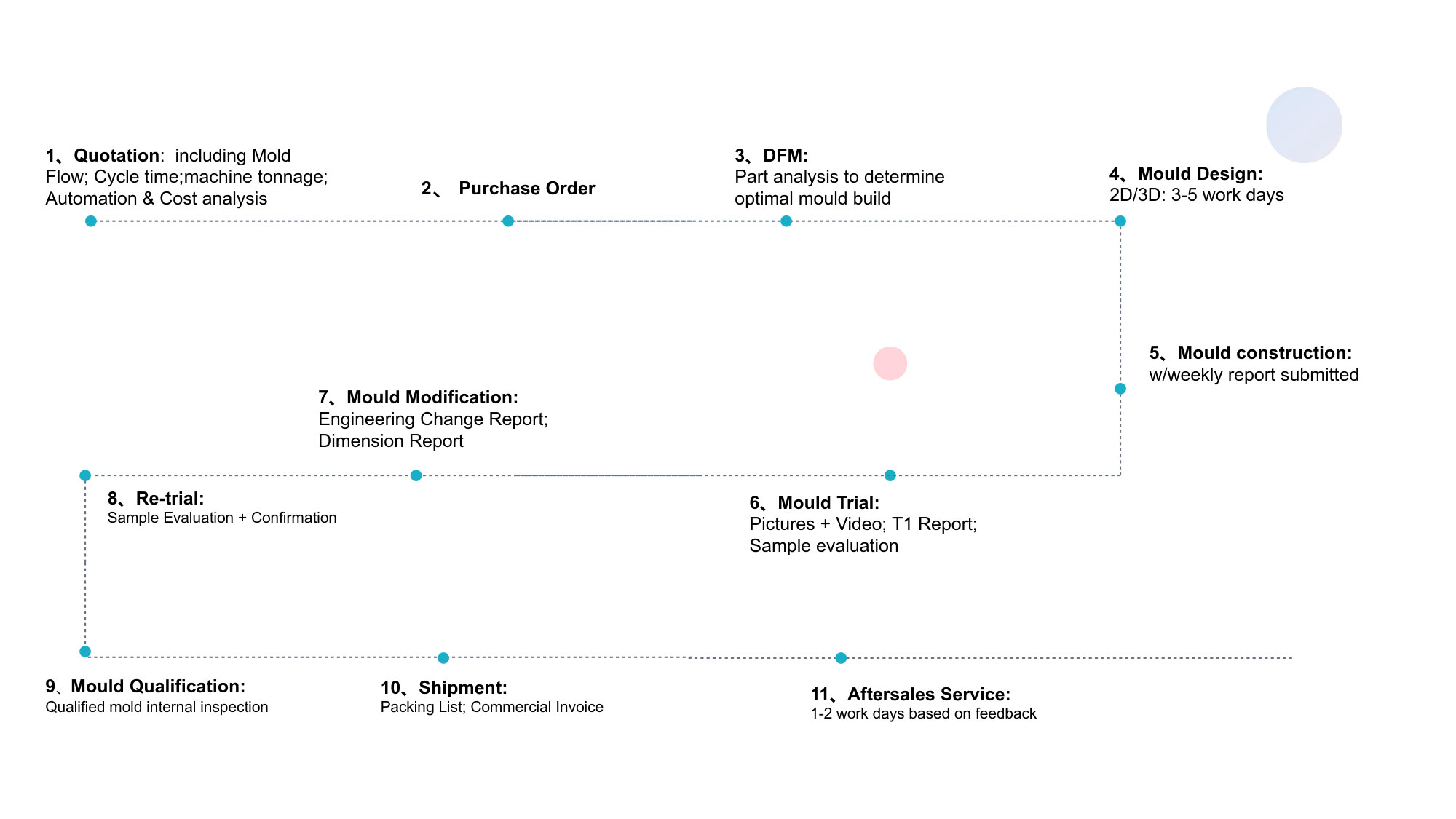
Step 1 — DFM & Mold Flow Analysis: Risk Elimination Before Steel Cutting
Our engineering team performs comprehensive DFM before any steel is cut, analyzing:
Part geometry: wall thickness analysis, draft angle recommendations, undercut feasibility
Gate placement optimization via Moldflow to minimize weld lines in optical zones
Ejector pin placement locating marks in non-visible areas
Predicted shrinkage behavior (±0.005mm vs actual material data)
Weld line location mapping to avoid optical areas entirely
A complete DFM report is delivered prior to project commitment, giving customers complete transparency before financial obligation.
Step 2 — Mold Design & CAD Detailing
Our engineers create complete 3D CAD models including:
Complete parting line geometry optimized for PMMA flow
Cooling circuit design with CAE-optimized channel placement
Ejection system layout with uniform push-off and visible-surface clearance
Runner and gate system design specific to PMMA’s moderate viscosity
Slider and lifter engineering for complex undercut geometries
Hot runner integration where specified (reduces runner waste)
Comprehensive 2D manufacturing drawings with full GD&T specifications
Step 3 — Steel Selection & Procurement
Material grades are selected based on:
Required production volume
Material abrasiveness
Optical surface requirements
Corrosion considerations
Each steel batch is supplied with full material certification and heat treatment documentation.
Step 4 — CNC Rough Machining
Rough stock removal using 3-axis CNC machining centers removes 85–90% of steel volume, establishing the mold’s overall geometry with material stock left for finishing passes. CNC turning produces precision round components including circular inserts and guide sleeves.
Step 5 — Heat Treatment
High-volume mold components requiring S136, H13, SKD61, or 8407 grades undergo vacuum heat treatment. Hardness targets HRC48–52 delivered with:
Vacuum heat treatment (prevents surface oxidation)
Tempering cycles to relieve internal stress
Complete hardness certification + heat treatment curve documentation
Step 6 — 5-Axis High-Speed Finishing & Hard Milling
Final cavity and core surface generation using 5-axis high-speed CNC machining, achieving ±0.002mm accuracy and Ra < 0.15μm surface roughness. Hard milling directly completes finished steel surfaces, minimizing downstream EDM and hand finishing.
Step 7 — Wire EDM
High-precision features machined via slow wire EDM:
Ejector pin holes with micron clearance
Insert cavities with precise fit tolerances
Slanted ejector slots
Narrow slots and undercut features
Step 8 — Sinker EDM
Deep cavity and sharp corner finishing via precision sinker EDM, achieving ±0.002mm accuracy and mirror surface finishes (Ra < 0.1μm) for tight corner radii, fine surface details, and complex core geometries.
Step 9 — Precision Grinding
Surface and profile finishing using precision grinding equipment:
Surface grinders: Flatness within 0.001mm
Profile grinders (WAIDA): Accuracy 0.001mm for inserts, slides, and mold bases
PG optical curve grinders for complex form tolerances
Step 10 — Hand Fitting & Polishing
PMMA mold finishing requires progressive polishing without skipping grit sequences:
800# → 1200# → 1500# → 2000# sandpaper progression
3μm → 1μm → 0.5μm → 0.25μm diamond compound polishing
Final soft wool wheel mirror polish to SPI-A1
Polishing direction matches intended melt flow direction to prevent flow marks
Step 11 — Mold Assembly
All components assembled into the complete mold:
Plate alignment and dowel pin installation
Ejector plate and return pin assembly
Cooling circuit connection and pressure testing (minimum 8–10 bar)
Hot runner system installation (if specified)
Mold validation against design models
Step 12 — Quality Inspection
Full dimensional inspection on Mitutoyo CMM and vision systems:
Full 3D tolerance inspection report (every critical dimension)
Cavity/core surface roughness verification
Cooling channel flow and leak testing
Complete assembly fit and function verification
Ejector pin flushness and travel validation
Step 13 — Mold Trial (T0–T3)
On-site mold tryout on Ansix Tech’s injection molding equipment produces first samples:
T1 (First Sample) — Verification of basic mold function, ejection reliability, and initial part quality
T2 (Optimization Run) — Parameter tuning to optimize fill, cooling, and ejection
T3 (Pre-production Validation) — 200-cycle run validates repeatability and identifies final tuning
Each trial accompanied by complete improvement report and sample documentation
Step 14 — Small-Batch Validation (100–500 Shots)
Optional pre-production validation before full-scale release:
Validates process stability across longer production runs
Documents actual CPK performance on critical dimensions
Confirms molding parameter sets for mass production
Customer approval prior to volume production release
Step 15 — Mass Production & In-Process Quality Control
Production on MES-monitored injection molding machines with:
First-article inspection per production batch (or per shift, whichever is more frequent)
In-process sampling per approved AQL plan
Dimensional checks on key features every 2–4 hours
Continuous parameter monitoring via MES with alarm thresholds
End-of-batch last-article inspection documenting drift throughout production run
Step 16 — Secondary Operations
As required by customer specifications:
Gate vestige trimming
Surface protection film application
Assembly of subcomponents
Functional testing per customer requirements
Step 17 — Packaging & Delivery
Packaging designed to prevent surface damage during transit. Delivery supported by full documentation:
Material certifications for all production batches
First-article and in-process inspection reports
Lot traceability documentation
Compliance certificates as required
Full CPK and capability analysis where specified
Standard FOB shipping with logistics management support.
Part VII: Quality Assurance System — Parameter Locking and Statistical Control
MES-Parameter Locking — Machine-Level Quality Discipline
Every Ansix Tech molding machine is connected to our MES (Manufacturing Execution System):
Parameter lockdown — Critical molding parameters (temperatures, pressures, speeds, times) are locked in MES and cannot be changed without engineering authorization
Real-time monitoring — All locked parameters are continuously displayed with real-time deviation alerts
Full traceability — Every production batch is logged with complete parameter profiles and material lot numbers
Audit trail — Complete parameter change logs provide full regulatory and customer audit trail
In-Process Quality Control
First-article inspection per cavity per production run
Scheduled sampling (minimum hourly or per AQL standard)
Continuous dimensional monitoring with automated alerts at tolerance limits
CPK tracking on all critical dimensions
Last-article inspection documenting any dimensional drift throughout run duration
Defect tracking and root-cause documentation for continuous improvement
Outgoing Quality Control
Sampling per customer-approved AQL or 100% inspection where specified
Dimensional verification prior to packaging release
Visual inspection under controlled lighting conditions
Packaging integrity verification
Certification & Documentation Provided
Full material certifications for each production batch
In-process quality reports with pass/fail status by part and cavity
First-article inspection reports with dimensional data
SPC / CPK reports where specified
Certificate of conformance for applicable regulatory standards
Complete compliance documentation for flame-retardant or UV-stabilized materials
Part VIII: Extended Customer Support — Beyond the First Shipment
Pre-Sales Engineering Consultation
Our engineering team works directly with customers before mold construction begins:
DFM review and optimization recommendations
Material selection guidance (base PMMA vs. UV-stabilized grades, cost vs. performance tradeoffs)
Production volume planning and mold configuration recommendations
Cost optimization analysis (material savings + cycle time reduction + secondary elimination)
Mold Testing & Validation Support
Throughout the T1 through T3 validation process:
On-site mold trials at Ansix Tech’s facilities
Complete documentation of samples and process parameters
Customer sample evaluation with full dimensional reports
Collaborative problem-solving for any identified issues
Maintenance & Spare Parts Program
Every mold delivered with:
Complete set of spare ejector pins and critical inserts
Recommended maintenance schedule (cleaning, lubrication, inspection intervals)
36-month structural warranty (excluding normal consumable wear components)
Ongoing mold support:
Preventive maintenance scheduling at customer-specified intervals
Emergency repair service — most repairs completed within 24 hours of receipt
Lifetime repair pricing at cost plus labor
Production Support & Troubleshooting
For customers running production in their own facilities:
Remote troubleshooting via video and data review
On-site engineering support when required
Process parameter adjustment recommendations
Technology transfer documentation for customer-operated facilities
Part IX: Common Customer Complaints — Addressed Directly
Customer Complaint Ansix Tech’s Solution
Mold constantly needs repair, disrupting orders 2,000-cycle pre-delivery wear test + 36-month structural warranty
High flash requires expensive hand trimming 0.03mm flash control standard across all batches; 0.005mm parting line fit eliminates flash entirely
Dimensions change from batch to batch MES-parameter locking + ultrasonic in-mold sensors + in-cavity pressure feedback control
Repair lead times kill production schedules In-house electrode and EDM workshop — 24-hour repair turnaround
Part X: Cost Control — How Ansix Tech Reduces Total Ownership Cost
Material Cost Reduction
Our team analyzes the specific PMMA grade required and selects the optimal cost-performance formulation. Sourcing relationships with major PMMA suppliers (Trinseo, Röhm, Mitsubishi Chemical) enable competitive raw material pricing with full traceability and batch consistency.
Average savings: 8–12% of material spend
Cycle Time Reduction
Conformal cooling reduces cooling segment by 20–35% compared to conventional designs. Faster cooling directly increases parts per hour on the same press, reducing labor and machine cost per part.
For a 250g pendant shade running 6,000 shots/day:
Standard cooling: 65 second cycle / 55 parts per hour
Optimized cooling: 45 second cycle / 80 parts per hour
45% more capacity from the same machine
Annual savings (1 million parts) — Approximately $60,000–85,000 in machine time + labor
Secondary Operation Elimination
Precision mold construction (0.005mm parting line fit) controls flash below 0.03mm, eliminating manual deflashing. SPI-A1 mirror finish eliminates secondary polishing entirely.
Annual savings (1 million parts) — Approximately $15,000–30,000 in manual finishing labor
Reduced Scrap and Rework
CPK ≥1.33 on critical dimensions eliminates dimensional rejects. MES-parameter locking eliminates operator-induced variation across shifts and batches.
Annual savings (1 million parts) — Approximately $20,000–50,000 in material + labor + handling
Reduced Mold Maintenance Cost
High-hardness steel selection reduces in-production wear. Spare parts included with initial mold minimize post-warranty repair expenses.
Annual savings — Approximately 30–50% on maintenance spend
Conclusion: Why Ansix Tech
Twenty-eight years of precision mold manufacturing and injection molding experience stand behind every PMMA pendant lamp shade mold we design and build. We deliver not equipment, but capability — capability that translates directly into lower cost, reduced risk, faster time to market, and guaranteed quality.
When you choose Ansix Tech, you choose a manufacturing partner who understands that your lamp shade mold isn’t just a tool — it’s the foundation of your production system. We design for manufacturability, we machine for precision, we control for consistency, and we support for longevity.
Your success is our success. Contact us to schedule a DFM review of your next pendant lamp shade project.
Ansix Tech Co Ltd
If you have any plans related to PMMA pendant lamp shade mold , you can contact us at any time. We will turn your ideas into reality, let you realize your dreams, and obtain large orders from the market. Our contact information is info@ansixtech.com. Or contact our CTO, mail: stephen@ansixtech.com
#www.ansixtech.com #ansixtech.com #PMMA pendant lamp shade mold #PMMA pendant lamp shade mold moulds #PMMA pendant lamp shade mold injection molding companies #PMMA pendant lamp shade mold Canopy Mold injection mold companies #Ansix #Ansix moulds #Ansix china #Ansix tech china #Ansix tech company #Ansix facotry #PMMA pendant lamp shade mold injection molding #PMMA pendant lamp shade mold injection tools #PMMA pendant lamp shade mold injection moulds #PMMA pendant lamp shade mold plastic mould #PMMA pendant lamp shade mold plastic tools #Ansix Tech #Ansix molds #Ansix injection molding #Ansix mold factory #injection molding PMMA pendant lamp shade mold #Ansix mold factory #PMMA pendant lamp shade mold china #PMMA pendant lamp shade mold molds #injection factory #PMMA pendant lamp shade mold injection molding #PMMA pendant lamp shade mold injection molding factory #injection molding company #PMMA pendant lamp shade mold injection mold companies #PMMA pendant lamp shade mold#PMMA pendant lamp shade mold mold limited #Ansix mold china #Ansix companies #Ansix company China #PMMA pendant lamp shade mold facotry #Ansix Tech #Ansix Tech mould #PMMA pendant lamp shade mold injection moulding #injection moulding company #Ansix PMMA pendant lamp shade mold parts injection mold companies #medical injection molding companieschina #PMMA pendant lamp shade mold china factory #Ansix moulding companies #Ansix molding company #PMMA pendant lamp shade mold injection moulding facotry #Ansix Tech mold #PMMA pendant lamp shade mold mould #PMMA pendant lamp shade mold plastic injection molding #ansix plastic mold #Mold manufacturing #PMMA pendant lamp shade mold parts manufacturing #PMMA pendant lamp shade mold plastic parts factory #PMMA pendant lamp shade mold injection parts mold #PMMA pendant lamp shade mold PRECISION MANUFACTURING #PMMA pendant lamp shade mold #China mold #PMMA pendant lamp shade mold injection moulding china #PMMA pendant lamp shade mold mould china #china precision mold #mold in china #PMMA pendant lamp shade mold mold china #Precision molds #High-precision molds #PMMA pendant lamp shade mold #Injection molds #PMMA pendant lamp shade mold Factory #PMMA pendant lamp shade mold Company #Super Large Injection Mold Factory #Large Tonnage Injection Molding Factory #PMMA pendant lamp shade mold Company #PMMA pendant lamp shade mold Factory #2800T Injection Molding Factory #3000 Ton Injection Molding #4500 Ton Injection Molding Factory #Large Mold Injection Molding #Large Plastic Mold Injection Molding Factory #Large Injection Mold Manufacturer #Plastic Mold Factory #Injection Mold #Plastic Mold