



PP float with embedded magnet foam molding
FEATURES
Four Production Bases & Global Footprint: Ansix Tech maintains an extensive manufacturing footprint across China and Vietnam, encompassing four production bases covering over 200,000 square meters with more than 1,200 employees and an annual turnover exceeding one billion RMB. This geographic diversification provides customers with supply chain resilience, cost optimization through regional advantages, and reduced geopolitical risk. Vietnam operations offer tariff advantages for Western markets while Chinese facilities provide deep manufacturing expertise and rapid prototyping.
-
Mold Description
Product Materials:
PP FOAMING
Mold Material:
S136ESR
Number of Cavities:
8
Glue Feeding Method:
Hot runner
Cooling Method:
Water cooling
Molding Cycle
22.5s
- The mold manufacturing process and product material selection
260 Injection Molding Machines (30T to 4000T Clamping Force): Ansix Tech operates 260 injection molding machines with clamping forces ranging from 30 tons to 2,800 tons, extending to 4,000 tons for large-scale applications. This ensures the company can handle everything from precision micro-floats to large industrial buoyancy components. The extensive fleet means clients never face capacity bottlenecks — multi-cavity tools for PP floats run efficiently on 160-500T machines while prototype and small-batch production use 30-90T high-efficiency servo drives.
Multi-Brand & All-Servo Machines: Ansix Tech’s machine portfolio includes Japan’s Fanuc, Sumitomo, Toshiba, Nissei, Austria’s Engel, Germany’s Arburg (specializing in liquid silicone injection molding with two-component configurations), and domestic machines from Haitian and Victor Taichung Machinery. The value of this diversity: customers benefit from application-specific optimization — Arburg’s precision for overmolding magnet assemblies, Fanuc’s servo efficiency for high-cavity production, and Engel’s stability for thick-walled foam structures. All machines are fully servo-electric driven, delivering repeatable process accuracy of ±0.1% and ensuring batch-to-batch consistency — the 100,000th PP foam float is identical to the first.
-
0.002mm Precision (5-Axis High-Speed CNC): Ansix Tech operates multiple five-axis high-speed machining centers achieving 0.002mm accuracy. For PP float molds, this means complex curved surfaces and critical parting lines are machined with extreme fidelity — producing seamless, burr-free floats with no secondary trimming required. For thin-walled float components with embedded magnets, this eliminates the hidden cost of manual flash removal that typically adds 0.3–0.5 minutes per part and downstream finishing expenses.
5. 0.03mm Micro-Feature Machining (Slow-Wire EDM): The company’s slow-speed wire electrical discharge machining (EDM) systems can produce features as fine as 0.03mm, essential for precision mold cavities, narrow flow channels, and thin-wall inserts that prevent deformation in delicate PP foam structures. For the customer, this guarantees first-pass success — poorly machined narrow slots that force expensive redesigns are eliminated entirely.
6. Advanced Metrology (CMM + Optical Imaging & CPK≥1.33): Ansix Tech’s quality laboratory is equipped with coordinate measuring machines (CMMs) and optical imaging systems capable of sub-micron resolution. Every mold undergoes full dimensional inspection before shipment, with critical dimensions validated to CPK ≥ 1.33 — statistically proving the process capability to deliver consistent, in-spec PP foam floats from the very start of production.
7. Comprehensive Certifications: Ansix Tech has successfully passed ISO9001, IATF16949 (automotive-grade quality), ISO13485 (medical devices), ISO14001 (environmental management), and BSCI (social compliance). For PP float customers, this means rigorous process controls and traceability — IATF16949 ensures automotive-level quality standards, ISO13485 supports medical-grade applications like fluid level sensors, and ISO14001 aligns with corporate sustainability goals through efficient production and waste management systems.
Part 2: PP Float with Embedded Magnet Foam Molding — Product Overview & Technical Specifications
Product Description: Ansix Tech produces PP (Polypropylene) foam floats with embedded magnets through advanced microcellular injection molding (MuCell® process). The design creates a foam core within a solid skin using a single material — unlike solid plastic floats, Ansix’s PP foam floats deliver lower density (enhanced buoyancy), reduced material consumption (lower cost), and excellent dimensional stability. The embedded magnet provides a reliable magnetic sensing interface for fluid level detection, automotive sensors, and other industrial applications.
PP Foam Float Density Ranges:
Solid PP Density Reference: ~0.90 – 0.91 g/cm³ (unfoamed)
Ansix Microcellular PP Foam Float Density: Achieves density reductions of up to 33% compared to solid PP. Density values typically range from 0.60 g/cm³ down to 0.25 g/cm³ depending on foaming process parameters and application requirements. For floating applications requiring high buoyancy, lower-density foams are specified; for structural integrity with moderate buoyancy, densities in the 0.60–0.75 g/cm³ range are used.
Typical PP Foam Float Density Range: 0.25 – 0.60 g/cm³ for molded PP foams
Ultra-Low Density Expanded PP (EPP): For specialized applications, EPP bead densities range from 25 g/L (0.025 g/cm³) to 150 g/L (0.15 g/cm³)
MuCell® Microcellular Foam Density Capabilities: The MuCell® process utilizes supercritical fluid (SCF) — either nitrogen or carbon dioxide — as a physical foaming agent. Through the injection of SCF into the polymer melt, a thermodynamic instability is induced, causing millions of microscopic bubbles to nucleate uniformly throughout the PP material. Weight reduction typically reaches 15-20% with standard processing, while density reduction can reach up to 33% relative to solid PP plates. Material and weight savings of up to 20% are achievable through optimized design-for-functionality.
Magnet Integration — Overmolding Technology: The floating magnet is precision-positioned within the foam structure using Ansix Tech’s advanced overmolding capability, which achieves micron-level magnet placement accuracy. During the molding cycle, the magnet insert is placed into the mold cavity before PP foam injection begins. The microcellular foam flows around the magnet, fully encapsulating it while protecting it from corrosion and mechanical damage. The result is a fully encapsulated magnet that never shifts position or corrodes, even after years of continuous operation in harsh fluid environments. PP foam’s closed-cell structure provides excellent chemical resistance and zero water absorption — the float will maintain its buoyancy indefinitely without degradation.
Part 3: Manufacturing Process — Material Selection, Tooling, and Production
Raw Material Selection for PP Foam Floats: Ansix Tech selects PP materials based on application-specific foam density requirements, melt flow characteristics, and end-use environmental conditions. The company maintains deep expertise in material science and has established long-term relationships with reliable global suppliers to ensure raw material quality and supply stability.
Material Options & Characteristics:
Standard Homopolymer PP for General Float Applications: Provides good stiffness, chemical resistance, and processability. Suitable for freshwater and mild chemical environments.
Copolymer PP for Impact-Resistant Floats: Enhanced low-temperature toughness, ideal for automotive applications that experience thermal cycling.
Glass Fiber-Reinforced PP (PP+20–40%GF): Increased stiffness and creep resistance for applications requiring a rigid foam structure. When combined with MuCell® foaming, glass fiber reinforcement helps maintain cell structure integrity and can improve tensile and flexural properties compared to unfilled PP foam.
High-Melt-Strength PP (HMS-PP) for Ultra-Low Density Foams: Specially formulated for superior foamability, enabling density ranges down to 0.25 g/cm³ while maintaining uniform cell structure.
Mold Manufacturing — Tool Steel Selection & Specifications:
Mold Component Material Grade Hardness (HRC) Key Properties Customer Value
Mold Base P20 / 1.2311 / 1.2738 28–34 High toughness, good machinability Excellent structural integrity, ease of maintenance
Cavity/Core Inserts (Standard) S136 / 1.2083 / 420 ESR 48–52 Stainless steel, corrosion-resistant, high polishability Mirror-like surface finish, suitable for medical/clean applications
Cavity/Core Inserts (High-Wear) 2344 / 8407 / H13 46–52 High hot hardness, thermal fatigue resistance Extended tool life for high-volume production
Wear-Resistant Inserts SKD11 / D2 58–62 High wear resistance Protection of mold in high-abrasion areas (ribs, slides)
High-Polish Optics NAK80 37–43 Excellent polishability, uniform hardness Perfect for clear or aesthetic float surfaces
Core Pins / Small Inserts DC53 60–63 Superior toughness, high wear resistance Long life for complex pin ejector systems
Chemical-Resistant Medical Grade M340 / 4Cr13 48–52 Premium corrosion resistance Ideal for harsh fluid environments, medical-grade floats
For glass fiber-reinforced PP materials, Ansix Tech guarantees 500,000 molding cycles minimum for tool life — with proper maintenance, tooling can exceed 1 million cycles. For standard unfilled PP foam applications, tool life reaches 1 million+ cycles.
Mold Design & DFM (Design for Manufacturability) Process:
1. DFM Study Before Production Commitment: Ansix Tech provides customers with a comprehensive mold feasibility analysis report before any tooling commitment. This report includes detailed recommendations for:
Draft Angle Optimization: Proper draft ensures smooth ejection without surface marring.
Wall Thickness Optimization: Uniform wall thickness is critical for PP foam — uneven walls cause irregular foam cell structure, density variations, and potential collapse zones.
Gate Location Strategy: Strategic gate placement ensures balanced cavity filling for foam expansion and uniform magnet encapsulation.
Parting Line Position and Ejector Pin Mark Locations: All witness marks are planned and disclosed to customers upfront — no surprises after tooling completion.
2. Mold Flow Analysis (MFA): Before any steel is cut, Ansix Tech performs extensive mold flow analysis to validate:
Melt front advancement and fill pattern uniformity
Foam cell nucleation distribution and uniformity
Weld line and knit line locations (managed away from critical sealing surfaces)
Air trap identification and venting requirements
Shrinkage and warpage prediction with precise compensation
3. Cooling System Design for PP Foam Floats: Effective mold cooling is critical for PP foam applications. Ansix Tech employs:
Conformal Cooling Channels: Computer-optimized cooling channels that follow the complex float contour — providing uniform cooling across thick foam sections, reducing hot spots, and minimizing cycle times.
Zoned Mold Temperature Control: The mold is partitioned into independent thermal zones, with each zone served by a dedicated thermolator system. Core temperature and cavity temperature are independently controlled — typically maintained within a 2°C differential — which eliminates the thermal stresses that cause warpage in asymmetric foam parts.
High-Turbulence Flow Design: Cooling channels are designed for turbulent flow regimes, which increases heat transfer efficiency by 3–5 times compared to laminar flow.
4. Mold Type Selection for PP Foam Float Applications:
Mold Type Best Application Customer Value
Two-Plate Cold Runner Mold Prototype and low-volume production (1,000–50,000 units) Lower initial tooling investment, simpler maintenance
Three-Plate Pin-Point Gate Mold Medium-volume floats requiring precise gate vestige Automatic gate separation, minimal post-molding trimming
Hot Runner Mold High-volume production (100,000+ units) Zero runner waste (saving 15–30% on resin costs), faster cycles
Insert Mold for Magnets All embedded magnet floats Precision magnet placement, full encapsulation, zero post-assembly
Stack Mold (Two-Level Tooling) Ultra-high volume production Doubled output per machine cycle without increasing clamp tonnage
5. Gate and Runner System Design: Through precise mold flow analysis, Ansix Tech predicts where weld lines and air traps will form, then optimizes gate locations and runner balancing before cutting any steel. For multi-cavity PP float tools — which may have 8, 16, or 32 cavities — the runner system is geometrically balanced to ensure each cavity receives identical melt pressure, temperature, and fill rate. This guarantees that every float from every cavity is identical in density, weight, dimensions, and surface finish.
6. Ejection System Design — Preventing Float Deformation: PP foam floats are relatively flexible compared to solid plastics — improper ejection can deform the float or damage the embedded magnet’s overmold encapsulation. Ansix Tech designs ejection systems with:
Strategically positioned ejector pins that push on ribs or thick sections (never on thin foam walls)
Large-diameter ejector sleeves around core pins when necessary
Air-assist ejection for delicate, thin-walled float designs
Valved air-blast systems that separate the part from the core without contact
In-House Mold Manufacturing Capabilities: Ansix Tech maintains an in-house tool room with electrode machining centers and EDM workshops, ensuring mold repairs and modifications are completed without external vendors. Routine repairs, weld repairs, and core/cavity insert replacements are typically completed within 24 hours, minimizing customer downtime.
Production Efficiency and Turnkey Manufacturing:
Rapid Prototyping: Utilizing advanced technologies such as 3D printing and CNC machining, the company delivers physical prototypes within 1–3 business days.
Turnkey Mold Making: Ansix Tech provides one-stop solutions with fastest delivery in 3–4 weeks for certain mold types.
Smart Factory Integration: All injection molding machines are networked and integrated into MES (Manufacturing Execution System). All critical process parameters — temperature profiles, injection pressures and speeds, holding pressure, cooling time, and back pressure — are locked within the MES. Only authorized engineers can modify settings, and every parameter change is logged with full traceability.
ISO 8 Cleanroom & GMP: Ansix Tech maintains an ISO 8 Cleanroom and complies with GMP (Good Manufacturing Practice) standards, fully aligned with US medical-grade FDA 510K requirements. For PP floats used in medical or food-contact fluid sensing, this ensures particulate-free production, validated cleaning protocols, and full traceability from raw material receipt to finished product shipment.
Part 4: PP Float Validation and Injection Molding Process Optimization
Injection Molding Process Development for PP Foam Floats:
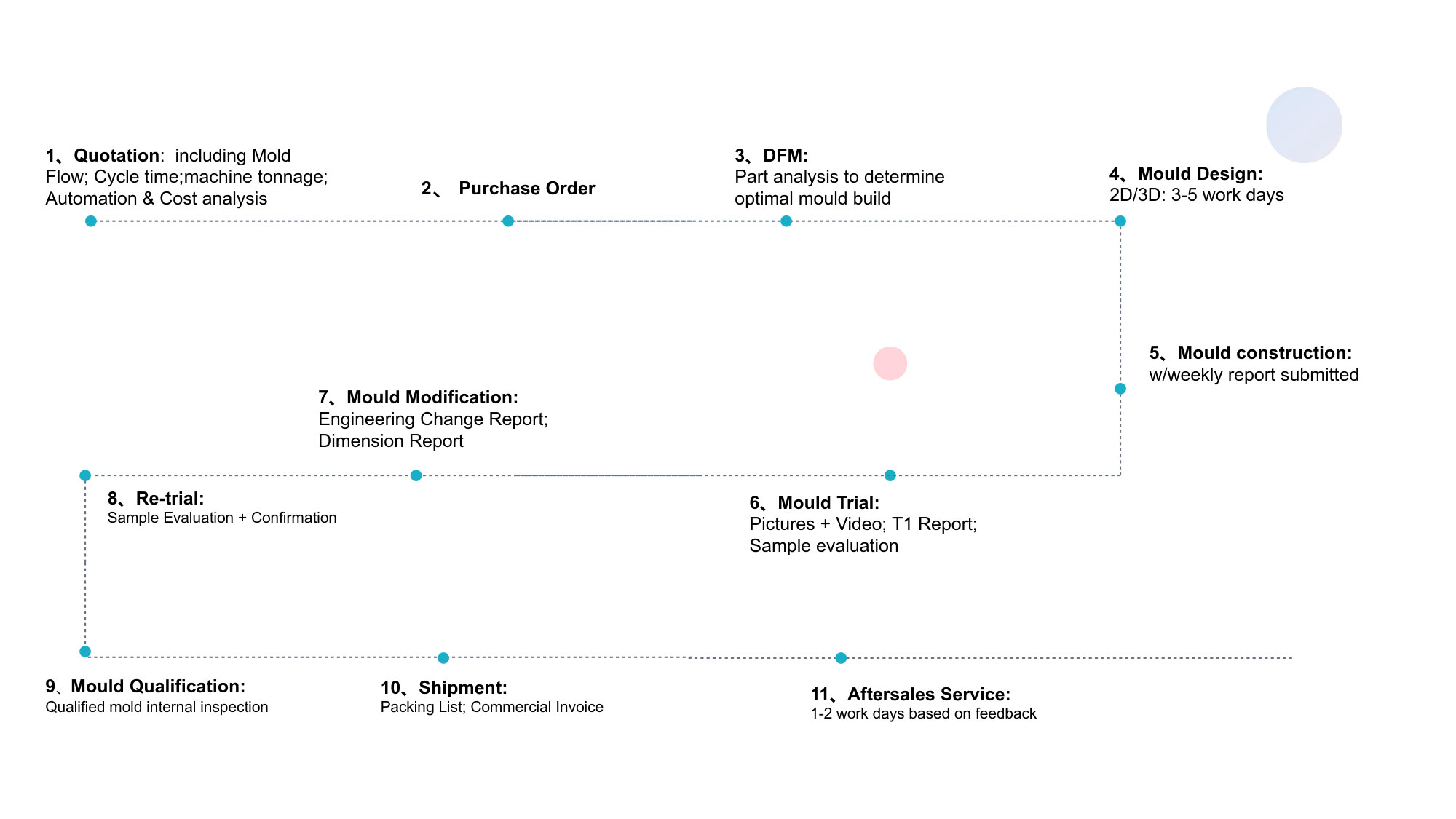
T0 to T3 Sampling Protocol: After the mold is complete, Ansix Tech follows a disciplined four-stage sampling protocol:
T0 (First Shot): The mold is mounted on a test press and the very first shots are taken. The purpose of T0 is purely functional — is the mold mechanically sound? Does it open and close correctly? Does the ejection system work? At this stage, dimensional accuracy is not yet expected; the focus is on fundamental mold function.
T1 (Dimensionally Verified Sample): After adjustments are made based on T0 observations, T1 samples are molded under controlled, documented parameters. All dimensions are measured on the CMM and compared to the customer’s 2D drawing. Shrinkage factors are confirmed, and dimensional compensation is applied as needed.
T2 (Optimized Process Sample): With baseline dimensions achieved, the process is fine-tuned for quality and efficiency. Foam cell structure is examined, weld line appearance is evaluated, and cycle time is reduced incrementally while maintaining quality.
T3 (Production-Ready Process): The final validation stage. All quality criteria are met, CPK is calculated on critical dimensions, and the complete process documentation package is prepared for transfer to production.
Quick Change Insert System: During the T1–T3 stages, Ansix Tech’s molds are designed with quick-change insert capabilities. Different gate designs, vent depths, or core geometries can be tested by swapping modular inserts rather than machining an entirely new mold. This accelerates the development timeline and dramatically reduces the cost of iterative optimization.
Injection Molding Process Parameters for PP Foams:
Parameter Solid PP Float MuCell® PP Foam Float Impact on Customer Value
Injection Pressure High (800–1500 bar) Reduced by 30–50% Lower energy consumption, less wear on molds and machines
Clamp Tonnage Standard Reduced by 30–50% Smaller machines can produce larger parts, lowering hourly rates
Melt Temperature 200–230°C 190–210°C Lower thermal stress, less material degradation
Cooling Time Long (requires full solidification) Reduced by 15–30% Shorter cycle times, higher daily output
Back Pressure Medium–High Optimized low setting Promotes uniform gas dissolution in melt
SCF Injection Rate N/A Precisely controlled Determines bubble density and foam uniformity
The use of microcellular foam molding provides significant reductions in injection pressure, clamp tonnage, and material consumption while improving dimensional stability.
Quality Assurance and Batch-to-Batch Consistency Control:
Real-time Process Monitoring: All Ansix Tech injection molding machines are fitted with sensors that track:
Cavity pressure curves — Any deviation from the master curve triggers an automatic part rejection before the part is even ejected.
Melt temperature at nozzle and in cavities — Ensures uniform viscosity and consistent flow.
Mold temperature at multiple points — Prevents hot spots that cause uneven foam expansion.
First Article Inspection (FAI): For every production batch, the first few shots are completely inspected before any additional parts are molded. This includes:
Dimensional verification of all critical features
Visual inspection under controlled lighting
Functional test of magnet pull force
Buoyancy/weight verification to confirm density targets
Last-article Comparison: After the batch is complete, the last parts molded are compared dimensionally, visually, and functionally to the first articles. If the last part matches the first part, the batch is certified as consistent.
Statistical Process Control (SPC): For long-running production, SPC charts are maintained for:
Part weight (directly correlates to density and foam consistency)
Critical dimensions (length, width, height at specified points)
Cycle time (monitoring for any slowdown that might indicate process drift)
Weld Line and Sink Mark Elimination: Ansix Tech has developed specific protocols for weld line management in PP foam floats. Through mold flow analysis that predicts weld line locations and optimized process conditions (melt temperature, injection speed, mold temperature control), weld lines are virtually eliminated or moved to non-critical locations where they have no functional impact. Sink marks — a common issue in thick-section molding — are effectively eliminated by the microcellular foam process, as the internal bubbles provide volumetric compensation during cooling.
Advanced Gloss and Surface Quality Control: For PP floats that require specific surface properties, Ansix Tech utilizes high-polish mold surfaces achieving Ra ≤ 0.05 μm. Transparent or high-appearance floats are produced without visible flow marks or bubbles. For surfaces requiring post-molding printing or labeling, appropriate draft angles and surface textures are incorporated to maintain print accuracy within ±0.1 mm. By adjusting packing pressure profiles, sink marks are eliminated and surface appearance is optimized to meet application requirements — from raw industrial finish to glossy consumer-grade finish.
Part 5: Customer Value Mapping — What Problems Does Ansix Tech Solve?
Customer Pain Point Ansix Tech Solution Measurable Customer Benefit
Frequent mold repairs cause production shutdowns 2000-cycle mold aging test before delivery; 3-year mold structure warranty (excluding normal wear items) Zero unplanned downtime during first 3 years of production; predictable maintenance scheduling
Excessive flash increases post-molding labor costs 0.005mm parting line fit accuracy; self-locking clamp force compensation Flash ≤ 0.03mm — eliminates manual flash removal entirely
Inconsistent dimensions between batches Closed-loop process control with ±0.1% machine repeatability; MES-locked parameters; ultrasonic wall thickness sensors Batch-to-batch variation eliminated — every float is identical
Floats sink or have inconsistent buoyancy Precisely controlled foam density (0.25–0.60 g/cm³); 100% weight and buoyancy verification Consistent buoyancy performance — eliminates field failures
Magnet positioning inconsistent Precision magnet insert mold design; automated magnet placement systems ±0.05mm magnet placement accuracy — reliable sensing every time
Long mold repair cycles In-house tool room with electrode and EDM capabilities 24-hour turnaround for most mold repairs
High unit cost due to material waste Hot runner systems eliminate runner scrap; 20–25% material reduction via MuCell® foaming 20–25% lower material cost per part
Quality documentation insufficient for audits ISO9001/IATF16949/ISO13485 systems; full CPK data; FAI reports; material certificates Audits pass with zero findings
Cannot verify mold quality before accepting Pre-shipment full dimensional report with CPK≥1.33; option for customer witness of mold trials Confidence that mold will perform from day one
Mold not optimized for foam process MuCell®-specific mold design (core-cavity temperature differentials, valve gates, conformal cooling) Perfect foam structure — uniform cell size, no collapse zones
Part 6: Quality Control, Batch Consistency, and Risk Reduction
The PP float product family demands absolute performance consistency — a buoyancy variation of just a few percent can cause a sensor to fail intermittently in the field.
Process Controls That Mitigate Risk:
Closed-Loop Parameter Control: Each injection molding machine at Ansix Tech is equipped with full closed-loop process control. Temperature, pressure, velocity, and position sensors feed real-time data to the machine controller, which makes continuous automatic adjustments to maintain the target process window. The result is a robust process that compensates for normal variations in raw material viscosity, ambient temperature, and humidity without operator intervention.
MES-Implemented Parameter Locking: All machines are networked and integrated into Ansix Tech’s Manufacturing Execution System (MES). Once a process is validated, every parameter — temperature zones, injection speeds and positions, holding pressure stages, cooling time, SCF injection rate — is locked and monitored by the MES. An alarm is triggered if any parameter drifts beyond its prescribed tolerance. Only a qualified process engineer can modify locked parameters, and every change is automatically logged with date, time, and operator identification.
Part Weight Monitoring: For MuCell® foam parts, part weight is a direct proxy for density and foam quality. Ansix Tech uses precision scales to check part weight at the start, middle, and end of every shift. If average part weight moves outside specification, the process is automatically flagged for inspection.
First Article and Last Article Inspection: Every production batch begins with a complete first article inspection (FAI) covering all dimensions and functional tests. When the batch is complete, the last parts produced are measured and tested again. If the last parts match the first parts, the batch is certified as consistent. This simple but powerful discipline eliminates the risk of process drift going undetected.
SPC Charts for Critical-to-Quality Characteristics: For each PP float product, Ansix Tech works with the customer to identify the Critical-to-Quality (CTQ) characteristics — typically dimensions that affect fit or sealing, magnet position, and float weight. These CTQ parameters are tracked on Statistical Process Control (SPC) charts. Control limits are established and CPK values are calculated — usually targeting CPK ≥ 1.33, which indicates a highly capable process with minimal risk of producing out-of-spec parts.
Supplier Quality Management: Ansix Tech maintains long-term relationships with reliable global raw material suppliers, ensuring raw material quality and supply chain stability. Every incoming batch of PP resin and SCF gas is verified against material specifications before being released to production floor. Certificate of Analysis (COA) documentation is maintained for full traceability. Dedicated quality control personnel monitor raw material storage conditions — PP resin is kept in climate-controlled silos to prevent moisture absorption, which would affect melt viscosity and foam consistency.
Environmental Management: The company complies with environmental regulations and standards, and takes steps to reduce its environmental impact through waste disposal and energy management. For PP foam float production, this includes recycling of runner scrap from cold runner systems, energy-efficient servo drive machines that consume significantly less electricity than traditional hydraulic machines, and responsible disposal of SCF gases with zero atmospheric release.
Supply Chain and Logistics Management: Ansix Tech works with trusted logistics partners to ensure timely delivery and efficient logistics. PP floats are packaged in custom-designed trays that prevent part-to-part contact and surface damage during transit. Packaging is optimized for container fill rates to minimize shipping costs per unit. For urgent orders, expedited air freight options are available with cost-effective consolidation strategies.
Part 7: Cost Control and Commercial Value Proposition
Ansix Tech delivers market-competitive pricing not through low-grade materials or compromised quality, but through systematic cost control embedded in every stage of the manufacturing process.
Material Cost Reduction:
MuCell® Foaming Reduces Resin Consumption by 20–25%: For a typical PP float, the shift from solid plastic to microcellular foam immediately reduces the mass of material required by 20–25%. On a high-volume production line running millions of floats per year, this resin savings alone can represent hundreds of thousands of dollars in annual material cost avoidance.
Hot Runner Systems Eliminate Runner Waste: For high-volume PP float production, Ansix Tech deploys hot runner mold systems. Unlike cold runner molds, where the feed system solidifies and becomes waste with each cycle, hot runners keep the material in the runner molten and reusable. This eliminates runner scrap entirely — a saving of 15–30% on material cost per part.
Multi-Cavity Molds Spread Tooling Cost Across More Parts: A 32-cavity mold costs more to build than an 8-cavity mold, but the tooling cost per part is dramatically lower because it is amortized across 4 times as many parts. Ansix Tech works with customers to select the optimal cavity count based on projected annual volume.
Bulk Material Purchasing Power: With annual material consumption in the thousands of tons across its four factories, Ansix Tech negotiates volume pricing with global resin suppliers. These savings are passed directly to customers.
Manufacturing Efficiency Cost Reduction:
Reduced Cycle Times: MuCell® microcellular foam processes require significantly less cooling time because the foam structure accelerates heat dissipation within the part. A solid PP float that requires 30 seconds of cooling might require only 22–25 seconds for its foam equivalent — a 15–30% reduction in cycle time. Over a 24-hour production day, this translates directly into more parts, or conversely, fewer machine hours to achieve the same volume.
Reduced Energy Consumption: Lower injection pressures (30–50% reduction) and lower clamp tonnage requirements (30–50% reduction) mean servo-electric injection molding machines consume substantially less electricity when running foam processes versus solid processes. This reduces the per-part energy cost.
Reduced Post-Molding Labor: By designing and building molds that produce flash-free, dimensionally stable parts from the first shot, Ansix Tech eliminates secondary operations such as flash trimming, gate cutting, and dimensional sorting. Each manual operation eliminated saves $0.01–0.05 per part — a significant saving at volumes of millions of parts per year.
Automated Part Handling and Packaging: For high-volume PP float production, Ansix Tech deploys robotic part removal systems, conveyor-based part handling, and automated packaging equipment. Parts are removed from the mold, visually inspected by camera systems, counted, and packed into shipping containers without human intervention — reducing labor costs and eliminating human error.
Logistics and Supply Chain Cost Reduction:
Strategic Factory Locations: With factories in China and Vietnam, Ansix Tech can optimize logistics based on customer destination. Vietnam operations offer competitive freight rates to European and North American markets due to favorable trade agreements, while Chinese factories serve Asia-Pacific customers with shorter lead times.
Consolidated Shipping Programs: For repeat customers, Ansix Tech consolidates multiple orders into full container loads, reducing per-unit freight costs by 30–50% compared to LCL (less-than-container-load) shipments.
Warehousing and Consignment Inventory: For customers with predictable monthly demand, Ansix Tech offers warehouse stocking and consignment inventory programs. Products are manufactured to a rolling forecast, held in Ansix’s warehouse, and shipped JIT (just-in-time) as the customer releases purchase orders. This eliminates the customer’s need to hold safety stock inventory, reducing their working capital requirements.
Design and Development Cost Reduction:
Early DFM Saves Expensive Design Revisions: The cost of modifying a design before a mold is cut is minimal; the cost of modifying a finished mold can be 10–50 times higher. By performing DFM analysis and issuing a comprehensive feasibility report before tooling commitment, Ansix Tech identifies potential manufacturability issues while they can still be fixed in CAD — saving customers thousands to tens of thousands of dollars in tooling rework costs.
Modular Insert Design for Process Development: Ansix Tech’s mold designs often incorporate modular inserts for gates, vents, and core geometries. This allows multiple design or process variations to be tested by swapping inserts rather than building new mold bases, dramatically reducing the cost of iterative optimization.
Turnkey Program Management: For customers who engage Ansix Tech from concept to production, the company provides turnkey program management. A single point of contact coordinates design, tooling, sampling, validation, production, quality, and logistics — eliminating the need for customers to manage multiple vendors and the overhead costs that entails.
Quality Failure Cost Reduction (The Most Important Saving): The cost of a quality failure — a float that sinks or leaks, a magnet that shifts position, a dimensional mismatch that prevents assembly — is never just the cost of the failed part. It includes the cost of field service, warranty claims, customer dissatisfaction, and possibly a recall. By building quality into the process from the outset, Ansix Tech saves customers the enormous expense of downstream quality failures.
Part 8: Delivery Reliability, Lead Times, and After-Sales Service
On-Time Delivery Performance: Ansix Tech maintains a documented on-time delivery rate exceeding 98% across all customer programs. This performance is achieved through:
Capacity buffers: Production lines are not scheduled to 100% theoretical capacity; capacity buffers are maintained to accommodate urgent orders and unexpected production issues without disrupting committed delivery dates.
Dedicated project managers: Every customer program is assigned a dedicated project manager who is responsible for tracking progress, identifying risks early, and communicating proactively with the customer.
Real-time production tracking: The MES provides real-time visibility into work-in-progress status. Customers can be provided with production reports showing how many parts have been completed, how many remain, and estimated completion time.
Lead Time Standards:
Service Type Standard Lead Time Expedite Option
Rapid Prototype (3D printed/CNC) 1–3 business days N/A
Simple Mold (up to 8 cavities) 10–15 days N/A
Medium-Complexity Mold (16–32 cavities) 25–35 days 20 days (with overtime)
Complex High-Cavity Mold (48+ cavities) 35–45 days 28 days (with overtime)
Production First Article 2–5 days after mold completion 1–2 days
Routine Production Order 15–30 days after PO receipt 7–10 days
Consignment Inventory Restock Ship within 48 hours of release 24 hours
For expedited mold builds, Ansix Tech deploys additional shifts and weekend work. Importantly, even on expedited schedules, none of the validation steps — mold flow analysis, T0–T3 sampling, first article inspection — are skipped or abbreviated. Every mold receives the full validation protocol regardless of schedule pressure.
After-Sales Service and Mold Maintenance:
Spare Parts Package: With every production mold, Ansix Tech provides a spare parts package containing commonly worn components: ejector pins, core pins, guide bushings, and wear plates. If a component wears out or breaks, the spare is on hand immediately — no waiting for replacement parts to be manufactured and shipped.
Documented Maintenance Schedule: Every mold is delivered with a maintenance schedule specifying what should be inspected and how often. Typical recommendations include: cleaning and inspection every 50,000 cycles, replacement of ejector pins every 100,000–200,000 cycles, and full mold overhaul every 500,000 cycles or 24 months, whichever comes first.
Lifetime Repair Service: Ansix Tech provides repair and maintenance service for the lifetime of the mold. Routine maintenance and minor repairs are charged at time-and-materials rates. Major overhauls and re-certifications are quoted separately. Importantly, for molds originally built by Ansix Tech, repair costs are substantially lower than for molds sourced elsewhere — the original design data, toolpaths, and specifications are already on file, eliminating the need for reverse engineering.
24-Hour Emergency Support: For critical production interruptions, Ansix Tech offers 24-hour emergency technical support via phone, email, and video conference. If on-site assistance is required, a technician can be dispatched within 48 hours (visa and travel time permitting).
Part 9: Manufacturing Solutions for PP Float with Embedded Magnet Foam Molding — A Technical Summary
Project Initiation and Product Definition: When a customer approaches Ansix Tech for a PP float with embedded magnet, the first step is a detailed design review. The customer provides:
Nominal dimensions and tolerances for the float
Magnet specifications (size, material grade, magnetic pull force requirement)
Buoyancy requirement (how much weight the float must support in the target fluid)
Environmental conditions (fluid type, temperature range, chemical exposure)
Expected annual volume
Material Selection and Validation: Based on the application requirements, Ansix Tech recommends a PP material appropriate for the foam process, including grade recommendations for melt flow index suitable for MuCell® processing. The magnet — typically neodymium (NdFeB) or ferrite — is qualified for the intended environment. When required, corrosion-resistant coated magnets (Ni-Cu-Ni or epoxy) are specified to prevent degradation in aggressive fluids.
Mold Flow Analysis and DFM: Before any steel is cut, mold flow analysis is performed. This virtual simulation of the injection molding process predicts how the PP foam will flow, where weld lines will form, how the foam cells will nucleate and grow, and where air might be trapped. The analysis guides:
Optimal gate location to ensure balanced filling
Vent placement to allow air escape without material leakage
Cooling channel layout for uniform temperature distribution
Warpage prediction and compensation
Mold Manufacturing (Core Competency): Ansix Tech’s in-house tool room manufactures the complete mold using:
Five-axis CNC machining for complex core and cavity geometries
Slow-wire EDM for precision features down to 0.03mm
In-process inspection at every manufacturing stage, with dimensional verification before assembly
Mold Materials: The selection of mold steel is a critical decision based on:
S136 / 420 ESR stainless steel for cavities requiring corrosion resistance or high polish (medical-grade floats)
2344 / H13 for cores requiring high hot hardness in high-cycling applications
P20 for mold bases and support plates
Cooling System Engineering for High-Efficiency Production: For PP foam floats, cooling typically represents 60–70% of the total cycle time. Ansix Tech employs conformal cooling channels and zoned temperature control to minimize cooling time while maintaining uniform part temperature and foam cell structure. Properly executed cooling reduces cycle time, eliminates warpage, and improves overall part quality.
Injection Molding Process Development: With the mold completed, the process development phase begins:
T0 samples: Proof of mold function
T1 samples: Dimensional verification and shrinkage confirmation
T2 samples: Process optimization for quality and efficiency
T3 samples: Production-ready process with CPK validation
Process Parameters for PP Float MuCell® Molding:
Parameter Typical Range Impact
Barrel Temperatures 190–220°C Determines melt viscosity and SCF solubility
Mold Temperature 30–60°C Controls skin thickness and foam cell growth
SCF (N₂ or CO₂) Injection Rate 0.5–3.0% by weight Dictates foam density and cell uniformity
Injection Speed Medium-High Affects skin formation and flow length
Packing Pressure Low to None Foam expansion provides internal packing
Cooling Time Optimized for part geometry 15–30% shorter than solid PP
Quality Assurance Protocol:
Full dimensional inspection on CMM with CPK ≥ 1.33
100% magnet pull force testing (automated, in-line)
Buoyancy verification on sampling basis
Surface finish verification to customer-specified Ra level
Material certificate for every resin batch
First article inspection report provided with first production shipment
Packaging and Logistics: PP floats are delicate products that can be damaged by part-to-part contact. Ansix Tech designs custom packaging trays that:
Hold each float in a dedicated pocket
Prevent contact between adjacent parts
Protect the exposed magnet from impact during transit
Nest efficiently for shipping (maximizing container fill rates)
After-Sales Service: Ansix Tech stands behind every mold and every part with:
Spare parts kit delivered with each mold
Documented maintenance schedule
Lifetime technical support
24-hour emergency response for production interruptions
Part 10: Conclusion — The Ansix Tech Difference
For customers seeking a manufacturing partner for PP floats with embedded magnets, Ansix Tech delivers a compelling value proposition built on measurable, documentable, and repeatable capabilities:
Technical Depth: Ansix Tech has mastered the MuCell® microcellular foam process, the overmolding of magnets, and the design of molds that perform reliably for millions of cycles.
Infrastructure Scale: With 260 injection molding machines across four factories, backed by 1,200+ employees and 200,000+ square meters of production space, Ansix Tech has the capacity to meet any volume requirement.
Certified Quality: ISO9001, IATF16949, ISO13485, ISO14001, BSCI — these are not marketing claims but documented, audited, and maintained certifications.
Customer-First Business Model: Ansix Tech’s philosophy — “marketing as the guide, quality for survival, technology for development, service for growth, mutual benefit as the goal” — is embedded in every customer interaction.
Measurable Cost Savings: Through material reduction (20–25% less resin via MuCell®), waste elimination (hot runner systems), efficiency improvements (15–30% shorter cycles), and secondary operation elimination (flash-free molds), Ansix Tech delivers PP floats at a lower total cost than conventional manufacturing approaches.
Field-Proven Reliability: With over 28 years of injection molding heritage and more than 30,000 mold sets delivered since 1998, Ansix Tech has the experience to handle complex, high-reliability components — exactly the kind required for mission-critical fluid level sensing applications.
Final Message to Customers: Ansix Tech invites potential customers to experience the company’s capabilities firsthand through a comprehensive DFM report on an existing product. The report demonstrates how Ansix Tech anticipates and resolves potential issues — weld lines, trapped air, shrinkage, magnet placement variations — before any tooling commitment. For any customer serious about PP foam floats with embedded magnets, Ansix Tech offers a transparent demonstration of capabilities: a complete design review, a full mold flow analysis, and a clear, costed proposal — all before a single dollar is committed to tooling.
For inquiries: info@ansixtech.com | Response within 12 hours
Ansix Tech Co Ltd
If you have any plans related to PP float with embedded magnet foam molding , you can contact us at any time. We will turn your ideas into reality, let you realize your dreams, and obtain large orders from the market. Our contact information is info@ansixtech.com. Or contact our CTO, mail: stephen@ansixtech.com
#www.ansixtech.com #ansixtech.com #PP float with embedded magnet foam molding #PP float with embedded magnet foam molding injection molding companies #PP float with embedded magnet foam molding Canopy Mold injection mold companies #Ansix #Ansix moulds #Ansix china #Ansix tech china #Ansix tech company #Ansix facotry #PP float with embedded magnet foam molding injection molding #PP float with embedded magnet foam molding injection tools #PP float with embedded magnet foam molding injection moulds #PP float with embedded magnet foam molding plastic mould #PP float with embedded magnet foam molding plastic tools #Ansix Tech #Ansix molds #Ansix injection molding #Ansix mold factory #injection molding PP float with embedded magnet foam molding#Ansix mold factory #PP float with embedded magnet foam molding china #PP float with embedded magnet foam molding molds #injection factory #PP float with embedded magnet foam molding injection molding #PP float with embedded magnet foam molding injection molding factory #injection molding company #PP float with embedded magnet foam molding injection mold companies #PP float with embedded magnet foam molding Tooling #PP float with embedded magnet foam molding mold limited #Ansix mold china #Ansix companies #Ansix company China #PP float with embedded magnet foam molding facotry #Ansix Tech #Ansix Tech mould #PP float with embedded magnet foam molding injection moulding #injection moulding company #Ansix PP float with embedded magnet foam molding parts injection mold companies #medical injection molding companieschina #PP float with embedded magnet foam molding china factory #Ansix moulding companies #Ansix molding company #PP float with embedded magnet foam molding injection moulding facotry #Ansix Tech mold #PP float with embedded magnet foam molding mould #PP float with embedded magnet foam molding plastic injection molding #ansix plastic mold #Mold manufacturing #PP float with embedded magnet foam molding parts manufacturing #PP float with embedded magnet foam molding plastic parts factory #PP float with embedded magnet foam molding injection parts mold #PP float with embedded magnet foam molding PRECISION MANUFACTURING #PP float with embedded magnet foam molding #China mold #PP float with embedded magnet foam molding injection moulding china #PP float with embedded magnet foam molding mould china #china precision mold #mold in china #PP float with embedded magnet foam molding mold china #Precision molds #High-precision molds #PP float with embedded magnet foam molding #Injection molds #PP float with embedded magnet foam molding Factory #PP float with embedded magnet foam molding Company #Super Large Injection Mold Factory #Large Tonnage Injection Molding Factory #PP float with embedded magnet foam molding Company #PP float with embedded magnet foam molding Factory #2800T Injection Molding Factory #3000 Ton Injection Molding #4500 Ton Injection Molding Factory #Large Mold Injection Molding #Large Plastic Mold Injection Molding Factory #Large Injection Mold Manufacturer #Plastic Mold Factory #Injection Mold #Plastic Mold