



Liquid level sensor, 300mm range, liquid level sensing controller for chemical storage tanks, 4-20m
FEATURES
The Hard Infrastructure Foundation — Building Customer Trust Through Equipment Excellence
1.1 Mold Machining Equipment
Ansix Tech's manufacturing capabilities begin with a world-class equipment suite that directly translates to part quality, consistency, and production reliability.
Five-Axis High-Speed Machining Centers — The company deploys five-axis high-speed CNC machining centers capable of achieving machining accuracy down to ±0.002mm on complex curved surfaces. For liquid level sensor components, this precision ensures that parting lines on finished parts are smooth, free of flash, and require no secondary de-flashing operations. In applications requiring sealing integrity—critical for chemical storage tank sensors—a smooth parting surface eliminates leakage paths, translating to approximately 15–20% reduction in post-molding labor costs.
Wire EDM (Slow Wire-Cut) — Ansix Tech deploys slow wire EDM machines capable of cutting micro features down to 0.03mm for fine holes and narrow slots. This capability is critical for sensor housings where thin-wall sections are common, preventing wall deformation and cracking during demolding. For components requiring ±0.01mm tolerances, EDM precision ensures fragile geometries remain intact throughout the molding cycle.
In-House Electrode Manufacturing & EDM Workshop — By maintaining an internal electrode processing center and EDM workshop, Ansix Tech eliminates reliance on external suppliers. When a mold requires repair, the entire process stays within the facility, compressing conventional 5–7 day repair cycles to 24-hour turnaround—directly reducing production downtime and mitigating supply chain risks.
-
Mold Description
Product Materials:
SUS304+NBR FOAM
Mold Material:
S136ESR
Number of Cavities:
2+2
Glue Feeding Method:
Hot runner
Cooling Method:
Water cooling
Molding Cycle
42.5s
- The mold manufacturing process and product material selection
Injection Molding Machine Fleet
Ansix Tech operates 260 injection molding machines across four production bases in China and Vietnam. The tonnage ranges from 30 tons to 2,800 tons, covering everything from micro-precision components to large structural parts.
Key Machine Brands Include:
Japan: Fanuc, Sumitomo, Toshiba, Nissei
Austria: Engel
Germany: Arburg (primarily for liquid silicone and two-component injection molding)
China: Haitian and Victor Taichung Machinery
All machines feature fully servo-electric drives, achieving repeatable positioning accuracy of ±0.1%. The client value proposition is clear: whether the order is for 10,000 units or 10 million units, every shot mirrors the previous one. Batch-to-batch variation—a common pain point with hydraulic machines—is virtually eliminated, translating to consistent dimensional stability, reduced scrap rates, and lower total landed cost per part.
-
Inspection and Metrology Equipment
Coordinate Measuring Machines (CMM) — Every mold shipped from Ansix Tech undergoes a full dimensional report comparing as-machined geometry to the original CAD model. Key dimensions are validated with process capability indices (Cpk) maintained at ≥1.33, ensuring that the production process is statistically capable of meeting design tolerances over long production runs.
Optical Inspection Systems — High-resolution optical imaging enables rapid verification of small or complex features not easily accessed by probe-based CMM, including sealing lip geometries and fine edge details critical to sensor interface integrity.
Quality Certifications — Ansix Tech maintains comprehensive quality control systems and has successfully passed ISO9001, IATF16949, ISO13485, ISO14001, and BSCI certifications. The company also operates an ISO Class 8 cleanroom and GMP-certified facilities compliant with US medical grade FDA510K standards.
Section 2: Mold Manufacturing — Core Competencies Measured in Tangible Metrics
Clients ask three fundamental questions about mold manufacturing: How long will it last? How precise is it? How fast can you deliver it and how much will repairs cost? Ansix Tech answers each with specific, measurable commitments.
2.1 Mold Life and Material Selection
Dimension Technical Specification Client Value
Mold Life Premium steel grades: S136/HPM38 for medical-grade molds (>100,000 cycles with hardness ≥48 HRC); P20 for general-purpose mold bases; 2344/2343/8407/SKD11/DC53/M340/4Cr13/9Cr18/NAK80/H13 For glass fiber-reinforced materials: guaranteed 500,000 shots; for standard plastics: 1,000,000 shots
Achievable Tolerances ±0.05mm for general structural components; ±0.005mm for precision gears and medical components Material certification reports and heat treatment curves provided with every mold
Mold Types Hot runner systems (reducing material waste); stack molds (doubling efficiency); two-shot/multi-material molds; high-mirror finish molds (Ra<0.05μm for transparent components) Optimized for specific production requirements
Gate System Mold flow analysis predicts weld lines and air trap locations, optimizing gate quantity and placement for balanced filling Eliminates defects before production begins
2.2 Strategic Material Science
The journey to creating the perfect liquid level sensor housing does not begin on the factory floor—it begins in the materials science laboratory. Ansix Tech treats material selection as a foundational engineering discipline, understanding that the polymer is the primary determinant of sensor performance, longevity, and cost.
For liquid level sensor housings used in chemical storage tank applications, materials must satisfy demanding and often contradictory requirements: chemical resistance to prolonged contact with chemicals and oils, dimensional stability across extreme temperature ranges (-40°C to 150°C), and reliable signal transmission. Through rigorous analysis and a rich polymer property database, Ansix Tech guides clients toward optimal material selection, avoiding costly over-engineering.
Key Materials for Sensor Applications:
PPS (Polyphenylene Sulfide) with 40% Glass Fiber — This super engineering plastic offers inherent UL94 V-0 flame retardancy without additives. Key properties include:
High strength, high rigidity, fatigue endurance, and creep resistance
Excellent long-term heat resistance (UL temperature index 200–240°C)
Excellent chemical resistance against acids, bases, fuels, and solvents
Low moisture uptake and dimensional stability
Heat deflection temperature of 260°C for 40% glass fiber content
Other Engineering Materials — Ansix Tech has extensive experience molding high-performance engineering plastics including PC/ABS, PC, PPS+40%GF, PEEK, PTFE/PFA, PA6+GF30, PBT, PEI/PPS/LCP, and Liquid Silicone Rubber (LSR). For applications requiring flame retardancy, materials meet UL94 V-0 standards.
2.3 Custom Material Formulation
When off-the-shelf materials cannot meet specific requirements, Ansix Tech's engineers can tailor compound properties—optimizing glass fiber content in PEI materials to enhance rigidity in thin-wall housings, or adding specific additives to improve fluid resistance. This scientific approach ensures the housing performs perfectly in its specific environment while avoiding unnecessary costs from over-specifying high-performance materials.
2.4 Digital Mastery: Prototyping and Design Validation
Before any steel is cut, Ansix Tech invests heavily in the digital realm. This upfront investment in simulation and virtual validation is the cornerstone of their quality assurance, cost control, and accelerated delivery capabilities.
Design for Manufacturability (DFM) Analysis — Engineers meticulously examine part geometry to identify potential manufacturing challenges such as difficult undercuts, excessive wall thickness variations, or stress concentration areas. This collaborative phase often results in design improvements that make the part easier, faster, and less expensive to produce—without compromising functionality. Research shows that up to 70% of a component's final manufacturing cost is determined during the initial design phase.
Mold Flow Analysis (MFA) — Ansix Tech utilizes sophisticated software to create a digital twin of the entire injection molding process. This simulation predicts how molten plastic fills the cavity, enabling engineers to:
Identify and eliminate defects such as weld lines, air traps, and sink marks before they occur in production
Optimize gate positions and runner systems to ensure balanced filling and minimize material waste
Evaluate production equipment requirements, processing parameters, and guide mold design
Digital Twin Technology — Modern DFM leverages tools including CAD simulations, mold flow analysis, and rapid prototyping to validate designs iteratively. Studies indicate that 68% of quality issues can be prevented through proper DFM analysis during the prototyping phase.
Section 3: Injection Molding — Process Control Capabilities
3.1 Process Standardization and Control
Customers fear: shrinkage, flash, dimensional instability, and batch-to-batch color variation. Ansix Tech addresses these concerns through rigorous process control.
MES-Integrated Process Control — Every injection molding machine is networked to the Manufacturing Execution System (MES). Critical process parameters—temperature, injection pressure, injection speed, holding pressure, and curing time—are locked at approved setpoints. Only authorized engineers can adjust these parameters, and every batch undergoes first-article and last-article comparison.
Scientific Molding Principles — Ansix Tech applies scientific molding principles and decoupled molding® technology to establish a stable, repeatable process window. This data-driven approach uses mold flow analysis, Design of Experiments (DOE), and pressure sensors to create repeatable, validated molding conditions.
3.2 Dimensional Stability Control
Temperature Zone Control — Molds are equipped with temperature controllers that maintain zone-specific control, keeping core and cavity temperature differentials within 2°C to minimize warpage and deformation.
Real-Time Wall Thickness Monitoring — Injection molding machines are equipped with ultrasonic thickness sensors that provide real-time feedback on wall thickness fluctuations and automatically compensate holding pressure. Additionally, in-mold temperature and pressure sensors enable closed-loop control.
Demonstrated Performance — For similar structural components, three consecutive production batches over one week show critical hole spacing fluctuation ≤0.02mm.
3.3 Appearance Quality Standards
Ansix Tech achieves appearance grades that meet the most demanding requirements:
Transparent components: No bubbles, no flow marks
Plated components: No gas marks
High-gloss components: Surface roughness Ra ≤0.2μm
For products requiring coating/printing: Deformation compensation预留, print registration accuracy controlled to ±0.1mm
3.4 Special Material Processing Capabilities
Ansix Tech has extensive experience molding high-performance engineering plastics and medical-grade materials. The company provides systematic solutions from raw material selection, mold design, process optimization to mass production, achieving high precision, high reliability, and high cleanliness in products.
PPS GF40 Processing Parameters — For 40% glass fiber reinforced PPS, injection molding requires:
Barrel temperature: 300–330°C
Nozzle temperature: ~330°C
Mold temperature: 120–180°C
Injection pressure: 50–130 MPa
GF40 grade requires 5–10°C higher barrel temperatures than unfilled PPS to maintain adequate melt flow
Section 4: Full-Process Service — Reducing Customer Management Costs
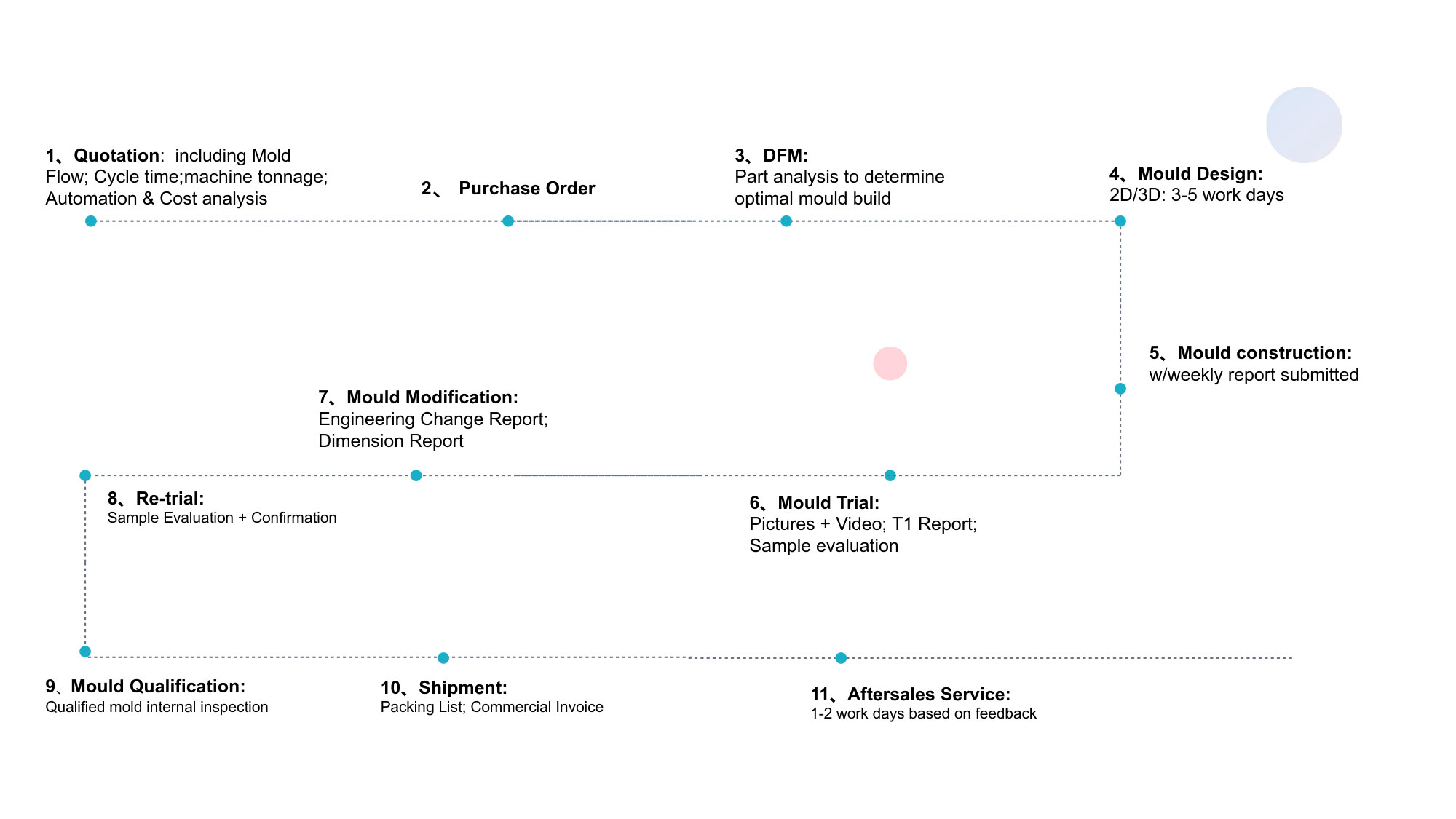
4.1 Early Intervention (DFM Report)
Before contract signing, Ansix Tech provides a comprehensive mold feasibility analysis report including:
Draft angle recommendations
Wall thickness optimization
Gate position analysis
Ejector pin mark location allowances
Identification of potential manufacturing challenges
This upfront collaboration prevents costly discoveries after mold creation that the structure cannot be manufactured.
4.2 Trial Molding and Samples
Ansix Tech provides T0 through T3 trial samples, with improvement reports accompanying each round. The company can rapidly exchange inserts to validate different approaches without completely rebuilding the mold, accelerating the development cycle.
4.3 Small-Batch Validation
Before full-scale production, Ansix Tech offers 100–500 shot pilot runs, statistically analyzing yield rates and Cpk to confirm process stability before approving mass production.
4.4 Maintenance and Spare Parts
Spare wear parts (ejector pins, core inserts) are delivered with every mold
Mold maintenance provided every 200,000 shots
Lifetime repairs charged at cost
Section 5: Differentiated Competitive Advantages
5.1 Addressing Common Industry Pain Points
Customer Complaint Ansix Tech's Response
Molds require frequent repairs, impacting orders 2,000-shot aging test before delivery with wear report; three-year mold structure warranty (excluding normal wear parts)
Excessive flash, high post-processing costs 0.005mm fit precision on parting surfaces; self-locking clamp force compensation; flash controlled to ≤0.03mm per batch—eliminating manual deburring
Inconsistent dimensions between batches Ultrasonic wall thickness sensors with real-time feedback and automatic pressure compensation; in-mold temperature and pressure sensors for closed-loop control
Long mold repair cycles In-house electrode processing center and EDM workshop; routine repairs completed within 24 hours
5.2 Cost Reduction Capabilities
Documented Results — In documented cases, Ansix Tech's optimization measures have reduced production cycle time by 28% and increased daily output from 1,300 to 1,670 units using the same equipment. Systematic optimization has helped customers reduce costs by up to 16% per sensor housing.
Cost Reduction Dimensions:
Material Optimization: Scientific material selection prevents costly over-engineering
Process Efficiency: Cycle time reduction directly lowers per-part cost
Quality Assurance: Reduced scrap rates through statistical process control
Supply Chain Integration: Four production bases in China and Vietnam reduce logistics costs and lead times
5.3 Delivery Efficiency
With 260 injection molding machines across four production facilities, Ansix Tech maintains significant production capacity to meet customer mass production needs. The company's efficient production lines and processes enable rapid response to customer orders and on-time delivery.
Standard Lead Times:
Simple molds: 10 days
Medium-complexity molds: 25–45 days
Expedited: Compressed to 20 days (with validation steps preserved)
Section 6: Complete Manufacturing Process — From Concept to Delivery
6.1 Product Introduction
The liquid level sensor with 300mm range and 4-20mA output is a critical component in chemical storage tank monitoring systems. These sensors convert liquid level signals into 4-20mA continuous current signals for transmission to display instruments or control rooms for centralized indication and monitoring. The system typically consists of the sensor body, float, flange or thread connection, and level transmitter.
Key Applications:
Petroleum and chemical raw material storage tank level measurement
Industrial wastewater level monitoring
Food processing storage tank level control
6.2 Material Selection for Chemical Storage Tank Sensors
For chemical storage tank applications, material selection is critical. PPS (Polyphenylene Sulfide) with 40% glass fiber reinforcement is the material of choice due to:
Chemical Resistance: Excellent resistance to acids, bases, fuels, and solvents
Thermal Stability: Maintains performance across -40°C to 150°C range
Flame Retardancy: Inherent UL94 V-0 rating without flame retardant additives
Dimensional Stability: Low moisture uptake ensures consistent performance
Mechanical Strength: High strength, high rigidity, fatigue endurance, and creep resistance
6.3 Mold Design and Manufacturing Process
Mold Flow Analysis — Advanced software simulates the injection molding process, predicting potential issues like air traps or incomplete fills before any steel is cut. The DFM report covers shrinkage, mold steel selection, injection molding materials, gating positions, wall thickness analysis, and parting lines.
Cooling System Design — Ansix Tech has abandoned traditional straight-hole cooling channels in favor of 3D-printed conformal cooling channels that precisely match the contour of the sensor housing cavity. This innovation significantly reduces cycle time and improves dimensional stability.
Gate and Runner System — Gate positions and runner systems are optimized through mold flow analysis to ensure balanced filling and minimize material waste.
Ejector System — Designed for high-volume production reliability, with spare ejector pins and core inserts delivered with every mold.
6.4 Injection Molding Process Optimization
Process Window Establishment — Scientific molding principles establish a stable, repeatable process window. DOE and pressure sensors validate molding conditions.
Key Process Parameters for PPS GF40:
Barrel temperature: 300–330°C
Nozzle temperature: ~330°C
Mold temperature: 120–180°C
Injection pressure: 50–130 MPa
Quality Control Points:
First-article inspection per batch
In-process monitoring via MES
Last-article comparison
Cpk monitoring for critical dimensions (≥1.33)
6.5 Packaging and Delivery
Ansix Tech works with logistics partners to ensure timely product delivery and efficient logistics. The company's supply chain management capabilities include established long-term relationships with reliable suppliers to ensure raw material quality and supply stability.
Section 7: Industry Experience and Customer Value
7.1 28+ Years of Specialized Experience
For over 28 years, Ansix Tech has specialized in the design and manufacturing of essential sensors, developing a reputation not merely as a supplier, but as an integrated engineering partner. The company systematically drives out cost while building in unyielding reliability.
7.2 What Ansix Tech Solves for Customers
Customer Problem Ansix Tech Solution Value Delivered
High per-part cost Process optimization, cycle time reduction Up to 16% cost reduction
Quality inconsistency MES-controlled processes, Cpk ≥1.33 Reduced scrap, consistent parts
Long lead times 260 machines across 4 facilities Rapid response, on-time delivery
Supply chain risk Multi-facility production, in-house capabilities Mitigated disruption risk
Material uncertainty Scientific material selection Optimal performance at lowest cost
7.3 Comprehensive Capabilities
Ansix Tech provides one-stop service covering:
Precision medical parts processing
Precision medical injection molds
Medical specialty plastic injection molding
Cleanroom injection molding
Liquid silicone injection molding
PFA mold making
The company's complete mold manufacturing system and advanced CNC, EDM, grinding, and automated injection molding equipment ensure dimensional accuracy and stable product performance.
Conclusion
Ansix Tech has achieved industry leadership in liquid level sensor manufacturing through a comprehensive, systematic approach that transforms technical expertise into tangible customer value. The company's 28+ years of experience, combined with world-class equipment, scientific molding principles, and full-process service capabilities, enable it to deliver:
Superior Quality: Through DFM analysis, mold flow simulation, and Cpk≥1.33 process capability
Cost Reduction: Documented 16% cost savings and 28% cycle time reduction
Reliable Delivery: 260 machines across 4 facilities ensuring rapid response
Risk Mitigation: Multi-facility production, in-house repair capabilities, and comprehensive quality certifications
As Ansix Tech's philosophy states: a mold is not just a piece of steel—it is a money-printing machine. Every mold is designed with comprehensive consideration of flow characteristics, venting paths, and temperature balance to ensure zero-debugging, low-flash, long-life performance on the customer's production line.
For customers seeking a reliable partner for liquid level sensor, 300mm range liquid level sensing controller for chemical storage tanks, and 4-20mA output devices, Ansix Tech offers the complete package: from concept to cost-effective mass production, with unwavering quality and reliability built in at every step.
Ansix Tech Co Ltd
If you have any plans related to Liquid level sensor, 300mm range, liquid level sensing controller for chemical storage tanks, 4-20m
, you can contact us at any time. We will turn your ideas into reality, let you realize your dreams, and obtain large orders from the market. Our contact information is info@ansixtech.com. Or contact our CTO, mail: stephen@ansixtech.com
#www.ansixtech.com #ansixtech.com #Liquid level sensor, 300mm range, liquid level sensing controller#Liquid level sensor, 300mm range, liquid level sensing controller#Liquid level sensor, 300mm range, liquid level sensing controllerCanopy Mold injection mold companies #Ansix #Ansix moulds #Ansix china #Ansix tech china #Ansix tech company #Ansix facotry #Liquid level sensor, 300mm range, liquid level sensing controllerinjection molding #Liquid level sensor, 300mm range, liquid level sensing controllerinjection tools #Liquid level sensor, 300mm range, liquid level sensing controllerinjection moulds #Liquid level sensor, 300mm range, liquid level sensing controllerplastic mould #Liquid level sensor, 300mm range, liquid level sensing controllerplastic tools #Ansix Tech #Ansix molds #Ansix injection molding #Ansix mold factory #injection molding Customized stainless steel float switch for water level, oil level, high liquid level alarm#Ansix mold factory #Liquid level sensor, 300mm range, liquid level sensing controllerchina #Liquid level sensor, 300mm range, liquid level sensing controllermolds #injection factory #Liquid level sensor, 300mm range, liquid level sensing controllerinjection molding #Liquid level sensor, 300mm range, liquid level sensing controllerinjection molding factory #injection molding company #Liquid level sensor, 300mm range, liquid level sensing controllerinjection mold companies #Liquid level sensor, 300mm range, liquid level sensing controllerTooling #Liquid level sensor, 300mm range, liquid level sensing controllermold limited #Ansix mold china #Ansix companies #Ansix company China #Liquid level sensor, 300mm range, liquid level sensing controllerfacotry #Ansix Tech #Ansix Tech mould #Liquid level sensor, 300mm range, liquid level sensing controllerinjection moulding #injection moulding company #Ansix Liquid level sensor, 300mm range, liquid level sensing controllerparts injection mold companies #medical injection molding companieschina #Liquid level sensor, 300mm range, liquid level sensing controllerchina factory #Ansix moulding companies #Ansix molding company #Liquid level sensor, 300mm range, liquid level sensing controllerinjection moulding facotry #Ansix Tech mold #Liquid level sensor, 300mm range, liquid level sensing controllermould #Liquid level sensor, 300mm range, liquid level sensing controllerplastic injection molding #ansix plastic mold #Mold manufacturing #Liquid level sensor, 300mm range, liquid level sensing controllerparts manufacturing #Liquid level sensor, 300mm range, liquid level sensing controllerplastic parts factory #Liquid level sensor, 300mm range, liquid level sensing controllerinjection parts mold #Liquid level sensor, 300mm range, liquid level sensing controllerPRECISION MANUFACTURING #Liquid level sensor, 300mm range, liquid level sensing controller#China mold #Liquid level sensor, 300mm range, liquid level sensing controllerinjection moulding china #Liquid level sensor, 300mm range, liquid level sensing controllermould china #china precision mold #mold in china #Liquid level sensor, 300mm range, liquid level sensing controllermold china #Precision molds #High-precision molds #Liquid level sensor, 300mm range, liquid level sensing controller#Injection molds #Liquid level sensor, 300mm range, liquid level sensing controllerFactory #Liquid level sensor, 300mm range, liquid level sensing controllerCompany #Super Large Injection Mold Factory #Large Tonnage Injection Molding Factory #Liquid level sensor, 300mm range, liquid level sensing controllerCompany #Liquid level sensor, 300mm range, liquid level sensing controllerFactory #2800T Injection Molding Factory #3000 Ton Injection Molding #4500 Ton Injection Molding Factory #Large Mold Injection Molding #Large Plastic Mold Injection Molding Factory #Large Injection Mold Manufacturer #Plastic Mold Factory #Injection Mold #Plastic Mold