



Tesla Rear Seat Dual Cup Holder
FEATURES
Mold Manufacturing: Engineering the Foundation of Flawless Production
At the heart of every high-quality injection-molded component lies a precision-crafted mold. For the Tesla Rear Seat Dual Cup Holder, our mold manufacturing process begins with advanced mold flow analysis (MFA) using Moldflow and UG software to simulate the injection process before any steel is cut. This predictive approach allows us to identify and eliminate potential defects – weld lines, trapped air, and uneven filling – guaranteeing that the final plastic component achieves Class-A surface finish with no visible flaws. Our mold processing capabilities are anchored by five-axis high-speed machining centers that achieve positioning accuracy of ±0.002mm on complex 3D contours, ensuring the cup holder‘s parting lines remain smooth, consistent, and virtually invisible. For delicate features such as retractable slide mechanisms and snap-fit tabs, we utilize precision wire electrical discharge machining capable of cutting channels as fine as 0.03mm without causing thin-wall deformation. This level of precision eliminates post-processing deburring operations on Tesla’s end, reducing both secondary processing costs and production lead times.
Material Selection: Durability That Stands the Test of Time
Material selection directly determines mold longevity and part dimensional stability. For Tesla‘s dual cup holder tooling, we specify mold steels matched to production demands. The mold base employs P20 pre-hardened steel for structural stability, while mold cores and cavities are fabricated from premium grades such as S136 stainless steel (corrosion-resistant, HRC 48-52) and H13 or SKD61 hot-work steels (high thermal stability, HRC 48-55) – materials selected based on their proven wear resistance against glass-fiber-reinforced thermoplastics. For the cup holder plastic component itself, we utilize engineering resins such as PC/ABS or glass-reinforced PA66, offering the right balance of impact strength, heat deflection temperature, and aesthetic finish. We provide full material certifications and heat treatment curves for every mold steel used, giving customers complete transparency.
Smart Manufacturing and Efficiency Improvement
We bring Industry 4.0 directly into the molding process. All injection molding machines are networked through Manufacturing Execution System (MES) software, which locks critical forming parameters – temperature, pressure, injection speed, and cooling time – preventing unauthorized adjustments. Only qualified engineers can modify these settings, with every change logged and traceable. Our mold temperature control integrates thermal oil circulators that maintain cavity-to-core temperature differentials within ±2°C, dramatically reducing part warpage, distortion, and residual stress. For cup holder components, continuous production across three separate batches demonstrates dimensional fluctuation of less than ±0.02mm on critical mounting features.
Process Quality Assurance: Eliminating Customer Anxiety
We address the five most common customer concerns – shrinkage, flash, dimensional drift, batch-to-batch color variation, and long repair cycles. Each production cycle begins with first-article inspection and ends with last-article comparison against certified standards. Molds are designed with optimized gate location and runner balancing, validated through mold flow analysis, to ensure complete cavity filling without overpacking. Before any mold is released for high-volume production, we conduct a thorough accelerated wear test to confirm that wear patterns remain acceptable after thousands of cycles under worst-case conditions. Our commitment to process stability means our customers receive components that are dimensionally identical, batch after batch, month after month.
-
Mold Description
Product Materials:
ABS/PC
Soft rubber: TPe
Mold Material:
S136ESR
Number of Cavities:
1*2
Glue Feeding Method:
cold runner
Cooling Method:
Water cooling
Molding Cycle
42.5s
Complete Production Solution: Tesla Rear Seat Dual Cup Holder
From DFM Analysis to Mass Production – Engineered for Reliability, Optimized for Cost
Executive Summary
Ansix Tech stands as a global leader in end-to-end injection molding solutions, seamlessly integrating every stage from product concept and prototyping through mold manufacturing, high-volume production, secondary processing, and final assembly. For the Tesla Rear Seat Dual Cup Holder, Ansix Tech brings together 28+ years of specialized experience, 260 injection molding machines spanning 30 to 2800 tons, four strategically located production bases across China and Vietnam, and a world-class quality management system certified to IATF 16949 (automotive), ISO 9001, ISO 14001, and ISO 13485. With more than 30,000 molds built since our founding in 1998 and an automated machining ratio of 70%, we deliver precision, speed, and cost efficiency that directly translates into customer value.
Our core mission is simple: Make Our Customers Successful.
-
SECTION 1: Technical Foundation – The Infrastructure That Builds Trust
1.1 Mold Processing Equipment
Precision injection molding begins with precision tooling. Our mold manufacturing facility is equipped with state-of-the-art machinery that sets the standard for accuracy and repeatability.
We feature five-axis high-speed CNC machining centers from leading global brands, capable of machining complex 3D contours and achieving positioning accuracy of ±0.002mm on critical mold features. For the Tesla Rear Seat Dual Cup Holder, this precision translates directly into product quality: parting line flash is held to less than 0.03mm, eliminating manual deflashing operations, while complex sliding mechanisms and snap-fit features are manufactured with sub-micron consistency that guarantees smooth assembly and reliable long-term operation. Our five-axis platform enables simultaneous multi-directional cutting, reducing setup time, minimizing cumulative tolerances, and accelerating mold delivery by eliminating multiple refixturing steps.
For micro-features such as narrow ejector pin slots, delicate undercuts, and intricate cooling channel geometries, we utilize wire electrical discharge machining (EDM) . This technology achieves cut widths as fine as 0.03mm, enabling the production of thin-wall sections and sharp internal corners without burrs, tool marks, or deformation stresses – critical for cup holder components with integrated retractable mechanisms. The wire EDM process leaves a consistent, damage-free surface that requires minimal hand finishing, preserving dimensional accuracy and extending mold life.
For fine surface finishing and precision detail work, we apply precision EDM sinking with graphite or copper electrodes machined in-house on our dedicated electrode machining centers. This approach is indispensable for producing sharp internal corners, rib details, and textured surfaces that meet Tesla‘s Class-A automotive interior specifications.
Customer Value Summary:
Investment Customer Benefit
5-axis machining ±0.002mm Parting lines ≤0.03mm flash – no deflashing cost
Wire EDM 0.03mm precision Clean thin-wall features – no secondary trimming
In-house electrode production Mold repair within 24 hours – minimal downtime
1.2 Injection Molding Machine Fleet – Capacity for Any Volume
Our injection molding machine fleet comprises 260 machines with clamping forces ranging from 30 tons (suitable for small, precision components) up to 2800 tons (capable of molding large structural automotive parts). Tesla‘s Rear Seat Dual Cup Holder, with its mid-sized envelope and complex geometry, is ideally matched to our fully electric servo-driven machines, which deliver shot-to-shot repeatability of ±0.1% across millions of cycles. All-electric drives eliminate hydraulic variability, ensuring that the melt pressure, screw travel, and injection speed are precisely identical for each shot – even during 24/7 production runs.
This level of repeatability means that whether Tesla orders 10,000 units or 500,000 units, each cup holder exhibits identical dimensions, fit, and functionality. No batch-to-batch surprises. No production line stoppages due to inconsistent parts. The consistent shot weight and cavity pressure profile guarantee stable CPK values of 1.33 or higher on all critical dimensions.
1.3 Metrology and Quality Inspection Equipment
Quality verification is embedded throughout our workflow. Our metrology lab is equipped with coordinate measuring machines (CMM) that perform full dimensional inspection on every new mold before production. Probe-based CMM systems measure complex three-dimensional features – mounting boss positions, snap-fit undercut depths, rib thickness – with micron-level accuracy. The CMM captures hundreds of data points and generates a complete, traceable inspection report for every mold delivered. For rapid in-process checks and high-throughput measurement, we deploy optical comparators and vision measurement systems that inspect parts for dimensional accuracy, surface finish, and gate witness mark acceptability in seconds.
Quality guarantee: Every mold leaving our facility is accompanied by a complete dimensional report, with critical features verified for CPK ≥1.33 – ensuring statistical process stability before mass production begins.
SECTION 2: Mold Manufacturing – Core Competencies Defined by Measurable Outcomes
2.1 Mold Life and Durability
Mold longevity is a fundamental customer concern: a mold that fails prematurely halts production, disrupts supply chains, and incurs expensive replacement costs. Our mold design specifications target 500,000 shots minimum for glass-fiber reinforced thermoplastics (such as PA66+GF30 or PC/ABS for the cup holder body) and 1,000,000 shots for unfilled engineering resins, based on rigorous accelerated wear modeling and real-world production experience across 30,000+ molds.
To achieve this longevity, we select mold materials strategically according to application demands:
Mold Component Material Selection Rationale
Mold Base P20 (pre-hardened) Structural stability, easy machining, 30-34 HRC
Cavities / Cores S136 stainless steel Corrosion resistance, high polishability (mirror finish for Class-A surfaces), HRC 48-52
High-wear inserts H13 / SKD61 hot-work steel Superior wear resistance against glass fibers, excellent thermal stability, HRC 48-55
High-gloss surfaces / transparent components NAK80 Excellent polishability (mirror finish), uniform hardness (HRC 37-43), good wear resistance, superior dimensional stability
Small precision cores / slides DC53 / SKD11 High toughness, excellent wear resistance, good hardening stability
High-temperature engineering plastics (PEEK/PEI) M340 / 4Cr13 / 9Cr18 Corrosion resistance for high-humidity processing, heat resistance up to 300°C+
Each batch of mold steel is accompanied by certified material test reports and complete heat treatment curves, providing full traceability from raw material to finished tool.
2.2 Dimensional Tolerances
We classify machining precision by functional requirements:
Feature Type Typical Tolerance Customer Value
General structural features ±0.05mm Guarantees part-to-part interchangeability
Precision mating surfaces / snap fits ±0.02mm Smooth assembly, consistent retention force
Ultra-precision critical dimensions ±0.005mm High-precision positioning, fit with mating components
Mold components are machined to critical feature tolerances of ±0.002mm on our five-axis platforms, with surface finishes down to Ra 0.025µm (mirror polish) on cavity faces that form visible surfaces. This level of finish eliminates visible flow marks and ensures the cup holder meets Tesla‘s Class-A interior trim standards without requiring secondary polishing operations.
2.3 Mold Configuration and Gate Architecture
The cup holder mold is designed for multi-cavity high-volume production – typically 2+2 or 4 cavity configurations balanced to maximize output per cycle. We specialize in:
Hot runner systems reducing material waste by eliminating cold runner scrap, lowering per-part material cost by 8–12%
Cold runner side-gate systems preferred for Class-A surfaces where gate vestige must be hidden from passenger view
Unscrewing / collapsible core mechanisms for threaded features and internal undercuts
Lifters and angled slides for side-action features such as retractable cup holder arms
For each mold, we run comprehensive mold flow analysis using Moldflow and UG software prior to machining to:
Identify optimal gate locations to achieve balanced cavity filling
Predict weld line positions and adjust cooling strategy to minimize visible lines
Detect trapped air locations and design appropriate venting channels
Optimize runner cross-sections for minimal pressure drop
Simulate fiber orientation for glass-reinforced materials to control warpage
Customer value: Eliminates costly mold rework cycles. Gates and vents are correct the first time, reducing time from T0 to production-ready mold by weeks.
2.4 Cooling System Design – Reducing Cycle Time
Cooling is the longest single phase in the injection molding cycle, typically accounting for 60–80% of total cycle time. Our molds incorporate high-efficiency conformal cooling channels and optimized thermal management systems to bring the cup holder to ejection temperature in the shortest possible time. Using thermal imaging and flow simulation, we design cooling circuits that maintain cavity-to-core temperature uniformity within ±2.0°C across the entire mold surface. Uniform temperature control reduces differential shrinkage, eliminates residual stress-induced warpage, and cuts cycle times by 15–30% compared to conventional cooling layouts.
For high-cavitation cup holder molds, conformal cooling channels following the part contour reduce cooling time by up to 56% and overall cycle time by 15% compared to straight-drilled cooling layouts. Faster cycles mean lower per-part cost and higher daily output – value that translates directly to Tesla‘s bottom line.
2.5 Lead Time Standards
Our track record in precision mold manufacturing enables predictable, reliable lead times:
Mold Complexity Standard Lead Time Expedited Lead Time
Simple prototype / single-cavity 10 days N/A
Medium complexity (2-4 cavity,100-400 components) 25-45 days 20 days
High-complexity (multi-cavity + slides / lifters) 45-60 days 35 days
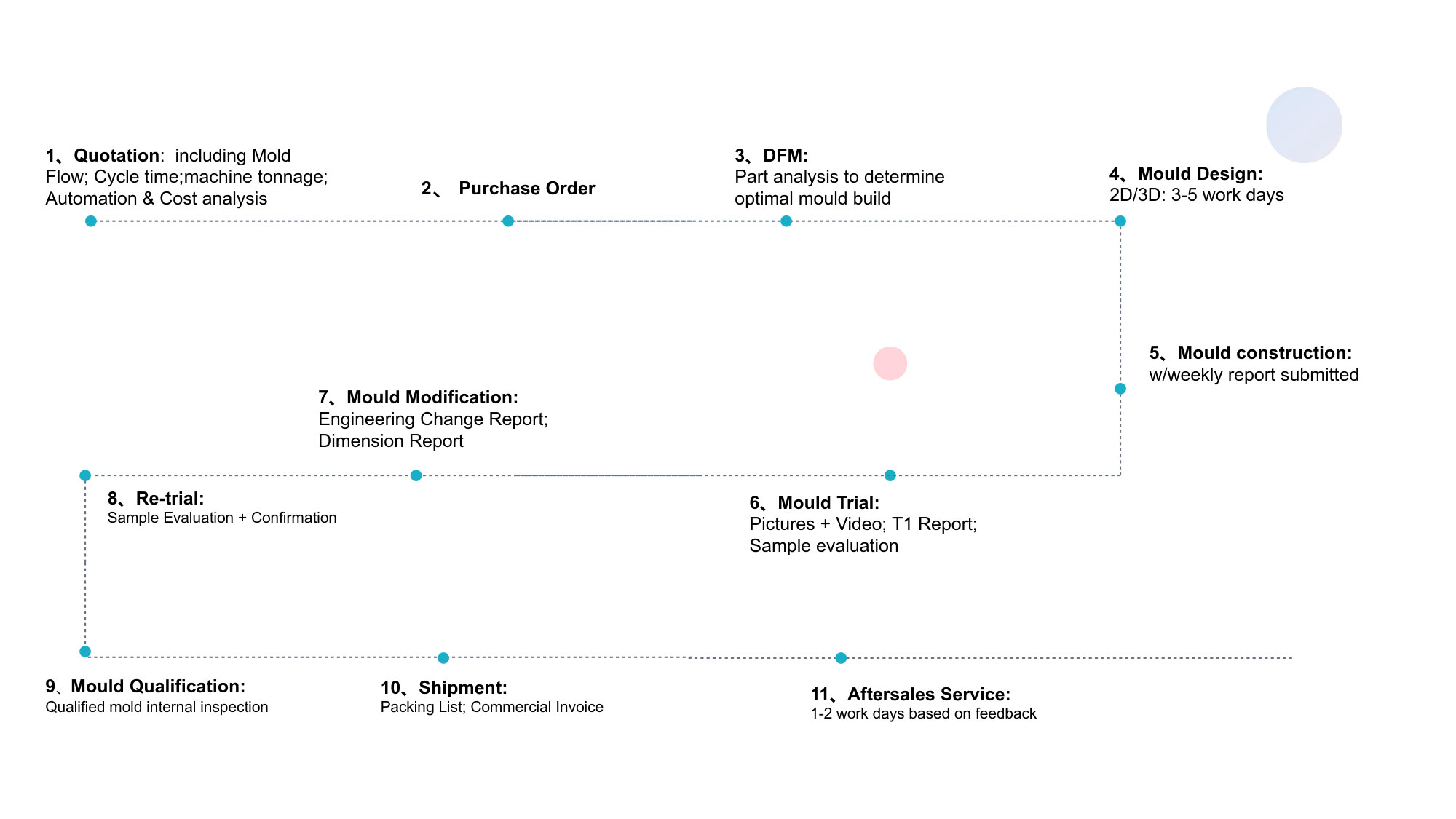
Expedited timelines are achieved through accelerated CNC programming, overlapping parallel workstreams, and prioritized machine scheduling - but crucially, we never skip validation steps. Every mold, regardless of schedule pressure, receives full DFM analysis, mold flow simulation, CMM inspection, and tryout validation.
SECTION 3: Injection Molding – Process Control and Quality Assurance
3.1 Process Standardization and Data Lock
All 260 injection molding machines are integrated into a centralized Manufacturing Execution System (MES) . Every process parameter - barrel temperatures (zoned), nozzle temperature, injection pressure profile, injection speed (multi-stage), holding pressure and duration, back pressure, screw rotation speed, cooling time, mold-open stroke, and ejector force - is locked within the MES and accessible only to authorized process engineers.
Any deviation from the locked process standard triggers an immediate alert. Batch-to-batch parameter adjustments are not permitted. This data lock ensures that the same process that produced the first approved part continues to produce identical parts through the millionth cycle. For Tesla‘s dual cup holder, this level of control guarantees** stable CPK values ≥1.33 on all critical dimensions**.
3.2 Dimensional Stability – Eliminating Variation
Our approach to dimensional stability addresses the root causes of drift:
We specify precisely the shrinkage characteristics of the selected engineering resin and adjust cavity dimensions accordingly in the design phase. Mold temperature controllers with circulation units maintain cavity and core temperatures within ±2.0°C of setpoint, eliminating warpage from non-uniform cooling. Our molding floor is climate-controlled to minimize ambient temperature and humidity influences on part dimensions. Each production run begins with first-article inspection and ends with last-article comparison. Any dimensional drift beyond specified limits triggers immediate process intervention. Customer result: Cup holder mounting bosses remain within ±0.02mm of nominal through full production campaigns lasting weeks or months.
3.3 Surface Finish Quality
The Tesla Rear Seat Dual Cup Holder requires a Class-A automotive interior surface - free from visible defects such as weld lines, flow marks, sink marks, gas burns, and gate blemishes in areas visible to passengers.
We achieve this through:
Mirror-polished cavity surfaces (≤Ra 0.025µm) for visible cosmetic areas
Optimized gate placement on hidden surfaces (e.g., underside of cup well) so gate witness marks never reach passenger view
High mold temperature control to prevent premature freezing and cold-slug defects
Venting channel design that allows trapped air to escape without leaving burn marks
Precise packing pressure timing to eliminate sink marks over ribs and bosses
All cup holder components are inspected under standardized lighting conditions to verify B-surface (hidden) and A-surface (visible) quality before packing.
3.4 Advanced Materials Capability
Our materials portfolio covers the full spectrum of engineering thermoplastics required for demanding automotive interior applications:
Material Type Examples Key Properties Typical Application
PC/ABS blends Bayblend, Cycoloy Impact strength, heat resistance, aesthetic finish cup holder body, retractable doors
PA6 / PA66 + GF PA6+GF30, PA66+GF30 High stiffness, creep resistance, dimensional stability structural components, mounting brackets
PBT + GF PBT+GF30 Chemical resistance, dimensional stability moving mechanisms
Global fire-retardant grades PC/ABS FR, PA FR (UL94 V-0) Flame retardancy, low smoke interior components requiring FMVSS compliance
High-heat engineering resins PEI (Ultem), PPS, LCP Continuous use up to 200°C+, chemical resistance under-hood components
Weather-resistant grades ASA, ASA+PC UV stability (up to 3000h QUV test), color retention light-colored cup holder components exposed to sunlight
For each cup holder component, we recommend materials based on a trade-off analysis between mechanical requirements (load capacity, impact resistance, thermal deflection temperature), aesthetic specifications (surface finish, color stability), and cost targets.
SECTION 4: Full-Process Service – Managing Customer Costs from Prototype to Production
4.1 Early Engagement: DFM Report (Design for Manufacturability)
Before any steel is cut, we deliver a comprehensive Design for Manufacturability (DFM) report to the customer. This report is our commitment to solving problems before they become costly errors.
The DFM report includes:
Draft angle recommendations – preventing ejection damage while maintaining functional geometry
Wall thickness optimization – identifying thick sections that would cause sink marks and recommending core-out or rib structures that maintain strength with thinner walls
Gate location selection – placing gates on hidden surfaces, specifying side or submarine gates to hide vestige marks
Witness mark mapping – informing customers exactly where ejector pin marks will appear (always in non-cosmetic zones)
Tolerance analysis review – recommending adjustments to overly tight uneconomical tolerances
Assembly feature check – verifying snap-fit clearance, living hinge thickness, insert alignment prior to tooling
Customer value: DFM resolution before tooling eliminates the single most expensive problem in injection molding – discovering a design flaw after the mold is cut. Each DFM recommendation is quantified in terms of cost avoidance and engineering risk reduction.
4.2 Sampling and Validation (T0 to T3)
We follow a disciplined iterative validation process that guarantees production readiness:
T0 sample: First mold trial. 50–100 parts produced. Full dimensional report and defect analysis provided. Engineering team reviews results and creates corrective action plan based on mold flow simulation comparison.
T1 sample: First corrective iteration. Molds adjusted based on T0 findings – gates polished, venting improved, cooling balanced. 100–200 parts produced. Conformity inspection report documents improvement.
T2 sample: Fine-tuning iteration, typically focusing on cycle time reduction and cosmetic surface enhancement. 200–500 parts produced. CPK analysis validates process capability.
T3 sample (Pre-Production Validation): Full process locked, tooling validated, machine assignment fixed. 500–1000 parts produced across multiple consecutive runs. Quality release signed when CPK ≥1.33 on all critical dimensions.
Quick-change inserts allow different design variants or gate configurations to be validated without remaking whole mold – a cost-saving feature particularly valuable when minor dimensional adjustments are needed after customer feedback. For urgent projects requiring accelerated timelines, we can compress this sampling schedule while maintaining full inspection rigor on every sample set.
*4.3 Low-Volume Validation Run*
Before releasing the mold for full mass production, we offer a pre-production trial run of 100–500 shots. This trial validates:
Statistical process capability (CPK ≥1.33) verified across a representative batch
Cycle time consistency and machine uptime under simulated production conditions
Packing, labeling, and logistics workflows
Secondary operation integration (if required)
Only after successful pre-production validation does the mold transition to high-volume production.
4.4 Maintenance and Spare Parts
We deliver each mold with a complete set of spare wear parts: ejector pins(top pins), core pins, slides and lifters) and critical cavity inserts that experience the highest wear. This spare kit enables customer toolrooms to perform routine maintenance on-site.
In addition, we provide:
Maintenance schedule: Preventive maintenance every 200,000 cycles covering cleaning, lubrication, wear measurement, and component inspection
Lifetime repair service: Repair and renovation at cost-recovery pricing – we do not mark up repairs for customers in active production
Emergency response: Critical repair within 24 hours for standard molds; for complex high-cavitation molds, we contract 48-hour turnaround
SECTION 5: Diffentiators – Solving Industry Pain Points
Customer Complaint Ansix Tech Response
Mold repairs take too long and cost too much We maintain in-house electrode machining and EDM capabilities. Mold repair rarely leaves the facility. Standard build/weld/insert repairs completed within 24 hours.
Flash defects require post-processing We hold parting line fit to 0.005mm and employ lock-up force compensation during setup. Flash is controlled to ≤0.03mm – no manual deflashing needed.
Dimensions drift between batches Closed-loop process control with real-time cavity pressure monitoring. Sonically measured wall thickness sensors provide feedback to molding machine.
Inconsistent material quality Full material traceability from pellet to finished part. Incoming material testing verifies melt flow index, moisture content, and mechanical properties per batch.
Unknown risk of mold wear Accelerated wear testing on all new tooling prior to release. Full wear profile documented and shared with customer.
Closing Statement – For Our Customers
At Ansix Tech, we do not view a mold as a block of steel but as a profit-generating asset. Every mold design decision is evaluated through the lens of manufacturability, maintainability, and longevity – ensuring that when the mold arrives at Tesla‘s production line, it is ready to run with minimal setup, low flash, and high uptime.
We invite Tesla to initiate a collaborative DFM review for the Rear Seat Dual Cup Holder. Through this review, we will demonstrate our systematic approach to eliminating weld lines, trapped air, sink marks, and other molding defects before tooling begins.
Ansix Tech Co Ltd
If you have any plans related to Tesla Rear Seat Dual Cup Holder , you can contact us at any time. We will turn your ideas into reality, let you realize your dreams, and obtain large orders from the market. Our contact information is info@ansixtech.com. Or contact our CTO, mail: stephen@ansixtech.com
#www.ansixtech.com #ansixtech.com #Tesla Rear Seat Dual Cup Holder #Tesla Rear Seat Dual Cup Holder moulds #Tesla Rear Seat Dual Cup Holder injection molding companies #Tesla Rear Seat Dual Cup Holder Canopy Mold injection mold companies #Ansix #Ansix moulds #Ansix china #Ansix tech china #Ansix tech company #Ansix facotry #Tesla Rear Seat Dual Cup Holder injection molding #Tesla Rear Seat Dual Cup Holder injection tools #Tesla Rear Seat Dual Cup Holder injection moulds #Tesla Rear Seat Dual Cup Holder plastic mould #Tesla Rear Seat Dual Cup Holder plastic tools #Ansix Tech #Ansix molds #Ansix injection molding #Ansix mold factory #injection molding Tesla Rear Seat Dual Cup Holder #Ansix mold factory #Tesla Rear Seat Dual Cup Holder china #Tesla Rear Seat Dual Cup Holder molds #injection factory #Tesla Rear Seat Dual Cup Holder injection molding #Tesla Rear Seat Dual Cup Holder injection molding factory #injection molding company #Tesla Rear Seat Dual Cup Holder injection mold companies #Tesla Rear Seat Dual Cup Holder#Tesla Rear Seat Dual Cup Holder mold limited #Ansix mold china #Ansix companies #Ansix company China #Tesla Rear Seat Dual Cup Holder facotry #Ansix Tech #Ansix Tech mould #Tesla Rear Seat Dual Cup Holder injection moulding #injection moulding company #Ansix Tesla Rear Seat Dual Cup Holder parts injection mold companies #medical injection molding companieschina #Tesla Rear Seat Dual Cup Holder china factory #Ansix moulding companies #Ansix molding company #Tesla Rear Seat Dual Cup Holder injection moulding facotry #Ansix Tech mold #Tesla Rear Seat Dual Cup Holder mould #Tesla Rear Seat Dual Cup Holder plastic injection molding #ansix plastic mold #Mold manufacturing #Tesla Rear Seat Dual Cup Holder parts manufacturing #Tesla Rear Seat Dual Cup Holder plastic parts factory #Tesla Rear Seat Dual Cup Holder injection parts mold #Tesla Rear Seat Dual Cup Holder PRECISION MANUFACTURING #Tesla Rear Seat Dual Cup Holder #China mold #Tesla Rear Seat Dual Cup Holder injection moulding china #Tesla Rear Seat Dual Cup Holder mould china #china precision mold #mold in china #Tesla Rear Seat Dual Cup Holder mold china #Precision molds #High-precision molds #Tesla Rear Seat Dual Cup Holder #Injection molds #Tesla Rear Seat Dual Cup Holder Factory #Tesla Rear Seat Dual Cup Holder Company #Super Large Injection Mold Factory #Large Tonnage Injection Molding Factory #Tesla Rear Seat Dual Cup Holder Company #Tesla Rear Seat Dual Cup Holder Factory #2800T Injection Molding Factory #3000 Ton Injection Molding #4500 Ton Injection Molding Factory #Large Mold Injection Molding #Large Plastic Mold Injection Molding Factory #Large Injection Mold Manufacturer #Plastic Mold Factory #Injection Mold #Plastic Mold