



Trocar Mold
FEATURES
Enabling Trust Through Precision Assets and Cleanroom Capability
1.1 Mold Machining Equipment: Uncompromising Accuracy and Surface Integrity
The foundation of a high-performing trocar mold lies in the machining assets used to build it. Ansix Tech operates a fleet of high-precision five-axis machining centers equipped with 30,000 RPM spindles and µ‑accurate positioning drives. These machines achieve positioning tolerances of ±0.002 mm on complex contoured geometries, directly translating into trocar component performance. The industry standard for high-speed 5‑axis machining allows cutting in a single clamping operation, eliminating tolerance stack-up from multiple setups and reducing total processing time by up to 40% compared to traditional milling-plus-EDM routes.
Customer Value Translation:
No visible flash or rough parting lines: Precise matching of core/cavity ensures patient‑contact surfaces remain smooth, eliminating manual deburring operations before assembly or sterilization.
-
Mold Description
Product Materials:
PP PC
Mold Material:
S136ESR
Number of Cavities:
64
Glue Feeding Method:
Hot runner
Cooling Method:
Water cooling
Molding Cycle
22.5s
- The mold manufacturing process and product material selection
Reduced mold trial iterations: High‑accuracy machining means the first test shot is significantly closer to final dimensions, cutting T0‑to‑production time by weeks.
Longer mold maintenance intervals: Machine‑produced surface finishes (Ra ≤ 0.2 µm) reduce abrasive wear on critical sealing surfaces when processing glass‑filled polymers.
Beside machining centers, Ansix employs slow‑wire EDM capable of producing micro‑cavities, narrow slots down to 0.03 mm, and intricate undercuts without inducing residual stress that could warp thin‑walled cannula sections. This capability ensures that complex living hinges, snap‑fit detents, and fluid channel geometries maintain both dimensional stability and structural integrity over hundreds of thousands of cycles.
-
Injection Molding Machine Park: Scalability with Process Consistency
Ansix Tech maintains 260 injection molding units spanning clamping forces from 30 tons (for fine‑pitch precision components) to 2800 tons (for larger trocar housings and multiple‑cavity tools). The majority are fully electric servo‑drive machines from FANUC, Sumitomo, Toshiba, and ARBURG (including liquid silicone rubber two‑shot platforms). Servo‑electric drives provide repeatable injection velocity, pressure, and screw position to within ±0.1% deviation shot‑to‑shot. For trocar sealing lips and threaded locking rings, this consistency translates directly into leak‑free assemblies and inter‑changeable components across production batches.
1.3 Quality Assurance Equipment: Statistical Proof of Conformance
Every trocar mold manufactured at Ansix Tech is subjected to full dimensional verification before release. The company operates coordinate measuring machines (CMM) for hard‑probe measurement of critical functional features, optical imaging systems for non‑contact inspection of soft sealing surfaces, and surface roughness testers. More importantly, Ansix commits that all critical-to-quality (CTQ) dimensions achieve Process Capability Index Cpk ≥ 1.33 before volume production begins. For surgical access devices, this statistical rigor eliminates the risk of out‑of‑spec components reaching sterile packaging lines.
Compliance with ISO 13485:2016 requires that these metrology systems undergo regular Gage Repeatability & Reproducibility (GR&R) studies. Ansix integrates measurement data directly into Device History Records (DHR) for full traceability from steel to sterile pack.
Section Two: Mold Manufacturing Core Competencies — Where Precision Meets Predictability
2.1 Tool Steel Selection and Lifetime Commitment
Trocar molds experience continuous mechanical cycling combined with thermal stress from high‑melt‑temperature engineering polymers (PC, PEEK, PPS+GF). Incorrect steel selection leads to premature wear, dimensional drift, and costly downtime.
Ansix Tech maintains a comprehensive material library matched to application demands:
Mold Component Recommended Steel Wear Resistance Corrosion Resistance Typical Applications
Cavity/Core for PC, ABS S136 / 4Cr13 / 9Cr18 (stainless) High Excellent PC trocar sleeves, transparent housings
PEEK / PPS + GF applications 2344 / 8407 / SKD61 (H13 class) Very high Medium High‑temperature engineered seals
Mirror finish / optical clarity NAK80 Medium Medium Pre‑polished to high gloss
Liquid silicone rubber (LSR) M340 (corrosion‑resistant) High Very high Soft sealing lips, overmolded grips
Ultra‑wear applications DC53 / SKD11 Extreme Medium Thin gates, shear‑prone edges
Specifically, for glass‑filled engineering resins commonly used in trocar puncture mechanisms, Ansix guarantees mold service life of 500,000 shots minimum. For unreinforced medical grades (PC, ABS, LSR), the guarantee extends to 1,000,000 shots before non‑consumable components require structural refurbishment. This commitment is backed by comprehensive material certification reports and documented heat‑treatment profiles for each mold steel batch.
2.2 Precision Tolerances Across Product Complexity
Part classification determines achievable tolerances. Ansix Tech delivers:
General structural components (trocar housing bodies, valve caps) — ±0.05 mm on nominal geometry
Precision functional features (sealing lip diameters, thread pitch, snap‑fit dimensions) — ±0.010 mm
Micro‑molded cannula tips and fluid channels — ±0.005 mm, essential for low‑friction surgical access
By pre‑declaring achievable tolerances during the Design for Manufacturability (DFM) phase, Ansix eliminates the risk of “over‑specification” that drives tooling cost without functional gain. The customer receives a Tolerance Verification Report with each first article inspection, documenting CPk values for each flagged CTQ dimension.
2.3 Advanced Mold Configurations for Trocar Families
Ansix designs and builds multiple mold classes to match production volume, cost targets, and component complexity:
Hot runner systems reduce material waste by eliminating cold sprue and runner scrap. For high‑volume trocar components, material savings alone recover tooling premium within 3–6 months of continuous production.
Stack molds (two‑layer) double output per machine cycle, effectively halving unit cost for large‑volume cannula and seal components without additional injection press investment.
Two‑shot / multi‑material overmolding integrates rigid polymer bases with soft silicone sealing elements in a single automated cycle, eliminating secondary assembly operations and ensuring zero leak paths.
High‑gloss mirror finish molds (Ra < 0.05 µm) produce smooth optical surfaces for transparent trocar sleeves without secondary polishing. This reduces both part cost and manufacturing lead time.
2.4 Scientific Gate Design and Balanced Filling
Using Mold Flow Analysis (MFA), Ansix engineers simulate polymer flow, melt‑front advancement, pressure drop, and air entrapment before any steel is cut. The analysis precisely predicts weld‑line formation and gas trap locations in multi‑cavity trocar tools. Based on simulation output, gating strategy (number of gates, gate type, location, and dimensions) is optimized to ensure balanced cavity filling to within ±5% across up to 64 cavities per tool.
Customer Value:
No weld lines on aesthetic patient‑contact surfaces.
Complete filling without short shots — no scrap from incomplete parts.
Eliminates costly and time‑consuming physical trial‑and‑error iterations during mold qualification.
2.5 Cooling System Optimization
Trocar components often have asymmetrical wall sections (thin cannula wall contrasted with thicker valve housings). Differential cooling causes warpage and ovality. Ansix designs zoned cooling circuits in which each cavity receives dedicated thermal control via temperature‑controlled water channels placed optimally based on MFA thermal simulation. By maintaining core and cavity temperature difference within 2 °C, Ansix minimizes post‑mold warpage, reduces cycle time by up to 20%, and ensures critical circular features (seal bores, cannula outer diameters) remain concentric after ejection.
2.6 Ejection System Design for Damage‑Free Part Release
Trocar components are sensitive to ejection marks, especially on sealing surfaces. Ansix engineers specify ejector pin placement outside functional zones, apply sleeve ejectors for thin‑walled cannulas, and design lifting features that release parts without stress whitening or deformation. The DFM report shows the exact location and size of all ejector witness marks, enabling customers to approve or relocate those marks before manufacturing begins—eliminating post‑tool rework.
2.7 Standard Lead Times
Ansix offers tiered scheduling to match customer project urgency:
Mold Complexity Typical Lead Time (business days)
Simple, low‑cavitation 10–15 days
Medium complexity (≤16 cavities, hot runner) 25–30 days
High complexity (64+ cavities, two‑shot, stack mold) 45–50 days
Expedited (additional shift + weekend machining) As short as 20 days
Crucially, expedited schedules never skip mold flow validation, material certification, or first‑article inspection—the milestones that ensure right‑first‑time mold performance.
2.8 Mold Validation Protocol Before Shipment
Every trocar mold undergoes a documented validation sequence before leaving Ansix’s manufacturing floors:
2000‑shot production test on designated injection press.
Full dimensional inspection of every cavity on CMM.
High‑speed video of ejection sequence — documented and shared with customer.
Digital First Article Inspection Report (FAIR) — scanned PDF with measurable deviations from nominal CAD.
Wear trend prediction based on material processed and shot count.
The result: a mold that arrives at the customer’s facility ready to mount, heat, and run, not a debug project requiring weeks of additional parameter tuning.
Section Three: Injection Molding Process Control — Eliminating Defects Through Scientific Molding
3.1 MES‑Based Parameter Locking and Traceability
All Ansix injection molding machines are connected to a central Manufacturing Execution System (MES). Critical process parameters—barrel temperature zones, injection velocity profile, holding pressure, holding time, cooling duration, and screw decompression—are locked by role‑based access approval. Only an authorized process engineer can modify settings, and every change is timestamped with operator ID and reason.
For each production shift, Ansix completes First‑Article Inspection (FAI) and Last‑Article Comparison. FAI matches master sample dimensions; last‑article confirms the process has not drifted over the shift period. The system automatically calculates CPk for each CTQ dimension and alerts quality personnel when trending approaches action limits.
3.2 Real‑Time Cavity Pressure Monitoring
Ansix equips critical trocar tools with in‑mold pressure and temperature sensors that feed real‑time data into the MES. The combination of cavity pressure‑controlled switchover from fill to pack (rather than screw position alone) eliminates part‑to‑part weight variation, a leading cause of sealing inconsistency. For multi‑cavity tools, per‑cavity monitoring identifies if a single cavity drifts, allowing targeted maintenance without taking the entire mold offline.
Measurable result: Over three consecutive production runs spanning five days, Ansix demonstrates key hole center‑to‑center spacing variation ≤ 0.02 mm — proving dimensional repeatability acceptable for precision medical device assembly.
3.3 Defect Mitigation Strategy
Customer Concern Ansix Controlled Parameter Outcome
Sink marks thick ribs Pack pressure extended, gate size optimized Flat surface finish without secondary grinding
Flash at parting lines Mold clamped with lock‑force compensation algorithm; 0.005 mm fit on parting surface Flash ≤ 0.03 mm across any cavity
Short shots / incomplete fill Mold flow validation before tooling; process parameters verified at OQ Zero incomplete parts once process window established
Discoloration from material degradation Decompression before open; controlled residence time; purge protocols Transparency retained for clear PC trocar sleeves
3.4 Appearance Grades
Ansix Tech defines achievable surface quality in quantifiable terms:
Transparent components (PC, medical grade) — No visible bubbles, flow lines, or light‑scattering defects; optical clarity suitable for surgical visualization.
Electroplated components — No gas marks, jetting defects, or substrate porosity that would compromise adhesion.
High‑gloss textured finishes — Measured surface roughness Ra ≤ 0.2 μm, meeting premium surgical instrument cosmetics.
3.5 Special Material Processing Expertise
Trocar devices leverage multiple polymer families depending on application zone. Ansix holds production history on:
Material Class Example Grades Key Consideration for Molding
Polycarbonate (PC) Medical‑grade PC Complete drying required; tight melt temperature control
ABS and PC/ABS blends Cycoloy, Bayblend Lower tooling sensitivity, good impact strength
Polyamide + 30–50% glass fiber PA6-GF30, PA66-GF35 High abrasive wear on gates; tool steel must be wear‑resistant
PEEK (medical grade) Victrex, Solvay Extremely high melt temperature (380–400°C); special screw designs
PPS (with or without GF) Ryton, Fortron High chemical resistance for sterilization exposure
PSU / PESU / PPSU Ultrason, Radel High transparency plus autoclave tolerance
Liquid Silicone Rubber (LSR) Nusil, Wacker, Dow Single‑ or multi‑shot overmolding onto rigid trocar base
PEI / Ultem SABIC Ultem High strength‑to‑weight for surgical handles
Fluoropolymers (PTFE/PFA) Chemours, Daikin Requires specialized screw and barrel coatings
For materials requiring UL94 V-0 flame rating (trocar electrosurgical housings) and UV stability for 3000 hours with no color shift, Ansix validates material certificates and retains lot traceability records. Material selection directly drives tool wear life, cycle times, and final part performance.
3.6 Process Validation (IQ/OQ/PQ) for Regulated Devices
Trocar components are typically Class II medical devices requiring formal process validation to meet FDA 21 CFR Part 820, ISO 13485, and EU MDR 2017/745 requirements.
Ansix executes a documented IQ → OQ → PQ protocol for every medical molding program:
IQ (Installation Qualification): Verify mold mounted correctly, water lines and thermocouples functional, machine calibration current, material handling system running.
OQ (Operational Qualification): Define process windows for melt temperature, injection speed profiles, holding pressure, and cooling time. Use Design of Experiments (DOE) to identify robust center points. Document upper and lower control limits for each parameter.
PQ (Performance Qualification): Run continuous production of three successive batches at commercial cycle times using routine operator inspection. Statistically prove Cpk ≥ 1.33 on all CTQ dimensions「21†L23-L33」.
Customers receive complete validation packages ready for submission to Notified Bodies or regulatory agents. Ansix maintains your Device Master Record (DMR) and Device History Record (DHR) on your behalf, ensuring audit readiness without burdening your internal quality team.
Section Four: Full‑Service Lifecycle — Reducing Total Cost of Ownership
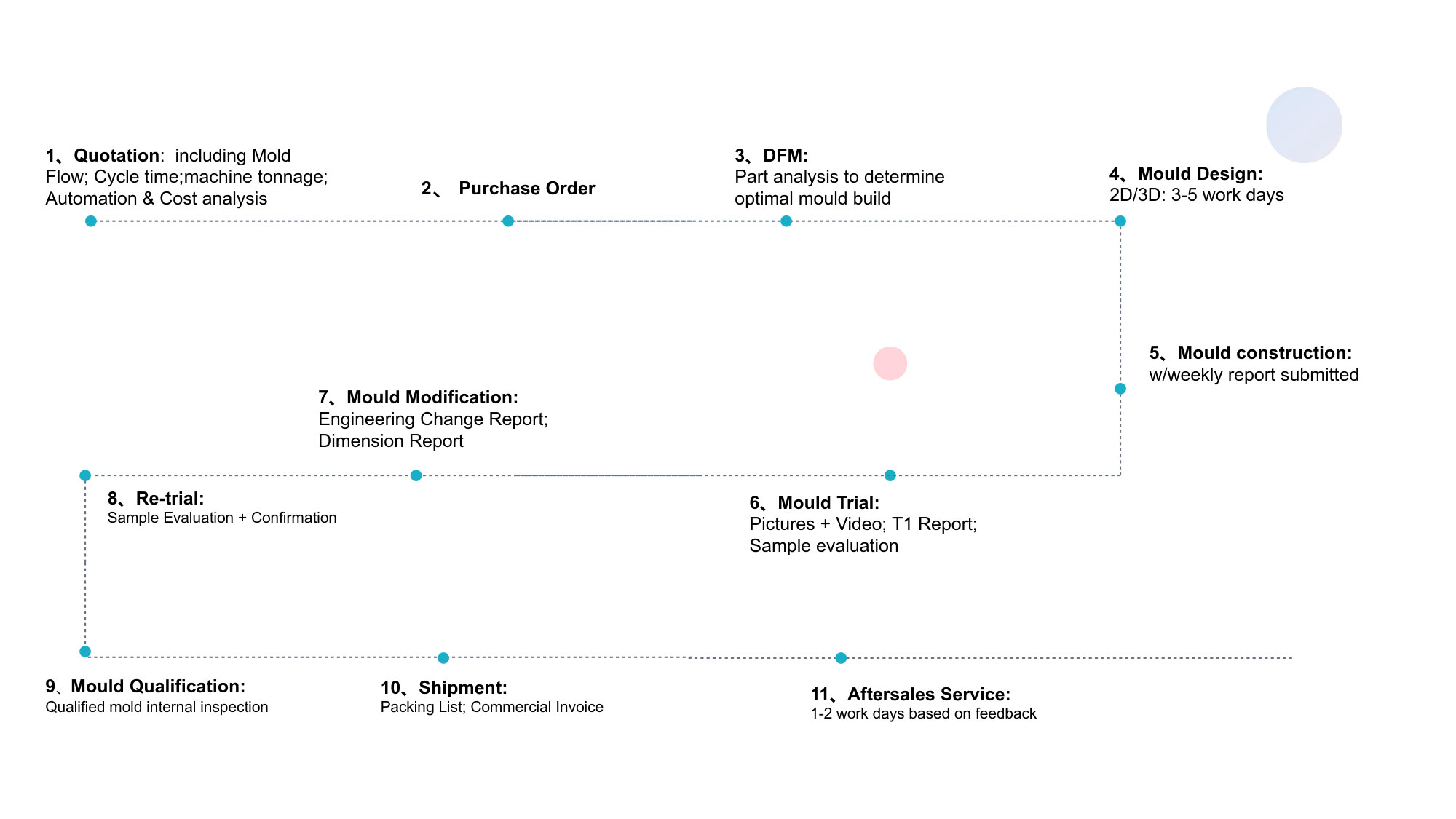
4.1 Early Engagement: DFM Report Before Contract
Ansix provides a zero‑cost, no‑obligation Design for Manufacturability (DFM) report before tooling kickoff—a practice that distinguishes Ansix from competitors charging for preliminary engineering.
The DFM document includes:
Recommended draft angles for each face (ensuring clean ejection).
Rib-to-wall thickness ratio recommendations to prevent sink.
Critical gate location analysis to keep weld lines away from functional zones.
Marking map — exact location of ejector pin marks, gate vestige, and parting lines — allowing customer to approve before tool steel is cut.
Material shrinkage assumptions and mold steel expansion compensation.
Customer Value: Ansix finds potential molding problems on screen, not on the injection machine. Modifying a CAD file costs virtually nothing. Re‑cutting a steel mold costs thousands of dollars and weeks of schedule delay.
4.2 T¹ Through T³ Samples with Improvement Reports
Ansix commits to iterative sampling and documentation. Following initial T¹ (first shot), the engineering team reviews molded samples, measures all dimensions against the DFM tolerance table, and writes a formal Sample Improvement Report (SIR) categorizing each non‑conformance:
Red items — Must be reworked before production.
Yellow items — Process adjustment may resolve.
Green items — Conform to spec.
T² and T³ samples repeat the cycle until all red and yellow items are resolved. The process may include interchangeable inserts to test alternative gate geometry or cooling configurations without machining an entire new mold.
4.3 Low‑Volume Pilot Run Before Commercial Commitments
Prior to signing a long‑term supply agreement, Ansix offers a 100 to 500 shot pilot production run. During this trial:
Production documentation (work instructions, quality checklists) is activated.
Operator training occurs on actual product.
CPk and scrap rates are calculated from real production data.
Final Costed Bill of Materials (BOM) is confirmed.
Only after the customer signs off pilot results does Ansix enter full commercial production. This approach removes the risk of discovering process issues after having already booked large volumes.
4.4 Consumable Spares and Maintenance Kits
At mold delivery, Ansix includes a spare parts kit containing common wear items:
Extra ejector pins (for each cavity)
Spare core inserts (pre‑machined to match active production)
Spare water fittings and o‑ring seals
Additionally, Ansix offers scheduled mold maintenance every 200,000 cycles — cleaning, lubrication, wear measurement, and recalibration of slide and core movements. Lifelong repair service is provided at direct cost (materials plus labor) without premium markup.
4.5 Local Support Options
Ansix operates four production bases — three in China and one in Vietnam — serving customers across North America, Europe, and Asia‑Pacific. Regional service engineers can perform on‑site mold inspection and minor repairs without returning tooling to Asia.
Section Five: Differentiators — How Ansix Converts Pain Points into Promises
Common Customer Complaint Ansix’s Explicit Commitment
Mold wears out early; frequent downtime for repair Deliver 500k (GF‑filled) to 1M (unfilled) shot guarantee on structural mold components. Provide documented wear prediction before contract.
Flash requires secondary trimming; labor cost adds 10¢ per part Hold flash ≤ 0.03 mm across all cavities. No manual deburring step needed. Mold design includes lock‑force compensation to maintain flash control over tool life.
Batch‑to‑batch dimensional variation (cannula ovality, seal bore position) Use cavity pressure closed‑loop control plus real‑time wall thickness monitoring. Full CPk reports with every shipment. Option to install in‑mold pressure sensors with live data reporting.
Mold repair cycles — weeks of lost production Ansix in‑house electrode making and EDM — most rework completed within 24 hours. Emergency fast‑turn maintenance available as standard service level.
Material certification not traceable to specific production lot Every bag of resin is lot‑tagged from dock to machine hopper. DHR links raw material COA, process parameters, and quality inspection results for each shipment. Full recall traceability.
Validation documentation takes months to assemble Ansix provides ready‑to‑submit IQ/OQ/PQ packages in customer’s preferred format (e.g., FDA 510(k) submission style). Full DMR and DHR archives maintained on customer’s behalf.
Engineering change cost blowouts Early DFM engagement catches 80%+ of potential change requirements before steel is cut. Interchangeable inserts accommodate minor revisions without full mold rebuild.
Section Six: Customer Cost Reduction Pathways — Material, Process, and Efficiency Optimization
Ansix Tech’s integrated ecosystem eliminates communication gaps between design, tooling, and production teams, accelerating timelines and reducing total cost. Cost savings flow from three primary levers:
6.1 Material Selection Optimization
Experience‑guided polymer recommendations — selecting an alternative resin with similar mechanical properties but lower material cost, easier moldability (wider processing window), or shorter cycle time. Over annual volumes exceeding one million units, this single decision yields six‑figure savings.
Material consolidation — where multiple secondary materials are replaced by a single base resin with overmolding, eliminating assembly BOM complexity and reducing purchasing overhead.
Scrap reduction — DFM‑optimized gate and runner designs reduce total runner mass by up to 30%, directly lowering material cost per part.
6.2 Cycle Time Compression
Mold cooling time typically accounts for 50–70% of total injection molding cycle time. Conformal cooling channels (3D‑printed or machined) reduce cooling time by an average of 20% compared to traditional drilled lines. For a high‑volume trocar component, 20% cycle time reduction cuts unit manufacturing cost by 12–15% without any change in material or labor.
6.3 Multi‑Cavity and Stack Mold Economics
Transitioning from a 16‑cavity tool to a 64‑cavity hot runner stack mold multiplies output per press by fourfold while requiring only incremental machine capacity increase. Ansix validates cavity‑to‑cavity variation to ≤ 5% using mold flow simulation and maintains the higher‑cavity tool with the same maintenance schedule as smaller tools. The result: part cost reduced by >50% for mature, high‑stability trocar products.
Conclusion: Partnering for Trocar Program Success
For surgical access device manufacturers, a trocar mold is not a commodity tool—it is the asset that defines production scalability, unit cost competitiveness, and regulatory compliance. Ansix Tech delivers end‑to‑end accountability from DFM to pilot validation to mass production, backed by 28+ years of experience, 30,000+ molds delivered, ISO 13485 certification, and over 1200 employees dedicated to making customers successful.
The company invites prospective partners to submit a current product file and receive a complimentary DFM and Mold Flow Evaluation—a working demonstration of how early engineering analysis eliminates downstream risk, shortens time to market, and optimizes total manufacturing expense. For Ansix Tech, a mold is not a piece of steel—it is a precision manufacturing tool designed for your success.
Ansix Tech Co Ltd
If you have any plans related to Trocar Mold , you can contact us at any time. We will turn your ideas into reality, let you realize your dreams, and obtain large orders from the market. Our contact information is info@ansixtech.com. Or contact our CTO, mail: stephen@ansixtech.com
#www.ansixtech.com #ansixtech.com #Trocar Mold #Trocar Mold moulds #Trocar Mold injection molding companies #Trocar Mold Canopy Mold injection mold companies #Ansix #Ansix moulds #Ansix china #Ansix tech china #Ansix tech company #Ansix facotry #Trocar Mold injection molding #Trocar Mold injection tools #Trocar Mold injection moulds #Trocar Mold plastic mould #Trocar Mold plastic tools #Ansix Tech #Ansix molds #Ansix injection molding #Ansix mold factory #injection molding Trocar Mold #Ansix mold factory #Trocar Mold china #Trocar Mold molds #injection factory #Trocar Mold injection molding #Trocar Mold injection molding factory #injection molding company #Trocar Mold injection mold companies #Trocar Mold#Trocar Mold mold limited #Ansix mold china #Ansix companies #Ansix company China #Trocar Mold facotry #Ansix Tech #Ansix Tech mould #Trocar Mold injection moulding #injection moulding company #Ansix Trocar Mold parts injection mold companies #medical injection molding companieschina #Trocar Mold china factory #Ansix moulding companies #Ansix molding company #Trocar Mold injection moulding facotry #Ansix Tech mold #Trocar Mold mould #Trocar Mold plastic injection molding #ansix plastic mold #Mold manufacturing #Trocar Mold parts manufacturing #Trocar Mold plastic parts factory #Trocar Mold injection parts mold #Trocar Mold PRECISION MANUFACTURING #Trocar Mold #China mold #Trocar Mold injection moulding china #Trocar Mold mould china #china precision mold #mold in china #Trocar Mold mold china #Precision molds #High-precision molds #Trocar Mold #Injection molds #Trocar Mold Factory #Trocar Mold Company #Super Large Injection Mold Factory #Large Tonnage Injection Molding Factory #Trocar Mold Company #Trocar Mold Factory #2800T Injection Molding Factory #3000 Ton Injection Molding #4500 Ton Injection Molding Factory #Large Mold Injection Molding #Large Plastic Mold Injection Molding Factory #Large Injection Mold Manufacturer #Plastic Mold Factory #Injection Mold #Plastic Mold