



Medical Stapler
FEATURES
Ansix Tech Medical Stapler Integration from Mold Manufacturing to Injection Molding—Turning Technical Capabilities into Customer Value
Executive Summary
The global surgical stapler market was valued at approximately
5.10 billionin2025andisprojectedtoreach9.04 billion by 2034, exhibiting a CAGR of 6.02%. This rapid expansion, driven by increasing surgical volumes, the adoption of minimally invasive procedures, and the growing demand for disposable and circular staplers, places immense pressure on medical device manufacturers. The core challenge is no longer just about creating a functioning device; it is about achieving unparalleled levels of precision, regulatory compliance, and cost-efficiency at scale.
-
Mold Description
Product Materials:
lcp
Mold Material:
S136ESR
Number of Cavities:
1
Glue Feeding Method:
cold runner
Cooling Method:
Water cooling
Molding Cycle
22.5s

How does a medical stapler manufacturer overcome the volatility of material price fluctuations, standardize a process where mold tolerances often fall into a confusing “gray zone,” and ultimately de-risk the transition from design to high-volume production? Ansix Tech has developed a comprehensive solution that transforms every challenging technical requirement into tangible customer value—lowering risk, reducing production costs, shortening time-to-market, and guaranteeing quality.
Part One: The Foundation—Equipment & Hard Capabilities that Build Client Trust
When clients partner with Ansix Tech for a Medical Stapler project, the first concern is: “Can your equipment handle the precision required for critical components such as the thin-wall staple cartridge, the tissue contacting anvil, and the ergonomic handle housing?”
-
Ansix Tech does not rely on general-purpose machinery. We operate an ecosystem of high-precision equipment designed specifically for Class II and Class III medical device manufacturing. As an ISO 13485:2016, IATF 16949, ISO 9001, and ISO 14001 certified manufacturer, every piece of equipment is operated under a validated quality management system that meets FDA and CE regulatory frameworks.
Mold Machining Equipment: The Precision that Eliminates Post-Processing
Medical stapler components require micron-level precision. A 0.02mm mismatch on a parting line can create flash that compromises tissue safety. A poorly finished cooling channel can cause dimensional drift that makes stapler jaws misalign after 5,000 cycles.
Five-axis high-speed machining centers (HSM): We utilize advanced five-axis machining capable of achieving 0.002mm accuracy on complex 3D surfaces. For the medical stapler core cavity, this ensures the parting line is smooth, free of burrs, and requires zero manual polishing—significantly reducing the risk of flash and eliminating costly secondary finishing operations that often account for 15–20% of total manufacturing spend.
CNC EDM (Electrical Discharge Machining) & Wire EDM (Slow Wire Cutting): The staple cartridge of a medical stapler contains dozens of micro-slots for staple exit and forming pockets. Using high-precision slow wire EDM technology, we machine slots as narrow as 0.03mm without causing thin-wall deformation. The result: perfectly formed staple paths that prevent staple misfiring or malformation—a common problem cited in FDA safety communications regarding surgical staplers.
Automated machining & in-process measurement: Over 70% of our machining operations are automated, integrated with online measurement systems (OMS). Sensors verify every cut in real time, ensuring that the physical tool geometry precisely matches the CAD model before the mold ever reaches the injection press.
Injection Molding Machine Park: Scalable Stability
Ansix Tech operates 260 injection molding machines across our four production bases in China and Vietnam, with a tonnage range spanning from 30 tons to 2,800 tons. This coverage means we can produce everything from micro-precision stapler release buttons to large structural components. However, tonnage alone is not the differentiator. Our fleet is dominated by all-electric servo-driven machines, offering repeatable precision within ±0.1% . Every single shot—whether it is the 1st or the 1,000,000th—enters the mold with identical velocity, pressure, and position. For a medical stapler body with multiple snap-fit assemblies, this tight repeatability guarantees that every component locks together perfectly without requiring selective assembly.
Metrology & Cleanroom Inspection: Verifying Reality Against the Blueprint
A medical stapler is only as reliable as its quality verification protocol. Ansix Tech’s metrology lab is a core component of our value proposition:
Three-Coordinate Measuring Machines (CMM) & Optical Imaging Systems: We conduct 100% dimension comparison against the design model. For multi-cavity hot runner molds producing the stapler handle or cartridge housing, we ensure fill balance variation stays below 1.5–2% between cavities, delivering part-to-part consistency that meets the most stringent medical validation standards.
Cpk (Process Capability Index) guarantees: Every mold leaving our facility undergoes a full dimensional report with Cpk ≥ 1.33 for critical-to-quality (CTQ) features. For implantable or high-risk Class III surgical stapler components, we push this to Cpk ≥ 1.67 —translating to 99.99% quality confidence on the production line.
Cleanroom environments: We operate within ISO Class 8 cleanrooms (and Class 7 for higher-stakes components), complemented by HEPA filtration and validated environmental monitoring protocols, ensuring that medical stapler components are produced free of particulate or microbial contamination.
The Customer Value Takeaway: Hard equipment capability eliminates the need for post-processing (saving up to 20% in direct labor), provides independent verification of quality (reducing regulatory audit risks), and ensures consistent output from the very first production run.
Part Two: Core Competitiveness in Mold Manufacturing—Speaking the Language of Tangible Metrics
Medical stapler molds are extremely complex. They often feature hot runner systems, multi-cavity configurations (4‑, 8‑, 16‑, even 32‑cavity designs), and require highly precise side-action systems for internal undercuts. Clients have told us they face three anxieties: How long will the mold last? Will the dimensions wander over millions of cycles? How quickly can we get the tool?
At Ansix Tech, we answer these questions with hard data, not vague promises.
Mold Life Expectancy (Investment Protection)
Your mold is not an expense—it is an asset, a “money printer” for your product line. Using laser steel marking to ensure traceability of material processing, we deliver certified material reports and heat treatment curves. Our material selection is anything but generic:
Mold base: P20 pre-hardened steel for structural support.
Mold core/cavity inserts: We utilize the optimal steel based on the polymer and filler—S136, 2344, 2343, 8407, SKD11, SKD61, DC53, M340, 4Cr13, 9Cr18, NAK80, or H13.
Performance promises:
Glass-filled polymers (e.g., PPS+40%GF, PA6+GF30 for high-stiffness stapler components): Guaranteed 500,000 cycles.
Unfilled polymers (PC, ABS, PP): Guaranteed 1,000,000+ cycles.
Surface treatments & maintenance: For optical-quality transparent components (e.g., PC/ABS viewing windows), we perform electropolishing to achieve Ra ≤ 0.05 μm. Mirror-finish tool steel (S136) ensures flawless polishability and optical clarity.
The Customer Value Takeaway: A 500,000-cycle guarantee means the mold will produce 500,000 perfect stapler parts without major overhaul. For a product life cycle of 1 million units over three years, the mold investment is amortized to near-zero cost per part, with zero risk of unexpected shutdowns due to tool wear.
Achievable Tolerances (Dimensional Integrity)
When we say “precision,” we define it:
Standard structural components (handles, covers): ±0.05mm.
Precision engagement features (gear teeth, sliding jaw mechanisms): ±0.005mm.
This tolerance capability completely eliminates the need for scrap due to assembly failure. If a metal stapler jaw and plastic housing have a 0.005mm mismatch at the interface, the assembly either breaks during force application or provides inconsistent staple formation. Ansix Tech’s CMM and optical verification ensure this never happens. For multi-cavity medical molds, we design and validate balanced runners with fill variation below 1.5–2% between cavities, ensuring identical product quality across all stations.
Part Three: Injection Molding Process Control—Eliminating Quality Anxiety
Medical staplers are subject to intense scrutiny during assembly and clinical use. Common fears from medical device OEMs include: sink marks on the handle causing ergonomic discomfort; warping of the alignment mechanism leading to staple misfiring; dimensional inconsistency across batches requiring bin-sorting; and cosmetic defects that fail aesthetic inspections.
Ansix Tech solves these through a combination of intelligent process standardization, conformal cooling, mold flow analysis, and scientific molding.
Process Standardization: Locked Parameters, Verified Output
Every Ansix Tech injection molding machine is networked to our MES (Manufacturing Execution System) . All process parameters—melt temperature, injection pressure, hold pressure profile, screw speed, cycle time—are electronically locked. Only a certified engineer can adjust them, and every adjustment is recorded in the Device History Record (DHR) for full 21 CFR Part 820 and ISO 13485 traceability.
We conduct First Article Inspection (FAI) and last-off comparison for every production batch.
For non-negotiable compliance requirements such as UL94 V-0 flame rating (essential for stapler electronics housing) or UV resistance requirements (3000-hour weatherometer testing without discoloration for reusable staplers maintained in outdoor medical environments), we perform material lot verification and periodic quality audits.
Dimensional Stability & Thermal Control
Warping and sink marks are classic injection molding defects that arise from uneven cooling, typically caused by poorly designed cooling channels. Ansix Tech uses two key technologies to solve this:
Conformal cooling channels designed through mold flow simulation, machined via five-axis CNC to follow the natural curvature of the medical stapler component. For the thin-wall staple cartridge (wall thickness often 0.8mm–1.5mm), conformal cooling reduces cycle time while maintaining thermal uniformity to within ±2°C across the entire cavity.
Closed-loop temperature sensing: Embedded temperature sensors monitor core and cavity temperatures in real time, automatically adjusting coolant flow to maintain precise zones.
The result—backed by data: For a typical stapler cartridge housing, we have demonstrated that three consecutive production batches (totaling 50,000 parts) maintained key hole-to-hole spacing variation ≤ 0.02mm. This level of stability eliminates the need for robotic sorting or manual gauge inspection, saving 5–10% in quality control overhead.
Addressing the Full Defect Spectrum in Medical Applications
In medical stapler manufacturing, even minor defects can lead to clinical failure:
Warping: An unintended bend in the alignment rail can cause the stapler to misfire during surgery. Our design-for-manufacture (DFM) analysis identifies and eliminates warp risk early.
Sink marks: Surface depressions on the trigger or handle compromise both ergonomics and assembly—a dimensionally inconsistent handle may fail snap-fit engagement.
Flash: Liquid resin escaping the mold cavity can create sharp protrusions that cut through protective packaging or seals, potentially compromising sterility. Our 0.005mm parting line accuracy and balanced clamp force keep flash to ≤ 0.03mm, eliminating the need for manual trimming.
Short shots: Incomplete fill of the staple forming anvil renders the part mechanically unusable. Our mold flow analysis ensures the part fills completely every cycle.
Material Compatibility & High-Performance Polymers
Ansix Tech maintains a comprehensive portfolio of medical-grade polymers and has proven experience across a range of materials commonly used in surgical staplers:
Structural components: PC, PC/ABS, ABS, PBT.
High-temperature / high-strength glass-filled components: PPS+40%GF, PA6+GF30, PEEK, PEI.
Specialty and high-performance: PTFE/PFA, LCP, and Liquid Silicone Rubber (LSR) for seals and gaskets.
Beyond our material database, we actively collaborate with clients to optimize material selection—often recommending higher-flow resin grades that reduce cycle time by 15–20% without compromising mechanical performance, or shifting from an over-specified engineering resin to a more cost-effective medical grade that still meets all FDA/ISO 10993 biocompatibility and sterilization requirements (EO gas, gamma radiation, or autoclave).
The Customer Value Takeaway: This precision process control eliminates manual trimming (saving
0.15
–
0.15–0.30 per part in labor), prevents scrap from dimensional drift (saving 8–12% of raw material waste), and fundamentally de-risks regulatory audit cycles with full data traceability.
Part Four: End-to-End Lifecycle Services—Reducing Client Management Overhead
A common complaint among medical device OEMs is that their contract manufacturer only starts adding value after the mold is built. By then, design flaws that should have been caught early turn into expensive and time-consuming engineering change orders.
Ansix Tech reverses this model. We deploy early DFM intervention, iterative validation sampling, and predictive mold maintenance to reduce client management overhead by 30–40%.
Early DFM (Design for Manufacturability) Report—Before Contract Signing
Too many projects fail because the product designer and mold engineer never spoke. Ansix Tech provides a comprehensive Mold Flow Analysis / DFM report before tooling kicks off:
The analysis uses Autodesk Moldflow to create a digital twin of the mold and predict filling patterns, pressure requirements, cooling times, weld line locations, air traps, and sink marks.
It identifies moldability risks:
Weld lines at structurally sensitive areas of the stapler jaw.
Air traps in the deepest sections of the thin-wall cartridge.
Sink marks above thick ribs in ergonomic contours.
The DFM report provides specific engineering recommendations: draft angle adjustments (typically a 1–3° increase on critical vertical walls to prevent sticking), gate location optimization (e.g., moving the gate from the side to the end of the runner to ensure equal cavity fill), wall thickness optimization (e.g., transitioning a 3.5mm local thick section to a 2.0mm cored rib to eliminate sink and reduce cooling time by 30%), and acceptable ejector pin mark positions that will not interfere with sealing surfaces or patient tissue contact areas.
Real client value: One medical stapler client arrived with a design featuring a 4.2mm thick boss adjacent to a 1.5mm wall. Ansix Tech’s DFM report identified the sink risk before tooling. We re-designed the boss geometry with core-out ribs, eliminating sink completely. Total cost avoided: $52,000 in tool rework and 8 weeks in project delay.
Scientific Molding & Validation Sampling (T0 through Tx)
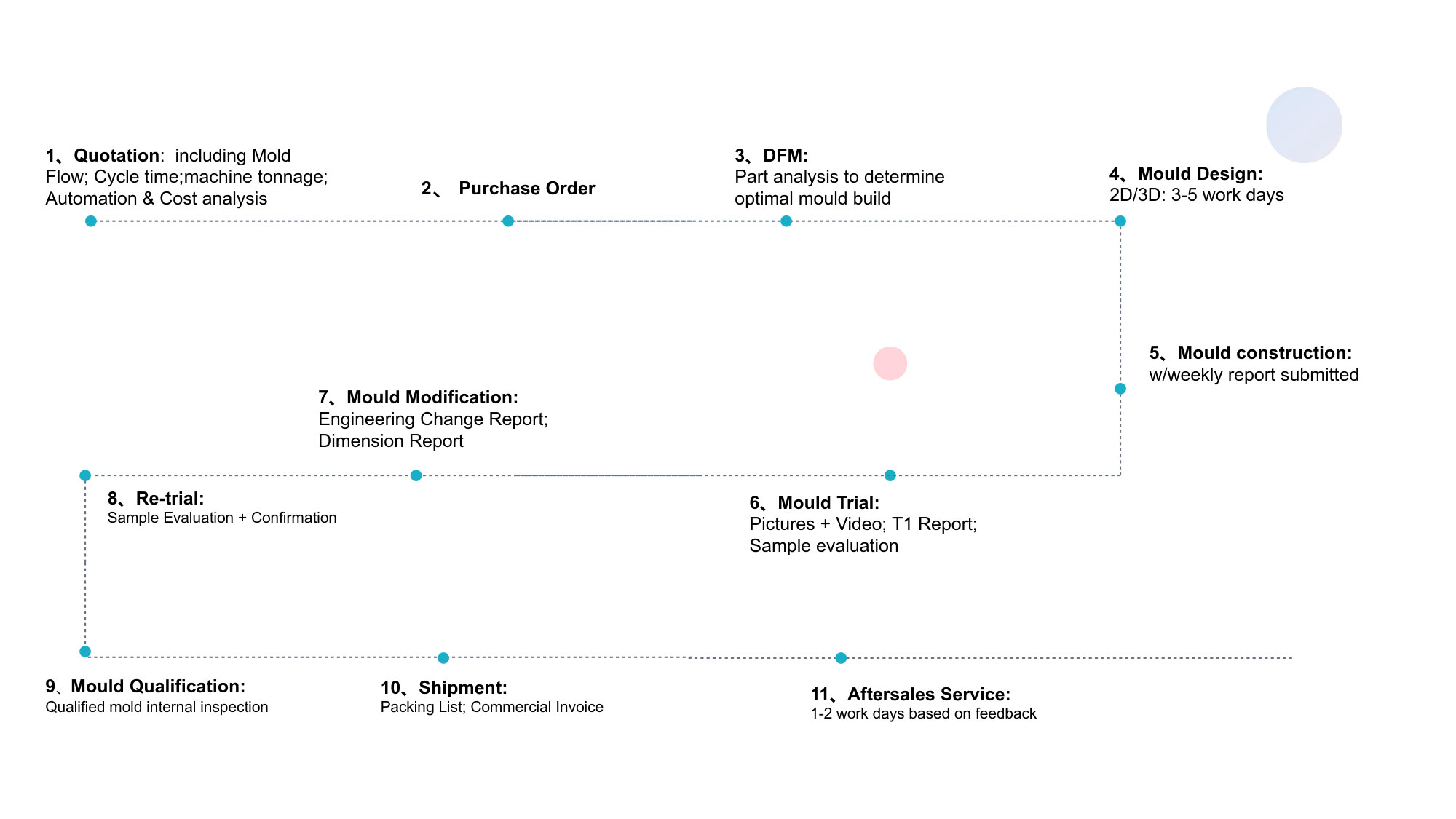
Ansix Tech does not treat mold sampling as a “pass/fail” transaction. We provide successive validation rounds (T0, T1, T2, T3) with full dimensional reports after each stage:
T0 (first shots on the new tool): We evaluate fill balance, ejection performance, and venting.
T1–T3 (iterative improvements): Each round includes a detailed improvement report detailing the modifications made. We use rapid-change inserts and interchangeable mold components to test multiple gating and cooling configurations without cutting a completely new mold, accelerating development cycles from months to weeks.
Pre-Production Validation Run (PPVR)
Before committing to high-volume production, Ansix Tech executes a 100- to 500-shot pilot run. During this phase, we statistically analyze process capability, calculating Ppk/Cpk on critical-to-function (CTF) dimensions and confirming yield. Only when the process is stable and capable do we transition to full-scale manufacturing.
Mold Maintenance & Spare Parts Management
Ansix Tech’s after-sales service keeps your production line running:
Spare parts kit: Every mold is delivered with a full set of pre-machined wear parts (ejector pins, core inserts) sufficient for the first 500,000 cycles.
Scheduled maintenance: We offer tool health inspections at 200,000-cycle intervals, including cleanliness verification, dimensional re-certification, and component replacement recommendation.
24-hour emergency repair: Our in-house electrode manufacturing and EDM repair shop means most mold repairs are completed without leaving our facility. Routine weld repair and insert replacement can be restored to production within 24 hours.
Part Five: Differentiated Commitment by Demand—Turning Client Pain Points into Performance Guarantees
In a crowded contract manufacturing landscape, medical device clients frequently encounter a common set of frustrations. Ansix Tech’s competitive advantages directly address each one:
Client Pain Point Ansix Tech’s Guarantee & Capability
“Our molds always need repair—production keeps stopping.” Delivery includes pre-production aging test of at least 2,000 cycles, with wear report documentation. We provide a three-year structural warranty on the mold (excluding normal consumables like ejector pins), supported by steel material certification, hardness testing, and wear tracking data.
“Flash/trimming costs are eating our margin.” With 0.005mm parting line fit precision and automatic clamp force compensation, we guarantee runner and part flash ≤ 0.03mm —eliminating manual deburring entirely.
“Our parts change size every batch.” Our machines incorporate ultrasonic wall thickness sensors that provide real-time feedback, automatically adjusting packing pressure to maintain stability. Premium projects also utilize in-mold pressure/temperature sensors for fully closed-loop process control.
“Lead times for mold repair are unacceptable.” Ansix Tech operates its own electrode manufacturing and EDM cell, enabling most repairs—weld repairs, insert swaps—to be completed within 24 hours, with no mold leaving the facility.
“We don’t have the internal resources to manage mold qualifications.” From design to post-molding assembly, Ansix Tech provides a fully validated, turnkey solution that eliminates client resource drain, backed by 28+ years of experience, 30,000+ molds built, and global regulatory compliance certifications.
The ultimate value proposition: Ansix Tech is not a commodity supplier of tooling and molding services. We are a strategic partner dedicated to making our customers successful through a vertically integrated ecosystem—from material selection and mold design to high-volume production and assembly—that systematically reduces per-unit cost, eliminates downstream quality risk, and accelerates time-to-market.
For medical stapler manufacturers looking to bring a new product to market or optimize an existing production line, Ansix Tech delivers molds that are not blocks of steel, but high-return capital assets: production-ready, dimensionally stable, with predictable lifecycle costs and full regulatory traceability. We invite you to schedule a DFM walkthrough on one of your existing products—and see firsthand how we eliminate weld lines, trapped air, shrinkage, and other defects before they ever become production problems.
Ansix Tech Co Ltd
If you have any plans related to Medical Stapler , you can contact us at any time. We will turn your ideas into reality, let you realize your dreams, and obtain large orders from the market. Our contact information is info@ansixtech.com. Or contact our CTO, mail: stephen@ansixtech.com
#www.ansixtech.com #ansixtech.com #Medical Stapler #Medical Stapler moulds #Medical Stapler molds #Medical Stapler injection molding companies #Medical Stapler Canopy Mold injection mold companies #Ansix #Ansix moulds #Ansix china #Ansix tech china #Ansix tech company #Ansix facotry #Medical Stapler injection molding #Medical Stapler injection tools #Medical Stapler injection moulds #Medical Stapler plastic mould #Medical Stapler plastic tools #Ansix Tech #Ansix molds #Ansix injection molding #Ansix mold factory #injection molding Medical Stapler #Ansix mold factory #Medical Stapler china #Medical Stapler molds #injection factory #Medical Stapler injection molding #Medical Stapler injection molding factory #injection molding company #Medical Stapler injection mold companies #Medical Stapler#Medical Stapler mold limited #Ansix mold china #Ansix companies #Ansix company China #Medical Stapler facotry #Ansix Tech #Ansix Tech mould #Medical Stapler injection moulding #injection moulding company #Ansix Medical Stapler parts injection mold companies #medical injection molding companieschina #Medical Stapler china factory #Ansix moulding companies #Ansix molding company #Medical Stapler injection moulding facotry #Ansix Tech mold #Medical Stapler mould #Medical Stapler plastic injection molding #ansix plastic mold #Mold manufacturing #Medical Stapler parts manufacturing #Medical Stapler plastic parts factory #Medical Stapler injection parts mold #Medical Stapler PRECISION MANUFACTURING #Medical Stapler #China mold #Medical Stapler injection moulding china #Medical Stapler mould china #china precision mold #mold in china #Medical Stapler mold china #Precision molds #High-precision molds #Medical Stapler #Injection molds #Medical Stapler Factory #Medical Stapler Company #Super Large Injection Mold Factory #Large Tonnage Injection Molding Factory #Medical Stapler Company #Medical Stapler Factory #2800T Injection Molding Factory #3000 Ton Injection Molding #4500 Ton Injection Molding Factory #Large Mold Injection Molding #Large Plastic Mold Injection Molding Factory #Large Injection Mold Manufacturer #Plastic Mold Factory #Injection Mold #Plastic Mold