



Yacht, ship, vessel water tank level, oil level, liquid level sensor probe, RV fuel tank float level detector
FEATURES
Product Portfolio Overview
Product Categories
Ansix Tech specializes in the design and manufacture of precision injection-molded components for liquid level sensing applications, including:
Water Level Sensors & Housings: Deployed in automotive coolant systems, industrial storage tanks, and smart home devices, these components must withstand chemical attack from ethylene glycol mixtures and extreme temperature fluctuations.
Fuel Level Sensors & Float Detectors: Critical components that monitor fuel levels in marine vessels and RVs, requiring exceptional chemical resistance to diesel, gasoline, and various fuel additives, along with dimensional stability across wide temperature ranges.
Oil Level & Pressure Sensors: Engine oil level sensors that operate in environments exceeding 150°C, exposed to continuous vibration, thermal cycling, and potential chemical attack from fuel contaminants.
Fuel-Water Separator Sensors: Specialized components that detect water contamination in diesel fuel systems—a critical safety function that prevents catastrophic engine corrosion and failure.
-
Mold Description
Product Materials:
SUS304+NBR FOAM
Mold Material:
S136ESR
Number of Cavities:
16
Glue Feeding Method:
Hot runner
Cooling Method:
Water cooling
Molding Cycle
42.5s
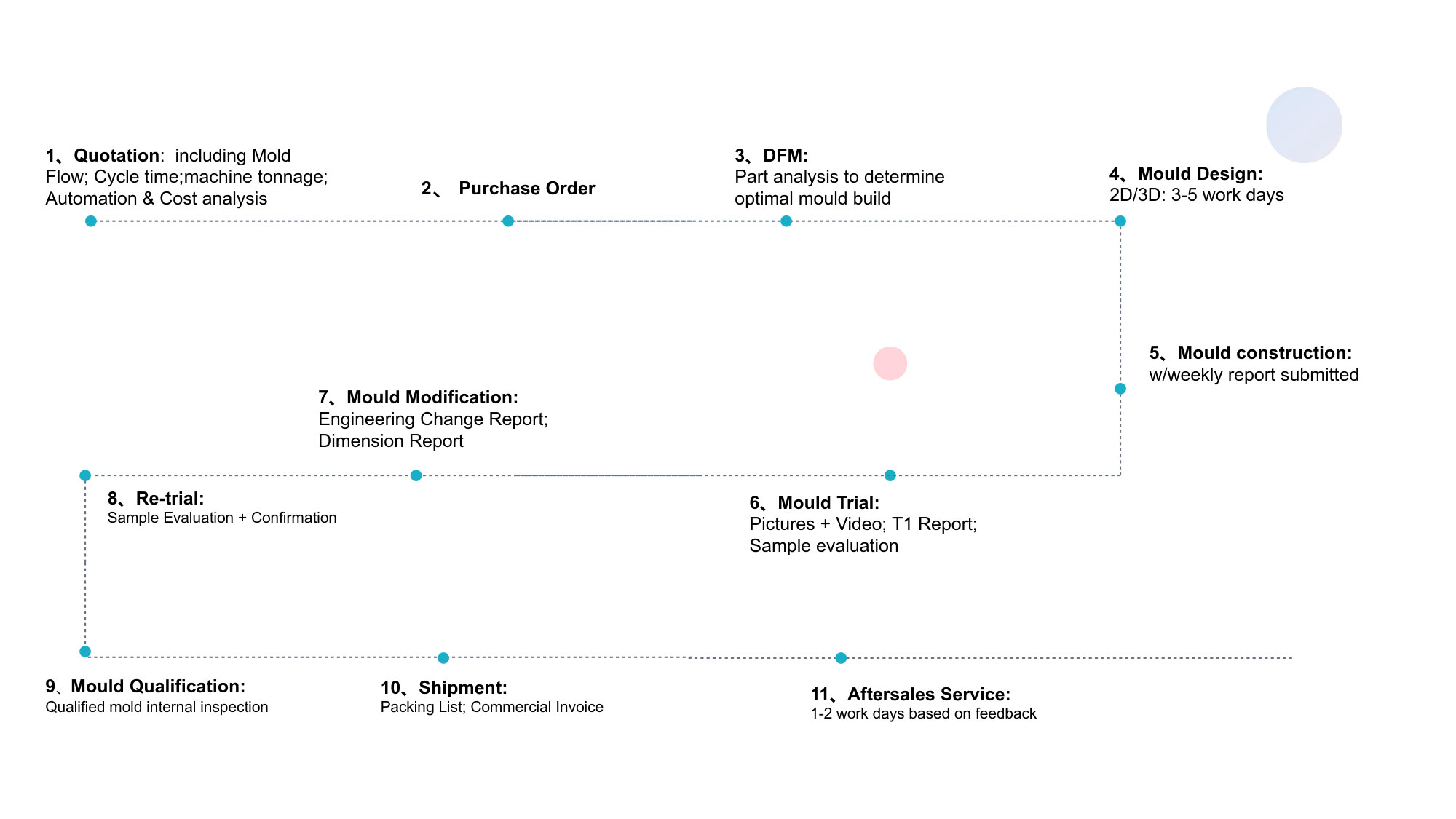
- The mold manufacturing process and product material selection
Hard Infrastructure – The Foundation of Trust
Precision Mold Manufacturing Equipment
Ansix Tech's manufacturing capability begins with a world-class mold fabrication facility equipped with advanced machinery that transforms engineering designs into production-ready tooling:
Five-Axis High-Speed Machining Centers: These machines enable the machining of complex curved surfaces with precision down to 0.002mm, ensuring that product parting lines remain smooth and free from burrs. This capability directly translates to superior cosmetic quality and reduced post-molding finishing operations.
Slow-Wire EDM (Electrical Discharge Machining): Capable of creating micro-holes and narrow slots as fine as 0.03mm, this technology prevents thin-wall deformation in delicate sensor components. For marine sensor applications where miniaturization and precision are paramount, this capability is indispensable.
Comprehensive EDM and Electrode Machining Workshop: Ansix maintains in-house electrode processing and spark erosion capabilities, meaning mold repairs and modifications can be completed without outsourcing. Routine weld repairs or insert replacements can restore production within 24 hours—a critical advantage when production schedules are tight.
-
Injection Molding Machine Fleet
Ansix operates a diverse fleet of injection molding machines covering clamping forces from 30 tons to 4,000 tons, accommodating everything from miniature sensor inserts to large housing components. All machines feature:
All-Servo Electric Drives: These systems deliver repeatable precision of ±0.1%, ensuring that every shot—whether the first or the hundred-thousandth—maintains identical dimensional characteristics. This consistency is essential for sensors where even microscopic variations can affect signal accuracy.
Networked Machine Connectivity: Every machine is integrated into a Manufacturing Execution System (MES) that locks critical parameters—temperature, pressure, velocity, and cycle time—with changes permitted only through authorized engineering access.
Quality Inspection Equipment
Coordinate Measuring Machines (CMM): Used for full dimensional inspection, ensuring every mold cavity meets specification before production release.
Optical Measurement Systems: High-resolution vision systems that verify surface finish and detect microscopic defects invisible to the naked eye.
Material Analysis Equipment: Spectrometers and testing apparatus that verify material composition against specifications, ensuring every batch of resin meets the required performance criteria.
Part Three: Mold Manufacturing – The Core Competency
Mold Life and Durability
For customers, mold longevity directly translates to predictable production costs and uninterrupted supply. Ansix addresses this through strategic material selection:
Mold Base: P20 tool steel provides the foundation, offering excellent machinability and dimensional stability.
Mold Core and Cavity Inserts: Premium materials selected based on application requirements:
S136, 2344, 2343, 8407: Stainless and hot-work tool steels offering corrosion resistance and thermal stability
SKD11, SKD61, DC53: High-wear-resistance steels for abrasive applications
M340, 4Cr13, 9Cr18: Martensitic stainless steels for corrosive environments
NAK80: Pre-hardened steel requiring no additional heat treatment, ideal for high-gloss finishes
H13: Hot-work steel for high-temperature applications
Performance Guarantees:
Glass-fiber reinforced materials: 500,000 cycles minimum
Standard plastics: 1,000,000 cycles minimum
Every mold ships with full material certification reports and heat treatment curves, providing complete traceability and confidence in long-term performance.
Dimensional Accuracy
Ansix achieves tolerances that meet the most demanding sensor applications:
Standard structural components: ±0.05mm
Precision gears and critical sealing surfaces: ±0.005mm
This precision ensures that sensor housings seal properly against fluids, that float mechanisms move freely without binding, and that electronic components fit correctly during assembly.
Mold Types and Capabilities
Hot Runner Systems: Reduce material waste by eliminating cold runners, lower cycle times through precise temperature control, and improve part quality by maintaining optimal melt temperatures.
Stack Molds: Double production efficiency by creating two parting lines within a single mold, effectively doubling output without increasing machine footprint.
Two-Shot/Multi-Material Molds: Enable overmolding of different materials—such as soft-touch seals on rigid housings—in a single automated cycle, eliminating secondary assembly operations.
High-Gloss Molds: Achieve surface finishes below Ra 0.05μm, essential for transparent sensor windows and cosmetic applications.
Gate and Runner System Design
Through advanced mold flow analysis (MFA) using software such as Autodesk Moldflow and Moldex3D, Ansix engineers:
Predict weld line locations and gas trap positions before steel is cut
Optimize gate quantity and placement to ensure balanced filling
Eliminate sink marks and voids through strategic gate positioning
Minimize material waste through runner system optimization
Lead Time Standards
Mold Complexity Standard Lead Time Expedited Lead Time
Simple molds 10 days 7 days
Medium complexity 25-45 days 20 days
High complexity 45-60 days 35 days
Critically, expedited timelines never compromise validation processes. Every mold still undergoes full inspection and validation before customer release.
Part Four: Injection Molding Process Control
Addressing Customer Quality Concerns
Customers consistently worry about four primary defects: sink marks, flash, dimensional instability, and batch-to-batch color variation. Ansix's process controls systematically eliminate each concern.
Process Standardization and MES Integration
Every machine is connected to a centralized MES system that locks all critical parameters:
Temperature: Barrel zones, nozzle, and hot runner temperatures
Pressure: Injection, holding, and back pressure profiles
Velocity: Injection speed and screw rotation
Time: Injection, holding, cooling, and mold open/close timing
Only authorized engineers can modify these parameters, ensuring process consistency across shifts and production runs. Every batch undergoes first-article and last-article inspection, with dimensional data compared against specifications.
Dimensional Stability Control
Ansix employs sophisticated thermal management to minimize warpage and distortion:
Zone-Controlled Mold Temperature Control: By maintaining core and cavity temperature differentials within 2°C, Ansix minimizes differential shrinkage that causes warpage.
Conformal Cooling Channels: Traditional straight-hole cooling has been replaced by 3D-printed conformal cooling channels that follow the exact contour of the sensor housing cavity. This innovation maintains uniform mold surface temperature, eliminating hot spots that cause warpage and extended cycle times. This single technology has achieved up to 28% cycle time reduction.
Real-Time Wall Thickness Monitoring: Ultrasonic sensors mounted on injection machines provide continuous feedback on wall thickness fluctuations, automatically compensating holding pressure to maintain dimensional consistency.
In-Mold Pressure and Temperature Sensors: Closed-loop control systems continuously monitor cavity conditions, making micro-adjustments during each cycle to ensure every part meets specification.
Documented Stability: In one documented case, a bracket component produced across three consecutive batches over one week showed critical hole spacing variation of less than 0.02mm—a level of consistency that eliminates assembly issues and rework.
Surface Quality Standards
Application Surface Requirement Ansix Capability
Transparent components No bubbles, no flow marks Ra ≤ 0.05μm
Plated components No gas marks Class A surface finish
High-gloss applications Mirror finish Ra ≤ 0.2μm
For components requiring painting or printing, Ansix builds in distortion compensation to ensure print registration accuracy within ±0.1mm.
Advanced Material Processing Capabilities
Ansix has extensive experience with a comprehensive range of engineering thermoplastics:
Material Key Properties Typical Applications
PP (Polypropylene) Chemical resistance, low cost, excellent floatation Float components, standard housings
PA6+GF30 (Nylon 30% glass) High strength, thermal stability Structural housings, automotive sensors
PC (Polycarbonate) Transparency, dimensional stability Sensor windows, transparent housings
PC/ABS Impact resistance, good flow Consumer and automotive housings
PPS+40%GF Exceptional heat resistance (up to 200°C+), chemical resistance High-temperature sensor housings
PEEK Ultra-high temperature, chemical resistance Extreme environment sensors
PEI (Ultem) High thermal stability, inherent flame resistance Aerospace and high-reliability applications
LCP (Liquid Crystal Polymer) Excellent flow, high stiffness Thin-wall precision components
PBT Good electrical properties, dimensional stability Connector housings
PTFE/PFA Exceptional chemical resistance Corrosive environment sensors
LSR (Liquid Silicone Rubber) Flexibility, sealing capability Seals and gaskets
Flame Retardancy: Materials certified to UL94 V-0 for applications requiring fire safety compliance.
Weatherability: Materials validated through UV testing up to 3,000 hours without discoloration, critical for marine and outdoor RV applications.
Specialty Formulations: Ansix works with material suppliers including Covestro (Makrolon® series) and SABIC to develop custom formulations for specific applications. For radar and LiDAR applications, materials are formulated to prevent signal interference and are compatible with PVD (Physical Vapor Deposition) coating processes.
Part Five: Full-Process Service – Reducing Customer Management Costs
Early Engineering介入 (DFM Reports)
Before any contractual commitment, Ansix provides comprehensive Design for Manufacturability (DFM) analysis. This report includes:
Draft angle recommendations to ensure proper ejection without damage
Wall thickness optimization to prevent sink marks and ensure balanced filling
Gate location recommendations to minimize weld lines in critical sealing areas
Ejector pin mark location allowances to ensure marks do not affect cosmetic or functional surfaces
Material recommendations based on application requirements and cost targets
This proactive approach prevents expensive mold modifications after steel has been cut. As Ansix's engineering philosophy states: up to 70% of a component's final manufacturing cost is determined during the initial design phase.
Mold Trial and Sample Provision
Ansix provides structured mold trial phases from T0 through T3, each accompanied by detailed improvement reports:
T0: First mold trial, identifying fundamental issues
T1: Corrected trial, verifying design changes
T2: Optimization trial, fine-tuning process parameters
T3: Validation trial, confirming production readiness
Rapid insert change capability allows different design variations to be tested without rebuilding the entire mold, significantly reducing development time and cost.
Small-Batch Validation
Before committing to full production, Ansix offers 100-500 shot pilot runs to:
Statistically validate yield rates
Confirm process capability (Cpk ≥ 1.33 for critical dimensions)
Identify any unexpected assembly or performance issues
Ensure production readiness before mass production begins
Maintenance and Spare Parts
Spare Parts Kit: Every mold ships with critical spare components—ejector pins, core inserts, and wear parts—ensuring immediate replacement capability.
Scheduled Maintenance: Ansix recommends maintenance intervals every 200,000 cycles, with detailed maintenance procedures provided.
Lifetime Repair: Repair services are available at cost throughout the mold's lifetime, with no obsolescence penalties.
Part Six: Competitive Differentiation – Addressing Common Industry Pain Points
Common Customer Complaint Ansix's Professional Response Value Delivered
Frequent mold repairs disrupting orders "We perform 2,000-cycle aging tests before delivery with full wear reports. We provide a three-year structural warranty (excluding normal consumable wear)." Predictable production, no unexpected downtime
Excessive flash requiring expensive secondary finishing "We machine parting surfaces to 0.005mm fit精度 and use self-locking clamp force compensation, keeping flash below 0.03mm per batch." Elimination of manual deflashing operations
Inconsistent dimensions from batch to batch "Ultrasonic wall thickness sensors provide real-time feedback with automatic holding pressure compensation. In-mold pressure and temperature sensors enable closed-loop control." Reliable assembly, no scrap due to dimensional variation
Long mold repair cycles "In-house electrode machining and EDM workshop means repairs never leave our facility. Routine weld repairs or insert replacements restore production within 24 hours." Minimal production interruption
Part Seven: Cost Leadership – Systematic Cost Reduction
Design Phase Cost Control
By addressing up to 70% of manufacturing cost during design, Ansix prevents expensive downstream problems. DFM analysis identifies:
Over-specified materials that add cost without performance benefit
Complex geometries that require expensive tooling features
Tolerances tighter than functionally necessary
Material Cost Optimization
Rather than simply accepting customer material specifications, Ansix's material science expertise enables:
Alternative material recommendations that meet all performance requirements at lower cost
Custom formulations that optimize the balance between performance and cost
Bulk purchasing power through strategic supplier partnerships (Covestro, SABIC, etc.)
Process Efficiency Gains
Documented results from actual projects demonstrate Ansix's cost reduction capability:
Thermostat Housing Project:
Four-cavity hot runner mold
Cycle time under 30 seconds
First-pass yield above 99.5%
Component cost reduced by minimum 15% compared to previous supplier
Water Level Sensor Housing Project:
Cycle time reduced by 28%
Daily output increased from 1,300 to 1,670 units on same equipment
Per-unit cost reduction of 16%
Waste Reduction
Hot runner systems: Eliminate runner waste entirely
Precision process control: Minimize scrap from dimensional rejects
First-pass yield ≥99.5%: Virtually eliminates rework and secondary operations
Part Eight: Delivery Efficiency – Speed Without Sacrifice
Accelerated Development Timeline
Through digital validation and virtual prototyping, Ansix reduces physical prototyping costs and time by over 50%. Virtual mold flow analysis eliminates the need for multiple physical mold trials, compressing the development timeline.
Production Capacity
With a machine fleet spanning 30 to 4,000 tons, Ansix can scale production from pilot quantities to millions of units annually. The 28% cycle time reduction achieved through conformal cooling directly translates to increased daily output.
Supply Chain Integration
Ansix manages the entire value chain under a unified technical vision:
Material procurement
Mold design and manufacturing
Injection molding
Quality inspection
Packaging and logistics
This eliminates friction between separate suppliers (material vendors, mold makers, and processors), ensuring every decision aligns with the final product's performance, lifecycle, and total cost of ownership.
Part Nine: Quality Assurance – Building Trust Through Verification
Material Verification
Every production batch begins with material verification:
Material certificates from approved suppliers
Incoming inspection of physical properties
Spectroscopic analysis confirming composition
In-Process Quality Control
First-Article Inspection (FAI): Comprehensive dimensional inspection of the first parts from each production run, comparing against CAD data and specifications.
In-Process Monitoring: Real-time monitoring of critical dimensions using automated inspection systems.
Statistical Process Control (SPC): Continuous tracking of key process parameters with control charts to detect and correct drift before defects occur.
Last-Article Inspection: Verification that the final parts of a production run maintain the same quality as the first, ensuring process stability throughout the run.
Final Inspection
100% Critical Dimension Inspection: For dimensions that affect function, fit, or safety.
AQL Sampling: For non-critical dimensions, industry-standard AQL sampling plans ensure batch quality.
Functional Testing: Where applicable, sensors undergo functional testing to verify electrical and mechanical performance.
Documentation and Traceability
Full Dimension Reports: Every mold ships with comprehensive dimensional inspection reports comparing actual measurements against specifications.
Cpk Analysis: Critical dimensions are validated with Cpk ≥ 1.33, demonstrating process capability.
Material Certificates: Full material certifications and heat treatment curves accompany every mold and production batch.
Batch Traceability: Complete traceability from raw material receipt through final shipment, enabling rapid root-cause analysis if issues arise.
Part Ten: Mold Design and Manufacturing Deep Dive
DFM Analysis Methodology
The journey to a reliable liquid level sensor begins not on the factory floor but in the digital realm. Ansix's DFM process involves:
3D CAD Review: Engineering team examines customer-provided 3D models to identify:
Under cuts requiring slides or lifters
Wall thickness transitions that cause sink marks
Areas of stress concentration
Features that complicate ejection
Mold Flow Analysis (MFA): Using advanced simulation software, Ansix creates a digital twin of the entire injection molding process. This virtual test run predicts:
Fill patterns and flow front behavior
Weld line locations (critical for sealing surfaces)
Gas trap positions (preventing burn marks)
Cooling behavior and warpage prediction
Shrinkage characteristics
Material Data Integration: The simulation incorporates specific material data including viscosity curves and PVT (Pressure-Volume-Temperature) relationships. In a recent float component analysis, simulation predicted a fill time of 2.8 seconds and peak injection pressure of 56.34 MPa, validating design feasibility before any steel was cut.
Gate Optimization: Simulation determines optimal gate location—typically at the geometric center for balanced filling. For sensor housings, this may mean repositioning gates to ensure weld lines do not form in critical sealing areas, preventing potential leak paths from the start.
Cooling System Design
Traditional straight-hole cooling has been superseded by 3D-printed conformal cooling channels. This innovation:
Follows the exact contour of the sensor housing cavity
Maintains uniform mold surface temperature
Eliminates hot spots that cause warpage
Reduces cycle time by up to 28%
For components with complex geometries, Ansix employs:
Baffle cooling: For deep cores requiring internal cooling
Bubbler cooling: For thin cores where conventional cooling is impractical
Thermal pin inserts: For localized hot spots requiring enhanced cooling
Runner and Gate System Design
Runner Systems:
Cold runners: Simple, cost-effective for low-volume production
Hot runners: Eliminate waste, reduce cycle time, improve quality for high-volume production
Gate Types:
Edge gates: Standard for most applications
Submarine gates: Automatic degating, reducing labor
Film gates: For large, flat components requiring minimal flow marks
Pinpoint gates: For precise control in multi-cavity molds
Ejection System Design
Proper ejection is critical for high-volume production. Ansix designs ejection systems that:
Distribute ejection force evenly to prevent part deformation
Position ejector pins in non-cosmetic areas
Include return pins and limit switches for reliable cycling
Accommodate complex geometries through sleeved ejectors and stripper plates
Venting Design
Proper venting prevents gas traps that cause burn marks and incomplete filling. Ansix incorporates:
Vent depths of 0.02-0.05mm (material-dependent)
Vent widths of 3-5mm for adequate gas escape
Vacuum venting for challenging applications
Part Eleven: Injection Molding Process Optimization
Challenge Identification
Common molding challenges for sensor components include:
Warpage: For PA66 sensor housings with 30% glass fiber reinforcement, research shows warpage is primarily influenced by melt temperature, followed by holding pressure and injection time. Understanding these hierarchies enables focused optimization.
Insert Molding: Sensor components often incorporate metal inserts for electrical contacts. These must be perfectly encapsulated to prevent leakage or electrical failure.
Chemical Resistance: Plastics must resist degradation from diesel, coolants, and various fuel additives.
Thermal Cycling: Components must maintain dimensional stability from -40°C to over 150°C.
Optimization Strategies
Melt Temperature Optimization: For glass-filled materials, precise melt temperature control minimizes warpage while maintaining flow.
Holding Pressure and Time: Optimized to compensate for shrinkage without creating excessive internal stress.
Cooling Time: Minimized through conformal cooling while ensuring dimensional stability.
Injection Speed: Balanced to prevent jetting (which causes flow marks) while achieving complete fill.
Cycle Time Reduction
The combination of conformal cooling, optimized process parameters, and high-performance mold steels has achieved:
Cycle time reductions of 28% in documented cases
First-pass yield above 99.5%
Daily output increases of 28% on same equipment
Part Twelve: The Ansix Value Proposition – Translating Technical Capability into Customer Value
What Problems Does Ansix Solve?
Problem: Inconsistent sensor performance due to dimensional variation
Ansix Solution: Cpk ≥ 1.33 on critical dimensions, real-time process monitoring, closed-loop control
Customer Value: Reliable sensor function, no field failures, reduced warranty claims
Problem: High scrap rates and material waste
Ansix Solution: DFM optimization, mold flow analysis, process validation before production
Customer Value: First-pass yield ≥99.5%, reduced material costs, lower per-unit cost
Problem: Long lead times delaying product launches
Ansix Solution: Virtual prototyping, accelerated mold development, rapid insert change capability
Customer Value: Faster time-to-market, competitive advantage
Problem: Mold failures disrupting supply
Ansix Solution: Premium mold materials, 1,000,000-cycle life, 3-year structural warranty, in-house repair capability
Customer Value: Uninterrupted supply, predictable production planning
Problem: High total cost of ownership
Ansix Solution: Design-phase cost optimization, material science expertise, process efficiency
Customer Value: 15-16% documented cost reduction
How Does Ansix Reduce Costs?
Design Phase: Addressing 70% of cost during design through DFM optimization
Material Selection: Optimal material choice avoiding over-specification
Process Efficiency: Cycle time reduction up to 28%
Waste Reduction: First-pass yield ≥99.5%
Scalability: Multi-cavity molds and stack molds for high-volume efficiency
How Does Ansix Ensure Quality?
Digital Validation: Mold flow analysis predicts and prevents defects before steel is cut
Process Control: MES-locked parameters ensure consistency
In-Process Monitoring: Real-time sensors and SPC detect drift immediately
Verification: First-article, in-process, and last-article inspection
Documentation: Full dimension reports, material certifications, Cpk analysis
How Does Ansix Ensure Delivery?
Accelerated Development: Virtual prototyping cuts physical trial time by 50%
In-House Capability: All manufacturing under one roof—no external dependencies
Rapid Repair: 24-hour repair capability through in-house EDM and electrode workshop
Scalable Capacity: Machine fleet from 30 to 4,000 tons
Part Thirteen: Conclusion – The Ansix Difference
For Ansix Tech, a mold is not merely a block of steel—it is a revenue-generating asset for the customer. Every mold design simultaneously considers flow characteristics, venting paths, thermal balance, and ejection reliability to ensure that once the mold reaches the customer's production line, it performs with zero debugging, minimal flash, and maximum service life.
The company's holistic approach—integrating advanced material science, predictive digital engineering, and intelligent process optimization—delivers more than components. It delivers engineered value: systematically reduced costs, guaranteed performance from prototype to high-volume production, and the peace of mind that comes from partnering with a manufacturer that treats reliability as the foundation of every product.
With 28 years of specialized experience in sensor component manufacturing, a comprehensive suite of in-house capabilities, and a demonstrated track record of 15-28% cost reductions, Ansix Tech has earned its position as a trusted partner for marine, automotive, and RV manufacturers worldwide. The company's commitment to translating complex technical requirements into measurable customer value—whether through cost savings, risk reduction, or reliability improvement—ensures that every sensor component delivered meets the exacting standards of the most demanding applications.
For customers in the yacht, ship, vessel, and RV industries, Ansix Tech represents not just a supplier, but a strategic partner capable of transforming component manufacturing from a cost center into a competitive advantage.
Ansix Tech Co Ltd
If you have any plans related to Yacht, ship, vessel water tank level, oil level, liquid level sensor probe, RV fuel tank float level detector , you can contact us at any time. We will turn your ideas into reality, let you realize your dreams, and obtain large orders from the market. Our contact information is info@ansixtech.com. Or contact our CTO, mail: stephen@ansixtech.com
#www.ansixtech.com #ansixtech.com #Yacht, ship, vessel water tank level, oil level, liquid level sensor probe #Yacht, ship, vessel water tank level, oil level, liquid level sensor probe #Yacht, ship, vessel water tank level, oil level, liquid level sensor probe Canopy Mold injection mold companies #Ansix #Ansix moulds #Ansix china #Ansix tech china #Ansix tech company #Ansix facotry #Yacht, ship, vessel water tank level, oil level, liquid level sensor probe injection molding #Yacht, ship, vessel water tank level, oil level, liquid level sensor probe injection tools #Yacht, ship, vessel water tank level, oil level, liquid level sensor probe injection moulds #Yacht, ship, vessel water tank level, oil level, liquid level sensor probe plastic mould #Yacht, ship, vessel water tank level, oil level, liquid level sensor probe plastic tools #Ansix Tech #Ansix molds #Ansix injection molding #Ansix mold factory #injection molding Yacht, ship, vessel water tank level, oil level, liquid level sensor probe#Ansix mold factory #Yacht, ship, vessel water tank level, oil level, liquid level sensor probe china #Yacht, ship, vessel water tank level, oil level, liquid level sensor probe molds #injection factory #Yacht, ship, vessel water tank level, oil level, liquid level sensor probe injection molding #Yacht, ship, vessel water tank level, oil level, liquid level sensor probe injection molding factory #injection molding company #Yacht, ship, vessel water tank level, oil level, liquid level sensor probe injection mold companies #Yacht, ship, vessel water tank level, oil level, liquid level sensor probe Tooling #Yacht, ship, vessel water tank level, oil level, liquid level sensor probe mold limited #Ansix mold china #Ansix companies #Ansix company China #Yacht, ship, vessel water tank level, oil level, liquid level sensor probe facotry #Ansix Tech #Ansix Tech mould #Yacht, ship, vessel water tank level, oil level, liquid level sensor probe injection moulding #injection moulding company #Ansix Yacht, ship, vessel water tank level, oil level, liquid level sensor probe parts injection mold companies #medical injection molding companieschina #Yacht, ship, vessel water tank level, oil level, liquid level sensor probe china factory #Ansix moulding companies #Ansix molding company #Yacht, ship, vessel water tank level, oil level, liquid level sensor probe injection moulding facotry #Ansix Tech mold #Yacht, ship, vessel water tank level, oil level, liquid level sensor probe mould #Yacht, ship, vessel water tank level, oil level, liquid level sensor probe plastic injection molding #ansix plastic mold #Mold manufacturing #Yacht, ship, vessel water tank level, oil level, liquid level sensor probe parts manufacturing #Yacht, ship, vessel water tank level, oil level, liquid level sensor probe plastic parts factory #Yacht, ship, vessel water tank level, oil level, liquid level sensor probe injection parts mold #Yacht, ship, vessel water tank level, oil level, liquid level sensor probe PRECISION MANUFACTURING #Yacht, ship, vessel water tank level, oil level, liquid level sensor probe #China mold #Yacht, ship, vessel water tank level, oil level, liquid level sensor probe injection moulding china #Yacht, ship, vessel water tank level, oil level, liquid level sensor probe mould china #china precision mold #mold in china #Yacht, ship, vessel water tank level, oil level, liquid level sensor probe mold china #Precision molds #High-precision molds #Yacht, ship, vessel water tank level, oil level, liquid level sensor probe #Injection molds #Yacht, ship, vessel water tank level, oil level, liquid level sensor probe Factory #Yacht, ship, vessel water tank level, oil level, liquid level sensor probe Company #Super Large Injection Mold Factory #Large Tonnage Injection Molding Factory #Yacht, ship, vessel water tank level, oil level, liquid level sensor probe Company #Yacht, ship, vessel water tank level, oil level, liquid level sensor probe Factory #2800T Injection Molding Factory #3000 Ton Injection Molding #4500 Ton Injection Molding Factory #Large Mold Injection Molding #Large Plastic Mold Injection Molding Factory #Large Injection Mold Manufacturer #Plastic Mold Factory #Injection Mold #Plastic Mold