



Fuel level sensor for cars, trucks, and yachts; water tank level sensor; fuel tank float; fuel level gauge; liquid level sensor
FEATURES
The Foundation of Hard Power — Building Customer Trust Through Equipment Capability
Mold Processing Equipment: Precision That Eliminates Variables
At Ansix Tech, the equipment portfolio is not merely a list of machines—it is the company's guarantee of zero-defect production. Every piece of equipment is selected to eliminate variables that could compromise product quality.
5-Axis High-Speed Machining Centers: Ansix Tech employs 5-axis high-speed machining centers capable of machining complex curves with ±0.002mm precision. For fuel level sensor housings and liquid level sensor components—which often feature intricate geometries, multiple mounting features, and sealing surfaces—this capability ensures that parting lines are smooth and burr-free. What this means for customers: No secondary deburring operations, no sharp edges that could damage O-rings or seals during assembly, and a professional appearance that enhances brand perception.
Slow-Wire EDM (Electrical Discharge Machining): The company's slow-wire EDM technology handles 0.03mm micro-hole and narrow-slot processing. For sensor components requiring precision through-holes for electrical terminals, venting channels, or snap-fit features, this capability effectively eliminates thin-wall deformation—a common failure point in competitive solutions. Customer value: Consistent part geometry that ensures proper terminal alignment, reliable electrical connections, and trouble-free assembly.
-
Mold Description
Product Materials:
SUS304+NBR FOAM
Mold Material:
S136ESR
Number of Cavities:
16
Glue Feeding Method:
Hot runner
Cooling Method:
Water cooling
Molding Cycle
42.5s
- The mold manufacturing process and product material selection
Comprehensive EDM Capabilities: The EDM process minimizes thermal stress on workpieces, preserving the metallurgical integrity of high-performance mold steels and avoiding micro-cracking that can lead to premature mold failure. Customer value: Longer mold life, fewer maintenance interruptions, and consistent part quality over millions of cycles.
Injection Molding Machine Fleet: Scale and Consistency
Ansix Tech operates 260 injection molding machines with clamping forces ranging from 30 tons to 2,800 tons. This breadth covers the entire spectrum of sensor production—from small, single-cavity molds for prototyping running on 30- to 90-ton machines, to high-cavity production molds for high-volume sensor components.
The fleet includes world-class brands: Japan's Fanuc, Sumitomo, Toshiba, Nissei, Engel; Germany's Arburg (primarily for liquid silicone rubber injection molding); and China's Haitian. All machines are equipped with all-servo electric drives, delivering repeatable injection accuracy of ±0.1%.
What this means for customers: From the first shot to the millionth, every unit is identical. Whether you need 1,000 pieces for a pilot run or 1,000,000 pieces for a global platform launch, the process remains stable and predictable. This repeatability translates directly to reduced scrap, lower rework costs, and consistent product performance in the field.
All molding machines are connected through a Manufacturing Execution System (MES). Every processing parameter—melt temperature profile, injection pressure, holding pressure, injection speed, screw rotation speed, cooling time, mold temperature, and back pressure—is locked into the system, with changes restricted to engineering approval only. Customer value: Complete process traceability, batch-to-batch consistency, and the ability to replicate perfect production conditions anywhere, anytime.
Quality Inspection Equipment: Verification, Not Trust
Ansix Tech utilizes Coordinate Measuring Machines (CMM) and Optical Imaging Systems for dimensional verification. Every mold undergoes a full dimensional report before leaving the shop, with Critical-to-Quality dimensions maintained at CPK ≥ 1.33.
What CPK ≥ 1.33 means for customers: Statistically, this represents a Six Sigma-equivalent capability, ensuring that 99.9937% of production parts will conform to specifications. For automotive-grade sensor components where critical dimensions impact sealing, fit, and signal integrity, this capability eliminates the risk of out-of-spec parts reaching your assembly line.
-
Mold Manufacturing — The Core of Longevity, Precision, and Speed
Mold Life: Engineering for Millions of Cycles
The mold is the heart of the production line—if it fails, your business stops. Ansix Tech engineers every mold around the precise behavior of the customer's resin, with clear commitments on mold life.
Steel Selection Based on Application: Ansix Tech maintains a strategic inventory of premium tool steels, matching material properties to exact service conditions:
Steel Grade Hardness (HRC) Key Properties Best Application
S136 / S136H Pre-hard: 35 / Quench: 48-54 Superior corrosion resistance, ultra-high mirror polishability (Ra < 0.05μm), excellent wear resistance Transparent sensor housings, optical-grade surfaces, corrosive fluid exposure
2344 / 8407 / H13 48-52 (Quench & temper) High hot hardness at 550-600°C, excellent toughness, superior thermal fatigue resistance High-temperature engineering plastics (PPS+40%GF, PEEK), high-thermal-load injection molds
NAK80 37-43 (Pre-hard) Super mirror polish (up to #15000), excellent EDM machinability High-gloss surfaces, cosmetic-grade appearances
SKD11 / DC53 58-62 High wear resistance, high compression strength Wear inserts, sliders, shear edges for abrasive filled materials
2343 48-52 Impact resistance superior to H13, good thermal conductivity Complex geometries with extreme mechanical shock loads
M340 / 4Cr13 / 9Cr18 48-53 Stainless martensitic, excellent corrosion resistance FDA-grade applications, acidic plastic compounds, humid environments
P20 28-32 (Pre-hard) Good machinability, cost-effective Mold bases, support plates, non-critical core/cavity applications
For glass-reinforced materials such as PA6+GF40 or PBT+GF30, Ansix Tech specifies SKD61 (HRC 52-56) cavity steel to withstand the abrasive wear of glass fibers. For transparent PVC or PMMA fittings requiring optical clarity, the company chooses S136 (HRC 48-52) to achieve Class A finishes below Ra 0.1 μm. For high-temperature engineering resins such as PPS or PEEK, 8407 is the preferred choice—its superior isotropic properties deliver thermal fatigue resistance that keeps production running longer with fewer maintenance stops.
Every material selection decision is documented in a formal steel certification, accompanied by the full heat-treatment curve for complete traceability. For S136, Ansix follows a precise quench at 1000-1050°C, oil-cooled to 50-100°C, then tempered at 200+°C to achieve 48-54HRC while preventing cracking.
Mold Life Commitments: For glass-reinforced materials, Ansix Tech guarantees 500,000 cycles; for unfilled materials, 1,000,000 cycles. What this means for customers: Predictable tooling amortization, minimal unplanned downtime, and lower total cost of ownership over the life of the program.
Achievable Tolerances: Precision That Eliminates Rework
For conventional structural components, Ansix Tech achieves ±0.05mm tolerances. For precision gears and medical components, tolerances reach ±0.005mm. Every mold is accompanied by a full material certification and heat-treatment curve documentation.
What these tolerances mean for customers: When Ansix says "±0.05mm," the customer hears "no trimming labor." When Ansix says "CPK ≥ 1.33," the customer hears "no assembly rework." When Ansix mentions "S136 stainless steel," the customer hears "no mold downtime for 1 million cycles."
Mold Types and Configurations
Ansix Tech offers a comprehensive range of mold types to meet diverse sensor manufacturing requirements:
Hot Runner Systems: Reducing material waste and improving fill balance for complex sensor geometries. For fuel level sensor housings with multiple cavities, hot runner systems minimize pressure drop and ensure consistent filling across all cavities.
Stack Molds: Doubling productivity for high-volume sensor components by running two layers of cavities simultaneously.
Two-Shot/Multi-Material Molds: Enabling overmolding of seals, gaskets, or soft-touch components onto rigid sensor housings in a single manufacturing cycle.
High-Gloss Molds: Achieving surface roughness Ra < 0.05μm for transparent sensor covers and optical-grade components.
Gating and Flow Optimization
Through comprehensive mold flow analysis using Autodesk Moldflow and Moldex3D, Ansix Tech engineers predict fill patterns, identify weld-line locations, expose air-trapping risks, and optimize gate placement to ensure balanced flow across complex sensor geometries. Customer value: Elimination of cosmetic defects, consistent mechanical properties, and reliable signal integrity for sensor functionality.
Part Three: Injection Molding — Process Control That Eliminates Quality Anxiety
What Customers Fear — And How Ansix Tech Eliminates Each Concern
Fear: Shrinkage and Sink Marks
Ansix Tech employs scientific molding principles with cavity pressure sensors and closed-loop control to precisely control injection speed, holding pressure, and cooling curves. Using Decoupled Molding® technology, the company separates the filling, packing, and cooling phases for optimal control. Customer value: Parts with consistent dimensions, no visible sink marks on cosmetic surfaces, and reliable sealing performance.
Fear: Flash and High Secondary Finishing Costs
Ansix Tech machines parting surfaces to 0.005mm fit precision and employs self-locking clamp force compensation, ensuring flash is controlled to within 0.03mm per batch. Customer value: Elimination of manual deburring operations, reduced labor costs, and clean parts that assemble without interference.
Fear: Dimensional Instability Between Batches
All machines are equipped with multi-zone mold temperature controllers that keep core-cavity temperature differences within 2°C, directly minimizing post-mold warpage and distortion. For demanding applications, Ansix embeds real-time cavity pressure sensors that feed closed-loop process corrections during every shot, delivering long-term dimensional stability even when resin lots vary.
Customer value: Parts produced in January fit the same as parts produced in December. Assembly lines run without interruption. Field failures due to dimensional variation are eliminated.
Fear: Batch-to-Batch Color Variation
Process parameters are locked in the MES system, eliminating operator-induced variation. First-article and last-article inspections are performed for every production run. Customer value: Consistent appearance, brand integrity, and no costly sorting or rework.
Size Stability Control: Data That Proves Consistency
For comparable bracket products, Ansix Tech has demonstrated that over three consecutive production runs within one week, critical hole-to-hole spacing fluctuated by ≤0.02mm. This level of stability is achieved through:
Zone-controlled mold temperature management
Real-time cavity pressure monitoring
Automated process parameter locking via MES
Ultrasonic wall-thickness sensors providing real-time feedback with automatic compensation adjustments
Surface Quality Grades: Meeting Every Application Requirement
Ansix Tech achieves surface quality levels appropriate to each application:
Transparent components: No bubbles, no flow marks
Electroplated components: No gas marks
High-gloss components: Surface roughness Ra ≤ 0.2μm
Components requiring painting/printing: Pre-compensation for deformation, print registration accuracy controlled to ±0.1mm
Specialty Material Capabilities
Ansix Tech has extensive production experience with a wide range of engineering thermoplastics critical to sensor applications:
Material Key Properties Sensor Application
PC (Polycarbonate) Impact strength, heat resistance, dimensional stability Sensor housings, transparent covers
PC/ABS blends Balanced properties, cost-effective Interior sensor components
PBT (Polybutylene Terephthalate) High heat deflection temperature, chemical resistance Fuel-exposed components
PA6/PA66 + GF30 Mechanical strength, thermal stability, wear resistance Structural sensor housings, brackets
PPS + 40% GF Exceptional chemical resistance, high-temperature stability (up to 200°C+) Fuel system sensors, under-hood applications
PEEK Ultra-high temperature resistance, chemical inertness Extreme-environment sensors
PEI (Polyetherimide) High strength, dimensional stability Thin-walled housings
LSR (Liquid Silicone Rubber) Flexibility, sealing performance, biocompatibility Sensor seals, gaskets, overmolded components
PTFE/PFA Chemical inertness, non-stick, high-temperature resistance Chemically aggressive fluid sensors
Flame Retardancy: Ansix Tech achieves UL94 V-0 ratings for sensor housings requiring fire safety compliance.
Weathering Resistance: UV testing up to 3,000 hours with no color change or property degradation.
Part Four: Full-Process Services — Reducing Customer Management Costs
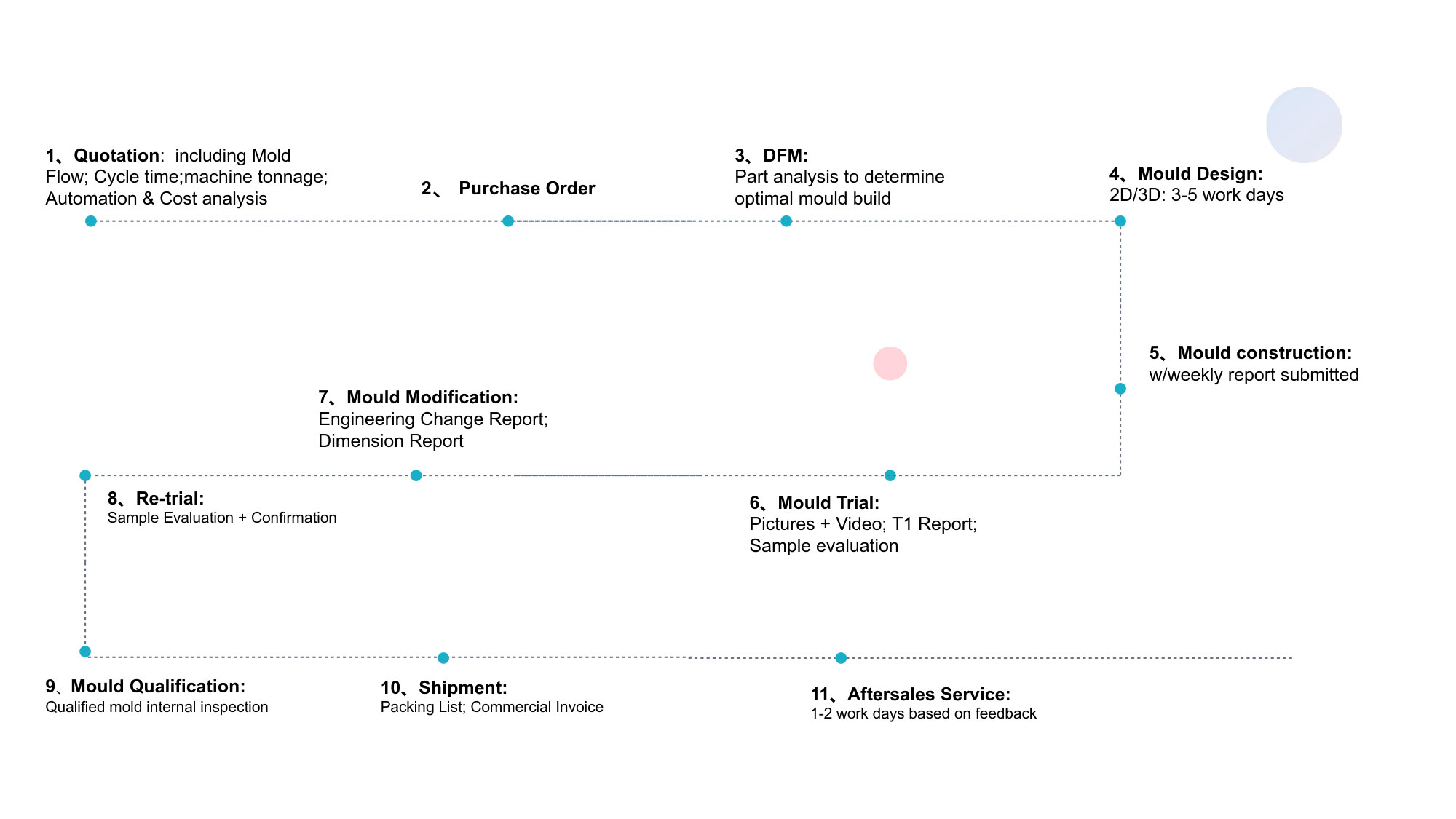
Early Intervention: DFM Reports Before Commitment
Ansix Tech's journey to building reliable sensors does not begin on the factory floor—it begins in the digital realm. The company's philosophy is that up to 70% of a component's final manufacturing cost is determined during the initial design phase.
Before any steel is cut, Ansix Tech delivers a comprehensive Design for Manufacturability (DFM) report. This collaborative process includes:
Draft angle recommendations
Wall thickness optimization
Gate location analysis
Ejector pin mark location allowances
Identification of potential manufacturing challenges such as difficult undercuts, excessive wall thickness variations, or stress concentration areas
What this means for customers: Issues are identified and resolved before they become expensive mold modifications. The risk of opening a mold only to discover the part cannot be manufactured is eliminated. This collaborative stage typically results in design improvements that make parts easier, faster, and less expensive to produce—without compromising functionality.
Trial Molding and Sampling: Iterative Validation
Ansix Tech provides T0 through T3 trial samples, with each round accompanied by a detailed improvement report. Quick-change insert capabilities allow different design variations to be validated without building an entirely new mold. Customer value: Faster design iteration, lower development costs, and confidence that the final design will perform as intended.
Small-Batch Verification: Prove It Before Scale-Up
Before full production release, Ansix Tech provides 100-500 piece pilot runs with yield rate and CPK statistical analysis. Production only proceeds to full scale when capability is confirmed. Customer value: No unpleasant surprises during ramp-up. Production lines start smoothly from day one.
Maintenance and Spare Parts: Protecting Your Investment
Ansix Tech delivers spare wear parts (ejector pins, core inserts) with every mold. Maintenance service is provided every 200,000 cycles, with lifetime repair available at cost. Customer value: Predictable maintenance costs, minimized unplanned downtime, and extended mold life.
Part Five: Differentiated Value — Direct Answers to Common Industry Pain Points
Common Customer Complaint Ansix Tech's Response (Delivered Value)
"Molds require frequent repairs, disrupting my orders" "We perform 2,000-cycle aging tests before delivery and provide a wear report. We offer a three-year structural warranty on the mold (excluding normal wear on consumable parts)."
"Excessive flash means high secondary finishing costs" "We machine parting surfaces to 0.005mm precision and employ self-locking clamp force compensation. Flash is controlled to within 0.03mm per batch—eliminating manual deburring."
"Dimensions change every batch" "Our machines are equipped with ultrasonic wall-thickness sensors that provide real-time feedback and automatically compensate holding pressure. We also embed in-mold temperature and pressure sensors for closed-loop control."
"Mold repair cycles take too long" "We operate our own electrode machining center and EDM workshop. Mold repairs rarely leave our facility. Routine weld repair and insert replacement is restored to production within 24 hours."
"I don't know if my part design is manufacturable" "We provide a comprehensive DFM report before we cut any steel—identifying and resolving issues while they're still on the screen, not after they're in the steel."
The Ansix Tech Value Proposition: Turning Technical Expertise into Customer Value
What Ansix Tech Solves for Customers
Design Risk: Through DFM analysis and Moldflow simulation, Ansix Tech eliminates manufacturability issues before tooling begins—saving customers from costly design iterations and project delays.
Quality Variability: Through MES-locked process parameters, closed-loop cavity pressure control, and CPK ≥ 1.33 capability, Ansix Tech ensures every part meets specification—eliminating sorting, rework, and field failures.
Production Uncertainty: Through validated molds, proven processes, and documented quality systems, Ansix Tech delivers predictable production—customers know exactly what they'll get, when they'll get it, and at what cost.
Supply Chain Complexity: As an integrated, one-stop provider, Ansix Tech eliminates the friction of managing separate suppliers for design, tooling, molding, and assembly.
How Ansix Tech Reduces Costs
Material Cost Reduction: Strategic material selection avoids over-engineering. Ansix Tech guides customers to the most cost-effective material grade that meets all functional requirements, preventing unnecessary expense on over-specified materials.
Process Efficiency: In documented cases, Ansix Tech's optimizations have reduced cycle times by 28%, increasing daily production from 1,300 to 1,670 parts using the same equipment. Customer value: Lower per-part cost without capital investment.
Scrap Reduction: Process capability of CPK ≥ 1.33 means fewer than 63 defects per million parts. Customer value: Less material waste, fewer rejected parts, and lower total production cost.
Maintenance Cost Reduction: Premium steel selection and precision manufacturing extend mold life to 1,000,000 cycles. Customer value: Tooling amortized over more parts, lower per-part tooling cost.
Lead Time Reduction: Through DFM validation and virtual prototyping, physical mold trials are reduced to an average of just two before production readiness. Customer value: Faster time-to-market and earlier revenue generation.
How Ansix Tech Ensures Quality Verification
Digital Validation: Moldflow and Moldex3D simulation predicts and eliminates defects before steel is cut.
Process Validation: MES-locked parameters ensure process repeatability batch after batch.
Dimensional Validation: CMM and optical inspection provide full dimensional reporting with CPK ≥ 1.33.
Production Validation: Small-batch pilot runs confirm capability before full-scale production release.
Ongoing Validation: First-article and last-article inspections for every production run ensure consistency.
How Ansix Tech Scales Capacity and Guarantees Delivery
With 260 injection molding machines across four production facilities, Ansix Tech has the capacity to scale from prototyping to high-volume production without missing a beat. The company's average of just two mold trials before production readiness accelerates time-to-market. Through its pioneering ANSIX Mold Workshop project, the company is revolutionizing how sensor components are designed, developed, and manufactured, delivering unprecedented value to its customers.
Conclusion: The Mold Is Not a Block of Steel—It's a Revenue Generator
At Ansix Tech, the mold is not viewed as a tool—it is viewed as a revenue generator. Every design decision—from steel selection and cooling channel layout to gate placement and ejector system design—is made with the customer's production reality in mind. The goal is not merely to build a mold that works, but to build a mold that runs faster, lasts longer, produces consistently high-quality parts, and requires minimal maintenance.
For fuel level sensors, water level sensors, and liquid level measurement components—where reliability is non-negotiable and failure is not an option—Ansix Tech delivers engineered value. The company systematically reduces costs while guaranteeing performance from prototype to high-volume production.
With over 28 years of experience, 260 injection molding machines, 30,000+ mold sets built, and certifications including IATF16949 for automotive quality, Ansix Tech has earned its reputation not merely as a supplier, but as an integrated engineering partner that systematically drives out cost while building in unyielding reliability.
"Think of the mold as the DNA of the final product," explains Dr. Lena Chen, Chief Engineering Officer at Ansix Tech. "Any defect in the mold—misaligned cooling channels, imperfect gating—will be replicated thousands of times in production. For sensors, even a slight deviation can affect signal integrity or seal performance, making perfection the only acceptable outcome."
When you choose Ansix Tech, you gain access to an engineering backbone that delivers precision at every stage of production—from digital blueprint to factory floor, from concept validation to high-volume delivery.
Ansix Tech Co Ltd
If you have any plans related to Fuel level sensor for cars, trucks, and yachts; water tank level sensor; fuel tank float; fuel level gauge; liquid level sensor , you can contact us at any time. We will turn your ideas into reality, let you realize your dreams, and obtain large orders from the market. Our contact information is info@ansixtech.com. Or contact our CTO, mail: stephen@ansixtech.com
#www.ansixtech.com #ansixtech.com #Fuel level sensor for cars, trucks, and yachts; water tank level sensor #Fuel level sensor for cars, trucks, and yachts; water tank level sensor #Fuel level sensor for cars, trucks, and yachts; water tank level sensor Canopy Mold injection mold companies #Ansix #Ansix moulds #Ansix china #Ansix tech china #Ansix tech company #Ansix facotry #Fuel level sensor for cars, trucks, and yachts; water tank level sensor injection molding #Fuel level sensor for cars, trucks, and yachts; water tank level sensor injection tools #Fuel level sensor for cars, trucks, and yachts; water tank level sensor injection moulds #Fuel level sensor for cars, trucks, and yachts; water tank level sensor plastic mould #Fuel level sensor for cars, trucks, and yachts; water tank level sensor plastic tools #Ansix Tech #Ansix molds #Ansix injection molding #Ansix mold factory #injection molding Fuel level sensor for cars, trucks, and yachts; water tank level sensor#Ansix mold factory #Fuel level sensor for cars, trucks, and yachts; water tank level sensor china #Fuel level sensor for cars, trucks, and yachts; water tank level sensor molds #injection factory #Fuel level sensor for cars, trucks, and yachts; water tank level sensor injection molding #Fuel level sensor for cars, trucks, and yachts; water tank level sensor injection molding factory #injection molding company #Fuel level sensor for cars, trucks, and yachts; water tank level sensor injection mold companies #Fuel level sensor for cars, trucks, and yachts; water tank level sensor Tooling #Fuel level sensor for cars, trucks, and yachts; water tank level sensor mold limited #Ansix mold china #Ansix companies #Ansix company China #Fuel level sensor for cars, trucks, and yachts; water tank level sensor facotry #Ansix Tech #Ansix Tech mould #Fuel level sensor for cars, trucks, and yachts; water tank level sensor injection moulding #injection moulding company #Ansix Fuel level sensor for cars, trucks, and yachts; water tank level sensor parts injection mold companies #medical injection molding companieschina #Fuel level sensor for cars, trucks, and yachts; water tank level sensor china factory #Ansix moulding companies #Ansix molding company #Fuel level sensor for cars, trucks, and yachts; water tank level sensor injection moulding facotry #Ansix Tech mold #Fuel level sensor for cars, trucks, and yachts; water tank level sensor mould #Fuel level sensor for cars, trucks, and yachts; water tank level sensor plastic injection molding #ansix plastic mold #Mold manufacturing #Fuel level sensor for cars, trucks, and yachts; water tank level sensor parts manufacturing #Fuel level sensor for cars, trucks, and yachts; water tank level sensor plastic parts factory #Fuel level sensor for cars, trucks, and yachts; water tank level sensor injection parts mold #Fuel level sensor for cars, trucks, and yachts; water tank level sensor PRECISION MANUFACTURING #Fuel level sensor for cars, trucks, and yachts; water tank level sensor #China mold #Fuel level sensor for cars, trucks, and yachts; water tank level sensor injection moulding china #Fuel level sensor for cars, trucks, and yachts; water tank level sensor mould china #china precision mold #mold in china #Fuel level sensor for cars, trucks, and yachts; water tank level sensor mold china #Precision molds #High-precision molds #Fuel level sensor for cars, trucks, and yachts; water tank level sensor #Injection molds #Fuel level sensor for cars, trucks, and yachts; water tank level sensor Factory #Fuel level sensor for cars, trucks, and yachts; water tank level sensor Company #Super Large Injection Mold Factory #Large Tonnage Injection Molding Factory #Fuel level sensor for cars, trucks, and yachts; water tank level sensor Company #Fuel level sensor for cars, trucks, and yachts; water tank level sensor Factory #2800T Injection Molding Factory #3000 Ton Injection Molding #4500 Ton Injection Molding Factory #Large Mold Injection Molding #Large Plastic Mold Injection Molding Factory #Large Injection Mold Manufacturer #Plastic Mold Factory #Injection Mold #Plastic Mold