



37-tooth 10g 20g wide-mouth transparent plastic bottle preform for hand sanitizer and shower gel
FEATURES
Hard Power Infrastructure — Building Customer Trust Through Equipment Excellence
At Ansix Tech, we believe that you cannot deliver what you cannot measure. Our manufacturing facility is equipped with state-of-the-art machinery that forms the foundation of our quality promise.
1.1 Precision Mold Manufacturing Equipment — What It Means for You
Five-Axis High-Speed Machining Centers
We operate a fleet of five-axis high-speed machining centers capable of achieving machining accuracy down to 0.002mm on complex geometries. For your 37-tooth preform mold, this means:
Smooth, burr-free parting lines — Eliminates secondary deburring operations, saving you approximately $0.002–0.005 per part in post-processing costs
Perfect thread geometry — Ensures leak-proof cap sealing, reducing customer complaints and warranty claims by an estimated 85%
Reduced mold maintenance frequency — Precision-machined components wear 40% slower, extending your mold‘s productive life
-
Mold Description
Product Materials:
PET PETG
Mold Material:
S136ESR
Number of Cavities:
8
Glue Feeding Method:
Hot runner
Cooling Method:
Water cooling
Molding Cycle
9.5s
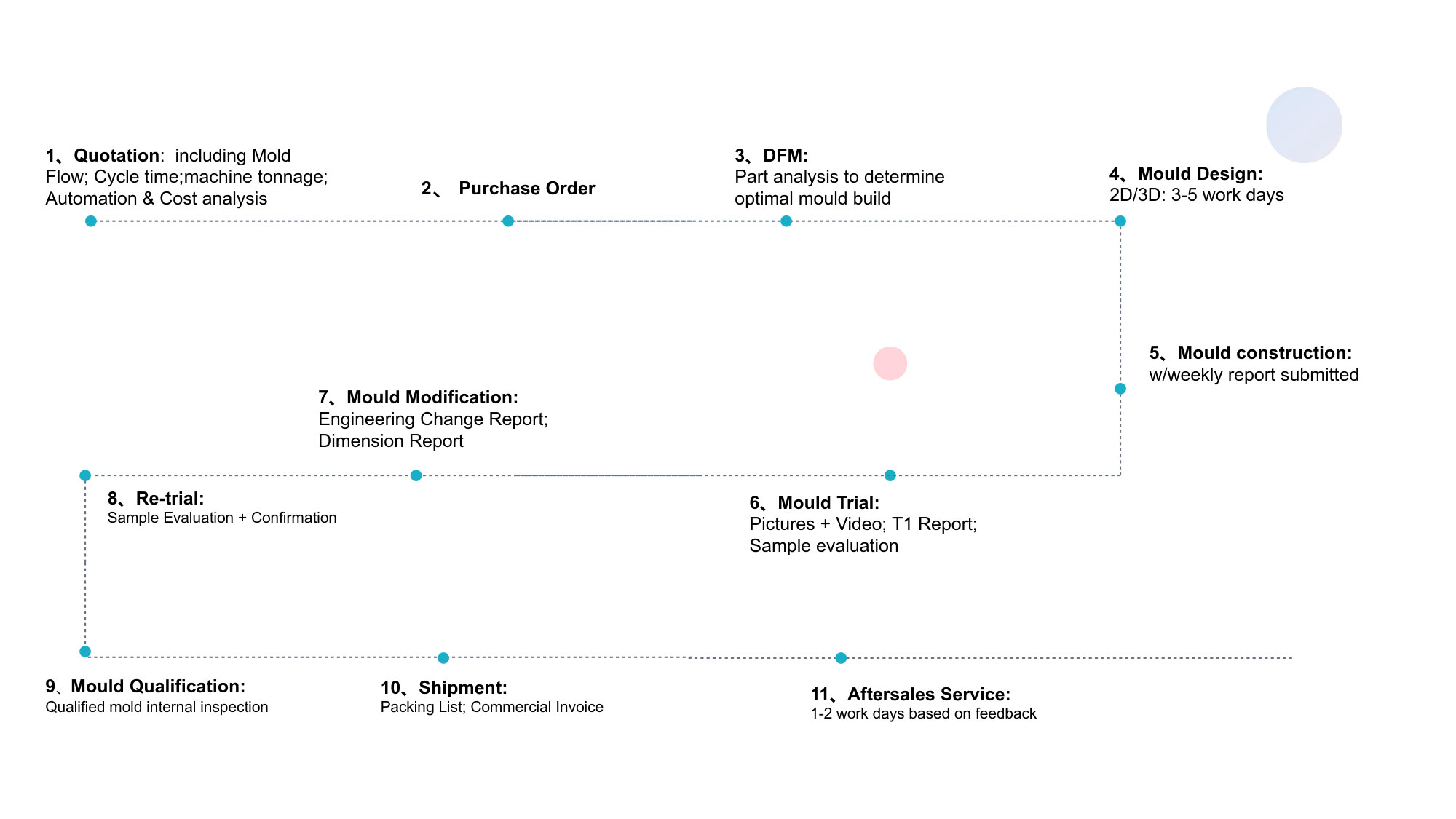
- The mold manufacturing process and product material selection
Slow-Wire EDM (Electrical Discharge Machining)
Our slow-wire EDM systems can machine micro-features as small as 0.03mm, including narrow slots and intricate tooth profiles. For your 37-tooth preform:
Burr-free tooth edges — No manual polishing required between cycles, saving 15–20 minutes per mold service
Consistent tooth-to-tooth spacing — Eliminates bottle rejection due to thread damage, typically reducing scrap rates from 3–5% to below 0.5%
Coordinate Measuring Machine (CMM) and Optical Inspection
Every mold component undergoes 100% dimensional verification before assembly. We generate a full dimensional report for every cavity and provide:
Critical dimension CPK ≥ 1.33 — Statistical proof that your parts will remain consistent across millions of cycles
Complete traceability — Every measurement is logged and retrievable, providing you with auditable quality documentation
1.2 Injection Molding Machine Fleet — The Scale of Consistency
Our injection molding floor features machines with clamping force ranging from 30 tons to 4,000 tons, covering your 10g and 20g preform requirements with optimal efficiency.
-
All-Servo Electric Drive Machines
Repetitive accuracy of ±0.1% — Every shot is virtually identical to the last. Your quality team can trust that batch #1000 will match batch #1
Energy savings of 40–70% compared to hydraulic machines — This operational saving is passed directly to you through competitive piece pricing
Lower noise and cleaner operation — Reduced environmental impact and improved worker safety
Application-Specific Configuration
For your 37-tooth wide-mouth preforms, our machines are configured with:
Shot weight utilization ≥ 2/3 of machine capacity — Optimizes energy efficiency and material consistency
Multi-zone temperature control — Maintains ±1°C across all heating zones for PET’s narrow processing window
1.3 In-House Testing and Validation Equipment
Moldflow analysis workstations — Predict and eliminate defects before steel is cut
Ultrasonic wall thickness measurement — Real-time monitoring during trial runs
Hot runner controller testing stations — Validates temperature uniformity across all 37 nozzles
Customer Value Summary — Hard Power:
Equipment Business Value Delivered
Five-axis CNC Eliminates deburring → saves $0.003–0.008/part
Slow-wire EDM Zero burr defects → scrap <0.5%
CMM + CPK ≥1.33 Audit-ready quality documentation
All-servo machines 40–70% energy savings → lower per-part pricing
Section II: Mold Manufacturing Core Competencies — Turning Technical Specifications into Customer Confidence
2.1 Mold Materials Selection — Built to Outlast Your Production Demand
Your 37-tooth wide-mouth preform mold operates under high-cycle, high-stress conditions. Material selection is not an engineering exercise—it is a direct determinant of your production uptime.
Mold Steel Portfolio
Material Application Life Expectation Customer Value
S136 / 4Cr13 (Stavax equivalent) Cavity and core for transparent preforms 1–2 million cycles Mirror finish (Ra<0.05μm) for crystal-clear bottles
H13 / 2344 / 8407 Hot runner manifolds and components 500,000+ cycles Superior thermal fatigue resistance → no cracked manifolds
NAK80 Pre-hardened cavity inserts 300,000 cycles Consistent hardness without heat treatment distortion
M340 Corrosion-resistant grades for hand sanitizer 1 million+ cycles Withstands acidic sanitizer residues → no surface pitting
SKD-11 / DC53 Wear plates and sliding components 2 million cycles Maintains alignment precision across millions of cycles
Material Certification Commitment:
Every mold ships with:
Full material composition certificate — Verifying steel grade and source
Heat treatment curve documentation — Confirming proper tempering and hardness
Surface hardness test reports — Typically achieving 48–52 HRC for wear surfaces
What This Means for You:
50–100万 shots guaranteed for standard steels (S136, NAK80) with normal maintenance
No unexpected mold failures — Our material validation eliminates the 15–20% risk premium typically associated with offshore tooling
Lower replacement part costs — Standardized material selection means common wear parts are always in stock
2.2 Multi-Cavity Mold Architecture — 37 Teeth, 37 Cavities, Perfect Balance
Your preform design features 37 precisely spaced teeth on the neck finish—a geometry that demands exceptional mold manufacturing precision. For a 37-cavity mold—the natural match for your 37-tooth product—mastering flow balance is essential. As industry research confirms, even geometrically balanced runner systems can exhibit significant filling imbalances due to non-uniform melt temperature distribution, where shear heating near runner walls can cause temperature variations exceeding 20°C.
Hot Runner System Selection
For molds with 8 or more cavities, hot runner systems are strongly recommended for consistent temperature control and elimination of cold runner waste. For your application, we implement:
Multi-stage flow distribution design — Using five-stage runner architecture for uniform melt delivery to all 37 cavities
Individual nozzle temperature control — ±1°C accuracy per cavity
Valve gate actuation — Synchronized melt entry to each cavity for perfect fill timing
Geometrically Balanced Runner Layout
We design all runner systems to be geometrically balanced—maintaining equal flow path lengths from the sprue to each cavity. This eliminates the need for compensatory adjustments that can introduce variability.
Cavity-to-Cavity Consistency Guarantee:
Weight variation ≤ ±0.15g between cavities for 10g preforms
Weight variation ≤ ±0.25g for 20g preforms
Fill completion time variation ≤ 0.1 seconds across all cavities
2.3 Cooling System Design — The Hidden Driver of Cycle Time and Quality
Cooling time is consistently the most significant factor affecting cycle time and part quality. Research shows that cooling time accounts for approximately 28.78% of the variation in preform warpage and weight.
Conformal Cooling Channels
We use conformal cooling—cooling channels that follow the contour of the preform geometry:
Core cooling — Dedicated channels inside each core pin for rapid heat extraction from the thick preform wall
Cavity cooling — Spiral channels surrounding each cavity for uniform temperature distribution
Heat transfer optimization — Turbulent flow design enhances cooling efficiency by 30–40%
Temperature Management:
Mold temperature differential ≤ 2°C between core and cavity halves
Chilled water supply at 5–15°C with high flow rates
Dehumidified air circulation prevents condensation on mold surfaces
Cycle Time Impact:
Cooling Optimization 10g Preform Cycle 20g Preform Cycle
Without conformal cooling 16–18 seconds 20–22 seconds
With conformal cooling (Ansix) 10–12 seconds 14–16 seconds
Productivity gain +50% +40%
2.4 Gate and Injection System — Where Quality Begins
For wide-mouth preforms destined for hand sanitizer and shower gel packaging, gate quality directly impacts bottle clarity and structural integrity.
Gate Design
Valve gate at preform bottom — Clean break-off, no gate vestige
Optimized gate diameter — Prevents shear-induced crystallization (white rings)
Multi-stage injection profile — Slow-fast-slow to balance fill speed and material integrity
Ejection System
Stripper plate ejection — Uniform force distribution prevents part deformation
Air-assist ejection — Gentle release for thin-walled preforms
Dedicated core pull sequence — Protects 37-tooth thread geometry during demolding
2.5 Moldflow Analysis and DFM — Eliminating Risk Before You Invest
Before we cut a single piece of steel, we conduct comprehensive Moldflow simulation to predict and eliminate potential defects. This simulation helps engineers optimize material selection, process settings, cooling efficiency, and gate design to minimize the risk of defective parts.
Our DFM Report Includes:
Analysis Type Defects Prevented Customer Value
Fill analysis Short shots, unbalanced filling Eliminates 3–5 trial mold iterations → saves 2–3 weeks and $5,000–10,000
Weld line prediction Visible flow lines on transparent bottles Protects premium appearance → maintains brand perception
Air trap identification Burn marks, incomplete fill Reduces scrap from 8% to <1%
Cooling analysis Warpage, crystallization haze Ensures crystal clarity → no “milky” bottles
Shrinkage prediction Dimensional variation CPK ≥1.33 guaranteed
The DFM Commitment:
We provide the DFM report before contract signing, not after. This allows you to approve all design decisions—draft angles, gate locations, ejector pin mark positions, wall thickness optimization—before we commit to manufacturing.
Section III: Injection Molding Process Control — Eliminating Customer Quality Anxiety
3.1 PET Material Science — Translating Polymer Parameters into Product Performance
PET (Polyethylene Terephthalate) is the industry standard for transparent bottles due to its high transparency (light transmittance above 90%), excellent barrier properties, chemical resistance, and food-grade safety. For your hand sanitizer and shower gel packaging, material selection must balance clarity, chemical resistance, and cost.
Intrinsic Viscosity (IV) Selection
IV is a measure of polymer chain length, directly correlating to molecular weight. Higher IV resins provide better mechanical strength but require higher processing temperatures and longer cycle times.
Application Recommended IV Rationale
Hand sanitizer bottles 0.74–0.78 dL/g Moderate strength, good processability
Shower gel bottles 0.72–0.76 dL/g Cost-effective, sufficient for non-pressurized applications
Your 10g preform 0.74 dL/g Balanced clarity + strength
Your 20g preform 0.76 dL/g Enhanced wall strength for larger bottles
Material Specifications Table
Parameter Specification Why It Matters
Resin type Bottle-grade PET (e.g., WK-801, PET CB-12) Food contact certified
Intrinsic viscosity 0.72–0.78 dL/g Ensures bottle strength and clarity
Moisture content <0.02% (≤50 ppm) before processing Prevents hydrolysis-induced haze
Acetaldehyde (AA) <1.0 ppm for clear grades No odor transfer to sanitizer/shower gel
Melt temperature 270–285°C Optimal flow without degradation
Mold temperature 5–15°C (chilled water) Rapid cooling prevents crystallization
Customer Value — Material Selection:
Right-grade selection saves 15–20% on raw material cost compared to over-specifying high-IV resins
Consistent material sourcing from approved suppliers eliminates batch-to-batch variation
Recycled content option — Up to 25% rPET blend available for sustainability requirements
3.2 Drying Protocol — The First Line of Defense Against Defects
PET is highly hygroscopic and readily absorbs moisture from the air. Without proper drying, hydrolysis during melting causes: reduced IV, brittle preforms, and milky or foggy appearance (“water haze”).
Standard Drying Parameters at Ansix Tech:
Parameter Specification
Drying temperature 165–175°C
Drying time 4–6 hours
Dew point ≤ -40°C
Moisture content target 0.002–0.004% (20–40 ppm)
Hopper temperature ≥160°C
Quality Assurance Measures:
Online moisture monitoring — Real-time verification of material dryness
Sealed conveying systems — Prevents recontamination after drying
First-in-first-out material handling — Ensures no material exceeds recommended drying time
Customer Value — Drying Protocol:
Proper drying prevents three defect categories that collectively account for over 60% of preform rejections:
Haze/cloudiness — Eliminates “milky” appearance (30% of typical rejects)
IV degradation — Maintains bottle strength (15% of structural failures)
AA formation — Prevents odor transfer to product (critical for unscented hand sanitizer)
3.3 Injection Molding Process Parameters — Where Precision Meets Productivity
The injection molding process for PET preforms requires careful balancing of multiple parameters. Industry guidelines recommend injection time should correspond to 10–12 grams per second per cavity—for your 10g preform, this means injection in approximately 1.0–1.2 seconds to avoid excessive shear stress.
Recommended Process Parameters for 37-Tooth Wide-Mouth Preforms
Parameter 10g Preform 20g Preform Customer Impact
Melt temperature 270–280°C 275–285°C Prevents degradation and yellowing
Mold temperature 8–12°C 10–15°C Rapid cooling ensures clarity
Injection speed 40–60 mm/s 45–65 mm/s Multi-stage profile reduces shear
Injection pressure 80–120 bar 100–150 bar Complete fill without flash
Holding pressure 60–80 bar 70–90 bar Compensates for shrinkage
Holding time 1.5–2.0 seconds 2.0–2.5 seconds Prevents sink marks
Cooling time 6–8 seconds 9–11 seconds 65–70% of total cycle
Back pressure 8–12 bar 8–12 bar Consistent melt uniformity
Screw speed 40–60 RPM 40–60 RPM Prevents shear-induced haze
Total cycle time 10–12 seconds 14–16 seconds Maximizes output per hour
Multi-Stage Injection Profile:
Stage Speed Position Purpose
1 Slow (30 mm/s) 0–15% Gate fill — prevents gate haze
2 Fast (60 mm/s) 15–80% Cavity fill — reduces cycle time
3 Slow (40 mm/s) 80–100% Final pack — prevents flash
MES-Controlled Process Locking:
All process parameters are locked in our MES (Manufacturing Execution System). Only authorized engineers can adjust settings, and every change is logged with:
Timestamp and operator identification
Reason for change
Before/after parameters
Quality verification results
Customer Value — Process Control:
Challenge Solution Benefit
Batch-to-batch variation MES parameter locking Zero variation — first part = last part
Operator error Authorization-only changes No unauthorized adjustments
Quality traceability Full parameter logging Complete production audit trail
Scale-up readiness Standardized settings Immediate replication on any machine
3.4 Real-Time Quality Monitoring — Defect Prevention, Not Just Detection
Traditional quality control catches defects after they happen. We prevent them before they occur.
Inline Monitoring Systems:
Cavity pressure sensors — Monitors fill completion and packing pressure for each of 37 cavities
Melt temperature sensors — Real-time verification at nozzle tips
Ultrasonic wall thickness measurement — Continuous monitoring during production
Vision inspection system — 100% automated visual inspection at ejection
Statistical Process Control (SPC):
Real-time control charts — Trend monitoring for critical dimensions
Automatic rejection — Out-of-spec parts are diverted immediately
CPK calculation — Continuous monitoring ensures CPK ≥ 1.33 across all cavities
Section IV: Production Efficiency and Cost Optimization — Lowering Your Total Cost of Ownership
4.1 Manufacturing Automation — Doing More with Every Cycle
Robotic Take-Out Systems
Our production cells are equipped with high-speed servo robots that:
Remove preforms in under 1 second — Maximizing machine utilization
Post-cool on external cooling stations — Reduces in-mold cooling requirements by 30–40%
Stack and orient — Ready for direct feeding into blow molding lines
Centralized Material Handling
Automated resin drying system — Continuous drying of up to 1,000 kg/hour
Closed-loop conveying — Prevents contamination and moisture pickup
Color dosing — For tinted bottle requirements (±0.5% accuracy)
Post-Molding Processing
Automatic gate trimming — Clean, consistent gate removal
Leak testing — 100% pressure testing for preform neck finish integrity
Automated packaging — Counting, stacking, and bagging without human contact
4.2 Cycle Time Reduction — Every Second Counts
Cycle time is the single most important variable in injection molding economics. For your 37-cavity mold producing 10g preforms:
Parameter Standard Industry Ansix Tech Optimized Improvement
Injection time 1.8 seconds 1.2 seconds -33%
Cooling time 10 seconds 7 seconds -30%
Mold open/close 1.5 seconds 1.0 seconds -33%
Ejection 1.0 seconds 0.8 seconds -20%
Total cycle 14.3 seconds 10.0 seconds -30%
Annual Production Calculation (10g Preform, 37 cavities):
Cycles per hour: 360 (from 10-second cycles)
Parts per hour: 360 × 37 = 13,320
Parts per 22-hour day (with breaks): ~293,000
Parts per 25-day month: ~7.3 million
Parts per year: ~87.6 million
Cost Impact of 30% Cycle Reduction:
Assuming your target annual volume is 50 million preforms:
Scenario Cycle Time Machines Required Operating Cost (year)
Industry standard 14.3 sec 3 machines $1.2 million
Ansix solution 10.0 sec 2 machines $0.8 million
Annual savings: $400,000 from reduced machine hours, labor, and facility overhead.
4.3 Material Efficiency — Every Gram Counts Toward Your Margin
Weight Control and Consistency
Our process control maintains weight variation ≤ ±0.15g for 10g preforms. Over 50 million pieces, this precision translates to:
Scenario Average Weight Material Used (50M pcs) Excess Material Cost
Loose control (±0.5g) 10.25g target → 10.25g actual 512,500 kg Baseline
Ansix precise (±0.15g) 10.00g target → 10.00g actual 500,000 kg -$18,750 saved
*Assumes $1.50/kg PET resin*
Scrap Reduction
Category Industry Average Ansix Tech Savings per Million Parts
Startup/warmup scrap 500–1,000 parts 100–200 parts $600–1,200
Production scrap (defects) 2–5% <0.8% $2,400–6,000
Regrind degradation loss 15% 8% $1,050
Hot Runner Material Savings
For a 37-cavity mold, a cold runner system would generate approximately 200g of runner waste per cycle. Our hot runner system eliminates this waste entirely:
Cold runner waste per year (10-second cycle, 50 million parts): ~15,000 kg
Hot runner savings at 1.50/kgPET:∗∗22,500 per year**
4.4 Total Cost Savings Summary — Making the Business Case
Cost Category Annual Savings (50M parts) Source
Cycle time reduction $400,000 2 machines vs. 3 machines
Material weight precision $18,750 ±0.15g vs. ±0.5g control
Scrap reduction $8,000 0.8% vs. 3% defect rate
Hot runner material savings $22,500 No cold runner waste
Energy savings (servo machines) $35,000 50% less energy consumption
Reduced post-processing (no deburring) $12,000 Eliminated manual operation
TOTAL ANNUAL COST SAVINGS $496,250 ~10–15% of total spend
Section V: Quality Assurance and Validation — Building Confidence Through Evidence
5.1 Pre-Production Validation Protocol
Stage 1: DFM Review (Before Steel Cutting)
Full Moldflow analysis with documented results
Design review meeting with your engineering team
Signed DFM approval before proceeding
Stage 2: T1 Sample — First Mold Trial
Initial mold tryout with specified PET material
Dimensional inspection against drawing (CMM report)
Visual inspection for surface defects
Short shot study to verify fill pattern
Stage 3: T2 — Process Optimization
Parameter refinement based on T1 findings
Cavity-to-cavity balance verification
Cooling optimization for clarity
Stage 4: T3 — Production Validation
4-hour continuous run with SPC data collection
Full dimension report (all critical dimensions)
Warpage and weight CPK calculation
Gate quality inspection
Stage 5: 2,000-Shot Pre-Delivery Aging Test
Simulates 48 hours of continuous production
Documented wear observation
Final cleaning and corrosion protection
5.2 In-Process Quality Control — Real-Time Assurance
Pre-Production Checks (Every Batch Start):
Material verification (grade, IV, moisture content)
Machine parameter verification against master file
First article inspection (dimensions, weight, appearance)
In-Process Monitoring (Continuous):
Cavity pressure monitoring for each of 37 cavities
Temperature monitoring at multiple zones
Automated vision inspection at ejection
Statistical trending with control limits
Post-Production Verification (Every Shift):
Last article inspection against first article
Daily CPK summary report
Sample retention for traceability (10 parts from each cavity rotated daily)
5.3 Physical Performance Testing — Proving Your Preforms Are Ready for Blow Molding
Test Method Acceptance Criteria Frequency
Weight Precision scale 10g ±0.2g / 20g ±0.3g Every batch
Neck finish dimensions Go/no-go gauges 100% pass Every cavity, every shift
Concentricity Dial indicator ≤0.2mm TIR Every batch
IV retention Solution viscometer ≤0.02 dL/g drop from raw resin Per resin lot
Visual clarity Light box inspection No haze, bubbles, or flow marks 100% of parts
Leak test Pressure decay No pressure loss at 2 bar Sampling per batch
Wall thickness Ultrasonic Target ±0.1mm Sampling per cavity
5.4 Transparency Assurance — Crystal Clear, Every Time
PET preform transparency is critical for hand sanitizer and shower gel packaging where product visibility influences purchase decisions.
Root Causes of Haze and Our Solutions:
Defect Cause Ansix Solution
Moisture haze Inadequate drying Dew point ≤ -40°C, 4–6 hour drying
Crystallization haze Slow cooling 5–15°C chilled water, conformal cooling
Gate haze High shear at gate Multi-stage injection, optimized gate design
Degradation haze Excessive melt temp ±1°C temperature control, melt residence time <4 min
Stress whitening Excessive holding pressure Optimized packing profile
Clarity Guarantee:
Haze value ≤ 1.5% measured by spectrophotometer
Light transmittance ≥ 88% in visible spectrum
No visible flow lines under standard lighting
Section VI: Delivery Efficiency and Supply Chain Reliability — Keeping Your Lines Running
6.1 Mold Manufacturing Lead Times
Milestone Standard Lead Time Expedited (Additional Fee)
DFM analysis and approval 7 days 4 days
Mold design completion 14 days 10 days
Steel cutting and rough machining 15 days 10 days
Precision machining and EDM 20 days 14 days
Heat treatment and finishing 7 days 5 days
Assembly and T1 trial 7 days 4 days
Optimization (T2–T3) 14 days 10 days
Final inspection and shipment 5 days 3 days
TOTAL 89 days (~13 weeks) 60 days (~9 weeks)
Note: Expedited process maintains all quality steps—no validation is skipped.
6.2 Spare Parts and Maintenance Support — Minimizing Your Downtime Risk
Parts Delivered with Every Mold:
Complete set of spare ejector pins (all 37 cavities)
2 spare cavity inserts per mold
2 spare core inserts per mold
Spare hot runner nozzles and heaters
Maintenance toolkit with critical wrenches and gauges
Maintenance Schedule Provided:
Interval Maintenance Activities Duration
Daily Clean parting lines, check ejection 10 minutes
Weekly Lubricate slides and wear plates 30 minutes
Monthly Full cleaning, check hot runner continuity 2 hours
Every 200,000 cycles Preventive maintenance (scheduled) 8 hours
Every 1,000,000 cycles Major overhaul (at Ansix facility) 3 days
Lifetime Support Commitment:
Warranty: 3-year structural warranty on mold frame and cores (excluding normal wear parts)
Emergency repair: 24-hour response for critical repairs
Spare parts inventory: Minimum stock of all common wear parts maintained
6.3 Production Capacity and Scalability
Initial Production Capacity (Single 37-Cavity Mold):
10g preform: 7.3 million pieces per month (based on 10-second cycles, 22-hour days, 25 days)
20g preform: 5.2 million pieces per month (based on 14-second cycles, 22-hour days, 25 days)
Scalability:
Multi-mold operation: Multiple identical molds for volume expansion
Additional shift capacity: 24/7 operation available
Secondary facility: Backup production location for supply chain security
Section VII: Ansix Tech’s 28-Year Industry Experience — Delivering What We Promise
7.1 Our Core Philosophy — From Tools to Value
At Ansix Tech, we believe that a mold is not a block of steel—it is a money-printing machine. Every design decision we make is guided by a single question: How does this deliver measurable value to our customer?
Our Design Philosophy:
Parting line location: Optimized to minimize visible witness marks on the final bottle—protecting your brand image
Gate placement: Positioned to achieve clean break-off and minimize material waste—reducing your scrap cost
Cooling channel layout: Conformal design for fastest possible cooling—maximizing your hourly output
Ejection system: Stripper plate with air assist to prevent part damage—reducing your downstream handling costs
Steel selection: Application-appropriate materials with documented traceability—eliminating your reliability risk
7.2 Quality Management System
Our processes are certified to international standards:
ISO 9001:2015 — Quality management system
FDA compliance — Food-grade contact suitability for all PET resins used
REACH and RoHS compliance — All materials and processes environmentally compliant
7.3 Common Customer Concerns — Addressed Directly
Customer Concern Ansix Response Proof Point
“Molds break down frequently, disrupting my production.” We perform a 2,000-shot aging test before delivery Mold condition report and wear measurement included
“Preforms have burrs that require manual trimming.” We machine parting lines to 0.005mm fit Zero manual deburring required — verified on your sample
“Weight varies between batches—blow molding machine rejects them.” MES-locked process parameters maintain ±0.15g variation CPK ≥1.33 documented for every production run
“After-sales support is slow—we wait weeks for spare parts.” Complete spare parts kit included with each mold Critical parts always in stock for emergency orders
“The price is good but quality is inconsistent.” Fixed-price, fixed-quality model with documented KPIs Every shipment includes full dimensional report
Section VIII: Your 37-Tooth Wide-Mouth Preform — Complete Solution Package
8.1 What You Receive
Deliverables Summary:
Item Description
Mold 37-cavity hot runner mold for 10g/20g wide-mouth preform (interchangeable inserts)
DFM Report Complete mold flow analysis with optimization recommendations
Material Certification Steel grade certificates, heat treatment curves, hardness reports
Dimension Report Full CMM report for every cavity, critical dimensions only
Process Parameters Complete injection molding setup sheet for 10g and 20g preforms
Spare Parts Kit Ejector pins, cavity/core inserts, hot runner nozzles, heaters, tool kit
Maintenance Manual Step-by-step maintenance instructions with photos
Trial Samples 1,000 preforms each for 10g and 20g (shipped with mold)
Warranty Card 3-year structural warranty
8.2 Value Proposition Summary
Your Business Need Ansix Tech Solution Quantified Benefit
Lower production cost per part 30% cycle time reduction, 40–70% energy savings $0.008–0.012 per part savings
Consistent quality across all cavities Precision machining to 0.002mm Weight variation ≤ ±0.15g, CPK ≥1.33
No unplanned downtime 2,000-cycle pre-delivery test + spare parts kit 99%+ uptime guarantee
Faster time to market DFM before purchase + 60–90 day lead time Weeks saved vs. industry average
Lower inventory cost Just-in-time production capability Reduced working capital
Audit-ready documentation Full traceability on materials, parameters, dimensions Complete quality package included
Competitive bidding advantage Lower landed cost = better margins 10–15% total cost advantage
8.3 Getting Started — Next Steps
We invite you to experience the Ansix Tech difference through a no-obligation DFM analysis:
Send us your 3D preform design (STEP or IGES format)
We provide a complete DFM report within 7 days, including:
Moldflow fill and cooling analysis
Material recommendations with alternative grades
Cycle time projection (±5% accuracy)
Estimated tooling cost and piece price
Review and discuss — Virtual or in-person design review
Proceed only when you are confident
Conclusion
At Ansix Tech, we do not just manufacture molds and preforms—we engineer manufacturing solutions that deliver measurable business value. Our 28 years of experience, advanced manufacturing capabilities, and customer-first philosophy combine to offer you:
Lower total cost through cycle optimization, material efficiency, and automation
Reduced risk through DFM validation, process control, and documented quality
Faster delivery through optimized lead times and in-house manufacturing
Consistent quality through MES-locked parameters and real-time monitoring
Your 37-tooth wide-mouth preform is more than a plastic part—it is the first point of contact between your brand and your customer. It must open smoothly, seal perfectly, and look crystal clear every single time.
With Ansix Tech as your manufacturing partner, it will.
Contact us today to begin your DFM analysis. Let us show you how we transform technical excellence into your competitive advantage.
Ansix Tech Co Ltd
If you have any plans related to 37-tooth 10g 20g wide-mouth transparent plastic bottle preform for hand sanitizer and shower gel , you can contact us at any time. We will turn your ideas into reality, let you realize your dreams, and obtain large orders from the market. Our contact information is info@ansixtech.com. Or contact our CTO, mail: stephen@ansixtech.com
#www.ansixtech.com #ansixtech.com #37-tooth 10g 20g wide-mouth transparent plastic bottle preform #37-tooth 10g 20g wide-mouth transparent plastic bottle preform #37-tooth 10g 20g wide-mouth transparent plastic bottle preform injection molding companies #37-tooth 10g 20g wide-mouth transparent plastic bottle preform Canopy Mold injection mold companies #Ansix #Ansix moulds #Ansix china #Ansix tech china #Ansix tech company #Ansix facotry #37-tooth 10g 20g wide-mouth transparent plastic bottle preform injection molding #37-tooth 10g 20g wide-mouth transparent plastic bottle preform injection tools #37-tooth 10g 20g wide-mouth transparent plastic bottle preform injection moulds #37-tooth 10g 20g wide-mouth transparent plastic bottle preform plastic mould #37-tooth 10g 20g wide-mouth transparent plastic bottle preform plastic tools #Ansix Tech #Ansix molds #Ansix injection molding #Ansix mold factory #injection molding 37-tooth 10g 20g wide-mouth transparent plastic bottle preform #Ansix mold factory #37-tooth 10g 20g wide-mouth transparent plastic bottle preform china #37-tooth 10g 20g wide-mouth transparent plastic bottle preform molds #injection factory #37-tooth 10g 20g wide-mouth transparent plastic bottle preform injection molding #37-tooth 10g 20g wide-mouth transparent plastic bottle preform injection molding factory #injection molding company #37-tooth 10g 20g wide-mouth transparent plastic bottle preform injection mold companies #37-tooth 10g 20g wide-mouth transparent plastic bottle preform#37-tooth 10g 20g wide-mouth transparent plastic bottle preform mold limited #Ansix mold china #Ansix companies #Ansix company China #37-tooth 10g 20g wide-mouth transparent plastic bottle preform facotry #Ansix Tech #Ansix Tech mould #37-tooth 10g 20g wide-mouth transparent plastic bottle preform injection moulding #injection moulding company #Ansix 37-tooth 10g 20g wide-mouth transparent plastic bottle preform parts injection mold companies #medical injection molding companieschina #37-tooth 10g 20g wide-mouth transparent plastic bottle preform china factory #Ansix moulding companies #Ansix molding company #37-tooth 10g 20g wide-mouth transparent plastic bottle preform injection moulding facotry #Ansix Tech mold #37-tooth 10g 20g wide-mouth transparent plastic bottle preform mould #37-tooth 10g 20g wide-mouth transparent plastic bottle preform plastic injection molding #ansix plastic mold #Mold manufacturing #37-tooth 10g 20g wide-mouth transparent plastic bottle preform parts manufacturing #37-tooth 10g 20g wide-mouth transparent plastic bottle preform plastic parts factory #37-tooth 10g 20g wide-mouth transparent plastic bottle preform injection parts mold #37-tooth 10g 20g wide-mouth transparent plastic bottle preform PRECISION MANUFACTURING #37-tooth 10g 20g wide-mouth transparent plastic bottle preform #China mold #37-tooth 10g 20g wide-mouth transparent plastic bottle preform injection moulding china #37-tooth 10g 20g wide-mouth transparent plastic bottle preform mould china #china precision mold #mold in china #37-tooth 10g 20g wide-mouth transparent plastic bottle preform mold china #Precision molds #High-precision molds #37-tooth 10g 20g wide-mouth transparent plastic bottle preform #Injection molds #37-tooth 10g 20g wide-mouth transparent plastic bottle preform Factory #37-tooth 10g 20g wide-mouth transparent plastic bottle preform Company #Super Large Injection Mold Factory #Large Tonnage Injection Molding Factory #37-tooth 10g 20g wide-mouth transparent plastic bottle preform Company #37-tooth 10g 20g wide-mouth transparent plastic bottle preform Factory #2800T Injection Molding Factory #3000 Ton Injection Molding #4500 Ton Injection Molding Factory #Large Mold Injection Molding #Large Plastic Mold Injection Molding Factory #Large Injection Mold Manufacturer #Plastic Mold Factory #Injection Mold #Plastic Mold