



Instrument panel lower cover mold
FEATURES
The Blueprint: Design, Market Requirements, and Product Standards
The inception of any automotive mold project is governed by a fortress of non-negotiable standards. For an IP Lower Cover, the requirements are multifaceted:
Safety & Regulatory: Must comply with FMVSS (in the US) and ECE (in Europe) regulations concerning occupant protection, head impact criteria, and knee bolster performance. It is a key part of the passive safety system, designed to manage energy in a collision.
Dimensional & Assembly Stability: The part must maintain ultra-tight tolerances (often within ±0.15mm) across a wide range of temperatures (-40°C to 85°C) to ensure perfect fit with the IP carrier, steering column, HVAC ducts, and wiring harnesses without squeaks or rattles.
Aesthetic & Functional: Surfaces may be Class B+ (semi-visible), requiring a high-quality, consistent finish free of flow lines, sink marks, or warpage. It often features complex ribbing, mounting bosses, snap-fits, and openings for pedals and sensors.
Material Performance: Must exhibit high strength, good impact resistance at low temperatures, excellent dimensional stability, and often, inherent flame retardancy.
Ansix Tech’s project team begins with a meticulous Design for Manufacturability (DFM) analysis, serving as the critical bridge between part design and mold reality.
-
Mold Description
Product Materials:
ABS/PC
Mold Material:
S136ESR
Number of Cavities:
1
Glue Feeding Method:
Hot runner
Cooling Method:
Water cooling
Molding Cycle
42.5s
- The mold manufacturing process and product material selection
The Digital Crucible: Prototype Design, Mold Flow Analysis (DFM), and Material Selection
A. Material Selection: The Foundation of Performance and Cost
The choice of plastic is a pivotal cost-performance decision. For IP Lower Covers, the industry typically uses engineered thermoplastics.
Primary Material: PC/ABS (Polycarbonate/Acrylonitrile Butadiene Styrene) Blends. A workhorse for interior trim, offering an optimal balance of impact strength (from PC), good processability (from ABS), heat resistance, and dimensional stability. A specific grade like Covestro Bayblend T85 MN or SABIC Cycoloy C6200 might be selected for its proven track record in automotive interiors, possessing UL94 V-0 flame retardancy and excellent flow characteristics.
Considerations: Ansix Tech’s material engineers don’t just accept the spec sheet. They analyze how the chosen grade (e.g., a 60% PC / 40% ABS blend with mineral fillers for reduced warpage) interacts with the proposed mold design. Could a slightly different filler package reduce cycle time? Would a higher-flow grade allow for a smaller, less costly gate? This early analysis is the first frontier of cost optimization, preventing over-specification and identifying processing advantages.
-
Mold Flow Analysis (DFM): Simulating Success
Before a single block of steel is cut, Ansix Tech employs advanced simulation software (such as Moldflow or Moldex3D) to create a digital twin of the injection process. This phase is non-negotiable for a part as large and complex as an IP Lower Cover.
Filling Pattern: Engineers ensure a balanced, simultaneous fill to avoid air traps, weld lines in critical areas, and excessive injection pressure.
Cooling & Warpage Analysis: Predicting and mitigating thermal-induced deformation is paramount. The analysis identifies areas prone to sink marks over ribs or warpage due to uneven cooling, allowing for corrective action in the mold design stage.
Gate Optimization: The location, type (e.g., submarine, pin-point, or fan gate), and size of the gate(s) are iteratively refined to ensure optimal packing while minimizing cosmetic defects and shear stress on the material.
Clamping Force Prediction: Accurately determining the required tonnage prevents selecting an oversized, energy-inefficient injection molding machine.
This digital verification de-risks the project, saving weeks of costly physical trial-and-error.
III. The Heart of the Matter: Key Aspects of Mold Design & Manufacturing
A. Steel Selection: Balancing Durability and Cost
For an IP Lower Cover mold destined for a production run of 500,000+ cycles, steel choice is critical. Ansix Tech typically opts for:
Cavity & Core: Pre-hardened steel like P20 (UNS T51620) or SSAB Hardox for good polishability and core toughness. For higher-volume or glossier finishes, a stainless steel like S136H (AISI 420) might be used for its superior corrosion resistance and ability to hold a high polish over time.
Critical Inserts & Slides: H13 (AISI) hot-work steel, hardened to 48-52 HRC, is used for complex slides, lifters, and high-wear areas due to its exceptional thermal fatigue resistance.
B. The Systems Within: A Symphony of Precision
Cooling System/Water Channels: This is the engine of efficiency. Ansix Tech designs conformal cooling channels that follow the complex contours of the part core and cavity as closely as possible. This innovation, often enabled by additive manufacturing (3D metal printing) for insoluble cores, dramatically reduces cycle time by ensuring uniform and rapid heat extraction, directly lowering energy cost per part.
Runner & Gating System: A cold runner system is standard for such a large part. Ansix Tech optimizes runner diameter and layout to ensure balanced filling while minimizing material waste (regrind). The gate is strategically placed in a non-visible area, often using a tab gate or tunnel gate to allow for clean, automatic degating.
Ejection System: Given the part’s large surface area and potential for sticking, a robust ejection strategy is essential. This includes a high number of ejector pins (often sleeved for strength), stripper plates for deep-draw sections, and air poppets or angle lifters to release undercuts smoothly. All are designed for reliability over millions of cycles.
C. Manufacturing Challenges & Workflow
The IP Lower Cover mold is massive, often a multi-ton assembly. Key challenges include:
Machining Large, Complex Geometries: Achieving perfect alignment between massive core and cavity blocks requires ultra-precise, large-scale CNC machining and coordinate measuring machine (CMM) verification.
Surface Finish Consistency: Polishing large, curved Class B surfaces to a uniform SPI (Society of the Plastics Industry) finish (e.g., SPI-B1) is an artisanal skill.
Integration of Complex Movements: Dozens of slides, lifters, and cores must operate in perfect, timed harmony, often driven by hydraulic or angled systems.
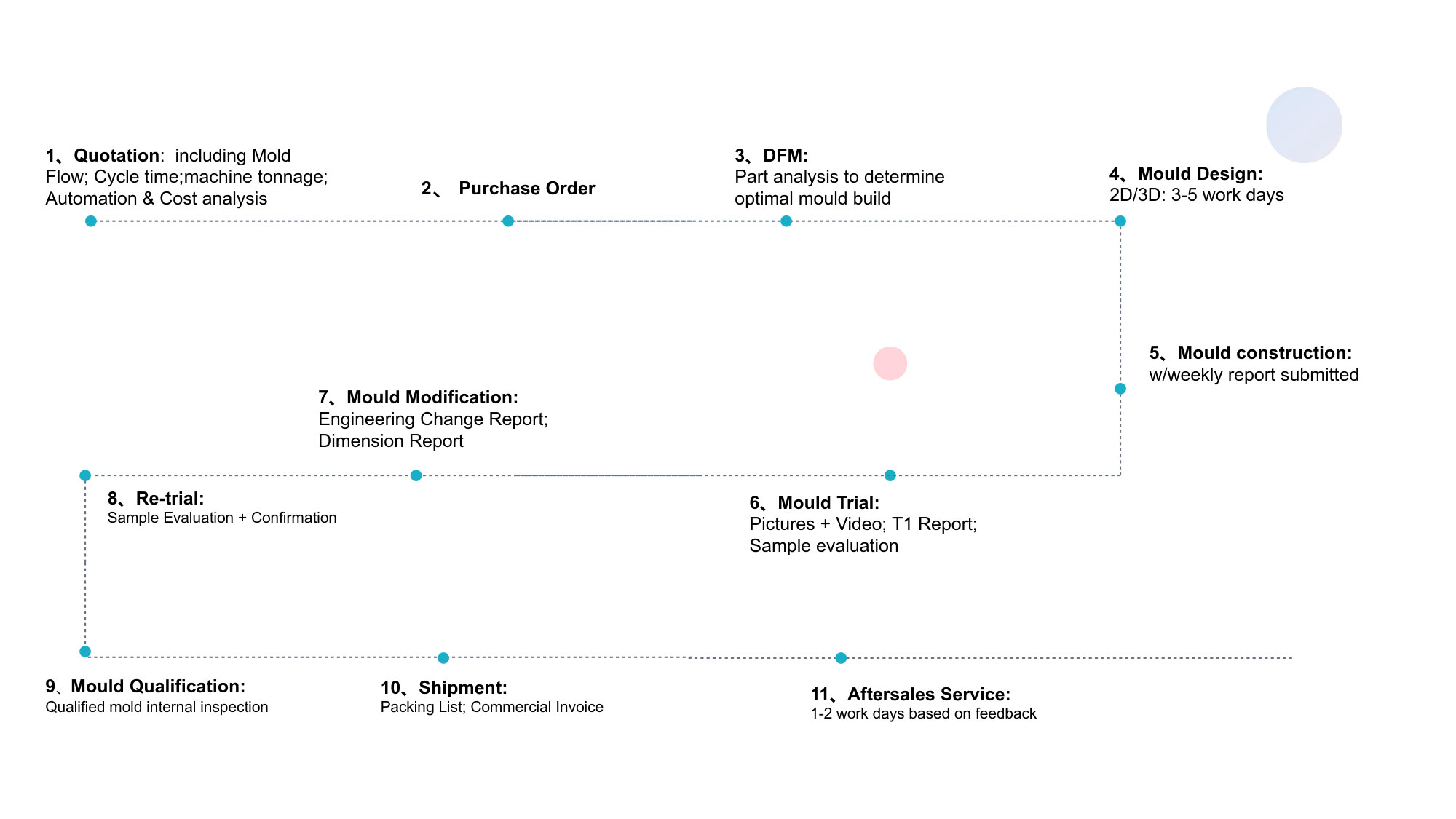
Ansix Tech’s processing workflow is a tightly orchestrated sequence: Detailed DFM → 3D Mold Design & Finalization → Steel Procurement & Rough Machining → Precision CNC Machining of Core/Cavity → Heat Treatment (if required) → Precision Grinding/EDM (Electrical Discharge Machining) → Polishing & Texturing → Assembly of Slider/Lifter Systems → Fitting of Ejector, Cooling, and Hydraulic Systems → Final Assembly and Bench Testing.
IV. From Steel to Part: Injection Molding Challenges, Process Optimization, and Quality Assurance
A. Molding Challenges & Optimization
Injection molding the first-shot part is a milestone, but stabilizing the process for mass production is the true test.
Challenges: Controlling warpage due to residual stress and uneven shrinkage; eliminating sink marks over thick ribs; preventing burn marks in deep, trapped air pockets; ensuring consistent color and gloss.
Process Optimization (Efficiency & Cost Control): This is where Ansix Tech’s experience pays direct dividends for the customer’s bottom line.
Cycle Time Reduction: Through optimized conformal cooling, Ansix Tech can reduce cooling time by 25-30%. Combined with fine-tuned packing pressure profiles and high-efficiency servohydraulic or all-electric molding machines, the overall cycle time is minimized. A 10% faster cycle translates directly to a 10% increase in output and a lower cost-per-part.
Scrap & Energy Reduction: Precise process control (via Cavity Pressure Sensors) ensures each shot uses the minimum required material and energy. Optimized runner systems reduce regrind. This cuts raw material costs and utility bills.
Automation Integration: The mold is designed for seamless integration with robots for part removal, insert loading (for clips or badges), and inline inspection, reducing labor costs and variability.
B. Quality Control & Assurance: The Zero-Defect Mandate
Ansix Tech implements a cradle-to-grave QC protocol:
First Article Inspection (FAI): Using laser scanners and CMMs, the first parts are meticulously measured against the CAD model to validate the mold.
Process Statistical Control (SPC): Critical dimensions (wall thickness, boss locations, etc.) are monitored in real-time during sampling runs.
Dimensional & Functional Testing: Parts undergo temperature cycling, fit-checks on assembly fixtures, and mechanical tests (snap-fit strength).
Production Part Approval Process (PPAP): Ansix Tech supports the customer through the full PPAP submission, providing all required documentation (DFMEA, PFMEA, Control Plans, MSA data) to secure mass production certification from the automotive OEM.
C. Packaging & Rapid Delivery
Understanding that the mold is a critical-path item, Ansix Tech designs custom, secure packaging for safe global transport. Their rapid delivery process is built on concurrent engineering, where design, procurement, and preliminary machining phases overlap. Digital project management platforms provide customers with real-time transparency on milestones, from steel arrival to final tryout, compressing lead times without compromising quality.
V. The Ansix Tech Advantage: Delivering Reliability and Value Through Cost Engineering
Ansix Tech’s extensive portfolio of IP Lower Cover and other complex interior trim projects is not just a record of delivery—it’s a testament to a philosophy of value-driven manufacturing. Their commitment goes beyond building a mold; it’s about engineering a lowest total-cost production solution.
How Ansix Tech Significantly Lowers Component Cost:
Material Intelligence: By advising on the optimal material grade that meets—but does not exceed—specifications, they prevent costly over-engineering. Their processing expertise allows them to use materials efficiently, maximizing yield.
Process-Centric Design: Every aspect of the mold, especially the cooling system, is engineered for maximum production efficiency. The resulting cycle time reduction is a continuous, compounding saving over the entire production life of the program.
Predictive Engineering: Heavy investment in DFM and mold flow analysis eliminates costly mold rework, delays, and production instability. “Right the first time” is the most powerful cost-saving strategy of all.
Lifecycle Durability: Selecting the correct steel and hardening processes ensures the mold achieves its planned lifespan with minimal downtime for maintenance, protecting the customer’s production schedule and tooling amortization costs.
In the high-stakes world of automotive supply chains, where margins are tight and quality is paramount, partners like Ansix Tech provide a critical edge. Their Instrument Panel Lower Cover mold project serves as a compelling case study: through a fusion of advanced engineering, pragmatic material science, and an unwavering focus on process efficiency, they deliver more than precision tooling. They deliver reliability, speed to market, and a tangible reduction in the cost of components, solidifying their role as a value-creation partner in the journey of automotive innovation.

Ansix Tech Co Ltd
If you have any plans related to Instrument panel lower cover mold , you can contact us at any time. We will turn your ideas into reality, let you realize your dreams, and obtain large orders from the market. Our contact information is info@ansixtech.com. Or contact our CTO, mail: stephen@ansixtech.com
#www.ansixtech.com #ansixtech.com #Instrument panel lower cover mold #Ansix mold factory #Ansix injection molding #Ansix mould Ltd #Instrument panel lower cover mold injection molding factory #Ansix injection mould #Instrument panel lower cover mold factory #Instrument panel lower cover mold injection molding company #Instrument panel lower cover mold injection mold companies #Ansix #Ansix moulds #Ansix china #Ansix tech china #Ansix tech company #Ansix facotry #Ansix Tech #Ansix molds #Ansix injection molding #Ansix mold factory #injection molding Instrument panel lower cover mold # Ansix mold factory #Instrument panel lower cover mold china #Instrument panel lower cover mold precision molds #injection factory #Instrument panel lower cover mold precision injection molding #L-shaped medical tumold injection molding factory #injection molding company #Instrument panel lower cover mold injection mold companies #Instrument panel lower cover mold factory #Instrument panel lower cover mold mold limited #Ansix mold china #Ansix companies #Ansix company China #Instrument panel lower cover mold facotry #Ansix Tech #Ansix Tech mould #Instrument panel lower cover mold injection moulding #injection moulding company #Ansix Instrument panel lower cover mold parts injection mold companies #Instrument panel lower cover mold #Instrument panel lower cover mold china #Instrument panel lower cover mold china factory #Ansix moulding companies #Ansix molding company #Instrument panel lower cover mold injection moulding facotry #Ansix Tech mold #Instrument panel lower cover mold precision mould #Instrument panel lower cover mold plastic injection molding #ansix plastic mold #Mold manufacturing #Instrument panel lower cover mold parts manufacturing #Instrument panel lower cover mold plastic parts factory #Instrument panel lower cover mold injection parts mold #Instrument panel lower cover mold PRECISION MANUFACTURING #Instrument panel lower cover mold precision #China mold #Instrument panel lower cover mold injection moulding china #Instrument panel lower cover mold mould china #china precision mold #mold in china #Instrument panel lower cover mold precision mold china #Precision molds #High-precision molds #Instrument panel lower cover mold #Injection molds #Instrument panel lower cover mold Factory #Instrument panel lower cover mold Company #Super Large Injection Mold Factory #Large Tonnage Injection Molding Factory #Instrument panel lower cover mold Company #Super Instrument panel lower cover mold Factory #2800T Injection Molding Factory #3000 Ton Injection Molding #4500 Ton Injection Molding Factory #Large Mold Injection Molding #Large Plastic Mold Injection Molding Factory #Large Injection Mold Manufacturer #Plastic Mold Factory #Injection Mold #Plastic Mold