



38mm diameter, 34g weight, round bottom plastic bottle preform, PET preform, transparent cosmetic bottle preform tube
FEATURES
Project Overview — Defining the 38mm Diameter, 34g Preform
Before we delve into the technical intricacies of mold design and process control, let us first establish a comprehensive understanding of the product that sits at the heart of this discussion. The 38mm diameter, 34g round bottom PET preform represents a critical component in the cosmetic and personal care packaging supply chain—a product that demands not only precision engineering but also a deep understanding of material science and downstream blow molding behavior.
1.1 Product Specifications and Design Requirements
The preform in question is characterized by a 38mm nominal diameter at its widest section, a consistent weight of 34 grams per unit, and a round bottom geometry optimized for subsequent stretch-blow molding operations. These specifications are not arbitrary; they have been carefully engineered to achieve specific finished bottle characteristics, including wall thickness distribution, mechanical strength, and optical clarity.
-
Mold Description
Product Materials:
PET PETG
Mold Material:
S136ESR
Number of Cavities:
64
Glue Feeding Method:
Hot runner
Cooling Method:
Water cooling
Molding Cycle
12.5s
- The mold manufacturing process and product material selection
From a dimensional perspective, the 38mm diameter preform typically supports finished bottle capacities ranging from 500ml to 1,000ml, depending on the stretch ratio applied during blow molding. The 34g weight target represents an optimized balance between material economy and structural integrity—light enough to remain cost-competitive, yet robust enough to withstand downstream handling, filling, transportation, and end-user application.
The round bottom design requires particular attention during mold engineering, as it directly influences the preform's stretch blow ratio and, consequently, the final bottle's material distribution. A properly designed round bottom ensures uniform wall thickness in the finished container's base region, minimizing stress cracking risk and maximizing drop impact resistance.
-
Application Context and Performance Demands
Transparent cosmetic bottles produced from this preform serve in demanding environments where visual appeal is as critical as functional performance. The end customer expects crystal-clear transparency free from haze, bubbles, flow lines, or gate vestige marks. The preform must also demonstrate consistent blow molding behavior across hundreds of thousands of cycles, with predictable axial stretch ratios and radial expansion characteristics.
Furthermore, cosmetic and personal care applications impose stringent regulatory and aesthetic requirements. The preform material must resist chemical interaction with product formulations, maintain dimensional stability under varying storage conditions, and exhibit no discoloration or degradation over the intended shelf life of the finished package. These demands place this 38mm, 34g preform squarely in the category of high-precision, high-value engineered components—far removed from commodity-grade packaging.
1.3 Why Ansix Tech for This Specific Preform?
Ansix Tech has dedicated over 28 years to perfecting the intersection of precision mold manufacturing and injection molding process control. Our expertise in PET preform production specifically addresses the three critical challenges that define this product category: achieving absolute material purity and dryness pre-processing, maintaining cavity-to-cavity dimensional consistency across multi-cavity tools, and delivering transparent, defect-free parts at cycle times that support profitable manufacturing.
Our approach to this 38mm, 34g project begins not with the injection molding machine, but with a comprehensive DFM (Design for Manufacturability) analysis that models the preform's behavior from melt through final blow molding. We do not simply build what you specify—we partner with you to specify what will work, and more importantly, what will work profitably at scale.
Part Two: Hard Power Infrastructure — The Physical Foundation of Reliability
Before we discuss design philosophy or process optimization, let me take you through the physical infrastructure that enables Ansix Tech to deliver on every promise we make regarding this 38mm diameter preform project. Technical specifications are only meaningful when backed by equipment that can execute them with unwavering consistency. Our shop floor is not merely a collection of machines—it is a carefully orchestrated ecosystem designed for precision, speed, and quality assurance.
2.1 Mold Manufacturing Equipment — Precision That Eliminates Defects at the Source
The quality of any injection molded part begins with the quality of the tool that produces it. At Ansix Tech, we maintain a comprehensive suite of precision mold manufacturing equipment that allows us to achieve tolerances and surface finishes that directly translate into customer value.
Five-Axis High-Speed Machining Centers: We operate state-of-the-art five-axis high-speed CNC machining centers capable of achieving positional accuracy down to 0.002mm. For your 38mm diameter preform mold, this capability manifests in a parting line that is smooth and virtually seamless—no unsightly witness marks, no secondary trimming operations, and no customer complaints about rough edges on your finished bottles. More importantly, this precision eliminates the microscopic mismatch that often leads to flash defects during injection molding. When we say your preforms will be flash-free, we are not making a subjective claim—we are stating an outcome guaranteed by our machining precision.
Slow Wire EDM (Electrical Discharge Machining): We utilize precision wire EDM equipment capable of machining features as fine as 0.03mm. In the context of your preform mold, this capability allows us to create venting channels, narrow slots, and fine details that are simply impossible to achieve with conventional milling. The customer value here is twofold. First, proper venting eliminates trapped gas that would otherwise cause burn marks or incomplete fills in your preforms. Second, the ability to machine delicate features without inducing mechanical stress preserves the structural integrity of thin-walled mold sections, preventing premature tool failure and extending mold life.
In-House Electrode Manufacturing and Sinker EDM: We manufacture our own EDM electrodes in-house using dedicated high-speed mills, ensuring total quality control over every step of the electrode creation process. This vertical integration eliminates the delays and quality uncertainties associated with outsourcing electrode production. For your preform mold, this means faster turnaround times on any required modifications, and electrodes precisely matched to your specific geometry—no approximations, no compromises.
Surface Grinding and Polishing Equipment: The optical clarity demanded by transparent cosmetic packaging requires mold cavity surfaces that are polished to mirror finishes. Our surface grinding and polishing equipment achieves cavity surface roughness values below Ra 0.05μm—a spec that directly translates to preforms with exceptional transparency, free from the surface defects that would otherwise scatter light and create visible haziness.
2.2 Injection Molding Machine Fleet — Stability Across Millions of Cycles
Having a precision mold is necessary, but insufficient. The injection molding machine that runs your preforms must be equally capable of delivering consistent results over production runs that can extend into tens of millions of cycles. Our machine fleet has been selected and configured specifically to meet this challenge.
Clamping Force Range Coverage: Our injection molding machines span clamping capacities from 30 tons to 4000 tons, covering the full spectrum of preform sizes from micro-packaging to large-format industrial containers. For your 38mm diameter preform with a 34g shot weight, we will deploy machines in the 300 to 500-ton range—sufficient clamping force to maintain mold separation resistance during high-pressure injection, yet optimized for the fast cycle times essential to profitable preform production. The customer value here is machine flexibility. Should your product portfolio expand to include larger bottles, we already have the equipment ready to handle the increased shot volumes.
All-Electric Servo Drive Systems: Every injection molding machine assigned to your preform project features all-electric servo drive technology. This is not a marketing embellishment—it is a functional differentiator that directly impacts your bottom line. All-electric drives achieve shot-to-shot repeatability within ±0.1%, meaning that when we set a 34g shot weight, every single preform deviates by less than 0.034g from target. In practical terms, this eliminates the material waste that would otherwise accumulate from weight variations. For a production run of 1 million preforms, that ±0.1% precision translates into hundreds of kilograms of PET saved—material that would otherwise have been scrapped or, worse, would have reached your blow molding line as out-of-spec preforms causing downstream defects.
Furthermore, all-electric drives consume significantly less energy than hydraulic alternatives, reducing both your carbon footprint and our operating costs—savings that we pass directly to you through our competitive pricing structure.
Temperature Control and Process Monitoring: Each machine in our fleet is equipped with multi-zone barrel temperature control and real-time process monitoring. PET is a material with a narrow processing window—too hot and you degrade the polymer, reducing intrinsic viscosity and compromising final bottle strength; too cool and the melt viscosity increases, causing incomplete cavity filling and flow lines. Our temperature control systems maintain melt homogeneity across all heating zones, while pressure sensors at the nozzle and within the mold cavity provide real-time feedback for closed-loop process adjustments.
2.3 Quality Assurance and Metrology Equipment — Objective Verification
We do not assume quality—we measure it. Our quality assurance laboratory is equipped with metrology instruments that provide objective, traceable verification of every critical parameter affecting your preform's performance.
Coordinate Measuring Machine (CMM): Our CMM provides three-dimensional dimensional verification with micron-level accuracy. Every mold cavity in your preform tool undergoes full dimensional inspection before the mold is approved for production. The output is not a verbal assurance but a comprehensive full-dimension report that documents every critical feature—neck finish dimensions, gate diameter, wall thickness at specified stations, overall length, and more. For key dimensions that influence blow molding behavior, we verify process capability indices (Cpk) at a minimum of 1.33, meaning that your process is operating with a safety margin of four standard deviations between nominal and specification limits.
Optical Vision Inspection System: For in-process quality control, we employ automated optical inspection systems that integrate directly with our manufacturing lines. These systems measure preform body diameter, gate length, wall thickness, concentricity, and color uniformity in-line, rejecting any preform that fails specified criteria. The customer value here is immediate: defective parts are identified and removed before they ever leave our facility, meaning you never pay freight or processing time on scrap.
Moisture and IV Testing Equipment: PET's sensitivity to moisture is well-documented, and intrinsic viscosity (IV) directly correlates with final bottle strength and blow moldability. Our laboratory is equipped with precision moisture analyzers and IV measurement instruments that verify incoming resin quality and monitor any IV degradation during processing. We maintain strict control limits: dried pellet moisture below 50 ppm, and IV drift constrained to within ±0.02 dL/g.
Part Three: Mold Manufacturing — Translating Engineering Precision into Customer Value
The injection mold is the single most important asset in your preform production line. At Ansix Tech, we do not view mold manufacturing as a discrete engineering task, but as an ongoing partnership that extends from initial design consultation through the entire lifecycle of your production program.
3.1 Material Selection — Why We Choose What We Choose
The material from which a mold is constructed directly determines three outcomes: tool life, part quality, and maintenance frequency. For your 38mm diameter preform mold, we select materials based on a rigorous evaluation of expected production volume, material aggressiveness, and cooling requirements.
Mold Base Materials — P20 Steel: For the non-cavity components of your mold—the support plates, clamping plates, and guidance systems—we specify P20 steel, a pre-hardened mold steel that offers excellent machinability and dimensional stability. P20 provides sufficient hardness for high-cycle production while remaining workable enough to accommodate any design modifications that may arise during your program.
Cavity and Core Inserts — Premium Tool Steels: The critical surfaces that directly shape your preform—the cavity that defines its outer geometry and the core pin that defines its inner diameter—are manufactured from premium tool steels selected for specific performance characteristics. For standard PET applications, we specify S136 stainless mold steel, which offers superior corrosion resistance, wear resistance, and polishability. S136 can be hardened to HRC 48–52, providing the surface durability required for multi-million cycle production runs while maintaining the corrosion resistance essential for processing PET and its recycled variants.
For higher-volume programs or applications involving glass-filled PET compounds, we specify H13 tool steel, a high-carbon, high-chromium alloy known for its exceptional heat resistance, toughness, and wear resistance. The customer value of these premium materials is straightforward: longer tool life means fewer mold rebuilds, less production downtime, and lower total cost of ownership over the life of your program.
Runner System Components — Heat-Resistant Alloys: The hot runner system components that channel molten PET from the injection unit to each cavity are manufactured from specialized heat-resistant alloys capable of withstanding continuous operation at PET processing temperatures (typically 260–295°C) without degradation. These materials maintain their mechanical properties under sustained thermal load, ensuring consistent gate quality throughout the life of the tool.
3.2 Design for Manufacturability — Eliminating Problems Before They Exist
At Ansix Tech, we do not wait for a mold to be built to identify potential manufacturing problems. Instead, we conduct a comprehensive DFM (Design for Manufacturability) analysis prior to any steel being cut, identifying and mitigating risks before they become costly change orders.
Mold Flow Analysis: Our mold flow simulation software models the behavior of PET from the moment it enters the hot runner system through complete cavity filling, packing, and cooling. The analysis identifies potential defects including weld lines (where two flow fronts meet incompletely), air traps (pockets of gas that cause burn marks), and short shots (incomplete cavity filling). For your 38mm preform, this analysis informs our decisions regarding gate location, gate design, and vent placement.
The customer value is risk reduction. A preform mold is a significant investment. By modeling its behavior computationally before committing to physical manufacturing, we eliminate the trial-and-error approach that characterizes less sophisticated mold shops. When we deliver your mold, you can be confident that it will run—not after weeks of debugging, but on the first day of installation.
Gate Location and Design: The gate is the point at which molten PET enters the cavity, and its design profoundly influences preform quality. For cosmetic applications demanding exceptional transparency, we typically specify a valve gate hot runner system. A valve gate uses a mechanical pin to open and close the gate, producing a clean, flush gate mark rather than the protruding gate vestige associated with conventional hot tips. The result is a preform with no visible gate remnant—a critical aesthetic advantage for transparent cosmetic packaging.
Cooling System Design — The Hidden Determinant of Cycle Time: Cooling typically accounts for 50–70% of the total injection molding cycle. A well-designed cooling system directly reduces cycle time, increasing your production capacity without any additional capital investment. For your 38mm diameter preform, we design conformal cooling channels that follow the contour of the preform geometry, rather than simple straight-drilled channels.
Conformal cooling channels can substantially reduce cooling time, resulting in increased productivity and improved efficiency of the injection molding process. For a 34g PET preform with a nominal wall thickness of approximately 2.5–3mm, optimized conformal cooling can reduce cycle time from 14 seconds to as low as 5–9 seconds per cycle. The customer value is direct: the faster each cycle, the more preforms we produce per hour, the lower your unit cost, and the shorter your lead times.
Ejection System Design — Damage-Free Part Removal: Your preform's round bottom geometry presents specific ejection challenges. A poorly designed ejector system can deform the preform during removal, creating out-of-round conditions that blow mold into oval bottles. Our ejector systems use a combination of stripper plates and air-assist ejection to release the preform without contact stress. The bottom of the preform, being the most visually conspicuous portion of the finished bottle, is particularly protected from ejection contact.
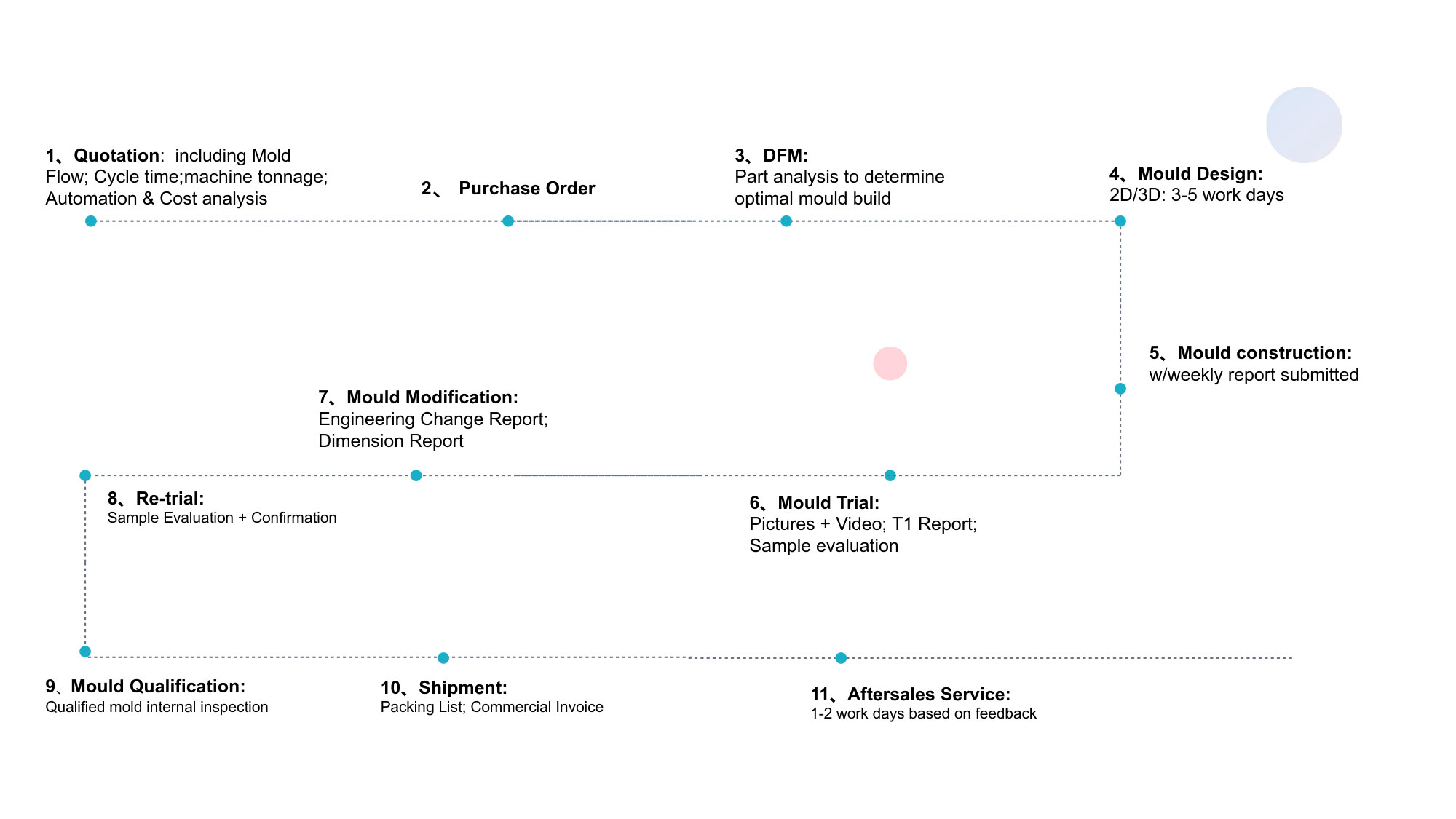
3.3 Mold Manufacturing Process Flow — From Design to Delivery
The journey from concept to finished mold follows a disciplined sequence of operations, each with defined quality gates and inspection points.
Stage 1 — Design and DFM (Week 1–2): Following project kickoff, our engineering team develops the initial mold design and conducts DFM analysis. We engage you during this stage, presenting our recommendations for gate location, cooling layout, and any modifications to your preform geometry that would improve manufacturability without affecting blow mold performance.
Stage 2 — Material Procurement and Preparation (Week 2–3): Raw materials for the mold are procured from approved suppliers. All mold steels are supplied with certified material test reports documenting chemical composition and mechanical properties. For critical components like the core pins and cavities, we perform hardness verification testing prior to machining.
Stage 3 — Rough Machining (Week 3–5): The mold base and support plates undergo rough machining to establish gross geometry. This stage removes the majority of material stock, relieving any internal stresses that could cause dimensional changes during fine machining.
Stage 4 — Heat Treatment (Week 5–6): Components requiring hardening undergo vacuum heat treatment under controlled atmosphere conditions. Heat treatment is performed with documented temperature curves and hardness verification after processing. For your preform mold, the cavity and core inserts are heat treated to HRC 48–52, balancing wear resistance against toughness.
Stage 5 — Fine Machining and EDM (Week 6–9): Five-axis high-speed milling and wire/sinker EDM operations create the final cavity geometry. Our in-house electrode production ensures that any changes required during this stage can be implemented without external supplier delays.
Stage 6 — Polishing and Surface Finishing (Week 9–11): The cavity surfaces are progressively polished to achieve the mirror finish required for transparent cosmetic preforms. Surface roughness is verified using contact profilometry.
Stage 7 — Assembly and Cooling System Testing (Week 11–12): The completed components are assembled into the finished mold. The cooling system is pressure-tested to identify any leaks before the mold is released for trial.
Stage 8 — Mold Trials (Week 12–13): The mold is installed on an injection molding machine for trial runs. We document shot weights, cycle times, and part quality at each trial stage, making any necessary adjustments to gate balance or venting before final acceptance.
Stage 9 — Final Inspection and Documentation (Week 13): Full dimensional inspection using CMM and optical measurement produces the final qualification report. All documentation—material certifications, heat treatment records, dimensional reports, and sample parts—is compiled for your records.
The result is a mold that arrives at your facility ready to run, with documented performance characteristics and a clear maintenance schedule extending years into the future.
3.4 Mold Life and Maintenance Commitment — The Ongoing Partnership
A mold is not a consumable, but neither is it a permanent asset without maintenance. We are transparent about expected mold life and provide the support necessary to achieve it.
For PET preform molds constructed with S136 or H13 cavities and cores, we guarantee mold life of 1 million cycles with proper maintenance. For standard applications, we routinely achieve 2–3 million cycles before any cavity refurbishment is required. The difference between these numbers is maintenance discipline—and we provide the documentation and spare parts to make that discipline achievable.
Every mold we deliver includes a comprehensive maintenance manual detailing lubrication schedules, cleaning procedures, and inspection checkpoints. We also provide a complete set of common spare parts—ejector pins, core pins, and wear plates—shipped with the mold. When a repair is needed, our in-house machining capabilities mean that replacement components can typically be produced within 24–48 hours, minimizing your production downtime.
Part Four: Injection Molding Process — Turning Mold Capability into Product Reliability
The finest mold in the world cannot compensate for an unstable injection molding process. At Ansix Tech, we approach process engineering with the same discipline and measurement rigor that we apply to mold manufacturing. Every parameter that influences preform quality is specified, monitored, and controlled—not approximated, but precisely managed.
4.1 Process Parameter Development — Scientific Molding Principles
We do not guess at process parameters. Our process engineers apply scientific molding methodology to develop injection molding parameters that are documented, validated, and optimized for both quality and efficiency.
PET Resin Drying — The Non-Negotiable First Step: PET is highly hygroscopic, meaning it readily absorbs moisture from ambient air. When moisture-laden PET is heated to processing temperatures, hydrolysis occurs—the polymer chains cleave, reducing molecular weight and causing IV drop. The consequences are severe: reduced bottle strength, poor clarity, and inconsistent blow molding behavior.
Our drying protocol is uncompromising. PET resin is dried to less than 50 ppm moisture content using desiccant dryers operating at 160–163°C for a minimum of 4 hours. Moisture content is verified using precision moisture analyzers before any resin is loaded into the injection machine. For perspective, 50 ppm represents 0.005% moisture by weight—virtually water-free. The customer value of this rigor is that you never receive preforms compromised by moisture-induced degradation. Your blow molding line runs with maximum yield, and your finished bottles meet their specified burst strength and impact resistance.
Injection Temperature Control — The Narrow Processing Window: PET has a relatively narrow processing temperature range of 260–295°C. Below this range, melt viscosity increases, causing incomplete cavity filling and flow marks. Above this range, thermal degradation occurs, reducing IV and producing yellow discoloration in transparent parts.
Our all-electric injection machines control barrel temperatures in five independent zones, maintaining melt homogeneity within ±2°C across all zones. Nozzle temperature is independently controlled to prevent drool or freeze-off. The result is consistent melt viscosity from the first shot of a production run to the millionth shot—no material variation, no quality drift.
Injection Pressure and Speed — Balancing Fill and Orientation: The injection phase fills the mold cavity with molten PET. For PET preforms, injection pressure typically ranges from 80–120 MPa, while injection speed is deliberately kept moderate to prevent excessive shear heating of the material.
The customer value of optimized injection parameters is both aesthetic and structural. Properly balanced injection fills the cavity completely, eliminating short shots. Controlled shear rates prevent the material degradation that would otherwise cause gate splay (silver streaks visible in transparent parts). And consistent packing pressure ensures that the preform's weight and dimensions remain within specification across all cavities of a multi-cavity mold.
Cooling Time Optimization — The Primary Lever on Cycle Time: Cooling typically consumes the majority of the injection molding cycle. For a 34g PET preform with approximately 3mm wall thickness at its thickest section, cooling time is largely determined by the preform's ability to reach ejection temperature without distortion or warpage.
Our conformal cooling channels dramatically accelerate cooling compared to conventional drilled channels. The temperature difference between core pin and cavity is maintained within 2°C using independent temperature control units for each side of the mold. Uniform cooling minimizes residual stress in the preform, reducing the warpage that would otherwise produce oval bottles during blow molding.
Through systematic process optimization, we can achieve stable cycle times of 9–12 seconds for your 38mm diameter preform, depending on the specific geometry and cooling system design. Each second saved per cycle multiplies across every cavity of your mold, directly increasing your effective production capacity without any additional capital equipment investment.
4.2 Cavity Balance and Multi-Cavity Consistency
Your preform mold may have 48, 72, or even 96 cavities—each producing a preform that must be dimensionally identical to its neighbors. Achieving cavity-to-cavity balance is one of the most demanding challenges in PET preform molding.
Runner System Design for Balanced Filling: The hot runner manifold that distributes melt to each cavity must deliver material of identical temperature, pressure, and shear history to every cavity simultaneously. Our hot runner systems are designed with flow simulation to ensure balanced fill across all cavities, with flow length and restriction matched so that each cavity fills within milliseconds of its neighbors.
Individual Cavity Weight Control: For a 34g preform, we maintain cavity-to-cavity weight variation within ±0.2–0.5%—that is, a maximum difference of approximately 0.17g between any two cavities in the same mold. This level of consistency ensures that every preform blow molds identically, regardless of which cavity produced it. No sorting, no segregation, no downstream surprises.
4.3 Process Stability and Statistical Control
We do not assume that a good process will remain good. We monitor it continuously, using statistical process control (SPC) methods to detect drift before it produces non-conforming parts.
Real-Time Parameter Monitoring: Each injection machine connected to our MES (Manufacturing Execution System) transmits real-time data on temperature, pressure, injection speed, cooling time, and part weight. These parameters are locked into the MES system, with changes permitted only by authorized process engineers. The system provides real-time monitoring of temperature, pressure, and cycle time, guaranteeing consistent product quality.
Closed-Loop Process Control: Our Industry 4.0 manufacturing platform integrates fully automated closed-loop injection molding with communication via OPC UA. This means that when process parameters drift toward specification limits, the system automatically adjusts back to target, maintaining quality without operator intervention. Early anomalies are detected by the system before they produce defects, ensuring production safety and minimizing scrap.
Statistical Process Capability: For the critical-to-quality dimensions that define your preform's performance, we compute process capability indices (Cpk) from production data. A Cpk of 1.33 indicates that the process is operating with four standard deviations of safety margin between the process mean and the specification limits. We routinely achieve Cpk values of 1.33 or higher for critical preform dimensions, providing statistical evidence of process stability that satisfies the most demanding quality audits.
Part Five: Intelligent Manufacturing — Industry 4.0 Integration for Transparency and Efficiency
The term "Industry 4.0" is often deployed as a marketing buzzword. At Ansix Tech, it is a functional reality—one that delivers measurable value to our customers through transparency, traceability, and operational efficiency.
5.1 Manufacturing Execution System — Real-Time Visibility
Our MES platform serves as the central nervous system of our manufacturing operations, integrating every injection molding machine, quality inspection station, and material handling system into a unified data architecture.
Production Tracking and Traceability: Every preform produced in our facility is associated with a production record documenting the machine that produced it, the mold cavity it came from, the batch of PET resin used, the operator responsible, and the quality inspection results. For customers in regulated industries like medical device manufacturing or pharmaceutical packaging, this level of traceability is not optional—it is mandatory. Our MES provides it as standard, not as an add-on service.
Real-Time Quality Alerts: The integration of automated optical inspection systems with our MES means that quality data flows instantly from inspection stations to production management. When any cavity begins producing out-of-spec parts, the system alerts operators immediately, before additional scrap is produced. The cost of an out-of-spec preform is not just the material—it is the freight, the processing time at your blow molding line, and the risk of customer dissatisfaction. Real-time quality alerts prevent all of these downstream costs.
Performance Analytics and Continuous Improvement: The MES aggregates production data across all machines, shifts, and product lines, enabling continuous improvement analytics. We can identify which molds are producing at the highest efficiency, which operators achieve the best quality metrics, and which process parameters correlate with optimal cycle times. This data drives our ongoing operational improvement—savings we share with you through stable or declining pricing over the life of your program.
5.2 Automation and Labor Efficiency
Manual operations introduce variation. Automation eliminates it. Wherever possible in the preform manufacturing process, we have deployed automation that reduces labor cost while improving consistency.
Automated Material Handling: PET resin is delivered from storage silos to dryers, and from dryers to injection machines, through a centralized material handling system that eliminates manual resin transfer. This automation ensures that every machine receives material of consistent dryness and bulk density, eliminating the weight variations that would otherwise result from manual loading.
Robotic Part Handling and Packaging: Preforms exiting the injection machine are handled by robotic systems that ensure consistent orientation, prevent surface damage, and pack finished parts into protective containers. The alternative—manual handling—risks scratching transparent preforms and introducing foreign materials that would become visible as black specks in finished bottles.
5.3 The Customer Value of Intelligent Manufacturing
For our customers, the value of our Industry 4.0 manufacturing platform is not technical—it is economic.
Lower Effective Cost Through Higher Yield: A 1% reduction in scrap at a plant producing 1 million preforms daily can save more than $100,000 annually. Our real-time quality monitoring and closed-loop process control achieve scrap rates significantly below industry averages. The savings are real, documented, and directly reduce your unit cost.
Faster Problem Resolution: When a quality issue does occur, our traceability systems identify the root cause within minutes rather than days. We know which machine, which cavity, which batch of resin, and which operator were involved. This rapid root cause analysis means that corrective action begins immediately, minimizing the duration of any quality deviation.
Objective Audit Evidence: For customers who require regular supplier audits, our MES provides objective, verifiable data documenting process capability, quality performance, and production volumes. The difference between a manual record and an automated system is the difference between subjective assurance and objective proof.
Part Six: Quality Assurance — Systematic Verification at Every Stage
Quality is not an inspection step—it is an outcome of a well-designed process. At Ansix Tech, we approach quality assurance as a systems engineering challenge, not a final inspection check. Our quality management system spans the entire product lifecycle, from raw material receiving through final packaging and shipment.
6.1 Incoming Quality Control — Starting with Verified Materials
No amount of process control can compensate for defective raw materials. Our incoming quality control laboratory inspects every batch of PET resin before it is released to production.
Resin Certification and Testing: Every shipment of PET resin is accompanied by a Certificate of Analysis from the supplier documenting IV value, moisture content, and color. We independently verify these parameters through our own laboratory testing, rejecting any batch that fails to meet specification.
Color and Additive Verification: For cosmetic applications requiring specific color matches or additive packages (UV stabilizers, oxygen scavengers, etc.), we perform verification testing to confirm that the resin meets your specific formulation requirements. The alternative—trusting that the resin compounder got it right—invites catastrophic product quality failures downstream.
6.2 In-Process Quality Control — Real-Time Defect Detection
The in-process quality control system integrates automated inspection equipment with real-time process data to detect and reject defective parts before they leave the machine.
Weight Monitoring: Each injection molding machine is equipped with a precision scale that verifies shot weight on a sampling basis. Weight trending is charted through the MES, with alerts triggered whenever measured weight deviates from the target by more than the statistical control limits.
Optical Preform Inspection: Automated optical inspection systems examine every preform for visible defects including bubbles, black specks, flow lines, gate splay, and dimensional variation. Defective preforms are automatically rejected and diverted from the good part stream.
Wall Thickness Measurement: The blow molding performance of a preform depends critically on wall thickness distribution. Our wall thickness measurement systems provide non-contact verification that thickness falls within specification across all key measurement points.
6.3 Final Quality Audit — Independent Verification Before Shipment
Before any shipment leaves our facility, a final quality audit verifies that the production lot meets all specified requirements.
Lot Sampling Protocol: Production lots are sampled according to a statistically valid sampling plan. Sample sizes are calculated to provide confidence that if the sample passes inspection, the entire lot has acceptably low defect levels.
Functional Testing: For each production lot, we perform blow molding trials on a representative sample of preforms. These trials verify that the preforms expand uniformly during stretch blow molding, producing bottles of consistent wall thickness and burst strength. No amount of dimensional measurement can substitute for the ultimate functional test—does the preform actually produce good bottles? We confirm this empirically.
Comprehensive Documentation: Each shipment is accompanied by a quality documentation package including material certifications, in-process inspection records, final inspection results, and any functional test reports. This documentation provides your quality assurance team with the evidence they need to accept the shipment without holding your own incoming inspection.
6.4 Defect Reduction — The Continuous Improvement Cycle
Defects are not inevitable—they are signals that the process can be improved. Our quality management system includes structured continuous improvement processes that systematically reduce defect rates over time.
Defect Root Cause Analysis: When a defect does occur, we conduct a formal root cause analysis using established problem-solving methodologies including the 5 Whys, fishbone diagrams, and failure mode and effects analysis (FMEA).
Corrective and Preventive Action (CAPA): Root cause analysis leads to corrective actions that address the specific defect and preventive actions that prevent similar defects from occurring in the future. Our CAPA process is documented and tracked, ensuring that improvements are sustained rather than temporary.
Customer Feedback Integration: Customer complaints and feedback are integrated into our quality improvement process as the most valuable source of information about our performance. We actively solicit customer feedback and treat it as an opportunity—not a threat—for improvement.
Part Seven: Cost Control and Efficiency Optimization — Lowering Your Total Cost of Ownership
The most compelling reason to partner with Ansix Tech is not our equipment, our processes, or our quality systems—it is the economic outcome those capabilities deliver: a lower total cost of ownership for your preform supply.
7.1 Material Cost Reduction — Doing More with Less
Resin cost is typically the largest variable expense in preform manufacturing. Our approach to material cost reduction targets both resin consumption and resin value.
Weight Optimization (Lightweighting): Through systematic process optimization, we can often reduce preform weight while maintaining blow molding performance and finished bottle mechanical properties. The reduction in warpage and weight achieved through optimized parameters leads to improved product quality, material efficiency, and cost savings in the manufacturing process. For your 34g preform, weight optimization could achieve a 5–10% weight reduction without compromising performance. At today's PET resin prices, that represents thousands of dollars in annual material savings.
Scrap Reduction: Our closed-loop process control and in-process inspection systems achieve scrap rates that consistently rank below industry benchmarks. Every percentage point reduction in scrap translates directly to saved material cost—material that you would otherwise pay for but never receive as usable parts.
Recycled Content Management: For customers with sustainability objectives, we have extensive experience incorporating recycled PET (rPET) into preform production. We validate every batch of rPET for IV, color, and contaminant levels, adjusting processing parameters to accommodate the material variations inherent to recycled content.
7.2 Process Efficiency — Maximizing Output Per Machine
The preform produced per hour of machine time is the fundamental driver of unit cost. Our efficiency improvements target both cycle time reduction and uptime maximization.
Cycle Time Optimization: As discussed in Section 4.1, optimized conformal cooling and process parameter development can reduce cycle time from the 14-second industry baseline to as low as 9–12 seconds for your 34g preform. The impact of even a one-second reduction is substantial: for a 48-cavity mold running 24/7, a one-second cycle time reduction adds approximately 115,000 preforms to annual capacity without any additional capital equipment.
Changeover Time Reduction: Our MES system stores complete process recipes for every product, including the drying profile, temperature settings, injection parameters, and cooling configuration. When you need to switch between different preform specifications, the system loads the complete recipe at the push of a button, reducing changeover time from hours to minutes.
Predictive Maintenance: Rather than waiting for equipment to fail, our predictive maintenance program monitors machine performance data to identify components approaching end of life. Replacement occurs during scheduled downtime rather than causing unplanned production stoppages.
7.3 Operational Cost Reduction — Lowering Overhead
Manufacturing cost is not only about resin and machine time—it also includes labor, energy, facility, and management overhead.
Energy Efficiency: Our all-electric injection machines consume 40–70% less energy than hydraulic machines of equivalent capacity. The energy saving is not just environmentally beneficial—it directly reduces our operating cost, part of which we pass to you through our pricing.
Labor Efficiency: Automation reduces the labor required to produce each preform. Our operators supervise automated systems rather than performing manual tasks, allowing each employee to oversee significantly more production volume than industry averages.
Vertical Integration: By manufacturing molds in-house and controlling the entire supply chain from resin to finished preform, we eliminate the markups and coordination costs that external suppliers would impose. The savings from vertical integration are captured as lower prices for our customers.
7.4 Transparent and Competitive Pricing
We do not obscure our pricing behind complexity. Our quotations include itemized cost components—tooling, materials, production, packaging, and freight—so you can see exactly where your money is going. And because our cost structure is lower than less efficient competitors, we pass those savings to you through pricing that beats the market while maintaining our quality standards.
Part Eight: Delivery Efficiency and Supply Chain Management
Fast delivery from order to shipment requires more than a fast production line—it requires a supply chain managed for speed, inventory positioned for responsiveness, and logistics systems optimized for reliability.
8.1 Order-to-Shipment Lead Time — How We Achieve Speed
Our typical order-to-shipment lead time for established preform specifications is 15–25 business days from order confirmation. For mold projects, lead times range from 10 weeks for simple molds to 25–45 weeks for complex multi-cavity tools. These lead times are achievable because we have eliminated the bottlenecks that cause delays elsewhere.
Resin Inventory Management: We maintain strategic inventory of the PET resins most commonly specified by our customers. When you place an order, we do not wait for resin to be ordered and delivered—we draw from inventory and begin production immediately, replenishing inventory for the next order concurrently.
Machine Capacity Planning: Our MES platform includes advanced planning and scheduling (APS) capabilities that optimize machine assignments against production priorities. Rush orders are prioritized without disrupting committed delivery dates for other customers.
Parallel Processing: For mold manufacturing, we design processes for parallel rather than sequential execution. Mold components are machined simultaneously on different machines, and cooling channels are completed while cavity finishing proceeds. The effect is a compressed overall timeline that preserves quality at each step.
8.2 Supply Chain Resilience — Protecting Your Production
A supply chain that is fast but fragile provides no long-term value. Our supply chain is engineered for resilience as well as speed.
Multi-Source Material Procurement: We maintain relationships with multiple PET resin suppliers, so a supply disruption at any single supplier does not halt our production. The cost of this redundancy is less than the cost of a single production stoppage.
Redundant Production Capacity: Our machine fleet includes multiple machines capable of running any given preform specification. If one machine requires unscheduled maintenance, we shift production to another machine while repairs proceed.
Continuous Operations Capability: For customers requiring uninterrupted supply, we maintain round-the-clock production capability with shift staffing and backup power systems. We never want to be the reason your blow molding line stops—and we design our operations to ensure that we never are.
8.3 Packaging and Shipment — Protection Through the Entire Journey
The quality of a preform is defined at the moment it leaves our injection molding machine. That quality must survive through packaging, warehousing, and transportation to your facility.
Protective Packaging Design: Our packaging specialists design packaging systems specifically for each preform geometry. For the 38mm diameter preform, we use protective trays that prevent part-on-part contact, eliminating the surface scratching that would otherwise compromise optical clarity.
Moisture Barrier Packaging: Even properly dried PET will reabsorb moisture from ambient air given sufficient time. Our preforms are sealed in moisture-barrier packaging that maintains dryness through the entire supply chain, so you can store inventory without degradation.
Damage-Resistant Palletizing: Pallets are configured for stability during transportation, with stretch wrap and corner protection preventing the load shifting that causes product damage.
Logistics Partner Management: We manage relationships with logistics providers to ensure that your shipments move through the transportation network with priority handling. For expedited deliveries, we offer air freight options with the same careful packaging protection.
Part Nine: Risk Reduction — Partnering with Ansix Tech
When you source preforms from Ansix Tech, you are not just buying a component—you are buying risk reduction. Every element of our operational approach is designed to eliminate the uncertainties that plague less capable suppliers.
9.1 Technical Risk — Eliminating the Unknowns
The most fundamental risk in preform sourcing is technical: will the preforms actually blow mold into good bottles? This question cannot be answered by engineering drawings alone. We eliminate technical risk through:
Functional Verification Before Production: We do not release any preform specification for production without completing blow molding trials that validate stretch ratio, wall thickness distribution, and mechanical performance.
Process Capability Documentation: Before you commit to a production agreement, we provide process capability documentation proving that we can achieve the required Cpk on all critical dimensions. You do not have to take our word for it—you can review the data.
Sample Approval Protocol: We provide T0 through T3 sample stages with accompanying improvement reports at each step. You see the preform quality improving with each iteration, so there are no surprises at production launch.
9.2 Supply Risk — Ensuring You Never Run Out
A supply interruption is the most catastrophic outcome for any sourcing relationship. We protect you against supply risk through:
Contractual Lead Time Commitments: Our supply agreements include specific lead time commitments, with service level agreements that define our obligations and your remedies in the event of delay.
Safety Stock Maintenance: For customers with predictable demand patterns, we maintain safety stock inventory that buffers against any production disruptions at our facility.
Transparent Communication: When any issue threatens your delivery schedule, we communicate proactively rather than waiting for you to discover the delay. Problems hidden are problems unmanaged—we keep no secrets about our performance.
9.3 Quality Risk — Preventing Defects at Your Line
A defective preform that reaches your blow molding line imposes costs far beyond its material value. In addition to the freight to get it there, the defective preform consumes machine time, occupies labor, and risks damaging downstream equipment. We prevent quality risk through:
100% In-Process Inspection: Every preform passes through automated inspection before packaging. No sampling plan, no skip-lot testing—every part inspected, every part confirmed.
Functional Release Testing: Before any shipment leaves our facility, we blow mold sample preforms from the production lot to verify functional performance. If the sample passes, the lot ships. If the sample fails, the entire lot is held pending investigation.
Lot Traceability: Should a quality issue be discovered after shipment—perhaps at your receiving inspection—our lot traceability systems allow us to identify the specific production batch, the specific mold cavities involved, and the specific time period of production. This traceability enables targeted recall rather than blanket replacement.
9.4 Financial Risk — Predictable Total Cost
Unpredictable costs are the enemy of profitable operations. We control financial risk through:
Fixed Price Quotations: Our quotes are fixed for the term of your order, with no hidden surcharges or surprise adjustments. The price you approve is the price you pay.
Volume Discount Transparency: Quantity-based discounts are clearly stated in our pricing schedules, so you can plan your order quantities with confidence in the per-unit cost.
Long-Term Pricing Stability: For customers committing to multi-year supply agreements, we offer fixed pricing extended over the agreement term, providing budget certainty that variable-price suppliers cannot match.
Part Ten: The Ansix Tech Difference — Why We Are the Right Partner
This document has systematically detailed our capabilities in mold manufacturing, injection molding, quality assurance, cost control, and delivery performance. But capabilities alone do not create customer value—value comes from applying those capabilities to solve your specific problems. Here is what that application means for you.
10.1 We Solve Your Production Pain Points
Problem: "Our current preforms vary in weight, causing inconsistent bottle quality."
Ansix Solution: Our all-electric injection machines achieve ±0.1% shot-to-shot repeatability, and our automated weight monitoring detects any deviation immediately. We do not ship weight variation—we eliminate it.
Problem: "Mold repairs are taking weeks, and we have no visibility into when the mold will be fixed."
Ansix Solution: We manufacture molds in-house and maintain spare components for every mold we deliver. Mold repairs typically complete within 24–48 hours, and our MES provides real-time visibility into repair status.
Problem: "We cannot get transparent preforms without visible flow lines or gate marks."
Ansix Solution: Our valve gate hot runner systems and optimized processing parameters produce preforms with flush gate marks and no visible flow defects. The transparency is cosmetic-grade from the first shot.
Problem: "Our current supplier's quality is inconsistent from batch to batch."
Ansix Solution: Our process control systems lock every production parameter into the MES, eliminating batch-to-batch variation. What ran well last month runs identically this month.
10.2 We Save You Real Money
Our operational capabilities translate directly to lower costs for our customers:
Material Savings: Through weight optimization and scrap reduction, we can typically reduce your preform material cost by 5–15% compared to less optimized suppliers.
Operational Savings: Our automation and efficiency improvements reduce labor and energy cost per preform, savings we share through our competitive pricing.
Downtime Avoidance: Reliable supply and consistent quality mean your blow molding line runs with fewer stops for material issues. Each avoided downtime hour is production capacity you keep.
Management Overhead Reduction: Our comprehensive documentation, transparent communication, and reliable performance reduce the management time you spend managing your preform supplier. That time can be redirected to higher-value activities.
10.3 We Reduce Your Risks
Partnering with Ansix Tech shifts risk away from you and onto us:
Technical Risk: We validate every preform design through mold flow analysis and blow molding trials before production. We do not discover problems on your production line.
Quality Risk: 100% inspection and functional testing mean defective preforms are identified and removed before they ever leave our facility.
Supply Risk: Our inventory management, redundant capacity, and proactive communication ensure that your production is never interrupted by a supply failure.
Financial Risk: Fixed pricing, transparent cost structures, and long-term agreements provide budget certainty that variable pricing cannot match.
Part Eleven: Implementation Roadmap — How We Get Started
If the capabilities described in this document align with your requirements, the path to partnership is clear and efficient.
11.1 Initial Consultation — Understanding Your Requirements
We begin with a detailed discussion of your application: the finished bottle volume, its intended use (cosmetic, personal care, pharmaceutical), any regulatory requirements (cGMP, ISO 13485, FDA), your quality expectations, your target pricing, and your delivery requirements.
During this consultation, we will also review any existing preform designs, mold specifications, or quality data you can share. The more we understand your current state, the more effectively we can propose an improved future state.
11.2 DFM Analysis and Proposal Development
Following initial consultation, our engineering team conducts a Design for Manufacturability analysis that evaluates your preform geometry against our manufacturing capabilities. The DFM identifies any modifications that would improve manufacturability, reduce cycle time, or lower material consumption without affecting blow mold performance.
Based on the DFM findings and your volume requirements, we develop a formal proposal that includes:
Mold design specifications, material selection, and manufacturing timeline
Production process parameters and expected cycle time
Quality assurance protocols and acceptance criteria
Pricing structure, including tooling amortization and per-unit costs
Delivery terms and service level commitments
Warranty terms and after-sales support provisions
11.3 Mold Manufacturing and Qualification
Upon proposal approval, we proceed with mold design, material procurement, and manufacturing according to the timeline documented in Section 3.3. Throughout the manufacturing process, we provide regular progress updates, including photographs of critical manufacturing stages and preliminary inspection results.
Mold qualification proceeds through T0, T1, T2, and T3 sample stages, with you receiving preform samples and accompanying quality reports at each stage. We do not finalize the mold until you have approved the preform samples.
11.4 Production Ramp and Long-Term Supply
Once mold qualification is complete and samples approved, we proceed to production ramp. Initial production runs are limited to 100–500 cycles to verify process stability and quality metrics before full-rate production begins.
For long-term supply, we establish a formal supply agreement that defines all commercial terms, quality specifications, delivery schedules, and service levels. We then integrate your requirements into our production planning systems, ensuring that our capacity is allocated to meet your demand with appropriate safety margins.
11.5 Ongoing Partnership and Continuous Improvement
A partnership with Ansix Tech does not end when the first shipment leaves our dock. We engage with you throughout the life of the program, seeking opportunities for continuous improvement in cost, quality, and delivery performance.
Our account management team conducts regular business reviews to assess our performance against agreed metrics, identify any emerging issues, and develop improvement plans. And our engineering team remains available to support any modifications or enhancements you may require as your product evolves.
Conclusion
The 38mm diameter, 34g round bottom PET preform that brought us to this conversation may seem like a simple component—a test-tube shaped piece of plastic that will eventually be blown into a cosmetic bottle. But as I hope this document has made clear, there is nothing simple about producing it at the quality, consistency, and cost structure that profitable operations demand.
At Ansix Tech, we have spent over 28 years mastering every element of this challenge. We have invested in the precision manufacturing equipment that eliminates variation at the source. We have developed process control systems that produce consistent quality across millions of cycles. We have built a quality assurance infrastructure that identifies and rejects defects before they become your problems. And we have structured our operations to deliver all of these capabilities at a total cost that makes you more competitive in your market.
But the most important investment we have made is in the philosophy that underlies this entire document: that technical capabilities exist only to serve customer value. Every five-axis machining center, every all-electric injection machine, every optical inspection system, and every MES data point is ultimately measured by one question only—does it make our customers more successful?
We believe the answer is yes. And we would welcome the opportunity to prove it to you on your next preform program.
About Ansix Tech
Ansix Tech is a precision injection molding manufacturer with over 28 years of experience serving customers in the cosmetic, personal care, medical device, pharmaceutical packaging, and industrial components markets. We provide integrated solutions spanning product design, mold manufacturing, injection molding production, assembly, and supply chain management. Our facilities are equipped with precision mold manufacturing equipment, all-electric injection molding machines, automated quality inspection systems, and an Industry 4.0 manufacturing execution platform that provides real-time visibility into production performance.
We are committed to transparent pricing, reliable delivery, and partnership-oriented customer relationships. For more information about our capabilities or to initiate a project discussion, please contact our customer engagement team.
Document prepared for prospective customers evaluating injection molding manufacturing partnerships. Specifications subject to change based on final design requirements.
Ansix Tech Co Ltd
If you have any plans related to 38mm diameter, 34g weight, round bottom plastic bottle preform, PET preform, transparent cosmetic bottle preform tube , you can contact us at any time. We will turn your ideas into reality, let you realize your dreams, and obtain large orders from the market. Our contact information is info@ansixtech.com. Or contact our CTO, mail: stephen@ansixtech.com
#www.ansixtech.com #ansixtech.com #38mm diameter, 34g weight, round bottom plastic bottle preform, PET preform, transparent cosmetic bottle #38mm diameter, 34g weight, round bottom plastic bottle preform, PET preform, transparent cosmetic bottle #38mm diameter, 34g weight, round bottom plastic bottle preform, PET preform, transparent cosmetic bottle injection molding companies #38mm diameter, 34g weight, round bottom plastic bottle preform, PET preform, transparent cosmetic bottle Canopy Mold injection mold companies #Ansix #Ansix moulds #Ansix china #Ansix tech china #Ansix tech company #Ansix facotry #38mm diameter, 34g weight, round bottom plastic bottle preform, PET preform, transparent cosmetic bottle injection molding #38mm diameter, 34g weight, round bottom plastic bottle preform, PET preform, transparent cosmetic bottle injection tools #38mm diameter, 34g weight, round bottom plastic bottle preform, PET preform, transparent cosmetic bottle injection moulds #38mm diameter, 34g weight, round bottom plastic bottle preform, PET preform, transparent cosmetic bottle plastic mould #38mm diameter, 34g weight, round bottom plastic bottle preform, PET preform, transparent cosmetic bottle plastic tools #Ansix Tech #Ansix molds #Ansix injection molding #Ansix mold factory #injection molding 38mm diameter, 34g weight, round bottom plastic bottle preform, PET preform, transparent cosmetic bottle #Ansix mold factory #38mm diameter, 34g weight, round bottom plastic bottle preform, PET preform, transparent cosmetic bottle china #38mm diameter, 34g weight, round bottom plastic bottle preform, PET preform, transparent cosmetic bottle molds #injection factory #38mm diameter, 34g weight, round bottom plastic bottle preform, PET preform, transparent cosmetic bottle injection molding #38mm diameter, 34g weight, round bottom plastic bottle preform, PET preform, transparent cosmetic bottle injection molding factory #injection molding company #38mm diameter, 34g weight, round bottom plastic bottle preform, PET preform, transparent cosmetic bottle injection mold companies #38mm diameter, 34g weight, round bottom plastic bottle preform, PET preform, transparent cosmetic bottle#38mm diameter, 34g weight, round bottom plastic bottle preform, PET preform, transparent cosmetic bottle mold limited #Ansix mold china #Ansix companies #Ansix company China #38mm diameter, 34g weight, round bottom plastic bottle preform, PET preform, transparent cosmetic bottle facotry #Ansix Tech #Ansix Tech mould #38mm diameter, 34g weight, round bottom plastic bottle preform, PET preform, transparent cosmetic bottle injection moulding #injection moulding company #Ansix 38mm diameter, 34g weight, round bottom plastic bottle preform, PET preform, transparent cosmetic bottle parts injection mold companies #medical injection molding companieschina #38mm diameter, 34g weight, round bottom plastic bottle preform, PET preform, transparent cosmetic bottle china factory #Ansix moulding companies #Ansix molding company #38mm diameter, 34g weight, round bottom plastic bottle preform, PET preform, transparent cosmetic bottle injection moulding facotry #Ansix Tech mold #38mm diameter, 34g weight, round bottom plastic bottle preform, PET preform, transparent cosmetic bottle mould #38mm diameter, 34g weight, round bottom plastic bottle preform, PET preform, transparent cosmetic bottle plastic injection molding #ansix plastic mold #Mold manufacturing #38mm diameter, 34g weight, round bottom plastic bottle preform, PET preform, transparent cosmetic bottle parts manufacturing #38mm diameter, 34g weight, round bottom plastic bottle preform, PET preform, transparent cosmetic bottle plastic parts factory #38mm diameter, 34g weight, round bottom plastic bottle preform, PET preform, transparent cosmetic bottle injection parts mold #38mm diameter, 34g weight, round bottom plastic bottle preform, PET preform, transparent cosmetic bottle PRECISION MANUFACTURING #38mm diameter, 34g weight, round bottom plastic bottle preform, PET preform, transparent cosmetic bottle #China mold #38mm diameter, 34g weight, round bottom plastic bottle preform, PET preform, transparent cosmetic bottle injection moulding china #38mm diameter, 34g weight, round bottom plastic bottle preform, PET preform, transparent cosmetic bottle mould china #china precision mold #mold in china #38mm diameter, 34g weight, round bottom plastic bottle preform, PET preform, transparent cosmetic bottle mold china #Precision molds #High-precision molds #38mm diameter, 34g weight, round bottom plastic bottle preform, PET preform, transparent cosmetic bottle #Injection molds #38mm diameter, 34g weight, round bottom plastic bottle preform, PET preform, transparent cosmetic bottle Factory #38mm diameter, 34g weight, round bottom plastic bottle preform, PET preform, transparent cosmetic bottle Company #Super Large Injection Mold Factory #Large Tonnage Injection Molding Factory #38mm diameter, 34g weight, round bottom plastic bottle preform, PET preform, transparent cosmetic bottle Company #38mm diameter, 34g weight, round bottom plastic bottle preform, PET preform, transparent cosmetic bottle Factory #2800T Injection Molding Factory #3000 Ton Injection Molding #4500 Ton Injection Molding Factory #Large Mold Injection Molding #Large Plastic Mold Injection Molding Factory #Large Injection Mold Manufacturer #Plastic Mold Factory #Injection Mold #Plastic Mold