



LG Washing Machine Electronic Control Board Protective Cover
FEATURES
Manufacturing Process: Our manufacturing begins with rigorous material selection. For LG’s electronic control board protective cover, we primarily utilize UL94 V-0 flame-retardant engineering plastics, which are capable of withstanding 650°C to 750°C glow wire tests without ignition, ensuring the highest level of fire safety for household appliances. These high-grade materials possess excellent electrical insulation properties, dimensional stability, and resistance to environmental aging. The molding process is executed on fully automated, servo-electric injection molding machines, offering repeatability accuracy within ±0.1%, ensuring that every single molded cover is dimensionally consistent with the specification. All machines are integrated with a MES (Manufacturing Execution System) that locks in all key parameters—temperature, pressure, speed, and cycle time—and permits adjustments only by authorized engineers.
-
Mold Description
Product Materials:
ABS/PC
Mold Material:
S136ESR
Number of Cavities:
2
Glue Feeding Method:
Hot runner
Cooling Method:
Water cooling
Molding Cycle
32.5s
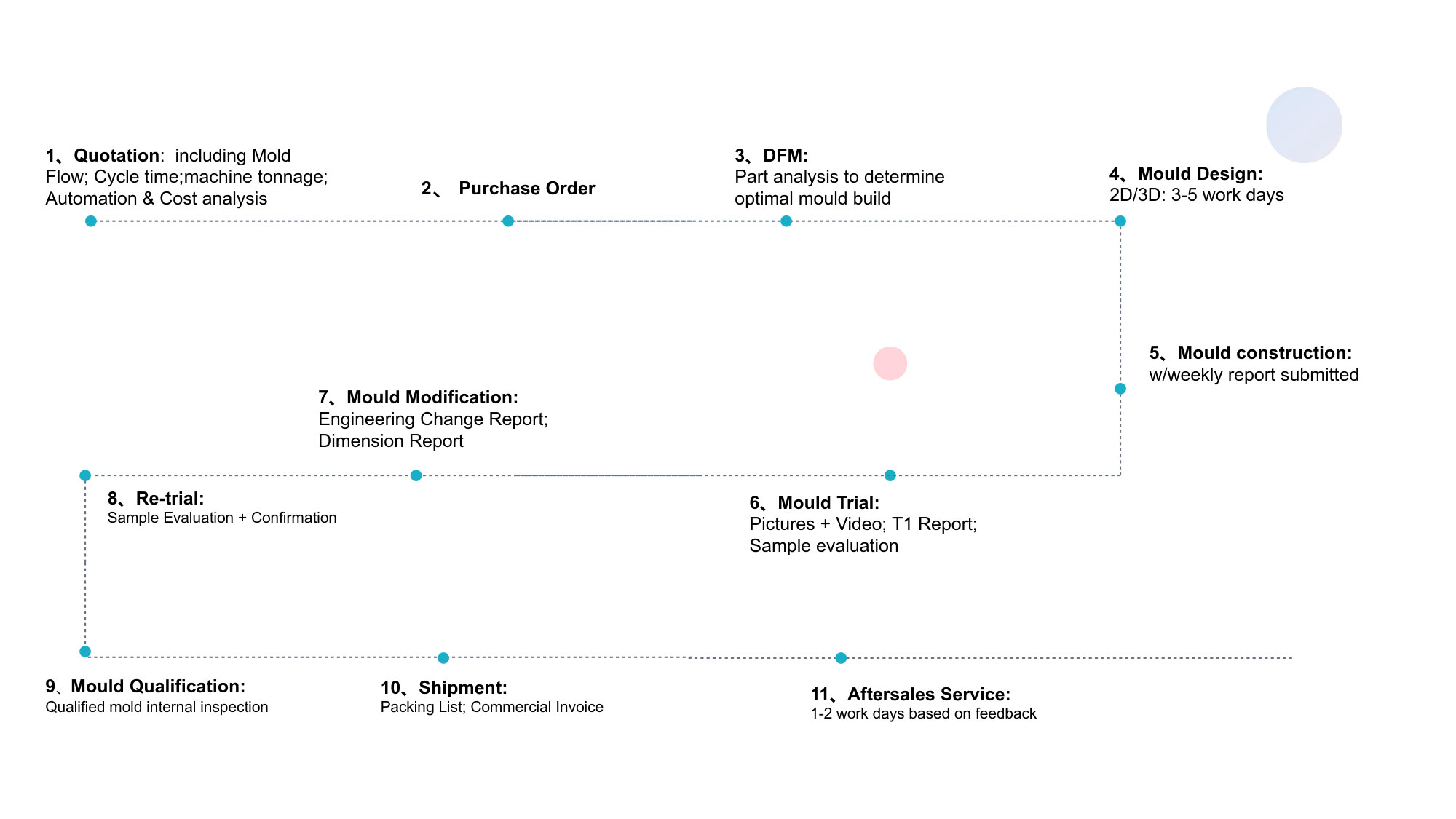
- The mold manufacturing process and product material selection
LG Washing Machine Electronic Control Board Protective Cover – Mold Manufacturing, Material Selection, Smart Manufacturing Integration, Process Quality Assurance, and Core Customer Value
Mold Manufacturing and Material Selection: The mold is the heart of the production process. For LG‘s electronic control board protective cover, we adopt a disciplined material strategy. The mold base is constructed from P20 steel for long-term structural integrity, while the mold core and cavities are machined from premium tool steels such as S136 (stainless mold steel), 2344/H13 (high-toughness hot-work steel), SKD61, or NAK80 (pre-hardened steel). These materials are selected based on the production volume and the specific resin being processed. For glass-fiber reinforced plastics, we guarantee mold life of over 500,000 shots; for standard unfilled resins, life expectancy exceeds 1,000,000 cycles. Each mold is accompanied by a full material certificate and a heat treatment curve to provide full transparency and assurance.
-
Smart Manufacturing Integration and Efficiency Improvement: Our production is powered by Industry 4.0 principles. All injection molding machines are connected to a central MES database. This system monitors every process variable in real-time, including melt temperature, injection pressure, holding pressure, and cooling time. Parameters are software-locked, preventing unauthorized or accidental changes. This real-time data collection enables predictive maintenance and rapid troubleshooting, directly translating into higher overall equipment effectiveness (OEE). Ultrasonic wall thickness sensors are installed on certain production lines to provide real-time feedback on dimensional fluctuations, allowing the machine to automatically adjust packing pressure to compensate. By implementing smart manufacturing technologies, we have increased production throughput while simultaneously reducing scrap rates and energy consumption.
Process Quality Assurance: The quality assurance philosophy extends far beyond final inspection. It is embedded into every step of the manufacturing cycle. Before any mass production begins, a comprehensive process validation (IQ/OQ/PQ) is conducted. The mold cavity surface temperature is controlled using a mold temperature controller, with the temperature difference between the core and cavity maintained within ±2°C to minimize residual stress and prevent part warpage. This is particularly critical for thin-walled electronic covers where flatness is paramount. The full validation package includes an initial sample inspection report (ISIR) with all critical dimensions recorded, a capability study (Cpk report), and a process window analysis that documents the acceptable range for all key molding parameters.
Core Customer Value: The ultimate value delivered to the customer is a perfectly produced protective cover that integrates flawlessly into the final product assembly. The combination of robust mold design, scientifically selected materials, smart manufacturing execution, and rigorous in-process quality control generates a product that is dimensionally exact, visually flawless, and functionally reliable. Customers benefit from reduced assembly line downtime caused by ill-fitting covers, lower field failure rates due to inadequate protection of the sensitive PCB, and decreased total cost of ownership over the lifecycle of the appliance. We transform what could be a simple plastic component into a value-adding engineered solution that enhances the safety, durability, and market reputation of the final washing machine.
Document 3: Comprehensive Manufacturing Solution for LG Washing Machine Electronic Control Board Protective Cover – Mold Manufacturing, Injection Molding, Production Capabilities, Quality Validation, and Cost Optimization by Ansix Tech
Executive Summary
Ansix Tech Limited, established in 1998 in Hong Kong, is a leading provider of one-stop injection molding solutions with over 28 years of industry experience. The company specializes in the design and manufacturing of precision injection molds and the high-volume production of injection-molded components. With four production bases strategically located in China and Vietnam and employing over 1,200 people, including more than 200 dedicated design engineers, Ansix Tech possesses the scale, technical depth, and operational maturity to serve demanding clients in the home appliance, automotive, medical, and consumer electronics sectors.
The LG Washing Machine Electronic Control Board Protective Cover is a safety-critical and function-critical component. Any dimensional variation, warpage, flash, or incomplete fill can compromise the seal integrity of the PCB enclosure, potentially allowing moisture ingress and leading to washing machine malfunction or even electrical safety hazards. This detailed solution document explains exactly how Ansix Tech addresses every aspect of product development, from material selection and mold construction to mass production and delivery, while translating raw technical specifications into tangible customer value—lower costs, reduced risks, faster time-to-market, and superior product reliability.
Section I: Hard Power Infrastructure – Building Customer Trust Through World-Class Equipment
The foundation of any successful injection molding project is the manufacturing equipment. Before discussing mold design or production processes, it is essential to demonstrate the physical capabilities of the production floor.
1.1 Mold Manufacturing Equipment:
At Ansix Tech, the mold fabrication workshop is equipped with high-end machinery capable of achieving sub-micron precision.
Five-Axis High-Speed Machining Centers: These machines are capable of machining complex three-dimensional contoured surfaces with an accuracy of ±0.002mm. For an electronic control board protective cover, this level of precision directly translates into a smooth, step-free parting line, eliminating sharp edges that could damage the PCB or interfere with assembly.
Wire EDM (Electrical Discharge Machining): For features such as 0.03mm fine venting slots and core pins that produce small-diameter holes, we utilize slow wire EDM. These fine features are often required for mould venting to prevent gas traps and burn marks on cosmetic surfaces. The high-precision wire cutting ensures that thin-walled sections of the cover are formed without deflection or deformation during ejection.
CNC EDM (Spark Erosion) with Electrode Manufacturing: An in-house electrode production center and a bank of CNC EDM machines allow us to machine complex cavity details, such as internal ribs, snap-fit hooks, and fine texture, with exceptional accuracy. By owning the entire electrode manufacturing process, we eliminate third-party lead times and gain complete control over surface finish quality.
1.2 Injection Molding Machine Fleet:
Ansix Tech operates a total of 260 injection molding machines with clamping forces ranging from 30 tons up to 2,800 tons, sourced primarily from leading Japanese manufacturers such as Fanuc. For an LG electronic control board protective cover, which typically falls into the small-to-medium part size category, we deploy machines in the 50-ton to 300-ton range, ensuring efficient energy consumption and precise control. All machines are fully electric, servo-driven systems, guaranteeing shot-to-shot repeatability within ±0.1%, eliminating the risk of part-to-part variation often seen with older hydraulic systems. This repeatability is critical because the protective cover must interface precisely with the mounting boss pattern on the washing machine chassis—any variation in hole location can cause cross-threading or stress fractures during assembly.
1.3 In-House Inspection and Metrology:
Quality is not assumed; it is measured. Ansix Tech maintains a comprehensive metrology laboratory featuring:
Coordinate Measuring Machines (CMM): For precise measurement of complex three-dimensional geometries and true-position tolerances.
Optical Comparators and Vision Measurement Systems: For rapid, non-contact measurement of profiles, angles, and hole positions.
Surface Roughness Testers: To certify the cosmetic finish of critical sealing surfaces.
Full-Size Reporting Protocol: Before any new mold is released from our facility, we issue a complete dimensional report comparing every measured feature against the customer‘s 2D drawing specification. All CTQ (Critical-to-Quality) dimensions are validated to a minimum CPK of 1.33 during the process qualification phase.
Customer Value Delivered: By investing in this tier of equipment, Ansix eliminates common manufacturing defects before they occur. The customer does not need to worry about mismatched parting lines, flash requiring manual trimming, out-of-tolerance dimensions causing assembly jams, or delayed program timelines due to tooling rework. This equipment base is the foundational promise that parts will be right the first time, every time.
Section II: Core Competencies in Mold Manufacturing – Precision, Material Science, and Lifecycle Value
The injection mold is the single most important asset affecting the final part quality, production rate, and overall project profitability. Ansix Tech overpays attention to the scientific and practical details of mold construction.
2.1 Mold Life and Steel Selection:
LG and other leading appliance brands require molds that can withstand millions of production cycles without degrading dimensional accuracy. Ansix Tech provides a guarantee on mold life based on the specific material processed:
For general-purpose plastics (ABS, PC/ABS, PP): Mold life of 1,000,000 shots or more is standard.
For glass-fiber-reinforced materials (PPS+40%GF, PA6+GF30, PBT+GF): Mold life of 500,000 shots is guaranteed, using high-hardness tool steels.
The choice of mold steels follows a disciplined selection matrix:
Steel Grade Hardness Application Value
S136 (Stavax ESR) HRC 48-52 Corrosion-resistant stainless steel for humid environments; provides A-grade mirror finish (Ra < 0.1μm)
2344 / H13 (Improved) HRC 46-50 Superior toughness for mold cores subjected to high injection pressures
8407 HRC 48-52 High-polishability and wear resistance for long-run mass production
NAK80 HRC 37-43 Pre-hardened steel for shorter lead time prototypes; excellent polishability
SKD61 / DC53 HRC 50-55 High-strength tool steel for mold inserts subjected to repeated shear stress
Every mold is supplied with a full material certificate and a documented heat treatment curve, ensuring full traceability and metallurgical consistency.
2.2 Achievable Dimensional Tolerances:
Part Type Tolerance Achieved
General structural features ±0.05mm
Precision snap fits and locating features ±0.02mm
Critical mating surfaces and flanges ±0.01mm
2.3 Mold Configuration and Gating Systems:
Hot Runner Systems: For high-volume production of LG control board covers, we recommend and implement valve-gated hot runner systems. The advantages are substantial: elimination of runner scrap reduces material waste by up to 40%; lower injection pressure requirements reduce stress on the part; faster color changes when multiple LG models require different coloration; and minimal gate vestige leaves a clean cosmetic surface.
Cold Runner Systems: For smaller volumes or price-sensitive programs, we use balanced runner systems designed using mold flow analysis to ensure simultaneous cavity filling, regardless of the distance from the sprue.
Multi-Cavity Molds: For the LG protective cover—typically a compact part—we can design family or multi-cavity molds (2-cavity, 4-cavity) to multiply output per machine cycle without compromising part quality.
2.4 Ejection and Venting Systems:
Through decades of mold design experience, Ansix has standardized best practices for ejection and venting. Ejector pins are strategically placed in non-cosmetic locations and on the underside of ribs. Ejection pins are sized and positioned to apply uniform force, preventing part distortion during the ejection stroke. Venting channels are machined to depths of 0.02mm to 0.05mm at the parting line and at the end of fill, allowing trapped air to escape and preventing burn marks on the final part.
2.5 Cooling System Design – Conformal Cooling for Cycle Time Reduction:
The cooling phase typically accounts for 50% to 70% of the total cycle time in injection molding. Ansix utilizes advanced conformal cooling channels that follow the contour of the LG protective cover. This approach efficiently removes heat from specific hot spots, such as thick rib sections and gate areas. By maintaining uniform cavity temperature across the mold, the cooling system reduces overall cycle time by 20% to 30% compared to conventional straight-drilled cooling channels. Faster cycles translate directly into lower piece-part cost and increased daily output without adding capital equipment.
Customer Value Delivered: The customer receives a mold that produces dimensionally stable parts from the very first production run, with no need for post-production trimming, deburring, or secondary rework. The mold runs for millions of cycles with predictable performance, and cooling efficiency delivers significant cost savings per part over the full mold life.
Section III: Injection Molding Process Control – From Raw Material to Finished Cover
The injection molding process is where theoretical design meets production reality. Ansix Tech treats injection molding as a closed-loop, data-driven discipline, not an art form.
3.1 Raw Material Selection – Engineering the PCB Cover Properties:
The LG Washing Machine Electronic Control Board Protective Cover is typically manufactured from flame-retardant engineering plastics. Material selection is determined by safety standards (UL94 V-0 is mandatory for electronic enclosures), mechanical requirements (impact strength for accidental drops during service), and environmental needs (moisture resistance).
Common Materials and Specific Grades for Electronic Control Covers:
Material Grade Key Properties Typical Applications
UL94 V-0 FR ABS Good impact strength, excellent surface finish, UL94 V-0 at 1.5mm thickness Standard control board covers
UL94 V-0 FR PC/ABS Higher heat deflection (up to 110°C RTI), improved dimensional stability High-temperature electronic enclosures, safety-critical applications
UL94 V-0 FR PP (Halogen-Free) Lower cost, better chemical resistance, UL94 V-0 at 1.5mm-3.0mm, meets RoHS/SVHC Cost-sensitive, large-volume programs
PBT+GF30 FR (V0) High stiffness, low moisture absorption, excellent creep resistance Precision-fit covers with integrated snap features
Flame-Retardant PPE/PS Outstanding electrical insulation, minimal moisture absorption, UL94 V-0 rating High-voltage isolation covers
For a typical LG PCB cover, Ansix Tech works with certified compounders to source UL94 V-0 compliant materials that also meet specific LG-proprietary flammability, CTI (Comparative Tracking Index, >250V per IEC 60112), and GWIT (Glow Wire Ignition Temperature >750°C) requirements. All incoming materials are documented with batch numbers, traceability records, and mill certificates.
3.2 Pre-Molding Drying and Handling – Avoiding Moisture-Induced Defects:
Many engineering plastics are hygroscopic. PC/ABS, in particular, must be dried to a moisture content below 0.02% before processing to prevent splay, bubbles, and degradation. Ansix utilizes dehumidifying dryers with honeycomb rotor technology, capable of achieving dew points as low as -40°C, ensuring that all moisture-sensitive resins are processed under optimal conditions.
3.3 Process Optimization for Efficiency and Cost:
Parameter Optimization Strategy Customer Benefit
Melt Temperature Tightly controlled heating barrel profile to prevent resin degradation No yellowing, carbon deposits
Injection Speed Profiled injection speed (slow at start → fast to fill thin walls → deceleration near end-of-fill) Warpage-free parts, no jetting
Holding Pressure Two-stage holding (high pressure to pack out thick sections → low pressure to relieve stress) Sink-free ribs, no post-mold shrinkage
Cooling Time Optimized channel layout delivering uniform cavity temperature (±2°C) 20-30% cycle reduction, output increase
Clamp Force Automatic lock-up pressure compensation to prevent flash Flash <0.03mm, eliminating manual deburring
Cavity Pressure Sensors Real-time cavity pressure monitoring with closed-loop adjustment Batch-to-batch dimensional stability, zero re-grind
3.4 MES-Integrated Parameter Control – Eliminating Operator Variability:
Every injection molding machine at Ansix Tech is connected to a central MES. All 40+ process parameters (injection pressure, holding pressure, back pressure, screw speed, barrel temperature profile, mold temperature, cooling time, etc.) are password-locked. Only an authorized process engineer can adjust these values after a proper change request is documented. For each production batch, we conduct a first-article inspection (FAI) and a last-article inspection. Any batch exhibiting process drift outside the defined process window is automatically quarantined.
Customer Value Delivered: The customer never receives parts with inconsistent dimensions, color variation from batch to batch, or hidden defects that appear only after assembly. By enforcing MES-locked process controls, we eliminate the “human error” factor and guarantee part consistency over millions of cycles.
Section IV: Full-Service Lifecycle Support – Reducing the Customer‘s Total Cost of Ownership
Ansix Tech distinguishes itself from traditional tool shops and molding houses by offering a comprehensive, cradle-to-grave service model. This approach reduces the customer’s administrative burden, shortens the program management timeline, and lowers total project cost.
4.1 Early Engineering Engagement – DFM (Design for Manufacturability) Report:
Before cutting any steel or committing to tooling investment, Ansix Tech‘s engineering team conducts a comprehensive DFM review. The DFM report includes the following critical analyses delivered to the customer for approval:
Mold Flow Analysis: Using Moldflow simulation software, we simulate the plastic melt flow inside the mold cavity. The simulation predicts filling patterns, identifies potential short shots, highlights weld line locations, pinpoints air traps, and suggests improvements such as gate relocation or fill speed adjustments.
Shrinkage and Warpage Prediction: The software predicts how the part will shrink upon cooling, allowing the mold cavity to be cut oversized by the correct compensation amount.
Draft Angle Analysis: We check all vertical walls to ensure sufficient draft (typically 1° to 3°) to guarantee smooth ejection without scratching cosmetic surfaces.
Thickness Uniformity Review: Thin sections cool faster than thick sections, creating residual stress and warpage. We review the 3D model and recommend uniform wall thickness or tapered transitions from thick to thin zones.
Gate Location Selection: The gate location determines the fill pattern, weld-line position, and cosmetic gate vestige location. Our engineers recommend the optimal gate location on flat or non-cosmetic surfaces to preserve the visible appearance of the finished cover.
Ejector Pin Mark Location: All ejector pin marks are identified and placed on non-cosmetic surfaces or inside the assembly such that they will not be visible to the end user.
Customer Value Delivered: The DFM report eliminates 90% of potential molding problems before the mold is built. The customer saves tens of thousands of dollars in mold rework costs and weeks of program delay. This stage is the single most cost-effective investment in the entire project.
4.2 Sample Progression – Structured T0, T1, T2, T3 Validation:
Ansix follows a disciplined, four-stage sample validation protocol:
Sample Stage Purpose Deliverables to Customer
T0 (First-Off Trial) Verify basic mold functionality (opening/closing, ejection, cooling channel integrity). No dimensional acceptance criteria. Visit report, sample parts
T1 (First Tuned Trial) First acceptable samples (within ±0.1mm of drawing). Dimension baselining, cosmetic surface evaluation. Sample parts, FAIR, corrective action plan
T2 (Process Stability Trial) Process window definition, capability study. 32-50 continuous shots measured. Cpk report (≥1.33 for CTQ dimensions), initial process parameter sheet
T3 (Process Validation) Long-run validation (100-500 parts) at full production cycle time, full quality checks. pp. Full ISIR, final CPK data, lot acceptance
Pre-Production Pilot (100-500 shots) Simulates mass production conditions; identifies any systemic issues Process capability confirmation, approval for mass production
Each sample iteration is accompanied by a detailed corrective action report (CAR), listing each non-conforming feature, the root cause analysis, and the proposed tool modification.
4.3 Maintenance and Spare Parts Service:
Molds will eventually wear. Ansix minimizes downtime by including a set of spare wear components with every new mold:
Spare ejector pins (5% of total quantity)
Spare core pins for vulnerable thin-wall features
Spare parting line lock components
Spare heater bands and thermocouples (for hot runner systems)
We also offer mold preventive maintenance agreements. At intervals of every 200,000 production cycles, Ansix will retrieve the mold, perform a complete teardown, clean cooling channels, polish surfaces, inspect for wear, and replace any worn components. This service is available at cost-plus pricing, with no hidden markups.
Customer Value Delivered: The customer never experiences unexpected production shutdowns due to mold failure. Repair wait times are reduced from weeks to 24 hours or less for standard components. The mold continues to deliver high-quality parts for the entire duration of the appliance production life.
Section V: Quality Assurance and Validation Systems – Eliminating Downstream Liability
Injection molding is not a laboratory exercise; it is a volume production process. Ansix Tech has built an ISO 9001-certified quality management system that operates at every step of the workflow.
5.1 Incoming Quality Control (IQC):
Every batch of incoming plastic resin is quarantined until a material certificate and melt-flow index (MFI) verification test is conducted. Only resin that passes the MFI specification is released for production.
5.2 In-Process Quality Control (IPQC):
Online Vision Inspection Systems: Installed on high-volume production lines to detect sink marks, flash, short shots, and dimensional variations in real time.
Statistical Process Control (SPC): For every hour of continuous production, an operator measures select CTQ dimensions, records the values onto an SPC control chart, and plots the trend. If any measurement exceeds the control limit, the machine is stopped for investigation.
Cavity Pressure Monitoring: For electronics-grade protective covers, Ansix utilizes in-mold pressure sensors that are connected to closed-loop controllers. If a shot exhibits cavity pressure above or below the acceptable window, the system auto-rejects that part.
5.3 Outgoing Quality Control (OQC):
Before any shipping container leaves the plant, an AQL (Acceptable Quality Level) sampling plan is executed. Typically, we apply AQL limits of 0.65 for critical dimensions and 1.0 for cosmetic defects. A full dimensional FAIR (First Article Inspection Report) is completed for the first shipment of every new part number.
5.4 Full Traceability:
Ansix Tech uses a direct part marking (laser marking) system to print traceable batch codes onto either the part surface or the sprue tag. The code links back to the specific machine, operator shift, raw material lot number, and QA inspection records. In the unlikely event of a field failure, full forensic traceability enables root cause analysis within hours.
Customer Value Delivered: The customer does not need to perform incoming inspection on every batch—our CPK and SPC data can be relied upon. There are no unexpected production stoppages due to parts failing in assembly. If an issue is ever found, traceability allows a targeted, low-cost recall rather than broad-scrap action.
Section VI: Differentiated Value – Direct Answers to Common Injection Molding Pain Points
Rather than simply listing technical credentials, Ansix Tech has built its value proposition around solving the specific problems that procurement and engineering teams face with typical injection molding suppliers.
Customer Complaint About Typical Suppliers Ansix Tech Commitment (Based on Proven Internal Capabilities)
The mold arrives and it was worn after only 200,000 shots. We run a 2,000-shot aging test on all new molds, document the wear pattern, and provide a written mold structure warranty for three years, covering structural integrity.
Parts have excessive flash, adding hours of manual deflashing labor. By machining parting lines to ±0.005mm accuracy and using automatic clamp force compensation during molding, we guarantee flash ≤0.03mm for the first million shots—eliminating all manual touch-up.
The first shipment fits perfectly, but the second shipment 6 months later is warped. Our closed-loop cavity pressure control and MES-locked parameters guarantee process repeatability across batches, operators, and shifts. No specification drift over time.
We have to send every mold out for repair—weeks without production. Because we operate in-house electrode manufacturing and EDM centers, 24-hour turnaround is standard for standard wear repairs (ejector pin replacement, core pin repair, polishing).
Our supplier never told us the gate mark would be visible on the front surface. Our DFM identifies gate locations and gate mark visibility before the first tool is cut. We present options—hot runner valve gate (no visible mark) or strategic cold gate placement.
Section VII: How Ansix Tech Reduces Project Costs – A Systematic Approach
Cost reduction is not achieved by using cheaper materials or cutting quality corners. Ansix Tech‘s cost advantage is structural and systematic:
Cost Reduction Strategy Mechanism Typical Savings Range
DFM-Driven Design Gates, draft angles, uniform wall thickness optimized before mold build; eliminates rework Saves 10-15% of mold cost
Hot Runner Material Savings Eliminates sprue and runner scrap; material waste drops from 30% to near 0% 25-40% material cost reduction
Cycle Time Reduction via Conformal Cooling Reduced cooling time accelerates output per machine, lowering piece-part overhead 15-30% labor/energy cost reduction
Multi-Cavity Molds Producing 2-4 parts per machine cycle instead of 1 reduces labor and per-part overhead costs 25-50% per-part overhead reduction
Automated Quality Inspection Eliminates manual sorting, reduces scrap, prevents rework 5-10% scrap reduction
Vertically Integrated Supply Chain In-house mold fabrication, molding, tool room, quality lab—no middleman 10-20% total project cost reduction
Section VIII: Conclusion – Transforming a Simple Cover into a Value-Bearing Asset
For Ansix Tech, an injection mold is not just a block of machined steel; it is a productive asset that generates value for the customer year after year. The LG Washing Machine Electronic Control Board Protective Cover, though modest in size, plays a critical role in the safety, reliability, and long-term durability of a major household appliance.
Ansix Tech‘s 28-year history, four production bases, 260 injection molding machines, 200 designers, and ISO 9001-certified quality management system provide the engineering muscle to deliver on every commitment. But what truly differentiates Ansix is the customer-centric philosophy: technical specifications are not discussed in isolation, but are always framed as solutions to specific customer problems. A 0.002mm high-speed machining center is not merely about precision—it is about eliminating step marks that would scrape a PCB. A 0.05mm mold vent is not just a geometry—it is about eliminating burn marks that would be visible to the end consumer. A 1.33 CPK is not a statistics class—it is about your assembly line never stopping because a cover does not fit.
For customers evaluating Ansix Tech for the LG Washing Machine Electronic Control Board Protective Cover—or for any injection-molded plastic component requiring precision, volume, and value—the company welcomes the opportunity to conduct a sample DFM report walkthrough. During this session, we will demonstrate exactly how we anticipate melt flow patterns, prevent weld line defects, eliminate gas traps, and optimize cooling to deliver a part that is ready for assembly directly from the injection molding machine. Schedule a consultation to experience the difference that almost three decades of focused injection molding leadership can make to your next project.
Ansix Tech Co Ltd
If you have any plans related to LG Washing Machine Electronic Control Board Protective Cover , you can contact us at any time. We will turn your ideas into reality, let you realize your dreams, and obtain large orders from the market. Our contact information is info@ansixtech.com. Or contact our CTO, mail: stephen@ansixtech.com
#www.ansixtech.com #ansixtech.com #LG Washing Machine Electronic Control Board Protective Cover #LG Washing Machine Electronic Control Board Protective Cover moulds #LG Washing Machine Electronic Control Board Protective Cover injection molding companies #LG Washing Machine Electronic Control Board Protective Cover Canopy Mold injection mold companies #Ansix #Ansix moulds #Ansix china #Ansix tech china #Ansix tech company #Ansix facotry #LG Washing Machine Electronic Control Board Protective Cover injection molding #LG Washing Machine Electronic Control Board Protective Cover injection tools #LG Washing Machine Electronic Control Board Protective Cover injection moulds #LG Washing Machine Electronic Control Board Protective Cover plastic mould #LG Washing Machine Electronic Control Board Protective Cover plastic tools #Ansix Tech #Ansix molds #Ansix injection molding #Ansix mold factory #injection molding LG Washing Machine Electronic Control Board Protective Cover #Ansix mold factory #LG Washing Machine Electronic Control Board Protective Cover china #LG Washing Machine Electronic Control Board Protective Cover molds #injection factory #LG Washing Machine Electronic Control Board Protective Cover injection molding #LG Washing Machine Electronic Control Board Protective Cover injection molding factory #injection molding company #LG Washing Machine Electronic Control Board Protective Cover injection mold companies #LG Washing Machine Electronic Control Board Protective Cover#LG Washing Machine Electronic Control Board Protective Cover mold limited #Ansix mold china #Ansix companies #Ansix company China #LG Washing Machine Electronic Control Board Protective Cover facotry #Ansix Tech #Ansix Tech mould #LG Washing Machine Electronic Control Board Protective Cover injection moulding #injection moulding company #Ansix LG Washing Machine Electronic Control Board Protective Cover parts injection mold companies #medical injection molding companieschina #LG Washing Machine Electronic Control Board Protective Cover china factory #Ansix moulding companies #Ansix molding company #LG Washing Machine Electronic Control Board Protective Cover injection moulding facotry #Ansix Tech mold #LG Washing Machine Electronic Control Board Protective Cover mould #LG Washing Machine Electronic Control Board Protective Cover plastic injection molding #ansix plastic mold #Mold manufacturing #LG Washing Machine Electronic Control Board Protective Cover parts manufacturing #LG Washing Machine Electronic Control Board Protective Cover plastic parts factory #LG Washing Machine Electronic Control Board Protective Cover injection parts mold #LG Washing Machine Electronic Control Board Protective Cover PRECISION MANUFACTURING #LG Washing Machine Electronic Control Board Protective Cover #China mold #LG Washing Machine Electronic Control Board Protective Cover injection moulding china #LG Washing Machine Electronic Control Board Protective Cover mould china #china precision mold #mold in china #LG Washing Machine Electronic Control Board Protective Cover mold china #Precision molds #High-precision molds #LG Washing Machine Electronic Control Board Protective Cover #Injection molds #LG Washing Machine Electronic Control Board Protective Cover Factory #LG Washing Machine Electronic Control Board Protective Cover Company #Super Large Injection Mold Factory #Large Tonnage Injection Molding Factory #LG Washing Machine Electronic Control Board Protective Cover Company #LG Washing Machine Electronic Control Board Protective Cover Factory #2800T Injection Molding Factory #3000 Ton Injection Molding #4500 Ton Injection Molding Factory #Large Mold Injection Molding #Large Plastic Mold Injection Molding Factory #Large Injection Mold Manufacturer #Plastic Mold Factory #Injection Mold #Plastic Mold