



LSR Liquid Silicone Laryngeal Mask
FEATURES
Manufacturing Process Overview
Raw Material Preparation
The manufacturing process begins with two-component medical-grade LSR — typically products such as Wacker SILPURAN® 6610/60 A/B or Silopren™ LSR 3950 series, which are FDA 21 CFR 177.2600 and USP Class VI compliant. The base polymer (Part A) and crosslinking/curing agent (Part B) are stored separately and precisely metered at a 1:1 ratio using automated dosing systems.Injection Molding
The two components are combined through a static mixer, ensuring thorough homogenization before entering the injection barrel. The mixed LSR is then injected into a precision-machined mold cavity under controlled pressure and temperature conditions. The mold is heated to typical curing temperatures between 150°C and 200°C, initiating the crosslinking (vulcanization) reaction that transforms the liquid silicone into a solid elastomer.
-
Mold Description
Product Materials:
LSR SILICONE
Soft rubber: LSR
Mold Material:
S136ESR
Number of Cavities:
4
Glue Feeding Method:
Hot runner
Cooling Method:
Water cooling
Molding Cycle
22.5s
- The mold manufacturing process and product material selection
Curing and Demolding
Once the mold cavity is filled, the LSR undergoes thermal curing. Cycle times typically range from 10 to 90 seconds depending on part geometry, cavity count, and material formulation. After sufficient curing — verified through simulation tools to ensure complete crosslinking across the entire part — the mold opens, and the finished laryngeal mask is ejected or robotically extracted.
2.4 Post-Processing and Sterilization
The molded laryngeal masks undergo flash removal (if necessary), visual inspection, dimensional verification, and packaging. Many manufacturers perform a post-cure baking step at 150°C to 200°C for 2 to 4 hours to complete the crosslinking reaction and remove any residual volatile compounds. Final products are then sterilized (typically via ethylene oxide or gamma irradiation) and packaged in sterile, sealed pouches ready for clinical use.
-
Delivery Efficiency
The high-volume manufacturing of LSR laryngeal masks benefits significantly from automated, high-cavitation molding systems. Modern LSR injection molding machines equipped with multi-cavity molds — supporting 16, 32, 64, or even 128 cavities per cycle — enable mass production with exceptional throughput. A single molding cycle can produce dozens of laryngeal masks simultaneously.
Cold runner systems represent a critical efficiency enabler for LSR molding. Unlike hot runners used for thermoplastics, cold runners maintain the LSR at low temperature until it reaches the heated mold cavity, preventing premature curing within the runner channels and significantly reducing material waste. This technology, combined with fully automated part handling and packaging, allows manufacturers to achieve consistent daily outputs measured in tens of thousands of units.
4. Quality Assurance
Quality assurance for LSR laryngeal masks is governed by stringent medical device regulations, particularly ISO 13485:2016. A robust quality system includes:
Material traceability: Every batch of medical-grade LSR is tracked from receipt through finished product to ensure full raw material genealogy.
In-process control: Key molding parameters (temperature, pressure, injection speed, cure time) are monitored in real-time and locked into MES (Manufacturing Execution Systems) with access restricted to authorized engineering personnel.
Dimensional verification: Critical dimensions, particularly those affecting airway seal integrity and cuff inflation performance, are measured using coordinate measuring machines (CMM) and optical inspection systems.
Performance testing: Laryngeal masks undergo leak testing, inflation/deflation cycle testing, and burst pressure verification before release.
5. Cost Control Advantages
The most compelling cost advantages for LSR laryngeal mask manufacturing come from:
Material cost optimization: Medical-grade LSR typically accounts for 40% to 60% of total component cost. Strategic partnerships with multiple LSR suppliers and volume-based procurement agreements can reduce material costs by 15% to 25% compared to spot-market purchases.
Waste reduction: Cold runner systems reduce runner waste from typical 30%–50% (hot runner) to under 10%, while fully automated cold runner valve gate systems further minimize scrap.
Cycle time optimization: Precision mold design and optimized curing parameters reduce cycle times by up to 30%, increasing output per machine-hour by approximately one-third and reducing per-part manufacturing costs by roughly 20%.
Multi-cavity efficiency: Higher cavity counts spread tooling and setup costs across more parts per cycle, lowering per-unit overhead expenses.
Reduced labor costs: Fully automated molding cells with integrated robots for part extraction, inspection, and packaging minimize manual intervention and associated labor expenses.
PART TWO: LSR Liquid Silicone Laryngeal Mask — Mold Manufacturing, Injection Molding Material Selection, Smart Manufacturing Integration, Efficiency Enhancement, and In-Process Quality Assurance
1. Mold Manufacturing for LSR Laryngeal Masks
The mold is the single most critical asset in LSR laryngeal mask production. Unlike thermoplastic molds, LSR molds require extremely tight shut-off surfaces because the low-viscosity liquid silicone (typically 50–150 bar injection pressure) can easily seep through the smallest gaps, creating flash — one of the most common and costly defects in LSR molding.
1.1 Precision Machining Capabilities
Ansix Tech employs high-precision machining equipment, including five-axis high-speed machining centers capable of achieving 0.002mm accuracy on complex curved surfaces. This ensures that part-line flash is virtually eliminated. Slow wire EDM (electrical discharge machining) is utilized for micro-features as small as 0.03mm, enabling precise narrow slots and thin-wall sections without inducing deformation. For comparison, many medical mold manufacturers achieve tolerance control within ±0.02mm.
1.2 Mold Steel Selection
For LSR laryngeal mask molds operating under high-volume production demands, material selection directly determines mold life, part consistency, and maintenance costs. Ansix specifies different steel grades for different mold components:
Mold base: P20 steel provides excellent machinability and dimensional stability for the non-cavity structural components.
Cavity/cores (mold inserts): Hardened tool steels including S136, 2344/2343 (H13 equivalent), 8407, SKD11/61/DC53, M340, 4Cr13, 9Cr18, NAK80, and premium H13 grades are selected based on specific wear and corrosion requirements.
Performance guarantees: For unreinforced medical-grade LSR, mold life of 1 million cycles is achievable; for glass-fiber reinforced materials that accelerate wear, 500,000 cycles are guaranteed with proper maintenance protocols.
2. Injection Molding Material Selection
2.1 Medical-Grade LSR Specifications
The material selection for laryngeal masks is driven by biocompatibility, mechanical performance, and regulatory compliance. Leading LSR brands for medical applications include:
Wacker SILPURAN® series: Meets USP Class VI and ISO 10993 standards; specifically designed for prolonged skin/tissue contact devices.
Momentive LSR grades: Engineered for high-precision molding of medical components where performance, consistency, and compliance are non-negotiable.
Specialty formulations: Radio-opaque LSR grades (e.g., Wacker ELASTOSIL® LR 34004/50) allow the mask to be visible under X-ray fluoroscopy, a critical safety feature for airway devices.
2.2 Material Properties That Matter
Understanding LSR rheology is essential. The material exhibits low viscosity at injection temperatures, enabling flow into intricate geometries and thin-wall sections — vital for achieving the precisely contoured cuff geometry of a laryngeal mask. However, the two components begin curing immediately after mixing, and the crosslinking reaction is exothermic, releasing heat that accelerates curing further. Precise control of injection timing and mold temperature is essential to prevent premature curing during cavity filling.
3. Smart Manufacturing Integration
Smart manufacturing is transforming LSR injection molding from an art into a precisely controlled science.
3.1 All-Electric Injection Molding Machines
All-servo-electric machines provide repeatable positioning accuracy of ±0.1%, ensuring that every shot delivers consistent shot volume, injection pressure, and mold clamping force. The absence of hydraulic oil also aligns with cleanroom requirements for medical manufacturing.
3.2 Networked Production Systems
All injection molding machines are connected to a central MES (Manufacturing Execution System). Critical process parameters — injection temperature profiles (zone-specific), injection pressure curves, fill speeds, cure times, and mold clamp forces — are locked in the MES with role-based access control. Only authorized engineering personnel can adjust parameters, with every change logged and auditable. First-article and last-article inspections are automatically compared against master samples for every production batch.
3.3 Advanced Cold Runner Control
The latest LSR cold runner systems incorporate servo-actuated nozzle needles that enable automatic startup, precise shot metering, and balanced filling across multi-cavity family molds without requiring additional sensor arrays. This SMARTshot technology reduces material waste and ensures consistent cavity-to-cavity filling.
3.4 Automation and Robotics
Fully automated LSR production cells combine injection molding machines with articulated robots for part extraction, vision inspection systems for 100% quality verification, and automated packaging lines. A typical high-efficiency LSR molding cell can operate unattended for multiple shifts, with robots handling every post-molding step.
4. Efficiency Enhancement Strategies
4.1 Cycle Time Reduction
Cycle time in LSR molding is dominated by the curing phase — the time required for the crosslinking reaction to reach completion throughout the entire part cross-section. Through simulation and thermal optimization, uniform mold temperature distribution (core and cavity temperature differentials controlled within 2°C) reduces cure time variability. Conformal cooling channels, designed using additive manufacturing techniques, follow the part contour precisely, removing heat more effectively than conventional straight-drilled cooling lines.
4.2 Cavity Optimization
Multi-cavity molds are the most direct path to higher throughput. An 8-cavity mold produces eight parts per cycle; a 64-cavity mold produces 64 parts per cycle, significantly accelerating production timelines for high-volume requirements. However, increasing cavity count introduces challenges in flow balancing, thermal control, and cavity-to-cavity consistency. Ansix uses Moldflow simulation to predict and correct filling imbalances before steel is cut, ensuring uniform filling across all cavities.
4.3 Intelligent Process Control
Real-time cavity pressure sensors and mold temperature sensors provide closed-loop feedback to the injection molding machine‘s control system. If a pressure deviation is detected mid-cycle, the system automatically adjusts injection parameters to compensate for viscosity fluctuations, maintaining part quality without requiring manual intervention.
5. In-Process Quality Assurance
Quality for medical devices is not inspected into the product — it is built into the process. Ansix‘s in-process quality approach follows three validated stages:
5.1 Installation Qualification (IQ) : All equipment used in manufacturing and testing — injection molding machines, material handling systems, robots, inspection stations — is qualified before production begins.
5.2 Operational Qualification (OQ) : The process is challenged across its operating window (temperature setpoints, injection speeds, clamp pressures) to identify worst-case conditions while still producing conforming parts. Critical dimensions are evaluated for capability (Cpk) at established high and low process limits.
5.3 Performance Qualification (PQ) : The qualified process is run under normal production conditions to demonstrate consistent capability. All critical-to-quality dimensions must achieve Cpk ≥ 1.33 — a statistical measure indicating that the process produces parts well within specification limits with minimal variation.
5.4 Defect Prevention
The most common LSR molding defects — flash at parting lines, air bubbles/voids, incomplete filling (short shots) — are prevented through design and process controls rather than post-mold sorting:
Flash: Achieved through precision mold shut-off surfaces machined to 0.005mm fit tolerance, combined with self-locking clamp force compensation that maintains consistent parting line sealing even as the mold expands thermally.
Air entrapment: Gate location optimization through flow analysis ensures that advancing melt fronts converge at vented locations rather than trapping air in the middle of the cavity.
Short shots: Real-time injection pressure monitoring and automated shot volume compensation prevent incomplete fills caused by viscosity variations or material feed inconsistencies.
PART THREE: ANSIX TECH — LSR Liquid Silicone Laryngeal Mask Mold Manufacturing and Injection Molding Production Solution
Executive Summary
Ansix Tech has established itself as a specialist in advanced injection molding of liquid silicone rubber for critical surgical and medical devices. With over 28 years of manufacturing experience, Ansix provides comprehensive services from concept design and prototyping through high-volume production and assembly verification for LSR laryngeal masks. This document outlines Ansix‘s holistic production solution for LSR laryngeal mask projects, organized around five core pillars that translate technical expertise into measurable customer value — including risk reduction, cost savings, and quality assurance.
PART ONE: Hardware Foundation — Building Customer Trust Through Capabilities
1.1 Mold Manufacturing Equipment
Customer concern: “Can you produce the precision I need for my laryngeal mask?”
Ansix‘s mold manufacturing workshop is equipped with:
Five-Axis High-Speed Machining Centers: We machine complex curved surfaces — such as the anatomically contoured laryngeal mask cuff profile — to 0.002mm accuracy. This level of precision ensures that parting lines on your finished mask are smooth and practically flash-free. In LSR molding, flash isn‘t just cosmetic; excess material at the parting line can compromise the airway seal and require costly manual deflashing operations. Our five-axis machining capability eliminates both concerns.
Slow Wire EDM (Electrical Discharge Machining) : For micro-features as fine as 0.03mm — narrow slots, micro-vents, or delicate core pins — slow wire EDM provides the precision that conventional milling cannot achieve. Thin-wall sections in the laryngeal mask‘s cuff are particularly vulnerable to deformation during machining; wire EDM minimizes cutting forces, preserving dimensional integrity.
Coordinate Measuring Machine (CMM) and Optical Inspection Systems: Every mold undergoes comprehensive dimensional validation before shipment. We provide full dimensional reports comparing as-machined dimensions against CAD models, with key dimensions qualified to Cpk ≥ 1.33. This gives you objective, verifiable evidence that your mold meets specifications before production begins.
1.2 Injection Molding Machine Fleet
Customer concern: “Will your machines maintain consistency across millions of cycles?”
Ansix operates a fleet of all-servo-electric injection molding machines covering clamp forces from 30 tons to 400 tons — sufficient for laryngeal masks ranging from neonatal to adult sizes. All-electric drives deliver repeatable positioning accuracy of ±0.1%, meaning that every shot, every cycle, and every batch produces parts within the same tight tolerances.
Our machines are equipped with LSR-specific dosing systems that precisely meter and mix the two-component LSR at a 1:1 ratio through static mixers. The absence of hydraulic oil in all-electric machines also aligns with ISO Class 7 cleanroom standards required for medical device manufacturing.
1.3 Quality Inspection Equipment
Customer concern: “How do I know you‘re not shipping nonconforming parts?”
Ansix maintains an ISO 13485-certified quality system with full material traceability. Our in-house inspection laboratory includes:
CMM (Coordinate Measuring Machine) for dimensional verification down to micron-level tolerances
Optical inspection systems for visual defect detection (flash, bubbles, incomplete fill)
Leak test equipment designed specifically for inflatable medical devices
Tensile and hardness testers for material property verification
Every production batch undergoes first-article inspection, in-process sampling, and final release testing before shipment.
PART TWO: Mold Manufacturing Core Competencies — Speaking the Language of Value
Customer question: “You have machines. But can you build a mold that lasts, prints precise parts every time, and won‘t cost me a fortune in repairs?”
2.1 Mold Life and Material Selection
The language of injection molding: “We use S136 hardened stainless steel for the mold cavity and cores.”
The language of customer value: “Your laryngeal mask mold will produce 1 million consistent parts before needing major refurbishment.”
Ansix selects mold materials based on specific application demands:
Mold base: P20 — excellent machinability, structural stability
Cavities and cores (mold inserts): S136, 2344/2343, 8407, SKD11/61/DC53, M340, 4Cr13, 9Cr18, NAK80, premium H13 grades
Performance commitment: For standard medical-grade LSR (non-filled), guaranteed mold life of 1 million cycles; for glass-fiber reinforced grades, 500,000 cycles guaranteed
Documentation: Complete steel material certifications and heat treatment curves provided with every mold
2.2 Tolerances You Can Trust
The language of injection molding: “We hold ±0.005mm on critical dimensions.”
The language of customer value: “Your parts will fit together correctly — every time, without sorting for bad ones.”
Ansix achieves:
General structural features: ±0.05mm
Precision features (cuff sealing surfaces, inflation port connections): ±0.005mm
Documented capability: Full dimensional reports with Cpk calculations for all critical-to-quality dimensions
For a laryngeal mask, the precision of the cuff‘s sealing surface and the alignment of the inflation tube inlet are critical to clinical performance. At ±0.005mm, you get a mask that seals reliably from the first part to the millionth.
2.3 Mold Types and Capabilities
The language of injection molding: “We build hot runner molds, cold runner molds, and multi-cavity configurations.”
The language of customer value: “We design the mold architecture that minimizes your material waste and maximizes your output per machine-hour.”
Cold runner systems: Specifically designed for LSR. Because LSR begins curing as soon as it is heated, cold runners keep the silicone cool until it reaches the hot mold cavity, preventing material waste in the runner channels. Cold runner waste is typically under 10% of shot volume — compared to 30%–50% with hot runner systems for thermoplastics.
Multi-cavity molds: 4, 8, 16, 32, or 64 cavities per mold. Higher cavity counts spread tooling costs across more parts per cycle, lowering your per-unit overhead.
High-gloss surface finishes: Ra < 0.05μm for transparent or aesthetically critical surfaces — particularly important for clear LSR laryngeal masks where optical clarity matters.
2.4 Gate and Runner Optimization Through Flow Analysis
The language of injection molding: “We perform Moldflow analysis to predict filling behavior.”
The language of customer value: “We find where air bubbles and weak weld lines would occur — and fix them in the design phase, not after you‘ve paid for steel.”
Using advanced flow simulation software, Ansix analyzes:
Optimal gate count and location to ensure balanced filling across all cavities
Air trap and weld line locations, adjusting venting strategy before cutting the mold
Pressure drop across the cavity to ensure complete filling without overpacking
Shear rate distribution to prevent material degradation or premature curing
The result is a mold that fills correctly from the first production trial, eliminating costly trial-and-error iterations. For medical customers, every trial loop avoided represents days of project delay and thousands of dollars in tooling and material costs.
2.5 Delivery Standards
The language of injection molding: “Lead time depends on complexity.”
The language of customer value: “Here‘s exactly when you will have your mold, and here‘s how we accelerate if you‘re behind schedule.”
Simple molds: 10 days
Medium-complexity (typical laryngeal mask tooling): 25–45 days
Expedited option: 20 days — but we do NOT skip validation steps. Expedited delivery still includes comprehensive mold testing before shipment.
PART THREE: Injection Molding Process Control — Eliminating Customer Quality Anxiety
Customer question: “Every supplier says they have quality. But how do I know I won‘t get sink marks, flash, dimension drift, or color variation?”
3.1 Process Standardization
The language of injection molding: “All machines are networked, and parameters are locked in MES.”
The language of customer value: “Your process can‘t be tampered with. Every part comes off the line the same way as the first validated sample — even if the shift changes.”
Ansix‘s MES (Manufacturing Execution System) locks every critical process parameter:
Injection temperature profiles (nozzle, barrel zones)
Injection speed and pressure curves
Cure time and mold temperature
Clamp force
Only engineer-authorized personnel can modify parameters, and every change is logged with date, time, and operator identification. First-article and last-article parts are compared against master samples for every production batch.
3.2 Dimensional Stability Control
The language of injection molding: “We use mold temperature controllers with zone control, maintaining core/cavity differential within 2°C.”
The language of customer value: “Your parts won‘t warp or shrink unpredictably from batch to batch.”
Thermal imbalance is a primary cause of warpage in molded parts. Ansix‘s mold temperature control strategy:
Multi-zone temperature controllers allow independent management of core and cavity temperatures
Differential maintained within 2°C, minimizing residual stress and post-mold distortion
Validated by example: Over a one-week continuous production run of a similar medical device, critical hole-to-hole spacing variation was measured at ≤0.02mm
For a laryngeal mask, dimensional stability ensures that the cuff inflates evenly, the mask seats correctly against the larynx, and the inflation port seals properly — every time.
3.3 Surface Quality Standards
The language of injection molding: “We achieve transparent parts with no bubbles or flow marks.”
The language of customer value: “Your clear LSR masks look professional, function flawlessly, and don‘t require secondary finishing.”
Ansix delivers:
Transparent LSR parts: Bubble-free, flow-mark-free — critical for clinical visualization
High-gloss surfaces: Ra ≤ 0.2μm for applications requiring aesthetic or tactile quality
Controlled flash: ≤0.03mm at parting lines, eliminating post-mold deflashing operations
For masks that will undergo printing or labeling, we design and validate dimensional compensation features that ensure printing registration accuracy within ±0.1mm.
3.4 Special Material Capabilities
The language of injection molding: “We have processed PC/ABS, PC, PPS+40%GF, PEEK, PTFE, PFA, PA6+GF30, PBT, PEI, PPS, LCP, and LSR.”
The language of customer value: “We‘ve already solved the hard material problems. You don‘t have to learn them on your dime.”
Ansix‘s materials portfolio includes:
Standard thermoplastics: PC/ABS, PC, PBT, PA6+GF30
High-performance engineering plastics: PEEK, PEI, PPS, LCP
Fluoropolymers: PTFE, PFA (for chemical-resistant components)
Elastomers: LSR (liquid silicone rubber), with specific experience in medical grades
For laryngeal masks that incorporate multicomponent overmolding (LSR overmolded onto a rigid thermoplastic airway tube), Ansix has validated bond interfaces between LSR and various thermoplastics, ensuring leak-proof, peel-resistant assembly without separate adhesive bonding steps.
3.5 Fire Resistance and Long-Term Reliability
UL94 V-0 rated materials available for components requiring flame retardancy
UV aging tested to 3000 hours without significant property degradation
Sterilization compatibility: Validated for EtO (ethylene oxide), gamma irradiation, and autoclave steam sterilization cycles
PART FOUR: Full-Service Approach — Reducing Your Management Overhead
Customer question: “You‘re a supplier. I already have engineers. Why should I pay you to do my design work?”
4.1 Early Involvement — DFM (Design for Manufacturability) Reports
The language of injection molding: “We provide mold flow analysis and design recommendations before you sign the contract.”
The language of customer value: “We catch the problems that would cost you tens of thousands of dollars to fix after tooling is cut — before you spend a dollar on steel.”
Ansix provides a comprehensive DFM report before project kickoff, including:
Draft angle recommendations: Ensuring parts eject cleanly without surface drag marks
Wall thickness optimization: Balancing fill, cure, and mechanical performance
Gate location recommendations: Placing gates where they minimize visible witness marks and optimize filling
Ejector pin mark placement: Confirming locations that won‘t interfere with sealing surfaces or cosmetic appearance
Parting line placement: Positioning the split line where flash is easiest to remove or most visually forgiving
The value: Every hour of DFM analysis prevents weeks of rework after tooling is cut. Customers avoid the painful realization —“We didn‘t think about draft angle there” — after the mold is already in steel.
4.2 Trial Molding and Sampling
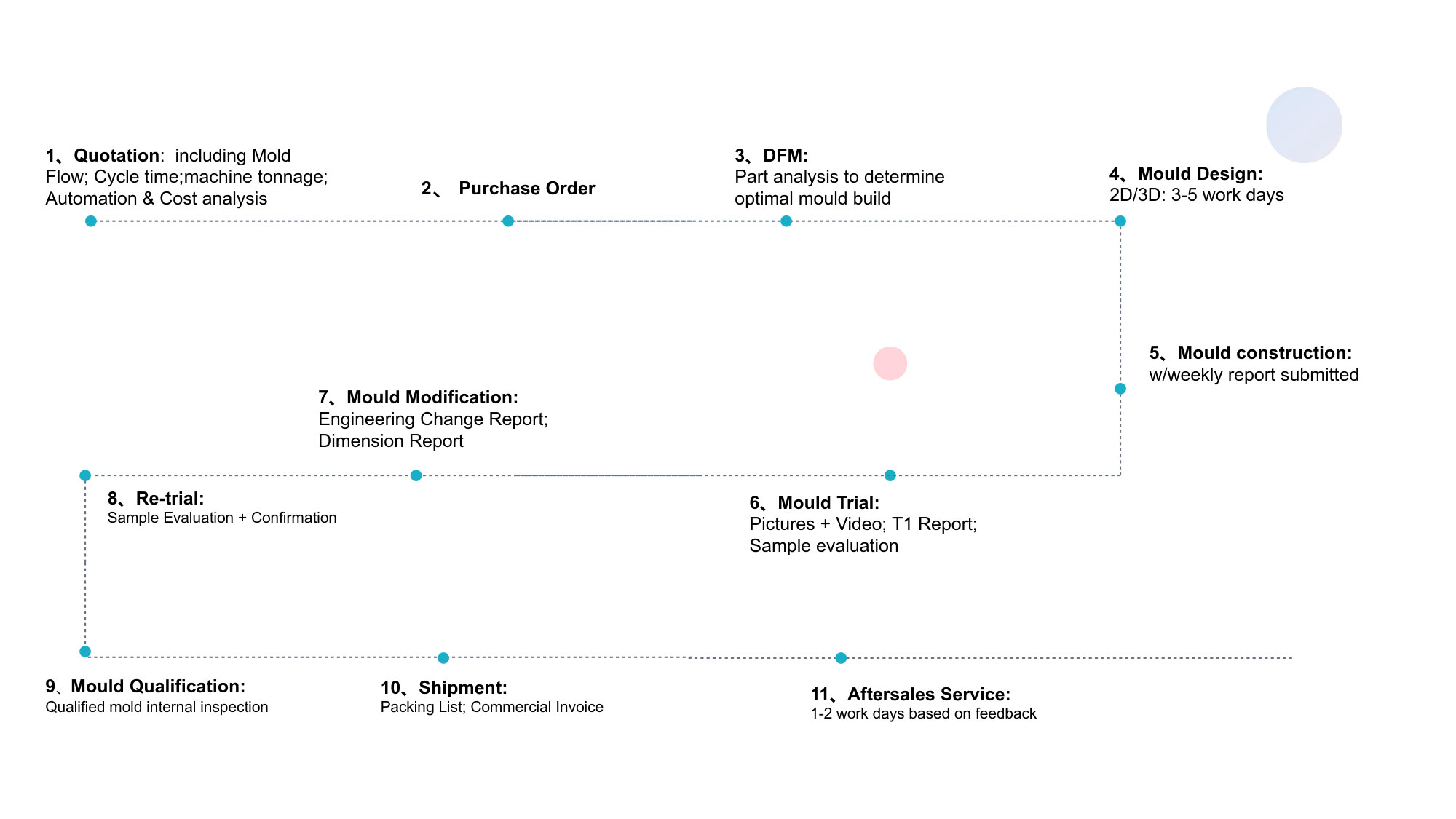
The language of injection molding: “We run T0, T1, T2, T3 trials with improvement reports after each.”
The language of customer value: “You see progressive improvement with documentation after each trial — so you know exactly what changed and why.”
Ansix‘s trial protocol:
T0 (first shot): Initial samples with baseline process parameters
T1: First optimization iteration based on T0 observations
T2: Fine-tuning
T3 (pre-production validation): Fully optimized process producing validated samples
Between trials, customers receive detailed reports documenting each adjustment and its effect on part quality. For designs requiring rapid iteration, Ansix maintains the ability to change mold inserts rather than recutting entire molds, enabling multiple design variations at a fraction of the cost and time of full mold rework.
4.3 Low-Volume Pilot Production
The language of injection molding: “We run 100–500 pilot parts before full production.”
The language of customer value: “We prove the process is stable and capable — before you commit to a million-part order.”
Before scaling to high-volume production, Ansix runs a pilot lot:
Statistical yield analysis performed across the entire pilot run
Cpk calculations for every critical dimension on pilot samples
Identification and correction of any remaining process instability
You don‘t sign off on mass production until the pilot proves that the process delivers the quality you require.
4.4 Maintenance and Spare Parts
The language of injection molding: “Spare ejector pins and core inserts ship with the mold.”
The language of customer value: “You‘re not waiting weeks for replacement parts when something wears out. And we‘re not charging emergency premiums.”
Spare wear components (ejector pins, core pins, slide inserts) are included with every mold delivery
Scheduled maintenance protocols every 200,000 cycles — extending mold life beyond its rated guarantee
Post-warranty repairs at cost (material + labor) — no markup on parts
In-house electrode manufacturing and EDM workshop means mold repairs don‘t leave the building. Typical turnaround for welding repair or insert replacement: 24 hours.
PART FIVE: Differentiated Commitments — Addressing Common Industry Pain Points Directly
Customer question: “Every supplier sounds good on paper. Tell me specifically how you‘re different where other suppliers fail.”
Common Customer Complaint Ansix‘s Direct Commitment
“My mold needs repairs constantly and disrupts my production schedule.” Pre-shipment 2,000-cycle wear test — we run your mold for 2,000 cycles and provide a documented wear report before shipment. Three-year mold structure warranty (excluding normal wear on consumables like ejector pins).
“My parts have flash edges that require expensive manual trimming.” Parting lines machined to 0.005mm fit tolerance — flash controlled to ≤0.03mm in production, eliminating manual deflashing operations.
“Every batch has different dimensions — I can‘t trust my assembly line.” Ultrasonic wall thickness sensors on injection machines — real-time feedback to automatically compensate for viscosity fluctuations. Optional in-mold temperature and pressure sensors for closed-loop control.
“My mold repair lead times are weeks — I‘m losing revenue.” In-house electrode manufacturing + EDM workshop — most mold repairs (welding, insert replacement) completed in-house without subcontractor delays. Standard repair turnaround: 24 hours.
Closing the Deal: Translating Technical Precision Into Customer Peace of Mind
To our customer:
For us at Ansix Tech, a mold is not just a block of steel. It is your revenue-generating asset — the machine that will produce your laryngeal masks day after day, year after year. When we design your mold, we are simultaneously planning for:
Rheological balance — ensuring every cavity fills uniformly without overpacking or short shots
Vent pathway strategy — preventing air entrapment that could cause voids or surface defects
Thermal equilibrium — eliminating localized hot spots that cause uneven curing
Structural robustness — maintaining shut-off surface integrity across millions of cycles
The result when the mold lands on your production floor: a tool that runs with no post-installation troubleshooting, minimal flash, and a documented lifespan. That‘s what we mean when we say: a mold that is ready to print money, not collect dust in the maintenance bay.
Next step: Let us select one of your existing LSR laryngeal mask designs or a similar geometry. We will prepare a full DFM report — wall thickness analysis, gate location optimization, venting strategy, and parting line placement. You will see precisely how we identify and eliminate weld line, air trap, sink mark, and flash risks before the first gram of steel is cut. That report is your proof of capability — delivered at no obligation, because we believe our work speaks for itself.
Ansix Tech — Over 28 Years of Medical-Grade LSR Molding Excellence. ISO 13485 Certified. Cleanroom Manufacturing. Full Material Traceability. Complete Validation Documentation.
From prototype confirmation to high-volume production to assembly verification, Ansix delivers LSR laryngeal mask solutions that you can trust — because we build reliability into every step of the process, not just inspect for it at the end.
Ansix Tech Co Ltd
If you have any plans related to LSR Liquid Silicone Laryngeal Mask , you can contact us at any time. We will turn your ideas into reality, let you realize your dreams, and obtain large orders from the market. Our contact information is info@ansixtech.com. Or contact our CTO, mail: stephen@ansixtech.com
#www.ansixtech.com #ansixtech.com #LSR Liquid Silicone Laryngeal Mask #LSR Liquid Silicone Cap injection molding companies #LSR Liquid Silicone Cap Canopy Mold injection mold companies #Ansix #Ansix moulds #Ansix china #Ansix tech china #Ansix tech company #Ansix facotry #LSR Liquid Silicone Cap injection molding #LSR Liquid Silicone Cap injection tools #LSR Liquid Silicone Cap injection moulds #LSR Liquid Silicone Cap plastic mould #LSR Liquid Silicone Cap plastic tools #Ansix Tech #Ansix molds #Ansix injection molding #Ansix mold factory #injection molding LSR Liquid Silicone Cap#Ansix mold factory #LSR Liquid Silicone Cap china #LSR Liquid Silicone Cap molds #injection factory #LSR Liquid Silicone Cap injection molding #LSR Liquid Silicone Cap injection molding factory #injection molding company #LSR Liquid Silicone Cap injection mold companies #LSR Liquid Silicone Cap Tooling #LSR Liquid Silicone Cap mold limited #Ansix mold china #Ansix companies #Ansix company China #LSR Liquid Silicone Cap facotry #Ansix Tech #Ansix Tech mould #LSR Liquid Silicone Cap injection moulding #injection moulding company #Ansix LSR Liquid Silicone Cap parts injection mold companies #medical injection molding companieschina #LSR Liquid Silicone Cap china factory #Ansix moulding companies #Ansix molding company #LSR Liquid Silicone Cap injection moulding facotry #Ansix Tech mold #LSR Liquid Silicone Cap mould #LSR Liquid Silicone Cap plastic injection molding #ansix plastic mold #Mold manufacturing #LSR Liquid Silicone Cap parts manufacturing #LSR Liquid Silicone Cap plastic parts factory #LSR Liquid Silicone Cap injection parts mold #LSR Liquid Silicone Cap PRECISION MANUFACTURING #LSR Liquid Silicone Cap #China mold #LSR Liquid Silicone Cap injection moulding china #LSR Liquid Silicone Cap mould china #china precision mold #mold in china #LSR Liquid Silicone Cap mold china #Precision molds #High-precision molds #LSR Liquid Silicone Cap #Injection molds #LSR Liquid Silicone Cap Factory #LSR Liquid Silicone Cap Company #Super Large Injection Mold Factory #Large Tonnage Injection Molding Factory #LSR Liquid Silicone Cap Company #LSR Liquid Silicone Cap Factory #2800T Injection Molding Factory #3000 Ton Injection Molding #4500 Ton Injection Molding Factory #Large Mold Injection Molding #Large Plastic Mold Injection Molding Factory #Large Injection Mold Manufacturer #Plastic Mold Factory #Injection Mold #Plastic Mold