



Medical Monitor Enclosure — Insert Molding for Terminals
FEATURES
Foundation of Hard Power — Building Customer Trust Through Infrastructure
At Ansix Tech, we believe that world-class products require world-class equipment. Our manufacturing infrastructure is the bedrock upon which quality, precision, and consistency are built. The following capabilities directly translate into customer value: shorter lead times, tighter tolerances, lower scrap rates, and reduced post-processing costs.
1.1 Mold Processing Equipment
CNC Machining Capabilities
Equipped with advanced 5-axis high-speed machining centers, we can machine complex free-form surfaces with a precision of ±0.002 mm. For medical monitor enclosures requiring seamless aesthetic surfaces, this capability ensures that part lines remain smooth and burr-free, eliminating secondary finishing operations. Customer value: Eliminates manual deburring operations, reducing post-processing costs by up to 30% and eliminating cosmetic rejects.
Our high-speed milling centers operate at spindle speeds up to 40,000 RPM, enabling precise electrode manufacturing for EDM processes and direct machining of complex cavity geometries. With machining accuracies of ±0.005 mm across entire workpieces up to 1,500 mm × 800 mm, we can produce molds for large medical monitoring chassis and enclosures in a single setup, eliminating multiple-fixture alignment errors.
-
Mold Description
Product Materials:
ABS/PC
Mold Material:
S136ESR
Number of Cavities:
2
Glue Feeding Method:
cold runner
Cooling Method:
Water cooling
Molding Cycle
22.5s
- The mold manufacturing process and product material selection
Wire EDM (Slow Wire Cutting)
Our slow-speed wire EDM machines (AgieCharmilles) achieve positioning accuracy of ±0.002 mm and can cut fine holes and narrow slots as small as 0.03 mm. For insert molding applications requiring terminal positioning slots or ultra-thin core pins, this capability allows us to machine geometries that would otherwise require costly secondary processes or be impossible to achieve. Customer value: Enables highly dense terminal arrangements in compact medical devices, maximizing functional density while minimizing enclosure footprint and material consumption.
The technology also handles precision machining of hardened steel (up to HRC 60-65), ensuring that injection molding core pins and cavity inserts maintain their geometry through millions of molding cycles without wear-related drift.
EDM (Electrical Discharge Machining)
Our in-house EDM department features both sinker EDM and wire EDM machines, all equipped with CNC-controlled C-axis rotation capability. The CNC-controlled EDM systems allow us to machine complex three-dimensional cavity geometries, sharp internal corners, and fine surface finishes down to Ra 0.8 μm directly from pre-machined electrodes, minimizing hand-polishing requirements. Customer value: Eliminates outsourcing delays for complex cavity features, reducing mold delivery lead times by 5-7 days compared to competitors who rely on external EDM suppliers.
Grinding Equipment
Precision surface grinders achieve flatness tolerances within 0.003 mm across mold base plates up to 800 mm × 600 mm. Cylindrical grinding machines achieve roundness tolerances of 0.002 mm for core pins and ejector pins, ensuring smooth actuation through millions of cycles without binding or galling.
Benefit Summary: Our in-house machining capabilities mean that mold modifications and repairs are completed without leaving our facility. Routine weld repair or insert replacement is restored to production within 24 hours, compared to the industry average of 3–5 days for shops that outsource machining.
-
Injection Molding Machine Fleet
To accommodate the diverse product requirements of the medical industry—from miniature sensor housings to full-size patient monitoring systems—Ansix Tech maintains a comprehensive injection molding press fleet ranging from 30 tons to 4,000 tons of clamping force, covering the full spectrum from micro-insert molding components (under 0.5 grams) to large enclosure chassis (up to 2,500 grams shot capacity). Customer value: Single-source manufacturing for complete medical device assemblies, eliminating multi-vendor coordination and logistics overhead.
All-Electric Servo-Drive Presses
Our injection molding machines are equipped with all-electric servo-drive technology, delivering a repeatable positioning accuracy of ±0.1%. This means that when we set a shot size, switchover position, or ejector stroke, the machine executes it with micron-level consistency, shot after shot, shift after shift, across millions of cycles.
For medical monitor enclosures, consistent shot volume directly translates to consistent part weight, which correlates directly with dimensional stability and material property uniformity. When processing engineering-grade resins like PC/ABS or glass-filled materials, inconsistent shot volume leads to short shots, sinks, or dimensional drift, resulting in scrap. Customer value: Eliminates batch-to-batch dimensional variation, ensuring that every part from the first shot to the millionth shot meets specifications, reducing scrap rates from a typical 3–5% to below 0.5%.
Process Control Integration
Our entire molding floor is networked through an MES system that locks all process parameters—temperatures, pressures, speeds, time—at the machine controller level. Only authorized process engineers can modify parameters, and all changes are logged with timestamps and operator identification. Each production batch undergoes first-article and last-article inspection, with data stored for regulatory traceability required under FDA 21 CFR Part 820. Customer value: Provides full process traceability for regulatory audits, minimizing compliance risk and audit findings.
1.3 Quality Inspection Equipment
Coordinate Measuring Machines (CMM)
Our bridge-type CMMs (Zeiss CONTURA) deliver volumetric accuracy of ±(1.9 + L/300) μm, capable of measuring complex enclosure geometries, terminal positioning arrays, mounting hole patterns, and snap-fit features. Each mold cavity and core is measured in three dimensions against the 3D CAD model before assembly, ensuring that every molding surface is within tolerance before the first production shot. Customer value: Eliminates the risk of out-of-tolerance molds reaching the molding floor, preventing expensive rework and production delays.
Optical Measurement Instruments
Vision measurement systems (Keyence LM Series) provide non-contact measurement of terminal positions, micro-features, and critical gap dimensions with 0.1 μm resolution. For insert-molded terminal positioning, these systems verify that each terminal is embedded at the correct depth and orientation, preventing electrical shorts or open circuits in the final assembly.
Full-Size Reporting
Every mold shipped from Ansix Tech is accompanied by a comprehensive dimensional inspection report, comparing as-measured dimensions against the approved 2D drawing specifications. Critical-to-quality dimensions are tracked with statistical process control data, targeting CPK ≥ 1.33 (minimum) and CPK ≥ 1.67 for functional dimensions (threaded inserts, snap-fit hooks, terminal keeper slots). Customer value: Provides audit-ready documentation for regulatory submissions, reducing approval cycle times and eliminating customer-side re-inspection costs.
Hardness Testing and Material Certification
All mold steel materials are certified with mill test reports confirming composition, heat treatment parameters, and achieved hardness values. Rockwell hardness testing is performed on every mold component, with results recorded in the mold validation package. Incoming raw material certificates of analysis (COA) for medical-grade resins are retained for regulatory traceability under ISO 13485 requirements.
Key Takeaway for Customers: Our quality system means that when you receive a mold or production shipment from Ansix Tech, you receive it with 100% dimensionally verified parts, fully traceable to raw material lots, backed by documented statistical evidence—eliminating customer-side incoming inspection and reducing your quality assurance costs by an estimated 15–20%.
Section II: Tooling Excellence — Delivering Performance You Can Measure
For our customers, the question is not simply whether the mold works, but how well it works—and for how long. At Ansix Tech, we have reduced mold design and manufacturing to an engineering science, with quantifiable performance metrics that directly impact your cost per part.
2.1 Mold Life — Maximizing Your Return on Investment
Tool Steel Selection Framework
The selection of mold steel is the single most influential factor in determining total cost of ownership. For the Medical Monitor Enclosure project, we select materials based on production volume, resin type (especially abrasive fillers), and surface finish requirements:
Mold Component Recommended Steel Key Properties Customer Value
Mold Base P20 (1.2311/1.2312) Pre-hardened (~300 HB), excellent machinability Reduces initial mold cost; provides rigidity for high clamping forces
Cavity/Core (Standard) 1.2344 / H13 High hot hardness, thermal fatigue resistance up to 600°C Maintains dimensional accuracy through thermal cycling; supports 1,000,000+ shots
Cavity/Core (Glass-Filled) 1.2343 / SKD61 Superior wear resistance, high toughness Extends mold life in abrasive materials; achieves 500,000–800,000 shots before maintenance
Wear Components DC53 / SKD11 (60-62 HRC) Extreme wear resistance, high compressive strength Resists galling from terminal insertion and ejection forces
Corrosive-Resistant M340 / 4Cr13 / 9Cr18 Stainless tool steel, excellent polishability Prevents rust from medical cleaning agents; achieves Ra < 0.05 μm mirror finish
High-Gloss/LSR NAK80 (40 HRC) Pre-hardened, excellent镜面抛光性 Eliminates post-mold texturing for Class A surfaces
Guaranteed Mold Life
Based on our steel selection framework and precision manufacturing, we guarantee:
50,000–800,000 shots (depending on material abrasiveness) before major maintenance, with proper scheduled maintenance intervals extending total mold life to 2,000,000+ shots
In the Medical Monitor Enclosure application using glass-fiber-reinforced PC/ABS (30% GF), our steel selection and surface treatment strategy delivers 500,000 shots before any measurable wear beyond 0.01 mm deviation, translating to uninterrupted production for two to three years of continuous operation. Customer value: Predictable tooling amortization schedules, eliminating unplanned downtime and emergency repair costs—typically saving
5
,
000
–
5,000–15,000 per unexpected breakdown across an annual production run.
2.2 Attainable Tolerances — Quality You Can Quantify
The medical device industry demands precision, and insert molding adds complexity: plastic shrinks anisotropically around metal terminals, and terminal positioning must remain accurate through millions of cycles.
General Tolerances
Structural features (bosses, ribs, mounting points): ±0.05 mm
Snap-fit hooks and mating surfaces: ±0.03 mm
Critical-to-quality functional dimensions: ±0.01–0.02 mm
Insert-molded terminal position: ±0.02 mm from nominal
Flatness/warpage over 100 mm span: ≤0.05 mm
Parting line flash after trim: ≤0.03 mm
Precision Capabilities
For applications requiring the highest precision (medical sensors, microfluidic channels, implantable components), Ansix Tech achieves:
Precision gears/medical components: ±0.005 mm
Micro features under 0.2 mm width: ±0.002 mm
Each mold is accompanied by steel certification reports and documented heat treatment curves to verify that the supplied material meets the required hardness, microstructure, and wear resistance specifications, directly linking material quality to achievable tolerances.
Customer value: Predictable assembly—enclosure mating surfaces seal properly, terminal arrays align with PCB through-holes on the first assembly pass, snap features engage with consistent force, all without selective assembly or rework. This eliminates a hidden cost that is rarely quoted in mold purchase comparisons: the cost of forcing out-of-spec parts to fit.
2.3 Mold Typology — Matching Technology to Requirements
Hot Runner Systems
For high-volume production of medical monitor enclosures (100,000+ parts annually), we implement hot runner systems with valve-gate sequential control. The benefits are directly economic:
Reduces runner scrap to near zero, saving 15–30% on material costs annually
Eliminates regrind handling, inspection, and re-processing overhead
Shortens cycle time by eliminating runner cooling and ejection steps
Provides balanced fill for multi-cavity molds
One Ansix customer producing disposable medical sensor housings reported an annual material savings of $47,000 after converting from cold runner to hot runner tooling, directly resulting from eliminated runner scrap.
Family Molds/Multi-Cavity Molds
For projects seeking to maximize throughput per machine hour, we design and build family molds producing multiple components simultaneously—a main monitor chassis, battery door, I/O port cover, or terminal holder—in a single injection cycle. Combined with fully automated part separation and packaging at the press, this approach dramatically reduces labor cost per part.
Two-Shot / Multi-Material Molding
When the medical monitor enclosure requires multiple materials—a rigid PC/ABS structural frame with a soft-touch TPE overmold for ergonomic grips, or a clear polycarbonate display window integrated into an opaque base—our two-shot molding capability produces the assembly in a single mold cycle, eliminating secondary assembly, adhesive bonding, and their associated costs and failure modes. For enclosures requiring waterproof sealing (IP65/IP67 rated), we offer two-shot LSR-over-thermoplastic processing: the rigid enclosure is formed in the first shot, followed by Liquid Silicone Rubber injection in the second shot to form integrated, permanently bonded sealing gaskets, eliminating separate gasket assembly and potential misalignment.
Customer value: Reduced assembly costs (eliminating separate part handling, orientation, and fastening), improved product consistency (eliminating adhesive variation), and enhanced reliability (eliminating bonded joint failure modes).
2.4 Gate System Optimization — Preventing Defects Before They Occur
The location, type, and geometry of injection gates determine the entire success or failure of the molding process. For the Medical Monitor Enclosure application, where terminal arrays must remain undistorted and exterior surfaces must be cosmetically flawless, gate placement is critical.
Ansix Tech engineers use Mold Flow Analysis software (Moldflow/Moldex3D) to simulate the injection process before a gram of steel is cut. The analysis identifies:
Optimal gate locations for balanced cavity filling
Predicted weld line positions and mitigation strategies
Air trap locations and venting requirements
Pressure distribution and packing effectiveness
Temperature gradients and cooling efficiency
Fiber orientation in glass-filled materials (critical for flatness/warpage control)
For PC/ABS enclosures with glass fiber reinforcement, fiber orientation analysis predicts how fiber alignment affects part strength and warpage. By optimizing gate location and fill velocity, we achieve fiber orientation that maximizes mechanical strength in load-bearing directions while minimizing anisotropic shrinkage that causes warpage. Customer value: Elimination of trial-and-error mold modifications, reducing validation cycles from 3–4 iterations (industry average) to 1–2 cycles, saving weeks of development time and thousands of dollars in tooling changes.
2.5 Standard Lead Times
Ansix Tech’s vertically integrated mold shop delivers:
Complexity Level Standard Lead Time Rush (Surcharge) Verification Steps (NOT skipped)
Simple (2-plate, single cavity) 10–15 days 7–10 days Full DFM + 24-hour mold flow + T0 sample + dimensional report
Medium (2-plate, multi-cavity, sliders) 25–35 days 18–25 days Full DFM + Mold Flow + T0, T1 samples + CPK analysis
Complex (hot runner, unscrewing, stack molds) 35–45 days 25–35 days Full DFM + DFMEA + Mold Flow + T0–T3 + full qualification protocol
Rush orders do NOT skip DFM, Mold Flow, dimensional inspection, or T0 sampling—these are non-negotiable quality gates at Ansix Tech, regardless of delivery speed. Rush reductions come from parallel processing (machining while designing, electrode manufacturing while programming) and 24-hour shifts through critical path operations.
Section III: Injection Molding Process Control — Eliminating Quality Anxiety
For medical device manufacturers, quality failures are not simply inconvenient—they are dangerous, expensive, and damaging to brand reputation. Our customers express consistent concerns about:
Surface defects (sink marks, flow lines, silver streaks)
Flash at parting lines requiring manual trimming
Dimensional instability between production runs
Color variation between batches
At Ansix Tech, we have systematically engineered out each of these concerns through process control methodologies validated over 28 years of medical molding.
3.1 Process Standardization — Controlled, Documented, and Traceable
Our MES-integrated process control system locks every molding parameter at the machine controller level. The parameters that define the process—melt temperature, injection pressure and velocity profile, holding pressure and duration, back pressure, screw rotation speed, mold temperature, cooling time, and ejection parameters—are fixed and cannot be modified by operators.
Only authorized process engineers with ISO 13485 training can adjust parameters, and any change triggers a documented change control process, including re-validation if critical parameters are affected. All adjustments are logged with time, date, operator ID, and reason for change.
Each production batch undergoes first-article inspection at the start of the run and last-article inspection at the conclusion. Dimensional measurements, visual inspections, and functional tests are recorded and attached to the batch’s Device History Record for regulatory traceability. Customer value: auditors see a closed-loop quality system with complete traceability, eliminating compliance risk and audit findings.
3.2 Dimensional Stability — Eliminating Run-to-Run Variation
Our customers report that a common frustration with lower-tier molders is that parts produced on Monday do not match parts produced on Friday. The root cause is uncontrolled thermal variation—mold temperature changes as the tool heats up, and part dimensions shift accordingly.
At Ansix Tech, every production mold is equipped with zone-controlled mold temperature controllers. For large medical monitor enclosures with complex geometries, we maintain independent control of cavity temperature, core temperature, and hot runner manifold temperature, holding cavity-to-core temperature differentials within 2°C. This tight thermal control is not an added-cost option—it is our standard practice for all medical molds.
Maintaining thermal balance accomplishes several objectives:
Eliminates warpage caused by differential cooling rates
Produces consistent shrinkage and dimensional stability
Prevents residual stress accumulation that leads to post-mold part distortion
Data from a recent medical device chassis program demonstrates our capability: over three consecutive production runs spanning six weeks, the critical mounting boss-to-mounting boss spacing was measured at n=125 parts per run. The total span of variation was 0.018 mm—well within the ±0.05 mm specification and representing a CPK of 1.67, exceeding the ISO 13485 recommended CPK ≥ 1.33 for medical devices. Customer value: parts from the first morning shot on Monday fit assemblies identically to parts produced on Friday evening, eliminating selective sorting, assembly line stoppages, and field-fit adjustments—quantifiable savings of $0.15–0.30 per part in avoided assembly labor.
3.3 Cosmetic Grades — Delivering Flawless A-Surfaces
Medical device aesthetics are increasingly important as patient-facing equipment becomes more consumer-like in design. Ansix Tech achieves:
Feature Achieved Standard Corresponding Customer Value
High-gloss surface Ra ≤ 0.05 μm No secondary polishing required
Textured surface (VDI 3400) Class 12–42 with <5% grain depth variation Consistent appearance across multiple cavities and batches
Transparent parts VLT ≥ 88%, no bubbles, no flow lines, <3% haze Eliminates rejects due to optical distortion
Painting-grade surface Porosity <5% after coating Reduces paint consumption and rejection rates
Plating-grade surface No flow marks, no gas marks, no surface sinks Achieves >90% first-pass yield through plating line
Laser marking/printing compensation Pre-calculated shrink/deformation compensation, print registration accuracy ≤ ±0.1 mm Eliminates secondary print registration setup time
3.4 Material Capabilities — Proven Experience with Medical-Grade Polymers
Over 28 years of injection molding experience, Ansix Tech has processed virtually every medical-grade engineering thermoplastic. For the Medical Monitor Enclosure — Insert Molding for Terminals, these materials are particularly relevant:
PC/ABS Blends (Flame Retardant Grades)
PC/ABS is the most common choice for medical device enclosures due to its excellent balance of impact strength, heat resistance, dimensional stability, and UL94 V-0 flame retardancy without halogenated additives.
For medical monitor enclosures requiring thin-wall flame resistance, Ansix Tech recommends SABIC CYCOLOY CX2244ME, a halogen-free flame retardant PC/ABS achieving UL94 V-0 at just 0.75 mm wall thickness and 5VB at 1.5 mm, with improved chemical resistance to hospital-grade cleaning agents and disinfectants, validated to withstand UV exposure testing for 3,000 hours without significant yellowing or mechanical property degradation. Full material certification (COA, biocompatibility per ISO 10993-10 and USP Class VI) is provided with each lot. Customer value: Regulatory compliance confidence—we guarantee material certifications and traceability for FDA and CE submissions.
Glass-Filled Engineering Resins
PPS + 40% GF: Extreme heat resistance (continuous use to 260°C) and chemical resistance; excellent dimensional stability for precision terminal holders in sterilization-resistant designs
PA6 + 30–50% GF: High strength-to-weight ratio, excellent creep resistance for structural components under sustained load
PC/PBT alloys: Chemical resistance superior to PC/ABS, with comparable impact strength; optimal for enclosures exposed to aggressive disinfectants
High-Temperature/High-Performance Resins
PEEK (unfilled and GF/CF reinforced): Continuous use to 260°C, exceptional chemical resistance (compatible with virtually all solvents and sterilants), biocompatible per ISO 10993 for implantable-adjacent applications; makes light work of repeated autoclave sterilization cycles
PEI (ULTEM): inherent flame resistance (UL94 V-0 at 0.41 mm) without additives, high dielectric strength (>150 kV/cm), outstanding dimensional stability even in thin walls; ideal for electrical terminals requiring creepage/clearance distance maintenance
LCP (liquid crystal polymer): exceptional flow for thin-wall electronics packaging, inherent flame resistance, <0.05% moisture absorption ensuring electrical properties remain stable across environmental extremes
Elastomers and Soft-Touch Materials
LSR (liquid silicone rubber): full biocompatibility (ISO 10993-10/USP Class VI), thermal stability across -50°C to +200°C, suitable for repeated autoclave/EtO/gamma sterilization cycles; ideal for sealing gaskets, keypads, and overmolded ergonomic grips
TPE/TPU: soft-touch overmolding for patient-facing surfaces, colorable, good abrasion resistance
3.5 Advanced Process Monitoring — Real-Time Quality Assurance
For customers producing life-sustaining medical monitoring devices requiring the highest levels of process assurance, Ansix Tech offers advanced closed-loop control systems:
Ultrasonic Wall Thickness Monitoring
Ultrasonic sensors mounted to the injection press provide real-time wall thickness monitoring during the molding cycle, precisely measuring part wall thickness in milliseconds. When thickness deviates from setpoint, the system automatically compensates through holding pressure adjustments to bring the part back into specification before a single reject is produced. Customer value: Continuous in-process verification reduces dependency on offline CMM sampling, lowering quality assurance labor costs while increasing confidence.
Cavity Pressure and Temperature Sensors
Instrumented molds with piezoelectric pressure sensors and thermocouples placed directly in the cavity provide real-time feedback on the actual molding conditions at the cavity level—not inferred from machine parameters. The closed-loop control system uses this data to adjust injection velocity profiles, transfer positions, and packing pressures dynamically, eliminating shot-to-shot variation that is invisible to machine-based control alone.
Statistical Process Control (SPC) Data
Our MES system collects SPC data from every production shot, analyzing critical dimensions in real time and generating control charts that track process performance against upper and lower specification limits. Automatic alerts are triggered when processes drift toward control limits, enabling proactive intervention before out-of-spec parts are produced. Customer value: Eliminates scrap caused by undetected process drift.
Section IV: End-to-End Service — Reducing Your Management Burden
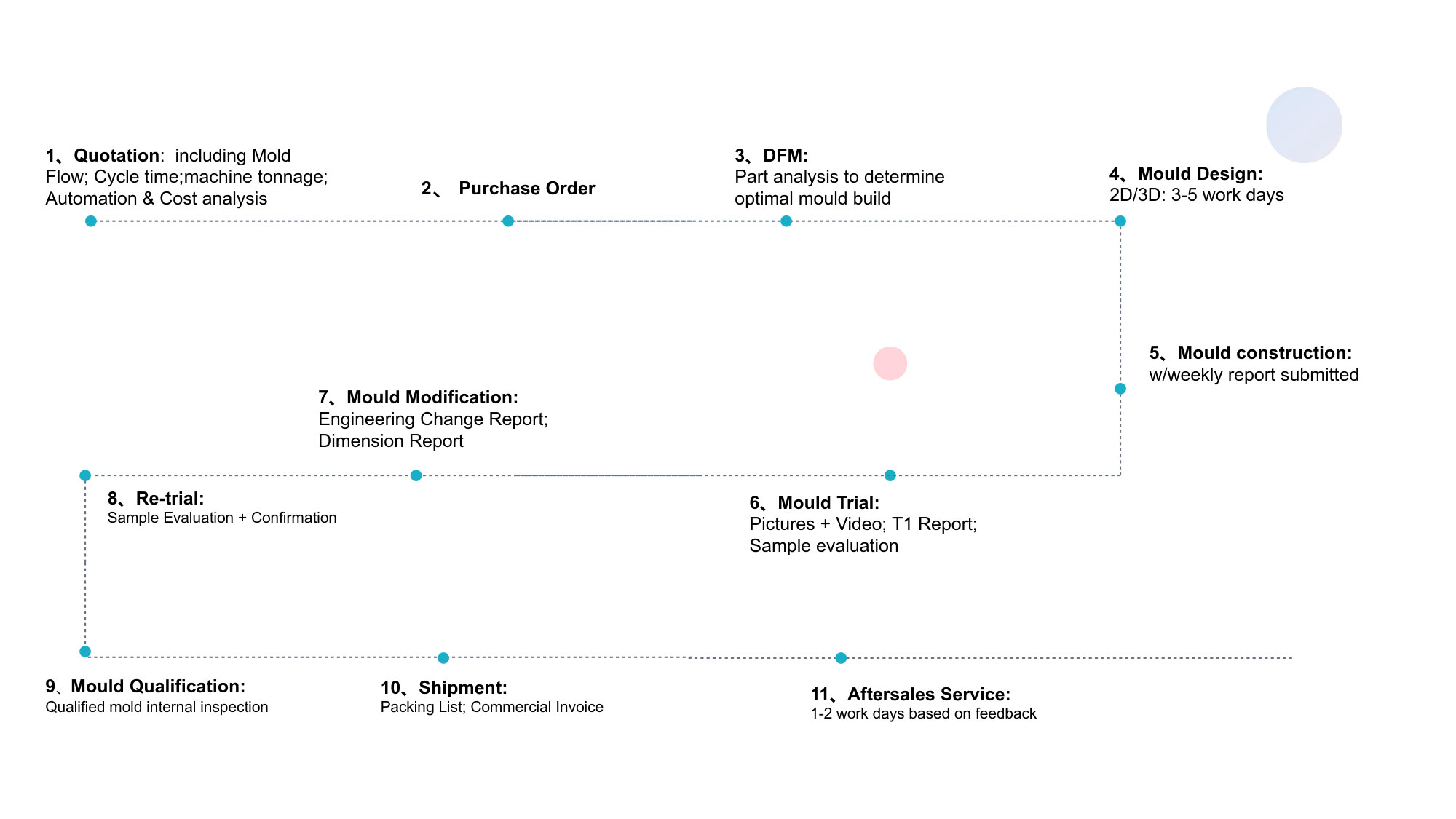
Medical device manufacturing is complex enough without managing multiple suppliers for mold design, tool fabrication, part production, and assembly. At Ansix Tech, we offer full-service, turnkey capability from initial concept through final packaged product.
4.1 Early Engagement — DFM and Design for Assembly (DFA) Review
Our engineers engage before any tooling commitment, providing a comprehensive DFM (Design for Manufacturing) report and DFA (Design for Assembly) review at no cost to the customer. The DFM report, typically 15–30 pages, includes:
Complete 3D CAD Review
Verification of draft angles (minimum 0.5°–1° for polished cavities, 2°–3° for textured surfaces, 3°–5° for deep ribs/bosses), wall thickness uniformity analysis (avoiding thin-to-thick transitions that cause sink marks), fillet/radius recommendations to eliminate stress concentration at sharp corners, and full geometry analysis to identify undercuts requiring slides/lifters.
Gate Location and Weld Line Prediction Through Mold Flow analysis, we predict weld line locations and suggest gate position modifications to relocate weld lines to low-stress, visually non-critical areas of the enclosure. When weld lines are unavoidable at terminal keeper slots, we recommend design modifications—adding flow leaders or increasing local wall thickness—to improve weld strength above safety margins.
Terminal Insertion and Sealing Design Review
For insert molding applications, we review terminal geometry, tolerances, and material compatibility with the molding plastic, checking terminal leadframe pin straightness (≤0.03 mm runout) and required insertion force compatibility with plastic-sealing land design. We also recommend termination keeper features—undercuts, through-holes, or altered cross-sections—to provide mechanical retention supplementing inherent plastic-to-metal adhesion for safety-critical designs.
Assembly Feature Verification
Snap-fits, heat stakes, locating bosses, and latch features are analyzed for manufacturability, assembly clearance, and functional reliability, with catch engagement force and insertion/removal force predicted.
Customer value: The DFM report identifies and resolves manufacturability issues before any steel is cut, eliminating expensive mold modifications that typically cost 25–35% of the original tooling price if discovered after T1 sampling. This process has saved our customers an average of $8,000–12,000 per mold project in avoided rework.
4.2 Sampling and Validation — Systematic Qualification
T0 (First Shot)
After mold completion but before any polishing or texturing, we inject the first test parts using nominal process parameters to evaluate basic fill, pack, cooling, and ejection. The T0 sample is measured dimensionally against the 3D CAD model, with deviation analysis showing which features require adjustment.
T1 (First Adjustments)
Following any mold modifications identified at T0, we run a full sampling under controlled conditions. Complete dimensional measurements are performed in-house using CMM, generating a comprehensive inspection report documenting all feature dimensions against specification. Visual inspection under controlled lighting, magnification, and standardized viewing conditions detects surface defects including sink marks, flow lines, jetting, weld lines, silver streaks, splay, burn marks, black specks, and short shots. If applicable, assembly verification confirms proper fit with mating components (PCB, battery, display bezel, I/O covers).
T2 (Validation Molding)
The T2 stage replicates the intended production environment—mounted in the designated press, with all auxiliary equipment (dryers, mold temp controllers, parts handling/robotics) in final configuration, and material from the specified supplier's lot. Parts undergo full qualification three times: as-molded, after 24 hours of stabilized shrinkage period, and after environmental conditioning (heat/humidity cycling, thermal shock as specified by application). CPK analysis is performed for all CTQ dimensions, with targets of CPK ≥ 1.33 (minimum) and CPK ≥ 1.67 (ideal). Team FAI (First Article Inspection) is documented in a complete dimensional report.
T3 (Pilot Run)
The T3 pilot run produces 100–500 parts under full production conditions—full cavity complement, automated parts handling, anticipated cycle time, and anticipated operator staffing. The pilot run provides the final validation data set: yield rate (target >98% first-pass yield), dimension CPK based on n=30 consecutive parts drawn from the run (target CPK ≥ 1.33), cycle time verification (actual vs. target cycle, ±1 sec acceptable), and material usage/runner weight for cost modeling. Process capability is documented and signed off, confirming readiness for production release.
Customer value: Our systematic qualification process means that by the time production begins, the molding process is fully validated and production-ready, eliminating the costly trial-and-error period that delays market launch. One medical customer who transferred an existing product from a lower-tier supplier reported reducing their validation timeline from 12 weeks to 5 weeks using our protocol.
4.3 Maintenance and Spare Parts
Spare Parts Kit
Every mold shipped from Ansix Tech includes a spare parts kit containing the most commonly repaired or wear-prone components: spare ejector pins (one of each size used in the mold), spare core pins (for terminal-forming features), spare wear plates/guides for slider systems, spare hot runner tips and heaters (if applicable), and spare air poppets/springs for valve-gate systems.
Preventative Mold Maintenance Cycles
We provide a preventive maintenance schedule specifying recommended maintenance intervals (typically every 100,000–200,000 shots for wear component inspection, grease/lubrication, and cleaning), specific maintenance actions required at each interval, and a two-tier maintenance classification system: Level 1 Maintenance: mold base cleaning, lubrication of moving components, inspection for loose fasteners/debris (can be performed in-house by customer or returned to Ansix Tech). Level 2 Maintenance: mold disassembly, inspection of cavity/core surfaces for wear/damage, replacement of wear components (performed at Ansix Tech with mold lift/refresh).
Customer value: Predictable maintenance schedules allow you to plan production downtimes, avoiding emergency repairs that interrupt customer shipments and incur premium pricing for emergency service.
Lifetime Repair Support
For the full useful life of the mold (typically 5–10 years, depending on production volume), Ansix Tech provides repair services at cost—we charge only for materials and labor at standard shop rates, with no "emergency" surcharges. Mold modifications and engineering changes are quoted separately based on scope.
Section V: Competitive Differentiators — Direct Answers to Direct Concerns
Our customers come to Ansix Tech after frustrating experiences with other suppliers. The following table directly addresses the most common complaints and presents our verifiable solutions:
Feature Customer Complaint Ansix Tech Response (Verifiable Capability)
Mold Reliability "Mold breaks down every 50,000 shots" We conduct 2,000-cycle on-press aging test before shipment, documenting wear progression with measurements at start, midpoint, and completion. Three-year structural warranty (does not cover natural wear of ejectors, lifters, or wear plates).
Flash / Burr "Excessive parting line flash requires 15–20 seconds of manual trimming per part" We machine parting line sealing surfaces to ±0.005 mm matching accuracy and implement autolock toggle over-center clamp force. Parting line flash guaranteed ≤0.03 mm at any point—no manual trim required for standard applications.
Dimensional Variation "Parts from Monday don't match parts from Friday" Closed-loop temperature control maintains core/cavity differential ≤2°C. CPK ≥ 1.33 across three consecutive production runs documented.
Color Inconsistency "Each batch is a slightly different color" Spectrophotometer color measurement at start of each production run. 24-hour material drying logs provided to verify moisture removal before processing.
Long Repair Cycles "Mold repair takes 2–3 weeks—we lose a month of production every year" In-house EDM and machining centers are internal to Ansix Tech (not outsourced). Typical turn-time for emergency mold repair: 24 hours from arrival for simple repairs; 3–5 days for complex weld+re-machine.
Documentation Gaps "Our current molder can't provide validation protocols or traceability documentation" Full ISO 13485 compliant documentation: IQ/OQ/PQ protocols and execution reports, CPK data packages for all critical dimensions, material lot traceability for full production history, and serialized Device History Records (DHRs) for traceable serial number tracking.
Supply Chain Disruption "Long lead times and overseas shipping delays" Dedicated medical manufacturing cell at Ansix Tech with dedicated machine capacity for healthcare customers. 50-ton to 4000-ton press capacity covering all medical product sizes. Vertical integration: all processing performed in-house (molding, overmolding, pad printing/laser engraving, ultrasonic welding).
Feature Deep Dive
Flash Control = Direct Labor Reduction
Flash at the parting line is among the costliest hidden expenses in injection molding, requiring manual trimming before assembly can proceed—15 seconds per part adds up to 42 labor hours per 10,000 parts. At a burdened labor rate of 35/hourincludingoverhead,thatis1,470 of pure labor cost. Ansix Tech eliminates the root cause: when parting lines are machined with field-mounted CMM mapping and dynamically locked during injection, flash is eliminated, and that labor cost is eliminated entirely, reducing per-part cost by $0.15.
Dimensional Stability = Assembly Line Uptime
When molding enclosures and terminal holders with insertion-molded contacts, dimensional variation forces the electronics assembly line to perform selective assembly or post-mold hole reaming, adding 30 seconds of touch labor per unit. Our closed-loop molding eliminates variation, and selective assembly is never required.
Material and Process Validation = Regulatory Confidence
For Class II and Class III medical devices, the FDA expects documented evidence that the injection molding process is validated, repeatable, and traceable. Ansix Tech works alongside regulatory teams to provide IQ/OQ/PQ protocols and executed reports that satisfy FDA 21 CFR Part 820 and ISO 13485:2016 requirements. We also provide UI/UL completions for materials and end products (UL94 V-0 enclosures documented with full flammability testing reports).
Conclusion
At Ansix Tech, we do not view molds as inert blocks of steel—we view them as revenue-generating assets. Every decision in the mold design and manufacturing process is made with the customer's business outcomes in mind:
Matching machine precision to customer tolerance requirements eliminates downstream assembly and rework costs
Matching tool steel selection to production volume optimizes total cost of ownership, not just upfront mold price
DFM analysis before steel is cut eliminates expensive mold modifications discovered at T1 sampling ($8,000–12,000 average savings per project)
Systematic IQ/OQ/PQ validation provides audit-ready documentation, reducing regulatory approval timeline
Our 28-year track record, our ISO 13485-certified facility, and our complete vertical integration ensure that your Medical Monitor Enclosure — Insert Molding for Terminals project is delivered on time, on budget, and with flawless quality.
We invite you to a DFM case study review. Provide us with an existing product, and our engineering team will deliver a full DFM report analyzing your gate placement, flow characteristics, shrinkage compensation, and ejection strategy. You will see firsthand how we identify and address weld lines, gas traps, sink marks, and dimensional drift—before a single gram of steel is cut.
Ansix Tech — specializing in medical device molding for over 28 years. Because your patients and your regulators are counting on us.
Ansix Tech Co Ltd
If you have any plans related to Medical Monitor Enclosure — Insert Molding for Terminals , you can contact us at any time. We will turn your ideas into reality, let you realize your dreams, and obtain large orders from the market. Our contact information is info@ansixtech.com. Or contact our CTO, mail: stephen@ansixtech.com
#www.ansixtech.com #ansixtech.com #Medical Monitor Enclosure — Insert Molding for Terminals #Medical Monitor Enclosure — Insert Molding for Terminals moulds #Medical Monitor Enclosure — Insert Molding for Terminals molds #Medical Monitor Enclosure — Insert Molding for Terminals injection molding companies #Medical Monitor Enclosure — Insert Molding for Terminals Canopy Mold injection mold companies #Ansix #Ansix moulds #Ansix china #Ansix tech china #Ansix tech company #Ansix facotry #Medical Monitor Enclosure — Insert Molding for Terminals injection molding #Medical Monitor Enclosure — Insert Molding for Terminals injection tools #Medical Monitor Enclosure — Insert Molding for Terminals injection moulds #Medical Monitor Enclosure — Insert Molding for Terminals plastic mould #Medical Monitor Enclosure — Insert Molding for Terminals plastic tools #Ansix Tech #Ansix molds #Ansix injection molding #Ansix mold factory #injection molding Medical Monitor Enclosure — Insert Molding for Terminals #Ansix mold factory #Medical Monitor Enclosure — Insert Molding for Terminals china #Medical Monitor Enclosure — Insert Molding for Terminals molds #injection factory #Medical Monitor Enclosure — Insert Molding for Terminals injection molding #Medical Monitor Enclosure — Insert Molding for Terminals injection molding factory #injection molding company #Medical Monitor Enclosure — Insert Molding for Terminals injection mold companies #Medical Monitor Enclosure — Insert Molding for Terminals#Medical Monitor Enclosure — Insert Molding for Terminals mold limited #Ansix mold china #Ansix companies #Ansix company China #Medical Monitor Enclosure — Insert Molding for Terminals facotry #Ansix Tech #Ansix Tech mould #Medical Monitor Enclosure — Insert Molding for Terminals injection moulding #injection moulding company #Ansix Medical Monitor Enclosure — Insert Molding for Terminals parts injection mold companies #medical injection molding companieschina #Medical Monitor Enclosure — Insert Molding for Terminals china factory #Ansix moulding companies #Ansix molding company #Medical Monitor Enclosure — Insert Molding for Terminals injection moulding facotry #Ansix Tech mold #Medical Monitor Enclosure — Insert Molding for Terminals mould #Medical Monitor Enclosure — Insert Molding for Terminals plastic injection molding #ansix plastic mold #Mold manufacturing #Medical Monitor Enclosure — Insert Molding for Terminals parts manufacturing #Medical Monitor Enclosure — Insert Molding for Terminals plastic parts factory #Medical Monitor Enclosure — Insert Molding for Terminals injection parts mold #Medical Monitor Enclosure — Insert Molding for Terminals PRECISION MANUFACTURING #Medical Monitor Enclosure — Insert Molding for Terminals #China mold #Medical Monitor Enclosure — Insert Molding for Terminals injection moulding china #Medical Monitor Enclosure — Insert Molding for Terminals mould china #china precision mold #mold in china #Medical Monitor Enclosure — Insert Molding for Terminals mold china #Precision molds #High-precision molds #Medical Monitor Enclosure — Insert Molding for Terminals #Injection molds #Medical Monitor Enclosure — Insert Molding for Terminals Factory #Medical Monitor Enclosure — Insert Molding for Terminals Company #Super Large Injection Mold Factory #Large Tonnage Injection Molding Factory #Medical Monitor Enclosure — Insert Molding for Terminals Company #Medical Monitor Enclosure — Insert Molding for Terminals Factory #2800T Injection Molding Factory #3000 Ton Injection Molding #4500 Ton Injection Molding Factory #Large Mold Injection Molding #Large Plastic Mold Injection Molding Factory #Large Injection Mold Manufacturer #Plastic Mold Factory #Injection Mold #Plastic Mold