



Medical Regulator Needle Valve Mold
FEATURES
Section One: The Hard-Power Foundation — Building Customer Trust Through Equipment Superiority
Before a single drop of molten polymer flows into a mold cavity, the foundation of quality is laid in the machining shop floor. Ansix Tech‘s equipment infrastructure is not merely a list of capital assets—it is the bedrock upon which precision, consistency, and reliability are built. For medical regulator needle valve components, where flow paths measured in micrometers can determine clinical outcomes, the precision of the tooling that creates those paths is non-negotiable.
-
Mold Description
Product Materials:
PP
Mold Material:
S136ESR
Number of Cavities:
1*64
Glue Feeding Method:
Hot runner
Cooling Method:
Water cooling
Molding Cycle
12.5s

Mold Machining Equipment: Where Micron-Level Accuracy Meets Complex Geometry
Five-Axis High-Speed Machining Centers: Ansix Tech deploys state-of-the-art five-axis simultaneous CNC machining centers capable of achieving tolerance control as tight as ±0.002mm—a precision level that exceeds ISO 286 global standards. For the complex curved surfaces characteristic of medical regulator needle valve geometries, this capability translates directly into customer value: seamless part lines, no burrs or flash that would require secondary manual finishing, and flawless mating surfaces between valve components that ensure leak-free operation. The five-axis capability eliminates the need for multiple fixture setups, reducing cumulative alignment errors and delivering a finished mold that produces parts ready for assembly right out of the machine.
-
But precision machining is only half the equation. For the exceptionally fine features required in medical needle valves—narrow slots, tiny flow channels, and micro-features that regulate fluid delivery—Ansix Tech employs high-precision wire electrical discharge machining. This technology enables the creation of micro-features down to 0.03mm, including fine flow orifices, narrow slots, and delicate geometries that would be impossible to achieve through conventional milling. When molding thin-walled sections of a needle valve housing, wire EDM minimizes the risk of core pin deflection and wall thickness variation, ensuring the finished component meets its dimensional specifications consistently shot after shot.
What does this mean for the customer? A medical regulator needle valve mold is an investment measured in hundreds of thousands of dollars. When a mold‘s complex surfaces are machined to 0.002mm accuracy, the customer receives a tool that requires less post-molding trimming, produces fewer rejects, and maintains its precision over millions of production cycles. Lower per-unit labor costs for deburring, reduced scrap rates, and extended mold life all flow directly from machining decisions made before the mold is even assembled.
Why This Matters for Medical Applications: Medical regulators must function with absolute precision. A valve needle that sticks or leaks due to poorly machined mold surfaces could compromise patient treatment. Ansix Tech‘s sub-micron machining ensures every molded part exhibits the exact dimensional characteristics required for proper valve seating and fluid metering.
Injection Molding Machine Fleet: Scalability with Uncompromised Consistency
Ansix Tech operates a fleet of 260 injection molding machines spanning clamping forces from 30 tons to 2800 tons. This range covers everything from small precision medical components weighing just a few grams to larger device housings and structural parts. The fleet includes Fanuc, Sumitomo, Toshiba, Nissei, Engel, Arburg (specializing in liquid silicone rubber for two-component applications), as well as Haitian and Victor Taichung machinery.
The customer value here is threefold: flexibility, stability, and redundancy.
Flexibility: Whether a project requires a low-cavitation mold running on a 60-ton press or a high-volume 48-cavity hot runner system—Ansix Tech has successfully developed, validated, and brought to full-scale production a 48-cavity hot runner mold system for a component similar to medical needle valves—the appropriate machine is available.
Stability: Across the entire fleet, all-electric servo-driven machines deliver repeatability precision of ±0.1%. For medical regulator components, this means every shot across millions of cycles is dimensionally identical to the first. No gradual drift, no mid-production surprises, no need for constant operator recalibration.
Redundancy: With 260 machines across four production bases in China and Vietnam, a medical device OEM gains production security. If one line requires maintenance, production seamlessly shifts to another. This eliminates a major source of customer anxiety: supply interruption.
Metrology and Inspection: Proof, Not Promises
A machine shop can claim accuracy. Ansix Tech proves it. Every mold and every production batch undergoes comprehensive dimensional verification using Coordinate Measuring Machines (CMMs) capable of detection accuracy to ±0.5μm and optical inspection systems.
CMM inspection provides a complete dimensional profile of every critical feature—valve seat diameters, needle guide bores, port locations, parting line sealing surfaces—traceable to international standards.
But measurement without process capability is meaningless. Ansix Tech employs Statistical Process Control (SPC) to calculate Cpk (Process Capability Index) for every critical dimension. The standard achieved across medical molds: Cpk ≥ 1.33 for key dimensions. What does Cpk ≥ 1.33 mean in customer terms? For every million parts produced, fewer than 66 will fall outside specification limits. That is 99.9934% conformance—a defect rate so low that it virtually eliminates customer sorting, rework, and field failure risks.
Every mold shipped undergoes a full dimensional report comparing as-machined measurements against CAD nominal values. This documentation package provides medical device customers with the traceability evidence required for FDA and ISO 13485 audits, directly reducing the regulatory burden on the customer‘s quality team.
Section Two: Mold Manufacturing Competitive Differentiation — Specifications That Speak Customer Language
Medical device engineers do not care about CNC spindle speeds or wire EDM power settings. They care about four things: how long the mold will last, how precise the parts will be, how soon they can start production, and how much it will cost when something needs fixing. Ansix Tech‘s specifications are built to answer exactly these four questions—directly, quantitatively, and with documented evidence.
Mold Life Expectancy: Guaranteed Longevity, Not Just a Number
A mold is not an assembly of steel blocks—it is a production asset whose depreciation directly affects part cost. Ansix Tech guarantees mold life based on empirical data, not theoretical maximums:
Mold Component Material Grade Guaranteed Cycles (Standard Plastics) Guaranteed Cycles (Glass-Filled Grades)
Mold Base P20 (pre-hardened) 1,000,000+ 800,000+
Mold Core/Cavity S136, 2344, 2343, 8407, SKD11/SKD61/DC53, M340, 4Cr13/9Cr18, NAK80, H13 500,000–1,000,000 300,000–500,000
For glass-fiber reinforced materials such as PPS+40%GF or PA6+GF30—commonly specified for medical device housings requiring high stiffness and dimensional stability—Ansix Tech‘s hardened steel selection and specialized heat treatment protocols extend mold life by 40% compared to standard tool steel cores.
Customer Value Translated: A customer projecting annual production of 500,000 units knows exactly how many years the mold will serve before major refurbishment. This predictability enables accurate depreciation schedules, cost-per-part calculations, and capital planning. No hidden surprises.
Achievable Tolerances: Precision That Solves Real Assembly Problems
Medical regulators involve moving parts—needles sliding within bores, seals compressing against seats, ports aligning with tubing. If these parts do not fit, the device does not function.
Ansix Tech‘s guaranteed tolerances by component type:
Conventional structural parts: ±0.05mm
Precision medical components & gears: ±0.005mm
For a needle valve regulator, the clearance between the needle and its guide bore directly affects flow metering accuracy and device sensitivity. Toleration stack-ups in the 0.01mm range can mean the difference between precise droplet control and free leakage. Ansix Tech‘s ±0.005mm capability for precision features ensures that every molded needle guide, every valve seat, and every port dimension consistently mates with its corresponding component.
Beyond the tolerance claim, Ansix Tech provides two critical documentation pieces:
Mold Steel Material Certification — Full chemical composition analysis and grain structure verification
Heat Treatment Curves — Documented time-temperature profiles for all heat treatment processes, including vacuum quenching and cryogenic treatment at −196°C for 24 hours to eliminate retained austenite and prevent dimensional shift
Mold Configuration Types: Matching Topology to Production Economics
One mold configuration does not fit all medical devices. Ansix Tech offers a portfolio of mold architectures, each chosen to optimize a specific production parameter:
Mold Type Application Advantage Customer Value
Hot Runner System Eliminates cold runner waste; reduces cycle time 20–50% Reduces medical-grade resin waste by 30–50%; for expensive materials like PEEK costing
80–120/kg,annualsavingsexceed50,000 per press
Stack Mold Two molding faces stacked vertically; doubles output per machine cycle Cuts per-unit machine hour cost by 40–50% without capital expansion
Two-Color/Multi-Material Mold Overmolds hard and soft materials in single cycle Eliminates secondary assembly; reduces labor and handling defects
High-Gloss Mold Surface finish Ra < 0.05μm Produces medical components ready for fluid contact without secondary polishing
Gate and Runner Design: Where Mold Flow Analysis Prevents Real Defects
Medical regulators often involve complex flow paths where melt fronts meet at weld lines. A poorly positioned weld line on a valve seat could become a crack initiation point under pressure cycling.
Ansix Tech employs Autodesk Moldflow and other advanced simulation software to create a digital twin of the mold and the plastic flow within it. This analysis predicts:
Weld line locations and strengths (target: ≥35 MPa for medical components)
Air trap positions requiring venting
Pressure drop distribution across the cavity
Cooling time requirements
Warpage patterns from differential shrinkage
For the medicine bottle cap needle valve component that Ansix Tech has successfully commercialized—critical to metered-dose inhaler functionality—simulation enabled optimization of gate quantity and positions to achieve balanced filling across all 48 cavities. The result: consistent part quality across every cavity, every cycle.
Customer Value: The customer does not pay for tooling modifications after T0 sampling. They do not discover weld line failures during regulatory testing. Ansix Tech eliminates these risks before steel is cut, potentially saving months of development time and hundreds of thousands of dollars in rework.
Delivery Lead Times: Predictable = Bankable
Time-to-market for new medical devices is measured in months, not years. A two-week delay in tooling delivery pushes back regulatory submissions, clinical trials, and ultimately revenue recognition.
Ansix Tech‘s standard delivery commitments:
Mold Complexity Lead Time (Standard) Lead Time (Accelerated)
Simple mold 10 days 7 days
Medium complexity 25–45 days 20 days
High complexity 60–90 days 45–55 days
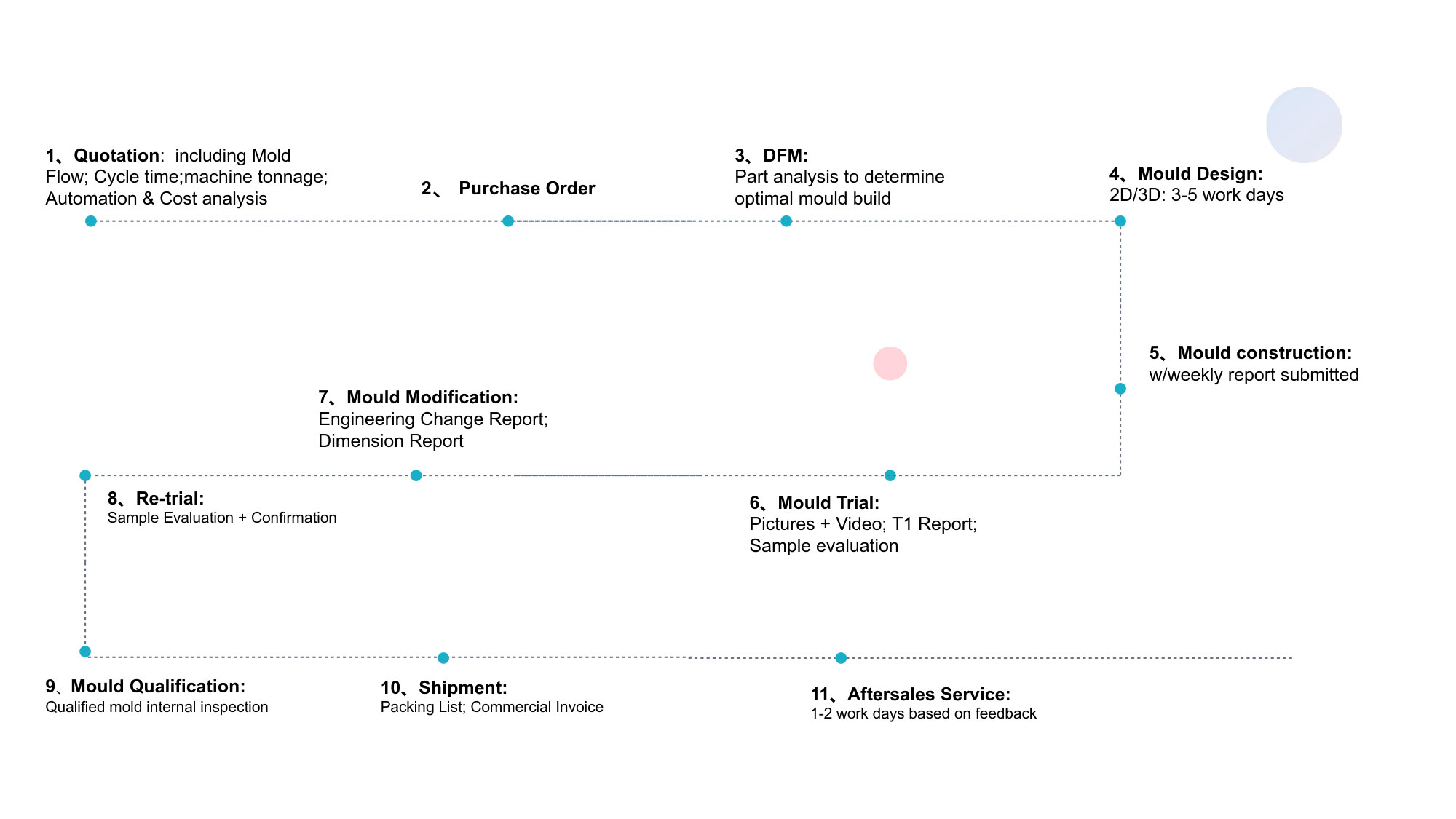
Accelerated deliveries are never achieved by skipping validation. Ansix Tech maintains parallel workstreams—CAD modeling runs simultaneously with material procurement—and maintains in-house electrode manufacturing and EDM capability to ensure that all validation steps (DFM review, T0 sampling, sample inspection, dimensional report) remain intact.
Section Three: Injection Molding Process Control — Eliminating Customer Quality Anxiety
In a conventional molding shop, customers worry about a predictable set of problems: sink marks ruining cosmetic surfaces, flash requiring costly hand-trimming, dimensional drift causing assembly failures, and color variation between batches that triggers rejection. In medical molding, these problems carry additional weight: a sink mark on a valve seat could compromise sealing; dimensional drift on a needle guide could cause premature wear; particulate contamination could threaten patient safety.
Ansix Tech has systematically engineered each of these failure modes out of the production process.
Process Standardization: Locked, Logged, and Unchangeable
Every injection molding machine across Ansix Tech‘s four factories is networked to a Manufacturing Execution System. Critical process parameters are not written on clipboards—they are locked in software, adjustable only by authorized engineers with documented change orders:
Barrel temperatures (zoned control with nozzle zone highest)
Injection pressure, holding pressure, back pressure
Injection speed profile (multi-stage filling)
Cooling time
Mold temperature (cavity-specific setpoints)
Each batch begins with first-article inspection and ends with last-article comparison. If the last part drifts from the first part, the batch is flagged for investigation before nonconforming parts reach the customer.
Dimensional Stability Control: Eliminating the “Every Batch Is Different” Complaint
Medical regulators require stable dimensions across not just shifts but across entire production campaigns. One of the most common customer complaints in the industry is dimensional variation between batches caused by inconsistent cooling. Ansix Tech addresses this through:
Zone-controlled mold temperature regulation. The mold is equipped with independent thermolators for the core and cavity sides, maintaining temperature differential between sides within 2°C. For thin-walled needle valve components, this controlled cooling gradient minimizes warpage and residual stress.
Conformal cooling channels. Cooling circuits are designed to follow the mold cavity contour, maintaining a consistent 2.5mm distance between cooling line and cavity wall for optimal heat transfer. For complex needle valve geometries with varying wall thicknesses, this targeted cooling eliminates hot spots that would otherwise produce uneven shrinkage.
Proven results. For a medical bracket component in Ansix Tech‘s production history, three consecutive production batches run over one week showed critical hole-to-hole spacing variation of ≤0.02mm—meeting ISO 13485 requirements for medical device dimensional traceability.
Aesthetic Quality Grades: What the Customer Sees and Touches
Medical devices carry expectations of precision that extend beyond function to appearance. A regulator with visible weld lines or flow marks feels incomplete, triggering quality concerns regardless of actual mechanical performance.
Ansix Tech‘s documented surface finish specifications:
Material/Application Surface Requirement Achievable Standard
Clear/transparent parts Bubble-free, streak-free Ra ≤ 0.2μm with no visible flow lines
Parts requiring painting/coating Weld line-free, sink-free ±0.1mm allowance for masking registration
High-gloss cosmetic surfaces Mirror finish Ra ≤ 0.2μm
Molded-in labeling/printing alignment Precise registration ±0.1mm positional tolerance
Special Material Capability: The Ansix Tech Material Library
Medical device OEMs do not have the luxury of choosing materials based on price alone. Biocompatibility (ISO 10993), sterilization compatibility (EtO, gamma, autoclave), and regulatory certification (USP Class VI) are non-negotiable requirements.
Ansix Tech maintains a comprehensive material processing database covering:
Material Category Specific Grades/Resins Typical Medical Application
Commodity medical PP, PE, PC, PC/ABS, ABS Syringes, housings, connectors
Engineering medical PBT, PA6+GF30, POM Structural components, gears
High-performance PEEK, PEI (Ultem), PPS, PPSU, LCP, PFA Implantables, sterilization trays, fluid handling
Specialty elastomers Liquid Silicone Rubber (LSR), TPU, TPE Seals, gaskets, soft-touch surfaces
For PEEK—a material increasingly specified for implantable and high-performance medical components due to its biocompatibility and elastic modulus comparable to human bone—Ansix Tech has developed specialized processing parameters to handle its high melting temperature (343°C) and limited flowability (MFR ≈ 3 g/10min @400°C).
Material certifications include:
USP Class VI biocompatibility certification
ISO 10993 series biological evaluation
UL 94 V-0 flame retardancy (critical for electrical medical devices)
UV stability: 3,000 hours of accelerated weathering without discoloration
Section Four: End-to-End Service Platform — Reducing Customer Management Burden
The most expensive cost in medical device manufacturing is often invisible: the management cost of coordinating multiple vendors, validating incompatible processes, and chasing information across disconnected supply chains.
Ansix Tech‘s one-stop service model eliminates these hidden costs by integrating design, engineering, tooling, production, and logistics under a single management system.
Early Engineering Engagement — The DFM Report That Prevents Failure
Before a contract is signed or a design frozen, Ansix Tech provides a comprehensive Design for Manufacturability (DFM) analysis report. This document is not a generic checklist—it is a component-specific engineering assessment delivered at no cost to the customer.
The DFM report addresses:
Draft angle recommendations — Ensuring part ejection without surface drag marks that could compromise biocompatibility.
Wall thickness optimization — Eliminating thick-to-thin transitions that create sink marks and internal voids, particularly critical for needle valve housing geometries where uniform wall thickness ensures consistent cooling and shrinkage.
Gate location selection — Positioning gates to minimize visible witness marks in non-cosmetic areas while ensuring complete cavity filling without over-packing.
Ejector pin placement zones — Showing customers exactly where ejector pin marks will appear so they can be positioned in non-functional areas or specified as allowable in device design control documentation.
Value of this phase: Customers avoid finding out after tooling completion that their part cannot be ejected, that the gate leaves an unacceptable mark on a sealing surface, or that thin sections are impossible to fill. Ansix Tech can deliver 500–1000 parts for design validation using low-cost aluminum tooling before committing to hardened production molds. This “try before you buy” step typically saves customers
50,000–150,000 in rework costs on complex medical molds.
Design and Engineering Integration — One Team, One Vision
Once the design is finalized, Ansix Tech‘s engineering team of over 200 designers translates approved geometry into production-ready tooling. Every design decision downstream is informed by manufacturing knowledge upstream—cooling channel placement accounts for ejection systems; vent depths are sized for material-specific flow characteristics; mold steel selection considers both part volume and chemical exposure.
Process Qualification and Validation — Evidence for Regulators
Medical device customers cannot simply trust that a mold works—they must prove it to FDA, EU Notified Bodies, and other regulators. Ansix Tech supports full validation protocols:
Installation Qualification — Documenting proper installation of mold into customer-specified machine, verifying all connectors and utilities.
Operation Qualification — Running the mold through its specified operating range (temperature, pressure, speed) and verifying all functions operate as intended.
Performance Qualification — Producing parts at production rates, testing dimensional stability (Cpk ≥ 1.33), and generating full statistical evidence of process capability.
Ansix Tech provides template protocols that customers can adapt to their quality systems, reducing the regulatory burden on internal validation teams.
Pilot Production — De-Risking Before Mass Production
Full-scale production commitment is a major decision point. Ansix Tech offers pilot runs of 100 to 500 shots to validate:
Molding process stability and parameter window
First-pass yield
Dimensional capability indices
Secondary operation compatibility (assembly, sterilization, packaging)
Only when pilot production metrics meet customer specifications does mass production commence. This low-risk stair-step approach prevents the nightmare scenario of committing to 100,000 parts only to discover that 30% require rework.
Maintenance and Spares — Protecting the Customer‘s Production Asset
A mold is a depreciating asset, but proper maintenance extends its productive life far beyond the warranty period.
Ansix Tech ships every mold with a starter set of wear parts:
Ejector pins
Core pins
Guide bushings
Spare cavity inserts for quick changeovers
Beyond initial delivery:
Preventive maintenance kits are available at 200,000-cycle intervals
Lifetime repair service is offered at cost (no markup on genuine parts)
In-field replacement support — For qualified customers, critical spares can be shipped next-day
Rapid Prototyping and Sample Approval — Faster Decision Cycles
Before committing to full production tooling, Ansix Tech produces functional prototypes and T0 (first trial) samples for customer approval. Each trial iteration is accompanied by a documented improvement report showing:
Changes made since previous trial
Validation data for corrected issues
Remaining open items requiring customer decision
This transparent, data-driven approach ensures customers are never surprised by the final production tool.
Section Five: Differentiated Problem-Solving — Turning Industry Pain Points Into Customer Wins
Every medical device manufacturer has been burned by common injection molding frustrations. Ansix Tech has built its process architecture specifically to eliminate each of these pain points.
Pain Point #1: “My mold is constantly being repaired, disrupting my production schedule.”
The Standard Industry Response: “We offer standard mold warranty.” (Fine print: wear parts excluded, expedite fees apply.)
Ansix Tech‘s Engineering Response: Pre-delivery aging test of 2,000 production cycles with comprehensive wear analysis. Every mold undergoes simulated production wear before it ships, generating documented evidence of wear patterns, tolerable wear limits, and predicted replacement intervals.
The Customer Value: No mold arrives untested. No customer discovers a design flaw on the third production run. Plus, Ansix Tech provides a three-year structural guarantee on the mold frame and cavity steel (excluding normal consumable wear on ejector pins and core pins). For a mold costing
150,000–300,000, this guarantee represents 50,000–100,000 of insured asset value.
Pain Point #2: “My parts have excessive flash that requires costly manual trimming—10 cents per part adds up to millions of dollars.”
The Standard Industry Response: “We meet industry-standard tolerances.”
Ansix Tech‘s Engineering Response: Parting line fit to 0.005mm accuracy—machined to optical-grade alignment. This is combined with self-locking clamp force compensation that actively adjusts for thermal expansion during the injection cycle.
The Customer Value: Flash controlled to ≤ 0.03mm per batch, eliminating post-mold manual deflashing. For a high-volume device with annual production of 5 million units, eliminating 10 cents per part in labor saves 500,000peryear.Overthetool‘slife,thatis2–5 million in direct labor savings.
Pain Point #3: “Every production batch has slightly different dimensions. I‘m constantly adjusting assembly fixtures.”
The Standard Industry Response: “Your raw material batch must have varied. Call your resin supplier.”
Ansix Tech‘s Engineering Response: In-mold pressure transducers mounted at strategic cavity locations providing real-time feedback to the molding machine. The control system automatically compensates for material viscosity variations, ambient temperature shifts, and machine drift. Additionally, ultrasound wall thickness sensors verify wall section conformance on every shot.
The Customer Value: Dimensions stay within tolerance across batches, across shifts, regardless of material lot variations. Assembly no longer requires bin-sorting or selective fitting. For medical assembly lines running 24/7, this consistency translates to millions of dollars in avoided rework and assembly downtime.
Pain Point #4: “Mold repair takes weeks and requires shipping the tool across continents.”
The Standard Industry Response: “Please return the tool to our factory for evaluation. Standard lead time is 4–6 weeks.”
Ansix Tech‘s Engineering Response: On-site electrode manufacturing and EDM capabilities mean mold repairs stay in-house. Standard weld repair or core pin replacement is completed in 24 hours.
The Customer Value: While a competitor‘s mold sits in customs clearance for two weeks, Ansix Tech‘s returned mold is back in production. For a high-volume medical device line generating
100,000perdayinrevenue,twoweeksofdowntimecosts1.4 million. Ansix Tech‘s rapid repair capability effectively insures customer revenue.
Cost Reduction: The Ansix Tech Value Equation
Cost reduction in medical device manufacturing is not a single lever—it is a system of interconnected optimizations. Ansix Tech has built its service model around three primary cost drivers:
Material Cost Reduction
Medical-grade resins represent 20–40% of direct part cost. PEEK costs $80–120 per kilogram. Even a 5% reduction in scrap yield yields six-figure annual savings at scale. Ansix Tech‘s material optimization strategies:
Cavitation optimization. A 32-cavity mold that Ansix Tech produced for a medical device customer reduced per-unit part costs by over 30%. Higher cavitation amortizes molding machine cost over more parts per cycle, directly lowering the unit price.
Gate and runner design. Hot runner systems eliminate cold runner waste, reducing material consumption by 30–50%. For medical-grade engineering resins, this saving alone often exceeds the incremental investment in hot runner tooling within the first year of production.
Material substitution guidance. Ansix Tech‘s materials engineering team analyzes functional requirements against specification documents, often identifying alternative certified medical grades with equivalent performance at lower cost or better processability.
Process Efficiency Cost Reduction
Cycle time optimization. Through scientific molding principles—systematically varying temperature, pressure, and cooling parameters while monitoring cavity pressure decay—Ansix Tech routinely reduces cycle times by 15–30% compared to baseline settings.
Automated demolding. Parts are designed for gravity or pick-and-place ejection, eliminating manual part removal labor. For high-cavitation molds, this automation represents 2–3 operators per press eliminated from the production cost structure.
Secondary operation elimination. Multi-material overmolding eliminates manual assembly of seals and gaskets. In-mold labeling eliminates post-mold printing. Part geometry optimized for one-step molding eliminates trimming, degating, and finishing.
Quality Cost Risk Reduction
Scrap reduction. By achieving Cpk ≥ 1.33 on critical dimensions, Ansix Tech‘s processes produce fewer than 66 rejects per million parts—99.9934% yield. For a typical medical device line, improving yield from 97% to 99.5% reduces scrap losses by 80%.
Regulatory validation cost. Full IQ/OQ/PQ documentation packages and ISO 13485–compliant quality records reduce the customer‘s internal validation burden by weeks of engineering time.
Conclusion: From Mold Steel to Revenue Stream
To the medical device customer, a mold is not a block of steel—it is a revenue-generating asset. Every day the mold sits idle, operating income is foregone. Every part that fails inspection, profitability is eroded. Every repair cycle, customer trust is tested.
Ansix Tech designs every Medical Regulator Needle Valve Mold with this truth in mind: the mold exists to produce revenue, not to consume maintenance budgets. The company‘s five-part value proposition—hard-power equipment foundation, quantitative mold specifications, rigorous process control, integrated service platform, and pain-point-eliminating engineering solutions—is not a marketing brochure. It is a documented, auditable, guarantee-backed framework for delivering medical components that meet specification the first time, every time.
From material selection (PMMA, PC, ABS, PEEK, PPSU) through DFM analysis, mold flow simulation, five-axis precision machining, IQ/OQ/PQ validation, and volumetric production—Ansix Tech provides the complete ecosystem. The company‘s 28 years of injection molding experience, 260 molding machines, ISO 13485 certification, ISO 8 cleanroom, and FDA 510(k) compliance documentation provide the confidence customers require for Class II and III medical devices.
For medical device OEMs evaluating medical regulator needle valve suppliers, the question is not whether the mold can be built—almost any mold shop can eventually succeed. The question is: who will deliver a mold that requires minimal maintenance, produces consistent parts, and enables the customer to focus on what matters most—bringing safe, effective medical devices to patients who need them?
That is the Ansix Tech answer.
About Ansix Tech
Ansix Tech was founded in Hong Kong in 1998. The company operates four production bases in China and Vietnam, employing over 1,200 people including more than 200 design engineers. Annual production capacity exceeds 30,000 mold sets since establishment. Quality certifications include ISO 9001, IATF 16949, ISO 13485, ISO 14001, and BSCI. The company maintains an ISO 8 Cleanroom and GMP manufacturing environment compliant with FDA 510(k) standards. For Medical Regulator Needle Valve Mold inquiries, contact info@ansixtech.com.
Ansix Tech Co Ltd
If you have any plans related to Medical Regulator Needle Valve Mold , you can contact us at any time. We will turn your ideas into reality, let you realize your dreams, and obtain large orders from the market. Our contact information is info@ansixtech.com. Or contact our CTO, mail: stephen@ansixtech.com
#www.ansixtech.com #ansixtech.com #Medical Regulator Needle Valve Mold #Medical Regulator Needle Valve Mold moulds #Medical Regulator Needle Valve Mold molds #Medical Regulator Needle Valve Mold injection molding companies #Medical Regulator Needle Valve Mold Canopy Mold injection mold companies #Ansix #Ansix moulds #Ansix china #Ansix tech china #Ansix tech company #Ansix facotry #Medical Regulator Needle Valve Mold injection molding #Medical Regulator Needle Valve Mold injection tools #Medical Regulator Needle Valve Mold injection moulds #Medical Regulator Needle Valve Mold plastic mould #Medical Regulator Needle Valve Mold plastic tools #Ansix Tech #Ansix molds #Ansix injection molding #Ansix mold factory #injection molding Medical Regulator Needle Valve Mold #Ansix mold factory #Medical Regulator Needle Valve Mold china #Medical Regulator Needle Valve Mold molds #injection factory #Medical Regulator Needle Valve Mold injection molding #Medical Regulator Needle Valve Mold injection molding factory #injection molding company #Medical Regulator Needle Valve Mold injection mold companies #Medical Regulator Needle Valve Mold#Medical Regulator Needle Valve Mold mold limited #Ansix mold china #Ansix companies #Ansix company China #Medical Regulator Needle Valve Mold facotry #Ansix Tech #Ansix Tech mould #Medical Regulator Needle Valve Mold injection moulding #injection moulding company #Ansix Medical Regulator Needle Valve Mold parts injection mold companies #medical injection molding companieschina #Medical Regulator Needle Valve Mold china factory #Ansix moulding companies #Ansix molding company #Medical Regulator Needle Valve Mold injection moulding facotry #Ansix Tech mold #Medical Regulator Needle Valve Mold mould #Medical Regulator Needle Valve Mold plastic injection molding #ansix plastic mold #Mold manufacturing #Medical Regulator Needle Valve Mold parts manufacturing #Medical Regulator Needle Valve Mold plastic parts factory #Medical Regulator Needle Valve Mold injection parts mold #Medical Regulator Needle Valve Mold PRECISION MANUFACTURING #Medical Regulator Needle Valve Mold #China mold #Medical Regulator Needle Valve Mold injection moulding china #Medical Regulator Needle Valve Mold mould china #china precision mold #mold in china #Medical Regulator Needle Valve Mold mold china #Precision molds #High-precision molds #Medical Regulator Needle Valve Mold #Injection molds #Medical Regulator Needle Valve Mold Factory #Medical Regulator Needle Valve Mold Company #Super Large Injection Mold Factory #Large Tonnage Injection Molding Factory #Medical Regulator Needle Valve Mold Company #Medical Regulator Needle Valve Mold Factory #2800T Injection Molding Factory #3000 Ton Injection Molding #4500 Ton Injection Molding Factory #Large Mold Injection Molding #Large Plastic Mold Injection Molding Factory #Large Injection Mold Manufacturer #Plastic Mold Factory #Injection Mold #Plastic Mold