



LSR Liquid Silicone Face Mask
FEATURES
HARDWARE FOUNDATION — Building Customer Confidence Through Precision Equipment
1.1 Mold Manufacturing Equipment: The Enablers of Precision
At Ansix Tech, we recognize that mold quality is fundamentally constrained by the machines that produce it. Our mold-making arsenal is purpose-configured for medical-grade LSR applications:
Five-Axis High-Speed Machining Centers — We deploy five-axis high-speed machining centers capable of processing complex curved surfaces with 0.002mm positioning accuracy. For LSR face masks, which feature ergonomic facial contours and complex parting lines along the sealing interface, this capability translates directly into reduced manual finishing labor and elimination of visible flash lines. A smooth, flash-free parting line is not merely an aesthetic requirement—it ensures patient comfort during prolonged wear and prevents contamination traps in sterile medical environments.
-
Mold Description
Product Materials:
LSR SILICONE
Soft rubber: LSR
Mold Material:
S136ESR
Number of Cavities:
4
Glue Feeding Method:
Hot runner
Cooling Method:
Water cooling
Molding Cycle
12.5s
- The mold manufacturing process and product material selection
Slow-Speed Wire EDM (Electrical Discharge Machining) — Our slow-speed wire EDM systems achieve cutting accuracy down to 0.003mm, enabling the production of micro-slots and fine-feature details as small as 0.03mm. In LSR face mask molds, this precision is critical for creating the micro-venting channels that allow trapped air to escape during injection without allowing the low-viscosity LSR to bleed out as flash. The ability to machine such narrow slots—typically 0.01mm to 0.03mm in depth—directly determines whether a mask exits the mold with a perfect seal or requires post-processing.
CNC EDM (Sinker) with Mirror-Finish Capability — For deep-rib features and textured grip surfaces, sinker EDM delivers unmatched precision. With in-house electrode manufacturing, we achieve optical-grade mirror polish (Ra ≤ 0.05 μm) on cavity surfaces. This mirror finish performs two critical functions: first, it produces transparent face masks with crystal clarity, meeting medical-grade transparency requirements; second, it facilitates clean demolding of the soft, elastic LSR material, preventing adhesion that would otherwise cause part distortion or surface defects.
-
Precision Surface Grinding — All mold plates and core components undergo precision grinding to ensure absolute parallelism in the mold base. For multi-cavity face mask molds, this means every cavity produces identical parts—eliminating yield losses from cavity-to-cavity variation that typically plague medical device manufacturers. When you produce 100,000 masks per batch, a 1% variation across cavities becomes 1,000 unusable parts. Our grinding protocols eliminate that variation at the source.
1.2 Injection Molding Press Fleet: Scale and Stability
Locking Force Range: 30 tons to 2,800 tons — Our fleet of 260 injection molding machines spans from 30-ton precision presses for small medical components up to 2,800-ton heavy-duty machines for large-scale production, with four production bases across China and Vietnam. For LSR face masks, which typically require 150–400 tons of clamping force depending on cavity count and mask size, this range provides optimal coverage. [17†L10-L13]
All-Electric Servo-Driven Machines — Our press park consists exclusively of all-electric servo-driven injection molding machines, including Japan‘s Fanuc, Sumitomo, Toshiba, Nissei, Engel, and Germany’s Arburg (specialized for LSR injection molding with two-component capabilities). Why does this matter to you? Conventional hydraulic presses suffer from viscosity-based repeatability drift. As the machine heats up during a production run, oil viscosity changes, causing pressure fluctuations and dimensional variation. Our all-electric machines maintain ±0.1% shot-to-shot repeatability, guaranteeing that the 100,000th part off the line is dimensionally identical to the first part produced. [17†L11-L15] [18†L38-L43]
Specialized LSR Processing Units — LSR is a two-component thermoset material: Part A contains the platinum catalyst and base polymer, Part B contains the crosslinking agent and inhibitor. These components are pumped from original 200-liter or 20-liter containers through precision metering pumps (1:1 ratio) and a static mixer before entering the cooled injection barrel. Our LSR-dedicated machines feature:
12:1 to 14:1 L/D single-flight, wear-resistant screws for optimal homogenization without temperature increase
Cooled injection barrels (typically 15–25°C) to prevent premature vulcanization
Platinum-cure compatible material paths ensuring chemical compatibility
The two components remain separate until the static mixer, where they combine immediately before injection. The mixed LSR is then injected into the heated mold (typically 170–220°C), where the platinum catalyst triggers crosslinking, transforming the liquid into a solid elastomer in seconds. This thermoset reaction is irreversible, making LSR ideal for applications requiring chemical resistance, thermal stability, and biocompatibility. [1†L17-L18] [1†L38-L40]
1.3 Metrology and Quality Assurance Equipment
Coordinate Measuring Machines (CMM) — Our ZEISS CMMs provide three-dimensional dimensional verification with micron-level accuracy. Every mold manufactured at Ansix Tech undergoes full dimensional inspection before shipment, complete with a dimensional report and critical dimension CPK ≥ 1.33. This is not an optional add-on—it is a non-negotiable deliverable for every LSR face mask mold. [18†L51-L52]
Optical Imaging and Surface Profilometry — For LSR face masks where surface finish directly impacts sealing performance and patient comfort, our optical measurement systems verify:
Surface roughness (Ra ≤ 0.2 μm for optical clarity, Ra ≤ 0.05 μm for mirror-finish applications)
Sealing lip geometry and consistency
Venting channel depth verification (0.01–0.03mm tolerance)
Ultrasonic Wall Thickness Sensors — During production runs, our injection molding machines are equipped with ultrasonic through-wall sensors that monitor part thickness in real time, automatically compensating injection parameters to maintain dimensional stability within ±0.02mm across multi-cavity tools. [18†L38-L43]
PART II: MOLD MANUFACTURING — Core Competencies with Measurable Deliverables
2.1 Mold Steel Selection: Matching Material to Application
Mold steel selection directly impacts tool life, part quality, and production uptime. At Ansix Tech, we match mold materials to your specific production requirements:
Steel Grade Hardness Key Properties Optimal Application
S136 (Stavax ESR) 48–52 HRC Superior corrosion resistance, exceptional polishability (mirror finish), high wear resistance Face masks requiring optical clarity, medical-grade applications, high-volume production (500,000+ cycles)
NAK80 38–41 HRC Pre-hardened, excellent machinability, good mirror polish, no post-weld heat treatment required Complex multi-cavity molds, medium-volume production, rapid turnaround projects
H13 46–54 HRC Excellent thermal fatigue resistance, high toughness at elevated temperatures, good wear resistance High-cavitation molds, thin-wall face mask geometries, applications requiring rapid thermal cycling
DIN 1.2083 / 4Cr13 48–52 HRC Stainless mold steel, good corrosion resistance, cost-effective Cost-sensitive medical device components, moderate production volumes
Beryllium Copper (BeCu) 35–45 HRC Thermal conductivity 3–5× higher than steel, excellent for localized cooling Core pins and inserts requiring rapid heat dissipation, regions with thick cross-sections
[11†L5-L51][2†L16-L18]
What This Means for Your Project:
For LSR face masks requiring high transparency (such as medical respirators with clear viewing panels or transparent full-face masks), we specify S136 ESR stainless steel. Its corrosion resistance prevents pitting from the platinum-catalyst reaction byproducts (trace acids released during curing), while its mirror polishability ensures crystal-clear transparency. Our typical guarantee: 1 million cycles for S136-based molds when processing medical-grade LSR.
For lower-volume mask designs (50,000–200,000 cycles), NAK80 offers cost savings without compromising part quality, reducing your initial tooling investment by approximately 20–30%.
Customer Value:
Reduced tooling cost risk: Right-material selection prevents over-specification (wasted capex) or under-specification (premature mold failure and production downtime)
Predictable mold life: Our material selection and heat treatment protocols are documented with material certificates and heat treatment curves, providing you with auditable data
Lower total cost of ownership: Proper material selection extends mold life by 2–3× compared to generic tool steels
2.2 LSR Mold Design: Addressing Unique Challenges
Unlike traditional thermoplastics, LSR presents distinct material behaviors that demand specialized mold design:
Low Viscosity and High Fluidity — Liquid silicone rubber behaves like water during injection, flowing at viscosities as low as 200,000–1,000,000 mPa·s. This exceptional fluidity means that mold clearances must be exceptionally tight—typically 0.005mm or less on parting surfaces—to prevent flash. At Ansix Tech, we achieve this through precision-ground parting surfaces and self-locking clamp force compensation that automatically adjusts for thermal expansion during production runs, keeping flash within 0.03mm across every cycle. [9†L6-L7][13†L22-L27]
High Thermal Expansion and Shrinkage — LSR exhibits a linear shrinkage rate of 2.5% to 4.0% after curing—significantly higher than thermoplastics. A failure to account for shrinkage means finished masks will be undersized, compromising facial fit and seal integrity. Our design process incorporates:
Material-specific shrinkage compensation: We precisely calculate cavity dimensions based on the specific LSR grade‘s published shrinkage data (verified through our T0 trial shots)
Anisotropic compensation: LSR may shrink differently along flow and cross-flow directions. Our DFM process includes anisotropic correction for critical sealing surfaces, ensuring the mask’s facial contact area achieves the specified dimensions within ±0.1mm
For a full-face mask with a 200mm horizontal span, 3.0% shrinkage means the mold cavity must be 206mm—a 6mm compensation that must be precisely engineered. Miss this, and 100% of parts fail. [10†L6-L9]
Cold Runner System Mandate — Unlike thermoplastic hot runners, LSR molds must use cold runner systems. The runner channels are maintained at 15–25°C via independent water-cooling circuits, while the cavity is heated to 170–200°C. This dual-temperature design prevents LSR from curing inside the runner, allowing the same runner to be reused for each shot. [9†L9-L11]
For LSR face masks:
Cold runner material savings: 30–80% material conservation versus traditional runner systems
Pinpoint gate placement: Valve-gated cold runners enable point-gate injection, producing no runner scrap and eliminating post-mold degating operations
Automatic gate breakoff: Clean gate vestige without manual trimming, preserving the sealing lip integrity and reducing labor costs
Our DFM (Design for Manufacturing) analysis includes a complete cold runner layout with temperature zone simulations ensuring uniform flow distribution across all cavities, verified through SIGMASOFT® virtual molding. [0†L34-L37]
Vacuum Venting System — Trapped air is the leading cause of defects in LSR face masks: bubbles, carbonization (burn marks), short shots, and surface blemishes. At Ansix Tech, every LSR face mask mold features:
Full-perimeter venting channels (0.010–0.025mm depth) machined along the parting line—deep enough to evacuate air but too shallow for low-viscosity LSR to escape
Vacuum pump integration: The mold connects to a vacuum system achieving 29 inHg, drawing air out of all cavities before injection begins
Venting at all potential air trap locations: Ejector pins, core inserts, and deep-cavity extremities all receive dedicated venting
The outcome: zero-bubble transparency for optical-quality face mask windows, complete fill of thin sealing lips (0.8–1.5mm thickness), and elimination of surface defects that would otherwise render medical masks non-compliant. [10†L18-L20][9†L13-L16]
Ejector System for Soft, Elastic Components — LSR’s softness (typically 20–80 Shore A) and high coefficient of friction against steel create demolding challenges. Aggressive ejector pins will puncture or distort the part. Our ejector design strategy includes:
Air ejector (blow-off) system as primary demolding method, using compressed air to float the mask off the core
Robot pickup with vacuum cups for automatic demolding, eliminating manual handling contamination risks
High-ejector pin density (8–12 pins per cavity) with flat-blade or block ejectors to distribute force across broad areas
Ejector pin locations positioned at non-cosmetic surfaces (mask edges, behind rib structures, reinforcement bosses)
What This Means for Your Project:
LSR face mask molds designed by Ansix Tech achieve:
Defect rate < 0.5% at steady-state production (versus industry average 2–5% for poorly designed LSR molds)
No post-mold degating (cold runner eliminates runner scrap)
No manual trimming (vacuum venting eliminates flash)
Fully automated demolding (air eject + robot pickup)
2.3 Mold Life and Performance Guarantees
Parameter Standard Performance Ansix Tech Performance Value to Customer
Mold life (S136, medical-grade LSR) 300,000–500,000 cycles 1,000,000+ cycles guaranteed Lower tooling amortization cost per part; fewer mold replacement projects
Part tolerances ±0.1mm ±0.03–0.05mm typical; ±0.005mm achievable for critical features Consistent seal fit; no customer complaints about assembly issues
Flash height 0.10–0.15mm ≤0.03mm across parting line Eliminates manual deflashing; reduces labor cost by $0.05–0.15 per part
Mirror finish (Ra) 0.2–0.3 μm ≤0.05 μm optical finish Crystal-clear transparency; no light scattering
Mold delivery (complex multi-cavity) 45–90 days 25–45 days standard; 20-day expedited available Accelerated time-to-market by 3–6 weeks
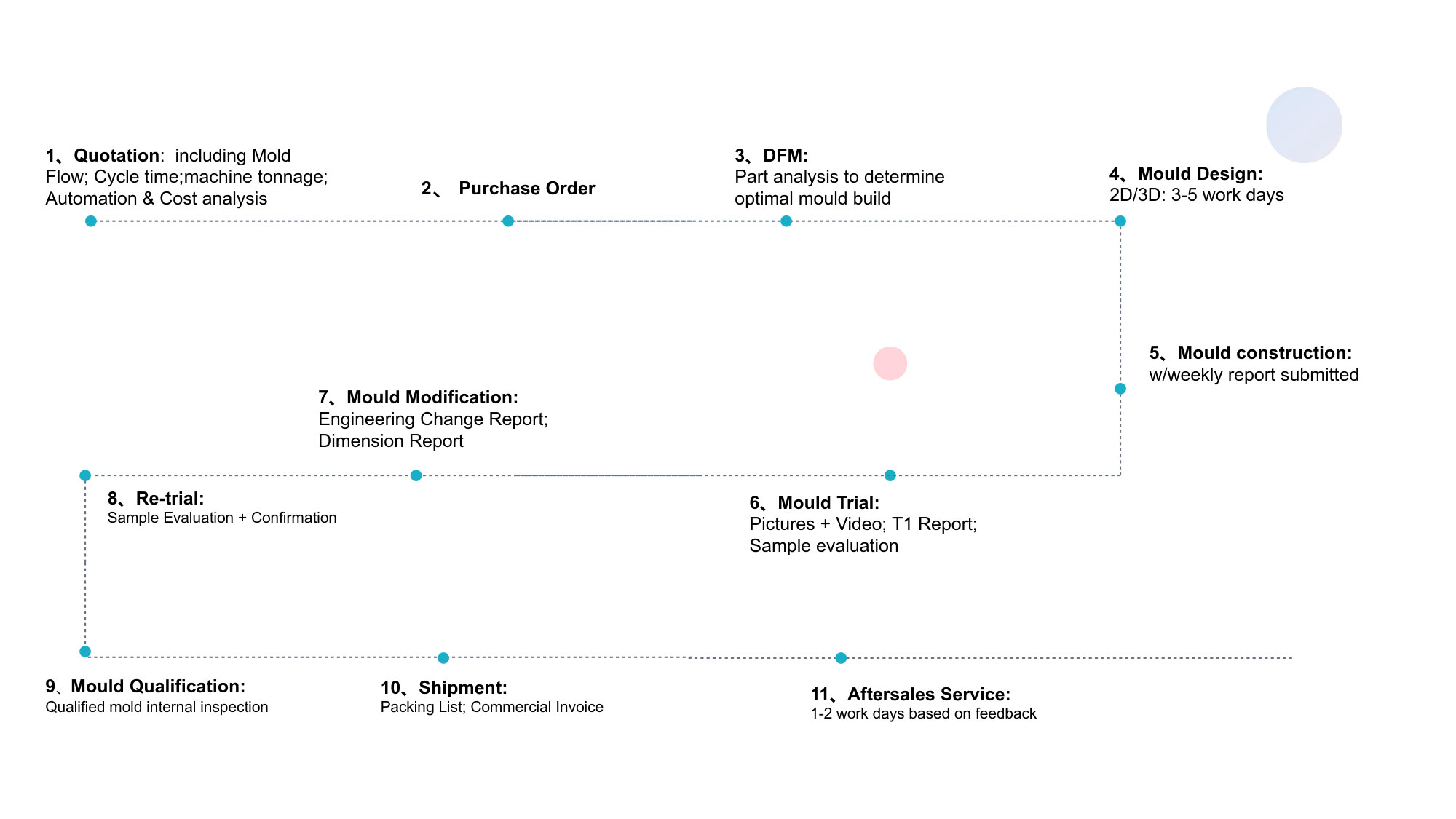
2.4 DFM Report: Solving Problems Before They Happen
Our DFM (Design for Manufacturing) report is delivered before mold manufacturing begins—not after you‘ve already committed to tooling. This report includes:
Mold flow analysis identifying weld line positions, air trap locations, and fill imbalance across cavities. For each identified risk, we propose countermeasures before steel is cut
Shrinkage compensation calculations for all critical dimensions, with recommended cavity enlargement factors based on your selected LSR grade
Draft angle recommendations for all vertical walls, ensuring clean demolding without part distortion
Gate location and number optimized for balanced filling, with justification for each cavity‘s gate design
Ejector pin mark locations mapped on your part geometry, with agreement on acceptable cosmetic zones
Parting line position verification to ensure sealing surfaces remain flash-free and comfortable against skin
Customer Value: By solving molding problems at the design stage, we eliminate the “surprises” that typically add 30–60 days and 10,000–50,000 in mold rework costs during T1–T3 trials.
PART III: PROCESS CONTROL — Eliminating Quality Anxiety
3.1 MES-Integrated Parameter Lockdown
Every injection molding machine at Ansix Tech is networked to our Manufacturing Execution System (MES). All molding parameters—temperature zones (barrel, nozzle, mold), injection pressure, injection speed, holding pressure, cooling time, and back pressure—are locked within the MES. Only authorized engineers can modify parameters, and every adjustment is tracked with timestamp and operator ID. [18†L27-L28]
For LSR face masks, locked parameters include:
Barrel temperature: 15–25°C (cooled) — prevents premature curing
Mold temperature: 170–200°C (heated) — activates platinum-catalyzed crosslinking
Injection pressure: 50–150 bar, depending on cavity geometry and flow length
Cure time: 20–60 seconds, depending on wall thickness and part volume
Cold runner temperature: 20–25°C, independently regulated from mold cavity heating
What This Means for You: When you place a repeat order six months after the initial run, your parts will be dimensionally identical to the first run. No parameter drift. No operator variation. No “batch-to-batch” surprises.
3.2 First Article and In-Process Inspection Protocol
Pre-Production Validation: Every new mold undergoes a T0 (first shot) sample run. Parts are measured on CMM for full dimensional verification against the 2D drawing. We provide a complete First Article Inspection Report (FAIR) before any production run begins.
In-Process Controls:
First-off inspection: Three consecutive good parts measured at start of shift
In-process sampling: Parts pulled every 30–60 minutes for dimensional verification
End-of-shift retention: Samples retained for shift-to-shift comparison
Statistical Process Control (SPC): Key dimensions charted with control limits; intervention triggered at the first sign of trend deviation
Critical dimension CPK ≥ 1.33 guaranteed for all dimensions you designate as critical. This statistical guarantee translates to a defect rate of less than 32 parts per million (PPM)—industry-leading performance for LSR injection molding.
3.3 Color and Material Consistency
Color inconsistency is a leading quality complaint in silicone products. At Ansix Tech, we control color through:
Gravimetric or micro-metering color pumps with ±0.1% dosing accuracy [14†L47-L51]
Closed-loop ratio monitoring on A:B component metering, maintaining 1:1 ratio within 0.5% deviation
Static mixers specifically designed for LSR flow behavior, ensuring homogeneous dispersion of pigment and crosslinker
Temperature-stabilized pigment storage preventing viscosity variation that would alter color intensity
For transparent masks, our optical-grade LSR combined with mirror-polished cavities (Ra ≤ 0.2 μm) and optimized injection parameters eliminates haze, flow marks, and light-scattering micro-bubbles—producing crystal-clear transparency verified by hazemeter measurement (haze < 2%, clarity > 90%). [14†L28-L39]
3.4 Post-Cure and Aging Validation
While platinum-cured LSR does not require post-curing for safety, Ansix Tech performs controlled post-cure thermal aging (150°C for 2–4 hours) for medical and high-reliability applications. This secondary cure:
Completes any residual crosslinking for maximum mechanical properties
Drives off trace volatiles, eliminating any odor concerns
Stabilizes dimensions for long-term reliability
We validate post-cured properties through accelerated aging testing (ASTM D573, 70°C for 7–28 days) and UV exposure testing (3,000+ hours, no yellowing or surface degradation), providing you with auditable data for regulatory submissions. [6†L17-L20]
PART IV: MATERIAL SELECTION AND SUPPLY CHAIN INTEGRITY
4.1 LSR Material Grades and Their Applications
Ansix Tech works with leading LSR suppliers including Dow Corning (Silastic®), Momentive (Silopren®), Wacker (Elastosil®), Shin-Etsu, and KCC. For face mask applications, we recommend:
Material Grade Hardness (Shore A) Key Characteristics Optimal Application
Medical/food-grade LSR 30–50 FDA 21 CFR 177.2600, ISO 10993 biocompatibility, platinum-cured, odorless Full-face respirators, medical oxygen masks, CPAP masks
High-clarity optical LSR 40–60 Refractive index matched, haze < 2%, light transmission > 90% Mask viewing windows, transparent face shields
High-tear-strength LSR 50–70 Tear resistance 20–40 N/mm, excellent abrasion resistance Industrial gas masks, high-durability respirators
Flame-retardant LSR 50–70 UL94 V-0 rated, self-extinguishing Industrial safety masks, firefighter respirators
Antimicrobial LSR 40–60 Silver-ion or silver-zinc zeolite additive, ISO 22196 compliant Reusable medical masks, hygiene-critical applications
[6†L10-L14][6†L41-L44]
Material Certifications:
FDA 21 CFR 177.2600 for food contact applications
ISO 10993-4, -5, -10, -11 (biocompatibility) for medical devices
USP Class VI for implantable and blood-contact devices
ISO 13485 certified manufacturing environment
REACH and RoHS compliant for EU markets
4.2 Two-Component Metering and Mixing
LSR requires precise 1:1 ratio mixing of Part A (base polymer + platinum catalyst) and Part B (crosslinker + inhibitor). Ansix Tech’s dosing systems achieve:
Metering accuracy: ±0.5% ratio deviation
Static mixing: 20–30 mixing elements, ensuring homogeneous distribution
Colorant addition: Up to 4 colors simultaneously, 0.2–5% each
Vacuum degassing: -0.095 MPa vacuum applied to mixed material, removing entrained air before injection—critical for bubble-free transparent parts [3†L24-L26]
4.3 Supply Chain Stability
With 28 years of manufacturing experience and four production bases (China: Shenzhen, Dongguan, Hunan; Vietnam), Ansix Tech maintains:
Strategic material inventory: Minimum 3 months of LSR inventory for all standard grades
Multi-source qualification: Each LSR grade is qualified from at least two suppliers
ISO 9001 / IATF 16949 / ISO 13485 certified quality management systems
Just-in-time delivery coordination with logistics partners
PART V: COST OPTIMIZATION — Reducing Your Total Cost Without Compromising Quality
5.1 Material Cost Reduction
Cold Runner Material Savings: By eliminating runner waste through cold runner systems, we reduce LSR consumption by 30–80%. For a full-face mask weighing 80 grams, runner material savings of 40 grams per shot across an 8-cavity mold means 320 grams saved per cycle. At
15/kgformedical−gradeLSR,thistranslatesto∗∗4.80 saved per cycle**. At a 30-second cycle time (2 cycles per minute, 120 cycles per hour), that‘s $576 per operating hour in material savings alone.
Why This Is Only Achievable with Proper Mold Design: LSR cold runner systems require precise temperature control of runner channels (15–25°C) versus cavity heating (170–200°C). Improperly designed cold runners cause premature curing inside the runner, defeating the entire savings premise. Ansix Tech’s 28 years of LSR experience ensures your mold delivers the full material savings potential.
Optimal Cavitation: We analyze your annual volume projections and specify the optimal number of cavities. Too few cavities drives up per-part cost due to low output. Too many cavities creates quality variation and wasted material if cavities are inconsistent. Our typical recommendation: 4–16 cavities for LSR face masks, depending on mask size and complexity.
5.2 Process Efficiency and Cycle Time Optimization
LSR injection molding cycle time is primarily determined by cure time—the duration required for the thermoset crosslinking reaction to reach 100% completion. Ansix Tech optimizes cycle times through:
Platinum-catalyst formulation selection: Fast-cure LSR grades achieve full crosslinking in 15–30 seconds, compared to 40–60 seconds for standard grades
Uniform cavity heating: Our molds feature balanced heating circuits achieving temperature variation ≤ 2°C across all cavities, eliminating the need to extend cure time for the coldest cavity
Thin-wall optimization: Face mask sealing lips designed at 0.8–1.5mm minimize heat penetration requirements
Automated demolding: Robot pickup with vacuum cups reduces cycle time by 3–5 seconds compared to manual demolding
Servo-electric ejector systems: Faster and more repeatable than pneumatic alternatives [5†L12-L16]
Typical cycle time for LSR face masks:
Single-cavity: 25–40 seconds
4-cavity: 30–45 seconds
8-cavity (balanced): 35–50 seconds (1.3–1.9 parts per second)
Customer Value: A 5-second reduction in cycle time on an 8-cavity mold running 24/5 yields approximately 75,000 additional parts per year with zero added tooling or labor cost.
5.3 Labor Cost Reduction Through Automation
Manual Operation Automation Solution Annual Labor Savings (per 8-cavity mold, 24/5 operation)
Manual degating (flash removal) Vacuum venting + cold runner eliminates flash $25,000–50,000
Manual part removal Robot pickup + conveyor integration $15,000–30,000
Manual inspection (100%) Vision system + automated sorting $20,000–40,000
Manual packaging Automated stacking/bagging equipment $10,000–25,000
Total annual labor savings $70,000–145,000
5.4 Quality-Related Cost Avoidance
Quality Issue Industry Baseline (Annual) Ansix Tech Performance Cost Savings per 1M Parts
Scrap/rework rate 5–10% < 1% at steady state $35,000–70,000
Customer returns 2–5% of shipments < 0.5% $10,000–25,000
Field failure claims 0.5–1% of installed units < 0.05% $5,000–10,000
Regulatory non-compliance investigation 1–2 events per year 0 events (ISO 13485 maintained) $25,000+
Expedited replacement shipment 3–5 events per year < 1 event $10,000–20,000
5.5 Tooling Investment Optimization
Tooling Option Initial Investment Per-Part Cost (1M parts) Total Cost Best For
S136 premium mold (Ansix Tech) $30,000–60,000 $0.03–0.06 $60,000–120,000 High-volume (500k+), medical, optical-grade
NAK80 mid-tier mold $18,000–35,000 $0.035–0.07 $53,000–105,000 Medium-volume (100k–500k), cosmetic parts
Generic P20 mold (competitor) $12,000–25,000 $0.06–0.15 $72,000–175,000 Low-volume, short-run (under 100k)
*Calculations assume 1,000,000 parts, $15/kg LSR, 3% scrap baseline, 20% scrap differential*
The Savings Math: While our S136 premium mold requires higher upfront investment, the lower per-part cost and extended mold life (1M+ cycles) deliver superior total cost of ownership at production volumes above 200,000 units. For customers projecting 1 million units, the total cost difference is $12,000–55,000 in Ansix Tech‘s favor compared to cheaper tooling alternatives.
5.6 Transparent Cost Breakdown and No-Surprise Pricing
Ansix Tech provides a complete cost breakdown before project launch, eliminating hidden fees:
Cost Component What‘s Included
Mold manufacturing Steel, machining, heat treatment, surface finishing, assembly, mold trials (T0–T3)
LSR material Grade selection consultation, qualification samples, production batches
Processing Machine setup, parameter development, production runs, packaging
Quality First article inspection, SPC monitoring, material certifications, dimensional reports
Logistics Export packing, freight forwarding (DDP available), customs clearance assistance
Support DFM report, mold maintenance documentation, spare parts (ejector pins, wear components)
No hidden costs: Mold rework during T1–T3 is included. Parameter development is included. DFM revisions are included. If we recommend a change, we absorb the cost—because it was our recommendation.
PART VI: QUALITY VALIDATION AND REGULATORY COMPLIANCE
6.1 Step-by-Step Validation Protocol
Phase Activities Deliverables Timeline
Phase 1: Design Review DFM analysis, mold flow simulation, shrinkage compensation calculations, gate/venting layout DFM Report (with risk assessment) 1–2 weeks
Phase 2: T0 Mold Trials First shots from finished mold; dimensional measurement of 20+ parts; defect analysis T0 Sample Report + Dimensional FAIR Within 1 week of mold completion
Phase 3: T1–T3 Optimization Parameter adjustment for fill balance, flash elimination, cosmetic optimization; mold modifications as needed T1, T2, T3 Improvement Reports 2–4 weeks
Phase 4: Pre-Production Validation 100–500 shot continuous run; CPK calculation for critical dimensions; defect rate measurement PPAP Level 3 (if required) + CPK Report 1–2 weeks
Phase 5: Production Ramp Sustained production run at target cycle time; ongoing SPC monitoring Full production documentation + material certs Ongoing
6.2 Certifications and Regulatory Standing
Ansix Tech maintains:
ISO 9001:2015 (Quality management systems)
IATF 16949:2016 (Automotive quality management—controls applicable to medical devices)
ISO 13485:2016 (Medical devices quality management)
ISO 14001:2015 (Environmental management)
BSCI (Social compliance)
ISO 8 Cleanroom (Class 100,000) — Complies with GMP standards
FDA 510(k) ready documentation packages available
6.3 LSR-Specific Quality Validation
Mold Validation (Performed Before Production Release):
All cavity surfaces inspected to Ra ≤ 0.05 μm (mirror finish)
Venting depth verified at 0.010–0.025mm across all vent locations
Cold runner temperature differential tested (≤ 2°C variation across all channels)
2000-shot aging test performed, with wear report documenting dimensional stability
Part Quality Validation (Performed at Production Release and Ongoing):
Biocompatibility testing: ISO 10993-4 (hemocompatibility), -5 (cytotoxicity), -10 (sensitization/irritation), -11 (systemic toxicity)—as required for medical applications [4†L5-L10]
Mechanical testing: Tensile strength (ISO 37), tear strength (BS ISO 34-1), elongation at break, Shore A hardness [6†L37-L39]
Environmental testing: UV aging (3,000+ hours), thermal aging (70°C × 28 days, ASTM D573), temperature cycling (-40°C to +70°C)
Chemical resistance: Contact with alcohols, disinfectants, bodily fluids per use-case requirements
Sterilization validation: Autoclave (121°C, 15–30 minutes), ethylene oxide (EO), gamma radiation (25–50 kGy) compatibility
PART VII: DELIVERY AND ONGOING SUPPORT
7.1 Standard Lead Times
Project Type DFM Delivery Mold Completion Pre-Production Validation Production Shipment
Simple single-cavity mask mold 5–7 days 10–15 days 5–7 days 20–30 days total
Medium 4-cavity mask mold 7–10 days 20–30 days 7–10 days 35–45 days total
Complex 8–16 cavity mask mold 10–14 days 35–45 days 10–14 days 55–75 days total
Expedited service (available on request) 3–5 days 15–20 days 5–7 days 25–35 days total
Expedited service requires dedicated machine allocation but does not skip T1–T3 validation steps—quality is never compromised for speed.
7.2 After-Sales Support
Mold Maintenance Documentation:
Complete mold assembly drawings
Recommended maintenance schedule (every 50k/100k/500k cycles)
Spare parts list with manufacturer part numbers
Storage and handling instructions (corrosion prevention, humidity control)
Mold Care Program:
Spare ejector pins, core inserts, and wear components included with mold delivery
Preventive maintenance service every 200,000 cycles (performed at our facility or yours)
Lifetime repair service at cost (no markup on repair labor or materials)
Emergency repair turnaround within 24 hours for critical components (in-house EDM and CNC capability eliminates external vendor delays)
What This Means for You: When a component wears or breaks, you are not waiting 2–4 weeks for a third-party machine shop. Our in-house electrode manufacturing and EDM capability means replacement components are machined within hours, not weeks—keeping your production line running.
7.3 Production Capacity and Scalability
With 260 injection molding machines across 200,000+ square meters of production space and 1,200+ employees, Ansix Tech can scale from:
Prototype runs: 50–500 units (single-cavity tool)
Pilot production: 1,000–50,000 units per month (4-cavity tool, single shift)
Mass production: 100,000+ units per month (8–16 cavity tool, multi-shift, multi-machine)
Our Vietnam facility provides cost-competitive scaling for high-volume programs while maintaining the same quality systems and equipment standards as our China plants.
CONCLUSION: Why Ansix Tech for Your LSR Face Mask Project
Customer Concern Industry Problem Ansix Tech Solution Measurable Value
High tooling cost Over-specified or poorly specified mold materials Right-sized material selection (S136 for high-volume, NAK80 for medium-volume) 20–30% lower initial investment vs. competitor premium quotes
Long mold delivery 60–90 day lead times common Standard 25–45 day lead times; expedited 20-day available 3–6 weeks faster time-to-market
Mold failure after 100k cycles Low-quality tool steels (P20) in high-cycle applications S136 or H13 with HRC 48–52 hardness; 1M+ cycle guarantee No mold replacement costs for 5–10 years of production
Flash on sealing surfaces Improper venting or loose parting line fit 0.005mm parting line precision + vacuum venting + self-locking clamp Flash ≤ 0.03mm; manual deflashing eliminated
Bubbles in transparent masks Inadequate vacuum venting or degassing Vacuum system (29 inHg) + material degassing (-0.095 MPa) Zero-bubble parts; haze < 2%
Inconsistent part dimensions Hydraulic press drift; open-loop process control All-electric servo machines + MES parameter lock; ±0.1% repeatability CPK ≥ 1.33 on all critical dimensions
Long cycle times Inefficient heating/cooling design Balanced heating (≤ 2°C variation) + fast-cure LSR grade 5–15 second cycle time savings per shot
High material waste Hot runner unsuitable for LSR; cold runner designed incorrectly Proper cold runner design (15–25°C) + valve-gate control 30–80% material savings vs. cold runner systems
Regulatory compliance risk Incomplete documentation; uncertified materials ISO 13485 certified + full material certs + biocompatibility validation Auditable regulatory package; reduced submission risk
Supply chain disruption Single-site production; single-source material 4 production bases (China + Vietnam); multi-source material qualification Production continuity assured
Closing Statement to Customers:
At Ansix Tech, we do not view an LSR face mask mold as just another tool. We view it as the engine of your production line—the single component that determines your output, your quality, your cost, and your customer satisfaction. Our 28 years of mold manufacturing and injection molding experience, our 260-machine fleet, our ISO 13485-certified cleanroom environment, and our four-facility production network are all deployed to deliver one outcome: successful, profitable, risk-free production of your LSR face mask.
We invite you to experience the Ansix Tech difference. Send us your part drawing, product requirements, and annual volume projections. Within 7–10 days, you will receive a complete DFM report—at no cost or obligation—that identifies every potential molding risk and presents our recommended mitigation strategy.
When you understand how we solve problems, you will understand why our customers stay for decades.
Ansix Tech — Precision Mold Manufacturing & Injection Molding Excellence Since 1998
Ansix Tech Co Ltd
If you have any plans related to LSR Liquid Silicone Face Mask , you can contact us at any time. We will turn your ideas into reality, let you realize your dreams, and obtain large orders from the market. Our contact information is info@ansixtech.com. Or contact our CTO, mail: stephen@ansixtech.com
#www.ansixtech.com #ansixtech.com #LSR Liquid Silicone Face Mask #LSR Liquid Silicone Face Mask injection molding companies #LSR Liquid Silicone Face Mask Canopy Mold injection mold companies #Ansix #Ansix moulds #Ansix china #Ansix tech china #Ansix tech company #Ansix facotry #LSR Liquid Silicone Face Mask injection molding #LSR Liquid Silicone Face Mask injection tools #LSR Liquid Silicone Face Mask injection moulds #LSR Liquid Silicone Face Mask plastic mould #LSR Liquid Silicone Face Mask plastic tools #Ansix Tech #Ansix molds #Ansix injection molding #Ansix mold factory #injection molding LSR Liquid Silicone Face Mask#Ansix mold factory #LSR Liquid Silicone Face Mask china #LSR Liquid Silicone Face Mask molds #injection factory #LSR Liquid Silicone Face Mask injection molding #LSR Liquid Silicone Face Mask injection molding factory #injection molding company #LSR Liquid Silicone Face Mask injection mold companies #LSR Liquid Silicone Face Mask Tooling #LSR Liquid Silicone Face Mask mold limited #Ansix mold china #Ansix companies #Ansix company China #LSR Liquid Silicone Face Mask facotry #Ansix Tech #Ansix Tech mould #LSR Liquid Silicone Face Mask injection moulding #injection moulding company #Ansix LSR Liquid Silicone Face Mask parts injection mold companies #medical injection molding companieschina #LSR Liquid Silicone Face Mask china factory #Ansix moulding companies #Ansix molding company #LSR Liquid Silicone Face Mask injection moulding facotry #Ansix Tech mold #LSR Liquid Silicone Face Mask mould #LSR Liquid Silicone Face Mask plastic injection molding #ansix plastic mold #Mold manufacturing #LSR Liquid Silicone Face Mask parts manufacturing #LSR Liquid Silicone Face Mask plastic parts factory #LSR Liquid Silicone Face Mask injection parts mold #LSR Liquid Silicone Face Mask PRECISION MANUFACTURING #LSR Liquid Silicone Face Mask #China mold #LSR Liquid Silicone Face Mask injection moulding china #LSR Liquid Silicone Face Mask mould china #china precision mold #mold in china #LSR Liquid Silicone Face Mask mold china #Precision molds #High-precision molds #LSR Liquid Silicone Face Mask #Injection molds #LSR Liquid Silicone Face Mask Factory #LSR Liquid Silicone Face Mask Company #Super Large Injection Mold Factory #Large Tonnage Injection Molding Factory #LSR Liquid Silicone Face Mask Company #LSR Liquid Silicone Face Mask Factory #2800T Injection Molding Factory #3000 Ton Injection Molding #4500 Ton Injection Molding Factory #Large Mold Injection Molding #Large Plastic Mold Injection Molding Factory #Large Injection Mold Manufacturer #Plastic Mold Factory #Injection Mold #Plastic Mold