



LSR Liquid Silicone CIDR Vaginal Suppositories
FEATURES
Customer Value Proposition – From Technical Terms to Business Benefits
When evaluating an LSR CIDR manufacturing partner, customers care about four core metrics: cost per part, quality consistency, production throughput, and regulatory compliance risk. The table below translates Ansix Tech‘s technical capabilities into these customer-centered business values.
-
Mold Description
Product Materials:
LSR SILICONE
Soft rubber: LSR
Mold Material:
S136ESR
Number of Cavities:
12
Glue Feeding Method:
Hot runner
Cooling Method:
Water cooling
Molding Cycle
12.5s
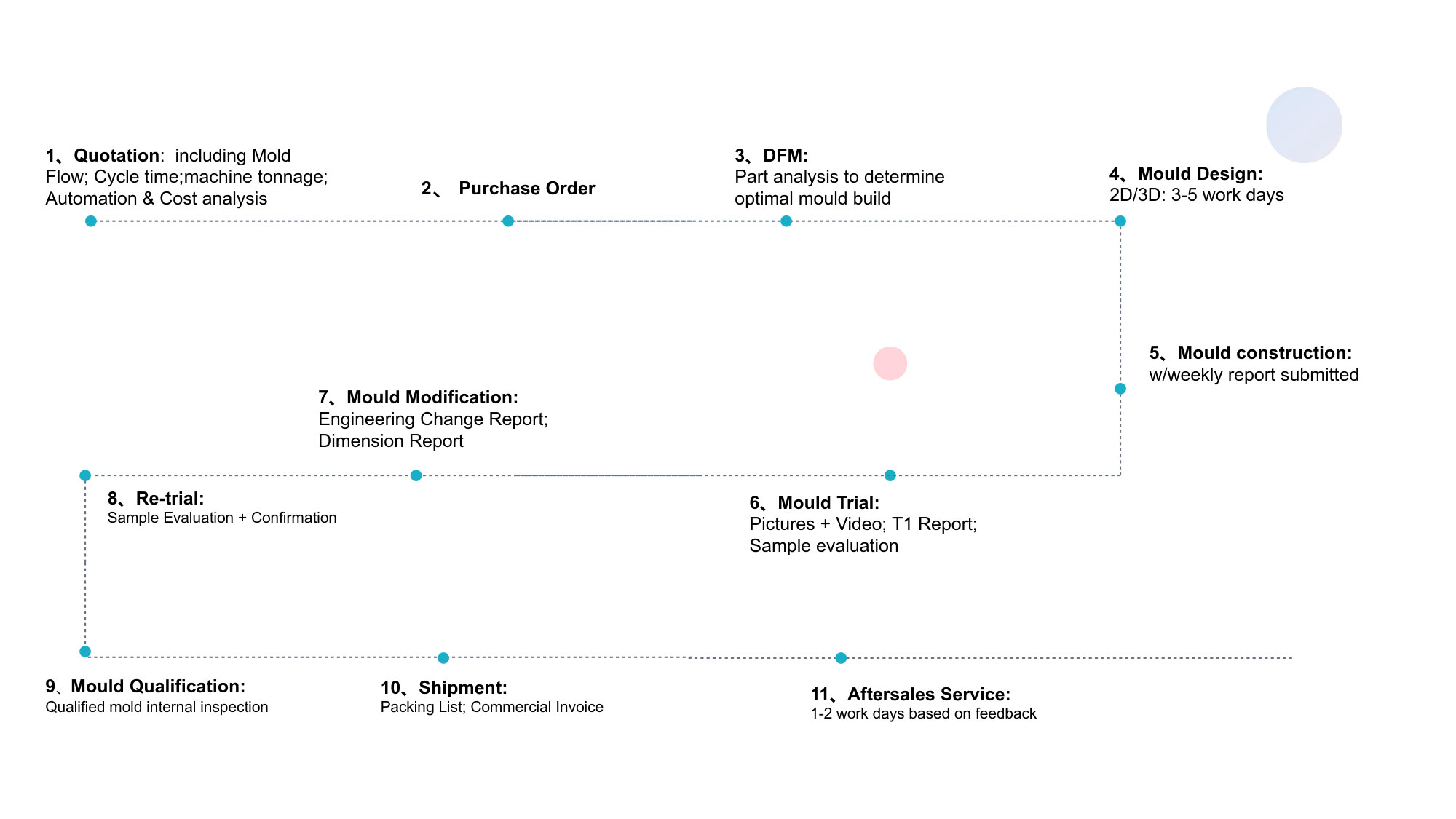
- The mold manufacturing process and product material selection
Technical Terminology Customer Value Translation
5-axis CNC high-speed machining with 0.002mm accuracy Flawless surface finish = No post-processing scrap, no patient discomfort, smooth drug release surface
EDM micro-hole machining down to 0.03mm Precision venting channels = Complete mold filling, no air entrapment defects, consistent dosing
Servo-electric injection molding, ±0.1% repeatability One part = every part = Zero dimension drift across millions of units, predictable assembly fit
CPK ≥ 1.33 quality validation Statistically validated stability = No recall risk, audit-ready documentation
MES-locked process parameters with role-based access Batch-to-batch consistency = Eliminate operator error, reduce quality deviation risk by 90%+
Cold runner system with needle valve shut-off Zero runner waste = Material cost savings of 15–25%, lower per-part cost without environmental burden
Cleanroom ISO Class 8 manufacturing Medical-grade cleanliness = Pass USP/ISO biocompatibility, safe for intravaginal use
3-day design for manufacturability (DFM) report Risk elimination before tooling = Avoid $50k+ rework cost, faster time-to-market
Section 2: Hard Power Foundation – Equipment That Builds Customer Trust
2.1 Mold Manufacturing Equipment
Ansix Tech operates a comprehensive suite of precision mold manufacturing equipment that directly translates into customer confidence:
5-Axis High-Speed Machining Centers: Capable of machining complex curved surfaces with 0.002mm precision accuracy, ensuring parting lines are smooth, seamless, and burr-free. For CIDR products, where the silicone layer must have uniform thickness for predictable drug release, this precision is mission-critical.
-
Slow Wire EDM (Wire-Cut Electrical Discharge Machining): Enables the machining of fine micro-holes and narrow slots down to 0.03mm, essential for precision venting channels in LSR molds without causing thin-wall deformation. CIDR molds require precisely controlled venting pathways to ensure complete cavity filling without flash formation around the nylon backbone.
CNC EDM (Sinker EDM): Provides high-precision cavity machining with superior surface finish control, ideal for LSR molds that require mirror-like cavity surfaces to prevent material sticking during demolding.
Optical Profile Grinding: Delivers surface roughness down to Ra ≤ 0.05μm for critical parting surfaces, ensuring leak-proof sealing between mold halves.
Coordinate Measuring Machine (CMM): Every mold undergoes a full dimensional inspection before shipping, with critical dimensions validated to CPK ≥ 1.33. Customers receive a comprehensive dimensional report with each mold delivery.
Optical Vision Measurement System: High-resolution inspection for micro-features, ensuring consistent performance for multi-cavity CIDR molds where 32, 64, or even 96 cavities must be perfectly identical.
2.2 Injection Molding Machine Fleet
Locking Force Range: 30 tons to 400 tons, covering product sizes from micro-components (<1g shot weight for certain veterinary CIDR products) to larger CIDR devices for cattle (1–5g progesterone loading).
All-Servo-Electric Drive Machines: Achieve stable repeatability precision at ±0.1%, ensuring that every molded CIDR part is identical to the first. When producing millions of units for herd estrus synchronization programs, this consistency directly translates to predictable drug release kinetics.
LSR-Specific Injection Units: Precision dosing systems with closed-loop control of A/B component mixing ratio (typically 1:1), injection speed, shot volume, and curing temperature, essential for platinum-catalyzed LSR materials used in biomedical applications.
Real-Time Process Monitoring: All machine parameters (temperature, pressure, injection speed, curing time) are locked in the MES system, accessible only by authorized engineers, with full traceability for each production batch.
2.3 Inspection and Testing Equipment
CMM with Temperature-Controlled Environment: Every mold is measured in a 20°C ±0.5°C environment, eliminating thermal expansion variables. Full dimensional reports are provided, with critical dimension CPK ≥ 1.33.
Optical Vision Inspection System: Automated measurement of parts directly from the molding line, enabling real-time quality feedback loops.
Tensile Testing Machine: Validates the mechanical properties of LSR materials against certified specifications, ensuring each batch meets USP Class VI and ISO 10993 requirements.
Hardness Tester (Shore A Durometer): Ensures silicone hardness remains within specified range (typically 30–70 Shore A for medical LSR applications).
Visual Inspection Station with Magnification: Detects surface defects invisible to the naked eye, ensuring flawless cosmetic appearance for patient-facing medical devices.
Section 3: Mold Manufacturing – The Core Differentiator
3.1 Mold Steel Selection and Guaranteed Lifespan
For LSR CIDR applications, mold steel selection directly determines tool longevity, part quality, and production economics. Ansix Tech utilizes a comprehensive portfolio of mold steels matched to specific customer requirements:
Steel Grade Typical Applications Expected Lifespan (Cycles) Customer Value
S136 / 4Cr13 (Stavax ESR) High-gloss LSR cavities, medical device molds 500,000 – 1,000,000 Mirror finish surface, no material sticking, consistent drug release surface
2344 / 8407 (H13) High-temperature LSR molding cores/cavities 300,000 – 500,000 Thermal fatigue resistance, extended production runs
NAK80 Pre-hardened steel for LSR prototype molds 100,000 – 200,000 Faster delivery, lower initial investment
M340 (Corrosion-resistant) LSR molds requiring frequent cleaning with aggressive solvents 500,000+ Chemical resistance for veterinary cleaning protocols
H13 ESR (Premium) High-volume medical LSR production 500,000 – 1,000,000 Maximum lifespan, lowest cost per part
Customer-Focused Value Statement: For glass fiber-reinforced materials, Ansix Tech guarantees 500,000 mold cycles; for standard LSR applications, customers can expect 1,000,000+ cycles. Each mold ships with material certification reports and heat treatment curves, providing full traceability for regulatory audits.
3.2 Achievable Tolerances
Standard Structural Components: ±0.05mm for non-critical LSR part features
Precision CIDR Features: ±0.005mm for critical dimensions such as wall thickness uniformity (essential for controlled drug release)
Flashing Control: Molds are machined to 0.005mm parting line fit precision, ensuring flash is controlled to ≤0.03mm and eliminating secondary deflashing operations—directly reducing per-unit labor costs
3.3 Mold Types and Configurations
Hot Runner Systems: Provide runnerless molding with zero material waste, ideal for high-volume LSR CIDR production where material efficiency directly impacts cost.
Cold Runner Systems with Needle Valve Shut-Off: LSR is a thermoset material that begins curing when heated. Unlike thermoplastics where hot runners keep material molten, LSR requires the runner and manifold to be cooled to prevent premature curing. Cold runner systems maintain the LSR in a liquid state until it enters the heated mold cavity, then cure instantly upon exposure to mold heat. Needle valve shut-off technology precisely controls material flow, enabling:
Complete elimination of runner waste
Cycle time reduction of 15–25%
Cleaner, more hygienic production suitable for medical-grade requirements
Multi-Cavity Molds: 32-, 64-, and 96-cavity configurations dramatically increase output per machine hour. For a typical CIDR product, a 64-cavity mold running a 45-second cycle produces over 5,000 units per hour—reducing per-part cost by 40–60% compared to 8-cavity molds.
Insert Molds: For CIDR devices that incorporate a nylon backbone or metal components, LSR overmolding technology ensures perfect bonding between materials, eliminating secondary assembly operations.
Two-Shot (2K) Molds: Capable of molding two different LSR grades in a single cycle, enabling dual-durometer CIDR devices—a softer, more flexible silicone layer over a firmer structural core.
3.4 Gate and Runner System Optimization
Cold Runner Channel Design: The runner system is specifically designed to maintain LSR at a controlled temperature (typically 20–30°C) through integrated cooling circuits, preventing material curing in the runner itself.
Direct Injection into Cavity: Pinpoint gates deliver material precisely where needed, minimizing flow distance and reducing potential for jetting or air entrapment.
Submarine (Tunnel) Gates: Automatically degate during part ejection, eliminating a secondary trimming operation and reducing labor costs.
Moldflow Analysis Integration: Prior to any steel cutting, Ansix Tech conducts comprehensive Moldflow analysis to predict and optimize:
Material fill patterns and flow front advancement
Weld line formation locations and severity
Air trap positions (critical for LSR where entrapped air causes porosity and weak spots)
Thermal distribution across the cavity
Shrinkage patterns and warpage prediction
For LSR CIDR applications, Moldflow analysis identifies optimal gate locations to ensure complete cavity filling around the nylon backbone without creating air pockets that would compromise drug release uniformity.
3.5 Cooling System Design for High-Volume Production
Efficient cooling is the single most important factor determining LSR cycle time and part quality. LSR cures through heat-induced cross-linking (vulcanization). The mold must rapidly heat the material to cure it, then quickly cool to allow ejection—all within a production cycle.
Ansix Tech‘s Cooling Design Principles:
Zone-Controlled Conformal Cooling: Cooling channels follow the CIDR product’s complex geometry, maintaining temperature uniformity across the entire cavity. The temperature difference between core and cavity is controlled within 2°C, minimizing thermal stress and part warpage.
High-Thermal-Conductivity Mold Materials: Copper-alloy inserts in high-heat regions accelerate heat transfer, reducing cycle times by 10–15%.
Integrated Thermocouple Sensors: Embedded temperature sensors provide real-time feedback to the process control system, automatically adjusting cooling flow rates to maintain ±1°C stability.
3.6 Ejection System Design for LSR
LSR‘s inherent stickiness (due to its elastomeric nature) requires specialized ejection strategies:
Electropolished Ejector Pins: Super-finished surfaces prevent LSR adhesion
Air-Assisted Ejection: Compressed air breaks the vacuum seal between cured LSR and the cavity surface, enabling flash-free demolding
Stripper Plate Systems: Even ejection force distribution prevents part distortion
Robotic Demolding Integration: Automated pick-and-place systems remove parts directly from open molds, eliminating manual handling contamination risks
3.7 Mold Delivery Standards
Mold Complexity Standard Lead Time Express Lead Time Customer Value
Single-cavity prototype mold 15 days 10 days Rapid product validation, faster time-to-market
4–8 cavity production mold 25 days 15–18 days Quick production ramp-up
16–32 cavity high-volume mold 30–35 days 20–22 days Minimal production delay, lower supply chain risk
64+ cavity complex multi-component mold 40–45 days 25–30 days Maximum scale, lowest per-part cost
Express delivery guarantee: Every accelerated mold project undergoes full dimensional validation and test runs—no shortcuts on quality.
3.8 Mold Maintenance and Repair Commitment
Service Commitment
Spare parts package Ejector pins, core inserts, and wear components included with mold delivery
Preventive maintenance schedule Recommended at every 200,000 cycles, performed at customer‘s facility or Ansix’s service center
Emergency repair 24-hour turnaround for routine repairs; rush service available
Lifelong repair cost Material cost plus nominal labor only; no markup on replacement components
Mold structure warranty Three-year structural warranty (excluding normal wear components)
Section 4: LSR Injection Molding Process – Transforming Raw Material into Medical Device
4.1 LSR Material Science and Selection
LSR is a two-component, platinum-catalyzed addition-cure silicone elastomer. Unlike thermoplastics that melt and solidify, LSR undergoes irreversible chemical cross-linking (vulcanization) when heated.
For CIDR Vaginal Suppositories, Ansix Tech selects LSR materials that meet the following stringent requirements:
Biocompatibility Standards: USP Class VI certification and ISO 10993 compliance for all medical-grade LSR
FDA Compliance: 21 CFR 177.2600 for food and drug contact applications
Platinum Catalysis: No peroxide byproducts, cleaner cure, superior consistency
Controlled Drug Release Compatibility: Precise permeability characteristics for progesterone elution profiling
Regulatory Compliance: ISO 13485 manufacturing environment with full traceability
Approved LSR Material Suppliers:
Supplier Material Grade Key Properties Medical/Veterinary Compliance
Wacker Chemie SILPURAN® 6610 Series USP Class VI, ISO 10993-certified, designed for implantation <30 days ✅ ISO 10993, USP Class VI, FDA
Momentive Silopren™ LSR 4000 Series USP Class VI, FDA-approved, excellent thermal stability ✅ USP Class VI, FDA
Dow Corning QP1 & BMG Series USP Class VI, platinum-catalyzed, ultra-high purity ✅ USP Class VI, FDA
Elkem Silbione™ Biomedical Grade ISO 10993, USP Class VI, 12-week implantation validated ✅ ISO 10993, USP Class VI
DuPont Liveo™ C6-8XX Series USP Class VI, ISO 10993, REACH compliant (<0.1% w/w SVHC) ✅ USP Class VI, ISO 10993, REACH
4.2 LSR Injection Molding Process Flow
Step Description Quality Control Checkpoint
1. Material Receiving FDA/USP-certified LSR from approved suppliers Certificate of Analysis (CoA) verification, lot number registration
2. Material Storage Temperature-controlled (2–8°C) cold storage to prevent premature cross-linking Daily temperature log verification
3. A/B Component Mixing Platinum-catalyzed two-component LSR mixed at precisely 1:1 ratio in static mixer Real-time viscosity monitoring, ±0.1% mix ratio control
4. Precision Dosing Closed-loop LSR injection unit doses material volume within ±0.5% tolerance Shot weight verification (every batch or statistically sampled)
5. Cold Runner Injection Material is injected through cooled runner system to cavities Runner temperature monitoring, pressure sensor feedback
6. Mold Filling Material enters heated cavity (150–200°C), begins curing Fill time monitoring, cavity pressure sensors (all cavities)
7. Curing (Vulcanization) Material cross-links at temperature; typical cycle time 20–60 seconds depending on part geometry Curing time recording, temperature profile logging
8. Mold Opening & Demolding Automated demolding using robotic system Vision inspection for flash/damage (100% of parts)
9. Post-Curing (as required) Some medical LSR grades require 2–4 hours at 200°C for full vulcanization Oven temperature monitoring, time recording
10. Assembly (if required) Insert molding or secondary assembly of CIDR components In-process inspection for assembly fit
11. Packaging Cleanroom packaging with lot traceability labels Weight verification, seal integrity check
4.3 LSR Injection Molding Process Parameters
Parameter Typical Range for LSR CIDR Why It Matters
Injection temperature 20–30°C Maintains material viscosity, prevents premature curing in runner
Mold temperature 150–200°C Activates platinum catalyst, cures material
Injection pressure 500–2,000 bar Ensures complete cavity filling, especially around insert components
Holding pressure 300–800 bar Compensates for material shrinkage during cooling
Curing time 15–60 seconds (part-dependent) Completely cross-links silicone for stable mechanical properties
Cycle time 25–90 seconds (depending on cavitation and part geometry) Determines production throughput
4.4 LSR Injection Molding Challenges and Ansix Tech‘s Solutions
Challenge How Ansix Tech Solves It Customer Value
Material flashing Parting lines machined to 0.005mm precision; self-locking clamping force compensation; cold runner gate shut-off valves Eliminates manual deflashing, reduces labor cost
Trapped air / porosities Precision venting channels (0.03mm depth); vacuum-assisted molding option; Moldflow-optimized gate positions No weak points in part, consistent drug release, zero functional defects
Dimension instability Zone-controlled mold temperature (±2°C); ultrasonic thickness sensor with real-time pressure compensation Predictable assembly fit, batch-to-batch consistency
Premature curing in runner Actively cooled cold runner system (20–30°C); thermal barrier between cold/hot zones Zero material waste, stable production
Insert movement during overmolding Magnetic or mechanical insert positioning pins; injection pressure profiling avoids insert shifting Consistent encapsulation, no exposed nylon core
Sticking in cavity after cure Electropolished cavity surfaces; air-assist demolding; mold release agent in development phase Higher yield, reduced downtime
4.5 LSR Verification and Validation
T0 – First Article Inspection: The initial molded parts are thoroughly measured against 3D CAD models. Dimensional deviations >0.01mm trigger immediate cavity adjustments. Full dimensional report provided to customer.
T1 – Corrective Action Run: After addressing T0 issues (if any), a second trial validates that corrections achieved target dimensions. Customer receives revised dimensional report and physical samples.
T2 – Process Window Validation: The mold is run across the full range of allowable process parameters (temperature, pressure, injection speed), demonstrating that robust part quality can be maintained even with normal process variation.
T3 – CPK Validation Run: Minimum 300 consecutive parts are produced under production conditions. Critical dimensions are measured and CPK calculated. Guarantee: CPK ≥ 1.33 for all designated critical dimensions.
Pre-Production Trial Run: 100–500 parts produced on actual production equipment to validate yield rate (target: 98%+ for LSR parts), cycle time, and material consumption before full production approval.
100% Vision Inspection: All production parts undergo automated optical inspection for surface defects, flash, dimensional deviations, and cosmetic appearance.
Section 5: Customer Support Throughout the Product Lifecycle
5.1 Early Stage Design for Manufacturability (DFM) Engineering
Before any steel is cut, Ansix Tech provides a comprehensive DFM report that translates product design requirements into manufacturable reality, identifying potential failure modes and proposing cost-optimized solutions.
DFM Report Includes:
Gate location recommendations
Draft angle optimization (typical: 1–3° for LSR)
Wall thickness analysis for uniform filling and curing
Identification of potential weld line locations and mitigation strategies
Ejector pin location and tip mark allowance
Parting line placement recommendations
Customer Value: Identifies and resolves manufacturing risks before tooling begins, typically saving customers
30,000–80,000 in avoided rework and production delays.
5.2 Turnkey Manufacturing Solutions
From Prototype to Mass Production: Single-source accountability for mold design, manufacturing, injection molding, assembly, and packaging.
Cleanroom Manufacturing: ISO Class 8 cleanroom for medical LSR production, preventing dust and biological contamination.
Secondary Operations: Assembly, functional testing, sterile packaging, labeling, and kit assembly performed in-house—reducing customer vendor management costs.
5.3 Quality Management System
ISO 13485:2016 Certified Medical Device Manufacturing – Governing all quality management activities.
ISO 9001:2015 Certified – Foundational quality management across all operations.
FDA Registration – Facility registered with US FDA, compliant with 21 CFR Part 820 (QSR).
Full Lot Traceability – Every LSR batch is tracked from raw material certificate to shipped product.
Real-Time SPC (Statistical Process Control) – In-mold sensors provide real-time feedback, automatically flagging out-of-spec conditions.
5.4 Quality Documentation Package for Regulatory Compliance
For each CIDR product, Ansix Tech delivers a comprehensive documentation package that includes:
Raw material certificates of analysis and compliance (ISO 10993, USP Class VI, FDA)
Mold validation report (dimensional inspection, steel certificates, heat treatment records)
Process validation protocol and results (IQ/OQ/PQ)
Production batch records with parameter logs
First article inspection report
CPK calculations for all critical dimensions
Customer Value: This documentation package provides medical device customers with the traceability evidence required for FDA and ISO 13485 audits, directly reducing the regulatory burden on the customer‘s quality team.
Section 6: Cost Reduction and Value Engineering
Ansix Tech delivers aggressive cost reduction not by sacrificing quality, but through intelligent process and supply chain optimization:
6.1 Material Cost Optimization
Bulk purchasing power: Volume agreements with tier-1 LSR suppliers (Wacker, Momentive, Dow) reduce material costs by 10–20%
Zero-waste cold runner system: Eliminates runner scrap that would otherwise constitute 15–25% of material consumption
Optimized shot size: Precision dosing reduces overfill waste by 3–5%
6.2 Process Efficiency Gains
Multi-cavity mold strategy: 64-cavity mold achieves 8x output per machine hour compared to 8-cavity, directly reducing per-part labor and overhead costs
Cycle time reduction: Optimized cooling and curing profiles shorten cycle times by 15–30%, increasing machine throughput
Automated demolding: Robotic part removal eliminates manual labor, reduces cycle time, and prevents handling damage
6.3 Quality-Driven Cost Avoidance
Deflash-free molding: 0.005mm parting line fit eliminates 100% of manual deflashing operations
First-pass yield target 98%+: Fewer rejected parts, lower scrap costs
Preventive maintenance program: Proactive tool care extends mold life from typical 500k to 1M+ cycles, amortizing tooling cost over more parts
6.4 Supply Chain and Logistics Optimization
Just-in-time manufacturing: Reduces customer inventory carrying costs
Consolidated shipping: Multiple product lines combined into single shipments
Local warehousing (optional): Stock programs reduce customer safety stock requirements
6.5 Cost Reduction ROI Summary
Cost Reduction Source Typical Savings Cumulative Impact
Material cost (bulk + cold runner) 20–30% Foundation
Cycle time reduction 15–30% 5–10% lower per-part cost
Deburring elimination $0.01–0.05/part Eliminates secondary operation entirely
Multi-cavity throughput 4–8x output Amortizes fixed costs across more units
Preventive maintenance 40–50% fewer repairs Extends tool life, lowers long-term cost
Section 7: Ansix Tech‘s 28-Year Experience Delivering Customer Value
With over 28 years of injection molding manufacturing experience, Ansix Tech has developed deep expertise in LSR medical device production, including laparoscopic trocar protective covers, medical-grade LSR components, and complex multi-material injection molding solutions.
What This Experience Means for CIDR Projects:
Proven material processing knowledge—knows exactly how different LSR grades behave in production
Established relationships with LSR material suppliers for reliable, certified materials
Optimized process parameters for typical CIDR geometries (thin-walled tubular structures with insert components)
Existing mold designs that can be adapted rather than designed from scratch, reducing development time
Regulatory compliance expertise—understands FDA, ISO 13485, and USP requirements for vaginal drug delivery devices
Section 8: Delivery Efficiency and Customer Support
8.1 Standard Lead Times
Service Standard Lead Time
DFM report delivery 3–5 business days after CAD receipt
Prototype mold (single cavity) 15 days
Production mold (8–16 cavities) 25–30 days
First article samples (T0) Within 3 days of mold completion
Pre-production trial (100–500 units) 5–7 days after mold validation
Mass production (first 100k units) 15–20 days after trial approval
Reorder / replenishment 10–15 days after purchase order
8.2 Communication and Collaboration
Bi-weekly project updates with clear milestone tracking
Real-time production visibility via customer portal (optional)
Dedicated project manager as single point of contact
24-hour response time for inquiries and technical questions
On-site technical support available for customer facilities
Conclusion: Why Ansix Tech for Your LSR CIDR Project
Ansix Tech‘s value proposition is simple: We translate technical expertise into customer profit.
Our mold design ensures low flash, consistent quality, and high cavitation for throughput efficiency. Our material science expertise ensures regulatory compliance (ISO 13485, ISO 10993, USP Class VI, FDA). Our quality systems provide batch-to-batch traceability and statistical validation (CPK ≥ 1.33). Our 28 years of experience ensure predictable outcomes, lower risk, and faster time-to-market.
We invite potential customers to engage in a DFM review of an existing CIDR design. This no-obligation analysis will demonstrate in concrete terms how Ansix Tech‘s mold design and LSR processing expertise can eliminate weld lines, prevent air traps, and eliminate shrink voids—before any tooling is committed.
For a detailed quotation or to schedule a DFM consultation, contact Ansix Tech‘s medical device manufacturing team today.
Ansix Tech Co Ltd
If you have any plans related to LSR Liquid Silicone CIDR Vaginal Suppositories , you can contact us at any time. We will turn your ideas into reality, let you realize your dreams, and obtain large orders from the market. Our contact information is info@ansixtech.com. Or contact our CTO, mail: stephen@ansixtech.com
#www.ansixtech.com #ansixtech.com #LSR Liquid Silicone CIDR Vaginal Suppositories #LSR Liquid Silicone CIDR Vaginal Suppositories injection molding companies #LSR Liquid Silicone CIDR Vaginal Suppositories Canopy Mold injection mold companies #Ansix #Ansix moulds #Ansix china #Ansix tech china #Ansix tech company #Ansix facotry #LSR Liquid Silicone CIDR Vaginal Suppositories injection molding #LSR Liquid Silicone CIDR Vaginal Suppositories injection tools #LSR Liquid Silicone CIDR Vaginal Suppositories injection moulds #LSR Liquid Silicone CIDR Vaginal Suppositories plastic mould #LSR Liquid Silicone CIDR Vaginal Suppositories plastic tools #Ansix Tech #Ansix molds #Ansix injection molding #Ansix mold factory #injection molding LSR Liquid Silicone CIDR Vaginal Suppositories#Ansix mold factory #LSR Liquid Silicone CIDR Vaginal Suppositories china #LSR Liquid Silicone CIDR Vaginal Suppositories molds #injection factory #LSR Liquid Silicone CIDR Vaginal Suppositories injection molding #LSR Liquid Silicone CIDR Vaginal Suppositories injection molding factory #injection molding company #LSR Liquid Silicone CIDR Vaginal Suppositories injection mold companies #LSR Liquid Silicone CIDR Vaginal Suppositories Tooling #LSR Liquid Silicone CIDR Vaginal Suppositories mold limited #Ansix mold china #Ansix companies #Ansix company China #LSR Liquid Silicone CIDR Vaginal Suppositories facotry #Ansix Tech #Ansix Tech mould #LSR Liquid Silicone CIDR Vaginal Suppositories injection moulding #injection moulding company #Ansix LSR Liquid Silicone CIDR Vaginal Suppositories parts injection mold companies #medical injection molding companieschina #LSR Liquid Silicone CIDR Vaginal Suppositories china factory #Ansix moulding companies #Ansix molding company #LSR Liquid Silicone CIDR Vaginal Suppositories injection moulding facotry #Ansix Tech mold #LSR Liquid Silicone CIDR Vaginal Suppositories mould #LSR Liquid Silicone CIDR Vaginal Suppositories plastic injection molding #ansix plastic mold #Mold manufacturing #LSR Liquid Silicone CIDR Vaginal Suppositories parts manufacturing #LSR Liquid Silicone CIDR Vaginal Suppositories plastic parts factory #LSR Liquid Silicone CIDR Vaginal Suppositories injection parts mold #LSR Liquid Silicone CIDR Vaginal Suppositories PRECISION MANUFACTURING #LSR Liquid Silicone CIDR Vaginal Suppositories #China mold #LSR Liquid Silicone CIDR Vaginal Suppositories injection moulding china #LSR Liquid Silicone CIDR Vaginal Suppositories mould china #china precision mold #mold in china #LSR Liquid Silicone CIDR Vaginal Suppositories mold china #Precision molds #High-precision molds #LSR Liquid Silicone CIDR Vaginal Suppositories #Injection molds #LSR Liquid Silicone CIDR Vaginal Suppositories Factory #LSR Liquid Silicone CIDR Vaginal Suppositories Company #Super Large Injection Mold Factory #Large Tonnage Injection Molding Factory #LSR Liquid Silicone CIDR Vaginal Suppositories Company #LSR Liquid Silicone CIDR Vaginal Suppositories Factory #2800T Injection Molding Factory #3000 Ton Injection Molding #4500 Ton Injection Molding Factory #Large Mold Injection Molding #Large Plastic Mold Injection Molding Factory #Large Injection Mold Manufacturer #Plastic Mold Factory #Injection Mold #Plastic Mold