



Luer Connector
FEATURES
Ansix Tech Luer Connector Injection Molding Project: Transforming Technical Capabilities into Customer Value
Executive Summary: A Value-Driven Manufacturing Partnership
In the medical device industry, success is not measured by the sophistication of a manufacturer‘s machinery—it is measured by patient outcomes, regulatory compliance, and supply chain reliability. For Ansix Tech, a global leader in injection molding with over 28 years of industry experience, the Luer Connector project represents more than a manufacturing contract. It represents a partnership model where every technical capability—every machining tolerance, every steel selection, every cooling channel design—is deliberately translated into measurable value: cost reduction, risk mitigation, and quality assurance.
This report presents a comprehensive framework demonstrating how Ansix Tech transforms what could be perceived as “technical jargon” into tangible customer benefits. The following five sections provide a logically structured introduction that speaks directly to customer pain points, supported by specific data, industry benchmarks, and actionable commitments.
-
Mold Description
Product Materials:
PC PA12
Mold Material:
S136ESR
Number of Cavities:
48
Glue Feeding Method:
Hot runner
Cooling Method:
Water cooling
Molding Cycle
12.5s
- The mold manufacturing process and product material selection
The “Hard Power” Foundation – Building Customer Confidence Through Equipment Capability
Before a customer entrusts their Luer Connector project to a manufacturer, they need to see—and trust—the physical assets that will bring their product to life. Ansix Tech’s equipment infrastructure is not a collection of machines; it is a customer confidence engine.
Precision Mold Manufacturing Equipment: From Microns to Millions of Cycles
Equipment Type Technical Specification Customer Value Translation
5-Axis High-Speed Machining Centers 0.002mm accuracy for complex geometric surfaces Ensures your Luer taper surface is smooth and burr-free—no silicone oil seepage, no particle contamination risk
Slow Wire EDM (Wire-Cut EDM) Capable of cutting micro holes down to 0.03mm and narrow slots Enables delicate Luer lock thread features without causing thin-wall deformation during molding
High-Precision CNC Grinding Sub-micron surface finish control Guarantees parting line sealing integrity—directly preventing flash defects
EDM (Electrical Discharge Machining) Workshop In-house electrode machining center Mold repairs don’t leave our facility. Routine rework—welding/insert replacement—restores production within 24 hours
Why this matters to you: Ansix Tech has built over 30,000 sets of molds since its founding, with an automated machining ratio of 70% and an average of just 2 mold trails per project. This means less iteration, faster validation, and quicker time to market for your Luer Connector.
-
Injection Molding Machine Fleet: Scalability That Matches Your Demand
Ansix Tech operates a total of 260 injection molding machines across four production bases in China and Vietnam. Our clamping force coverage ranges from 30 tons to 2,800 tons, accommodating:
Clamping Force Range Product Applications
30–150 tons Micro Luer fittings, small-bore connectors, caps
150–500 tons Standard Luer connectors, Y-sites, stopcocks
500–2,800 tons Multi-cavity high-output Luer connector families
All machines are fully electric servo-driven, delivering repeatable precision of ±0.1%. In the medical Luer connector industry, where millions of parts must perform identically for patient safety, batch-to-batch consistency is not negotiable. Our automated MES system locks in molding parameters—temperature, pressure, speed, and dwell time—with engineer-authorized access only. Each batch undergoes first-article and last-article inspection to confirm that “Part #1,000,000” is identical to “Part #1.”
Customer value: You never worry about dimensional drift or hidden quality escapes. Every shot is as accurate as the first.
Comprehensive Inspection and Validation Equipment
Every Ansix Tech mold ships with a full-dimensional inspection report. Our quality lab is equipped with:
Coordinate Measuring Machines (CMMs): Verifies complex 3D geometries against CAD models (±0.001mm resolution)
Optical Comparators / Vision Measurement Systems: Rapidly inspects fine Luer taper dimensions, thread profiles, and gate vestiges
Blue Lead / Pressure-Sensitive Paper Testing: Validates parting line contact area exceeds 90%—the physical barrier against flash
Hardness Testers: Confirms mold steel heat treatment consistency (HRC ±1 tolerance)
Mold Flow Analysis Software (Moldflow/Sigmasoft): Pre-inspection simulation that eliminates surprises before steel is cut
Key performance metric: All critical Luer connector dimensions are validated to CPK ≥ 1.33 before mass production begins. This is the industry gold standard for process capability. When CPK ≥ 1.33, your defect rate drops to near-zero levels—typically less than 63 ppm (parts per million).
For our ISO 13485:2016 certified facility, these capabilities are not marketing claims. They are regulatory requirements. And they are your risk-reduction guarantees.
Section Two: Mold Manufacturing Core Competitiveness – Measurable Commitments, Not Abstract Promises
In Luer Connector manufacturing, customers fear one thing above all else: unexpected failures. A mold that wears prematurely, a tolerance that drifts, a repair that takes weeks—each scenario translates to delayed revenue, regulatory scrutiny, and reputational damage. Ansix Tech addresses these fears with specific, measurable, and contractually credible commitments.
Mold Life Expectancy: Engineered for the Long Run
Ansix Tech designs Luer Connector molds for extreme durability, using materials strategically matched to your resin family:
Primary mold steel applications for Luer Connector tooling:
Mold Component Recommended Steel Hardness (HRC) Customer Value
Mold Base P20 / 718H 30–35 Structural stability for >1 million cycles; cost-effective pre-hardened steel
Mold Core & Cavity (Standard Resins: PP, PE, ABS) S136 / 2316 / 4Cr13 / 9Cr18 48–52 Stainless, corrosion-resistant—prevents rust; enables Ra < 0.05μm mirror finish for transparent Luer fittings
High-Wear Components (Glass-Fiber Reinforced Resins: PA6+GF30, PPS+40%GF) H13 / 8407 / SKD61 / DC53 / M340 52–58 High hot hardness resists abrasive glass fiber wear; extends tool life dramatically
High-Volume Medical Grades (PC, PSU, PPSU) NAK80 / H13 (nitrided) 38–42 (pre-hard) / 50+ (treated) Excellent polishability for cosmetic clarity; dimensional stability through sterilization cycles
Extreme Performance (PEEK, PEI, LCP) Powder metallurgy steels (ELMAX, V4E, S690) / Coated variants 58–66 + PVD/DLC coating Superior wear resistance for ultra-aggressive engineering polymers
Explicit guarantee: For glass-fiber reinforced Luer Connector materials (e.g., PA6+30% GF, PPS+40% GF), Ansix Tech guarantees 500,000 injection cycles minimum. For standard unfilled medical-grade resins (PP, PE, PC), we guarantee 1,000,000 cycles.
What this means for your business: You amortize tooling cost over millions of parts, not thousands. You avoid the crisis of a mold failure at peak demand. Ansix Tech ships a complete set of spare wear parts (ejector pins, core pins, sliders) with every mold—at no additional charge.
Dimensional Accuracy and Tolerance Capability
Luer Connectors are governed by ISO 80369-7 (replacing ISO 594-1 and ISO 594-2), which mandates strict dimensional requirements to prevent life-threatening misconnections between incompatible medical devices. The 6% Luer taper must be produced with exceptional precision to guarantee leak-proof, reliable connections.
Ansix Tech’s capability matrix:
Product Category Achievable Tolerance Industry Benchmark Verification Method
Standard Structural Components ±0.05 mm Meets ISO standards CMM full-dimension inspection
Precision Luer Taper / Luer Lock Thread Features ±0.01 mm to ±0.02 mm Exceeds ISO 80369-7 requirements Optical comparator + go/no-go gauges
Micro Medical Components (Luer-activated valves, small-bore fittings) ±0.005 mm Precision molding class CMM + vision measurement
Every Ansix Tech mold shipment includes:
Material certification report (steel chemistry, heat treatment curve, hardness verification)
Full dimensional inspection report with graphical deviation analysis
Process capability report (CPK values for all customer-identified critical dimensions)
Customer value: Regulatory audits become faster and easier. Your design verification plan for FDA 510(k) submission is supported by detailed, traceable manufacturing documentation.
Mold Type Capabilities: One Platform for All Luer Geometries
Ansix Tech engineers and builds multiple mold configurations to match your production volume and part complexity:
Mold Type Best For Customer Value
Cold Runner (2- or 3-Plate) Low-to-medium volume, simple Luer connectors Lower initial tooling investment; faster lead time (10–15 days for simple molds)
Hot Runner (Valve Gate / Open Gate) High-volume Luer connectors (8, 16, 32, 64+ cavities) Zero runner waste; reduced cycle time; consistent multi-cavity filling
Stack Mold (Two-Level / Tandem) Ultra-high volume commodity Luer connectors Up to double output without doubling machine size; significantly lower per-part cost
Two-Shot (2K / Multi-Material) Mold Overmolded Luer connectors (rigid hub + soft TPE seal) Integrates assembly steps; eliminates secondary handling; reduces total part cost
Insert Mold Needle hubs, metal-reinforced Luer locks, encapsulated electrical components Precise positioning of metal inserts; eliminates post-mold assembly
High-Gloss / Mirror Finish Mold Transparent Luer connector bodies requiring optical clarity Ra < 0.05μm surface finish; delivers crystal-clear parts free of visual defects
Our commitment: We do not force customers into a single mold architecture. Ansix Tech presents unbiased, data-driven recommendations—backed by Moldflow simulation—to identify the optimal balance of tooling cost, cycle time, and part quality.
Gating and Flow Channel Optimization
Luer Connectors present unique flow challenges. The 6% taper requires uniform filling to avoid weld lines at functional sealing surfaces. Ansix Tech’s approach:
Mold Flow Analysis (MFA) is performed before any steel is cut.
The analysis predicts weld line locations, air trap positions, filling imbalances, and potential sink marks.
Gates are strategically positioned to move weld lines to non-critical areas—away from tapered sealing surfaces and thread crests.
For multi-cavity molds, hot runner systems are designed for naturally balanced flow (equal flow path lengths), not artificially balanced, to ensure cavity-to-cavity consistency.
Customer value: You avoid the “surprise defect” discovered during Trial 1 that forces a complete mold redesign. You receive a DFM (Design for Manufacturing) report predicting potential molding issues before you authorize tooling spend.
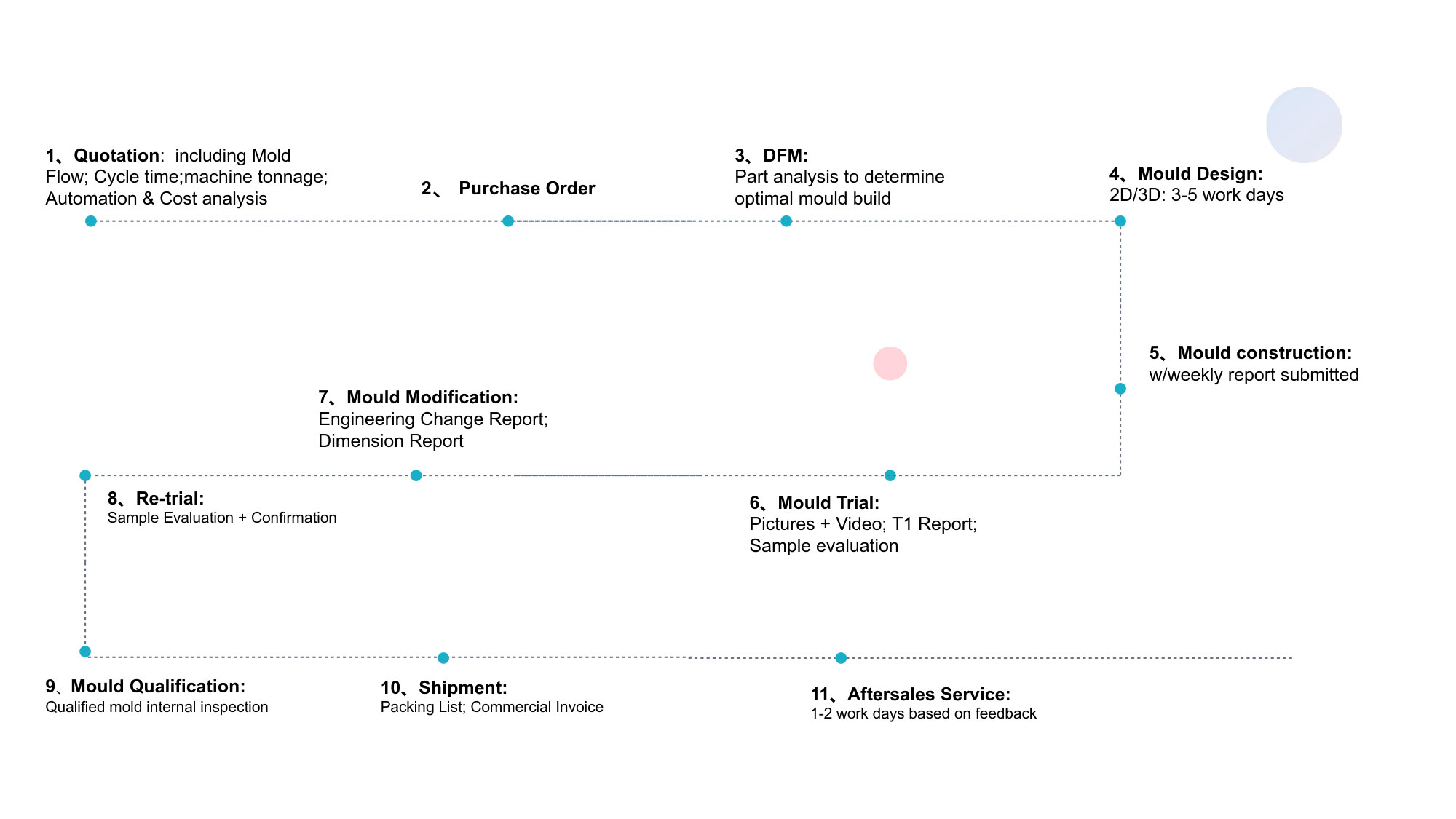
Lead Time Standards: Predictable Delivery, Accelerated When Needed
At Ansix Tech, we recognize that market windows do not wait for manufacturing readiness. Our lead time structure balances speed with quality:
Mold Complexity Standard Lead Time Rush Lead Time Quality Assurance
Simple Luer Connectors (≤4 cavities, basic geometry) 10–15 days 7–10 days (T0 to T1) DQ + IQ validation phase retained
Medium Complexity (8–16 cavities, hot runner, tight taper tolerances) 25–45 days 18–22 days Full IQ/OQ documented; PQ may be partially transferred to customer site
High Complexity (32+ cavities, multi-material, active components) 45–65 days 30–45 days All validation stages (DQ, IQ, OQ, PQ) fully executed before shipment
Note on rush manufacturing: Ansix Tech never eliminates validation steps to meet deadlines. Instead, we deploy in-parallel engineering (simultaneous DFM review, steel ordering, and CNC programming) and on-site qualification resources to compress timelines without compromising quality.
Section Three: Injection Molding Process Control – Eliminating Customer Quality Anxiety
In medical injection molding, quality is not a monthly audit outcome. Quality is the absence of a field failure. Ansix Tech’s process control systems are engineered to eliminate the three scariest words in a medical device buyer’s vocabulary: “It varied from batch to batch.”
Process Standardization and MES Integration
Every injection molding machine in the Ansix Tech fleet is connected to a centralized Manufacturing Execution System (MES) . Within MES:
Temperature zones (barrel, nozzle, mold)
Injection pressure (primary, hold, back pressure)
Injection speed profile (multi-stage)
Cooling time and mold-open timing
Shot volume and screw position
…are locked with engineer-only authorization. Unauthorized modifications trigger automated alerts.
How this helps you: Every batch follows the same “digital recipe.” First-article and last-article inspections are stored in the system. If a customer requests production records for regulatory submission, Ansix Tech delivers a complete, timestamped parameter history in 24 hours.
Dimensional Stability Control: From Thermal Uniformity to Real-Time Feedback
Luer Connector dimensions are sensitive to temperature gradients. A mold with uneven cooling produces parts that warp, shrink unevenly, or fail gauge checks. Ansix Tech addresses this with four integrated strategies:
Mold Temperature Controllers (Thermolators) with Zonal PID Control: The mold is divided into cooling zones. Each zone has independently controlled water channels. Core temperature and cavity temperature are maintained within 2°C of each other.
Conformal Cooling Channels: On complex Luer Connector geometries, Ansix Tech employs conformal cooling (via additive manufacturing or 5-axis drilling) to follow part contours. Conformal cooling improves thermal uniformity, reduces warpage, and improves cavity-to-cavity repeatability.
Ultrasonic Thickness Sensors (In-Mold): Real-time wall thickness monitoring detects variations during the shot. Data feeds back to the injection molding machine, which automatically adjusts packing pressure to compensate.
In-Mold Cavity Pressure and Temperature Sensors: For FDA-regulated medical devices, cavity pressure sensors provide closed-loop process control. Ansix Tech integrates sensors into critical Luer Connector tooling, enabling real-time CPK calculation during production runs.
Customer validation data: In a recent Ansix Tech project producing PPSU Luer connectors, three consecutive production batches run over one week showed a key hole-to-hole spacing variation of ≤0.02 mm. This is well within ISO 80369-7 tolerances and demonstrates true process capability.
Surface Quality Standards – Clear, Measurable Commitments
Medical Luer Connectors often require specific surface appearances. Ansix Tech commits to well-defined surface quality levels:
Surface Type Achievable Quality SPI / VDI Standard Equivalent Customer Application
Transparent / Non-fillered PC, COC, PMMA Bubble-free, flow-line-free, distortion-free optical clarity SPI A-1 (Diamond Buff) / VDI 12–15 Transparent Luer bodies requiring visual inspection of fluid path
High-Gloss Opaque Ra ≤ 0.2 μm surface roughness SPI A-2 / VDI 18–21 Cosmetic housings and Luer lock exteriors
Matte / Textured Uniform matte with no sink marks or visible gate vestiges SPI C-1 (Stone Finish) / VDI 30–33 Anti-glare surfaces, grip features
Electroplating-Ready Mirage-free, no gas streaks, no micro-porosity SPI B-1 (Paper 600 Grit) / VDI 24–27 Components sent for secondary EMI shielding or nickel plating
Printing-Ready (Pad Printing / Laser Marking) Uniform surface energy, ±0.1 mm printing registration accuracy SPI C-1 or B-2 Luer connectors requiring lot numbers, logos, or torque specifications printed directly on the part
Our commitment to paint/printing customers: Ansix Tech incorporates 0.2–0.5 mm compensatory shrinkage offsets into the mold design when printing or painting is specified. This ensures that post-mold cosmetics register correctly without moving secondary fixtures.
Advanced Material Processing Capabilities
Ansix Tech has extensive production experience with medical-grade engineering plastics. We provide:
Full material compatibility analysis pre-quoting
Proven processing parameters for each resin (developed through years of trial history)
Drying and handling specifications tailored to moisture-sensitive materials
Material portfolio (proven production experience):
Polymer Family Examples Key Properties for Luer Connectors
Polyolefins PP (Homo/Copolymer), PE (HDPE/LDPE) Low cost, chemical resistance, gamma/EtO sterilizable
Polycarbonates PC, PC/ABS blends High impact strength, dimensional stability, optical clarity
High-Temperature PEEK, PEI (Ultem), PPSU, PSU Autoclavable, creep-resistant, biocompatible for implantables
Glass-Fiber Reinforced PA6+GF30, PA66+GF30, PPS+40%GF, PBT+GF30 High stiffness, heat deflection temperature >250°C
Flame-Retardant UL94 V-0 rated PC, PA, PBT Meets hospital fire safety codes for electrical medical devices
Liquid Silicone Rubber (LSR) LSR (various durometers) Soft-touch seals, overmolded Luer-activated valves
Regulatory assurance: All materials can be traced to their ISO 10993 biocompatibility certification for patient-contacting applications. Ansix Tech provides Certificates of Analysis (CoA) and material lot traceability across every production batch.
Section Four: Full-Service Lifecycle Support – Reducing Your Management Burden
Most molders stop at “ship the mold.” Ansix Tech understands that your team wants to focus on product innovation and market growth—not on chasing mold repairs, validation documents, or shipping status.
Early Engagement: DFM (Design for Manufacturing) Before Any Metal Is Cut
When to engage Ansix Tech: During the product concept stage—before finalizing part geometry.
What you receive free of charge upon NDA execution and project viability review:
DFM (Design for Manufacturing) Report covering:
Recommended draft angles for clean ejection (≥1° per side for textured surfaces, ≥0.5° for polished surfaces)
Wall thickness optimization (consistent walls reduce sink)
Predicted gate and weld line locations (with recommended gate style and location)
Predicted air trap locations and vent placement strategy
Shrinkage and warpage prediction (using actual selected material grade)
Ejector pin mark location proposals (avoiding critical sealing surfaces)
Mold flow analysis summary showing projected fill pattern, temperature distribution, and pressure requirements at the injection point
Alternative material recommendations if selected material presents molding difficulty
What this saves you: Discovering that your ideal part geometry is unmoldable before cutting steel—instead of after burning $50,000 in tooling costs.
Scientific Molding: T0 to T3 Sample Progression with Full Transparency
Ansix Tech follows a structured, documented sample progression:
Trial Objective Deliverable to Customer
T0 (Initial Trial) Validate basic mold function—ejection, core pull, cooling circuit integrity Molded sample parts (visual inspection); initial parameter range report
T1 (Optimization Trial #1) Achieve dimensional compliance at nominal molding conditions Dimensionally measured sample parts; gap analysis to CAD; modified parameter recommendations
T2 (Optimization Trial #2) Verify modifications and target CPK Full dimension report; CPK analysis; process window characterization (DOE summary)
T3 (Qualification Trial) Simulate production conditions; dry-run IQ/OQ/PQ Full qualification package; 1,000+ parts for customer functional testing
Ansix Tech’s rapid-change advantage: On multi-cavity Luer connector molds requiring different gate or cooling experiments, we integrate modular inserts and interchangeable cavity blocks into the mold design. This allows us to validate alternate configurations without building a completely new mold.
Customer value: You receive physical parts and supporting data early—proving the mold works before you sign off on high-volume production.
Pilot Run / Process Validation: Statistical Proof Before Full Commitment
Before releasing any Luer Connector mold to full-scale production, Ansix Tech executes a risk-mitigating pilot run:
Typical pilot quantity: 500–5,000 parts (customer-specified)
Run conditions: Actual production injection molding machine, actual environmental conditions (ISO 8 Class 100,000 cleanroom)
Measurements: 100% critical dimension inspection on first 50 parts; then statistical sampling per AQL (Acceptable Quality Limit) table
Outputs: Complete dimensional inspection report; CPK and PPK values for every critical dimension; capability histogram showing distribution shape
Biocompatibility validation (if required): Sample parts provided for ISO 10993 cytotoxicity, sensitization, and systemic toxicity testing
Sterilization validation (if required): Parts processed through customer-specified sterilization cycle (EtO, Gamma, E-beam, Autoclave) and re-inspected to confirm dimensional and material stability
Our commitment: We do not require purchase orders for full annual quantities to begin process validation. One pilot order validates the process; subsequent POs ship production parts. You de-risk before you commit volume.
Maintenance, Spare Parts, and Long-Term Risk Mitigation
Ansix Tech views each mold as a long-term capital asset that requires proactive care:
Service What Is Included Customer Cost
Initial Spare Part Kit 3–5 ejector pins (each size), 2 core pins (high-wear cavities), 1 set of sliders (if applicable) Included with initial mold purchase
Preventive Maintenance Schedule (Every 200,000 cycles) Cleaning, lubrication, parting line inspection, ejector pin length check, cooling channel flow verification Included (free) for molds under warranty
Three-Year Structural Warranty Covers cracking of mold base, core/cavity inserts, hot runner manifold failures (excludes wear-related failures of ejectors, pins, sliders, and seals) Included
Lifetime Repair Service Any additional repair work needed after warranty period Cost-plus pricing (materials + labor at cost; no margin on repair labor)
Emergency Rapid Response (24-hour priority) On-site repair at Ansix Tech facility for molds shipped back Expedite surcharge: waived for warranted structural failures; charged only at marginal cost for customer-induced damage
Customer benefit: Your production line is never down because an ejector pin broke. You are never stranded. Ansix Tech retains digital copies of every mold design, CNC program, and EDM electrode file for at least 10 years after project completion. Late-night repairs happen—but not to you.
Section Five: Differentiated Value Proposition – Direct Answers to Common Industry Pain Points
Instead of abstract claims, here is how Ansix Tech directly addresses the specific complaints customers frequently express about their current Luer Connector suppliers.
Customer Complaint (Common in the Industry) Ansix Tech‘s Specific, Actionable Commitment
“My mold requires constant repairs. I’ve lost three production runs this year to downtime.” Ansix Tech runs 2,000+ test shots on every new mold before shipment. We provide a wear pattern report showing which ejector pins, slides, and core surfaces showed first signs of contact wear—and include those as spares in your initial kit. Three-year structural warranty covers mold base and inserts.
“Every batch has flash. My assembly line spends hours manually deburring Luer connectors before they can be packaged.” Ansix Tech machines parting lines and slider interfaces to 0.005 mm fit tolerance. We use self-locking clamp force compensation to maintain consistent mold clamping across temperature changes. Our documented flash thickness is ≤0.03 mm—so thin it typically detaches during ejection, not on your assembly line. 70% of flash originates from mold accuracy issues; we fix the root cause.
“Critical dimensions shift between batches. I reject 5–10% of every shipment because parts don’t mate correctly.” Every Ansix Tech injection molding machine includes ultrasonic wall thickness sensors providing real-time feedback. For high-risk Luer connectors, we install cavity pressure sensors to enable closed-loop process control (validated to <0.01mm dimensional shift over 8-hour continuous shifts). Three consecutive pilot batches across one week achieved ≤0.02 mm hole-to-hole variation.
“I need a design change. My current molder says ‘six weeks for mold modification.’ I can’t absorb that delay.” Ansix Tech maintains an in-house electrode machining center and EDM workshop. For minor modifications (gate relocation, vent deepening, ejector pin repositioning), we do not send molds to outside vendors. Pin reset: 4 hours. Gate modification: 8 hours. Cavity steel repair: 24 hours. Your production line stays running.
“My mold supplier builds molds, but they’ve never run a medical injection molding machine. I have to debug their mistakes on my floor.” Ansix Tech owns and operates 260 injection molding machines. Our mold designers are also process engineers. We design with complete understanding of melt flow, clamp force, cooling curve, and ejection dynamics. Our molds arrive at your facility “ready-to-run”—typically requiring fewer than 2 hours of process tuning before hitting production scrap targets. We do DQ (Design Qualification) and IQ (Installation Qualification) on our machines before shipping; OQ and PQ can be conducted on your machine or ours.
The Ansix Tech Manufacturing Philosophy: Your Luer Connector Mold Is Not “Just Steel.” It Is Your Revenue Engine.
At Ansix Tech, we design every Luer Connector mold from the perspective of the entire product lifecycle:
Melt flow path is optimized for complete filling without degradation
Venting placement ensures no trapped gas burns the sealing taper
Cooling channel layout guarantees uniform temperature within 2°C across core and cavity
Ejection system is stress-analyzed to avoid part deformation or sticking
Wear allowance is built into high-friction areas to maintain tolerance over 500,000+ cycles
The result is molds that arrive at your facility with near-zero debugging time—because we have already debugged them on our own injection molding machines, under cleanroom conditions, using the exact same resin you will use in production.
A Final Offer: See the DFM Process for Yourself
For any customer evaluating Ansix Tech for a Luer Connector project, we make this commitment:
Bring us an existing product or a new concept. We will perform a live DFM (Design for Manufacturing) presentation—processed through Moldflow—showing exactly where potential weld lines, gas traps, and sink marks will form, and how we will engineer your mold to eliminate them.
You will see, in real time, how Ansix Tech converts technical thermoplastics expertise into risk reduction, cost containment, and supply chain reliability—before you purchase a single piece of tooling.
Appendix: Ansix Tech at a Glance
Metric Detail
Founded 1998 (Hong Kong)
Years of Experience 28+ years
Production Bases 4 (China and Vietnam)
Total Factory Area ~200,000 m²
Injection Molding Machines 260 units (30–2,800 tons clamping force)
Molds Built Since Founding 30,000+ sets
Automated Machining Ratio 70%
Employees 1,200+ (200+ dedicated design engineers)
Certifications ISO 9001, ISO 14001, IATF 16949, ISO 13485:2016
Cleanroom Classification ISO 8 (Class 100,000)
Quality Standard Key dimensions validated to CPK ≥ 1.33
Corporate Mission “Make Our Customers Successful.”
This document is published for informational and pre-sales discussion purposes. All performance claims are supported by internal quality records and documented customer validation data. Specific project commitments must be confirmed in writing as part of a definitive supply agreement.
Contact Ansix Tech: info@ansixtech.com | www.ansixtech.com
Ansix Tech Co Ltd
If you have any plans related to Luer Connector , you can contact us at any time. We will turn your ideas into reality, let you realize your dreams, and obtain large orders from the market. Our contact information is info@ansixtech.com. Or contact our CTO, mail: stephen@ansixtech.com
#www.ansixtech.com #ansixtech.com #Luer Connector #Luer Connector moulds #Luer Connector molds #Luer Connector injection molding companies #Luer Connector Canopy Mold injection mold companies #Ansix #Ansix moulds #Ansix china #Ansix tech china #Ansix tech company #Ansix facotry #Luer Connector injection molding #Luer Connector injection tools #Luer Connector injection moulds #Luer Connector plastic mould #Luer Connector plastic tools #Ansix Tech #Ansix molds #Ansix injection molding #Ansix mold factory #injection molding Luer Connector #Ansix mold factory #Luer Connector china #Luer Connector molds #injection factory #Luer Connector injection molding #Luer Connector injection molding factory #injection molding company #Luer Connector injection mold companies #Luer Connector#Luer Connector mold limited #Ansix mold china #Ansix companies #Ansix company China #Luer Connector facotry #Ansix Tech #Ansix Tech mould #Luer Connector injection moulding #injection moulding company #Ansix Luer Connector parts injection mold companies #medical injection molding companieschina #Luer Connector china factory #Ansix moulding companies #Ansix molding company #Luer Connector injection moulding facotry #Ansix Tech mold #Luer Connector mould #Luer Connector plastic injection molding #ansix plastic mold #Mold manufacturing #Luer Connector parts manufacturing #Luer Connector plastic parts factory #Luer Connector injection parts mold #Luer Connector PRECISION MANUFACTURING #Luer Connector #China mold #Luer Connector injection moulding china #Luer Connector mould china #china precision mold #mold in china #Luer Connector mold china #Precision molds #High-precision molds #Luer Connector #Injection molds #Luer Connector Factory #Luer Connector Company #Super Large Injection Mold Factory #Large Tonnage Injection Molding Factory #Luer Connector Company #Luer Connector Factory #2800T Injection Molding Factory #3000 Ton Injection Molding #4500 Ton Injection Molding Factory #Large Mold Injection Molding #Large Plastic Mold Injection Molding Factory #Large Injection Mold Manufacturer #Plastic Mold Factory #Injection Mold #Plastic Mold