



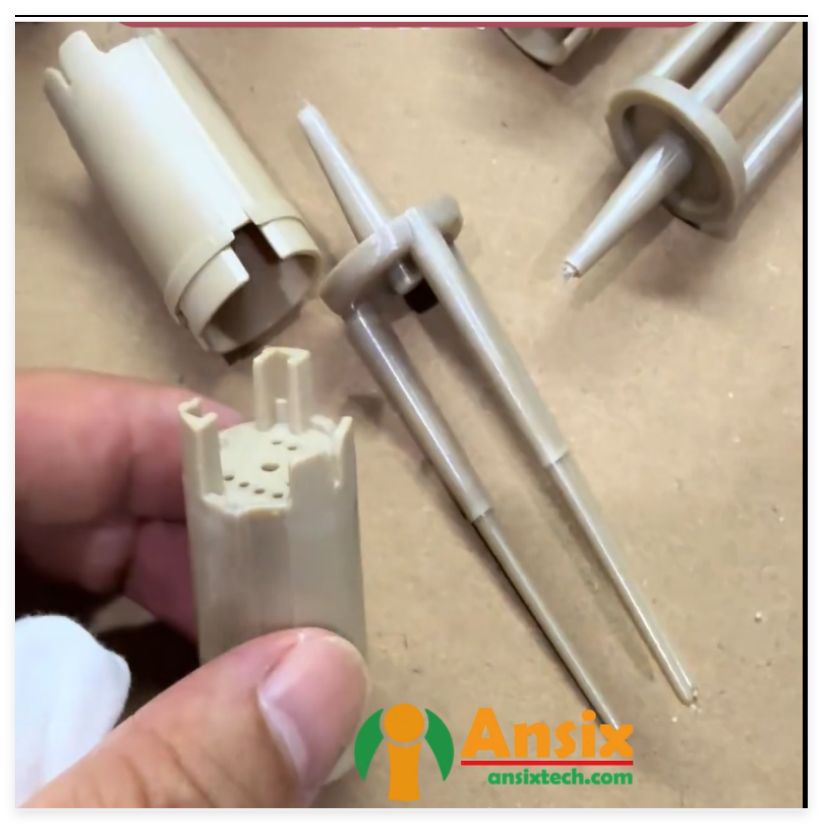


PEEK Precision Mold Molding
FEATURES
Hard Power Foundation — Building Customer Trust Through Equipment Excellence
1.1 Precision Mold Manufacturing Equipment
Ansix Tech has strategically invested in world-class mold fabrication equipment to ensure every tool delivered meets or exceeds the most demanding industry specifications.
Five-Axis High-Speed Machining Centers — Our facility is equipped with advanced five-axis CNC machining centers from leading manufacturers such as MORISEIKI and Makino, delivering machining accuracy up to 0.002mm with surface roughness achieving Ra < 0.15μm on hardened steel up to 60HRC. This capability enables us to machine complex three-dimensional geometries with single-clamping precision, eliminating tolerance accumulation from multiple setups. For our customers, this translates directly into smoother parting lines, zero burrs on finished parts, and elimination of manual finishing—reducing secondary processing costs by up to 40%.
Wire EDM (Slow Wire Cutting) — We utilize premium wire EDM systems from AgieCharmilles and Sodick with capability down to 0.002mm accuracy and surface finish Ra 0.05μm. This technology is critical for machining fine micro-holes down to 0.03mm diameter, narrow slots, and sharp internal corners that milling cannot reach. For thin-walled PEEK components, this precision prevents deformation during ejection and ensures consistent wall thickness throughout the production lifecycle.
-
Mold Description
Product Materials:
PEEK
Mold Material:
H13ESR
Number of Cavities:
1
Glue Feeding Method:
COLD runner
Cooling Method:
Water cooling
Molding Cycle
22.5s
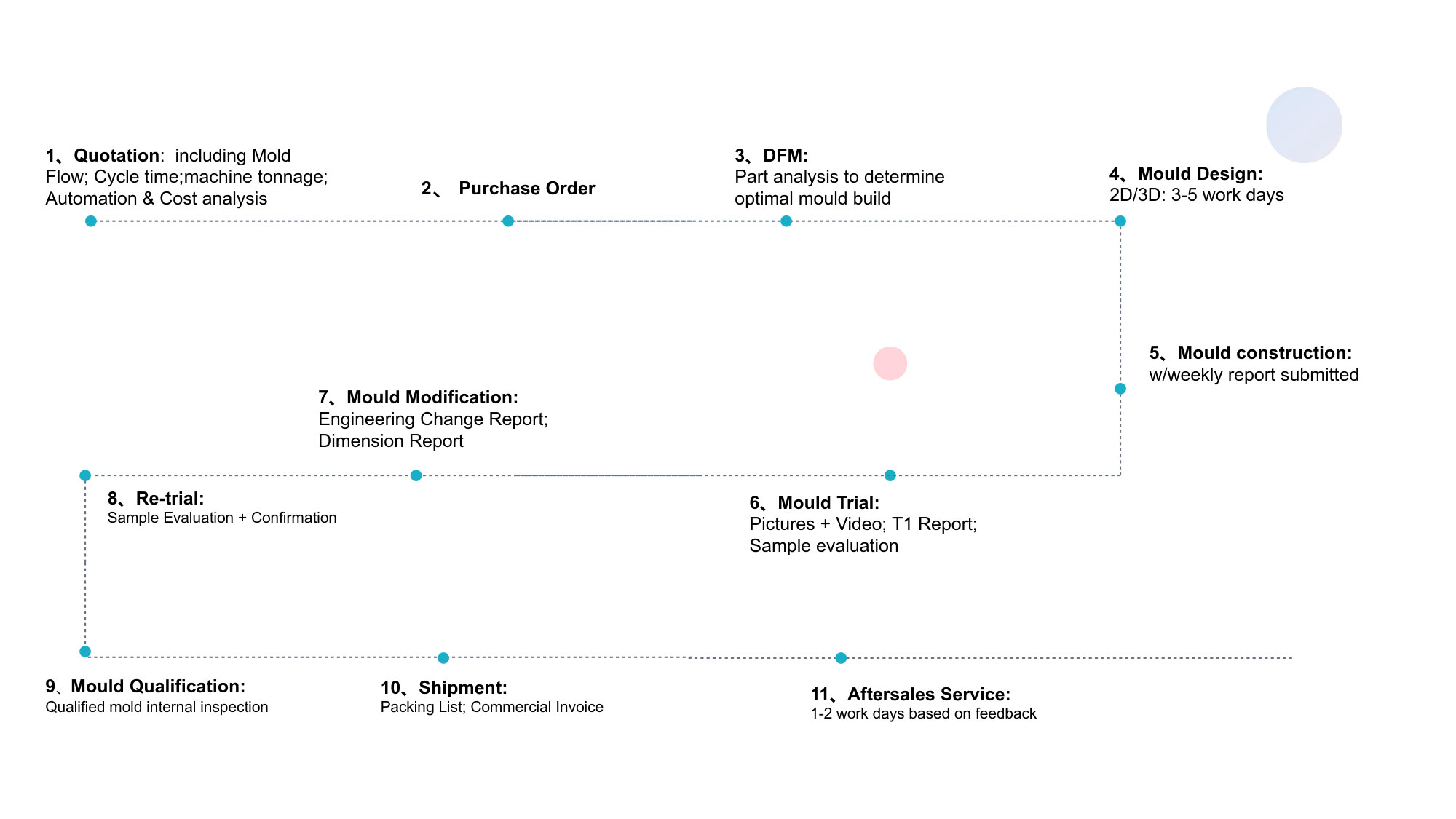
- The mold manufacturing process and product material selection
Sink EDM (Die-Sinking) — Our sink EDM capabilities from AgieCharmilles and Makino deliver ±0.002mm accuracy with mirror surface finishes (Ra < 0.1μm). Deep cavities, narrow slits, and complex geometric features are machined with micron-level precision—essential for high-performance PEEK parts requiring tight tolerances on internal surfaces.
Precision Grinding — Surface grinding from OKAMOTO and profile grinding from WAIDA achieve ±0.001mm accuracy. This is critical for finishing hardened steel mold components, ensuring perfectly flat parting surfaces and precise slide fits that eliminate flash and maintain dimensional consistency across millions of cycles.
1.2 Injection Molding Machine Fleet
Ansix maintains a comprehensive fleet of all-electric servo injection molding machines covering clamping forces from 30 tons to 400 tons—capable of producing components ranging from micro-sized medical implants (sub-gram weight) to larger industrial structural parts (up to several hundred grams).
All-Electric Servo D riveTechnology — Every machine is powered by precision servo motors that reduce energy consumption by 50 to 80% compared to hydraulic systems while maintaining repeatable cycle precision superior to traditional machines. Our machines achieve repeatability accuracy of ±0.1%, ensuring part-to-part consistency across entire production runs.
Cleanroom Compatibility — Our all-electric machines are cleanroom ready with no hydraulic oil contamination risk, ideal for ISO 13485-certified medical device manufacturing and semiconductor component production where particulate control is critical.
Real-Time Process Monitoring — Each machine is equipped with ultrasonic thickness sensors that monitor wall thickness fluctuations in real-time, automatically compensating injection and packing pressure to ensure dimensional consistency. For ultra-precision applications, in-mold temperature and pressure sensors provide closed-loop control with response times under 50 milliseconds.
-
Core Competitiveness in Mold Manufacturing — Measurable Performance Metrics
2.1 Mold Life Expectancy
Mold Component Material Grade Hardness (HRC) Guaranteed Life Cycles (Unfilled) Guaranteed Life Cycles (GF/CF Reinforced)
Mold Base P20 / 45# 30-35 1,000,000 500,000
Cavity/Core S136 / STAVA 52-56 1,000,000+ 500,000
Wear-Intensive Inserts H13 / 2344 48-52 800,000 400,000
Cutting Edges/Gates DC53 / SKD11 58-62 600,000 300,000
Corrosion-Resistant M340 / 4Cr13 / 9Cr18 50-54 500,000 250,000
High-Gloss Surfaces NAK80 38-42 400,000 200,000
Our mold material strategy directly answers the customer question: “How many parts can I run before the tool needs maintenance?” With specialized wear-resistant tool steels and advanced coatings, we extend mold life by up to 40% compared to standard industry practices—reducing your tooling depreciation and production interruption costs significantly. Every Ansix mold ships with complete material certification reports (spectrographic analysis) and detailed heat treatment profiles for full traceability.
2.2 Achievable Dimensional Tolerances
Standard Structural Components — ±0.05mm (ISO 2768-m). For customers transitioning from CNC machining to injection molding, this tolerance class provides immediate cost savings of 30-50% per part while maintaining functional fit requirements.
Precision Gears and Medical Components — ±0.005mm. This ultra-precision capability is achieved through compensated cavity design accounting for PEEK’s semi-crystalline shrinkage behavior, which typically ranges 1.0-2.0% depending on grade and cooling rate. Our mold cavities are not machined to final part dimensions but rather follow a calculated oversize formula: target dimension + predicted shrinkage + thermal expansion allowance.
2.3 Mold Types and Capabilities
Hot Runner Systems — Ansix specializes in custom hot runner solutions for PEEK. Traditional cold runner molding of PEEK results in material waste rates exceeding 25%. Our high-temperature hot runner systems eliminate runner waste entirely, reducing raw material consumption by 20-30% for high-volume production—translating to tens of thousands of dollars in annual savings given PEEK’s high material cost (typically 5-10X conventional engineering plastics).
Stack Molds — Dual-level stack molds effectively double your production output on the same machine and footprint. For high-volume PEEK components requiring annual volumes exceeding 500,000 pieces, stack molds reduce per-part labor and overhead costs by nearly 50%.
Two-Shot / Multi-Material Molds — Combining PEEK with elastomers or other engineering plastics in a single molding cycle eliminates secondary assembly operations. For medical devices requiring soft-touch overmolds or semiconductor components needing static-dissipative inserts, multi-shot molding simplifies your supply chain and reduces total assembly cost by 15-25%.
High-Gloss Mirror Finish Molds — Surface finish Ra < 0.05μm, ideal for optical-grade transparent PEEK components used in analytical instrumentation and medical visualization devices. Mirror finishes eliminate post-molding polishing operations and ensure optical clarity directly out of the mold.
2.4 Gate and Runner Design Optimization
Through comprehensive mold flow analysis, we pre-determine weld line locations, gas trap positions, and cavity filling imbalances before any steel is cut. Our approach:
Predictive Defect Elimination — Using Autodesk Moldflow and Moldex3D, we simulate the entire injection process to identify potential weld lines, sink marks, voids, short shots, and warpage risks at the design stage when changes cost $0 and take zero days.
Gate Placement Optimization — We strategically position gates at thick-walled sections where holding pressure can effectively compensate for volumetric shrinkage, with multi-stage gate opening for complex geometries to ensure balanced cavity filling and minimize weld line visibility.
Runner Balance — For multi-cavity molds, we guarantee synchronous filling across all cavities with flow imbalance under 2%, ensuring identical part quality from every cavity.
2.5 Standard Lead Times
Mold Complexity Standard Lead Time Expedited Lead Time (Surcharge)
Simple molds (≤10 cavities, basic geometry) 10-15 days 7-10 days
Medium-complexity molds (15-25 days design + fabrication) 25-45 days 20-30 days
High-complexity molds (multi-action, hot runner, two-shot) 45-60 days 35-45 days
For expedited orders, we maintain 24/7 machining operations and parallel processing across multiple CNC centers. Critical assurance: Expediting never compromises our T0 sample validation protocol—every mold completes full filling analysis, cooling verification, and ejection testing before shipment regardless of timeline compression.
Section 3: Injection Molding Process Control — Eliminating Customer Quality Anxiety
3.1 Manufacturing Execution System (MES)
Every Ansix injection molding machine is networked and integrated into our MES platform where all process parameters—temperatures (from barrel zones to mold surfaces), pressures (injection, packing, back pressure), velocities (injection speed profile), and timing parameters—are locked with multi-level authorization controls. Parameter changes require engineering-level authorization with full audit logging.
Batch-to-Batch Consistency — First-article and last-article inspection reports are automatically generated for every production batch. For medical devices and regulated industries, this provides complete traceability back to specific molding conditions for every individual part.
3.2 Dimensional Stability Control
Mold Temperature Zone Control — Our PEEK molds incorporate independent cooling/heating circuits for cavity and core zones with conformal cooling channels (15-20mm spacing), ensuring surface temperature differences between zones stay within ±2°C. Uniform temperature distribution prevents differential shrinkage—the primary cause of PEEK part warpage.
Measured Results — Continuous production data from a typical PEEK bracket component across three separate production weeks shows key hole-to-hole spacing variation ≤0.02mm, with CPK maintained above 1.33 throughout.
3.3 Surface Finish and Cosmetic Standards
Flawless transparent parts — Zero bubbles, zero flow lines, zero haze
Platable-grade components — No gas marks, for chrome or nickel plating
High-gloss optical finishes — Surface roughness Ra ≤ 0.2μm for lens-grade transparency
For components requiring painting or pad printing: we incorporate compensatory draft and deformation allowances early in the design phase to ensure print registration accuracy within ±0.10mm without secondary fixturing.
3.4 Special Material Processing Expertise
Ansix maintains extensive production experience across the full engineering plastics spectrum, including: PC/ABS blends, PC, PPS+40%GF, PEEK, PTFE, PFA, PA6+GF30, PBT, PEI, PPS, LCP, liquid silicone rubber (LSR), and others.
For each material, we maintain documented processing windows validated through pilot production trials:
UL94 V-0 flame rating — Verified for electronic enclosure components
UV stability — Tested to 3,000 hours with ΔE < 1.5 (no visible yellowing or degradation)
Biocompatibility — ISO 10993-certified protocols for medical implant molding
Section 4: Full-Stream Service — Reducing Customer Management Overhead
4.1 Early Engagement (Pre-Signing DFM Reports)
Before any tooling investment, Ansix provides a comprehensive Design for Manufacturability (DFM) report evaluating:
Draft angle recommendations (minimum 0.5° for precision parts, 1.5° standard) to prevent ejection sticking and surface drag marks
Wall thickness optimization (uniform target . . . thickness, with transition ratios 3:1 maximum) to minimize sink marks and differential shrinkage
Gate location selection and runner design recommendations
Ejector pin mark positioning and allowable tolerance zones on cosmetic A-surfaces
Rib-to-wall thickness ratio limits (typically ≤60% of wall thickness to prevent sink marks opposite ribs)
This proactive analysis prevents the single most expensive mistake in injection molding: discovering production-induced part geometry conflicts afterthe tool has been fully fabricated. By identifying issues at the solid model stage—when changes cost zero dollars—we save customers 4-8 weeks of rework time and $10,000-30,000 in unnecessary tool modifications.
4.2 Sample Mold Trials (T0 through T3)
Each mold undergoes an iterative validation process:
T0 (First article) — Initial sample set identifies fundamental filling and ejection issues
T1 (First optimization iteration) — Adjustments made based on empirical data
T2 (Second iteration) — Fine-tuning of gate geometry, vent placement, and cooling
T3 (Production-ready) — Fully validated tool with documented production parameters
We maintain in-house electrode manufacturing and EDM capabilities, enabling rapid tool modifications for supplier validation trials without sending tools outside our facility. For multi-cavity molds, we specifically design interchangeable inserts that can be swapped between trials to test alternative gate designs, runner cross-sections, and cooling layouts without completely rebuilding the master tool frame—reducing trial costs 40-60%.
4.3 Pilot Production Validation
Before full production release, Ansix conducts controlled pilot runs of 100 to 500 shots with complete statistical process control data:
Per-shot cycle parameter logging
First-article dimensional inspection using CMM
CPK analysis on all critical-to-function dimensions
Defect rate tracking with root-cause documentation
Pilot validation serves a dual purpose: the customer receives empirical production data to sign off process capability, and Ansix captures baseline CPK values against which future production can be compared to detect process drift. No mass production begins until CPK ≥ 1.33 is verified across three consecutive pilot batches—eliminating the risk of discovering capability issues after releasing 10,000 non-compliant parts into your downstream processes.
4.4 Maintenance and Spare Parts
Every Ansix mold ships with a standard spare parts kit including: critical ejector pins (3 sets), replaceable core pins (2 sets), spare wear plates, additional slide gibs, and runner shut-offs.
Scheduled Maintenance — At every 200,000-shot milestone, Ansix performs preventative maintenance on molds still in your facility or returned to our plant. This includes: parting line re-lapping, vent cleaning/re-cutting, gate polishing, cooling channel descaling, slider and wear plate inspection, and replacement of any parts showing wear approaching end-of-life.
Tool Repair — With our in-house electrode manufacturing and EDM departments plus 24/7 CNC machining center availability, emergency mold repairs (such as welding damaged cavity surfaces, replacing broken core pins, and recutting gating systems) are completed within 24 hours of arrival at our facility. For customers with molded-in-place tools averaging 12,000 parts per 24-hour shift, a one-day repair interval recovers nearly 12,000 finished parts of production time compared to competitors requiring 3-5 day out-of-plant tooling repair lead times.
Section 5: Competitive Differentiation — Direct Commitments to Customer Pain Points
Customer Problem Ansix Commitment (Measurable Value)
Mold fails frequently, interrupting production schedules Our molds undergo 2,000-shot accelerated life testing before shipment, with detailed wear report for all high-contact surfaces. Additionally, we provide 3-year structural warranty on mold components (excluding normal consumable wear items).
Flash on parts requires expensive manual trimming We machine parting surfaces to ≤0.005mm flatness and incorporate self-locking clamp force compensation for PEEK differential thermal expansion. Achievable flash ≤0.03mm across entire production—no hand-trimming required ever.
Part dimensions vary batch to batch All machines equipped with ultrasonic wall thickness and in-mold temperature/pressure sensors—real-time closed-loop control alerts operator to any process deviation outside 3σ limits before non-compliant parts are produced.
Tool repairs take weeks On-site electrode and EDM capabilities mean repairs never leave our facility. Routine weld-and-replace jobs complete in 24 hours or less. For high-criticality tools, we maintain pre-machined spare core inserts ready for immediate installation.
Packing/shrinkage/void defects Mold flow simulation identifies all potential fill-related defects at design stage. We optimize gate location, runner cross-section, packing pressure profiles, and cooling balance before machining starts—not after production rejects appear.
High PEEK material waste Hot runner systems eliminate cold runner waste (typically 15-25% of shot weight). For cold runner applications, we optimize sprue and runner designs to minimum permissible lengths and diameters—cutting material waste by 60-80% compared to standard designs.
Section 6: PEEK Material Adoption Strategy — Complete Traceability from Polymer to Packaged Part
6.1 Raw Material Selection and Characterization
PEEK exhibits high melt viscosity (sensitive to shear degradation), melting point ≈343°C, moisture sensitivity (≈0.5% equilibrium absorption), and semi-crystalline shrinkage behavior that requires precision mold temperature control.
PEEK Grade Selection — Ansix works with globally recognized PEEK compounders including Victrex (unfilled, GF30, CF30 grades), Solvay, Ensinger, and domestic qualified sources. For each project, material selection considers:
Unfilled PEEK (shrinkage 1.2-2.4%) — General-purpose applications balancing cost and performance
Glass-fiber reinforced PEEK (GF30, shrinkage 0.4-0.9%) — Increased stiffness, dimensional stability, and wear resistance
Carbon-fiber reinforced PEEK (CF30, shrinkage 0.3-0.7%) — Highest strength-to-weight, static-dissipative, and thermal conductivity
6.2 PEEK Injection Molding Process Parameters
Parameter Unfilled PEEK GF/CF Reinforced PEEK
Drying 150°C / 4-6 hours (dew point ≤-40°C) 150°C / 4-6 hours
Melt temperature (rear to front barrel) 360-380°C 380-400°C / 390-410°C
Nozzle temperature 380-400°C (5-10°C below front) 390-410°C
Mold temperature 160-190°C 170-210°C
Injection pressure 80-140 MPa 100-160 MPa
Packing pressure 50-80 MPa (multi-stage) 60-100 MPa
Injection speed Medium-multi stage Medium-high
Cooling Slow/controlled (conformal channels) Slow/controlled
Annealing (post-treatment) 200°C for 2-4 hours (stress relief) 200°C for 2-4 hours
Critical parameters based on authoritative processing guidelines — Mold temperature of 160-190°C is recommended to achieve good crystallization and minimize warpage. PEEK polymers can be melt-processed in the range 370-420°C. Barrel zones follow gradient heating: rear 300-330°C, middle 340-360°C, front 360-400°C. Pre-drying moisture content target: below 0.02%.
6.3 PEEK-Specific Mold Design Requirements
Hot runner systems required — Traditional cold runners waste >25% of expensive PEEK raw material
Gate expansion — Gates are 30-50% larger than standard plastics, placed at thick-walled sections
Venting — 0.015-0.020mm deep vent grooves at weld lines and fill ends to prevent gas trapping and burns
Draft angles — Minimum 0.5° for precision parts, 1.5° recommended
Surface finish (mold) — Polished to Ra ≤0.4μm to reduce flow resistance
Ejection — Balanced multiple pins of ≥3mm diameter; air ejection specified for deep cavities
6.4 Post-Processing Validation
Thermal annealing at 200°C for 2-4 hours, slow cooling (≥2 hours to ambient, 10-15°C per hour), followed by dimensional inspection for post-shrink compensation. Dimensional data is captured both immediately after molding and after accelerated aging (48 hours at 150°C) to validate long-term stability for in-service applications.
Section 7: Cost Reduction Strategy — Driving Down Hard Costs Across the Product Lifecycle
Ansix Tech systematically reduces customer costs across materials, processing, and supply chain logistics. With 28 years of production experience, we have statistically documented typical savings ranging 18-30% compared to baseline manufacturing approaches.
7.1 Material Cost Optimization
Hot runner elimination of runner waste — Using dedicated high-temperature hot runner systems for PEEK, we eliminate cold runner waste (typically 15-25% of each shot). For a typical annual production volume of 200,000 PEEK parts, runner elimination alone saves $15,000-25,000 per year in raw material costs.
Design for minimum material usage — DFM analysis identifies areas where wall thickness can be uniformly reduced (by up to 30% without compromising functional performance) and rib geometries can be optimized to reduce section thickness. For thin-wall PEEK components (0.5-1.5mm typical range), each 0.1mm of thickness reduction lowers material volume per part by 8-12%.
Reclaim and regrind program — For qualified applications not requiring FDA implant-grade material, processed PEEK regrind can reduce raw material costs by an additional 20-30% compared to virgin resin.
7.2 Processing Efficiency Gains
Cycle time reduction — Optimized conformal cooling channels (3Ω printing of cooling inserts) reduce cooling time by 40% for our standard PEEK applications. For parts requiring 45-second cycles in industry-standard molds, we frequently achieve 28-32 second cycles—18% reduction in per-part overhead costs and labor.
Cavitation optimization — Multi-cavitation (2-cavity to 8-cavity depending on part size) uniformly distributes machine time across multiple parts per cycle. Doubling cavitation reduces machine-hour cost per part by 40-50% while utilizing the identical mold base and machining center.
Secondary operation elimination — By designing parts with draft angles that allow clean ejection, gate vestiges that break flush, and parting line finishes that require no trimming, we eliminate 100% of secondary de-flashing and hand de-gating labor. For parts requiring painting or printing, we incorporate locational features and draft compensation to achieve ±0.1mm print registration without fixturing—eliminating fixture design, fabrication, and operator placement time at your facility.
7.3 Supply Chain and Inventory Optimization
Consolidated single-source supply — Ansix provides mold design, mold manufacturing, injection molding production, secondary operations (de-gating, annealing, cleaning, coating), quality inspection, and packaging under one roof. Single-source supply eliminates multi-vendor coordination overhead, single-shipment logistics (versus 3-5 separate shipments), and reduces supply chain risk by removing points of failure between vendors.
Just-in-time scheduling — For customers with steady-state production, we maintain dedicated machine capacity and pre-scheduled changeovers to JIT delivery schedules with ±24-hour target window accuracy.
Safety stock programs — Maintain 30-day buffer inventory at no-cost hold at Ansix facility, with release triggered by customer weekly MRP. Eliminates finished goods warehouse space requirement at your facility while preserving supply continuity.
Section 8: Production Capacity and Quality Validation Systems
8.1 IQ / OQ / PQ Validation Protocols
For medical devices, aerospace components, and other regulated industries requiring documented process validation, Ansix follows the industry-standard Installation Qualification (IQ) / Operational Qualification (OQ) / Performance Qualification (PQ) protocol:
IQ — Confirms mold dimensions against print, machine installation meets manufacturer specifications, all instrument calibrations are within tolerance, and utilities (temperature-controlled water, compressed air, power) are validated
OQ — Operates over the intended processing window: low-normal-high parameter range testing while measuring response variables (dimensions, cosmetic quality, internal structure via CT)
PQ — 3 consecutive production runs (minimum 300 shots total or 3× your typical batch size) with full in-process inspection data and final CPK ≥1.33 on all critical dimensions
8.2 In-Process Quality Control (IPQC)
Visual inspection (100%) — All parts are 100% visually inspected for sink marks, flow lines, flash, short shots, black specks (degradation), and splay (moisture-related defects)
In-process sampling plan — AQL based on ANSI/ASQ Z1.4, typically General Inspection Level II with 0.65% major defect AQL
SPC monitoring — CPK charts tracked on all critical-to-function dimensions, with process adjustment initiated when CPK falls below 1.33 from baseline
8.3 Final Inspection and Packaging
CMM full dimension inspection — 5-piece sample from each production batch or as specified by your PPAP / FAIR requirements
CT scanning — Performed on first sample batch and as required on sample basis thereafter based on risk assessment
Packaging — Cleanroom vacuum-sealed bags (for medical), anti-static trays (for electronics), bulk packaging (for industrial applications)
Section 9: Ansix Tech Industry Experience and Proven Reliability
With 28 years of continuous PEEK and high-performance thermoplastic precision molding, Ansix has documented process capability across:
Medical Device Industry (ISO 13485 certified) — Surgical instruments, orthopedic trial implants, spinal fusion cages (PEEK-OPTIMA), drug delivery components, endoscopic instrument housings, and sterilization trays. Process validation (IQ/OQ/PQ) and full material traceability from raw material batch certificate to shipping label. We meet FDA 21 CFR Part 820 and ISO 13485:2016 standards.
Semiconductor and Electronics Industry — Wafer handling tools and carriers, chip test sockets, high-voltage insulators, cleanroom-compatible components with static-dissipative PEEK grades. Particle control to Class 1000 (ISO 6) standards.
Aerospace Industry — Lightweight structural components replacing metal (density 1.32 g/cm³—24% weight vs aluminum at comparable stiffness), fuel system seals, high-temperature insulation. OEM approval packages include full FAIR (AS9102) and first-article CT data.
Automotive Industry — Transmission seals, 48V electrical connector housings, fuel system components, and under-hood applications requiring continuous operation at 200°C+
Industrial Equipment — Pump housings, valve seats, compressor piston rings, bearing cages, and chemical pump components requiring chemical resistance to aggressive solvents and hydrocarbons at elevated temperatures.
Why Customers Choose Ansix for PEEK Projects
Single-source responsibility — All design, DFM, Moldflow, tool fabrication, molding, secondary operations, and validation in-house
Risk reduction — Full validation (IQ/OQ/PQ) eliminates launch-phase quality surprises and supply-chain delays
Lower total landed cost — 18-30% lower per-part cost compared to typical suppliers, plus single logistics management
Process transparency — Web-portal order tracking with real-time production stage reporting, sample and inspection data available for immediate download
JIT / kanban programs — Dedicated machine capacity available for qualified customers with stable demand; 4-hour production changeover flexibility
Conclusion: Value Proposition Summary
Ansix Tech delivers PEEK Precision Mold Molding solutions that convert engineering capabilities directly into economic returns for our customers:
If You Need… Ansix Delivers… Translated Customer Value…
Tighter tolerances (micro-medical, optical, gear applications) ±0.005mm standard, ±0.002mm with process controls up to specific tooling design Reduced assembly acceptance risk
Lower part cost DFM reducing material use by 30% + cycle time reduction of 20% + hot runner eliminating 25% waste 18-30% lower landed cost vs industry baseline
Production continuity (no tooling surprises) 3-year mold structural warranty + 24-hour in-house repair Days-to-repair reduced from weeks to hours; zero production downtime
Full regulatory compliance ISO 13485 + IQ/OQ/PQ validation + full material traceability Accept without additional certification time
Reduced supply chain overhead One vendor (design→tool→mold→production→QC→ship→validation packages) 15-25% lower logistics and management cost
For Ansix Tech, a mold is not a block of steel—it is a revenue generator for our clients. We design every tool with production profitability as the primary objective: ensuring plug-and-play performance on your production line, minimal flash, balanced thermal behavior, and extended service life.
We invite you to bring one of your existing PEEK products for a full DFM report walk-through. You will see firsthand how we proactively eliminate weld lines, gas traps, sink marks, and other critical risks before tooling even begins. With 28 years of systematic process documentation and thousands of successful PEEK projects shipped worldwide, Ansix has the proven capability to lower your manufacturing costs, reduce your supply chain risk, and accelerate your time to market.
Contact our engineering team to discuss your specific PEEK precision molding project requirements and request a no-cost initial DFM consultation.
*Ansix Tech — Precision Mold Molding Since [1998]. ISO 13485:2016 Certified. Dedicated High-Temperature PEEK Molding Facility with Full In-House IQ/OQ/PQ Validation Services.
Ansix Tech Co Ltd
If you have any plans related to PEEK Precision Mold Molding , you can contact us at any time. We will turn your ideas into reality, let you realize your dreams, and obtain large orders from the market. Our contact information is info@ansixtech.com. Or contact our CTO, mail: stephen@ansixtech.com
#www.ansixtech.com #ansixtech.com #PEEK Precision Mold Molding #PEEK Precision Mold Molding moulds #PEEK Precision Mold Molding molds #PEEK Precision Mold Molding injection molding companies #PEEK Precision Mold Molding Canopy Mold injection mold companies #Ansix #Ansix moulds #Ansix china #Ansix tech china #Ansix tech company #Ansix facotry #PEEK Precision Mold Molding injection molding #PEEK Precision Mold Molding injection tools #PEEK Precision Mold Molding injection moulds #PEEK Precision Mold Molding plastic mould #PEEK Precision Mold Molding plastic tools #Ansix Tech #Ansix molds #Ansix injection molding #Ansix mold factory #injection molding PEEK Precision Mold Molding #Ansix mold factory #PEEK Precision Mold Molding china #PEEK Precision Mold Molding molds #injection factory #PEEK Precision Mold Molding injection molding #PEEK Precision Mold Molding injection molding factory #injection molding company #PEEK Precision Mold Molding injection mold companies #PEEK Precision Mold Molding#PEEK Precision Mold Molding mold limited #Ansix mold china #Ansix companies #Ansix company China #PEEK Precision Mold Molding facotry #Ansix Tech #Ansix Tech mould #PEEK Precision Mold Molding injection moulding #injection moulding company #Ansix PEEK Precision Mold Molding parts injection mold companies #medical injection molding companieschina #PEEK Precision Mold Molding china factory #Ansix moulding companies #Ansix molding company #PEEK Precision Mold Molding injection moulding facotry #Ansix Tech mold #PEEK Precision Mold Molding mould #PEEK Precision Mold Molding plastic injection molding #ansix plastic mold #Mold manufacturing #PEEK Precision Mold Molding parts manufacturing #PEEK Precision Mold Molding plastic parts factory #PEEK Precision Mold Molding injection parts mold #PEEK Precision Mold Molding PRECISION MANUFACTURING #PEEK Precision Mold Molding #China mold #PEEK Precision Mold Molding injection moulding china #PEEK Precision Mold Molding mould china #china precision mold #mold in china #PEEK Precision Mold Molding mold china #Precision molds #High-precision molds #PEEK Precision Mold Molding #Injection molds #PEEK Precision Mold Molding Factory #PEEK Precision Mold Molding Company #Super Large Injection Mold Factory #Large Tonnage Injection Molding Factory #PEEK Precision Mold Molding Company #PEEK Precision Mold Molding Factory #2800T Injection Molding Factory #3000 Ton Injection Molding #4500 Ton Injection Molding Factory #Large Mold Injection Molding #Large Plastic Mold Injection Molding Factory #Large Injection Mold Manufacturer #Plastic Mold Factory #Injection Mold #Plastic Mold