



Petri dish
FEATURES
Hard Power Foundation — Building Customer Trust through Infrastructure
Before discussing capabilities, we must establish credibility. Customers need to see and understand the physical foundation upon which quality is built.
Mold Manufacturing Equipment
Precision begins with the machines that cut and shape the mold steel. Ansix Tech operates a fleet of advanced CNC machining centers that form the backbone of our mold-building capacity.
Five-Axis High-Speed Machining Centers: We are equipped with five-axis high-speed machining centers capable of machining complex curved surfaces with an accuracy of 0.002mm. For Petri dish molds, where the parting line between the lid and the base must be smooth and free from burrs, this capability is critical. A rough parting line creates friction during stack handling, scratches the optical surface, and allows contamination pathways. Our five-axis capability means every mating surface is finished in a single clamping operation, eliminating step marks that would otherwise compromise the clean seal between dish and lid.
Slow Wire EDM (Electrical Discharge Machining): The venting channels in a Petri dish mold must be precise enough to allow air to escape during the injection fill, yet narrow enough to prevent plastic flash from bleeding through. On a high-speed production mold, improper venting leads to burn marks on the optical surface or, worse, incomplete filling due to trapped gas. Our slow wire EDM is capable of machining 0.03mm micro-pores and narrow slots. This capability is the difference between a dish that presents a perfectly flat, clear observation surface and one that shows surface blemishes, bubbles, or incomplete wall formation.
What this means for the customer: You receive molds that produce parts requiring no secondary hand-finishing of mating surfaces. The cost of manual deburring is eliminated. The risk of field failure due to poor sealing is engineered out of the product before the first shot is ever run.
-
Mold Description
Product Materials:
PS AS
Mold Material:
S136ESR
Number of Cavities:
4+4
Glue Feeding Method:
Hot runner
Cooling Method:
Water cooling
Molding Cycle
8.5s
- The mold manufacturing process and product material selection
Injection Molding Machine Fleet
The mold is only half the equation. The machine that runs it must be equally capable.
Ansix Tech operates a comprehensive fleet of injection molding machines spanning a clamping force range from 30 tons to 4000 tons, covering product sizes from micro-volume specialized dishes up to large-format 150mm square culture plates. Our all-servo electric drive machines deliver repeatable precision of ±0.1% , ensuring that batch after batch, every molded part is identical to the last.
For high-speed Petri dish production, we utilize specialized medical-grade machines that meet ISO 8 cleanroom production environment requirements, with maximum injection speeds reaching 500mm/s. These high-speed machines, combined with our multi-cavity molds, achieve molding cycle times as low as 4.5 ± 0.5 seconds per complete shot.
What this means for the customer: Production capacity predictability. When Ansix commits to delivering 5 million sterile dishes per month, our machine capacity and process stability make that target not merely achievable but routine.
Quality Inspection and Metrology Equipment
A mold is certified before it ships—not when it arrives at your facility.
-
We employ CMM (Coordinate Measuring Machines) and optical imaging systems as core inspection tools. Every mold produced at Ansix undergoes a full dimensional report before release. Key dimensions are verified to achieve CPK ≥ 1.33 , a statistical measure indicating that the manufacturing process is capable of producing parts within specification limits over time with minimal deviation. For ISO 24998-compliant Petri dishes, which specify stringent dimensional controls for outer diameters, wall thicknesses, and flatness, this level of process capability is not optional—it is mandatory.
What this means for the customer: The mold arrives ready to run. No costly trial-and-error iterations on your production floor. No dimensional surprises. The validation work has already been completed at our facility, under our quality systems.
Part Two: Mold Manufacturing Core Competencies — Speaking in Metrics Customers Trust
Customers care about four things: lifetime, precision, lead time, and repair cost. Here is how Ansix addresses each with verifiable metrics.
Mold Service Life
The mold is the single largest capital investment in a plastic injection project. Its usable life determines the amortized cost per part over the production run.
Ansix constructs molds using materials selected specifically for the application: P20 for mold bases (providing excellent machinability and dimensional stability), S136, 2344, 2343, 8407, SKD11/61, DC53, M340, 4Cr13, 9Cr18, NAK80, and H13 for mold cores and cavities (providing the hardness, wear resistance, and corrosion resistance required for high-volume production).
Our performance commitments are clear and verifiable. For glass-fiber-reinforced materials, which are highly abrasive, we guarantee a mold life of 500,000 cycles. For standard commodity resins like GPPS (General Purpose Polystyrene) and PP (Polypropylene), we guarantee 1,000,000 or more cycles. Each mold is delivered with material certification reports and heat treatment curves documenting the exact thermal processing that achieved the specified hardness and toughness.
What this means for the customer: The mold is an asset, not a consumable. With proper maintenance, a Petri dish mold from Ansix will remain productive for years, amortizing its cost across millions of perfectly formed parts.
Achievable Tolerances
Medical devices live and die by dimensional accuracy. A Petri dish that does not properly seat its lid is not merely a quality defect—it is a failed experiment, a compromised culture, a regulatory liability.
For standard structural components, Ansix routinely holds tolerances of ±0.05mm. For precision-critical applications such as gear-driven dish indexing systems or microfluidic integration features, we hold tolerances to ±0.005mm.
What this means for the customer: Lids seal properly. Dishes stack without wobbling. Automated handling equipment indexes precisely. The dimensional integrity of the product is guaranteed from the first shot to the last.
Mold Types and Specializations
Not all molds are created equal, and not all applications require the same mold architecture.
Hot Runner Systems: For high-volume Petri dish production, we employ valve-gated hot runner systems. The valve gate provides a smooth, tiny injection point and superior control over even wall thickness—critical for thin-walled dishes where uniform cooling is the difference between optical clarity and haze.
Stack Molds (Multi-Daylight Molds): For ultimate production efficiency, we deploy 8+8 cavity stack molds that effectively double output per machine cycle without increasing machine tonnage proportionally. Each cycle produces both lids and bases simultaneously, maintaining perfect matching through common processing conditions.
High-Gloss Molds: Transparent Petri dishes require optical clarity. Our molds achieve surface roughness Ra < 0.05μm , producing parts suitable for direct microscopic observation without distortion or light scattering.
What this means for the customer: The mold type is matched to the production volume and quality requirements. Low-volume validation runs use simpler tooling to minimize upfront investment. High-volume commercial production uses advanced architectures to minimize per-part cost.
Gating Strategy and Mold Flow Optimization
Before steel is cut, we run comprehensive mold flow simulations using advanced CAE software. This virtual testing platform predicts how molten polymer will behave as it flows through the proposed cavity geometry. It identifies potential defects before they become real: air traps that would cause burn marks , weld lines that would create mechanical weak points , and warpage patterns that would distort the finished dish after cooling.
By simulating different gate locations, fill patterns, and cooling channel layouts, we optimize the design before machining begins. This eliminates downstream rework, accelerates the tooling timeline, and ensures first-shot success.
What this means for the customer: You see the science before you approve the investment. The DFM report is not an afterthought—it is the blueprint for quality.
Lead Time Standards
Time to market is a competitive weapon. Ansix maintains aggressive yet realistic lead time standards:
Simple family molds: 10 days
Medium difficulty molds: 25–45 days
Difficult/complex molds: 45–60 days
Expedited service for urgent projects: Available upon request (with all validation steps preserved)
What this means for the customer: Mold delivery dates are not aspirational—they are contractual commitments.
Part Three: Injection Molding Process Control — Eliminating Customer Quality Anxiety
Every injection molder talks about quality. Ansix documents and controls it.
Customer anxieties about high-volume plastic injection are consistent and legitimate: shrinkage voids that mar optical surfaces, flash that requires secondary trimming, dimensional drift across production runs, and batch-to-batch color variation. Ansix addresses each with process-level controls.
Process Standardization and MES Integration
All molding machines in our facility are networked and integrated into a Manufacturing Execution System (MES) . Key process parameters—melt temperature, injection pressure, injection speed, holding pressure, cooling time, and mold temperature—are locked into the system and cannot be adjusted without authorized engineering access. Every production batch is tracked with first-article and last-article inspection , ensuring that parts run at hour 1 match parts run at hour 1000.
What this means for the customer: No unauthorized process changes on your project. Complete traceability. Audit-ready documentation for regulatory submissions.
Dimensional Stability Control
Dimensional variation is the enemy of high-volume production. Ansix controls this through precise mold temperature management.
We employ thermal zone control using mold temperature controllers, maintaining the temperature differential between the core and cavity within ±2°C . This tight control minimizes the differential cooling rates that cause warpage and shrinkage in plastic parts. To validate this capability, we point to real data: for comparable pharmaceutical packaging components produced in continuous runs across three separate weeks, Ansix maintained critical hole spacing variation below ±0.02mm.
What this means for the customer: You can run month-long production campaigns without mid-run recalibration. Your automated assembly equipment will not stop for dimensional drift.
Surface Quality and Appearance Standards
For Petri dishes, surface quality is not cosmetic—it is functional. Cloudy or blemished plastic obscures microbiological observation, rendering the dish unsuitable for its intended purpose.
Ansix achieves surface quality standards that meet and exceed industry requirements. Our transparent GPPS parts are delivered free of bubbles, weld lines, and flow marks . For products intended for post-molding operations such as printing or labeling, we can engineer preemptive deformation compensation into the mold, holding print registration accuracy to ±0.1mm.
What this means for the customer: The optical surface of every dish is suitable for direct microscopic observation. No sorting for optical rejects. No customer complaints about visibility or clarity.
Advanced Material Processing Capabilities
The breadth of material experience is a key differentiator between commodity injection molders and technical specialists. Ansix has successfully processed and optimized production for an extensive range of engineering thermoplastics:
GPPS (General Purpose Polystyrene) —standard optical-grade material for single-use Petri dishes
PP (Polypropylene) —for autoclavable reusable dishes requiring high impact resistance and steam sterilization compatibility
PC/ABS and PC —for applications requiring impact resistance combined with transparency
PPS + 40% GF —for high-temperature and chemical-resistant applications
PEEK —for demanding biopharmaceutical and extreme-environment applications
PTFE/PFA —for ultra-low friction and chemical inertness
PA6 + GF30 and PBT —for structural laboratory consumables
PEI/PPS/LCP —for high-heat and precision-critical applications
Liquid Silicone Rubber (LSR) —for specialized gasketed or soft-contact applications
Where applicable, we verify and certify UL94 V-0 flame ratings and confirm UV resistance through accelerated aging testing up to 3000 hours.
What this means for the customer: When your application demands a specific material property—sterilizability, chemical resistance, optical clarity, mechanical strength—Ansix has already validated the processing window. The material is not an unknown variable.
Part Four: End-to-End Service Model — Reducing Customer Management Costs
Many molders build a mold and ship it. Ansix partners through the entire product lifecycle, from concept to continuous production. This full-spectrum service model is where we deliver the greatest reduction in our customers' management overhead.
Early-Phase Engagement (DFM Reports)
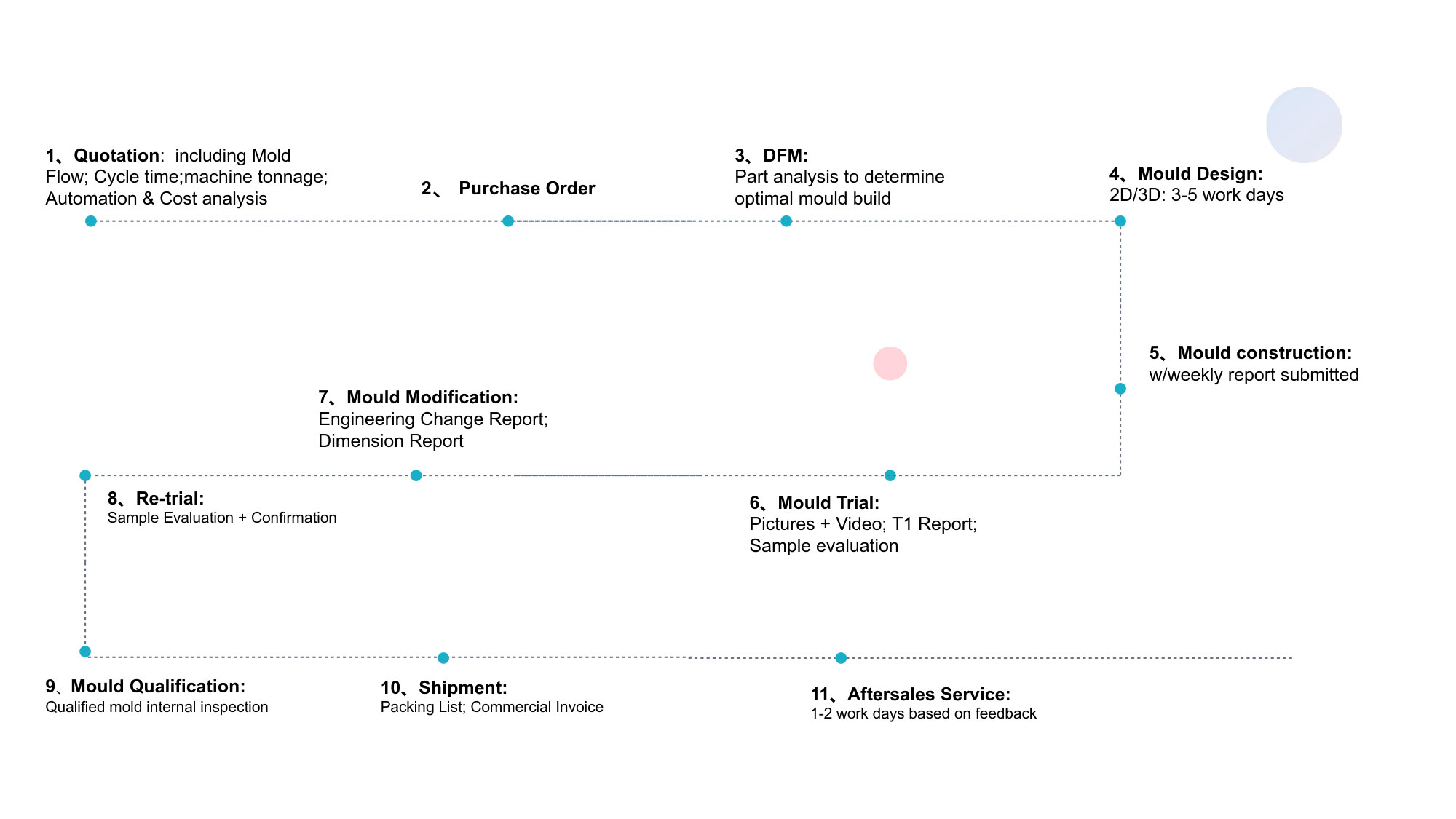
The most expensive defect is the one discovered after tool steel has been cut. Ansix prevents this by providing a comprehensive Design for Manufacturability (DFM) report before the mold manufacturing contract is signed.
This pre-production feasibility analysis steps through every aspect of the part design: draft angle recommendations (ensuring the part releases cleanly without sticking), wall thickness optimization (balancing strength, weight, and cooling time), gate location proposals (optimizing fill patterns while minimizing cosmetic impact), and ejector pin mark location allowances (consenting in advance where witness marks are acceptable).
The DFM report is not rubber-stamped boilerplate. It is the product of our engineering team analyzing your specific CAD files, running mold flow simulations, and proposing improvements that reduce production risk and per-part cost.
What this means for the customer: No unpleasant surprises in the mold trial. No "we should have told you that earlier" moments. The mold design is validated on-screen before the first machining pass.
Mold Trials and Sampling
New molds do not go straight to production. They go through a systematic validation protocol: T0 (first shot) through T3 (third trial) , with detailed improvement reports accompanying each round. Our in-house machining capability supports rapid design iterations through replaceable mold inserts, allowing alternative gate or vent configurations to be tested without rebuilding the entire mold.
What this means for the customer: You receive samples at every stage. You see the improvement arc. You approve each step. There are no dark spaces in the validation process.
Low-Volume Pilot Validation
Before committing to full-scale commercial production, Ansix offers 100- to 500-piece pilot runs . These validation batches are processed under final production parameters, run through our quality inspection workflow, and statistically analyzed for yield and process capability. Only after the pilot verification—complete with Cpk data showing the process is capable and controlled—do we transition to volume production.
What this means for the customer: You prove the process at scale before you commit to volume purchasing. The pilot run is an insurance policy against production surprises.
Maintenance, Spares, and Lifetime Support
A mold is a machine. Machines require maintenance.
Every mold shipped from Ansix includes a set of consumable spare parts—ejector pins, core inserts, and wear components—delivered alongside the mold itself. We recommend and can perform scheduled maintenance at 200,000-cycle intervals , inspecting and replacing wear components before they cause quality degradation. For emergency repairs, Ansix provides lifetime repair services at cost, with typical restoration of production within 24 hours for common repairs such as minor cavity rework or ejector pin replacement.
What this means for the customer: You are not stranded when a mold needs service. The support infrastructure is already in place.
Part Five: Differentiated Commitments — Direct Answers to Common Customer Pain Points
Instead of generic claims of quality, Ansix provides direct, actionable responses to the most frequent customer complaints about injection molding vendors. Each commitment is followed by the technical capability that makes it real.


Engineering Deep Dive: The Full Petri Dish Manufacturing Process
To ground the capability commitments in concrete process detail, this section walks through the complete engineering sequence for a Petridish project at Ansix.
Phase One: Design and Prototyping
The journey begins not with molten plastic, but with a digital blueprint. Our engineering team works closely with the customer to translate Petri dish specifications—typically standard diameters such as 60mm, 90mm, or 100mm —into a 3D CAD model that precisely reflects the final part geometry.
Using additive manufacturing, we produce functional prototypes. These prototypes serve critical validation purposes: they allow verification of ergonomics, stackability, and most importantly, the integrity of the lid-to-base seal—the essential feature for sterile containment. Any design issues identified at this stage are corrected digitally, at minimal cost, before mold steel is cut.
Phase Two: Strategic Material Selection
The choice of polymer family determines both performance and cost. For standard Petri dishes, General Purpose Polystyrene (GPPS) is the industry-preferred material due to its excellent transparency, rigidity, compatibility with gamma or ethylene oxide sterilization, and outstanding moldability.
Ansix specifies Supreme GPPS SC 206 grade, a resin known for its good flowability, excellent transparency, and regulatory approval for single-use medical devices. This strategic selection is the cornerstone of our cost-control philosophy: by selecting the resin that best balances performance, processability, and price, we avoid over-engineering with premium specialty plastics. The stable melt flow index ensures uniform filling of thin-walled sections, reducing waste and improving yield.
For reusable autoclavable dishes, we shift to medical-grade PP (Polypropylene) , which offers high impact resistance and steam sterilization compatibility.
Phase Three: Mold Flow Analysis
With part design and material determined, our engineering team applies DFM principles using advanced simulation software. This virtual test bed identifies and resolves potential production problems before they occur.
Engineers analyze how the molten polymer will flow through the proposed cavity. The software predicts potential defects: air traps that would produce burn marks, weld lines that would create mechanical weak points, and critically, post-cooling warpage or shrinkage. By simulating different gate placements, fill patterns, and cooling channel layouts, we optimize the design before machining begins.
Phase Four: Mold Manufacturing and Assembly
Mold fabrication is a multi-stage precision manufacturing process:
Steel selection and pre-treatment: Identified mold steel is thermally treated to specified hardness and toughness
Rough machining: Material is rough-shaped on conventional machining centers
Semi-finish milling: Fine surface features are machined on high-speed CNC equipment
EDM operations: Micro-features and cooling channels are wire or sinker EDM'd
Hand finishing: Critical sealing surfaces and parting lines are hand-finished to mirror-quality polish
Heat treatment (if required): Secondary hardening applied specified for wear-resistant steels
Assembly: Mold components are assembled with guide pins, bushings, and cooling connections
Inspection: Complete dimensional verification using CMM and optical measurement
Hot testing: Initial sample shots taken with specified material to validate performance
Packaging and shipment: Mold is crated with spare parts kit and documentation
Phase Five: Injection Molding Process Optimization
Optimization targets cycle time reduction and yield improvement —the two primary levers for per-part cost reduction.
Material handling: GPPS sealed bags can be processed without pre-drying. For hygroscopic materials, proper drying protocols are specified.
Machine parameter setting: Melt temperatures, injection speeds, holding pressures, and cooling times are established during DFM simulation and refined during mold trials. All parameters are then locked into the MES to prevent unauthorized changes.
Automation integration: Our high-volume Petri dish production configuration is fully automated, requiring no manual participation from raw pellets to bagged dishes. Sprues and runners are automatically separated and reground for material recovery. After molding, an integrated high-speed robotic system removes the parts, closes lids onto bases, stacks completed dishes, and transfers them to automated bagging equipment.
Post-molding operations: Sterilization options are matched to the material: gamma sterilization for GPPS, autoclaving for PP, and ethylene oxide for sensitive applications. Packaging is configured to maintain sterility through final delivery.
Phase Six: Quality Control and Assurance
Our quality control system operates at three tiers:
Incoming material inspection: Raw resin certifications are verified with material test reports confirming compliance with medical-grade specifications (USP Class VI, FDA 21 CFR for relevant applications).
In-process quality checks: Automated vision systems inspect every molded part at rates matching the cycle time, detecting surface defects, dimensional drift, and part completeness in real time.
Final inspection and release: Samples from each production lot are inspected against the master dimensional report before release.
Materials Data: Polypropylene (PP) and GPPS for Medical Petri Dishes
Polypropylene medical-grade PP is characterized by:
High impact resistance ensuring dish survives handling and transport
Autoclavability for reusable dish applications
USP Class VI and FDA 21 CFR compliant grades available
Drying recommended (80–100°C for 1–2 hours)
Mold temperature: 40–60°C for thick-walled sections, or 20–30°C for thin walls
GPPS General Purpose Polystyrene (GPPS) is characterized by:
Superior optical clarity optimized for microscopic observation
High stiffness and rigidity for maintained flatness under stack load
Compatibility with gamma radiation sterilization
Minimal mold shrinkage: 0.3–0.6%
Excellent flowability in thin-wall sections
For specialized applications, Ansix offers alternative materials:
PMMA (Acrylic): Superior weather resistance and surface hardness, used for premium optical applications requiring long-term UV stability
SAN (Styrene Acrylonitrile): Improved chemical resistance and heat deflection temperature compared to GPPS
COC/COP (Cyclic Olefin Copolymer/Polymer): Ultra-high transparency with low autofluorescence for fluorescence microscopy applications, minimal extractables/leachables profile similar to glass
Cost Reduction: The Ansix Business Case
Cost reduction is not a byproduct of our process—it is an engineered outcome. Ansix attacks per-part cost through four primary levers:
Material Cost Optimization
Material accounts for 50–70% of a molded part's total production cost. By selecting the specific resin grade that balances performance requirements (clarity, sterilization compatibility, stiffness) with price, we avoid the 20–40% premium of over-specified engineering plastics. Strategic sourcing at the volumes required for large-scale production further reduces the per-unit material cost.
Cycle Time Optimization
Cooling typically consumes 50–70% of the total injection molding cycle time. Our conformal cooling channel designs, optimized through mold flow simulation, reduce cooling time by 15–25% compared to conventional straight-drilled cooling layouts. On a high-cavity mold running at million-part volumes, each second trimmed from the cycle time represents thousands of dollars in annual labor and machine cost savings. Every additional 1% yield improvement reduces waste material costs proportionally.
Efficiency Optimization (Automation and Throughput)
Our stack mold technology and 8-cavity hot runner systems maximize output per machine hour. The integrated automation—removing, stacking, closing, and bagging—eliminates manual touch labor entirely for high-volume production. Labor cost per part approaches zero. Throughput is limited only by the injection molding machine's cycle time.
Tooling Intelligence (Long Mold Life)
A mold that wears out at 200,000 cycles must be replaced or extensively refurbished four times to reach one million parts. A mold that lasts one million cycles—backed by proper material selection, heat treatment, and maintenance—requires a single investment. The amortized tooling cost per part is reduced by 80% across the same production volume. Our standard life commitments of 500,000 cycles for abrasive glass-filled materials and one million cycles for standard resins are not marketing statements—they are engineered targets validated by material selection and design.
Risk Reduction: How Ansix Protects Your Program
Reducing cost is valuable. Reducing risk is invaluable. Ansix mitigates the major risks inherent to plastic injection molding programs through systematic engineering controls.
Product development risk: DFM reports, mold flow analysis, and functional prototyping eliminate design-related surprises before tooling begins.
Tooling investment risk: Full dimensional inspection reports and in-house hot testing ensure the mold performs as specified before shipment. No "debugging" is required on your production floor.
Manufacturing continuity risk: Standardized mold designs, in-house repair capability, and 24-hour emergency response ensure that when a mold requires maintenance, production resumes quickly—not weeks later.
Quality compliance risk: MES-locked process parameters, traceable inspection data, and systematic pilot validation protocols produce audit-ready documentation for regulatory submissions.
Conclusion: The Ansix Value Proposition
Dear customer, to Ansix, a mold is not a block of steel. It is a money-printing machine. When we design a mold, we simultaneously engineer the retention system, the venting path, and the thermal balance to ensure that when it arrives at your production line, it is plug-and-play ready: low flash, high cavity life, and requiring no on-site debugging.
From material selection—GPPS for optical transparency, PP for autoclavability, specialized resins for demanding applications —to mold design, validation, and high-volume production, Ansix delivers a turnkey solution that reduces your costs, protects your program from technical risk, and accelerates your time to market.
We invite you to bring an existing product to Ansix for a full DFM report walk-through. You will see how we anticipate and resolve weld lines, air traps, and shrinkage risks—before a single gram of material enters a mold.
For a project consultation or to request a DFM analysis, please contact Ansix Tech.
References and Standards Compliance:
EN ISO 24998:2008 — Plastics laboratory ware — Single-use Petri dishes for microbiological use
USP Class VI — Biological reactivity testing for medical-grade plastics
FDA 21 CFR — Food and Drug Administration compliance for medical device materials
ISO 9001:2015 — Quality management systems
Glossary of Key Terms (Translated to Customer Value):

Ansix Tech — Precision in Pressure, Value by Design.
Ansix Tech Co Ltd
If you have any plans related to Petri dish , you can contact us at any time. We will turn your ideas into reality, let you realize your dreams, and obtain large orders from the market. Our contact information is info@ansixtech.com. Or contact our CTO, mail: stephen@ansixtech.com
#www.ansixtech.com #ansixtech.com #Petri dish #Petri dish moulds #Petri dish molds #Petri dish injection molding companies #Petri dish Canopy Mold injection mold companies #Ansix #Ansix moulds #Ansix china #Ansix tech china #Ansix tech company #Ansix facotry #Petri dish injection molding #Petri dish injection tools #Petri dish injection moulds #Petri dish plastic mould #Petri dish plastic tools #Ansix Tech #Ansix molds #Ansix injection molding #Ansix mold factory #injection molding Petri dish #Ansix mold factory #Petri dish china #Petri dish molds #injection factory #Petri dish injection molding #Petri dish injection molding factory #injection molding company #Petri dish injection mold companies #Petri dish#Petri dish mold limited #Ansix mold china #Ansix companies #Ansix company China #Petri dish facotry #Ansix Tech #Ansix Tech mould #Petri dish injection moulding #injection moulding company #Ansix Petri dish parts injection mold companies #medical injection molding companieschina #Petri dish china factory #Ansix moulding companies #Ansix molding company #Petri dish injection moulding facotry #Ansix Tech mold #Petri dish mould #Petri dish plastic injection molding #ansix plastic mold #Mold manufacturing #Petri dish parts manufacturing #Petri dish plastic parts factory #Petri dish injection parts mold #Petri dish PRECISION MANUFACTURING #Petri dish #China mold #Petri dish injection moulding china #Petri dish mould china #china precision mold #mold in china #Petri dish mold china #Precision molds #High-precision molds #Petri dish #Injection molds #Petri dish Factory #Petri dish Company #Super Large Injection Mold Factory #Large Tonnage Injection Molding Factory #Petri dish Company #Petri dish Factory #2800T Injection Molding Factory #3000 Ton Injection Molding #4500 Ton Injection Molding Factory #Large Mold Injection Molding #Large Plastic Mold Injection Molding Factory #Large Injection Mold Manufacturer #Plastic Mold Factory #Injection Mold #Plastic Mold