



PP plastic foam solid float
FEATURES
The MuCell® process uses supercritical fluid (typically nitrogen or CO₂) as a physical blowing agent. During plasticization, precisely metered amounts of SCF are injected into the polymer melt through specialized injectors mounted on the plasticizing barrel. The specially designed mixing section creates a homogeneous single-phase solution of SCF and molten polymer. Upon injection into the mold cavity, rapid pressure drop triggers nucleation, with cells forming in the range of approximately 5 to 50 micrometers. These cells expand until the polymer matrix solidifies. Unlike conventional injection molding which requires high-pressure pack-and-hold stages, MuCell replaces this phase with controlled cell growth—cells expand uniformly across the cavity, naturally compensating for shrinkage and eliminating sink marks.
-
Mold Description
Product Materials:
PP FOAM
Mold Material:
S136ESR
Number of Cavities:
2
Glue Feeding Method:
Hot runner
Cooling Method:
Water cooling
Molding Cycle
22.5s
- The mold manufacturing process and product material selection
Quality Assurance
Quality assurance begins with material selection. Ansix Tech uses virgin polypropylene resins with optimized melt flow indices specifically formulated for microcellular foaming. The company holds ISO9001, IATF16949, ISO13485, and ISO14001 certifications, providing a complete quality control system across four manufacturing facilities in China and Vietnam. Every production batch undergoes density verification, cell morphology analysis, dimensional inspection using CMM equipment, and floatation performance testing. Key quality indices monitored include closed-cell ratio (≥85%), surface skin integrity, and dimensional stability across production runs.
Competitive Cost Control
Cost efficiency comes from multiple sources: reduced resin consumption (typically 8–20% less material compared to solid molding), shorter cycle times, lower energy consumption, and the ability to run molds on smaller-tonnage machines. Ansix’s vertically integrated manufacturing model—in-house mold making, in-house injection molding, and in-house assembly—eliminates external sourcing markups. Factory costs are further optimized through strategic locations in both China and Vietnam. The company operates 260 injection molding machines ranging from 30 tons to 2,800 tons, including machines from FANUC, Sumitomo, Toshiba, Engel, and Haitian. This scale enables Ansix to amortize fixed costs across high-volume production runs.
-
After-Sales Service Quality Assurance
Ansix provides a complete service cycle: spare wear parts (ejector pins, core inserts) delivered with the mold; mold maintenance scheduled every 200,000 cycles; and lifetime repair service at cost price. Delivery response is within 12 hours for customer inquiries.
Part 2: Core Values for Molds, Materials, Smart Manufacturing, and Quality
Mold Manufacturing
Ansix’s mold manufacturing capability is built on precision equipment: five-axis high-speed machining centers for 0.002mm complex surfaces, and wire EDM machines for 0.03mm micro-holes and narrow slots to prevent thin-wall deformation【provided framework】. Mold frame material uses P20, while cavity materials select appropriate grades: S136, 2344, 2343, 8407, SKD11/61/DC53, M340, 4Cr13, 9Cr18, NAK80, and H13, chosen based on production volume and material abrasiveness. For glass-fiber-reinforced materials, mold life exceeds 500,000 cycles; for unfilled plastics, 1,000,000 cycles. Every mold undergoes full dimensional reporting before delivery, with critical dimensions achieving Cpk ≥ 1.33. Conventional structural parts achieve tolerance ±0.05mm; precision components achieve ±0.005mm.
Injection Molding Material Selection
For PP foam float production, the optimal resin is polypropylene copolymer (PP copolymer) with controlled melt flow index. PP offers chemical resistance, low density base (0.90–0.91 g/cm³ solid), and excellent compatibility with supercritical fluid foaming. Filled PP grades with talc or glass fiber provide synergistic effects with SCF, often delivering the best combination of weight reduction and cycle time improvement.
Smart Manufacturing Capabilities
Ansix implements MES (Manufacturing Execution System) across all machines, locking injection parameters—temperature, pressure, speed, and timing—with adjustments only accessible by authorized engineers. Each machine is equipped with ultrasonic wall thickness sensors providing real-time feedback, automatically adjusting packing pressure to compensate for fluctuations. The company has mastered Industry 4.0 technologies: machine connectivity, real-time monitoring, and carbon footprint tracking. For PP foam floats, smart molding ensures every shot meets specifications before ejection. Automated removal systems reduce manual handling and improve consistency.
Process Quality Assurance
Ansix begins with Moldflow analysis to predict weld line locations, gas trap positions, and fill patterns, optimizing gate placement and quantity to ensure balanced filling. Each production run requires first-article and last-article inspections, with statistical process control data recorded. For customers requiring high-volume consistency, Ansix provides PPAP documentation including FAI reports and process capability studies. With IATF 16949 certification, the quality system meets automotive industry standards, ensuring traceability and rigorous documentation. All mold designs plan for maintainability—standardized components, accessible cooling channels, and modular cavity inserts for quick replacement.
Part 3: Comprehensive Manufacturing Plan for PP Plastic Foam Solid Float – 2000+ Words
I. Understanding Customer Value: Turning Technical Specifications into Business Outcomes
In the injection molding industry, the gap between technical capability and customer perception is often where opportunities are lost. Ansix Tech bridges this gap by consistently translating engineering metrics into tangible customer value—reduced costs, mitigated risks, and accelerated time-to-market. The framework below presents how Ansix approaches PP plastic foam solid float projects by answering three fundamental questions: What problems can we solve? How much cost can we save? What risks can we reduce?
The following five-pillar structure demonstrates Ansix’s comprehensive capability from project initiation through mass production delivery.
II. Pillar One: Hard Asset Infrastructure – Building Customer Trust from the Foundation
Mold Processing Equipment – Precision You Can Measure
Ansix’s toolroom is equipped with five-axis high-speed machining centers capable of machining complex curved surfaces to 0.002mm accuracy. This level of precision ensures that parting lines on PP foam float products are smooth and free from flash, eliminating secondary deburring operations. For customers, this means receiving parts that are ready for assembly directly from the molding machine. Slow-moving wire EDM machines are available for machining 0.03mm micro-holes and narrow slots, which is critical for float designs that incorporate thin-wall sensing windows or magnetic component retention features. The precision of wire EDM prevents thin-wall distortion during machining—a common failure mode that leads to inconsistent float wall thickness and compromised buoyancy.
Injection Molding Machine Fleet – Scale Meets Consistency
Ansix operates 260 injection molding machines across four manufacturing facilities in China and Vietnam, with clamp force ranging from 30 tons to 2,800 tons. This tonnage range covers PP foam floats of all sizes, from miniature sensors requiring only a few grams of material to large industrial floats demanding several kilograms per shot. The fleet includes machines from world-leading manufacturers: Japanese brands FANUC, Sumitomo, Toshiba, Nissei; European brands Engel and Arburg (primarily for liquid silicone rubber two-shot molding); and domestic brands Haitian, TYC, and others.
What matters to customers is not the brand names, but what these machines deliver: all are servo-motor-driven, ensuring stable repeatability of ±0.1%. When Ansix says the 100,000th float will match the 1st float, that precision tolerance is the guarantee. Every injection molding machine is connected to a central MES. Molding parameters—temperature, pressure, speed, and timing—are locked in the system, accessible only by authorized engineers. Each batch requires first-article and last-article dimensional validation, ensuring that production drifts are detected and corrected before non-conforming parts can be produced.
Inspection and Measurement – Data That Validates Quality
Ansix’s quality laboratory is equipped with coordinate measuring machines (CMM) and optical imaging systems. Every mold before delivery undergoes full dimensional reporting, with critical dimensions validated to Cpk ≥ 1.33. For PP foam floats, density measurement is performed using water displacement methods (ISO 1183) to confirm flotation performance. Cell morphology is analyzed to ensure uniform microcellular structure with closed-cell ratio ≥85% and average cell size within specifications. Compression strength is tested using universal testing machines. For customers in automotive or medical sectors, Ansix provides PPAP documentation including FAIR, process flow diagrams, control plans, and capability studies—all backed by IATF 16949 certification.
III. Pillar Two: Mold Manufacturing Core Competitiveness – Specific Metrics That Matter
Customers care about mold life expectancy, achievable tolerances, delivery time, and maintenance cost over the mold’s service life. Ansix addresses each dimension with specific, verifiable commitments.
Mold Life Expectations
The mold life guarantee depends on material selection and application. Ansix constructs mold frames from P20 tool steel, providing structural integrity across hundreds of thousands of cycles. Cavity and core materials are selected based on production volume and material properties: S136 stainless steel provides corrosion resistance for high-humidity float applications; H13 hot-work tool steel offers high hardness and wear resistance for glass-filled PP grades; NAK80 provides excellent polishability for cosmetic surface requirements; and DC53 provides toughness and wear resistance for high-cycle production. For glass-fiber-reinforced materials, Ansix guarantees 500,000 shots; for unfilled PP materials, the guarantee extends to 1,000,000 shots. A steel material certification report and heat treatment curve are provided with every mold.
Achievable Tolerances
Conventional structural features on PP foam floats are held to ±0.05mm. Precision features—such as magnetic sensor mounting locations, sealing surfaces, and mating diameters—are held to ±0.005mm. These tolerances are verified using CMM with full dimensional reporting. For foam parts where shrinkage behavior differs from solid molding due to the presence of microcellular structure, Ansix uses Moldflow simulation incorporating foam-specific shrinkage models to predict and compensate for dimensional changes prior to mold manufacturing.
Mold Types and Configurations
Ansix offers several mold configurations optimized for PP foam float production. Hot runner systems minimize material waste by eliminating cold runner scrap—critical for high-volume production where accumulated savings from material recovery are substantial. Hot runner systems are particularly valuable for PP foam applications because they provide consistent melt temperature and pressure delivery to each cavity, ensuring uniform cell nucleation and growth. Multi-cavity molds (typically 4, 8, 16, or 32 cavities) multiply output per cycle, directly reducing per-part cost. For PP foam floats, where cooling time dominates cycle length, maximizing cavity count within available machine tonnage yields the greatest productivity benefit.
Gating System Optimization
Through Moldflow analysis, Ansix predicts weld line locations, gas trap positions, and fill imbalances before steel is cut. For PP foam floats, the gate location is particularly critical because it affects cell morphology uniformity across the part. Gates placed near thick wall sections allow the foaming front to advance with minimal pressure drop, maintaining uniform cell nucleation conditions across the cavity. Runner design is balanced to ensure simultaneous fill completion for all cavities, preventing overpacking of some cavities while others remain underfilled.
Lead Time Standards
Simple molds for PP foam floats with low complexity—single cavity, standard hot runner, basic cooling—are delivered in 10 days. Medium-complexity molds requiring multi-cavity configurations and conformal cooling are delivered in 25–45 days. Expedited delivery (such as 20 days for medium-complexity molds) is available but requires that all design verification steps including Moldflow simulation are completed without shortcuts.
IV. Pillar Three: Injection Molding Process Control – Eliminating Customer Quality Anxiety
Customers fear common injection molding defects: sink marks, flash, dimensional instability, and batch-to-batch color variation. Ansix addresses each of these fears through systematic process control.
Process Standardization and Traceability
Every injection molding machine is connected to the MES. Production parameters—temperatures (barrel zones, nozzle, mold), pressures (injection, holding, backpressure), speeds (injection, screw rotation, clamp), and timing (injection, cooling, mold open/close)—are locked and can only be modified with engineering authorization. This prevents unauthorized operator adjustments that could lead to quality drift. Each batch’s first-article and last-article dimensions are compared and recorded. Statistical process control charts track trend data across batches, enabling predictive intervention before specifications are exceeded.
Dimensional Stability Control
For PP foam floats, dimensional stability presents unique challenges because foaming adds a variable—cell expansion—to the traditional shrinkage equation. Ansix controls this through mold temperature zoning: mold temperature controllers分区控制 core and cavity temperatures independently, maintaining temperature difference within 2°C, reducing warpage and maintaining dimensional accuracy. For a typical PP foam float with wall thickness of 3–5 mm, the optimal mold temperature range is 15–22°C. Conformal cooling channels—CNC-machined to follow part contours—provide uniform heat extraction across complex geometries. Production data for similar foam components demonstrates that key hole-to-hole spacing maintains ≤0.02mm variation across three consecutive production runs within a one-week period.
Surface Quality and Appearance
PP foam floats require a smooth, defect-free surface for consistent hydrodynamic performance and aesthetic requirements. Ansix achieves specific surface quality grades: foam structure analysis measures average cell diameter (50–500μm) with cell diameter distribution CV ≤15%, ensuring that surface cells do not break open and create rough spots. For floats requiring secondary painting or printing, Ansix reserves compensation allowance for warpage during mold design, achieving registration accuracy of ±0.1mm.
Special Material Capabilities
Beyond PP, Ansix’s expertise extends across a broad material spectrum: PC/ABS blends, unfilled PC, PPS with 40% glass fiber, high-performance PEEK, PTFE/PFA fluoropolymers, PA6 with 30% glass fiber, PBT, PEI, LCP, and liquid silicone rubber (LSR). For applications requiring flame retardance, UL94 V-0 ratings are available for foam-compatible formulations. For outdoor exposure, UV testing to 3,000 hours with no color change is verified through accredited testing protocols. For marine applications requiring saltwater resistance, the PP microcellular foam structure inherently provides excellent chemical resistance due to the closed-cell morphology that prevents water ingress.
V. Pillar Four: Full-Service Lifecycle – Reducing Customer Management Costs
Many factories overlook the value of comprehensive service. Ansix builds value into every stage of the customer engagement.
Early Engagement – DFM (Design for Manufacturing) Report
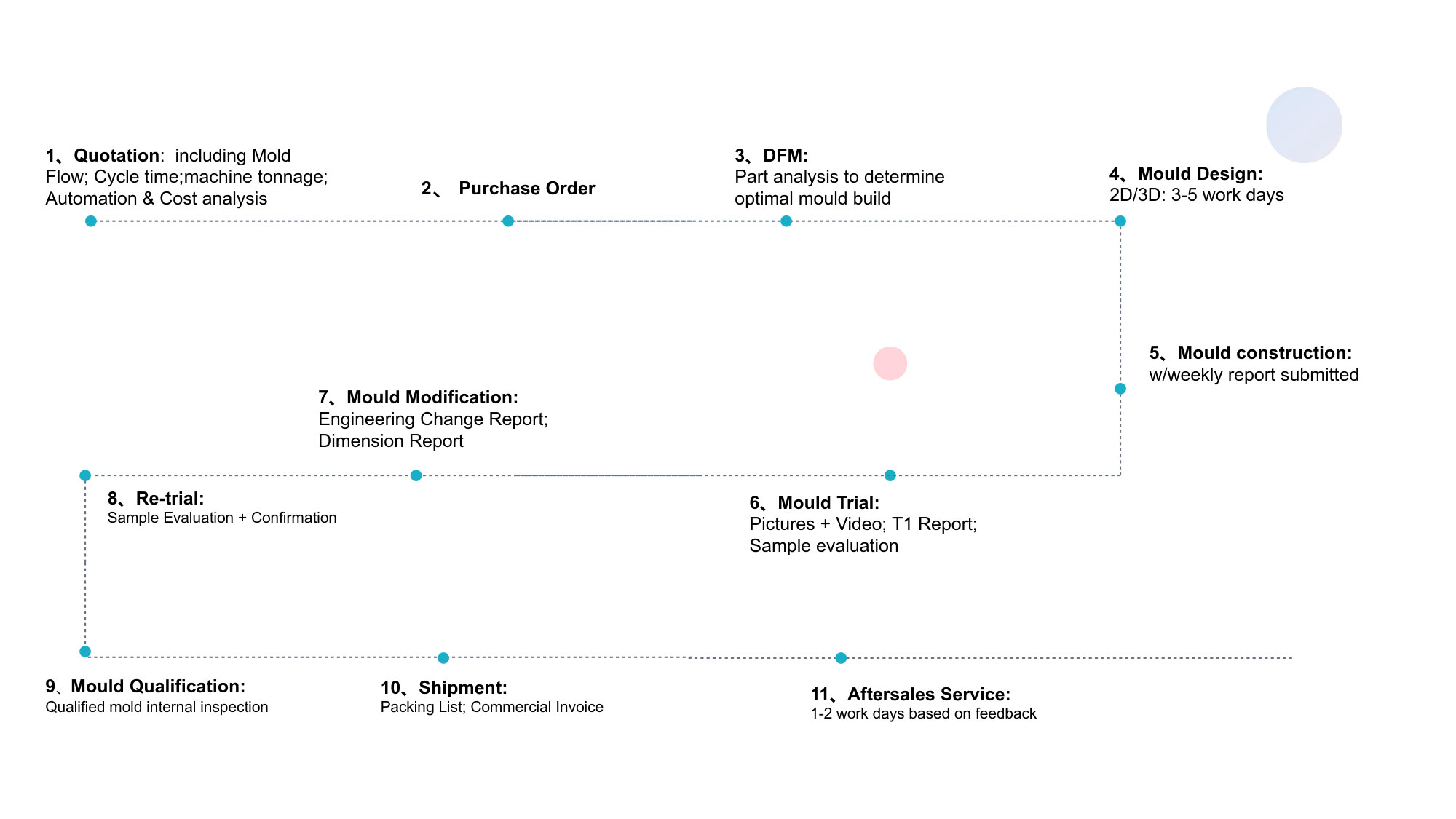
Before any steel is cut, Ansix provides a comprehensive Mold Flow Analysis and mold feasibility study. This report includes recommendations for draft angles (≥0.5° for smooth surfaces, ≥1° for fine texture, ≥1.5° for rough texture), wall thickness optimization to maintain uniform fill and cooling, gate location selection based on flow modeling, ejection pin position allowances to avoid visible marks on appearance surfaces, and weld line mitigation strategies through gate placement or gas vent design. This early-stage analysis prevents the costly scenario where a customer discovers after mold completion that their design cannot be injection molded as originally conceived.
Trial Molding and Sample Delivery
From T0 (first mold trial) through T3 (final validation), Ansix provides molded samples at each stage, accompanied by improvement reports documenting changes made and results achieved. Quick-change inserts allow alternative gating or cooling configurations to be tested without cutting a completely new mold—saving weeks and thousands of dollars in development time.
Low-Volume Pre-Production Validation
Before committing to full-scale mass production, Ansix offers 100–500 shot pre-production runs to validate the process at scale. Yield rates and process capability indices (Cpk) are calculated from this run, confirming that the production process is stable and capable before the customer places a production purchase order.
Maintenance and Spare Parts
Spare wear parts—ejector pins, core inserts, slide components—are delivered with the mold, enabling customers to address minor maintenance issues without waiting for resupply. Ansix schedules mold maintenance every 200,000 cycles, performing cleaning, lubrication, and wear inspection. Lifetime repair service is available at cost price, with no mark-up on replacement parts or labor. This approach ensures that the mold continues to produce conforming parts throughout its design life without unexpected maintenance costs burdening the customer’s budget.
VI. Pillar Five: Differentiated Commitments – Addressing Common Industry Pain Points
Rather than making generic claims about being “better,” Ansix addresses specific customer complaints common across the injection molding industry:
Customer Complaint Ansix Technical Response
Molds require frequent repair, disrupting production schedules 2,000-cycle wear test performed before mold delivery, with wear report documenting performance. Three-year structural warranty on mold frame and core/cavity set (excluding normal wear of ejector pins and slide components).
Flash requires time-consuming and expensive manual trimming Parting lines machined to 0.005mm fit accuracy. Self-locking tonnage compensation system adjusts clamp force automatically during production to maintain mold closure. Flash controlled to ≤0.03mm per batch, eliminating manual trimming requirements.
Dimensional variation from batch to batch Ultrasonic wall thickness sensors provide real-time part thickness feedback, automatically adjusting packing pressure to compensate. Optional in-mold temperature and pressure sensors enable closed-loop control of foaming parameters.
Mold repair lead times disrupt customer production schedules In-house electrode machining center and EDM workshop ensure mold repairs never leave the facility. Standard weld repair and insert replacement completed within 24 hours.
Translating Expertise into Customer Value
For Ansix, a mold is not a piece of metal—it is a revenue-generating asset for the customer. Every mold designed at Ansix simultaneously optimizes for moldability, venting path design to prevent gas trap defects, temperature balance for uniform cooling and shrinkage, and ejector layout to prevent part deformation. The design philosophy is that molds should arrive at the customer’s production line ready for immediate operation without trial-and-error setup.
VII. The Ansix Value Proposition: What We Solve, How We Reduce Costs, and How We Ensure Quality
What Problems Does Ansix Solve?
PP plastic foam floats face several inherent manufacturing challenges. The microcellular foaming process requires precise control of supercritical fluid concentration, injection pressure profile, and cooling rate to achieve uniform cell nucleation and expansion. Without this control, floats may exhibit non-uniform density distribution, causing uneven flotation performance or sink marks on critical surfaces. Ansix has mastered this process over 28 years of manufacturing experience, delivering PP foam floats that provide consistent buoyancy, smooth surface finish, and dimensional stability across millions of production cycles.
Cost Reduction Across Materials, Process, and Efficiency
Cost savings with MuCell technology are substantial and verifiable. Resin consumption is reduced by 8–20% because the internal cellular structure displaces solid polymer with gas. Cycle time reductions of up to 40% come from eliminating the pack-and-hold phase. Energy consumption per part drops significantly—clamp force requirements decrease by 25–50%, meaning smaller-tonnage machines can produce the same parts. For customers requiring engineering-grade resins like PEEK ($30–100/kg), a 15–20% material reduction translates directly to per-part savings. Ansix’s strategic manufacturing presence in both China and Vietnam further optimizes labor and overhead costs.
Quality Verification Systems
Ansix’s quality verification framework is built on four pillars. First, during product development, Moldflow analysis validates fill, pack, cooling, and warpage predictions against design specifications. Second, during mold manufacturing, in-process inspections at each machining stage ensure dimensional accuracy is maintained. Third, during trial production, full dimensional inspection using CMM verifies that molded parts conform to CAD specifications, with density and cell morphology analysis verifying foam structure uniformity. Fourth, during mass production, statistical process control monitors key quality characteristics, with sample parts retained from each batch for archival reference.
Production Capacity and Delivery Assurance
With 260 injection molding machines and 1,200+ employees across facilities, Ansix provides scalable production capacity for projects ranging from tens of thousands to tens of millions of units annually. Prototype delivery for PP foam floats is available within 1–3 weeks. Tooling completion for medium-complexity floats requires 25–45 days. First mass production shipments follow sample approval, typically within 2–3 weeks. Expedited delivery schedules are available for customers with urgent requirements. Packaging is customized to customer specifications, with options including bulk packing for cost efficiency, individual cartoning for retail presentation, and palletized containers for ocean freight shipment.
Industry Experience and Proven Reliability
Ansix Tech was founded in Hong Kong in 1998, establishing subsidiaries in Shenzhen, Dongguan, Hunan, and Vietnam. The company holds ISO9001, IATF16949, ISO13485, and ISO14001 certifications, serving customers across automotive, medical, consumer electronics, and industrial equipment sectors. PP foam float production represents a specialized application of the company’s broader microcellular foaming expertise, which also encompasses automotive interior components, medical device housings, and consumer goods requiring lightweighting. This cross-industry experience enables Ansix to bring proven solutions from adjacent applications to the PP foam float domain, accelerating development and reducing technical risk.
The Ultimate Value Proposition: Reducing Hard Costs Through Optimization
Ansix reduces customer hard costs through multiple optimization pathways. On the material side, resin grades are selected to balance performance with cost, avoiding unnecessary over-specification. On the process side, cycle time is minimized through optimized cooling channel design and mold temperature control, increasing output per machine hour. On the efficiency side, multi-cavity molds maximize part production per cycle, and automated part removal reduces manual handling requirements. On the quality side, CpK ≥1.33 dimensional capability reduces scrap rates, and preventive maintenance extends mold life and reduces unplanned downtime. On the supply chain side, strategic manufacturing locations and vertical integration eliminate external sourcing markups.
VIII. Call to Action
For customers evaluating Ansix Tech for PP plastic foam float production, the company offers a full DFM report walkthrough using an existing product to demonstrate how weld lines, gas traps, and shrinkage risks are identified and resolved before mold manufacturing begins. This transparent, data-driven approach ensures that every project starts with a clear understanding of technical requirements, manufacturing capabilities, and cost expectations—with no surprises when production begins.
Part 4: PP Plastic Foam Solid Float – Density Data for PP Foam and MuCell Microcellular Foam
PP Solid vs. Foamed Density Comparison
The density of solid polypropylene (unfilled PP homopolymer or copolymer) ranges from 0.90 to 0.91 g/cm³. When foamed using MuCell® microcellular technology, density reductions of 8% to 20% are achievable with minimal impact on mechanical properties. For optimized material grades and mold geometries, weight reduction can reach 5–40%, depending on supercritical fluid concentration, polymer grade selection, and part geometry.
MuCell® Microcellular Foam Density Ranges
For unfilled PP grades, typical foam densities fall between 0.72 and 0.83 g/cm³ (representing 10–20% reduction). For filled PP grades (talc or glass fiber reinforced), the base solid density is higher; but filled materials often provide the greatest value as fillers act synergistically with the supercritical fluid, enabling the best combination of weight reduction and cycle time improvement. For PP nanocomposite foams, density values have been documented as low as 0.65–0.75 g/cm³ depending on filler type and concentration. For reference, ARPRO® expanded polypropylene (EPP) foam typically exhibits densities from 0.020 to 0.090 g/cm³ (20–90 g/L), but EPP is produced through bead foam molding rather than direct injection foam molding, with corresponding differences in mechanical properties and surface quality.
Key Density Metrics to Consider
Parameter Value Range Notes
Solid PP Density 0.90–0.91 g/cm³ Base PP copolymer/homopolymer
MuCell® PP Density 0.72–0.83 g/cm³ (8–20% reduction) Typical for unfilled grades
MuCell® PP with SCF optimization 5–40% reduction achievable Dependent on SCF concentration, grade, geometry
Closed-cell ratio requirement >85% For buoyancy applications
Cell size range 5–50 μm Typical MuCell® cell diameter
For PP plastic foam floats, the targeted density range typically falls between 0.70 and 0.85 g/cm³, balancing flotation performance (lower density = higher buoyancy) with mechanical robustness and surface integrity. The MuCell® process produces a solid skin layer with a microcellular core, maintaining surface durability while achieving internal lightweighting. This solid-skin/foam-core morphology ensures that the float surface resists abrasion and chemical attack while the internal structure provides buoyancy.
Summary
Ansix Tech transforms PP plastic foam solid float production from an art into an engineered science. By integrating precision mold manufacturing, MuCell® microcellular foaming technology, smart manufacturing systems, and comprehensive quality assurance, the company delivers floats that are lighter, more consistent, and more cost-effective than conventionally molded alternatives. Every technical decision—from material selection to mold cooling design—is made with customer value as the primary criterion, ensuring that engineering excellence translates directly into business outcomes: reduced costs, mitigated risks, and accelerated time-to-market. With 28 years of manufacturing experience, 260 injection molding machines across four facilities, and IATF 16949/ISO 13485 quality certifications, Ansix Tech stands as a reliable partner for PP foam float production projects of any scale.
Ansix Tech Co Ltd
If you have any plans related to PP plastic foam solid float , you can contact us at any time. We will turn your ideas into reality, let you realize your dreams, and obtain large orders from the market. Our contact information is info@ansixtech.com. Or contact our CTO, mail: stephen@ansixtech.com
#www.ansixtech.com #ansixtech.com #PP plastic foam solid float #PP plastic foam solid float injection molding companies #PP plastic foam solid float Canopy Mold injection mold companies #Ansix #Ansix moulds #Ansix china #Ansix tech china #Ansix tech company #Ansix facotry #PP plastic foam solid float injection molding #PP plastic foam solid float injection tools #PP plastic foam solid float injection moulds #PP plastic foam solid float plastic mould #PP plastic foam solid float plastic tools #Ansix Tech #Ansix molds #Ansix injection molding #Ansix mold factory #injection molding PP plastic foam solid float#Ansix mold factory #PP plastic foam solid float china #PP plastic foam solid float molds #injection factory #PP plastic foam solid float injection molding #PP plastic foam solid float injection molding factory #injection molding company #PP plastic foam solid float injection mold companies #PP plastic foam solid float Tooling #PP plastic foam solid float mold limited #Ansix mold china #Ansix companies #Ansix company China #PP plastic foam solid float facotry #Ansix Tech #Ansix Tech mould #PP plastic foam solid float injection moulding #injection moulding company #Ansix PP plastic foam solid float parts injection mold companies #medical injection molding companieschina #PP plastic foam solid float china factory #Ansix moulding companies #Ansix molding company #PP plastic foam solid float injection moulding facotry #Ansix Tech mold #PP plastic foam solid float mould #PP plastic foam solid float plastic injection molding #ansix plastic mold #Mold manufacturing #PP plastic foam solid float parts manufacturing #PP plastic foam solid float plastic parts factory #PP plastic foam solid float injection parts mold #PP plastic foam solid float PRECISION MANUFACTURING #PP plastic foam solid float #China mold #PP plastic foam solid float injection moulding china #PP plastic foam solid float mould china #china precision mold #mold in china #PP plastic foam solid float mold china #Precision molds #High-precision molds #PP plastic foam solid float #Injection molds #PP plastic foam solid float Factory #PP plastic foam solid float Company #Super Large Injection Mold Factory #Large Tonnage Injection Molding Factory #PP plastic foam solid float Company #PP plastic foam solid float Factory #2800T Injection Molding Factory #3000 Ton Injection Molding #4500 Ton Injection Molding Factory #Large Mold Injection Molding #Large Plastic Mold Injection Molding Factory #Large Injection Mold Manufacturer #Plastic Mold Factory #Injection Mold #Plastic Mold