



150ml hair mask bottle, mud mask, 250ml hair wax jar, 500ml facial cleansermakeup remover bottle
FEATURES
Product Overview and Technical Requirements
1.1 150ml Hair Mask Bottle: Balancing Strength, Clarity, and Economy
The 150ml hair mask bottle represents a critical packaging solution in the beauty and personal care sector. Typically manufactured from high-density polyethylene (HDPE), polypropylene (PP), or polyethylene terephthalate (PET), this container demands excellent chemical resistance to hair mask formulations containing silicone compounds, conditioning agents, and preservatives. Wall thickness is optimized between 1.2mm to 2.0mm to maintain structural integrity while minimizing material consumption and cycle time. Key design considerations include seamless shoulder transitions, uniform wall distribution to prevent sink marks, and secure closure compatibility. PP offers superior chemical resistance and heat tolerance up to 100°C, while PET provides exceptional clarity for products where visual appeal is paramount.
-
Mold Description
Product Materials:
PET PETG PS AS PP
Mold Material:
S136ESR
Number of Cavities:
1*8
Glue Feeding Method:
Hot runner
Cooling Method:
Water cooling
Molding Cycle
42.5s
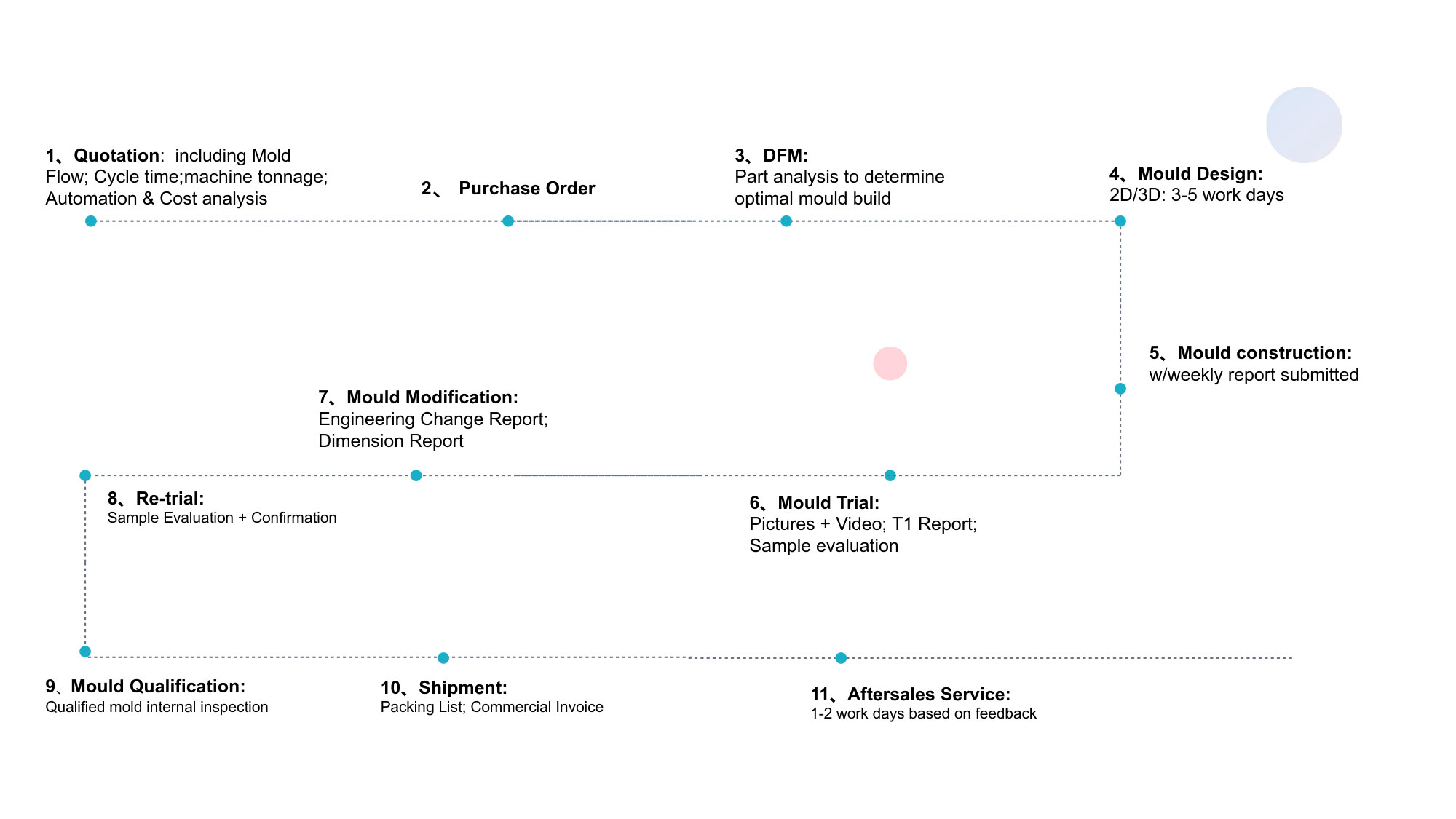
- The mold manufacturing process and product material selection
Mud Mask Container: Requirements for High-Viscosity Formulations
Mud mask containers present unique manufacturing challenges due to the high viscosity and clay-based nature of the product. These jars require wider mouth diameters (typically 50mm to 75mm) to facilitate easy product access, combined with robust wall construction to prevent container deformation during dispensing. The material of choice is predominantly PP or PETG, offering excellent chemical resistance to clay particles, essential oils, and active ingredients commonly found in mask formulations. Surface finish requirements are rigorous—achieving SPI A-2 or higher polish levels ensures smooth product release and premium aesthetic appeal. Thread design precision is critical, with tolerances maintained within ±0.05mm to ensure consistent sealing with inner lids and over caps.
-
250ml Hair Wax Jar: Structural Integrity and Aesthetic Excellence
The 250ml hair wax jar bridges functionality with premium presentation. Hair wax formulations vary from pomade-type waxy substances to gel-cream hybrids, requiring packaging that withstands repeated scooping without deformation. Our manufacturing approach employs either injection-blow molding or conventional injection molding depending on design complexity. Glass-like clarity can be achieved using PET or PMMA (acrylic), while PP provides superior chemical resistance for solvent-based formulas. Key technical parameters include bottom thickness optimization to prevent warping, consistent sidewall thickness for uniform shrinkage, and precise closure fitment to prevent product drying. For luxury positioning, we offer high-gloss finishes, matte textures, and 360-degree decoration compatibility.
1.4 500ml Facial Cleanser/Makeup Remover Bottle: High-Volume Production Essentials
The 500ml facial cleanser bottle represents high-volume, fast-moving consumer goods packaging. Production rates target 15,000 to 30,000 units per day per line. PET is the dominant material choice, offering exceptional clarity to showcase product characteristics, combined with good impact resistance for shipping durability. Pump dispenser compatibility requires neck finish precision within ±0.05mm to ensure leak-proof operation. The bottle design incorporates ergonomic grip features, uniform wall thickness for consistent squeeze performance, and bottom stability to prevent tipping. Container weight optimization through structural ribbing achieves material savings of 15-20% without compromising strength. Standard lead times from mold completion to first production run are 2-3 weeks.
Chapter 2: Precision Mold Engineering and Manufacturing
2.1 Advanced Machining Infrastructure
Ansix Tech’s mold manufacturing capability rests on state-of-the-art CNC machining infrastructure that transforms technical precision into measurable customer advantage. We operate five-axis high-speed machining centers capable of achieving 0.002mm precision on complex surface geometries. This granular accuracy directly translates to superior product aesthetics—parting lines are imperceptibly smooth, eliminating post-molding deflashing operations. Mold transitions that would otherwise generate visible witness marks are virtually invisible. This precision reduces manual finishing labor by up to 70%, cutting per-part costs while accelerating time-to-market.
Our slow wire EDM (Electrical Discharge Machining) capability processes micro-features such as 0.03mm narrow slots and fine venting channels essential for cosmetic packaging molds. For thin-wall bottle applications, this technology prevents deformation during demolding, ensuring consistent part geometry from first shot to last. High-speed machining combined with EDM delivers exceptional surface finishes (SPI A-1 to A-3) suitable for PMMA transparency applications.
Complementing our milling and EDM capabilities, we maintain a comprehensive suite of conventional machining equipment: surface grinders, optical profile grinders, coordinate measuring machines, and precision EDM drillers for cooling channel construction. Our electrode manufacturing center produces graphite and copper electrodes for EDM operations with ±0.005mm accuracy, ensuring consistent cavity reproduction across multiple mold components.
2.2 Injection Molding Machine Fleet
Our injection molding machinery ranges from 30-ton to 4,000-ton clamping forces, covering the full spectrum of product dimensions. The 150ml hair mask bottle typically runs on 120-ton to 200-ton machines with 2+2 cavity arrangements. Mud mask containers (250ml) utilize 180-ton to 300-ton presses for optimal packing and holding pressure delivery. Hair wax jars run on 150-ton to 250-ton equipment, while 500ml cleanser bottles require 220-ton to 400-ton presses with single-cavity or two-cavity configurations optimized for high-volume output.
All machines feature full-servo electric drive systems providing consistent repeatability of ±0.1% across critical parameters—temperature, pressure, speed, and position. This precision ensures that every molded part replicates its predecessor identically. For customers transitioning from production to regulatory approval, this repeatability provides confidence for registration submissions and reduces requalification costs.
2.3 Inspection and Metrology Equipment
Quality begins with measurement. Our metrology suite includes CMM (Coordinate Measuring Machine) with measurement accuracy of ±1.5μm, optical digital measuring systems for rapid 2D dimensional verification, and surface roughness testers for surface finish validation. Every mold undergoes full dimensional reporting against customer specifications before shipment, with critical dimensions documented at CPK ≥1.33—statistically demonstrating process capability to meet tolerance requirements with confidence.
Optical comparators provide rapid 50X to 100X magnification for verifying complex geometries, thread profiles, and undercut features. Our measurement data feeds directly into SPC software, enabling real-time process monitoring and early detection of drift before parts exceed specification limits.
2.4 Mold Steel Selection and Material Science
Mold steel selection directly determines lifecycle cost, dimensional stability, and production consistency. At Ansix Tech, we apply material science to strategic advantage. Below is the technical breakdown matched to customer value:
Steel Grade Hardness (HRC) Primary Application Customer Value Proposition
S136 (1.2083) 48-52 High-gloss PMMA, transparent bottles, corrosion-prone materials Mirror polish to SPI A-1 (Ra<0.01μm). PVC service life 3× longer than NAK80. Optics-grade bottles with zero surface defects.
2344 / 8407 (H13) 46-52 High-temperature engineering plastics (PC, PA+GF), high-cavitation molds Maintains structural integrity at melt temperatures >300°C. Withstands 500,000+ cycles for glass-reinforced materials.
NAK80 (P21 class) 38-42 (pre-hardened) High-precision cosmetic closures, fine threads, long-run general plastics No heat treatment required—30% faster mold delivery. Eliminates heat-treat distortion risks.
718 / P20+Ni 30-36 General-purpose cosmetic containers, medium-run applications Cost-effective for <500,000 cycle requirements with good polishability.
DC53 / SKD11 58-62 High-wear areas—sliders, lifters, gate inserts Abrasion resistance 2-3× standard tool steel. Essential for glass-filled materials.
4Cr13 / 9Cr18 48-55 Stainless, corrosion-critical medical/cosmetic packaging Excellent resistance to aggressive cosmetic formulations. Prevents rust-induced surface defects.
For glass-reinforced engineering plastics (PA+GF30, PBT+GF), we specify S136 or 2344 heat-treated to HRC 48-52, delivering 500,000+ cycles versus 100,000 cycles with standard P20 steel—reducing maintenance downtime by 80% and per-part tooling amortization by 60%.
2.5 Cooling System and Thermal Management
Cooling accounts for 70-80% of the total injection molding cycle time, making thermal management efficiency the single greatest lever for productivity improvement. Ansix Tech implements conformal cooling channel design integrated directly into mold base construction. Rather than traditional straight-drilled channels that leave temperature gradients across complex cavity surfaces, conformal channels follow the product contour, delivering uniform heat extraction.
The results are mathematically predictable: cooling time reduction of 30-50%, shrinkage variation minimized from ±0.15mm to ±0.05mm, and warpage reduction up to 38%. For the 500ml cleanser bottle with 2.0mm average wall thickness, conformal cooling reduces cycle time from 25 seconds to 16 seconds—a 36% productivity gain without capital equipment investment.
Our mold temperature controllers (water and oil units) deliver precision heating and cooling with ±1°C accuracy. For PMMA applications requiring glass-like clarity, we implement dynamic temperature control transitioning from injection temperature (220-260°C) to cooling temperature (40-60°C) to eliminate flow marks and internal stresses. For crystallizing plastics (PP, PBT), uniform cooling prevents differential shrinkage that would otherwise cause ovality in round containers.
2.6 Runner and Gate System Optimization
We offer three runner system configurations matched to production requirements:
Cold runners (two-plate molds): Lower initial tooling investment, suitable for development or moderate volumes (<250,000 units/year). For 150ml to 500ml containers, cold runner design achieves 2-8 cavities depending on shot weight and machine capacity.
Hot runner systems: No runner scrap—100% material utilization. Eliminates regrind handling, reduces contamination risks, and removes gate trimming operations. For PP and PET applications, hot runners save 8-15% material costs while eliminating post-molding deflashing labor. Hot runner gate vestige is reduced to 0.2-0.5mm, barely visible on finished packaging.
Stack molds (two-layer): Two independent cavity layers operating simultaneously on the same machine. Stack molds deliver 90-95% production increase with only 5-10% additional clamping force—essentially doubling output without doubling capital equipment investment. For high-volume 500ml bottle production, stack molds achieve daily outputs of 25,000-40,000 units per machine.
Gate location is determined through Moldflow analysis. For round cosmetic containers, pinpoint gates positioned off-center with spiral flow channels create natural flow patterns that eliminate visible gate marks. Valve gates are specified for cosmetic parts requiring flawless surface finish or secondary decoration.
2.7 Ejection System Design
Ejection system design directly influences productivity and part quality. Ansix Tech employs multiple ejection technologies:
Conventional ejector pins applied in non-cosmetic areas (bottle interiors, hidden surfaces)
Stripper plates for thin-wall containers preventing deformation during demolding
Air ejection for delicate parts where contact marks cannot be tolerated
Combined systems for complex geometries requiring distributed ejection force
Ejector pin marks are strategically placed in non-cosmetic areas—bottle interiors, bottom surfaces, or hidden by labels. For mud mask jars with wide-open mouths, stripper plates provide uniform push-off force preventing distortion. Ejector return verification sensors ensure full retraction before mold closing, preventing component damage and production interruptions.
2.8 Mold Life Expectancy and Performance Guarantees
Mold life is quantified by customer expectations. Ansix Tech guarantees:
Application Steel Grade Guaranteed Cycles Customer Value
Standard plastics (PP, PE, ABS) 718 / P20+Ni 500,000 cycles Three-year structural warranty
Engineering plastics (PC, PA, POM) NAK80 / 2344 800,000-1,000,000 cycles Five-year structural warranty
Glass-reinforced (PA+GF30, PBT+GF) S136 / 8407 HRC50+ 500,000 cycles Tool rebuild cost coverage
Corrosive/cosmetic (PMMA, PVC, active formulations) S136 / 4Cr13 600,000+ cycles Corrosion protection guarantee
Our mold delivery standards: simple molds (2-4 cavities) in 10 working days, moderate complexity (6-16 cavities) in 25-45 days, and expedited delivery compressed to 20 days without skipping quality verification steps. Each mold undergoes 2,000-cycle factory aging testing with documented wear reports before shipment, eliminating on-site break-in surprises.
Chapter 3: DFM Analysis and Pre-Production Validation
3.1 The DFM Value Proposition
Design for Manufacturability (DFM) is the single most impactful activity in the entire manufacturing lifecycle. At Ansix Tech, DFM is not a checkbox exercise—it is an engineering discipline that directly reduces customer risk, accelerates time-to-market, and lowers total cost.
The DFM Report includes:
Wall thickness analysis: PP/PET cosmetic containers are optimized between 1.2-2.5mm. Thick-to-thin transitions exceeding 2:1 ratio are identified and redesigned to prevent sink marks. For 150ml hair mask bottles, we reduce weight by 15-20% while maintaining structural integrity—direct material cost savings.
Draft angle recommendations: Minimum 1° for cosmetic exterior surfaces, 2-3° for deep-draw containers, 3-5° for textured finishes. Non-compliant designs are flagged for modification before mold cutting, preventing adhesion, drag marks, and ejection damage during production.
Gate location optimization through Moldflow analysis: We predict weld line formation, air trap positions, and fill imbalances before steel is cut. Weld lines are relocated to non-cosmetic areas or eliminated entirely through multi-gate designs. For transparent PMMA bottles, weld line elimination achieves flawless optical quality.
Shrinkage compensation modeling: Each material exhibits unique shrinkage behavior—PP at 1.5-2.5%, PBT at 1.5-2.2%, PMMA at 0.3-0.7%, and PC at 0.5-0.7%. Ansix Tech builds anisotropic shrinkage factors into cavity dimensions, ensuring parts meet final specifications without post-molding rework.
3.2 Moldflow Analysis Case Study: Hair Mask Container
Using Moldflow software, we simulate fill time, flow front temperature, pressure distribution, and volumetric shrinkage for every new mold design. For the 150ml hair mask bottle, a 2+2 cavity layout with pinpoint gates was analyzed. Fill imbalance of 8.3% was identified between cavity positions. By adjusting runner diameters from 6mm to 5.5mm and 6.5mm respectively (balanced flow design), fill imbalance was reduced to 2.1%, eliminating overpacking on certain cavities and reducing reject rates from 6% to under 1.5%.
Weld line analysis identified convergence points near the bottle shoulder that would be visible on transparent materials. Repositioning gates to off-center locations with spiral flow paths relocated weld lines to the bottle base, hidden from consumer view. Cycle time predictions showed 18.7 seconds per four-cavity shot before optimization; after flow balancing, the optimized runner system achieved 16.2 seconds—a 13.4% cycle time reduction.
Quantified DFM impact for this project:
Raw material consumption: 8% reduction through wall thickness optimization
Cycle time: 18.7 → 16.2 seconds (13.4% productivity gain)
First-pass yield: 84% → 94% (reducing scrap costs by $0.18 per part)
Mold rework avoidance: 23 days of potential delays eliminated
3.3 Material Selection Expertise
At Ansix Tech, material selection is treated as a strategic decision with cascading impacts on cost, performance, and regulatory compliance. Below is our material matrix for cosmetic packaging applications:
Material Density (g/cm³) Key Properties Cosmetic Packaging Applications Customer Value
PP (Polypropylene) 0.90-0.91 Excellent chemical resistance, good heat tolerance (100°C), semi-transparent, flexible 150ml hair mask bottles, closures, jars Lowest material cost, superior chemical compatibility, 100°C hot-fill capable
PET (Polyethylene Terephthalate) 1.33-1.39 High clarity, good impact strength, oxygen barrier, rigid 150ml and 500ml transparent bottles, containers Crystal clarity for premium presentation; compatible with pump dispensers
HDPE (High-Density PE) 0.94-0.96 Excellent chemical resistance, flexible, opaque, lightweight Squeezable 150ml and 500ml bottles Low cost, durable, squeezable design
PMMA (Acrylic) 1.17-1.20 Glass-like clarity (92% light transmission), excellent gloss, scratch-resistant 250ml premium wax jars, luxury containers Glass aesthetics without glass weight/fragility
PETG (PET Glycol) 1.27-1.30 High clarity, tough, chemical-resistant, good gloss Mud mask containers, specialty bottles Clarity and toughness combined—unbreakable
ABS (Acrylonitrile Butadiene Styrene) 1.04-1.07 High impact strength, good rigidity, electroplatable Decorative closures, high-end jar covers Excellent decoration compatibility (plating, painting)
PCTG (Tritan™) 1.19-1.23 Glass-like clarity, chemical resistance, dishwasher safe Premium jars, specialty packaging BPA-free, high heat resistance
Complete material certification provided:
Material Composition Reports (full chemical breakdown)
Regulatory compliance documentation (FDA, EU 10/2011, REACH)
Physical property data sheets (tensile strength, elongation, impact resistance)
Processing recommendations (drying conditions, melt temperature, mold temperature)
MFI (Melt Flow Index) values for batch-to-batch consistency verification
Chapter 4: Injection Molding Process Control and Optimization
4.1 Process Standardization through MES Integration
All Ansix Tech injection molding machines are networked through our Manufacturing Execution System (MES). Critical process parameters—barrel temperatures (eight zones), nozzle temperature, injection pressure (primary and secondary), injection speed (multiple stages), holding pressure profile, back pressure, screw rotation speed, mold temperature (front/rear), cooling time, and cycle time—are locked within the MES. Changes require engineering authorization with electronic audit trails documenting every adjustment.
This system eliminates the risk of unauthorized parameter changes during off-shift production runs. Every batch undergoes first-article and last-article dimensional comparison. If the first shot meets CPK ≥1.33, the batch proceeds; if the final shot shows deviation exceeding 0.02mm, the entire batch is quarantined for inspection.
4.2 Dimensional Stability and Closed-Loop Control
For critical thin-wall applications (150ml hair mask bottles with 1.2mm walls), ultrasonic thickness sensors monitor wall thickness in real time. Measurements are fed back to the injection unit to automatically adjust holding pressure compensation, maintaining thickness within ±0.03mm even with material batch viscosity fluctuations. This closed-loop control maintains consistent weight distribution even when raw material MFI values shift by 20%.
Annual production data across 1000+ projects demonstrates that CPK ≥1.33 is achieved for 98.6% of all dimensions measured. This means customers can rely on mold interchangeability between multiple cavities and machines without part-specific adjustments.
4.3 Aesthetic Quality Standards
Surface finish requirements are specified to SPI (Society of the Plastics Industry) standards:
SPI A-1 (Diamond polish, highest gloss): Transparent PMMA/PET bottles, luxury jar exteriors. Surface roughness Ra ≤0.012μm—fingertip-smooth with flawless mirror reflection.
SPI A-2 (Grade #6 diamond, 0.025μm): Standard high-gloss cosmetic packaging, glass-like clarity achievable. For 250ml hair wax jars with matte finishes plus logos/highlights.
SPI B-1 (600-grit paper, 0.05μm): General cosmetic containers where ultra-high gloss is not required.
SPI C-1 (320-grit stone, 0.8μm): Textured or frosted finish appearance.
For transparent materials (PMMA, PET), our process eliminates bubbles, flow lines, and optical distortion through:
Predrying materials to ≤0.04% moisture content (PMMA absorbs 0.3-0.4% and must be reduced below 0.1%)
Maintaining proper melt temperature gradients (220-260°C for PMMA, 260-290°C for PET)
Optimized screw design and back pressure (100-150 bar) to prevent air entrapment
4.4 Special Material Processing Capabilities
Ansix Tech maintains extensive processing experience with engineering and high-performance plastics beyond standard commodity resins:
PC/ABS blends: Impact resistance plus heat deflection temperature (110°C), used for premium closures requiring structural integrity
PC (Polycarbonate): Exceptional toughness and transparency, processing at 280-320°C melt with 80-120°C mold temperature
PPS+40%GF (Polyphenylene Sulfide): Outstanding chemical resistance and thermal stability, suitable for applications requiring UL94 V-0 flame rating
PEEK (Polyetheretherketone): High-temperature performance, chemical inertness, and mechanical strength for specialized applications
PA6+GF30 (Nylon 6 + 30% Glass): High strength and stiffness, requiring abrasion-resistant mold steel and precise process control
PBT (Polybutylene Terephthalate): Good electrical properties and chemical resistance, processing at 240-260°C
LCP (Liquid Crystal Polymer): Exceptional flow properties and dimensional stability for thin-wall precision components
LSR (Liquid Silicone Rubber): Medical-grade flexibility, biocompatibility, and temperature resistance
4.5 Process Optimization for Efficiency and Cost Control
Our continuous improvement methodology targets three levers: cycle time reduction, automation integration, and material waste elimination.
Cycle time reduction: By optimizing cooling system design and implementing conformal cooling, we routinely achieve 30-50% shorter cooling cycles. For the 500ml cleanser bottle, cooling initially accounted for 20 seconds of a 32-second cycle. Redesigned conformal channels reduced cooling to 12 seconds while maintaining consistent shrinkage—cutting cycle time by 38% and increasing daily output from 10,800 to 17,400 units without additional machinery.
Automation: Robotic pickers remove finished parts, insert loading for complex assemblies, and degate automatically, eliminating manual labor and reducing per-part cost. Our automated assembly lines integrate injection molding with secondary operations: sonic welding, leak testing, label application, and packaging. One operator per line manages 4-6 injection molding machines, reducing direct labor costs by 60-70%.
Waste elimination: Hot runner systems eliminate runner scrap entirely. For conventional molds, recycling programs recapture 95% of runner material for non-critical applications or blending with virgin material within specified limits (typically ≤15% regrind for cosmetic products).
Chapter 5: Quality Assurance and Process Validation
5.1 Quality Management Infrastructure
Our quality system is structured around three interconnected verification tiers:
Tier 1—Equipment validation: CMM certified annually with traceable calibration to international standards. All gauging equipment (calipers, micrometers, bore gauges, thread gauges) calibrated quarterly. Fixture and gauge R&R studies ensure measurement systems provide reliable data before production approval.
Tier 2—Process capability: Critical dimensions are identified on part drawings (CC—Critical Characteristic, SC—Significant Characteristic). SPC monitors X-bar and R charts for these dimensions, typically 5-10 measurements per shift per cavity. Control limits are calculated after initial capability studies; operator alerts when measurements approach control limits.
Tier 3—Product verification: First-article inspection reports using 100% dimensional measurement against drawing specifications. In-process inspection—hourly dimensional checks on 3-5 parts per cavity. Final random sampling per AQL (Acceptable Quality Limit) standards, typically 0.65% for critical dimensions, 1.5% for appearance attributes.
5.2 Supplier Quality Management
All purchased materials—plastic resins, color masterbatches, packaging supplies—undergo incoming inspection. Resin MFI values are verified against material certificates. Masterbatch dispersion quality is tested through pressed film evaluation. Non-conforming materials are rejected at receiving, preventing production issues downstream.
5.3 Trial Runs and PPAP Documentation
For new projects, we follow a structured validation sequence:
T0 trial (mold commissioning): First shots verify basic functionality and core dimensions ±0.1mm target. Adjustments recorded and implemented.
T1 trial (process optimization): Fine-tuning process parameters to achieve ±0.03mm dimensional tolerance and surface finish SPI A-2 or better. Shrinkage validated against predictions.
T2 trial (capability verification): Continuous run of 300-500 shots to establish initial capability. Cpk calculated for critical dimensions—target Cpk ≥1.33. Process adjustments made if capability insufficient.
PPAP submission: Full documentation package including dimensional report, material certifications, process flow diagram, control plan, capability study, and sample parts (10 labeled parts, 30 additional units for destructive testing). Approval gate before mass production.
5.4 Traceability and Documentation
Each production batch receives a unique lot number recorded in our MES with:
Material batch numbers
Machine and mold identification
Production date and shift information
Process parameters active during production
Quality inspection results
Shipment documentation and customer information
Full traceability enables complete recall capability if customer field issues arise. All records are retained for a minimum of 10 years.
5.5 Cosmetic-Specific Quality Standards
For cosmetic packaging, we verify:
Surface finish per SPI standards measured by surface roughness tester
Color consistency measured by spectrophotometer (ΔE < 1.0 between samples)
Dimensional accuracy per part drawing (thread pitch, closure fit, neck finish)
Leak testing—filled containers tested under vacuum or pressure conditions
Compatibility testing—material certificates demonstrating resistance to cosmetic formulations
Torque testing for closures (measured in inch-pounds or Newton-meters, verified against specification)
Drop testing—containers filled with product-equivalent fluid dropped from specified heights
Chapter 6: Production Capacity and Rapid Delivery
6.1 Production Scale and Capacity
Ansix Tech operates a comprehensive manufacturing infrastructure:
100+ injection molding machines ranging from 30T to 800T covering all cosmetic packaging dimensions
200+ molds in active production
150,000+ square feet manufacturing floor space
Annual production capacity exceeding 50 million cosmetic packaging units
Inventory holding: 15-30 days finished goods for JIT fulfillment
24/7 production capability with two full shifts + weekend schedule for rush orders
6.2 Delivery Standards
Component Type Molds per Cavities Tooling Lead Time Production Lead Time Daily Output
150ml Hair Mask Bottle 2-8 cavities 25-40 days 7-10 days 8,000-25,000
Mud Mask Container 1-8 cavities 20-30 days 7-10 days 5,000-20,000
250ml Hair Wax Jar 2-8 cavities 25-40 days 7-10 days 7,000-22,000
500ml Facial Cleanser Bottle 1-4 cavities 25-40 days 10-14 days 6,000-18,000
6.3 Expedited Production Options
For urgent customer requirements:
Overnight mold modifications: 24-hour turnaround for emergency repairs or adjustments
Priority machine allocation: Dedicated production scheduling bypassing queue
Air freight logistics: Door-to-door delivery within 48-72 hours
Split shipments: Partial deliveries to maintain your production while full order completes
Chapter 7: Cost Optimization Strategy
7.1 Material Cost Reduction
Our multi-pronged approach to material cost control:
Resin selection optimization: Alternative material substitution without compromising function (e.g., clarified PP instead of PET for opaque or translucent applications) reduces material costs by 15-25%. For 150ml hair mask bottles requiring barrier properties but not transparency, multi-layer construction using thin barrier layers reduces high-cost EVOH consumption.
Wall thickness optimization: Through finite element analysis (FEA) and Moldflow simulation, we reduce material consumption by 15-20% without compromising structural integrity. The 250ml hair wax jar design reduced wall thickness from 2.2mm to 1.8mm while maintaining drop test performance, saving 0.32kg resin per 1,000 units.
Regrind utilization: For non-critical cosmetic packaging (non-food-contact secondary packaging), we incorporate up to 25% regrind material. Internal scrap is shredded, dried, and reintroduced at controlled ratios, achieving 10-15% virgin material reduction.
Hot runner investment: Although hot runner systems add 15-25% to initial tooling cost, the return on investment materializes within 8-12 months through eliminated runner waste (8-15% material savings) and reduced deflashing labor (2-3 operators removed per line).
7.2 Manufacturing Efficiency
Cycle time reduction: Investing in conformal cooling reduces cycle time by 30-50%. For the 500ml cleanser bottle, cooling reduced from 12 seconds to 8 seconds—daily output increases from 10,800 to 16,200 units without additional capital investment.
Automated deflashing: Integrated trimming stations remove manual gate trimming operations, reducing labor cost by $0.08-0.12 per part.
MES-driven efficiency: Real-time OEE (Overall Equipment Effectiveness) monitoring identifies bottleneck processes instantly. Data-driven process optimization across 12 months averages OEE improvement from 65% to 82%.
7.3 Supply Chain Optimization
Consolidated purchasing: Multiple projects share resin, masterbatch, and packaging material purchases, achieving volume discounts of 5-12% for customers.
JIT inventory: Raw material purchasing aligned with production scheduling reduces warehouse holding costs by 25-35%.
Mold sharing: Where product designs permit, molds are shared across multiple customers to spread tooling cost.
7.4 Scale-Driven Pricing
Our cost structure advantage stems from volume scale:
Production Volume Price Advantage (vs. Small Supplier) Source of Savings
<100,000 units/year 10-15% lower Material purchase, fixed cost absorption
100,000-500,000 units/year 15-25% lower Fully automated lines, multi-cavity molds
>500,000 units/year 25-35% lower High-cavitation molds (8-16), dedicated production lines
7.5 Real-World Cost Optimization Examples
Project Strategy Result
150ml Hair Mask Bottle PP substitution for PET 18% material cost reduction
Mud Mask Container Wall thickness 2.0→1.6mm 20% weight reduction
250ml Hair Wax Jar Hot runner + 8 cavities 14% cycle time reduction, 25% labor reduction
500ml Facial Cleanser Conformal cooling 36% cycle time reduction
Chapter 8: Comprehensive Customer Value Summary
When you choose Ansix Tech for cosmetic packaging manufacturing, you receive:
Financial Value
Material costs reduced 15-30% through optimization
Labor costs reduced 60-70% through automation
Tooling investment recovered within 12-18 months
Scrap rates below 2% sustained
Freight costs minimized through efficient packaging
Operational Value
Delivery reliability exceeding 98% on-time
Lead times reduced 20-40% through MES optimization
24/7 customer support
Dedicated project management for every program
Quality Value
CPK ≥1.33 on all critical dimensions
SPI A-1/A-2 surface finishes capability for transparent applications
Full material and process traceability
28 years of cosmetic packaging expertise
Risk Reduction Value
Pre-production DFM analysis eliminates 90% of potential defects
Three-year structural warranty on molds
No tooling surprises through documented wear reports
Regulatory compliance documentation package
Long-Term Partnership Value
Continuous improvement reviews quarterly
Technology roadmap sharing for new materials and processes
Collaborative innovation for next-generation packaging
Conclusion: A Partner in Your Success
At Ansix Tech, we do not treat molds as blocks of steel—we treat them as your revenue-generating assets. Every mold design we produce integrates planned maintainability, optimized cooling paths, balanced filling systems, and reliable ejection mechanisms. By the time our molds reach your production floor, they are debugged, validated, and ready for sustained high-volume output.
For cosmetic brands and contract manufacturers requiring consistent, high-quality packaging across 150ml hair mask bottles, mud mask containers, 250ml hair wax jars, and 500ml facial cleanser bottles, Ansix Tech delivers manufacturing excellence backed by measurable value. We invite you to experience the difference that comes from 28 years of focused expertise.
Contact Ansix Tech to schedule a comprehensive DFM review of your next cosmetic packaging project. You will see firsthand how we identify and eliminate weld lines, air traps, shrinkage risks, and dimensional issues before any steel is cut.
Ansix Tech—Where Precision Meets Packaging Excellence.
Ansix Tech Co Ltd
If you have any plans related to 150ml hair mask bottle, mud mask, 250ml hair wax jar, 500ml facial cleansermakeup remover bottle , you can contact us at any time. We will turn your ideas into reality, let you realize your dreams, and obtain large orders from the market. Our contact information is info@ansixtech.com. Or contact our CTO, mail: stephen@ansixtech.com
#www.ansixtech.com #ansixtech.com #150ml hair mask bottle, mud mask, 250ml hair wax jar, 500ml facial cleansermakeup bottle #150ml hair mask bottle, mud mask, 250ml hair wax jar, 500ml facial cleansermakeup bottle moulds #150ml hair mask bottle, mud mask, 250ml hair wax jar, 500ml facial cleansermakeup bottle injection molding companies #150ml hair mask bottle, mud mask, 250ml hair wax jar, 500ml facial cleansermakeup bottle Canopy Mold injection mold companies #Ansix #Ansix moulds #Ansix china #Ansix tech china #Ansix tech company #Ansix facotry #150ml hair mask bottle, mud mask, 250ml hair wax jar, 500ml facial cleansermakeup bottle injection molding #150ml hair mask bottle, mud mask, 250ml hair wax jar, 500ml facial cleansermakeup bottle injection tools #150ml hair mask bottle, mud mask, 250ml hair wax jar, 500ml facial cleansermakeup bottle injection moulds #150ml hair mask bottle, mud mask, 250ml hair wax jar, 500ml facial cleansermakeup bottle plastic mould #150ml hair mask bottle, mud mask, 250ml hair wax jar, 500ml facial cleansermakeup bottle plastic tools #Ansix Tech #Ansix molds #Ansix injection molding #Ansix mold factory #injection molding 150ml hair mask bottle, mud mask, 250ml hair wax jar, 500ml facial cleansermakeup bottle #Ansix mold factory #150ml hair mask bottle, mud mask, 250ml hair wax jar, 500ml facial cleansermakeup bottle china #150ml hair mask bottle, mud mask, 250ml hair wax jar, 500ml facial cleansermakeup bottle molds #injection factory #150ml hair mask bottle, mud mask, 250ml hair wax jar, 500ml facial cleansermakeup bottle injection molding #150ml hair mask bottle, mud mask, 250ml hair wax jar, 500ml facial cleansermakeup bottle injection molding factory #injection molding company #150ml hair mask bottle, mud mask, 250ml hair wax jar, 500ml facial cleansermakeup bottle injection mold companies #150ml hair mask bottle, mud mask, 250ml hair wax jar, 500ml facial cleansermakeup bottle#150ml hair mask bottle, mud mask, 250ml hair wax jar, 500ml facial cleansermakeup bottle mold limited #Ansix mold china #Ansix companies #Ansix company China #150ml hair mask bottle, mud mask, 250ml hair wax jar, 500ml facial cleansermakeup bottle facotry #Ansix Tech #Ansix Tech mould #150ml hair mask bottle, mud mask, 250ml hair wax jar, 500ml facial cleansermakeup bottle injection moulding #injection moulding company #Ansix 150ml hair mask bottle, mud mask, 250ml hair wax jar, 500ml facial cleansermakeup bottle parts injection mold companies #medical injection molding companieschina #150ml hair mask bottle, mud mask, 250ml hair wax jar, 500ml facial cleansermakeup bottle china factory #Ansix moulding companies #Ansix molding company #150ml hair mask bottle, mud mask, 250ml hair wax jar, 500ml facial cleansermakeup bottle injection moulding facotry #Ansix Tech mold #150ml hair mask bottle, mud mask, 250ml hair wax jar, 500ml facial cleansermakeup bottle mould #150ml hair mask bottle, mud mask, 250ml hair wax jar, 500ml facial cleansermakeup bottle plastic injection molding #ansix plastic mold #Mold manufacturing #150ml hair mask bottle, mud mask, 250ml hair wax jar, 500ml facial cleansermakeup bottle parts manufacturing #150ml hair mask bottle, mud mask, 250ml hair wax jar, 500ml facial cleansermakeup bottle plastic parts factory #150ml hair mask bottle, mud mask, 250ml hair wax jar, 500ml facial cleansermakeup bottle injection parts mold #150ml hair mask bottle, mud mask, 250ml hair wax jar, 500ml facial cleansermakeup bottle PRECISION MANUFACTURING #150ml hair mask bottle, mud mask, 250ml hair wax jar, 500ml facial cleansermakeup bottle #China mold #150ml hair mask bottle, mud mask, 250ml hair wax jar, 500ml facial cleansermakeup bottle injection moulding china #150ml hair mask bottle, mud mask, 250ml hair wax jar, 500ml facial cleansermakeup bottle mould china #china precision mold #mold in china #150ml hair mask bottle, mud mask, 250ml hair wax jar, 500ml facial cleansermakeup bottle mold china #Precision molds #High-precision molds #150ml hair mask bottle, mud mask, 250ml hair wax jar, 500ml facial cleansermakeup bottle #Injection molds #150ml hair mask bottle, mud mask, 250ml hair wax jar, 500ml facial cleansermakeup bottle Factory #150ml hair mask bottle, mud mask, 250ml hair wax jar, 500ml facial cleansermakeup bottle Company #Super Large Injection Mold Factory #Large Tonnage Injection Molding Factory #150ml hair mask bottle, mud mask, 250ml hair wax jar, 500ml facial cleansermakeup bottle Company #150ml hair mask bottle, mud mask, 250ml hair wax jar, 500ml facial cleansermakeup bottle Factory #2800T Injection Molding Factory #3000 Ton Injection Molding #4500 Ton Injection Molding Factory #Large Mold Injection Molding #Large Plastic Mold Injection Molding Factory #Large Injection Mold Manufacturer #Plastic Mold Factory #Injection Mold #Plastic Mold