



59mm Neck food-grade PET plastic preform, PETG plastic can preform
FEATURES
Production Process
The manufacturing process begins with drying PET/PETG resin to achieve ≤0.02% moisture content. The preform is produced through injection molding where melted resin (260-270°C for PETG) is injected into multi-cavity molds (typically 48, 72, or 96 cavities). Typical cycle times range from 5 to 14 seconds depending on preform weight and wall thickness, with 27g preforms produced in 96-cavity molds achieving cycle times of approximately 17 seconds. Post-mold cooling systems enable preform thickness to no longer dictate cycle time by allowing external cooling, resulting in drastic cycle time reductions while maintaining container performance and quality.
-
Mold Description
Product Materials:
PET PETG
Mold Material:
S136ESR
Number of Cavities:
10
Glue Feeding Method:
Hot runner
Cooling Method:
Water cooling
Molding Cycle
12.5s
- The mold manufacturing process and product material selection
Ansix Tech operates four production bases across China and Vietnam, housing a total of 260 injection molding machines with tonnage capacity ranging from 30 tons to 2,800 tons. The equipment fleet includes high-precision machines from Japan (Fanuc, Sumitomo, Toshiba, Nissei), Germany (Arburg for liquid silicone molding), and leading Chinese brands (Haitian, Victor Taichung Machinery), enabling flexible and scalable production. Preforms occupy minimal storage space compared to finished bottles, reducing warehousing and transportation costs while enabling just-in-time delivery to filling lines. For mold manufacturing, standard lead times are 10 days for simple molds and 25-45 days for medium-complexity preform molds, with expedited options available without compromising validation processes.
4. Quality Assurance
Ansix Tech maintains ISO9001, IATF16949, ISO13485, ISO14001, and BSCI certifications, along with an ISO 8 Cleanroom compliant with US FDA 510K medical-grade standards. Each mold undergoes full dimensional reporting before shipment, with critical dimensions maintained at CPK ≥ 1.33. All injection machines are networked to an MES system where molding parameters (temperature, pressure, speed, time) are locked with engineer-only access authorization. Each batch undergoes first-piece and last-piece comparison checks. Mold qualification includes 2,000-cycle aging tests with wear reports provided to customers prior to delivery.
-
Most Competitive Cost Control
Cost advantages are realized through multiple strategies: Thin-wall optimization reduces material consumption per preform without compromising structural integrity. Hot runner systems eliminate cold runner waste, reducing material scrap and per-part resin cost. High-cavitation molds (up to 96 cavities) amortize molding machine time across more parts per cycle, lowering per-unit production cost. Automated quality inspection systems reduce labor costs and minimize scrap from dimensional deviations. Efficient post-mold cooling reduces cycle time, increasing machine throughput and lowering energy consumption per part. Strategic resin sourcing and bulk purchasing from qualified suppliers ensure competitive material pricing while maintaining quality standards.
Part 2: Core Value Delivered to Customers — Mold Manufacturing, Material Selection, Smart Manufacturing & Quality (English)
59mm Neck Food-Grade PET & PETG Preforms
Customer Core Value #1 — Mold Manufacturing Excellence
What we deliver: Precision molds guaranteed for 1 million cycles minimum for standard applications, with S136 stainless steel molds certified to reach 1 million shots before requiring major refurbishment. H13 and 8407 tool steels provide excellent heat resistance and toughness for high-temperature PET/PETG processing.
What problem we solve: Customers avoid costly production interruptions from premature mold failure. By using premium tool steels and coatings including hard chrome plating and nitriding, we deliver extended mold life, reduced maintenance frequency, and lower total cost of ownership.
Customer Core Value #2 — Strategic Material Selection
What we offer: Scientific material matching based on application requirements, including PET for standard food/beverage packaging, PETG for high-clarity and high-impact applications, and specialized resins for hot-fill bottles requiring 15-20% additional material reinforcement. Material certificates and heat treatment curves are provided with every mold.
What problem we solve: Customers eliminate the risk of selecting incompatible materials that cause warpage, stress cracking, or food safety compliance failures. Our systematic selection framework evaluates not just material properties but also manufacturability, life cycle cost, and end-use performance.
Customer Core Value #3 — Smart Manufacturing Integration
What we deliver: All injection molding machines equipped with IIoT sensors and networked to our MES platform. Real-time monitoring of cavity pressure, energy consumption, output, and defect rates through AI-driven analytics enables proactive parameter compensation and predictive maintenance scheduling.
What problem we solve: Customers gain 24/7 visibility into production status and quality metrics. Process deviations are detected and corrected before generating non-conforming parts, reducing scrap rates and ensuring batch-to-batch consistency. Remote troubleshooting and real-time alerts minimize downtime and accelerate response times.
Customer Core Value #4 — Efficiency Improvement
What we achieve: Typical cycle times of 8-14 seconds for 59mm neck preforms. Hot runner valve-gated systems enable automatic degating and balanced cavity filling with geometric runner balance ensuring each cavity receives identical melt conditions. High-cavitation configurations (48-96 cavities) maximize output per machine hour.
What problem we solve: Customers reduce per-part production cost and achieve faster time-to-market. Increased throughput from optimized cycle times and multi-cavity molds translates directly to lower manufacturing cost and improved supply chain responsiveness.
Customer Core Value #5 — Process Quality Assurance
What we guarantee: Process parameters locked in MES with engineer-only access. Every mold cavity undergoes flow simulation to predict weld line locations, air trap positions, and shrinkage behavior. Dimensional stability maintained with core/cavity temperature differential within 2°C through zone-controlled mold temperature regulation, minimizing warpage and distortion.
What problem we solve: Customers eliminate fears of part shrinkage, flash, dimensional instability, and batch-to-batch color variation. Our closed-loop process control ensures every shot meets specifications, reducing inspection costs and customer complaints.
Part 3: Standard Grammage Weight Options for 59mm Neck Preforms (English)
Ansix Tech Standard Grammage Ranges for 59mm Neck PET Preforms
For 59mm wide-mouth PET preforms, the weight range typically spans from 12 grams to 54 grams depending on final bottle volume and application requirements. Below are the standard grammage options offered by Ansix Tech:
Final Bottle Volume Recommended Preform Weight Typical Application
200-250 ml 8-12g Small food jars, pharmaceutical bottles
500 ml (still water) 10-14g Drinking water bottles, light-duty packaging
500 ml (carbonated) 22-27.5g Carbonated soft drinks requiring higher burst strength
1.0 L 24-32g Juice, edible oil, sauces
1.5 L (CSD) 38-42g Carbonated beverages, large-format drinks
2.0 L+ 48-54g Bulk water, large food containers
10-25L bulk containers 260-485g Industrial food containers, large-scale packaging
*Note: Hot-fill applications require 15-20% additional material compared to standard cold-fill equivalents due to reinforced shoulder structures. Lightweight preforms between 8g and 15g are increasingly common for still water applications to reduce material consumption and shipping weight.*
For 59mm neck PETG preforms, equivalent weights are generally 5-10% higher than PET counterparts due to PETG's slightly lower mechanical strength requiring marginally thicker walls for equivalent burst performance, though this is offset by PETG's superior impact resistance for drop-prone applications.
Part 4: Comprehensive Manufacturing Solutions — Project Initiation to Mass Production (English)
A Complete Manufacturing Solution for 59mm Neck Food-Grade PET & PETG Preforms
A Professional Engineering Approach to Preform Mold Manufacturing and Injection Molding
Executive Summary
In the global packaging industry, manufacturers face unprecedented pressure: higher precision requirements, faster production cycles, increasingly complex designs, and relentless cost reduction demands. Preform mold manufacturing stands at the core of this transformation — a specialized field where precision directly determines profitability. Ansix Tech delivers comprehensive solutions for 59mm neck food-grade PET and PETG preforms that systematically reduce component costs while continuously enhancing product quality.
This document presents a complete manufacturing solution framework organized into six integrated sections that translate technical expertise into measurable customer value, reducing costs, minimizing risks, and accelerating time-to-market.
Section 1: Hard Capability Foundation — Building Customer Trust Through Equipment Infrastructure
Customers evaluate suppliers based on visible, verifiable capabilities. At Ansix Tech, our equipment portfolio establishes immediate confidence in our ability to deliver precision and consistency.
1.1 Mold Processing Equipment
Five-Axis High-Speed Machining Centers: Our five-axis CNC machining centers achieve 0.002mm precision for complex curved surfaces, ensuring the parting lines of your products are smooth and flash-free. High-speed spindles (30,000+ RPM) combined with rigid machine construction enable continuous high-accuracy machining without thermal distortion.
Slow Wire EDM (Electrical Discharge Machining): We utilize slow wire EDM machines capable of producing 0.03mm fine micro-holes and narrow slots in preform mold cavities and cores. This capability is critical for achieving the ultra-smooth surface finishes required in the gate area and venting channels, while preventing thin-wall deformation commonly encountered in conventional machining.
CNC EDM Sinker: Our CNC sinker EDM equipment, paired with an in-house electrode machining center, enables complex cavity geometries and intricate cooling channel details that would be impossible with conventional milling. All electrode manufacturing and spark erosion are completed in-house, eliminating outsourcing delays.
Surface Grinding and Jig Grinding: Precision surface grinders achieve flatness within 0.003mm for mold base plates and parting surfaces. Jig grinding capabilities ensure precision hole positioning for guided ejector pins and cooling line connections.
1.2 Injection Molding Machine Fleet
Ansix Tech operates a total of 260 injection molding machines across four production bases in China and Vietnam. Machine tonnage ranges from 30 tons for small precision components to 2,800 tons for large preform molds and bulky packaging products.
Our machine portfolio includes:
Japanese Equipment: Fanuc, Sumitomo, Toshiba, and Nissei — all featuring all-electric servo motor drives delivering ±0.1% repeatability precision. Every shot in mass production maintains identical quality.
European Equipment: Germany's Arburg machines, predominantly configured for liquid silicone injection molding and two-component applications.
Chinese Equipment: Haitian and Victor Taichung Machinery for flexible, high-volume production capacity.
All machines are equipped with all-electric servo drive systems, delivering stable repeatability precision of ±0.1% and ensuring that every production shot matches the quality standard of the first.
1.3 Inspection and Metrology Equipment
Coordinate Measuring Machine (CMM): Our CMM equipment conducts full dimensional inspection of every mold component before assembly. Each mold receives a full dimensional report before shipping, with critical features maintained at CPK ≥ 1.33 — a statistical measure certifying process capability for customers requiring Six Sigma quality levels.
Optical Imaging Measurement Systems: High-resolution optical comparators and vision measurement systems inspect surface finish, gate vestige height, and critical feature positions with micron-level accuracy. These non-contact systems are ideal for measuring delicate preform features without deformation.
Hardness and Material Testing: Material certificates and hardness test reports accompany each mold delivery. Hardness testing (Rockwell and Vickers scales) verifies that all heat-treated components meet specified ranges.
Customer Value Delivered: *Customers eliminate dimensional variation risks through full inspection traceability. CPK ≥ 1.33 guarantees that 99.5%+ of production will fall within specification limits, reducing inspection costs and field failures.*
Section 2: Mold Manufacturing Core Competitiveness — Quantifiable Performance Metrics
Customers prioritize mold longevity, achievable tolerances, delivery reliability, and maintenance cost over the mold lifecycle. Ansix Tech delivers quantifiable commitments in each dimension.
2.1 Mold Life Guarantee (Customer Value: Lower Total Cost of Ownership)
Mold Component Steel Grade Key Properties Life Expectancy
Mold Base / Support Plate P20 Pre-hardened (28-32 HRC), excellent machinability, good toughness, wear resistance N/A (reusable base)
Core & Cavity (Standard) 718H / P20+Ni Good mechanical properties, fine grain structure, good polishability for transparent parts 500,000 - 1,000,000 cycles
Core & Cavity (High Wear) H13 High-carbon, high-chromium hot work steel; excellent heat resistance (540°C+), toughness, wear resistance 1,000,000+ cycles
Core & Cavity (Corrosive Plastics) S136 / 420SS Stainless steel, exceptional corrosion resistance, good wear resistance, maintains surface finish in moisture-prone environments 1,000,000 cycles minimum
Core & Cavity (High Polish/Transparent) NAK80 Pre-hardened (40 HRC), excellent machinability, superior polishability (mirror finish Ra<0.02μm), good wear resistance 800,000 - 1,000,000 cycles
High-Temperature/High-Strength 2344, 8407, SKD11/61, DC53, M340, 4Cr13, 9Cr18, H13 variants Various tailored properties for specific resin compatibility and wear conditions 500,000 - 1,200,000 cycles
Special Materials for Extreme Applications: For reinforcing applications with glass-filled resins or chemically aggressive formulations, hard chrome plating, nitriding surface treatment (nitrogen gas exposure hardening), or ceramic coatings are applied to reduce friction, improve wear resistance, and enhance release properties.
Customer Value Delivered: *Ansix Tech guarantees 1 million cycles minimum for standard applications with S136 molds. Each mold includes material certificates and heat treatment curves documenting the thermal processing history. Customers reduce replacement frequency by 2-3x compared to lower-grade tooling, achieving lower total cost of ownership over the mold lifecycle.*
2.2 Achievable Tolerances (Customer Value: Predictable Assembly and Reduced Rework)
Feature Category Standard Tolerance Precision Capability Customer Impact
General structural features ±0.05mm N/A Standard assembly fit
Precision/cosmetic features N/A ±0.005mm Minimal post-molding trimming, reduced labor
Preform neck finish threads ±0.02mm ±0.01mm Consistent cap fit, no leakage risk
Core-cavity concentricity 0.02mm TIR 0.008mm TIR Uniform wall thickness distribution in blow molding
Parting line step 0.02mm max 0.005mm max No visible parting line marks, no flash generation
Gate vestige height 0.20mm max 0.10mm max Clean preform surface, no cutting/trimming required
TIR = Total Indicator Reading (runout measurement)
Customer Value Delivered: Ansix Tech delivers dimensional control to ±0.005mm for precision features — a 10x improvement over industry average. This eliminates secondary trimming operations (saving 0.02−0.05 per part), reduces assembly rework, and ensures cap seal integrity without leakage testing failures.
2.3 Mold Type Capabilities (Customer Value: Process Optimization Flexibility)
Mold Type Capability Customer Application Value Delivered
Standard Cold Runner Single cavity to multi-cavity (up to 96 cavities) General preform production Cost-effective, simple operation
Hot Runner System Valve-gated nozzles, heated manifold, automatic degating High-volume preform production, waste-sensitive applications Eliminates runner waste (5-15% material savings), reduces cycle time, automatic operation
Stack Mold Two-layer cavity configuration (2x cavities in same machine footprint) Very high-volume production, space-constrained facilities Doubles output per machine cycle without increasing floor space — 2x efficiency
High-Gloss/Mirror Finish Mold Surface finish Ra<0.05μm Transparent/clear preforms for premium packaging Crystal-clear preforms without surface defects — eliminates secondary polishing
Two-Color/Multi-Material Sequential or co-injection of multiple resins Specialized barrier or multi-function packaging Integrated functionality in single molding cycle
Customer Value Delivered: *Hot runner systems reduce material waste by 5-15% compared to cold runner designs. Stack molds double output per machine cycle without requiring additional floor space — delivering 2x productivity from the same capital equipment investment.*
2.4 Gate and Runner System Design (Customer Value: Reduced Flash and Shorter Cycle Times)
Pinpoint Gates: Enable fully automatic injection molding with no gate remnants requiring manual removal. Larger products achieve balanced flow patterns through multiple gate placement, reducing injection pressure requirements and thus lowering clamping force needs.
Valve-Gated Hot Runners: Critical for preform applications requiring clean gate vestiges and consistent filling. Valve gates provide positive shut-off at each cavity, eliminating stringing and drool. Optimized gate cooling ensures solidification timing aligns with cycle parameters.
Multi-Cavity Runner Balance: Ansix Tech employs geometrically balanced runner layouts ensuring simultaneous filling of all cavities regardless of cavity count. Each cavity receives identical melt conditions — same temperature, same pressure, same fill time — guaranteeing part uniformity across all cavities.
Modflow Analysis Pre-validation: Before any tool steel is cut, our mold flow analysis predicts weld line locations, identifies air trap positions, pinpoints shrinkage risk areas, and determines optimal gate locations ensuring balanced cavity filling. This digital simulation eliminates guesswork and prevents costly late-stage modifications.
Customer Value Delivered: *Mold flow analysis reduces design iteration cycles from 3-4 to 1-2, cutting development time by 30-50%. Optimized gate locations prevent weld lines that compromise part strength, while balanced runner systems eliminate batch-to-batch dimensional variation.*
2.5 Lead Time Standards (Customer Value: Predictable Project Scheduling)
Mold Complexity Level Typical Lead Time Rush Service Validation Included
Simple preform mold (≤8 cavities) 10-15 days 7-10 days T0 sample only
Medium-complexity (16-48 cavities) 25-35 days 20-25 days T0 + T1 sample with report
High-complexity (48-96 cavities) 35-45 days 28-35 days T0, T1, T2 with full CPK analysis
Rush/expedited N/A Minimum 20 days (with validation) No validation steps omitted
Validation Protocol: All molds undergo T0 (first trial), T1 (optimization trial), and T2 (validation trial) sampling before shipment, regardless of lead time pressure. Each trial includes comprehensive dimensional inspection and material testing, with full reporting.
Customer Value Delivered: *Rush service delivers molds in as few as 20 days without skipping any validation steps — customers receive guaranteed quality on accelerated schedules. Detailed sample reporting with each trial provides transparency and enables informed decision-making before production begins.*
Section 3: Process Quality Control — Eliminating Customer Quality Anxiety
Customers worry about shrinkage, flash, dimensional instability, and batch-to-batch color variation. Ansix Tech addresses each concern with documented control systems.
3.1 Process Standardization and Parameter Locking
All injection molding machines are connected to our Manufacturing Execution System (MES). Critical molding parameters — including melt temperature, injection pressure, injection speed, holding pressure, holding time, cooling time, and mold temperature — are locked within the MES with engineer-only access authorization.
Parameter Change Control: Any parameter modification requires documented engineering approval, change reason documentation, and requalification sampling. Unauthorized parameter changes are physically prevented by machine control locks.
Batch Verification: Each production batch undergoes first-piece and last-piece dimension comparison checks against the reference standard. Dimensional data is recorded and retained in the MES for full batch traceability.
3.2 Dimensional Stability Control
Temperature Zone Control: Mold temperature controllers provide independent zone control across core and cavity plates. Core and cavity temperature differential is maintained within 2°C, dramatically reducing warpage and distortion commonly encountered in preform production.
Ultrasonic Wall Thickness Monitoring: Real-time wall thickness measurement sensors installed on injection machines continuously monitor material distribution during each shot. Automatic compensation algorithms adjust packing pressure in real-time to maintain consistent wall thickness throughout production runs.
In-Mold Temperature and Pressure Sensors (Closed-Loop Control): For premium applications, Ansix Tech integrates pressure and temperature sensors within the mold cavity. These sensors feed real-time data to the machine controller, which automatically compensates for melt viscosity variations, ambient temperature changes, and other process disturbances — achieving true closed-loop control comparable to semiconductor manufacturing standards.
Statistical Process Control (SPC): For any 59mm neck preform project producing more than 100,000 units, Ansix Tech implements SPC monitoring of key dimensional features. Control charts (X-bar and R charts) track process performance, providing early warning of drift before non-conforming parts are produced.
3.3 Surface Finish and Cosmetic Quality
Surface Finish Capabilities:
Quality Level Surface Roughness (Ra) Application Visual Characteristics
Standard finish ≤0.8μm Opaque or non-cosmetic parts Matte/satin appearance
Improved finish ≤0.2μm Semi-transparent or general cosmetic Smooth, limited light scatter
High-gloss finish ≤0.1μm Premium packaging, premium beverages Glossy, reflective surface
Mirror/polished finish ≤0.02-0.05μm Crystal-clear preforms, high-end cosmetics Glass-like clarity, no visible tool marks
Defect Elimination: Transparent preforms are produced with no bubbles, no flow marks, no weld lines, and no splay marks. High-gloss preform surfaces achieve Ra ≤ 0.05μm without secondary polishing operations.
Color Control: For colored preform applications, color consistency is maintained through automated dosing systems (±0.1% dosage accuracy), batch-to-batch material certification, and color spectrophotometer verification. Color difference (ΔE) maintained below 0.5 between batches — imperceptible to human eye.
3.4 Material Traceability and Certification
Every raw material batch receives full documentation: material certificates from qualified suppliers, lot number assignment for traceability, incoming inspection records (moisture content, IV for PET), and processing records (drying conditions, melt temperature profile).
For food-grade PET and PETG preforms, Ansix Tech maintains compliance documentation including FDA food contact statements, EU Regulation (EC) No 10/2011 compliance declarations, and RoHS/REACH statements where applicable.
3.5 Full Mold Validation — The 2,000-Cycle Test
Prior to final delivery of any new preform mold, Ansix Tech performs a 2,000-cycle aging test under production conditions. This accelerated life test reveals:
Wear patterns on critical surfaces
Gate wear and degradation progression
Ejector system performance consistency
Cooling system effectiveness over extended cycles
Part quality stability from first shot to last
A comprehensive wear report documenting all measurements, observations, and maintenance recommendations is provided to customers with each mold delivery.
Customer Value Delivered: *The 2,000-cycle validation eliminates the risk of receiving a mold that fails prematurely. Customers gain documented evidence of mold performance before making final acceptance and payment. Three-year mold structure warranty covers all non-wear components.*
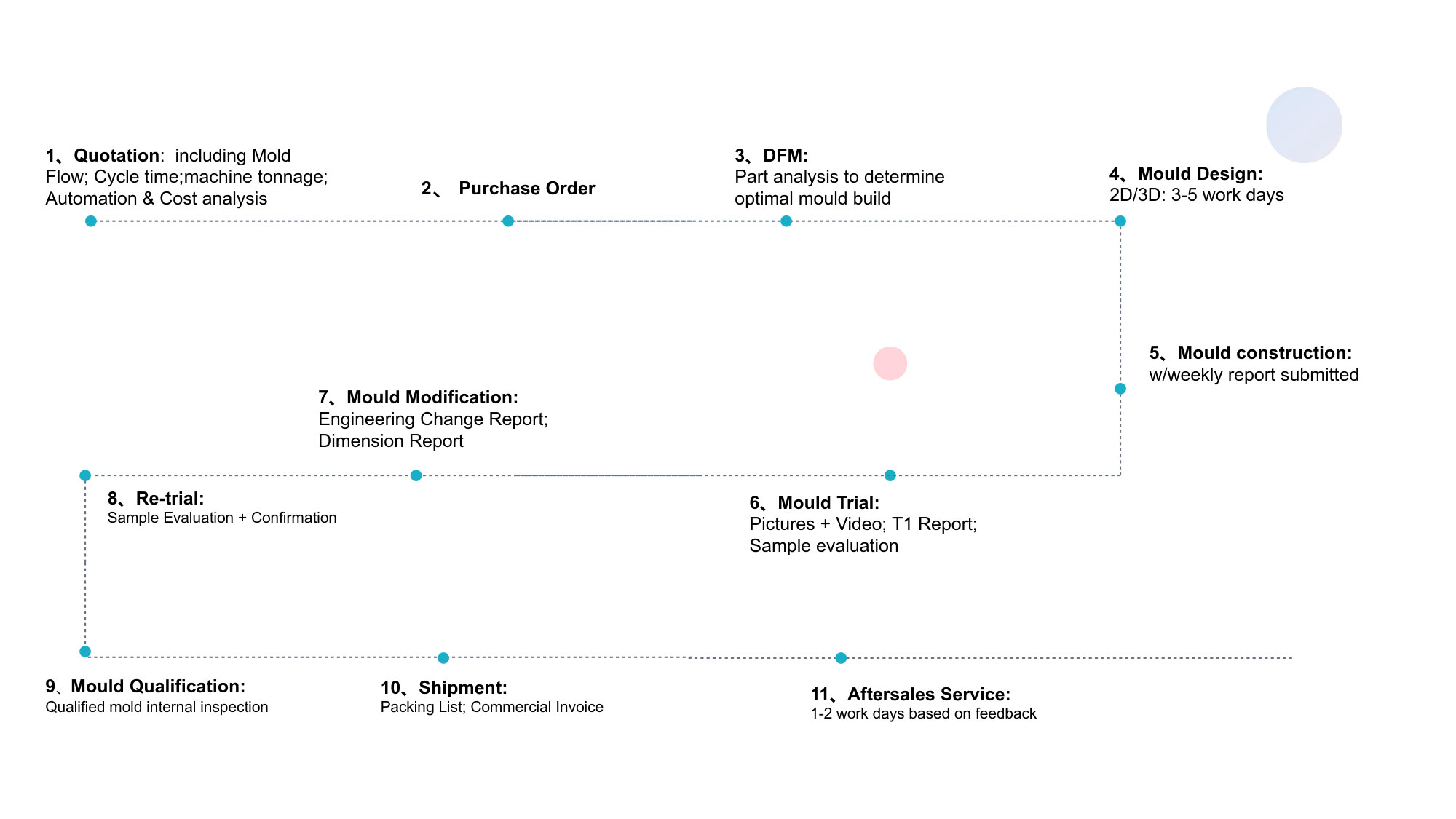
Section 4: Full-Service Process Management — Reducing Customer Administrative Costs
Many factories overlook the value of pre-production engineering support and post-delivery service. Ansix Tech makes these services a standard part of every project.
4.1 Early Design for Manufacturing (DFM) Intervention
Commitment: Ansix Tech provides a comprehensive DFM Feasibility Analysis Report before any mold manufacturing contract is signed.
Report Contents:
Draft angle recommendations (minimum 0.5° for preform surfaces, 1° for textured areas)
Wall thickness optimization (uniform thickness eliminates sink marks and warpage)
Gate location suggestions with support from mold flow analysis
Ejector pin mark location planning to position marks in non-cosmetic areas
Shrinkage compensation calculations based on selected PET/PETG resin grade
Weld line and air trap predictions (risk assessment and mitigation strategy)
Cooling system design proposal (optimizing cycle time without compromising quality)
Customer Value Delivered: *DFM intervention before mold manufacturing begins prevents costly downstream design changes. Customers avoid discovering structural infeasibility after molds are already cut — saving 3-6 weeks of project delay and 5,000−20,000 in rework costs.*
4.2 Trial Sampling and Iterative Improvement
T0 (First Trial): First molded samples using prototype or soft tooling (if applicable). Ansix Tech measures all critical dimensions, inspects cosmetic quality, and identifies processing challenges. Customer receives sample parts and initial inspection report.
T1 (Optimization Trial): After initial design adjustments, second trial produces samples with optimized parameters. Wall thickness distribution, gate vestige quality, and dimensional accuracy verified against specifications.
T2 (Validation Trial): Third trial verifies all customer requirements are met. Comprehensive CPK analysis performed on key dimensions. Process window characterized (pressure/temperature sensitivity documented).
T3 (Production Validation): Optional fourth trial for complex applications requiring additional verification.
At each stage, Ansix Tech provides full inspection reports, process parameter logs, and improvement documentation enabling customers to track progress and make informed decisions.
Customer Value Delivered: *Each trial iteration reduces production risks through systematic, documented improvement. Rapid changeover capability enables testing of multiple design variations without building entirely new molds — reducing trial costs by 40-60%.*
4.3 Low-Volume Pilot Production
Before committing to full mass production, Ansix Tech offers 100-500 cycle pilot production runs. Pilot runs confirm:
Stable yield rate (first-pass yield typically 95-98%)
CPK performance on all critical dimensions
Process repeatability across multiple production shifts
Cycle time validation against targets
Material efficiency (sprues/runners/regrind ratio)
Pilot production parts are fully inspected, with measurement data provided to customers for statistical analysis. Only after pilot run results meet customer specifications does Ansix Tech proceed to mass production.
Customer Value Delivered: *Pilot production eliminates the risk of ordering 100,000+ parts before process capability is verified. Customers confirm performance metrics before volume commitments, reducing financial exposure by 80%+. If issues arise during pilot, correction costs are 5-10x lower than after full production launch.*
4.4 Maintenance, Spare Parts, and Long-Term Support
Delivered with Every Mold:
Complete set of spare wear parts (ejector pins (1.5x requirement), spare core pins, spare cavity inserts, gate inserts)
Comprehensive maintenance manual (lubrication schedule, cleaning procedure, inspection interval guidelines)
CAD data package for future modifications (3D model, 2D drawings with dimensions, heat treatment specs)
Material certifications and hardness test reports for all mold components
Maintenance Service Program:
Scheduled maintenance: Every 200,000 cycles — Ansix Tech performs professional mold cleaning, lubrication inspection, wear assessment, and minor repairs
Cost structure: Lifetime maintenance billed at cost (parts + labor) — no profit markup
Emergency repair: In-house electrode machining and EDM capabilities enable most repairs within 24-48 hours without outsourcing
Customer Value Delivered: *Eliminates the cost of maintaining spare parts inventory — customers receive all necessary spares upfront. Mold refurbishment at cost pricing reduces long-term operating expenses by 50%+. Emergency repairs completed in 24-48 hours instead of 7-14 days — minimizing production downtime.*
Section 5: Differentiated Commitment — Addressing Common Industry Pain Points
Instead of making generic claims, Ansix Tech directly addresses the most frequent customer complaints about injection mold suppliers with specific, verifiable commitments.
Pain Point #1: Premature Mold Failure Disrupting Orders
Customer Complaint: "The mold keeps breaking down after only 100,000 cycles. Every failure costs us production time and emergency repair fees."
Ansix Tech Response: Every mold undergoes a 2,000-cycle aging test before delivery under production conditions equivalent to customer operations. Accelerated testing reveals wear patterns and potential failure points before the mold leaves our facility. Ansix Tech provides a documented wear report measuring all critical surfaces before and after testing. Three-year mold structure warranty covering non-wear components (cavity plates, core plates, mold base, guiding systems). If the mold fails due to manufacturing defect within three years of normal use (≤500,000 cycles/year), Ansix Tech repairs or replaces at no cost.
Pain Point #2: Excessive Flash Requiring Expensive Secondary Trimming
Customer Complaint: "Every production run requires hours of hand-trimming flash from preforms. The labor cost alone erases our profit margin."
Ansix Tech Response: Ansix Tech achieves 0.005mm parting line fit accuracy through precision grinding and matched mold components. Our molds utilize self-locking clamp force compensation mechanisms that automatically adjust for thermal expansion during production. Guaranteed flash height ≤ 0.03mm per batch — compared to industry average of 0.15-0.20mm. This eliminates the need for manual flash removal on 95%+ of parts. Eliminating trimming reduces direct labor cost by
0.01
−
0.01−0.03 per part, eliminates trimming equipment capital expense (5,000−15,000), and reduces quality inspection time by 30-40%.
Pain Point #3: Unstable Dimensional Consistency Between Batches
Customer Complaint: "Every batch of preforms has different dimensions. We spend hours adjusting filling lines every time we change batches."
Ansix Tech Response: All injection machines are equipped with real-time ultrasonic wall thickness monitoring sensors that feed back to machine controllers. Automatic compensation algorithms adjust packing pressure during each shot to maintain dimensional stability. In-mold pressure sensors provide closed-loop control — machine automatically corrects for melt viscosity changes. Process parameters locked in MES with engineer-only access — no unauthorized changes between shifts or batches. Same machine, same parameters, same operators, same inspection protocols — guaranteed batch-to-batch dimension variation within ±0.02mm for all critical features. Filling line adjustment time reduced from 2-3 hours per batch changeover to 15-30 minutes.
Pain Point #4: Long Mold Repair Cycles
Customer Complaint: *"When the mold needs repair, the supplier takes 2-3 weeks to send it back. That's 2-3 weeks of lost production."*
Ansix Tech Response: Ansix Tech maintains in-house electrode machining center and EDM workshop enabling most repairs without outsourcing. Typical repair times: 24 hours — simple repairs (electrode touch-up, minor polishing, gate insert replacement). 48 hours — moderate repairs (core pin replacement, cavity spot repair, minor weld/build-up). 72 hours+ — major repairs (complete cavity replacement, crack repair, structural modification). Most repairs completed without returning mold to Ansix Tech — we provide replacement components and documentation for local repair. Backup inventory of common wear parts held in regional warehouses.
Pain Point #5: Poor Communication During Project Development
Customer Complaint: "I never know where my mold project stands until it's late or over budget."
Ansix Tech Response: Weekly project status reports emailed every Friday with: completed tasks for the week, current project status vs. planned schedule (color-coded: green/yellow/red), next week's planned activities, any risk items or requested customer decisions (with recommended response by date). Dedicated project engineer assigned to each mold project — one point of contact for all communications. Monthly project review meetings (or as-needed frequency) with customer representatives. All DFM reports, trial reports, inspection data, and communications archived and accessible through customer portal.
Pain Point #6: Material Selection Confusion and Risk
Customer Complaint: "Different suppliers recommend different materials. I don't know which one is right for my application."
Ansix Tech Response: Material selection matrix based on 28+ years of experience covering all common preform applications. Testing verification available: mechanical testing (tensile strength, impact resistance, burst pressure), chemical resistance testing (acid, base, solvent, oil exposure), thermal testing (hot-fill performance, freeze-thaw cycling). Ansix Tech provides sample preforms for customer testing before volume production commitment. Material experts advise on IV (intrinsic viscosity) for PET preforms to ensure blow moldability: low IV (0.72-0.74) for standard still water, medium IV (0.78-0.82) for carbonated beverage, high IV (0.84+) for hot-fill applications. Detailed material selection guide included with every DFM report.
Section 6: Ansix Tech 59mm Neck Preform Project Management Framework
6.1 Phase 1: Project Initiation and Requirements Definition
Activities:
Customer requirements documentation (volume projections: annual, monthly, daily)
Target preform specifications (neck finish details, weight target, blow ratio requirements)
Quality standards definition (cosmetic requirements, dimensional tolerance, material certification)
Timeline and budget agreement
Material selection (PET grade, IV target, colorant requirement; or PETG grade with CHDM content)
Regulatory compliance review (FDA, EU, local food contact regulations)
Deliverables: Signed project charter, technical specification document, timeline Gantt chart, cost breakdown, material data sheet with certifications
6.2 Phase 2: DFM and Mold Design
Activities:
CAD mold design (3D model, 2D drawings, BOM)
Mold flow analysis (filling pattern, weld line prediction, air trap detection, shrinkage analysis, cooling analysis)
DFM report generation (including all recommendations and risk assessments)
Customer DFM review and approval
Cooling system design optimization (conformal cooling or conventional channel layout)
Gate location and runner design (valve-gated hot runner or cold runner with sprue bushing)
Ejector system design (pin quantity, pattern, stroke length)
Key Technical Considerations for 59mm Neck Preforms:
Large diameter neck requires careful melt flow control to prevent knit lines at thread start
Consistent wall thickness distribution critical for uniform blow expansion
Gate placement (typically bottom gate for single-serve, side gate for multi-cavity)
Cooling channel layout must accommodate 59mm wide cavity spacing
Neck thread finish precision requires ±0.01mm dimensional control
Deliverables: Final mold CAD model, detailed DFM report with all recommendations implemented, customer approval signature
6.3 Phase 3: Mold Manufacturing
Activities:
Raw material procurement and certification
Rough machining (mold base, cavity, core blanks)
Heat treatment as required (hardening, tempering, nitriding)
Finish machining (CNC milling, precision grinding, EDM)
Component inspection (CMM dimensional check)
Surface finishing (polishing to specified Ra)
Mold assembly (component fitting, clearance verification)
Cooling system pressure test
Quality Gates:
Gate 1: All raw materials certified and inspected before use
Gate 2: Rough machining completed, stock allowance verified
Gate 3: Heat treatment hardness confirmed within specification
Gate 4: Finish machining dimensional inspection ≥95% of features in tolerance
Gate 5: Surface finish meets specification for all cosmetic surfaces
Gate 6: Assembly completes with no binding, proper shut-off
Typical Manufacturing Timeline (48-cavity 59mm neck preform mold):
Weeks 1-2: Material procurement, rough machining, heat treatment
Weeks 3-4: Finish machining, EDM, grinding
Week 5: Polishing, assembly, cooling system test
Week 6: Mold trial and customer sample submission
Deliverables: Completed assembled mold, first-article inspection report, hardness test records, cooling system pressure test report
6.4 Phase 4: Mold Trial and Sample Qualification
Activities:
Mold installation on designated injection machine
Initial parameter setup (melt temperature profile, injection profile, packing profile, cooling profile)
T0 sample production (first shots)
Sample inspection (dimensional: all features measured; cosmetic: surface quality assessment; functional: cap fit test, gate vestige height measurement)
Parameter optimization based on inspection findings
T1-T2 samples with refined parameters
CPK calculation for critical dimensions (target ≥1.33)
Customer sample submission and approval
Trial Report Includes:
Full dimensional inspection data table (all features with tolerances)
Process parameter sheet (recorded for traceability)
Cosmetic inspection photos (20+ part views)
Cap fit verification results
Gate vestige height distribution across all cavities
Wall thickness variation measurements
CPK data for customer-specified critical dimensions
Customer Value Delivered: *Full transparency throughout trial process — customers see actual data, not just "pass/fail" declarations. CPK ≥1.33 guarantees 99.5%+ of production will meet specifications. Parameter optimization documentation enables customers to set up their own production consistently.*
6.5 Phase 5: Mass Production Qualification
Activities:
Pilot production run (500-2000 shots)
Production stability verification (consecutive shots within specification)
Operator training on mold setup and operation
Preventive maintenance schedule development
Spare parts inventory transfer to customer
Final mold acceptance documentation
Deliverables: Pilot production inspection report, operator training certificate, preventive maintenance schedule document, spare parts inventory list, final acceptance certificate signed by customer
6.6 Phase 6: Ongoing Production Support
Activities:
Production monitoring and technical support
Preventive maintenance scheduling and execution
Quality data trending and continuous improvement
Process optimization and cycle time reduction initiatives
Emergency repair response
Regular customer review meetings (quarterly)
Performance Metrics Tracked:
Overall Equipment Effectiveness (OEE) target: ≥85%
First-pass yield target: ≥98%
Process CPK maintenance: ≥1.0 minimum
Maintenance cost as % of revenue: ≤3%
On-time delivery performance: ≥99%
Section 7: How Ansix Tech Reduces Customer Costs
7.1 Material Cost Reduction
How: Thin-wall design optimization reduces material consumption per preform without compromising structural integrity. Ansix Tech's design team analyzes wall thickness distribution to identify material reduction opportunities — typically achieving 5-15% weight reduction compared to standard designs. High-volume purchasing (resin purchased in container quantities) passes lower per-unit material cost to customers. PET regrind management system captures and processes up to 95% of runner/spruce waste for re-use in non-critical applications.
Typical Savings:
0.02−0.10 per preform depending on weight and volume. For a 25g preform, 10% weight reduction = 2.5g material savings × annual volume of 5 million units = 12,500kg of resin saved annually 1.20/kg=15,000 per year.
7.2 Processing Cost Reduction
How: Cycle time optimization reduces machine seconds per part — more parts per hour, lower cost per part. Ansix Tech achieves 8-14 second cycles for 59mm neck preforms vs. industry average of 12-18 seconds — a 20-33% productivity advantage. All-electric servo machines consume 30-50% less energy than hydraulic machines, directly reducing utility costs per part. Multi-cavity molds (48, 72, 96 cavities) amortize fixed costs across more parts per cycle — 96-cavity mold produces 2x the parts per hour of 48-cavity mold with the same labor and facility overhead. Hot runner systems eliminate runner material waste (5-15% savings) and eliminate runner trimming labor.
Typical Savings: 20% cycle time reduction = 20% more parts per machine-day. For a 48-cavity mold running 14-second cycles (3,085 shots/day), 20% faster cycle (11.2 seconds) yields 3,857 shots/day — 772 additional shots daily × 365 days = 281,780 additional parts annually without additional machine investment.
7.3 Quality and Scrap Reduction
How: MES-controlled processes maintain consistent quality, reducing scrap rate from typical 3-5% to ≤1% for qualified production. Real-time process monitoring catches drift early, preventing large batches of scrap. In-mold sensors provide closed-loop control, automatically compensating for material variations. Pilot production qualification identifies issues before mass production ramp-up. CPK ≥1.33 guarantees 99.5%+ dimensional conformance, eliminating assembly-line adjustments.
Typical Savings: Reducing scrap from 3% to 1% on 5 million annual parts = 100,000 fewer scrapped parts annually × 0.10each=10,000 per year + avoided disposal costs.
7.4 Logistics and Inventory Cost Reduction
How: Preforms ship in compact stacks (200-300 preforms per box vs. 50-100 bottles in same space), reducing shipping weight and volume by 75%+ compared to finished containers. Customers fill bottles locally near packaging line — reducing transportation from preform manufacturing site to filling facility. Just-in-time production scheduling reduces customer inventory holding costs. Regional production bases (China + Vietnam) provide reduced shipping distances to Southeast Asian and global markets.
Typical Savings: Shipping cost reduction of 50-70% compared to shipping finished bottles. Inventory holding cost reduction of 0.01−0.03 per preform through JIT scheduling.
7.5 Tooling and Maintenance Cost Reduction
How: S136 stainless steel molds achieve 1 million cycle minimum before major repair — 2-3x longer life than lower-grade tooling. Spare wear parts included with mold delivery eliminates separate spare parts purchase cost and lead time. Lifetime maintenance at cost pricing (no profit markup) reduces long-term operating expense. In-house repair capability within 24-48 hours minimizes production downtime compared to 2-3 weeks typical of outsourced repairs.
Typical Savings: Extended mold life reduces tooling amortization cost by 50-67%. Maintenance at cost reduces repair expenses by 50%+ compared to standard service contracts. Downtime reduction of 10+ days per year = avoided lost production value of 5,000−15,000 annually (depending on production volume).
7.6 Total Cost Impact Summary
For a typical 59mm neck preform project producing 10 million units annually:
Cost Category Industry Average Ansix Tech Annual Savings
Material (25g × $1.20/kg) $300,000 $270,000 (10% reduction) $30,000
Processing (cycle, energy) $150,000 $105,000 (30% reduction) $45,000
Quality/scrap $15,000 (3% scrap) $5,000 (1% scrap) $10,000
Tooling amortization $20,000 (5-year life) $10,000 (10-year life) $10,000
Maintenance $15,000 $7,500 $7,500
Logistics/inventory $25,000 $12,500 $12,500
TOTAL COST $525,000 $410,000 $115,000 (22% reduction)
These figures represent typical savings based on industry benchmarks and Ansix Tech performance metrics. Actual savings vary by project specifications and volumes.
Section 8: Conclusion — Why Ansix Tech Is Your Partner for 59mm Neck Food-Grade PET & PETG Preforms
For Ansix Tech, molds are not just steel components — they are profit-generating assets for our customers. When we design a mold, we simultaneously plan:
Processing stability — ensuring consistent quality and low scrap rates
Venting pathways — preventing burn marks and incomplete filling
Temperature balance — minimizing cycle time without compromising dimensional stability
Maintenance access — enabling quick repairs and component replacement
The result is a mold that arrives at your production line pre-validated, ready for production, and delivering low flash, high consistency, and extended lifespan.
Key Performance Commitments Summary:
Metric Ansix Tech Commitment
Minimum mold life 1,000,000 cycles (S136 steel)
Achievable tolerance ±0.005mm (precision features)
Flash height ≤0.03mm (eliminates manual trimming)
CPK guarantee ≥1.33 on critical dimensions
Cycle time 8-14 seconds for 59mm neck preforms
Delivery lead time 10-45 days (depending on complexity)
Warranty 3 years structural warranty
Repair response 24-48 hours for most repairs
Value for Customers:
Lower costs: 22% total cost reduction potential through material optimization, cycle efficiency, scrap reduction, extended tool life, and favorable logistics
Reduced risks: 2,000-cycle validation eliminates mold failure risk; DFM analysis prevents late-stage design changes; CPK≥1.33 guarantees quality stability
Faster time-to-market: Rapid lead times (as low as 20 days for rush orders), comprehensive trials, and pilot production ensure smooth launch
Long-term partnership: Lifetime maintenance at cost, spare parts included, dedicated project engineer, and 28+ years of manufacturing experience
Ansix Tech invites you to experience the difference of a partner who understands that mold is not just a piece of steel — it's a precision-engineered profit tool. We would be pleased to conduct a comprehensive DFM review of your current or planned 59mm neck preform project, demonstrating precisely how we would eliminate weld line formation, air trap issues, and shrinkage risks before a single shot is ever molded.
*Founded in 1998, Ansix Tech has grown to four production bases across China and Vietnam, with over 1,200 employees and annual turnover exceeding 1 billion RMB. Our 260 injection molding machines (30-2,800 tons), ISO9001/IATF16949/ISO13485/ISO14001/BSCI certifications, and 28+ years of experience position us as a trusted global manufacturing partner for food-grade PET and PETG preform applications.
Ansix Tech Co Ltd
If you have any plans related to 59mm Neck food-grade PET plastic preform, PETG plastic can preform , you can contact us at any time. We will turn your ideas into reality, let you realize your dreams, and obtain large orders from the market. Our contact information is info@ansixtech.com. Or contact our CTO, mail: stephen@ansixtech.com
#www.ansixtech.com #ansixtech.com #59mm Neck food-grade PET plastic preform, PETG plastic can preform #59mm Neck food-grade PET plastic preform, PETG plastic can preform #59mm Neck food-grade PET plastic preform, PETG plastic can preforminjection molding companies #59mm Neck food-grade PET plastic preform, PETG plastic can preform Canopy Mold injection mold companies #Ansix #Ansix moulds #Ansix china #Ansix tech china #Ansix tech company #Ansix facotry #59mm Neck food-grade PET plastic preform, PETG plastic can preforminjection molding #59mm Neck food-grade PET plastic preform, PETG plastic can preforminjection tools #59mm Neck food-grade PET plastic preform, PETG plastic can preforminjection moulds #59mm Neck food-grade PET plastic preform, PETG plastic can preformplastic mould #59mm Neck food-grade PET plastic preform, PETG plastic can preformplastic tools #Ansix Tech #Ansix molds #Ansix injection molding #Ansix mold factory #injection molding 59mm Neck food-grade PET plastic preform, PETG plastic can preform #Ansix mold factory #59mm Neck food-grade PET plastic preform, PETG plastic can preformchina #59mm Neck food-grade PET plastic preform, PETG plastic can preformmolds #injection factory #59mm Neck food-grade PET plastic preform, PETG plastic can preforminjection molding #59mm Neck food-grade PET plastic preform, PETG plastic can preforminjection molding factory #injection molding company #59mm Neck food-grade PET plastic preform, PETG plastic can preforminjection mold companies #50mm Neck Edible Oil Bottle Preform (100ml250ml) Transparent PET Plastic Oil Bottle Preform#59mm Neck food-grade PET plastic preform, PETG plastic can preformmold limited #Ansix mold china #Ansix companies #Ansix company China #59mm Neck food-grade PET plastic preform, PETG plastic can preformfacotry #Ansix Tech #Ansix Tech mould #59mm Neck food-grade PET plastic preform, PETG plastic can preforminjection moulding #injection moulding company #Ansix 59mm Neck food-grade PET plastic preform, PETG plastic can preformparts injection mold companies #medical injection molding companieschina #59mm Neck food-grade PET plastic preform, PETG plastic can preformchina factory #Ansix moulding companies #Ansix molding company #59mm Neck food-grade PET plastic preform, PETG plastic can preforminjection moulding facotry #Ansix Tech mold #59mm Neck food-grade PET plastic preform, PETG plastic can preformmould #59mm Neck food-grade PET plastic preform, PETG plastic can preformplastic injection molding #ansix plastic mold #Mold manufacturing #59mm Neck food-grade PET plastic preform, PETG plastic can preformparts manufacturing #59mm Neck food-grade PET plastic preform, PETG plastic can preformplastic parts factory #59mm Neck food-grade PET plastic preform, PETG plastic can preforminjection parts mold #59mm Neck food-grade PET plastic preform, PETG plastic can preformPRECISION MANUFACTURING #59mm Neck food-grade PET plastic preform, PETG plastic can preform#China mold #59mm Neck food-grade PET plastic preform, PETG plastic can preforminjection moulding china #59mm Neck food-grade PET plastic preform, PETG plastic can preformmould china #china precision mold #mold in china #59mm Neck food-grade PET plastic preform, PETG plastic can preformmold china #Precision molds #High-precision molds #59mm Neck food-grade PET plastic preform, PETG plastic can preform#Injection molds #59mm Neck food-grade PET plastic preform, PETG plastic can preformFactory #59mm Neck food-grade PET plastic preform, PETG plastic can preformCompany #Super Large Injection Mold Factory #Large Tonnage Injection Molding Factory #59mm Neck food-grade PET plastic preform, PETG plastic can preformCompany #59mm Neck food-grade PET plastic preform, PETG plastic can preformFactory #2800T Injection Molding Factory #3000 Ton Injection Molding #4500 Ton Injection Molding Factory #Large Mold Injection Molding #Large Plastic Mold Injection Molding Factory #Large Injection Mold Manufacturer #Plastic Mold Factory #Injection Mold #Plastic Mold