



15-tooth transparent plastic bottle preform, 4g6g cosmetic packaging preform tube, PET small weight thick-bottom bottle preform
FEATURES
PET Small Weight Thick-Bottom Bottle Preform
The thick-bottom design enhances drop impact resistance and provides the stability necessary for base cup assemblies. Despite the small overall weight, the bottom area retains additional material thickness to prevent stress cracking and improve standing stability on filling lines.
Manufacturing Process
PET preform manufacturing demands rigorous control at every stage. The process begins with material preparation: PET resin is dried in a dehumidifying dryer at approximately 170°C for 4 to 6 hours to reduce moisture content below 50 ppm, preventing hydrolysis and bubble formation during injection. The dried granules are then fed into an injection molding machine where they are melted to 270–290°C. Because PET has strong moisture absorption properties, thorough drying is essential; insufficient drying can result in splay marks, reduced molecular weight, and compromised mechanical properties.
-
Mold Description
Product Materials:
PET PETG
Mold Material:
S136ESR
Number of Cavities:
1*8
Glue Feeding Method:
Hot runner
Cooling Method:
Water cooling
Molding Cycle
12.5s
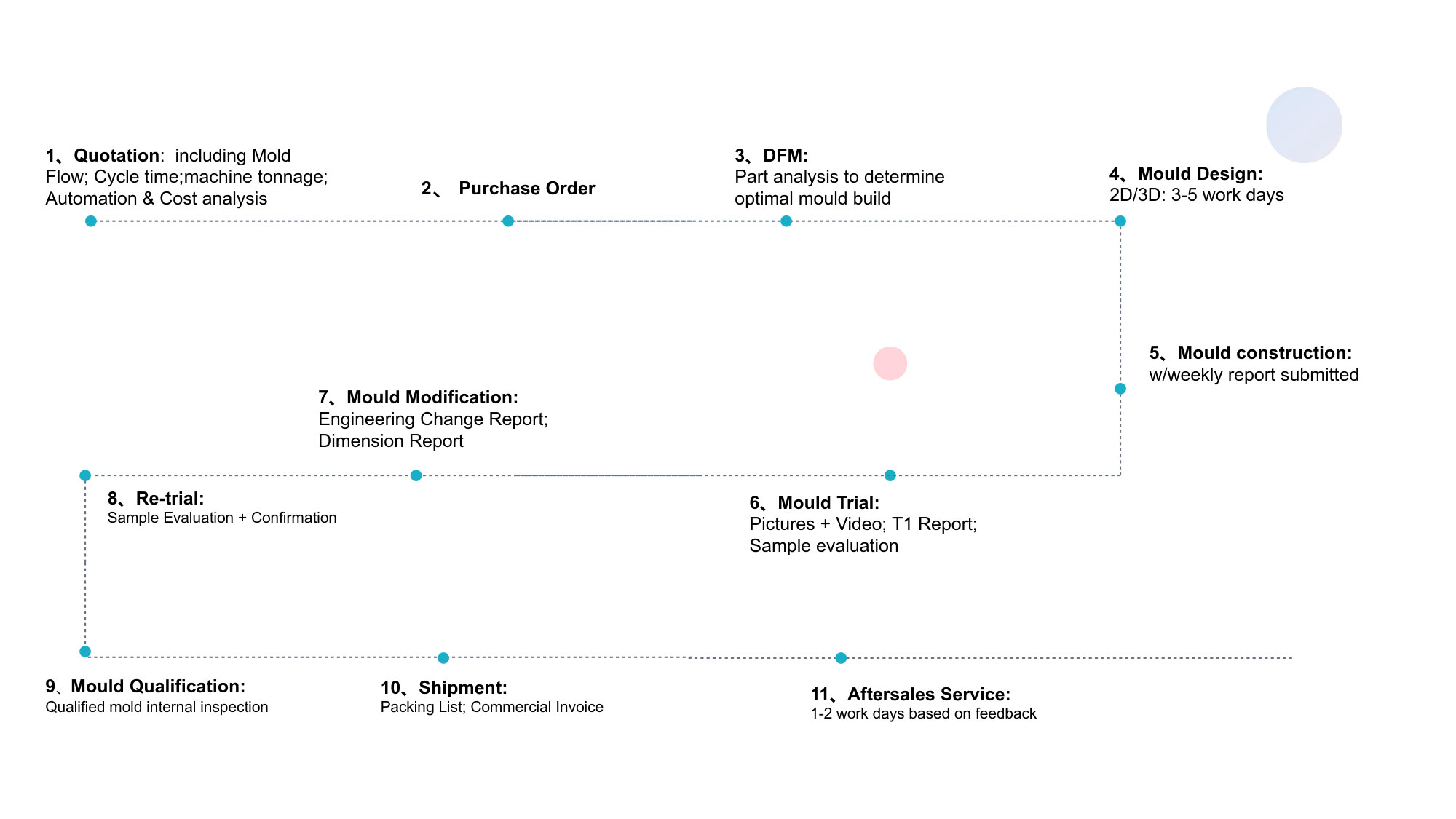
- The mold manufacturing process and product material selection
The molten PET is injected at high pressure into a precision steel mold, typically featuring multiple cavities. A hot runner system maintains uniform melt temperature throughout the injection pathway, preventing premature solidification and ensuring all cavities fill simultaneously. Inside the mold, a conformal cooling system rapidly reduces the temperature, solidifying the molten PET into the final preform shape. The mold clamping pressure and cooling parameters are precisely controlled to avoid defects such as crystallization, internal stress, and dimensional variation.
For the 4g/6g preform tubes, special attention is given to wall thickness uniformity and gate vestige control. The small shot weight requires ultra-precise injection volume control, typically achieved with servo-electric injection units capable of positioning accuracy within ±0.01 mm.
Delivery Efficiency
Ansix Tech maintains a lean manufacturing ecosystem that prioritizes rapid turnaround. Our standard lead times are structured to meet diverse customer demands:
-
Product Type Standard Lead Time Rush Option
15-Tooth Preform 25–45 days 20 days
4g/6g Tube Preform 25–40 days 18 days
Small Weight Thick-Bottom Preform 20–35 days 15 days
For high-volume customers, we offer dedicated mold sets and reserved production capacity that reduces per-batch lead times to as low as 5–7 days from order confirmation. Our MES-integrated scheduling system tracks every active job in real time, providing customers with transparent visibility into order status, estimated completion dates, and shipping milestones.
Quality Assurance
Quality assurance at Ansix Tech is built on three pillars: material certification, in-process monitoring, and final inspection. All incoming PET resin batches are verified against specified intrinsic viscosity (IV) targets and acetaldehyde (AA) content limits. Typical IV values range from 0.74 to 0.84 dL/g depending on application requirements, while AA content is maintained below 1.0 ppm to prevent taste and odor transfer in beverage applications.
During production, each injection molding machine is equipped with cavity pressure sensors and real-time process monitoring. Critical parameters including melt temperature, injection pressure, holding pressure, and cooling time are locked in MES, accessible only to authorized engineers. Every batch undergoes first-article inspection before production release, and random sampling is performed at predetermined intervals for dimensional verification using CMM and optical inspection systems.
Final inspection includes:
Visual examination for bubbles, flow marks, and silver streaks
Dimensional measurement of neck finish, body diameter, and wall thickness
Weight verification to ensure ±0.5% tolerance
Transparency testing using haze meters
Gate vestige inspection
All inspection records are retained for traceability, and full dimensional reports are provided upon request.
Cost Control
Our cost competitiveness stems from multiple strategic advantages. We leverage economies of scale in material procurement, securing PET resin pricing that is consistently 8–12% below spot market rates. Cycle time optimization, achieved through conformal cooling channel design and advanced process control, reduces per-part production time by 15–20%. Energy efficiency programs, including servo-driven injection units and waste heat recovery systems, lower utility costs by approximately 25%. Our vertical integration approach—designing, machining, assembling, and molding in-house—eliminates outsourced service markups and reduces quality variability. We also maintain a comprehensive regrind management system that reclaims up to 98% of runner and reject material, subject to customer approval on regrind usage limits.
Part 2: Mold Manufacturing, Material Selection, Smart Manufacturing Integration, and Customer Core Value
Mold Manufacturing Capabilities
Our mold manufacturing facility is equipped with five-axis high-speed machining centers capable of achieving complex surface precision to 0.002 mm. This ensures that critical features such as the 15-tooth geometry and neck thread profiles are produced with zero draft interference and smooth part lines free of burrs. We also operate slow wire EDM machines for creating fine micro-features as small as 0.03 mm diameter narrow slots, which is essential for thin-wall preform cooling channels and venting grooves.
Our injection molding machine fleet covers clamping forces from 30 tons to 4,000 tons, accommodating product ranges from the smallest 4g cosmetic preforms up to large thick-bottom bottles. All machines are equipped with all-servo electric drives, delivering stable repeatability precision of ±0.1%, ensuring that every cycle produces parts identical to the qualification sample.
Every mold undergoes full dimensional inspection on CMM equipment before shipment. Key dimensions are tracked with CpK ≥ 1.33, providing statistical proof of process capability. Full inspection reports accompany each mold delivery.
Mold Material Selection
We categorize mold material selection based on component function and production volume:
Component Recommended Materials Selection Criteria
Mold Base (Plates) P20 (pre-hardened) Stability against deformation, cost-effectiveness
Cavity/Core (High-wear) S136, 8407, 2344, DC53 Corrosion resistance for transparent parts, high hardness
Neck Ring/Thread Area SKD61, SKD11, H13 Wear resistance for high-cycle threading operations
High-gloss/Transparent S136H, NAK80, M340, 9Cr18 Mirror polishability (Ra < 0.01 μm), corrosion resistance
Hot Runner Components HPM38, Böhler M300/M310 (16% Cr) High-temperature stability, minimal thermal expansion
Slides/Cores 2343, 4Cr13 Toughness with good wear properties
For the 15-tooth transparent preform, we specify mirror-grade stainless steel with hardness of HRC 48–52 in the cavity area to achieve optical clarity and prevent surface defects. The core pins are made from pre-hardened NAK80 for improved thermal conductivity and faster cooling cycles.
Injection Molding Material Selection
For PET resin selection, the key parameter is intrinsic viscosity (IV). For standard beverage-grade preforms with IV between 0.74–0.78 dL/g, we recommend grades such as Relpet H7761. For thick-wall applications requiring optimal transparency, we select slow-crystallizing resins such as RAMAPET P184 with IV of 0.84. For high-transparency cosmetic containers requiring FDA compliance, we specify Polyclear Plus PET 1111, which provides low acetaldehyde levels while retaining high IV.
PET material selection must also consider final application requirements:
Hot-fill applications: High-crystallinity PET grades with IV 0.80–0.84
Carbonated soft drinks: IV 0.78–0.82 for pressure resistance
Cosmetic packaging: IV 0.80–0.84 with enhanced optical properties
Thick-wall preforms: Copolymer PET grades with IV > 0.85 for slow crystallization
General-purpose lightweight: IV 0.74–0.78 for cost-optimized production
Alternative materials include PETG for chemical resistance applications, PCTA for enhanced clarity, and recycled PET (rPET) with controlled percentages (typically ≤25% of total material input). Each material selection is documented with full material certification and test reports confirming compliance with applicable regulatory standards.
Smart Manufacturing Integration and Efficiency Improvement
Ansix Tech has fully embraced Industry 4.0 principles in our preform manufacturing operations. Our all-injection machines are connected through a centralized MES that records every process parameter for each shot. This enables real-time data visualization, automated alerting when parameters drift outside validated limits, and comprehensive traceability for every production batch. All molding parameters are locked in the system and cannot be modified without engineer authorization, eliminating operator-induced process variation.
We employ scientific molding methodologies based on cavity pressure monitoring to ensure consistent part quality across production runs. Cavity pressure sensors placed at gate and end-of-fill positions capture pressure signatures for each shot, enabling real-time detection of process drift and automatic adjustment of holding pressure to maintain weight consistency. When signals deviate beyond validated limits, the system automatically segregates non-conforming parts without human intervention.
Each of our mold sets is designed with temperature zone control integrated into the MES. Both core and cavity mold temperatures are maintained within ±1°C of setpoint using PID-controlled heating/cooling circuits. This level of thermal control reduces warpage and improves dimensional stability across multi-cavity tools.
Our digital twin system simulates mold performance before steel is cut, using Moldflow software to predict melt flow behavior, identify potential air traps or weld lines, and optimize gate and cooling channel design. This predictive capability eliminates the need for physical trial iterations and accelerates first-article qualification.
Process capability is validated using Design of Experiments (DOE) window mapping, establishing guard bands for temperature, pressure, and time variations that do not affect part quality. Each cavity is verified through CpK analysis with controlled sampling (n ≥ 30) and validated measurement systems (Gauge R&R < 10%). Tool transfers are pre-qualified, ensuring that same mold on any validated machine delivers identical parts. First-article inspection before production release, coupled with batch sampling at predetermined intervals for CMM/optical verification, provides comprehensive quality assurance. All inspection records are retained for audit purposes.
Quality Assurance That Solves Customer Pain Points
Customers consistently express five quality-related concerns. We have developed specific solutions for each:
Customer Concern Ansix Solution
Molds requiring frequent repairs, affecting order fulfillment 2,000-cycle aging test before mold delivery; full wear report provided; three-year structural warranty (excluding normal wear components)
Flash causing high post-processing costs 0.005 mm precision fit on parting lines; self-locking clamp force compensation; flash controlled under 0.03 mm, eliminating manual deburring
Inconsistent dimensions across production runs Ultrasonic wall thickness sensors with closed-loop packing pressure compensation; in-mold temperature/pressure sensors for real-time control
Long mold repair turnaround times In-house electrode manufacturing and EDM workshops; typical repair completed within 24 hours; emergency support available
Inadequate validation before high-volume production T0–T3 trial samples with corrective action reports; 100–500 shot pilot run before mass production; CpK and yield data provided
For transparent preform applications, we have implemented specific process controls to eliminate common optical defects. We maintain raw material batch consistency through melt index testing on each incoming batch, and process parameters are stabilized with intelligent temperature control systems. Exhaust grooves are set to depth not exceeding 0.03 mm to vent gases while preventing flash.
Part 3: Comprehensive Manufacturing Solution for Preform Projects
Executive Summary
In the highly competitive preform manufacturing industry, customers are no longer satisfied with suppliers who simply deliver molds and parts. They demand partners who understand their full production ecosystem—partners who can translate technical specifications into measurable business value, eliminate hidden costs, reduce operational risks, and enable faster time-to-market.
Ansix Tech, with over 28 years of specialized experience in preform mold manufacturing and injection molding, has developed a comprehensive solution framework for 15-tooth transparent PET preforms, 4g/6g cosmetic packaging preform tubes, and PET small weight thick-bottom bottle preforms. This white paper presents our manufacturing capabilities, the customer value we deliver, and the practical solutions we bring to the most persistent challenges facing preform manufacturers today.
Section 1: Hard Infrastructure That Builds Customer Trust
Mold Machining Equipment
Value Delivered: Precision you can see in every preform—reduced scrap, lower finishing costs, longer tool life.
Our mold manufacturing facility is equipped with five-axis high-speed machining centers from Germany and Japan capable of processing complex three-dimensional surfaces to ±0.002 mm accuracy. This precision directly translates to your production line: parting lines on your preform molds will be so smooth that flash is virtually eliminated, saving you thousands of dollars annually in manual trimming and downstream cleanup. Complex cavity geometries with undercuts and slides are machined in a single setup, eliminating alignment errors that typically cause dimensional drift across cavity sets.
We operate slow wire EDM equipment that can produce features as fine as 0.03 mm diameter narrow slots and precise cooling channel geometries. For thin-wall preform molds where cooling channel placement is critical to cycle time and part quality, this capability ensures uniform heat extraction. The result: your cycle times are minimized without compromising dimensional stability.
What this solves for you: When molds are machined with insufficient precision, you face downstream issues including inconsistent wall thickness across cavities, high scrap rates during process validation, and early mold wear that leads to premature replacement. Our equipment capability eliminates these concerns at the source.
Injection Molding Machine Fleet
Value Delivered: One machine setup works across your entire product portfolio—no surprises, no re-validation.
We maintain an injection molding machine fleet covering clamping forces from 30 tons to 4,000 tons. This range accommodates everything from 4g cosmetic preforms (requiring lower clamping forces) to large thick-bottom preforms for 5-gallon water bottles and industrial containers. Regardless of your product size, we have a machine optimized for its specific requirements.
All our injection machines are equipped with all-servo electric drives, delivering shot-to-shot repeatability precision of ±0.1%. When you produce 100,000 preforms, the 100,000th preform is dimensionally identical to the first. For customers requiring supplier-managed inventory or just-in-time delivery, this consistency eliminates the need for batch segregation or re-inspection of incoming material.
What this solves for you: Variation between production batches is one of the costliest hidden expenses in preform manufacturing. Inconsistent preforms cause inconsistent blow molding results, leading to downstream bottle failures, customer complaints, and brand damage. Our precision-controlled injection process eliminates batch-to-batch variability.
Inspection and Metrology Equipment
Value Delivered: Statistical proof that every mold we ship will perform to specification—no unpleasant surprises after installation.
Every mold we manufacture undergoes full dimensional inspection before leaving our facility. Our CMM equipment generates complete dimensional reports for every mold, with critical dimensions tracked against CpK ≥ 1.33. We do not ship molds that have not been fully validated. Optical inspection systems capture surface finish quality across all cavity surfaces, verifying that mirror-finish requirements for transparent preforms are met.
For our 15-tooth preform molds, the tooth geometry is inspected under magnification to verify form accuracy. For 4g/6g tube preforms, gate vestige height and finish are measured to ensure they will not interfere with subsequent stretch blow molding. For small weight thick-bottom preforms, bottom wall thickness is mapped to verify the gradient transitions smoothly from thick base to thin sidewall.
What this solves for you: The most expensive problem in preform manufacturing is discovering mold defects after installation on your injection machine. Lost production time, tooling rework costs, and delayed product launches can exceed the cost of the mold itself. Our pre-delivery verification transfers this risk from you to us.
Section 2: Mold Manufacturing Core Competencies—Performance Measured in Customer Language
Mold Life Expectancy
Customer Value: Fewer mold replacements, lower long-term tooling costs, predictable maintenance scheduling.
We do not guess about mold durability. Our mold life guarantees are backed by material certifications and over two decades of production data:
For glass-filled PET or other abrasive materials: Guaranteed 500,000 cycles minimum
For standard PET resin with ≤25% regrind: Guaranteed 1,000,000 cycles minimum
The foundation of this longevity is our material selection. For mold base plates, we specify pre-hardened P20 steel, which provides dimensional stability and resists deformation under high clamping pressures. For cavity and core components that contact molten plastic, we select from a portfolio of high-performance tool steels including:
Material Hardness Best Application
S136 (stainless, mirror grade) HRC 48–52 15-tooth transparent preforms requiring optical clarity
NAK80 (pre-hardened) HRC 38–42 Core pins requiring high thermal conductivity
8407/H13 HRC 48–52 High-wear neck ring and thread components
SKD61/DC53 HRC 55–60 Ejector pins and high-cycle moving components
2344/2316 HRC 45–50 Corrosive environments and food-contact applications
M340 (powder metallurgy) HRC 58–62 Extreme wear applications (25 million+ cycles)
Every steel shipment is accompanied by material certification and heat treatment records, ensuring traceability and consistency across production runs.
What this solves for you: Mold replacement is not just a capital expense—it creates production gaps, requalification costs, and inventory disruptions. By engineering molds for million-cycle life, we eliminate these recurring disruptions from your production schedule.
Achievable Tolerances
Customer Value: Parts that assemble correctly the first time, no shimming, no rework, no customer returns.
Our standard precision for structural components is ±0.05 mm. For critical features including neck finish dimensions, tooth geometry, and gate location, we hold ±0.005 mm. This means your blow molding tooling will accept our preforms without adjustment, and your filling lines will experience no jams or misfeeds.
What this solves for you: Poor dimensional accuracy creates a cascade of downstream problems: preforms that do not feed reliably into blow molding machines, blow-molded bottles with oval cross-sections or off-center necks, and containers that fail capping torque specifications. Our precision eliminates all these failure modes.
Mold Type Capabilities
Customer Value: One supplier who can handle any requirement—no sourcing fragmentation, no compatibility issues.
We design and manufacture all common mold configurations:
Hot runner molds: Standard for PET preforms, eliminates runner waste and reduces cycle time. Our hot runner systems feature independently controlled heating zones along the entire melt pathway for uniform temperature distribution.
Multi-cavity molds: Up to 96 cavities for high-volume production
Stack molds: Doubles output per machine cycle by using two mold faces
Two-shot/multi-material molds: For bi-injection and multi-layer applications requiring barrier layers or recycled content cores
High-gloss/optical molds: With polished surfaces reaching Ra < 0.01 μm for transparent preform applications
What this solves for you: Working with a single supplier for all mold requirements reduces your procurement complexity, eliminates compatibility issues between molds from different sources, and simplifies your spare parts inventory.
Gating and Runner Design Optimization
Customer Value: No weld lines, no air traps, no guesswork—just balanced filling across all cavities.
We do not guess at gate placement. Every mold design undergoes Moldflow analysis before any steel is cut. We use finite element simulation to:
Predict weld line locations and adjust gate positioning or processing conditions to eliminate them
Identify air trap locations and incorporate venting features before production
Optimize gate placement to achieve balanced filling across all cavities
Verify shear rate limits to prevent polymer degradation
This is particularly critical for the 15-tooth preform, where improper flow can cause uneven tooth filling and variable material distribution. For 4g/6g tube preforms, gate vestige control is essential for post-molding blow quality. For small weight thick-bottom preforms, flow simulation ensures that the transitional wall thickness does not create stress concentrations.
What this solves for you: Every mold that arrives without proper flow simulation carries the risk of requiring modifications after trial runs. Each modification means weeks of delay, thousands of dollars in rework, and lost production. Our upfront simulation eliminates this risk.
Mold Cooling System Design
Customer Value: Shorter cycle times, lower energy costs, more parts per hour from your existing machine capacity.
Cooling typically accounts for 60–70% of the total injection molding cycle time. Optimizing cooling is the single biggest opportunity for productivity improvement.
We design cooling systems with the following features:
Zone-specific temperature control: Independent circuits for neck, body, and bottom zones
Conformal cooling channels: Follows the contour of the preform rather than being limited to straight drilled holes, reducing cooling time by 20–40%
Temperature differential control: Core and cavity temperatures maintained within 2°C of each other to minimize warpage
High-flow water manifolds: Minimizes pressure drop and ensures consistent flow to all cavities
For high-cavitation molds (48–96 cavities), we incorporate balance flow dividers to ensure that every cavity receives the same coolant flow rate, eliminating cavity-to-cavity variation in cooling efficiency.
What this solves for you: Every second of cycle time reduction translates directly to increased output from your existing injection machine investment. If we reduce your cycle time from 12 seconds to 10 seconds on a 48-cavity mold running 24/7, you gain approximately 1.2 million additional preforms per year without buying new equipment.
Section 3: Injection Molding Process Control—Eliminating Quality Anxiety
Process Standardization and Parameter Locking
Customer Value: Every batch identical to the previous batch—no drift, no surprises, no re-qualification.
All our injection molding machines are connected to a centralized MES that records every process parameter for every shot. Temperature, pressure, speed, and time settings are locked within the system and cannot be changed without engineer authorization and documented change control. Each production batch starts with first-article inspection, and every batch ends with last-article verification.
What this solves for you: In traditional manufacturing, process drift across shifts or operators is a constant source of quality variation. Our locked parameter system eliminates this variation at its source.
Dimensional Stability Control
Customer Value: Preforms that blow mold consistently across millions of parts—no line stoppages, no rejected containers.
We implement multiple controls to ensure dimensional stability:
Mold temperature control: Core and cavity zones are independently heated/cooled using PID controllers that maintain setpoint within ±1°C. Both zones are kept within 2°C of each other to eliminate warpage-inducing thermal gradients.
Real-time wall thickness monitoring: Ultrasonic sensors mounted on the injection machine continuously monitor wall thickness during production, feeding back to the machine controller to adjust packing pressure automatically.
In-mold pressure and temperature sensing: Cavity pressure sensors placed at gate and end-of-fill positions provide real-time feedback for closed-loop process control. The system can automatically adjust holding pressure to compensate for material viscosity variation.
Performance data: For thick-bottom preform applications, our controlled process maintains wall thickness variation under 0.1 mm across 5,000 consecutive cycles. For 15-tooth preforms, tooth geometry variation is maintained under ±0.02 mm cavity-to-cavity.
What this solves for you: Dimensional variation is the leading cause of blow molding defects. Preforms with inconsistent wall thickness create bottles with uneven expansion—thin spots, blow-outs, and out-of-spec finish dimensions. Our dimensional control ensures your blow molding operation runs at full efficiency.
Surface Finish Standards
Customer Value: Crystal-clear preforms that showcase your brand—no haze, no flow marks, no blemishes.
We classify our surface finish capabilities across five grades:
Grade Ra Value Application
Standard as-machined < 1.6 μm Non-visible internal surfaces
Fine finish < 0.8 μm General purpose, molded-in labels
Polished < 0.4 μm Standard cosmetic packaging
High-polish < 0.1 μm Premium cosmetic and luxury packaging
Mirror finish < 0.01 μm Crystal-clear transparent preforms and optical applications
For our 15-tooth transparent preform, the cavity surface is polished to mirror finish (Ra < 0.01 μm), ensuring that the final preform exhibits maximum light transmission with no visible surface defects. For 4g/6g tube preforms used in lipstick and essence packaging, the finish is held to high-polish to maintain the premium aesthetic customers demand.
To prevent demolding difficulties that can scratch or deform finished parts, we incorporate specific design elements: demolding slopes (draft angles) of at least 0.5° on all vertical surfaces, hard chrome plating on cavity surfaces to improve release and reduce friction, and cooling to below the material glass transition temperature before ejection.
What this solves for you: In consumer packaging, appearance is not secondary—it is primary. Haze, flow marks, or surface defects send the wrong message about your brand quality. Our surface finish capability ensures your products present the premium image your brand requires.
Material Processing Capabilities
Customer Value: One supplier who can handle your full material portfolio—no new supplier qualification for every project.
Our material processing experience extends across the full range of engineering thermoplastics used in preform applications:
PET (all grades): Standard beverage grade, hot-fill grade, high-IV thick-wall grade
PETG: For chemical resistance and enhanced clarity applications
Recycled PET (rPET): Up to 50% post-consumer recycled content with controlled IV retention
Bio-based PET: Partially renewable content for sustainability-focused brands
Barrier materials: EVOH layers for multi-layer preforms with extended shelf life
For customers with specialized requirements, we have experience processing:
High-temperature materials: PEEK, PEI, PPS, LCP (for industrial or medical applications)
Glass-filled materials: PPS+40% GF, PA6+GF30 (for structural preforms)
High-clarity engineering resins: PC, PMMA, SAN
Liquid Silicone Rubber (LSR): For soft-touch overmolded features
What this solves for you: Supplier fragmentation drives procurement costs up and quality consistency down. When you have a new material requirement, working with an existing qualified supplier eliminates months of qualification time and reduces your vendor management overhead.
Section 4: Full-Service Support—Reducing Customer Management Costs
Design for Manufacturing (DFM) Early Engagement
Customer Value: Problems solved before they exist—not after steel is cut.
Before any steel is machined, we provide a comprehensive DFM report that analyzes your product design for manufacturability. This report includes:
Parting line location recommendations to minimize flash and simplify tool construction
Draft angle analysis to ensure reliable ejection without part damage
Wall thickness uniformity assessment to prevent sink marks and warpage
Gate location optimization to achieve balanced filling and minimize gate vestige visibility
Ejector pin placement to ensure part release without aesthetic compromises
Undercut evaluation with recommendations for slides or lifters
The DFM process typically requires 3–5 days from receipt of your product design and is provided at no cost before any order is placed.
What this solves for you: The single most expensive mistake in preform mold projects is discovering after mold construction that the product design cannot be manufactured. The cost of mold modification after machining is 10–100 times higher than design changes made before machining starts. Our DFM process transfers this risk from your P&L to our engineering process.
Trial Shots and Progressive Verification
Customer Value: No surprises at startup—we find and fix problems before you see them.
We provide progressive verification throughout the mold development process:
T0 (first shots): Initial molding trial immediately after mold completion. Samples provided with preliminary process settings and initial defect analysis.
T1 (first correction): After initial modifications, additional samples provided with corrective action documentation.
T2 (second correction): Final refinement before release.
T3 (qualified mold): Fully validated mold ready for production.
Between each trial, we provide detailed reports documenting changes made, defects addressed, and remaining issues requiring resolution. This transparent, iterative process means you never receive a mold that has not been fully tested and validated.
What this solves for you: Receiving an unvalidated mold and discovering problems only after installation on your production line creates unplanned downtime, expedited shipping costs for replacement components, and delayed product launches. Our progressive verification eliminates this risk.
Pilot Production Validation
Customer Value: Proof of production readiness—data, not promises.
Before releasing any mold for mass production, we perform a pilot production run of 100–500 shots. This pilot run is used to:
Establish baseline process settings optimized for your production environment
Calculate initial yield rate and CpK values for critical dimensions
Identify any process sensitivity to environmental factors (temperature, humidity)
Document optimal cycle time and machine settings
The pilot run includes full inspection and capability analysis, with all data provided to you before we ship the mold.
What this solves for you: The gap between mold qualification and mass production readiness is where many projects fail. Process settings that work in a moldmaker's facility may not transfer directly to your production environment. Our pilot run bridges this gap, delivering not just a mold but a production-ready process.
Maintenance and Spare Parts Support
Customer Value: Long mold life without escalating maintenance costs.
Every mold we deliver includes:
Spare parts kit: Critical wear components (ejector pins, core pins, heater bands, thermocouples, seals) shipped with the mold
Maintenance schedule: Recommended maintenance intervals based on expected cycle count
Spare part numbering system: All components numbered for easy reordering
Lifetime repair service: Repairs performed at cost—no markup on replacement parts
Preventive maintenance program: Optional scheduled maintenance at 200,000 cycle intervals
What this solves for you: Hidden mold maintenance costs are one of the largest unplanned expenses in preform manufacturing. When you need a replacement ejector pin and cannot source it quickly, production stops. When you have to replace an entire mold because wear components are unavailable, capital budget overruns occur. Our maintenance program eliminates these risks.
Fast-Response Repair Service
Customer Value: When something goes wrong, we get you back online—not in the queue.
We maintain in-house electrode manufacturing and EDM machining capabilities. When a mold requires repair, the work never leaves our facility. Typical turnaround times:
Repair Type Turnaround Time
Minor polish/clean 4–8 hours
Ejector pin replacement 8–12 hours
Cavity/core spot repair (weld + re-machine) 24–48 hours
Full cavity replacement 3–5 days
For critical situations, we offer emergency support with technicians available 24/7/365.
What this solves for you: Every hour your mold is offline costs you production revenue. When your mold goes down, you need it back online as quickly as possible—not in two weeks. Our in-house repair capability delivers that speed.
Section 5: Differentiated Commitments That Address Common Industry Complaints
Five Common Customer Frustrations and How Ansix Tech Eliminates Them
What Customers Hate How Ansix Tech Eliminates It
"The mold supplier promised one thing and delivered another." We provide full dimensional inspection reports and mold flow simulation results before shipment. Every claim is documented, every promise is verifiable.
"Every production batch is different. We requalify every run." Our MES locks all process parameters and tracks every shot. The 100,000th preform is identical to the first.
"The mold required extensive rework before it could run." Our T0 to T3 progressive verification ensures the mold is validated before you receive it. No surprises at installation.
"We can't get spare parts when we need them." Spare parts kits are included with every mold. Emergency repairs are performed in days, not weeks.
"We have no idea if the mold will last." We provide 2,000-cycle aging test results before mold delivery and a three-year structural warranty (excluding normal wear).
An Open Commitment to Our Customers
At Ansix Tech, we view molds not as pieces of metal but as profit-generating assets—what we like to call "money-printing machines" for our customers. Every mold we design is engineered with production-line efficiency, balanced temperature control, optimized venting pathways, and robust wear resistance. Our goal is that when a mold arrives at your facility, it runs with no debugging, produces minimal flash, and delivers long, predictable service life.
We invite you to partner with Ansix Tech for your next preform mold project. Whether you are producing 15-tooth transparent bottle preforms, 4g/6g cosmetic packaging tubes, or PET small weight thick-bottom preforms, we have the equipment, the expertise, and the commitment to deliver value that extends far beyond the mold itself.
For a deeper discussion of your specific requirements, we would be pleased to walk you through a sample DFM analysis using one of your existing products. You will see firsthand how we identify and eliminate potential issues—weld lines, air traps, shrinkage concerns, and other hidden risks—before they ever impact your production schedule.
Ansix Tech: Twenty-eight years of making precision work for you.
Ansix Tech Co Ltd
If you have any plans related to 15-tooth transparent plastic bottle preform, 4g6g cosmetic packaging preform tube, PET small weight thick-bottom bottle preform , you can contact us at any time. We will turn your ideas into reality, let you realize your dreams, and obtain large orders from the market. Our contact information is info@ansixtech.com. Or contact our CTO, mail: stephen@ansixtech.com
#www.ansixtech.com #ansixtech.com #15-tooth transparent plastic bottle preform, 4g6g cosmetic packaging preform tube #15-tooth transparent plastic bottle preform, 4g6g cosmetic packaging preform tube #15-tooth transparent plastic bottle preform, 4g6g cosmetic packaging preform tube injection molding companies #15-tooth transparent plastic bottle preform, 4g6g cosmetic packaging preform tube Canopy Mold injection mold companies #Ansix #Ansix moulds #Ansix china #Ansix tech china #Ansix tech company #Ansix facotry #15-tooth transparent plastic bottle preform, 4g6g cosmetic packaging preform tube injection molding #15-tooth transparent plastic bottle preform, 4g6g cosmetic packaging preform tube injection tools #15-tooth transparent plastic bottle preform, 4g6g cosmetic packaging preform tube injection moulds #15-tooth transparent plastic bottle preform, 4g6g cosmetic packaging preform tube plastic mould #15-tooth transparent plastic bottle preform, 4g6g cosmetic packaging preform tube plastic tools #Ansix Tech #Ansix molds #Ansix injection molding #Ansix mold factory #injection molding 15-tooth transparent plastic bottle preform, 4g6g cosmetic packaging preform tube #Ansix mold factory #15-tooth transparent plastic bottle preform, 4g6g cosmetic packaging preform tube china #15-tooth transparent plastic bottle preform, 4g6g cosmetic packaging preform tube molds #injection factory #15-tooth transparent plastic bottle preform, 4g6g cosmetic packaging preform tube injection molding #15-tooth transparent plastic bottle preform, 4g6g cosmetic packaging preform tube injection molding factory #injection molding company #15-tooth transparent plastic bottle preform, 4g6g cosmetic packaging preform tube injection mold companies #15-tooth transparent plastic bottle preform, 4g6g cosmetic packaging preform tube#15-tooth transparent plastic bottle preform, 4g6g cosmetic packaging preform tube mold limited #Ansix mold china #Ansix companies #Ansix company China #15-tooth transparent plastic bottle preform, 4g6g cosmetic packaging preform tube facotry #Ansix Tech #Ansix Tech mould #15-tooth transparent plastic bottle preform, 4g6g cosmetic packaging preform tube injection moulding #injection moulding company #Ansix 15-tooth transparent plastic bottle preform, 4g6g cosmetic packaging preform tube parts injection mold companies #medical injection molding companieschina #15-tooth transparent plastic bottle preform, 4g6g cosmetic packaging preform tube china factory #Ansix moulding companies #Ansix molding company #15-tooth transparent plastic bottle preform, 4g6g cosmetic packaging preform tube injection moulding facotry #Ansix Tech mold #15-tooth transparent plastic bottle preform, 4g6g cosmetic packaging preform tube mould #15-tooth transparent plastic bottle preform, 4g6g cosmetic packaging preform tube plastic injection molding #ansix plastic mold #Mold manufacturing #15-tooth transparent plastic bottle preform, 4g6g cosmetic packaging preform tube parts manufacturing #15-tooth transparent plastic bottle preform, 4g6g cosmetic packaging preform tube plastic parts factory #15-tooth transparent plastic bottle preform, 4g6g cosmetic packaging preform tube injection parts mold #15-tooth transparent plastic bottle preform, 4g6g cosmetic packaging preform tube PRECISION MANUFACTURING #15-tooth transparent plastic bottle preform, 4g6g cosmetic packaging preform tube #China mold #15-tooth transparent plastic bottle preform, 4g6g cosmetic packaging preform tube injection moulding china #15-tooth transparent plastic bottle preform, 4g6g cosmetic packaging preform tube mould china #china precision mold #mold in china #15-tooth transparent plastic bottle preform, 4g6g cosmetic packaging preform tube mold china #Precision molds #High-precision molds #15-tooth transparent plastic bottle preform, 4g6g cosmetic packaging preform tube #Injection molds #15-tooth transparent plastic bottle preform, 4g6g cosmetic packaging preform tube Factory #15-tooth transparent plastic bottle preform, 4g6g cosmetic packaging preform tube Company #Super Large Injection Mold Factory #Large Tonnage Injection Molding Factory #15-tooth transparent plastic bottle preform, 4g6g cosmetic packaging preform tube Company #15-tooth transparent plastic bottle preform, 4g6g cosmetic packaging preform tube Factory #2800T Injection Molding Factory #3000 Ton Injection Molding #4500 Ton Injection Molding Factory #Large Mold Injection Molding #Large Plastic Mold Injection Molding Factory #Large Injection Mold Manufacturer #Plastic Mold Factory #Injection Mold #Plastic Mold