



goggles LSR liquid silicone molding
FEATURES
Core Value Proposition – Goggles LSR Tooling and Injection Molding
Ansix Tech translates technical excellence into measurable client value across three core dimensions:
2.1 Tooling Manufacturing and Material Selection Value
We equip our customers with custom-engineered LSR injection molds built from premium tooling steels selected specifically for LSR processing: S136 stainless steel provides high hardness (HRC 48-52), superior corrosion resistance against platinum-catalyst byproducts during vulcanization, and outstanding polishability reaching Ra ≤ 0.025 μm for optical-grade surface finishes on clear LSR components. SKD61 (H13) tool steel offers excellent thermal conductivity and toughness for complex core/cavity geometries with demanding thermal cycling requirements. NAK80 pre-hardened stainless steel delivers exceptional machinability and mirror-polish finishes for complex multi-cavity goggle frame molds without post-heat-treatment distortion. For high-wear applications and multi-cavity high-volume tools (e.g., 16+ cavity molds), we apply nitriding surface treatments or DLC (Diamond-Like Carbon) coatings to achieve surface hardness HV 2000-3000, extending mold life well beyond 500,000 cycles even for abrasive or highly filled LSR compounds.
-
Mold Description
Product Materials:
LSR silicone
Soft rubber: lsr
Mold Material:
S136ESR
Number of Cavities:
1
Glue Feeding Method:
Hot runner
Cooling Method:
Water cooling
Molding Cycle
16.5s
- The mold manufacturing process and product material selection
Our cold runner (cold deck) system is the cornerstone of LSR material efficiency. Unlike thermoplastic hot runners, LSR cold runners incorporate cooling channels that keep the silicone in the runner/manifold system at low temperature (typically 20-40°C), preventing premature vulcanization before injection. This allows the runner material to be reused or automatically purged rather than discarded as scrap after every shot. Compared to conventional hot runner systems where the runner solidifies with each cycle, properly implemented LSR cold runners reduce material waste by up to 40%, representing significant raw material cost savings over million-shot production runs for goggle sealing components. For high-precision optical LSR components requiring shot-to-shot consistency within ±0.5% weight variation, we implement servomotor-driven needle valve cold runner systems offering nozzle positioning accuracy of ±0.002 mm and active needle travel precision of ±0.05%, eliminating gate vestige defects and preventing LSR drool or stringing between cycles.
-
Smart Manufacturing Integration and Efficiency Value
We deploy fully networked injection molding cells where all LSR machines are connected to MES (Manufacturing Execution System) with closed-loop process control. Each machine incorporates:
All-electric servo-driven injection units with zero-compression CPM screws (L/D ratio 14:1 to 16:1), water-jacketed barrels for closed-loop thermal regulation preventing premature LSR curing, spring-loaded poppet non-return valves, and static mixers ensuring complete 1:1 A/B component homogenization before injection.
Mold temperature controllers providing 8 to 24 independently controlled heating zones per mold half, maintaining core/cavity temperature differential within 2°C across the entire parting surface to eliminate warpage and uneven crosslinking.
Automated part handling systems: integrated linear robots with custom-designed suction grippers or brush demolding systems enabling gentle removal of flexible LSR goggle seals without stretching or deformation, reducing manual handling labor by 85% and eliminating part damage from human extraction.
Smart manufacturing features: real-time process parameter monitoring including injection pressure, filling speed, mold temperature uniformity, and cure time verification. We are developing AI-assisted self-optimizing cold runner control based on online rheometry that detects batch-to-batch LSR viscosity variations and automatically adjusts injection volume within the same shot cycle, reducing shot-to-shot dimensional variation by 62% and scrap rates accordingly.
For high-volume goggle frame overmolding applications (two-shot molding: rigid polycarbonate frame first shot, LSR soft seal second shot), we integrate rotary index plate systems where the pre-molded thermoplastic substrate indexes from the first injection station to the second LSR injection station in cycle times as low as 85 seconds per two-cavity family mold, eliminating secondary assembly steps and multiple polymer inventory requirements.
2.3 Process Quality Assurance Value
Our quality management system eliminates the four biggest customer anxieties in LSR goggles production:
Shrinkage instability: LSR exhibits shrinkage rates of 2.5% to 3.5% after curing, which can cause dimensional drift if not precisely compensated. We perform Moldflow simulation before tooling cut to calculate exact shrinkage compensation per material grade and part geometry, ensuring final molded dimensions match drawing specifications within ±0.02 mm for critical sealing interfaces like goggle frame groove-to-lens sealing lips.
Flash and deflashing costs: LSR’s low mixed viscosity (water-thin for certain grades) naturally flows into any tiny gap between mold faces. We design parting lines with strategic placement to conceal cosmetic seams away from optical zones, machine mating surfaces to 0.005 mm shutoff accuracy, apply self-locking clamp force compensation, and incorporate micro-venting channels at high points and tight corners to evacuate trapped air without compromising mold steel integrity. This maintains flash thickness below 0.03 mm across million-shot production, eliminating 100% of manual deflashing labor for most designs.
Batch-to-batch consistency: All LSR process parameters (injection speed profile, mold temperature distribution, curing time, back pressure, material mixing ratio confirmation, vacuum degassing activation) are locked in MES with role-based access control—only authorized process engineers can modify parameters, and all adjustments require electronic sign-off. We implement first-article inspection and last-article comparison for every production batch, backed by ultrasonic wall thickness sensors mounted in the mold that provide real-time feedback to the injection unit for automatic packing pressure compensation.
Regulatory compliance: For medical-grade or food-contact goggle applications, we provide full material traceability documentation including certificate of analysis for each LSR batch, ISO 10993 biocompatibility test reports, FDA 21 CFR 177.2600 compliance letters, and REACH/RoHS declarations.
Every LSR production mold undergoes 1,000-cycle pre-shipment aging validation with full wear report documenting core/cavity condition, vent depth retention, and gate wear. For critical goggle sealing dimensions, we provide CPk (Process Capability Index) statistical reports achieving minimum 1.33 after process qualification, with key sealing lip dimensions often exceeding 1.67 capability.
Part 3: Comprehensive Manufacturing Solution for Goggles LSR Tooling and Injection Molding
Complete Manufacturing Solution for Goggles LSR Liquid Silicone Rubber Injection Molding – Ansix Tech
Executive Summary: From Tooling to High-Volume Production – What Our Customers Actually Gain
At Ansix Tech, we view LSR injection molds not as capital equipment, but as profit-generating assets for our customers. With 28 years of manufacturing experience, our approach to goggles LSR liquid silicone molding begins with a fundamental principle: every technical decision we make—every material choice, every machining tolerance, every process parameter—is evaluated against a single question: does this reduce our customer‘s total cost of ownership while lowering their manufacturing risk? This document describes our complete goggles LSR solution, organized around the five value dimensions that matter most to product managers and sourcing professionals: hard infrastructure that guarantees consistent quality, mold engineering that maximizes return on tooling investment, in-process control that eliminates quality anxiety, supply chain integration that reduces management overhead, and transparent cost levers that we will actively manage to reduce your landed part price over the life of your program.
Section One: Hard Infrastructure – The Equipment Foundation That Eliminates Manufacturing Variability
Customer investments in LSR tooling fail most often not because of poor mold design, but because the manufacturing environment cannot hold the tolerances that the mold was designed to deliver. We have structured our facility to eliminate this failure mode.
Five-axis high-speed machining centers. We have deployed five-axis CNC machining centers capable of holding 0.002 mm positioning accuracy on complex contoured surfaces—directly translating to parting lines so smooth that flash is effectively eliminated before optimization even begins. On goggle frames with curved sealing surfaces that must mate perfectly against polycarbonate lenses, this machining capability means our customers never see visible witness lines across the bridge or temple areas. Equally critical: slow wire EDM (electrical discharge machining) with wire diameters capable of cutting features as small as 0.03 mm. For goggle sealing lips with micro-ribs designed to improve compression set, or for venting slots that evacuate air from deep cavity pockets without allowing LSR bleed, this EDM precision ensures geometric fidelity that cannot be achieved through conventional milling.
All-electric injection molding machine fleet. We operate all-electric servo-driven injection molding machines ranging from 30 tons to 400 tons of clamping force, covering goggle frame production from small single-cavity sealing gaskets up to eight-cavity family molds producing complete left-and-right goggle assemblies in one cycle. The technical advantage that matters to our customers is repeatability: our all-electric machines achieve shot-to-shot injection weight repeatability of ±0.1%, meaning the first part of a Monday morning production run is dimensionally identical to the last part of a Friday night run, regardless of ambient temperature shifts or machine duty cycle. Our injection units are purpose-configured for LSR processing, incorporating water-cooled feed barrels to prevent premature vulcanization, zero-compression CPM screws (L/D ratio 14:1 to 16:1) that do not over-shear the pre-mixed LSR before injection, spring-loaded poppet non-return valves that prevent material backflow during the injection stroke, and static mixers that ensure complete homogenization of Part A and Part B components even with viscosity variations between batches.
Integrated metering and mixing systems. LSR injection molding requires precise 1:1 ratio metering of the two-part platinum-cured silicone system. Our dosing stations are equipped with servo-electrically driven metering pumps that maintain mixing ratio accuracy within ±0.5%, regardless of barrel level fluctuations or ambient temperature changes. The mixed material passes through static mixing elements with sufficient length to guarantee homogeneity before entering the water-jacketed injection barrel. When material batch variations occur—as they inevitably do across different lot numbers—our systems allow programmable adjustment of mixing parameters and injection profiles to compensate without interrupting production.
Coordinate measuring machines and optical inspection. Every mold we ship undergoes full dimensional inspection against the 3D CAD model, with a comprehensive CMM report documenting every critical dimension. We set the minimum acceptable CPk at 1.33 for all customer-defined critical-to-quality dimensions; for sealing interfaces where compression set and leak-tightness are non-negotiable, we routinely achieve CPk values exceeding 1.67. Optical inspection systems verify surface finish and detect micro-defects that cannot be captured by contact measurement.
Why this matters to you, the customer. When your mold arrives at your facility or when we run production for you, you are not inheriting variability from our equipment. The five-axis machining ensures your parting lines are flash-free from the first shot. The all-electric injection machines guarantee batch-to-batch consistency independent of operator skill or environmental conditions. The CMM and optical verification means you receive comprehensive documentation, not just a mold. This is the foundation upon which every other value claim in this document rests.
Section Two: Mold Engineering – How We Engineer LSR Tooling for Maximum Customer Return
Material selection: matching tool steel to production economics. We build LSR molds from steel grades selected specifically for the interaction between LSR chemistry and the tool surface. S136 stainless steel (hardness HRC 48-52) is our standard choice for goggle molds requiring optical-grade surface finishes and corrosion resistance against platinum-catalyst reaction byproducts. For high-cavitation applications where cycle counts exceed one million shots, we upgrade to S136H with nitriding surface treatment achieving surface hardness HV 1000+ while maintaining core toughness. For molds with complex thermal management requirements—such as goggle frame molds requiring independent zone heating across the bridge, left lens seal, right lens seal, and temple pad areas—we select H13 hot-work tool steel for its superior thermal conductivity and toughness under cyclic heating loads. For large-format molds where weight reduction and thermal response speed matter, we incorporate beryllium-copper alloy inserts in strategic locations to locally accelerate heat transfer and cure uniformity without compromising tool life.
We provide full material certification documentation including chemical composition analysis, heat treatment temperature-time curves, hardness test reports, and microstructure inspection photos upon customer request. For medical-grade or food-contact applications, we can supply raw material certificates of analysis and FDA-compliant coating documentation.
Cold runner systems: how we eliminate LSR material waste while maintaining shot-to-shot precision. LSR is a thermoset material—once cured, it cannot be re-melted like thermoplastics. Every gram of material that solidifies in the runner system is permanent waste unless the runner is designed to remain uncured. Our cold runner (cold deck) systems maintain the silicone in the manifold and nozzle channels at 20-40°C while the mold cavities are heated to 150-200°C, creating a precise temperature gradient across the nozzle-cavity interface. This keeps runner material in liquid form after the shot is ejected, allowing it to be automatically purged and reused for subsequent cycles rather than discarded as solid scrap.
For high-precision applications requiring gate vestige below 0.2 mm on cosmetic surfaces, we implement servomotor-driven needle valve cold runner systems. Unlike pneumatic needle valves, our servo-driven systems achieve needle positioning accuracy of ±0.002 mm and active stroke control error of ±0.05%. This precision eliminates gate stringing (LSR drool between cycles) that would otherwise cause cosmetic defects on lens-adjacent sealing surfaces, and ensures each cavity in a multi-cavity mold receives precisely the calculated shot volume regardless of viscosity variations across the runner network. The result is material savings of up to 40% compared to conventional LSR hot runner tools where runner material solidifies with every cycle.
Gate placement and mold filling optimization through Moldflow simulation. Before any metal is cut, we perform comprehensive Moldflow analysis to predict LSR flow behavior in the mold cavity. We simulate the effects of gate location, gate size, injection speed profile, mold temperature distribution, and vent placement to identify potential defects before tooling exists. The specific defects we preemptively eliminate include:
Air traps: trapped gas pockets that cause surface bubbles, burn marks, or incomplete filling at cavity extremities. We adjust gate placement and add micro-venting channels at predicted air accumulation points to evacuate gas without allowing material bleed.
Jetting: unstable flow front behavior occurring when injection velocity is too high relative to gate geometry, causing material to snake into the cavity and trap air. We optimize gate design and injection speed profiles using simulation-based Design of Experiments (DOE) to find the balance between fast filling (for productivity) and stable flow (for quality).
Weld/knit lines: visible seams where two flow fronts meet around core pins or after flowing around obstacles. On goggle frames, weld lines across the bridge area are both cosmetic defects and potential leak paths. We reposition gates or add flow leaders to move weld lines to non-critical zones.
Uneven cavity fill: in multi-cavity molds, gravitational effects cause cavities at different orientations to fill at different rates. Simulation identifies which cavities will short-shot or flash first, allowing us to balance runner diameters or adjust gate sizes per cavity before machining.
By resolving these issues in simulation, we eliminate the costly trial-and-error loop of machining a mold, discovering a filling defect on the press, re-machining the affected tooling components, and repeating. Our customers receive first-shot success on production-capable molds, not prototype tools requiring three or four design iterations.
Parting line design and flash prevention. The parting line—the interface where the two mold halves meet—is the single most common source of LSR flash defects. Because LSR has extremely low viscosity (comparable to water for some optical grades), any gap larger than 0.01 mm between cavity and core surfaces will produce a flash fin. We machine all parting surfaces to 0.005 mm shutoff accuracy across the entire mold perimeter, using our five-axis machining capability to maintain this tolerance even on complex contoured parting surfaces. Strategic parting line placement also ensures that the cosmetic witness line falls on non-critical surfaces: for goggle frames, we position the parting line along the outermost edge where visible seams are least objectionable, rather than across the bridge or through optical zones.
Venting design for defect-free LSR filling. LSR vulcanization produces small quantities of gaseous byproducts that must escape the cavity before the material fully crosslinks. Trapped gas causes surface bubbles, incomplete cure in thick sections, and burn marks that render goggle frames cosmetically unacceptable. We design venting channels 0.02-0.05 mm deep at all predicted air accumulation points—typically the highest points of the cavity and the extremities of the flow path farthest from the gate. For complex geometries where natural venting is insufficient, we incorporate vacuum-assisted venting systems that actively evacuate the cavity before injection. The depth of our venting channels is precisely controlled by wire EDM machining to prevent LSR bleed while allowing air escape.
Ejection system design for automated handling. LSR parts are flexible and tacky before full cooling, making them difficult to eject cleanly without deformation or sticking. We design ejection systems that avoid these problems: ejector pins are strategically placed on stiff features (goggle frame corners and thick sections) rather than flexible sealing lips, and we incorporate air blow-off channels that gently separate the part from the core surface before pins engage. For high-volume production requiring fully automated removal, we design mold layouts compatible with integrated linear robots equipped with custom grippers or suction pickers, enabling lights-out manufacturing without operator intervention.
Section Three: LSR Injection Molding Process – Eliminating Customer Quality Anxiety
Our customers worry about four specific LSR molding defects that directly impact their production costs and brand reputation: shrinkage-driven dimensional drift, flash that requires manual trimming, batch-to-batch inconsistency caused by process drift, and incomplete cure that leads to premature sealing failure. Our process control systems address each of these systematically.
Shrinkage compensation and dimensional stability. LSR exhibits post-cure shrinkage of 2.5% to 3.5%—substantially higher than typical thermoplastics. If not properly compensated in tool design, this shrinkage pulls critical sealing dimensions out of specification, causing leak paths in goggles that should seal against dust and water. We perform mold design with shrinkage factors derived from: (a) published material data sheets from suppliers like Dow Corning, Wacker, Shin-Etsu, (b) our internal database of previous goggle frame projects using similar LSR grades and wall thickness profiles, and (c) Moldflow simulation that calculates localized shrinkage based on wall thickness, flow path length, and curing temperature profile.
After initial sampling, we measure part dimensions and adjust core/cavity geometry through electrode re-machining or steel-safe modifications to dial in final dimensions. Once the tool is qualified, we maintain dimensional stability through closed-loop process control: mold temperature is controlled to within 1°C of setpoint across all zones; injection speed follows profiled ramps and holds programmed by actual screw position; holding pressure and time are verified on every cycle; cooling time is locked to achieve consistent post-mold shrinkage.
Temperature control for uniform cure and consistent crosslink density. LSR cures via a platinum-catalyzed addition reaction that proceeds at a rate determined by temperature. If mold temperature varies across the cavity—typically caused by uneven heater placement, insufficient heating zones, or thermal gradients introduced by cooling channels—different regions of the same part cure at different rates, producing localized soft spots, incomplete crosslinking, and variable compression set performance. We design molds with independently controlled heater zones for each cavity region, typically 8 to 24 zones per mold half depending on part complexity. Thermocouples are placed within 5 mm of the cavity surface at critical locations (gate entry points, thick wall sections, the far flow length). Temperature differential across the parting surface is maintained below 2°C for standard production and below 1°C for optical-grade or medical components.
For two-shot overmolding applications where LSR is molded directly onto a pre-formed polycarbonate or nylon goggle frame, we implement sequential temperature control: the first cavity (thermoplastic frame) is run at conventional thermoplastic temperatures, the index plate rotates the pre-molded frame into the second cavity, and the second cavity heating system is independently profiled to promote LSR adhesion to the substrate without softening or distorting the thermoplastic frame. This process, when correctly executed, eliminates the need for secondary assembly or adhesive bonding, reducing both part cost and assembly labor.
Material traceability and batch-to-batch consistency. We maintain full traceability from incoming LSR raw material lot numbers to finished molded parts. For every batch of A and B components, we record: batch numbers and expiration dates, certificate of analysis from the supplier documenting viscosity, durometer, cure characteristics, and platinum catalyst concentration, our internal receiving inspection verification of mix ratio and cure time, and first-article inspection results for all dimensions and cosmetic standards. When a new LSR batch arrives with slightly different rheological properties than the previous batch, our process engineering team adjusts injection parameters (speed, pressure, temperature profile) as needed to maintain part quality before production resumes. Customers never see batch-related defects because we absorb the re-qualification effort.
Ultrasonic in-mold wall thickness monitoring. For goggle frame sealing lips where wall thickness tolerance directly determines compression force and leak tightness, we install ultrasonic sensors within the mold cavity that measure part wall thickness in real-time during the injection cycle. The sensor data feeds back to the injection unit, which automatically compensates holding pressure and injection volume on subsequent cycles if thickness drifts outside programmed limits. This closed-loop control maintains sealing lip thickness variation below 0.03 mm over million-shot production runs, eliminating customer concerns about inconsistent seal compression from part to part.
Section Four: Full-Service Capabilities – Reducing Customer Management Overhead
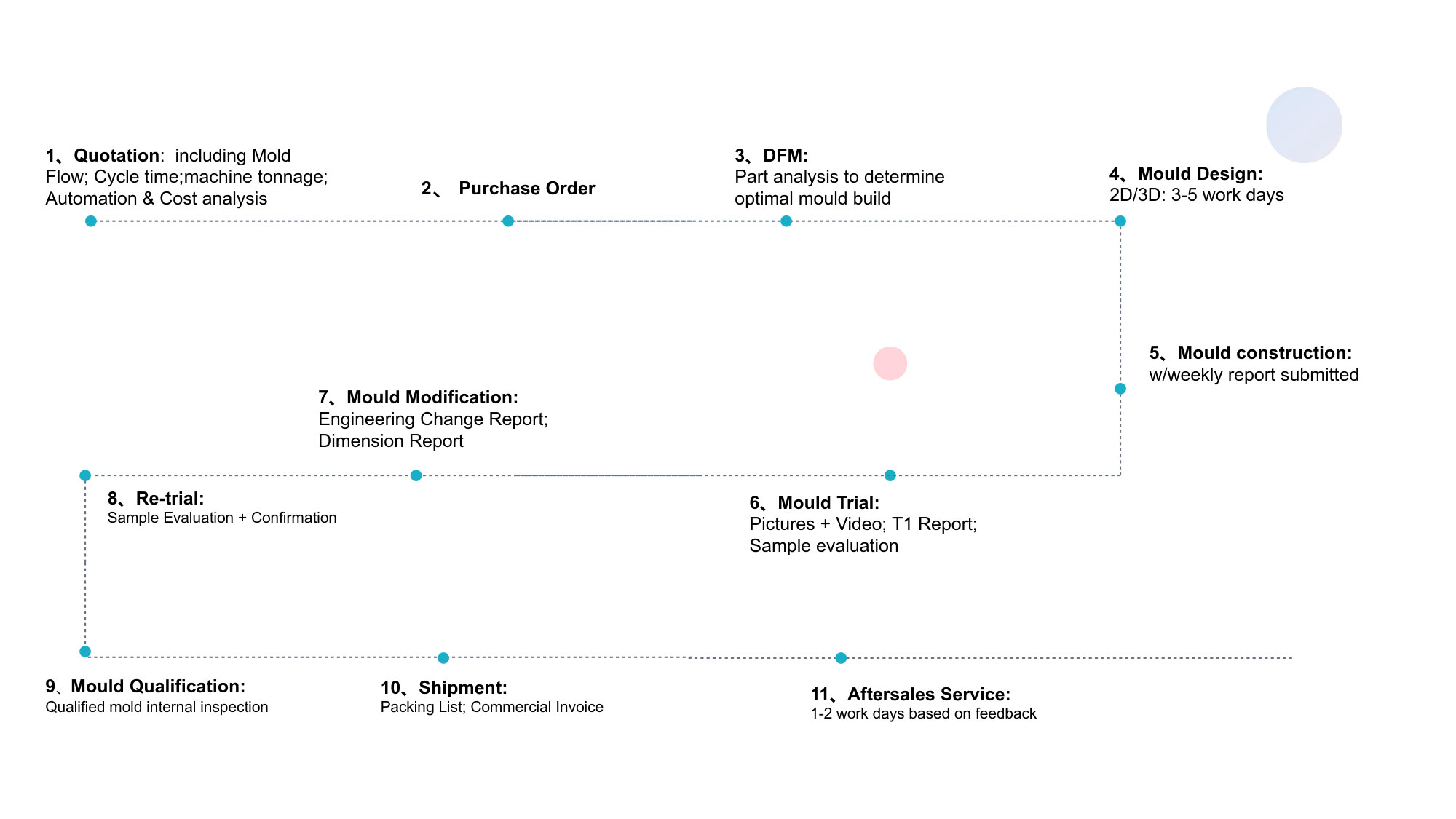
Most molders offer tooling and production as separate transactions. Ansix Tech provides an integrated solution from early-stage DFM through mass production and mold maintenance, reducing the number of suppliers our customers must manage and eliminating coordination failures between design, tooling, and production teams.
Design for Manufacturability (DFM) reports before tooling investment. We provide comprehensive DFM analysis before a customer commits to mold fabrication—often the single most valuable service we offer because it prevents expensive mistakes before they are locked into hardened steel. Our DFM report addresses: draft angle recommendations (minimum 1-3 degrees on all vertical walls to facilitate ejection), wall thickness optimization to avoid sink marks and uneven curing, gate location and type selection based on part geometry and cosmetic requirements, parting line placement to minimize visible seams, the location and size of any ejector pin witness marks on cosmetic surfaces, material-specific shrinkage compensation factors, and overmolding adhesion design rules when molding LSR onto plastic or metal inserts.
A well-executed DFM analysis pays for itself many times over. Consider a typical scenario: a customer provides a goggle frame design where a sharp internal corner makes mold machining impossible and creates an area of thick wall section that will sink during curing. Without DFM, this flaw is discovered during sampling after tooling is complete, requiring mold modification or rework at significant cost and schedule delay. With our DFM analysis, we identify the issue before any metal is cut, recommend a design change (a small radius in the corner and a core-out pocket), and the customer approves the modification in days rather than months. We have prevented hundreds of such scenarios over 28 years of LSR tooling experience.
Rapid sampling through staged mold qualification. Our sampling protocol involves T0 (first shots from the complete mold), T1 (corrective modifications based on T0 findings), T2 (process optimization and capability demonstration), and T3 (final customer approval). For each sample stage, we provide a complete dimensional inspection report, process parameter documentation, and a summary of any modifications made and their impact on part quality. Sampling continues until the mold meets the customer‘s quality standards, not until our budget runs out. We also offer quick-change insert capability that allows us to evaluate multiple gate configurations or vent designs by swapping a small insert rather than re-machining entire mold halves.
Pilot production validation before mass production. Before committing to high-volume production, we run pilot batches of 100 to 1,000 parts (customer‘s choice) with full process documentation and CPk analysis on all critical dimensions. The pilot run uses the same process parameters, tooling, and inspection equipment that will be used for mass production, ensuring that pilot results predict full-scale production capability. Only after customer approves pilot results do we transition to routine production.
Automated production cells for cost-effective scale. For goggles programs with annual volumes exceeding 250,000 units, we deploy fully automated LSR injection molding cells integrating robot part removal, conveyor transport, and automated packaging. Cycle times across eight-cavity family molds typically run 45 to 85 seconds depending on part size and wall thickness, achieving daily outputs of 8,000 to 15,000 finished parts per shift with minimal operator intervention.
Mold maintenance and spare parts management. We provide a complete set of spare wear components (ejector pins, core inserts, gate inserts, vent inserts) with every mold shipment, enabling our customers to perform preventative maintenance without waiting for replacement parts from overseas. Preventative maintenance schedules are documented in our mold care manual, including lubrication intervals, cleaning procedures, torque specifications for mold assembly bolts, and recommended spare part reorder quantities. When mold repair is required, we maintain in-house EDM and CNC machining capabilities that allow us to rework worn components without outsourcing—typically restoring production within 24 hours of receiving the mold. For molds that have reached end-of-life after several million cycles, we offer refurbishment services including core/cavity re-machining, vent re-cutting, gate replacement, and full re-qualification at approximately 40% of new tooling cost.
Section Five: Cost Competitiveness – The Levers We Actively Manage to Reduce Your Landed Part Cost
Our approach to cost reduction focuses on three controllable levers: material yield, cycle time optimization, and process stability that eliminates rework and scrap. We do not compete on raw material price—LSR grades from Dow Corning, Wacker, and Shin-Etsu cost what they cost globally. Instead, we compete on how efficiently we convert that material into finished parts.
Material yield: cold runner efficiency and runner re-use. The single largest material cost driver in LSR molding is runner waste. For a typical eight-cavity goggle seal mold producing parts of 5 g each, a conventional runner might weigh 2-3 g per shot. Over one million shots, runner waste totals 2,000 to 3,000 kg of LSR material—representing significant unnecessary cost. Our cold runner systems reduce runner weight by up to 60% compared to conventional two-plate mold designs, and the uncured runner material is automatically purged and reused, not discarded. For high-volume programs where material savings accumulate over millions of cycles, the incremental investment in cold runner tooling pays for itself within three to six months of production. We will provide a detailed material savings calculation for any specific goggles project upon request.
Cycle time: the hidden variable in per-part cost. LSR cycle time is dominated by two factors: injection/fill time (typically 2-10 seconds depending on part size and gate count) and cure time (typically 20-90 seconds depending on wall thickness and mold temperature). Cure time is dictated by LSR chemistry and crosslinking kinetics—faster cure requires higher mold temperature, which risks thermal damage to sensitive substrates in overmolding applications or causes premature vulcanization in the nozzle system. We optimize the balance between mold temperature, cure time, and part quality through systematic process characterization on each new tool. For applications where LSR is molded onto polycarbonate frames (maximum allowed substrate temperature 120°C before deformation), we have developed low-temperature cure cycles that complete crosslinking at 130-140°C in extended cure times, achieving full adhesion without softening the substrate. Where faster cycle time is the priority—such as for thick sealing gaskets without sensitive inserts—we run molds at 180-200°C, curing parts in 20-30 seconds and achieving throughput exceeding 100 cycles per hour on eight-cavity tools.
Zero-defect process control as a cost lever, not a quality luxury. Scrap costs in LSR molding are not limited to raw material loss—they also include the labor of producing defective parts, the inspection effort required to screen them, and the inventory cost of safety stock held to compensate for production yield uncertainty. Our closed-loop process control systems are designed to make scrap an exception rather than an expectation. With CPk ≥ 1.33 on all critical dimensions, we reject fewer than 0.5% of parts for dimensional defects. By eliminating manual trimming through precise flash control (flash below 0.03 mm typically requires no post-processing), we reduce labor content by 10-15 seconds per part compared to molds that produce visible flash fins requiring manual removal. Across one million parts at a conservative labor rate, this translates to substantial direct labor savings.
Conclusion: What Our Customers Receive
When you source goggles LSR tooling and molding from Ansix Tech, you receive a documented, validated, production-ready solution—not a collection of equipment and processes. You receive mold design optimized for your specific LSR material grade, wall thickness profile, and production volume. You receive process documentation including proven temperature, pressure, speed, and cure time settings that will produce acceptable parts from the first production run. You receive statistical evidence (CPk reports, dimensional inspection records, material certifications) that demonstrate process capability before mass production begins. And you receive cost calculations—material yield analysis, cycle time projection, labor content estimate—that allow you to forecast landed part cost accurately.
We have delivered goggles LSR tooling and molded components to customers in safety eyewear, sports optics, industrial protective equipment, and medical face protection. For each customer, we have reduced total cost of ownership through material-efficient runner design, cycle time optimization, and elimination of post-molding trimming. We have reduced manufacturing risk through DFM analysis that prevents design flaws from reaching hardened tooling, and through process control systems that maintain part quality across millions of cycles despite LSR batch variation and environmental changes. We have reduced supply chain management overhead by providing DFM, tooling, sampling, pilot production, mass production, and mold maintenance from a single qualified supplier.
If you have an existing goggles product that you would like to convert to LSR, or a new design requiring LSR sealing components, we offer a no-cost DFM review of your current CAD model. Our tooling engineers will provide written comments on manufacturability, material selection, and cost-saving opportunities. Contact our sales engineering team to schedule a technical review.
Ansix Tech Co Ltd
If you have any plans related to goggles LSR liquid silicone molding , you can contact us at any time. We will turn your ideas into reality, let you realize your dreams, and obtain large orders from the market. Our contact information is info@ansixtech.com. Or contact our CTO, mail: stephen@ansixtech.com
#www.ansixtech.com #ansixtech.com #goggles LSR liquid silicone molding #goggles LSR liquid silicone molding injection molding companies #goggles LSR liquid silicone molding Canopy Mold injection mold companies #Ansix #Ansix moulds #Ansix china #Ansix tech china #Ansix tech company #Ansix facotry #goggles LSR liquid silicone molding injection molding #goggles LSR liquid silicone molding injection tools #goggles LSR liquid silicone molding injection moulds #goggles LSR liquid silicone molding plastic mould #goggles LSR liquid silicone molding plastic tools #Ansix Tech #Ansix molds #Ansix injection molding #Ansix mold factory #injection molding goggles LSR liquid silicone molding#Ansix mold factory #goggles LSR liquid silicone molding china #goggles LSR liquid silicone molding molds #injection factory #goggles LSR liquid silicone molding injection molding #goggles LSR liquid silicone molding injection molding factory #injection molding company #goggles LSR liquid silicone molding injection mold companies #goggles LSR liquid silicone molding Tooling #goggles LSR liquid silicone molding mold limited #Ansix mold china #Ansix companies #Ansix company China #goggles LSR liquid silicone molding facotry #Ansix Tech #Ansix Tech mould #goggles LSR liquid silicone molding injection moulding #injection moulding company #Ansix goggles LSR liquid silicone molding parts injection mold companies #medical injection molding companieschina #goggles LSR liquid silicone molding china factory #Ansix moulding companies #Ansix molding company #goggles LSR liquid silicone molding injection moulding facotry #Ansix Tech mold #goggles LSR liquid silicone molding mould #goggles LSR liquid silicone molding plastic injection molding #ansix plastic mold #Mold manufacturing #goggles LSR liquid silicone molding parts manufacturing #goggles LSR liquid silicone molding plastic parts factory #goggles LSR liquid silicone molding injection parts mold #goggles LSR liquid silicone molding PRECISION MANUFACTURING #goggles LSR liquid silicone molding #China mold #goggles LSR liquid silicone molding injection moulding china #goggles LSR liquid silicone molding mould china #china precision mold #mold in china #goggles LSR liquid silicone molding mold china #Precision molds #High-precision molds #goggles LSR liquid silicone molding #Injection molds #goggles LSR liquid silicone molding Factory #goggles LSR liquid silicone molding Company #Super Large Injection Mold Factory #Large Tonnage Injection Molding Factory #goggles LSR liquid silicone molding Company #goggles LSR liquid silicone molding Factory #2800T Injection Molding Factory #3000 Ton Injection Molding #4500 Ton Injection Molding Factory #Large Mold Injection Molding #Large Plastic Mold Injection Molding Factory #Large Injection Mold Manufacturer #Plastic Mold Factory #Injection Mold #Plastic Mold