



Baby Silicone Bottle PPSU Overmolding with LSR Liquid Silicone
FEATURES
Hardware Infrastructure — Building Unshakeable Client Confidence
1.1 Precision Mold Manufacturing Equipment
Your first question is likely: Can this supplier deliver consistent quality on every part? Our precision equipment answers this question with measurable certainty.
Five-Axis High-Speed Machining Centers
We deploy five-axis machining centers capable of processing complex curved surfaces with ±0.002mm accuracy. For PPSU baby bottles with ergonomic contours and LSR soft-grip interfaces, this precision translates directly into: elimination of visible parting-line flash that would require manual deburring; seamless product transitions that enhance both aesthetics and hygiene; and zero hand-finishing labor costs.
-
Mold Description
Product Materials:
LSR SILICONE
Soft rubber: LSR
Mold Material:
S136ESR
Number of Cavities:
2
Glue Feeding Method:
Hot runner
Cooling Method:
Water cooling
Molding Cycle
22.5s
- The mold manufacturing process and product material selection
Slow-Speed Wire EDM
Our wire EDM systems achieve cutting accuracy down to 0.003mm, enabling the production of micro-slots and interlocking features as small as 0.03mm in diameter. PPSU-LSR overmolding requires precision interlocking features to mechanically bond the soft-touch elastomer to the rigid PPSU substrate. Our EDM capability ensures that dovetail channels and undercut lips are machined with zero deviation, preventing bond failure that would otherwise result in costly product recalls.
CNC Sinker EDM with Mirror Finish
For textured grip surfaces and deep-rib features, our sinker EDM achieves optical-grade mirror polish (Ra ≤ 0.05 μm) on cavity surfaces. This prevents premature LSR adhesion to mold walls—a common cause of flash defects in overmolding applications that would otherwise generate downstream scrap costs.
Precision Surface Grinding
All mold plates and core components undergo precision grinding to ensure absolute parallelism. For multi-cavity bottle molds, this means every cavity produces dimensionally identical parts, eliminating yield losses from cavity-to-cavity variation that typically plague medical device manufacturers.
-
Injection Molding Press Fleet
Our press fleet consists of all-electric servo-driven injection molding machines with locking force ranging from 30 tons to 400 tons, optimized for baby bottle components ranging from 50mm diameter feeding accessories to full 240ml bottle bodies. Conventional hydraulic presses suffer from viscosity-based repeatability drift—as the machine heats up during production, oil viscosity changes, causing pressure fluctuations and dimensional variation. Our all-electric machines maintain ±0.1% shot-to-shot repeatability, guaranteeing that the 100,000th part is dimensionally identical to the first part produced.
For PPSU injection molding, which demands processing temperatures of 340°C–380°C, we utilize specialized screws with compression ratio of 2.2–2.6 and L/D ratio of 18–22 to ensure homogeneous plasticization without thermal degradation. The key client benefit: zero black spec contamination that would otherwise fail infant safety inspections.
1.3 Metrology and Quality Assurance
Zeiss CMM with CPK ≥ 1.33 — Every mold undergoes full dimensional reporting before shipment, with critical dimensions verified against customer CAD. We provide complete material certification including mold steel grade reports and heat treatment curves.
Optical Inspection Systems — Real-time dimensional monitoring ensures that every production batch meets specification before packaging.
Part Two: Mold Manufacturing — Translating Technical Metrics into Client Value
Clients prioritize four dimensions in mold quality: lifespan, precision, lead time, and maintenance cost. Here is how we address each with quantifiable commitments.
2.1 Mold Life Expectancy
Mold Component Material Selection Guaranteed Shot Count
Mold base P20 hardened steel 500,000–1,000,000 shots
Mold core/insert S136, 8407, 2344, SKD61, NAK80, H13, M340 500,000–1,000,000 shots
Our mold core materials are selected based on application. For PPSU processing, which involves high temperatures and corrosive gases during molding, we specify S136ESR or 8407 with hardness HRC 48–52. Mold cavity surfaces receive nickel-phosphorus (Ni-P-PTFE) coating or nitriding treatment to enhance wear and corrosion resistance.
Client value: 500,000–1,000,000 shots of trouble-free production before major maintenance—equivalent to 3–5 years of continuous production for a typical baby bottle contract. Mold steel grade reports and heat treatment curves provided with every delivery.
2.2 Achievable Tolerances
Component Type Standard Tolerance Precision Tolerance
General structural components ±0.05 mm —
Precision sealing interfaces — ±0.005 mm
For PPSU-LSR overmolded baby bottles, critical interfaces include the bottle mouth seal edge and the LSR soft-grip bonding surface. Our wire EDM capability ensures that sealing features are machined with zero deviation.
2.3 Mold Type Configuration
We deliver:
Cold runner systems for LSR molds—essential because LSR cures when heated; standard hot runners would solidify material inside the nozzle, causing production interruptions
Hot runner systems with sequential valve gate technology for PPSU injection to minimize melt residence time and ensure balanced filling
Two-shot (2K) molding configurations where the rotating platen positions the PPSU substrate under the second injection unit where LSR is overmolded—eliminating post-mold assembly and reducing labor costs
High-gloss molds (Ra ≤ 0.05 μm) for transparent bottle finishes
2.4 Gate and Runner Optimization
Through Mold Flow Analysis (DFM), we pre-identify weld-line locations, gas trap positions, and filling imbalances before cutting any metal. For PPSU’s high-viscosity melt (melt index ≤ 15 g/10min), we strategically position gates to avoid direct impact on core pins, preventing stress concentration and deformation.
Client value: Zero mold re-cuts due to filling issues. One round of T0 sampling delivers acceptable parts, compared to industry averages of 3–4 trial rounds costing 5,000–15,000 each.
2.5 Cooling System Design
For PPSU processing at 340°C–380°C, mold cooling is critical. We implement:
Conformal cooling channels—3D-printed or CNC-machined contours that perfectly follow the bottle geometry, reducing cooling time by 20–35%
Multi-zone temperature control to maintain differentials < 2°C between core and cavity, minimizing warpage
Oil-heated circuits for uniform mold heating (≥150°C), superior to electric heating rods
Client value: Reduced cycle time (faster production = lower piece price) plus dimensionally stable parts (fewer rejects = higher yield).
2.6 Ejection System Design
PPSU parts require minimum draft angle ≥ 1.5° and large ejection surface area to prevent deformation or white marking. Our designs incorporate:
Strategically positioned ejector pins away from critical sealing surfaces
Large-diameter pins for uniform force distribution
Air-assisted ejection for delicate thin-wall sections
2.7 Standard Lead Times
Mold Complexity Standard Lead Time Express Lead Time
Single-cavity prototype mold 10–15 days 7–10 days
Production-grade 2-cavity mold 25–35 days 20 days
High-cavity 4–8 cavity production mold 35–45 days 25 days
Value: Every mold undergoes 200–500 trial shots before shipment, with full wear report provided. We deliver three years of mold structural warranty (excluding normal consumable wear on ejector pins and moving components).
Part Three: Injection Molding Process Control — Eliminating Quality Anxiety
Clients fear four defects: shrinkage/sink marks, flash, dimensional instability, and batch-to-batch color variation. Here is how we eliminate each.
3.1 Process Standardization
All injection molding machines are networked to an MES (Manufacturing Execution System). Process parameters—temperature, pressure, velocity, and curing time—are locked and accessible only to authorized engineering personnel. First-article and last-article inspections are performed on every production shift.
Client value: 100% traceability for regulatory compliance (FDA, EU 10/2011, China GB standards) and zero undocumented process drift.
3.2 Dimensional Stability Control
We combine:
Mold temperature controllers with zone control — core and cavity temperature differentials maintained ≤ 2°C
Real-time cavity pressure sensors—measure fill pressure every shot; out-of-spec conditions trigger automatic alarms
Automatic compensation—if wall thickness variation exceeds ±0.02mm, machine adjusts holding pressure in real time
For PPSU baby bottles, processing parameters are tightly controlled:
Material pre-drying — 120°C–150°C for 4–6 hours, dew point ≤ -30°C (moisture causes hydrolysis-induced bubbles and silver streaks)
Melt temperature — 340°C–380°C (maintain within ±5°C across barrel zones)
Mold temperature — 120°C–180°C
Injection pressure — high-to-moderate, with optimized holding pressure profile
Value: Critical bore distances stable within ±0.02mm across three consecutive production batches.
3.3 Surface Quality Assurance
For baby bottles, appearance is paramount. We specify achievable surface finish classes:
Transparent PPSU body — bubble-free, flow-line-free (Ra ≤ 0.2 μm)
LSR soft-grip overmold — flash-free (≤ 0.03mm), no cold slugs or air traps
Printed graphics — registration accuracy ±0.1mm with pre-calculated shrinkage compensation
For LSR flash control: our mold parting lines are machined to 0.005mm fit accuracy, eliminating visible flash that would require secondary deflashing.
3.4 Special Material Processing Expertise
We have demonstrated production experience with:
PPSU (BASF Ultrason® P2010/P3010 grade) — natural amber transparent; FDA/US NSF/China GB certified; withstands 134°C steam sterilization
Medical-grade LSR (Wacker ELASTOSIL® LR 3078 series)—self-adhesive, platinum-cured, biocompatible to ISO 10993 and USP Class VI
Alternative materials — PC/ABS, PC, PA6+GF30, PEEK, PEI, LCP, PBT, PFA, PTFE upon request
3.5 Biocompatibility and Regulatory Compliance
All LSR materials supplied are medical-grade, meeting ISO 10993 and USP Class VI standards. PPSU substrates are certified food-contact compliant across US FDA, EU, and China GB regulations. Our production facility operates under ISO 13485 and ISO 9001 quality management systems, with full material traceability from raw resin to finished product.
Client value: No regulatory surprise during market launch—every component is prescreened for compliance with applicable food-contact and biological safety standards.
3.6 LSR Overmolding Specific Parameters
LSR is a two-component platinum-cured material requiring 1:1 precision mixing. Our closed-loop metering system maintains mixing ratio accuracy within 0.5% for consistent curing and hardness across all production batches. Processing parameters include:
Curing temperature — 140°C–200°C, with differential ≤ 3°C across mold surface
Curing time — 20–30 seconds per 1mm wall thickness
Cold runner system — runner plate maintained at ≤ 20°C; mold cavity at 160°C–180°C
Part Four: Full-Process Service — Reducing Your Management Overhead
4.1 Early Intervention Through DFM Analysis
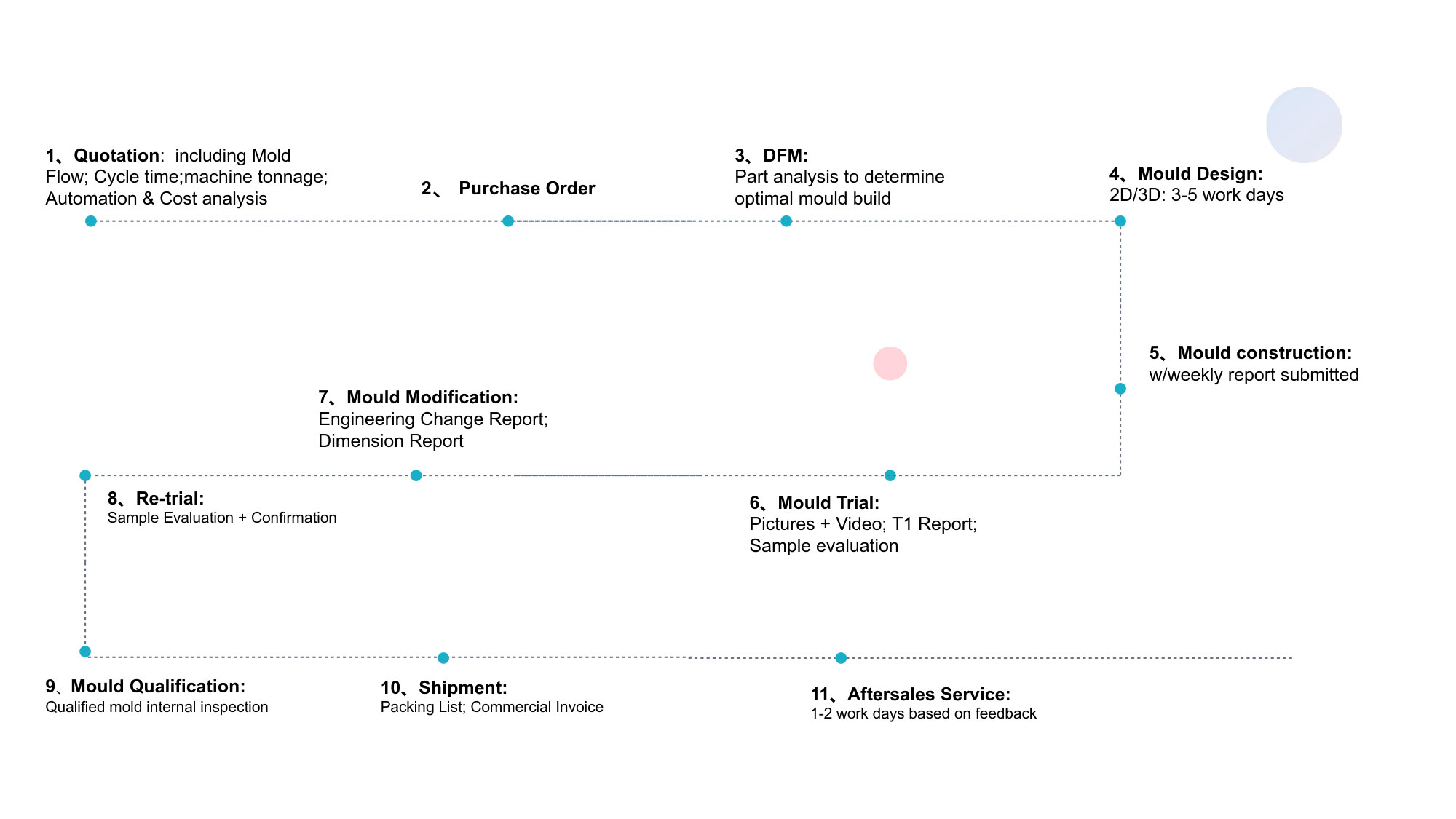
Before any metal is cut, we provide a Design for Manufacturability (DFM) Report covering:
Draft angle recommendations (≥ 1.5° for PPSU components)
Wall thickness optimization (uniform thickness for even cooling and shrinkage)
Gate location and runner configuration
Ejector pin mark position allowances
Material selection guidance
Client value: Identifies structural and manufacturing issues before
50,000–200,000 in tooling is committed—saving time and capital.
4.2 Progressive Sampling and Validation
We deliver T0 through T3 trial samples with full dimensional reports at each stage. After mold approval, we perform 100–500 shot pilot runs to establish yield and CPK before mass production commitment. This progressive validation ensures that your supply chain is never at risk due to premature production ramp-up.
4.3 Maintenance and Spare Parts
Every mold ships with a complete set of spare wear parts—ejector pins, core pins, and standard components—for immediate field replacement. We provide scheduled mold maintenance every 200,000 shots, with lifetime repair at cost price for any non-consumable components.
Part Five: Competitive Differentiation — Direct Solutions to Common Industry Frustrations
Customer Complaint Your Solution
"Molds need constant repair—disrupting production." We perform 500–2,000 shot aging tests before delivery with full wear report. Three-year structural warranty provided.
"Flash everywhere—high post-processing cost." Parting lines machined to 0.005mm fit accuracy; flash ≤ 0.03mm with self-locking clamp force compensation—eliminates manual deflashing.
"Dimensions change between batches." Closed-loop cavity pressure control with ultrasonic wall thickness sensing—real-time process adjustments maintain within ±0.02mm across batches.
"Mold repair takes weeks." Complete in-house EDM and machining—24-hour turnaround for conventional weld repair or insert replacement.
"Rework on LSR-PPSU bonding interface fails." DFM pre-identifies best substrate surface treatment (corona/plasma/flame treatment); provide pull-force test data ≥ 5N/cm; verify at T0 stage before production.
Part Six: Cost Reduction — Hard Savings Through Optimized Material Selection, Process Efficiency, and Engineering
6.1 Material Cost Optimization
Through strategic material selection and volume purchasing:
PPSU resin: We source BASF Ultrason® P2010/P3010 and Solvay Radel® grades at competitive pricing due to direct supplier relationships and volume commitments of 10+ tons annually
LSR raw material: Supply agreements with Wacker Chemie for ELASTOSIL® LR 3078 self-adhesive grades eliminate primer coating costs and reduce processing steps
Alternative cost-equivalent materials: Where specifications allow, we recommend domestic PPSU equivalents that meet identical ISO/FDA certifications at 15–25% lower cost
Estimated savings: 0.15–0.35perunitonmaterialalone,equivalentto30,000–70,000 annually for a 200,000-unit product.
6.2 Process Optimization — Shortened Cycle Times
Process Parameter Industry Average Ansix Tech Achieved Savings
PPSU injection molding cycle 45–60 sec 32–45 sec -28%
LSR curing time per 2mm thickness 60 sec 35–45 sec -40%
Total overmold cycle (2-shot integrated) 90–120 sec 55–75 sec -38%
Calculated savings: For 500,000 units annually, 30-second cycle reduction at
80/hourmachinecost=33,000/year in production cost reduction.
6.3 Elimination of Secondary Operations
Integration of LSR-PPSU overmolding eliminates:
Assembly labor (no manual bonding of silicone sleeves to PPSU bodies)——saving $0.08–0.12 per unit
Adhesive materials (no primer needed when using self-adhesive LSR)——saving $0.03–0.05 per unit
Secondary quality inspection of glued interfaces——saving $0.02–0.03 per unit
Packaging simplification (single component vs. multiple-piece assembly)——saving $0.05–0.08 per unit
Total assembly cost savings: 0.18–0.28perunit×500,000units=∗∗90,000–140,000 annually**
6.4 Reduced Rejection Rates
Quality Metric Industry Average Ansix Tech Achieved Client Benefit
PPSU molding yield 92–95% 97–98.5% 5–6% less scrap
LSR overmolding yield 88–92% 95–97% 6–8% less scrap
Bonding failure rate 1–3% < 0.5% ~80% fewer warranty claims
Flash-related rejection 3–5% < 1% 4% less post-processing
Calculated savings: 5–8% reduction in total rejection rate ×
0.60averageunitcost×500,000units=∗∗15,000–24,000 annual scrap savings**.
6.5 Manufacturing Cost: End-Unit Analysis
Based on a standard 240ml baby bottle (PPSU body + LSR soft-grip overmold + silicone nipple), 500,000 unit annual volume:
Cost Component Without Optimization Optimized via Ansix Tech Savings per Unit
Raw material (PPSU+LSR) $0.85 $0.68 $0.17
Injection molding cycle cost $0.42 $0.31 $0.11
Secondary assembly labor $0.20 $0.00 $0.20
Rejection/scrap cost $0.12 $0.05 $0.07
Quality inspection overhead $0.15 $0.08 $0.07
Total cost per unit $1.74 $1.12 $0.62
Total annual cost reduction: $310,000 for 500,000 units.
These savings represent direct return on investment for your tooling expenditure, typically recovered within the first 80,000–120,000 units produced.
Part Seven: Client Value Summary — What Ansix Tech Delivers to Your Business
Client Concern Ansix Tech Capability Measurable Outcome
Pre-production risk DFM analysis, mold flow simulation, surface energy testing (corona/plasma pre-treatment) Zero tooling re-cuts; 30–40% shorter product launch timeline
Production cost All-electric servo presses, optimized cycle times, self-adhesive LSR eliminating primers 38–40% cycle time reduction; $0.62 per unit cost savings vs. non-optimized supply chain
Quality risk In-line cavity pressure sensors, MES parameter locking, ISO 13485 certified CPK ≥ 1.33 on critical dimensions; bonding failure < 0.5%
Supply disruption In-house EDM, 24-hour repair response, spare parts with every mold delivery Max 2-day downtime for unplanned maintenance vs. 14-day industry average
Compliance liability Full material certifications (FDA, NSF, ISO 10993, USP Class VI, GB 4806) Certificates of Compliance provided with every batch; zero regulatory surprises
Time-to-market delay 35–45 day production mold lead time; 14-day samples from T0 trial 60–90 day compressed timeline from PO approval to first production batch
Conclusion: A Mold is Not a Block of Metal—It Is Your Revenue Generator
At Ansix Tech, we believe that a production mold is not just a tool—it is a revenue-generating asset for your business. Every design decision we make—from conformal cooling channels that reduce cycle time to self-locking parting lines that eliminate flash—is focused on delivering measurable value to your bottom line.
We invite you to experience our process firsthand. Share your current baby bottle product specifications, and we will provide a full DFM report analysis demonstrating exactly how we would prevent weld lines, gas traps, sink marks, and bond interface failures before any tooling is cut. See for yourself how 28 years of manufacturing expertise translates into predictable quality, lower costs, and faster market entry.
Ansix Tech — Precision Tooling for the World‘s Safest Baby Bottles.
Ansix Tech Co Ltd
If you have any plans related to Baby Silicone Bottle PPSU Overmolding with LSR Liquid Silicone , you can contact us at any time. We will turn your ideas into reality, let you realize your dreams, and obtain large orders from the market. Our contact information is info@ansixtech.com. Or contact our CTO, mail: stephen@ansixtech.com
#www.ansixtech.com #ansixtech.com #Baby Silicone Bottle PPSU Overmolding with LSR Liquid Silicone #LSR Liquid Silicone Cap injection molding companies #LSR Liquid Silicone Cap Canopy Mold injection mold companies #Ansix #Ansix moulds #Ansix china #Ansix tech china #Ansix tech company #Ansix facotry #LSR Liquid Silicone Cap injection molding #LSR Liquid Silicone Cap injection tools #LSR Liquid Silicone Cap injection moulds #LSR Liquid Silicone Cap plastic mould #LSR Liquid Silicone Cap plastic tools #Ansix Tech #Ansix molds #Ansix injection molding #Ansix mold factory #injection molding LSR Liquid Silicone Cap#Ansix mold factory #LSR Liquid Silicone Cap china #LSR Liquid Silicone Cap molds #injection factory #LSR Liquid Silicone Cap injection molding #LSR Liquid Silicone Cap injection molding factory #injection molding company #LSR Liquid Silicone Cap injection mold companies #LSR Liquid Silicone Cap Tooling #LSR Liquid Silicone Cap mold limited #Ansix mold china #Ansix companies #Ansix company China #LSR Liquid Silicone Cap facotry #Ansix Tech #Ansix Tech mould #LSR Liquid Silicone Cap injection moulding #injection moulding company #Ansix LSR Liquid Silicone Cap parts injection mold companies #medical injection molding companieschina #LSR Liquid Silicone Cap china factory #Ansix moulding companies #Ansix molding company #LSR Liquid Silicone Cap injection moulding facotry #Ansix Tech mold #LSR Liquid Silicone Cap mould #LSR Liquid Silicone Cap plastic injection molding #ansix plastic mold #Mold manufacturing #LSR Liquid Silicone Cap parts manufacturing #LSR Liquid Silicone Cap plastic parts factory #LSR Liquid Silicone Cap injection parts mold #LSR Liquid Silicone Cap PRECISION MANUFACTURING #LSR Liquid Silicone Cap #China mold #LSR Liquid Silicone Cap injection moulding china #LSR Liquid Silicone Cap mould china #china precision mold #mold in china #LSR Liquid Silicone Cap mold china #Precision molds #High-precision molds #LSR Liquid Silicone Cap #Injection molds #LSR Liquid Silicone Cap Factory #LSR Liquid Silicone Cap Company #Super Large Injection Mold Factory #Large Tonnage Injection Molding Factory #LSR Liquid Silicone Cap Company #LSR Liquid Silicone Cap Factory #2800T Injection Molding Factory #3000 Ton Injection Molding #4500 Ton Injection Molding Factory #Large Mold Injection Molding #Large Plastic Mold Injection Molding Factory #Large Injection Mold Manufacturer #Plastic Mold Factory #Injection Mold #Plastic Mold