



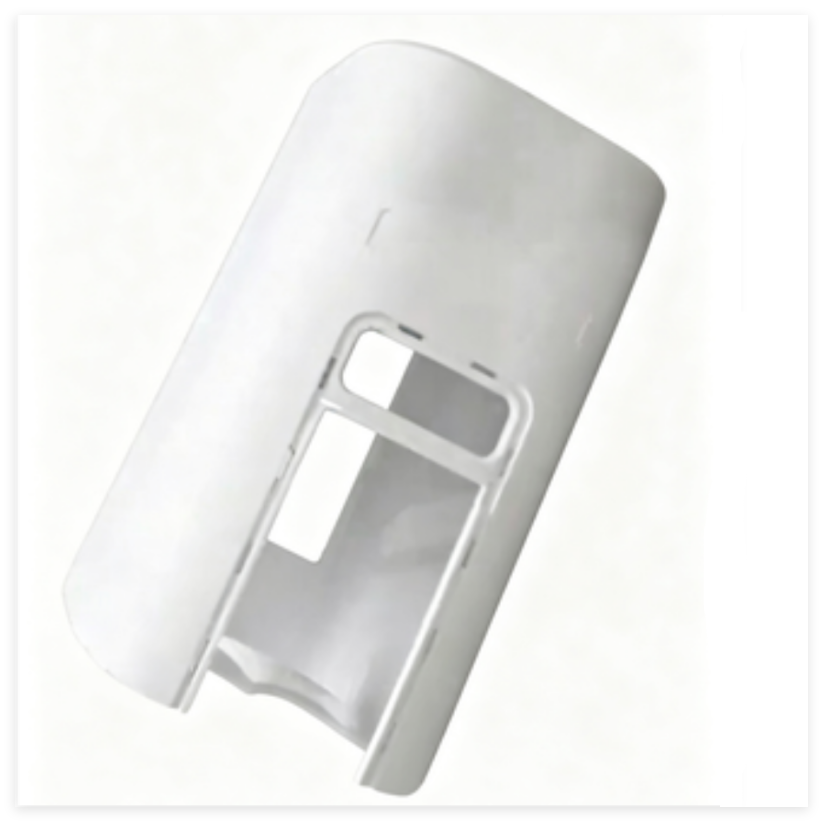
Tempatkan pendingin di dekat bagian yang tebal (zona risiko tenggelam)
Saluran air dirancang untuk aliran turbulen (bilangan Reynolds >4.000) dan dialirkan dalam sirkuit yang tidak melewati bagian panas.
Desain sistem runner. Runner mengantarkan plastik cair dari sprue (atau manifold hot runner) ke lokasi gate. Desain AnsixTech:
Panjang saluran pengisi yang seimbang ke setiap rongga untuk cetakan multi-rongga
-
Penampang yang dirancang untuk meminimalkan penurunan tekanan sekaligus memaksimalkan pembangkitan panas geser.
Sumur penangkap siput dingin untuk menangkap plastik yang lebih dingin di ujung saluran.
Penampang melintang runner (trapesium, lingkaran penuh, atau sebagian lingkaran) dioptimalkan untuk reologi material.
Desain sistem gerbang. Lokasi, jenis, dan geometri gerbang menentukan kualitas komponen. Pilihannya meliputi:
Jenis Gerbang
Aplikasi
Fitur
Gerbang tepi
Sebagian besar suku cadang standar

- Mudah dilepas, sisa yang terlihat masih ada di tepinya.
Gerbang kapal selam/terowongan
Pembukaan gerbang otomatis
Pintu geser saat pengeluaran, meninggalkan sisa kecil pada permukaan yang tidak terlihat.
Gerbang ujung panas
Sistem hot runner
Sisa minimal, penutupan material yang tepat
Gerbang katup
Hot runner, komponen besar
Pengaturan gerbang berurutan untuk pengisian area luas, tanpa sisa
Pemilihan lokasi gerbang menyeimbangkan: keseimbangan pengisian di seluruh bagian, kontrol garis las (tempatkan garis las di zona non-kritis), evakuasi udara (hindari jebakan udara di bagian depan aliran), batasan permukaan kosmetik (jauhkan gerbang dari permukaan yang sangat terlihat), dan gangguan pengeluaran dan penanganan bagian (jauhkan gerbang dari jalur pengeluaran).
-
Desain sistem ejektor. Ejektor yang tepat sangat penting untuk pengoperasian otomatis yang andal. Desain ejektor meliputi:
Susunan pin ejektor: dirancang untuk menekan permukaan struktural, bukan bagian yang tipis atau fleksibel.
Ejektor selongsong: untuk bagian yang dicetak di sekitar inti.
Pelat pelepas: untuk bagian-bagian dengan permukaan datar yang besar atau rusuk yang dalam
Penyemprotan udara: untuk bagian yang sangat tipis atau rapuh.
Posisi tanda pin ejektor didokumentasikan untuk persetujuan pelanggan sebelum pembuatan alat – tidak ada kejutan pada komponen jadi.
Alur Proses Pembuatan Cetakan
Proses pembuatan cetakan lengkap di dalam perusahaan:
Desain CAD dan analisis aliran cetakan – mendesain gerbang, saluran, pendinginan, dan ejektor.
Pemrograman CAM – menghasilkan jalur pemesinan untuk semua peralatan CNC.
Pemesinan kasar – buang sebagian besar material dari dasar cetakan dan masukkan bahan baku.
Perlakuan panas – jika diperlukan (H13, 8407 hingga HRC48-52; S136 hingga HRC50-53)
Pemesinan semi-finishing – mendekati dimensi akhir, menyisakan material untuk proses finishing.
EDM (jika diperlukan) – membuat fitur detail (sudut dalam yang tajam, celah sempit)
Penyelesaian akhir pemesinan – dimensi akhir dan penyelesaian permukaan.
Penyelesaian/pemolesan/pemberian tekstur secara manual – mencapai kekasaran permukaan atau kedalaman tekstur yang diinginkan.
Perakitan cetakan – pasang semua komponen, periksa pergerakan slide dan ejektor.
Percobaan cetakan (T0) – tembakan uji pertama pada mesin cetak injeksi
Inspeksi dan verifikasi CMM – laporan dimensi lengkap.
Optimalisasi T1/T2/T3 – tingkatkan sesuai kebutuhan berdasarkan hasil uji coba.
Pengujian keausan (2.000 siklus) – mempercepat keausan awal, mendokumentasikan kondisi
Inspeksi dan sertifikasi akhir – siap untuk persetujuan pelanggan.
Optimalisasi Proses Pencetakan Injeksi – Efisiensi dan Pengendalian Biaya
Pengurangan waktu siklus. AnsixTech secara sistematis menurunkan waktu siklus melalui:
Saluran pendingin konformal untuk pembuangan panas yang cepat.
Suhu dan laju aliran air pendingin yang dioptimalkan (mempertahankan ΔT
Waktu pendinginan dikurangi hingga minimum yang diperlukan untuk pelepasan komponen dari cetakan tanpa deformasi.
Kecepatan buka/tutup cetakan dioptimalkan (pendekatan cepat, perlindungan cetakan lambat, penutupan cepat)
Kecepatan pengeluaran diatur cukup cepat untuk memberikan ruang gerak pada komponen tetapi tidak merusak.
Pengambilan komponen oleh robot dijadwalkan bertepatan dengan selesainya pembukaan cetakan.
Efisiensi energi. Mesin servo serba listrik mengonsumsi listrik 40-70% lebih sedikit daripada mesin hidrolik yang setara. Dikombinasikan dengan kontrol suhu cetakan cepat panas dan cepat dingin (penghematan listrik sekitar 8%) dan sistem pemulihan panas, total konsumsi energi fasilitas per bagian jauh lebih rendah daripada rata-rata industri.
Efisiensi material. Sistem hot runner menghilangkan limbah runner sepenuhnya. Jika cetakan cold runner tidak dapat dihindari, sistem daur ulang dan manajemen limbah tertutup mengembalikan limbah runner menjadi material yang dapat digunakan, dengan tunduk pada batasan persentase daur ulang yang disetujui pelanggan.
Pengurangan limbah. Kontrol proses loop tertutup menjaga agar komponen tetap sesuai spesifikasi di seluruh proses produksi. Untuk aplikasi CpK tinggi, variasi antar komponen cukup rendah untuk menghilangkan penyortiran inspeksi untuk sebagian besar dimensi, memungkinkan 100% produksi lolos gerbang kualitas dalam proses.
Sistem Pengendalian dan Penjaminan Mutu
Sistem mutu AnsixTech mengikuti prosedur yang terdokumentasi di setiap tahap:
Panggung
Aktivitas Berkualitas
Standar / Alat
Bahan baku yang masuk
Verifikasi MFI, uji kelembaban, pengecekan warna
ASTM D1238, ISO 1133
Produksi
Inspeksi artikel pertama setiap shift, pembuatan grafik proses statistik, inspeksi visual 100% pada akhir siklus.
ANSI/ASQ Z1.4, sistem visi AI milik perusahaan
Penyelesaian batch
Inspeksi artikel terakhir, bandingkan dengan artikel pertama.
CMM, komparator optik
Pengiriman banyak barang
Sertifikat Analisis, laporan ringkasan dimensi, ketelusuran material.
Sesuai dengan standar ISO 9001:2015
Pembuatan grafik SPC dalam proses. Dimensi kritis diplot pada grafik kontrol X-bar dan R. Cp dan CpK dihitung secara berkala. Tindakan dipicu ketika batas kontrol mendekati batas yang ditentukan.
Tingkat sertifikasi. AnsixTech menyediakan secara standar: sertifikasi sistem manajemen mutu ISO 9001:2015. Atas permintaan: IATF 16949 (dokumentasi PPAP kelas otomotif untuk komponen peralatan yang ditujukan untuk aplikasi terkait otomotif), ISO 13485 (dokumentasi kelas medis untuk komponen peralatan dengan aplikasi perangkat medis).
Pengemasan dan Logistik – Pelaksanaan Pengiriman Cepat
Pengemasan di pabrik. Komponen dikemas ke dalam wadah yang ditentukan pelanggan (wadah, nampan, kotak, kotak Gaylord) langsung dari konveyor otomatis atau sel pengemasan robotik. Jumlah kemasan diverifikasi dengan penimbangan atau penghitungan visual. Label ditempelkan sesuai spesifikasi pelanggan.
Perencanaan produksi / manajemen inventaris. MES melacak kemajuan produksi secara real-time dan memprediksi tanggal penyelesaian dengan cukup akurat untuk perencanaan logistik just-in-time. Pelanggan dapat mengintegrasikan data MES ke dalam sistem perencanaan mereka sendiri melalui API atau ekspor laporan.
Modus logistik. Kapal AnsixTech:
Melalui udara – untuk pengiriman cetakan (peralatan berat, pengiriman barang melalui udara)
Melalui jalur laut – untuk pesanan suku cadang produksi dalam jumlah besar, dimuat dalam kontainer dari pabrik ke pelabuhan tujuan.
Melalui jalur darat/kereta api – untuk distribusi regional dari fasilitas di dalam negeri.
Komitmen waktu pengerjaan: Perkakas cetakan sederhana: 10 hari dari penyelesaian desain hingga uji coba T0. Cetakan dengan kompleksitas sedang: 25-45 hari. Pesanan suku cadang produksi massal: berdasarkan jumlah rongga cetakan, jadwal pelanggan, dan moda logistik. AnsixTech memberikan konfirmasi pengiriman tertulis dengan setiap penerimaan pesanan.
Pengalaman Industri dan Nilai Keandalan
Dengan pengalaman lebih dari 28 tahun dalam pembuatan casing peralatan rumah tangga, AnsixTech telah mengumpulkan pengalaman komprehensif di berbagai kategori:
*Peralatan listrik hemat ruang (penyedot debu, pengisi daya baterai). Peralatan rumah tangga besar (lemari es, freezer, mesin cuci, pengering). Peralatan pengatur suhu (AC, dehumidifier, kipas angin, pemanas). Peralatan dapur kecil (mesin kopi, ketel, blender, pengolah makanan, penanak nasi, microwave). *Panel kontrol rumah pintar (panel sentuh, bezel layar, rumah sensor). Peralatan listrik dan peralatan taman (rumah dan penutup pegangan dengan ergonomi pegangan yang baik).
Kedalaman ini memastikan bahwa AnsixTech mengenali pola perilaku material, sensitivitas gerbang, perilaku pendinginan, dan faktor risiko geometri bagian sebelum analisis aliran cetakan dimulai, sehingga mengurangi waktu pengembangan dan percobaan untuk setiap aplikasi baru.
Ringkasan – Mengapa AnsixTech Pilihan untuk Casing Peralatan Rumah Tangga?
AnsixTech menggabungkan manufaktur cetakan presisi (kemampuan pemesinan 0,002 mm, masa pakai cetakan 500.000-1.000 tembakan), kapasitas pencetakan injeksi yang luas (260 mesin, 30-2.800 ton), manufaktur cerdas (MES terintegrasi, inspeksi visi AI, kontrol proses loop tertutup), stabilitas proses (perbedaan suhu ≤2°C, kemampuan CpK≥1,33), portofolio material lengkap (UL94 V-0, stabilitas UV, termoplastik rekayasa plus overmolding LSR), keunggulan biaya total (biaya 15-30% lebih rendah melalui optimasi material, proses, dan limbah), dan dukungan layanan penuh (pra-analisis DFM, uji coba sampel, produksi massal, perakitan, pemeliharaan). Pelanggan yang mencari mitra terpercaya, jangka panjang, dan layanan penuh untuk wadah peralatan rumah tangga dapat menghubungi AnsixTech untuk meninjau desain produk mereka saat ini, mendiskusikan spesifikasi cetakan, dan menerima proposal khusus termasuk tinjauan DFM dan perkiraan biaya.
Proposal teknis ini mencakup kemampuan komprehensif AnsixTech dalam pembuatan cetakan penutup peralatan rumah tangga, pemilihan material cetakan injeksi, infrastruktur manufaktur cerdas, pengendalian mutu proses, metodologi pengurangan biaya, protokol validasi, dan penyampaian nilai kepada pelanggan. Untuk pertanyaan proyek spesifik atau untuk mengatur demonstrasi DFM, silakan hubungi tim teknik AnsixTech.
Ansix Tech Co Ltd
Jika Anda memiliki rencana terkait dengan Kotak Pelindung Peralatan Rumah Tangga, Anda dapat menghubungi kami kapan saja. Kami akan mewujudkan ide-ide Anda, membantu Anda mewujudkan impian Anda, dan mendapatkan pesanan besar dari pasar. Informasi kontak kami adalah info@ansixtech.com. Atau hubungi CTO kami, email: stephen@ansixtech.com
#www.ansixtech.com #ansixtech.com #Penutup Peralatan Rumah Tangga #Cetakan Penutup Peralatan Rumah Tangga #Perusahaan Cetakan Injeksi Penutup Peralatan Rumah Tangga #Perusahaan Cetakan Injeksi Kanopi Penutup Peralatan Rumah Tangga #Ansix #Cetakan Ansix #Ansix China #Ansix Tech China #Perusahaan Ansix Tech #Pabrik Ansix #Pencetakan Injeksi Penutup Peralatan Rumah Tangga #Peralatan Injeksi Penutup Peralatan Rumah Tangga #Cetakan Injeksi Penutup Peralatan Rumah Tangga #Cetakan Plastik Penutup Peralatan Rumah Tangga #Peralatan Plastik Penutup Peralatan Rumah Tangga #Ansix Tech #Cetakan Ansix #Pencetakan Injeksi Ansix #Pabrik Cetakan Ansix #Pencetakan Injeksi Penutup Peralatan Rumah Tangga #Pabrik Cetakan Ansix #Penutup Peralatan Rumah Tangga China #Cetakan Penutup Peralatan Rumah Tangga #Pabrik Injeksi #Pencetakan Injeksi Penutup Peralatan Rumah Tangga #Pabrik Cetakan Injeksi Penutup Peralatan Rumah Tangga #Perusahaan Cetakan Injeksi #Perusahaan Cetakan Injeksi Penutup Peralatan Rumah Tangga #Penutup Peralatan Rumah Tangga #Penutup Peralatan Rumah Tangga Mold Limited #Ansix Mold China #Perusahaan Ansix #Perusahaan Ansix China #Pabrik Casing Peralatan Rumah Tangga #Ansix Tech #Cetakan Ansix Tech #Pencetakan injeksi Casing Peralatan Rumah Tangga #Perusahaan pencetakan injeksi #Perusahaan cetakan injeksi suku cadang Casing Peralatan Rumah Tangga Ansix #Perusahaan pencetakan injeksi medis China #Pabrik Casing Peralatan Rumah Tangga China #Perusahaan pencetakan Ansix #Perusahaan pencetakan Ansix #Pabrik pencetakan injeksi Casing Peralatan Rumah Tangga #Cetakan Ansix Tech #Cetakan Casing Peralatan Rumah Tangga #Pencetakan injeksi plastik Casing Peralatan Rumah Tangga #Cetakan plastik ansix #Pembuatan cetakan #Pembuatan suku cadang Casing Peralatan Rumah Tangga #Pabrik suku cadang plastik Casing Peralatan Rumah Tangga #Cetakan suku cadang injeksi Casing Peralatan Rumah Tangga #Pembuatan presisi Casing Peralatan Rumah Tangga #Casing Peralatan Rumah Tangga #Cetakan China #Pencetakan injeksi Casing Peralatan Rumah Tangga China #Cetakan Casing Peralatan Rumah Tangga China #Cetakan presisi China #Cetakan di China #Cetakan Casing Peralatan Rumah Tangga China #Cetakan presisi #Cetakan presisi tinggi #Casing Peralatan Rumah Tangga #Cetakan injeksi #Rumah Pabrik Penutup Peralatan Rumah Tangga #Perusahaan Penutup Peralatan Rumah Tangga #Pabrik Cetakan Injeksi Super Besar #Pabrik Cetakan Injeksi Tonase Besar #Perusahaan Penutup Peralatan Rumah Tangga #Pabrik Penutup Peralatan Rumah Tangga #Pabrik Cetakan Injeksi 2800T #Cetakan Injeksi 3000 Ton #Pabrik Cetakan Injeksi 4500 Ton #Cetakan Injeksi Cetakan Besar #Pabrik Cetakan Injeksi Plastik Besar #Produsen Cetakan Injeksi Besar #Pabrik Cetakan Plastik #Cetakan Injeksi #Cetakan Plastik
Produk terkait
01
Komponen Penopang Plastik Mesin Kopi
01
Cetakan Casing Rice Cooker, Pelepasan Cetakan 0 Derajat
01
Cetakan penutup penyesuaian bagian pengatur plastik peralatan dapur
01
Wadah Blender Kecepatan Tinggi
01
Aksesoris Katup Outlet Dapur dan Kamar Mandi Cetakan Injeksi untuk Peralatan Listrik
Ansix adalah pembuat dan produsen perkakas yang mengkhususkan diri dalam penelitian dan pengembangan, desain, pembuatan, penjualan, dan layanan cetakan dan barang plastik. Ansix memiliki empat basis produksi di Tiongkok dan Vietnam. Kami memiliki total 260 mesin cetak injeksi dan kapasitas injeksi mulai dari yang terkecil 30 ton hingga 2800 ton.
informasi
Profil Ansix
Album untuk AnsixTech
Visi dan Nilai Inti
Pertanyaan yang Sering Diajukan (FAQ) Berita Hubungi kami
Kategori Produk Manufaktur Alat Kesehatan Cetakan Presisi dan Dua Komponen
Sisipan Dekorasi Cetakan untuk Suku Cadang Otomotif Cetakan & Injeksi untuk Peralatan Rumah Tangga dan Listrik Produk kemasan kosmetik dan PET PreformCap
Komponen Mesin CNC Plastik Hubungi kami Telp:+86 158 1869 2114
Email: info@ansixtech.com Skype: Stephenhuang2010 WhatsApp: +86 13530645990
Alamat: Gedung F, Kawasan Industri Guanlan Weiyecheng, Distrik Longhua, Shenzhen, Tiongkok Hak Cipta © 2024 Semua Hak Dilindungi Undang-Undang Peta Situs
-
BLOG TERBAIK
-
Topik Utama
Temukan wadah pelindung peralatan rumah tangga yang tahan lama, dirancang untuk gaya dan perlindungan. Tingkatkan tampilan ruangan Anda sekaligus menjaga peralatan tetap aman dan tertata. Belanja sekarang!
Pelindung Peralatan Rumah Tangga, Penutup Peralatan Kustom, Pelindung Peralatan Komersial, Kotak Pelindung Peralatan, Pelindung Peralatan Industri, Solusi Pelindung Peralatan yang Andal
Hot Runner Systems. For high-volume enclosures, AnsixTech implements hot runner injection systems. Unlike cold runners that create solid sprue and runner waste after each cycle – often 15-30% of shot weight – hot runner systems maintain plastic in a molten state continuously, eliminating runner waste completely. Value delivered: lower resin consumption per part, reduced regrind management, shorter cycle times, and better filling control through individual nozzle temperature regulation.
Stack Molds. For high-output applications where mold size is constrained by machine platen dimensions, stack molds place two parting lines in a single mold base, effectively doubling cavity count without increasing clamping force requirement. Value delivered: output capacity doubled with same machine investment, lower per-part manufacturing cost, and reduced capital expenditure for additional machines.
Two-Shot / Multi-Material Molds. For enclosures requiring multiple materials – for example, a rigid PC/ABS frame with a soft-touch TPE or LSR seal overmolded in a single cycle – two-shot molds eliminate secondary assembly steps. This reduces part cost, eliminates separate purchasing and inventory of seal components, ensures perfect alignment between materials, and improves product reliability.
High-Gloss / Mirror-Finish Molds. For transparent or high-gloss appliance parts – such as refrigerator shelf trims, display windows, or decorative control panels – diamond-grade polished cavities achieve Ra<0.05μm surface finish. This eliminates secondary polishing operations for clear parts and paint adhesion preparation for painted parts.
Mold Materials Selection in Detail
Material Grade Key Properties Typical Application Expected Life
P20 (e.g., 1.2311, 1.2312) Good machinability, moderate wear resistance Mold base plates, support structures, non-wear surfaces As base, indefinite
S136 / 4Cr13 / 9Cr18 Corrosion resistance, mirror polish, thermal stability High-gloss cavities, transparent parts, corrosive plastics (PVC, etc.) 1,000,000+ shots
2344 / H13 / 8407 High-temperature strength, thermal fatigue resistance, good hot hardness Cores/cavities for glass-filled plastics, high-temperature thermoplastics (PPS, PEEK, LCP) 500,000-1,000,000 shots
2343 / SKD61 Erosion resistance, toughness, polishability General-purpose cavities, moderate-glass materials 500,000-800,000 shots
SKD11 / DC53 Wear resistance, high hardness (HRC58-62) High-wear inserts, sliding surfaces, shut-off areas 300,000-800,000 shots
NAK80 Pre-hardened (HRC37-43), no post-heat treat distortion, uniform structure over large areas Large cavity plates, high-gloss parts, moderate-volume production 300,000-500,000 shots
M340 / 1.2083 Stainless properties, corrosion resistance Medical-related appliance parts, humid environment enclosures 500,000+ shots
Material Certification. Every mold is supplied with material certificates and heat treatment curves documenting hardness, microstructure, and processing conditions. This traceability is essential for customers operating under ISO 9001, IATF 16949, or other quality system requirements.
Section 3: Injection Molding Process Control – Reducing Customer Quality Anxiety
Home appliance manufacturers consistently report the same molding-related fears: Sink marks visible on aesthetic surfaces. Flash requiring manual deflashing. Dimensions shifting between production runs. Batch-to-batch color variation. AnsixTech’s molding process controls are designed to eliminate these anxieties systematically.
Process Standardization
MES Parameter Lockdown. All injection molding machines are connected to our centralized Manufacturing Execution System (MES). Every process parameter – melt temperature profile (measured at barrel zones), injection pressure ramping profile (multistage with specific setpoints), injection velocity profile (fill rate control stages), holding pressure switching position and pressure levels, cooling duration, mold temperature (core and cavity independently), screw backpressure and rotational speed – is stored in the MES database and digitally locked.
Only authorized engineering personnel, verified through digital identity authentication, are permitted to modify any parameter. Every parameter change is time-stamped and logged with the operator’s electronic signature, providing full process traceability for quality audits and recall investigations.
Batch Verification Protocol. Every production batch is initiated with a certified first-piece sample – inspected against dimensions, appearance, and functional test criteria. At batch completion or mold changeover, a last-piece sample is extracted and compared against the first-piece record to confirm dimensional and visual stability across the entire production run.
Dimensional Stability Control
Temperature management is the single most important factor influencing part stability:
Independent Core/Cavity Temperature Control. AnsixTech applies mold temperature controllers with independent circuits for core (moving half) and cavity (stationary half). Temperature differential between core and cavity is maintained at ≤2°C (3.6°F). This eliminates differential shrinkage that drives part warpage.
Conformal Cooling. For complex enclosure geometries, AnsixTech implements conformal cooling channels – water lines that follow the contour of the part rather than staying in straight machined passages. The conformal approach reduces cooling time and minimizes hot spots, producing parts with lower residual stress and higher dimensional stability.
Process Capability Demonstration. For a typical home appliance control panel frame – a product with critical hole spacing that must align with PCB mounting bosses – AnsixTech demonstrates: hole spacing fluctuation ≤0.02mm across three consecutive weeks of production, part flatness variation ≤0.10mm across week-long runs, and consistent assembly fit with mating parts without selective sorting.
Visual Quality Grading
AnsixTech delivers cosmetic grades matching customer requirements:
Premium Visible Grade (Class A). For front-facing appliance panels, no visible defects when viewed under specified lighting at standard viewing distance. Surface roughness Ra≤0.2μm, free of flow marks, weld lines, gas streaks, splay, or gloss variation.
Commercial Grade (Class B). For surfaces that may be visible but not primary focal points, minor cosmetic imperfections allowed within agreed boundaries.
Functional Grade (Class C). For interior or hidden surfaces, no defects affecting part strength or function.
Transparent Parts. For parts such as appliance display windows, water filter housings, or light guides: no visible bubbles, flow lines, or contamination. High-clarity materials (PC, PMMA, clear ABS) processed with dedicated machine conditions and material handling systems.
Paint-Ready / Electroplating-Ready Parts. For parts destined for painting, printing, or vacuum metallization: gas streaks and splay eliminated, surface sealed to prevent outgassing during paint cure, and dimensional stability maintained through thermal cycles. For printing applications, AnsixTech can engineer compensated mold designs that account for deformation, delivering printed registration accuracy controlled to ±0.1mm.
Electronics-Integrated Parts. For enclosures requiring PCB mounting, display window alignment, or sensor positioning: insert molding compatibility for threaded inserts, brass nuts, or metal brackets molded directly into plastic.
Special Engineering Material Capabilities
AnsixTech maintains extensive production experience with the full spectrum of engineering thermoplastics required for home appliance enclosures. Each material demands specific mold design considerations and processing conditions:
PC/ABS (Polycarbonate/Acrylonitrile Butadiene Styrene blend). The most common choice for home appliance enclosures requiring impact resistance, heat deflection capability, and aesthetic appearance. Challenges include sensitivity to moisture (requires thorough drying) and tendency to splay at high shear rates. AnsixTech experience: extensive production across control panels, front bezels, and structural housings.
PC (Polycarbonate). High transparency and high impact strength for windows, lenses, and clear housings. Challenges include high melt viscosity requiring high injection pressures, moisture sensitivity, and tendency toward internal stress cracks. AnsixTech transparent part experience includes refrigerator shelf trim, water filter housings, and display covers.
PPS+40%GF (Polyphenylene Sulfide with 40% Glass Fiber). High-temperature stability (continuous service to 240°C/464°F), chemical resistance, and dimensional stability for hot air paths, pump housings, and high-performance appliance components. Challenges include high abrasiveness (wears mold steel) and stiff flow characteristics requiring high injection pressures. For glass-filled materials, AnsixTech commits 500,000+ shot mold life when appropriate steel (8407, 2344, H13) is specified.
PEEK (Polyetheretherketone). Premium high-performance material for extreme service conditions – mechanical strength at elevated temperatures, chemical resistance, and wear resistance. Used for bearings, seals, and high-reliability appliance mechanisms.
PA6+GF30 (Nylon 6 with 30% Glass Fiber). High strength-to-weight ratio and good chemical resistance for structural components, fan blades, and mechanical housings. Challenges include hydroscopic nature (requires dry processing) and tendency toward flash at high injection pressures.
PBT (Polybutylene Terephthalate). Good electrical insulation properties, dimensional stability, and chemical resistance for electrical connectors, coil bobbins, and electronic components used within appliances.
PEI, PPS, LCP (Polyetherimide, Polyphenylene Sulfide, Liquid Crystal Polymer). High-temperature thermoplastics for component carriers, wave-soldering compatible parts, and strength-to-weight critical structures. Experienced in small/medium volume applications demanding precise repeatability.
LSR (Liquid Silicone Rubber). Dedicated injection molding cells (Arburg two-component presses) produce silicone seals, gaskets, buttons, and sealing components that can be overmolded directly onto appliance enclosures, eliminating secondary seal assembly. Overmolded LSR provides perfect sealing geometry without separate gasket handling.
Regulatory Certifications. AnsixTech materials comply with UL94 V-0 flame retardancy for electrical enclosure applications. For materials requiring outdoor exposure resistance, we can provide test documentation for UV stability up to 3,000 hours (accelerated weathering) without significant discoloration or mechanical property loss.
Closed-Loop Process Control
For applications demanding highest stability, AnsixTech implements closed-loop control systems:
Ultrasonic Wall Thickness Feedback. Ultrasonic sensors mounted on mold cavity walls continuously monitor fill front advancement across the part geometry. The signal provides real-time feedback on actual wall thickness achieved during injection. The machine control automatically adjusts holding pressure and injection speed to compensate for material viscosity variations or temperature fluctuations, maintaining consistent thickness between cavities and across batches.
In-Mold Pressure and Temperature Sensors. Cavity pressure sensors and thermocouples provide direct monitoring of internal mold conditions. Closed-loop algorithms adjust packing pressure, holding time, and mold temperature instantly to bring conditions back within specification. This eliminates the traditional reliance on external part measurement after molding.
Section 4: Full-Service Lifecycle Support – Reducing Customer Total Management Cost
Many mold suppliers quote a mold, build it, deliver it, and then become unavailable for engineering support until something breaks. AnsixTech takes the opposite approach – full-service lifecycle support that reduces customers’ management cost through engineering partnership.
Early Engagement (Pre-Signing DFM Report)
Before committing tooling funds, AnsixTech delivers a Design for Manufacturing (DFM) analysis report covering:
Draft angle recommendations. Minimum draft for each surface based on texture depth and material shrinkage
Wall thickness optimization. Identifying sections that are too thick (sink risk) or too thin (fill risk)
Gate location proposals. With justification for final location based on fill balance and cosmetic requirements
Ejector placement planning. Mark positions agreed with customer appearance requirements (preventing visible marks on Class A surfaces)
Mold configuration options. Hot runner vs. cold runner, number of cavities, parting line placement
Potential defect risk identification. Weld line positions, air trap locations, sink areas predicted by mold flow
Customer value. No unpleasant surprises after mold steel is cut. No engineering changes costing time and money. No “this won’t work” discovery during initial trials.
Trial Shots and Sample Development
AnsixTech provides T0 through T3 sample shots, with accompanying improvement reports at each stage:
T0 (First Trial). Unmodified mold performance baseline. Issues documented.
T1 (First Improvement). Corrective actions applied based on T0 findings.
T2 (Second Improvement). Fine-tuning and optimization.
T3 (Completion). Approved sample ready for customer sign-off.
Quick-change insert capability. For applications requiring comparison of different gate designs or runner configurations, interchangeable mold inserts allow rapid A/B testing without remaking entire mold base.
Small-Batch Pre-Production Validation
Before committing to full mass production, AnsixTech offers 100- to 500-shot pre-production validation runs. Deliverables include:
Statistical process capability (Cp/Cpk) data for critical dimensions
First-pass yield data
Cycle time optimization recommendation
Material consumption verification
Customer value. No scaling up an unstable process. No factory-wide quality problems caused by undetected molding issues. Customer chooses to proceed to mass production only after seeing proven capability data.
Repair, Maintenance, and Spare Parts
Spare parts delivery. Spare ejector pins, core inserts, sliding wear plates, and other consumable components are shipped with the initial mold order, eliminating urgent procurement of common wear items. Customers receive initial spare inventory at delivery, then replenish as needed.
Preventive maintenance intervals. AnsixTech provides factory maintenance at 200,000-cycle intervals. Service includes full mold cleaning, lubrication, wear inspection, component replacement as needed, and dimensional re-verification.
Cost-based repairs beyond warranty. After warranty period, repairs are charged at material cost with minimal labor markup, ensuring mold refreshment does not become a budget-breaking event.
On-site repair capability. Customers with large mold fleets can negotiate on-site training and spare inventory programs.
Section 5: Differentiated Comparison – Directly Addressing Common Industry Pain Points
Rather than generic claims of being “better,” AnsixTech addresses specific customer complaints commonly reported from other mold manufacturers.
Customer Complaints in Industry AnsixTech Commitment
Molds require frequent repair, interrupting production schedules. AnsixTech molds undergo 2,000-cycle accelerated wear testing before shipment, with documented wear report upon completion. We offer three-year structural warranty on molds (excluding normal wear of ejector pins and sliding components).
Flash is consistently present, requiring expensive manual deflashing. Parting lines machined to 0.005mm fit accuracy. Servo-driven clamping force compensation maintains closing force during injection, delivering flash controlled to ≤0.03mm across production batches – eliminating manual deflashing entirely for typical applications.
Dimensions change unpredictably between production runs. Ultrasonic wall thickness sensors provide real-time thickness monitoring and automatic holding pressure compensation. In-mold pressure and temperature sensors enable closed-loop control for highest stability applications. Alternatively, statistically controlled processes without full closed-loop deliver batch-to-batch stability within acceptable ranges (<0.02mm critical dimensions).
Mold repair lead times are unacceptable – weeks of downtime. In-house electrode manufacturing center and EDM cell allow mold rework without leaving our facility. Standard repairs (electrode rework, core insert changes, weld repair with re-machining) typically 24-hour turnaround.
Mold performance depends on operator skill – results not repeatable across shifts. All machines networked with MES system. Process parameters locked and only accessible to authorized engineers. No operator parameter adjustments. Full shift-to-shift reproducibility.
Our philosophy:
“To us, a mold is not a block of steel. It is a money-printing machine. We design molds with production flow, venting paths, and thermal balance planned from day one. When our mold arrives at your production line, it produces good parts from the first cycle – no extended ramp-up, no trial-and-error adjustments, no daily operator fiddling. We invite you to bring an existing product for a full demonstration of our DFM process, where we walk through how AnsixTech identifies every weld line, air trap, and sink risk before cutting a single piece of steel.”
AnsixTech Value Summary – What We Deliver, What Problems We Solve
Customer Value Delivery
Our Capability Problem We Solve Cost & Risk Impact
Mold flow analysis and DFM feasibility reports prior to tooling commitment Prevent “can’t mold” geometry, eliminate design changes after steel is cut Saves $15,000-50,000+ in canceled mold charges and engineering rework time
Precision mold machining (0.002mm five-axis capability, 0.005mm parting line fit accuracy) Eliminate flash that requires manual trimming, prevent mismatch on assembled parts Saves $5,000-20,000+ annually in manual deflashing labor across multi-year production
500,000-1,000,000 shot mold life commitment Prevent mold replacement costs mid-production Saves $30,000-200,000+ in unplanned mold replacement costs across program life
In-mold pressure/temperature sensors with closed-loop process control Eliminate dimensional drift between batches, prevent out-of-tolerance parts Reduces scrap rate 70-90% for critical tolerances
MES parameter lockdown – no operator adjustment Eliminate shift-to-shift process variation Reduces CpK-intervention events 80-95% versus manual control
Small-batch pre-production validation (100-500 shots) with CpK data Prevent scaling unstable processes to mass production Avoids $10,000-100,000+ in mass production scrap and rework
UL94 V-0 certification, UV 3,000-hour stability, comprehensive material track records Eliminate certification delays, prevent material-related field failures Avoids product safety violations and recall costs
Spare parts delivered with mold, 24-hour repair turnaround, cost-price maintenance after warranty Eliminate production stoppages from minor repairs Reduces downtime cost by tens of thousands in prevented idle machine hours
Quality Validation Workflow That Customers Can Trust
AnsixTech implements a four-stage quality validation system that provides full visibility and documented confirmation at every step:
Stage Activity Deliverable to Customer
Stage 1: Design Validation DFM analysis, mold flow analysis, gate/runner optimization study DFM Report, Mold Flow Report, Gate Position Recommendation
Stage 2: Manufacturing Validation In-process inspection (CMM, optical measurement) at each machining step Partial dimensional reports as relevant
Stage 3: Pre-Production Validation T0-T3 trial shots, 100-500 shot small-batch validation with CpK data Sample parts, Dimensional Full Report, CpK Capability Study
Stage 4: Production Validation First-article inspection each batch, last-article comparison, SPC charting Certified FAIR, Process Stability Data
Cost Reduction Strategy (How AnsixTech Reduces Customer Hard Cost)
AnsixTech pursues cost reduction through multiple integrated levers:
Cost Driver Reduction Method Typical Savings
Material cost Volume resin purchasing across 4 factories, optimized material selection matching performance requirements (no over-spec) 8-15% material spend reduction
Mold cost amortization 500k-1,000k shot life spreads mold cost across longer production life 30-50% lower amortized mold cost per part
Processing efficiency Hot runner eliminates runner waste (15-30% material savings), stack mold doubles output on same machine 15-30% reduction in material cost per part
Cycle time reduction Conformal cooling, optimized process parameters, automated part retrieval 15-40% shorter cycle time = more parts per machine hour
Energy reduction All-electric servo machines (40-70% lower energy than hydraulic), fast-heat fast-cool (approx. 8% energy savings) Lower electricity cost per part
Waste reduction Closed-loop process control eliminates off-spec production, ≤0.03mm flash eliminates manual deflashing 90%+ reduction in scrap and manual finishing labor
Logistics cost Combined assembly and packaging designed with part, container utilization optimized 5-15% landed cost reduction
Typical total cost impact. Home appliance customers working with AnsixTech typically achieve 15-30% reduction in total landed cost across full program life compared to alternative sourcing options.
Manufacturing Process Details (Comprehensive)
Raw Material Selection and Material Characteristics
Material selection for home appliance enclosures requires balancing multiple factors:
Mechanical requirements. Load-bearing enclosures may require glass-filled nylons for strength and stiffness. Decorative panels may prioritize surface appearance and impact resistance (PC/ABS). High-heat housings require PPS, PEI, or LCP to withstand oven or exhaust temperatures.
Cosmetic requirements. High-gloss painted parts require mold surfaces finished to mirror quality. Textured surfaces require consistent grain depth across entire cavity. Transparent parts require crystal-clear material (PC, PMMA) processed with dedicated dryers and clean material handling systems.
Regulatory requirements. Electrical enclosures require UL94 V-0 flame retardant ratings. Food-contact parts must comply with FDA or LFGB food contact regulations. Outdoor enclosures require UV stability certification.
Production requirements. High-volume programs can justify hot runner systems and expensive mold steels. Low-volume programs may use less complex tooling approaches.
AnsixTech material portfolio examples (specific grades):
PC/ABS – Bayer/LG/SABIC grades for impact resistance (typically 500-600 J/m notched Izod), heat deflection temperature 100-120°C (212-248°F). Used for: control panel bezels, appliance front housings, small appliance bodies.
PC – SABIC Lexan or equivalent grades for transparency (88-91% light transmission at 3mm) and impact strength (700-900 J/m). Used for: display windows, water filter housings, light guides.
PPS+40%GF – DIC, Toray, or Celanese grades for high-temperature capability (continuous service to 240°C/464°F), chemical resistance, and dimensional stability (low CTE). Used for: pump housings, hot air handling ducts, high-reliability enclosures in heat-generating appliances.
PA6+GF30 – BASF Ultramid or equivalent for strength-to-weight ratio (tensile strength 150-180 MPa). Hydroscopic – requires desiccant drying before molding. Used for: fan blades, structural brackets, high-load components.
LSR – Momentive, Dow, Wacker grades for shore hardness A20-A80, compression set resistance, and biocompatibility. Two-component LSR/plastic overmolding for integrated seals and gaskets.
Mold Flow Analysis (DFM) – Comprehensive Coverage
For every home appliance enclosure project, AnsixTech performs mold flow analysis addressing:
Melt front progression – ensures all cavities fill simultaneously without hesitation or race tracking
Weld line prediction – identifies weld positions; allows gate relocation to move weld lines to non-aesthetic surfaces
Air trap prediction – identifies trapped air zones; guides venting placement to prevent burn marks
Pressure distribution – ensures cavity pressure remains within machine capability; prevents short shots in thin sections
Temperature distribution – identifies hot spots and cold zones; guides cooling channel placement
Shear rate and stress – ensures material remains within recommended shear limits; prevents degradation and splay
Shrinkage and warpage – predicts final part dimensions after cooling; allows mold geometry compensation in CAD
Value to customer. Reduced physical trial shots. Shorter development schedules. Predictable part quality from T1 onward.
Mold Design Focus Areas for Home Appliance Enclosures
Cooling system / water channel design. Efficient cooling is the most important factor in cycle time and part stability. AnsixTech designs cooling layouts to:
Maintain core/cavity temperature differential ≤2°C
Target uniform cooling across all part sections
Use conformal cooling for complex 3D surfaces (where design permits)
Position cooling close to thick sections (sink risk zones)
Water lines are sized for turbulent flow (Reynolds number >4,000) and routed in a circuit that does not bypass hot sections.
Runner system design. Runners deliver molten plastic from sprue (or hot runner manifold) to gate locations. AnsixTech designs:
Balanced runner lengths to each cavity for multi-cavity molds
Cross-sections sized to minimize pressure drop while maximizing shear heat generation
Cold slug wells to capture cooler plastic at runner ends
Runner cross-sections (trapezoidal, full-round, or partially round) optimized for material rheology
Gate system design. Gate location, type, and geometry determine part quality. Options include:
Gate Type Application Feature
Edge gate Most standard parts Easy to degate, visible vestige remains on edge
Submarine/tunnel gate Automatic degating Gate shears during ejection, leaves small vestige on non-visible surface
Hot tip gate Hot runner systems Minimal vestige, precise material shutoff
Valve gate Hot runner, large parts Sequential gating for large-area filling, no vestige
Gate location selection balances: fill balance across part, weld line control (place weld lines in non-critical zones), air evacuation (avoid trapping air at flow fronts), cosmetic surface limits (keep gates away from highly visible surfaces), and ejection and part handling interference (keep gates away from ejection path).
Ejector system design. Proper ejection is essential for reliable automatic operation. Ejector designs include:
Ejector pin arrays: sized to push on structural surfaces, not thin or flexible sections
Sleeve ejectors: for parts molded around cores
Stripper plates: for parts with large flat surfaces or deep ribs
Air ejection: for very thin or fragile parts
Ejector pin mark position is documented for customer approval before tool construction – no surprises on finished parts.
Mold Manufacturing Process Flow
Complete in-house mold manufacturing process:
CAD design and mold flow analysis – design gates, runners, cooling, ejectors
CAM programming – generate machining paths for all CNC equipment
Rough machining – remove bulk material from mold base and insert blanks
Heat treatment – if required (H13, 8407 to HRC48-52; S136 to HRC50-53)
Semi-finish machining – approach final dimensions, leaving stock for finish passes
EDM (where needed) – create detailed features (sharp internal corners, narrow slots)
Finish machining – final dimensions and surface finish
Manual finishing / polishing / texturing – achieve required surface roughness or texture depth
Mold assembly – fit all components, check slide and ejector movement
Mold tryout (T0) – first test shot on injection press
Inspection and CMM verification – full dimensional report
T1/T2/T3 optimization – improve as needed from trial results
Wear testing (2,000 cycles) – accelerate initial wear, document condition
Final inspection and certification – ready for customer approval
Injection Molding Process Optimization – Efficiency and Cost Control
Cycle time reduction. AnsixTech systematically drives cycle time down through:
Conformal cooling channels for rapid heat removal
Optimized cooling water temperature and flow rate (maintaining ΔT<0.5°C between in/out)
Cooling time reduced to minimum required for part demolding without deformation
Mold opening/closing speeds optimized (fast approach, slow mold protection, fast close)
Ejection speeds set fast enough for part clearance but not damaging
Robotic part retrieval timed to coincide with mold opening completion
Energy efficiency. All-electric servo machines consume 40-70% less electricity than hydraulic equivalents. Combined with fast-heat fast-cool mold temperature control (approx. 8% electricity savings) and heat recovery systems, total facility energy consumption per part is substantially lower than industry average.
Material efficiency. Hot runner systems eliminate runner waste entirely. Where cold runner molds are unavoidable, regrind systems and closed-loop scrap management return runner waste to usable material, subject to customer-approved regrind percentage limitations.
Scrap reduction. Closed-loop process control keeps parts within specification across entire runs. For high-CpK applications, part-to-part variation is low enough to eliminate inspection sorting for most dimensions, allowing 100% production to pass in-process quality gates.
Quality Control and Assurance System
AnsixTech’s quality system follows documented procedures at every stage:
Stage Quality Activity Standard / Tool
Incoming raw materials MFI verification, moisture test, color check ASTM D1238, ISO 1133
Production First-article inspection each shift, statistical process charting, 100% vision inspection at cycle completion ANSI/ASQ Z1.4, proprietary AI vision system
Batch completion Last-article inspection, compare vs. first-article CMM, optical comparator
Lot shipment Certificate of Analysis, dimensional summary report, material traceability ISO 9001:2015 compliant
In-process SPC charting. Critical dimensions plotted on X-bar and R control charts. Cp and CpK calculated periodically. Actions triggered when control limits approached.
Certification levels. AnsixTech provides as standard: ISO 9001:2015 quality management system certification. On request: IATF 16949 (automotive-grade PPAP documentation for appliance parts destined for automotive-adjacent applications), ISO 13485 (medical-grade documentation for appliance parts with medical device applications).
Packaging and Logistics – Rapid Delivery Execution
In-plant packaging. Parts are packed into customer-specified containers (totes, trays, boxes, Gaylord boxes) directly from automated conveyors or robotic packing cells. Packing counts verified by weight or vision counting. Labels applied per customer specification.
Production planning / inventory management. MES tracks real-time production progress and predicts completion dates accurately enough for just-in-time logistics planning. Customers can integrate MES data into their own planning systems via API or report exports.
Logistics modes. AnsixTech ships:
By air – for mold shipment (heavy tools, air freight)
By ocean – for large-volume production part orders, container-loaded from factory to destination port
By land/rail – for regional distribution from in-country facilities
Lead time commitment: Simple mold tooling: 10 days from design completion to T0 trial. Medium-complexity mold: 25-45 days. Mass production part orders: based on mold cavity count, customer schedule, and logistics mode. AnsixTech provides written delivery confirmation with each order acceptance.
Industry Experience and Reliability Value
With over 28 years in home appliance enclosure manufacturing, AnsixTech has accumulated comprehensive cross-category experience:
*Space-saving electrical appliances (vacuum cleaners, battery chargers). Large white goods (refrigerators, freezers, washers, dryers). Climate control appliances (air conditioners, dehumidifiers, fans, heaters). Small kitchen appliances (coffee makers, kettles, blenders, food processors, rice cookers, microwaves). *Smart home control panels (touch panels, display bezels, sensor housings). Power tools and garden appliances (housings and handle enclosures with good grip ergonomics).
This depth ensures that AnsixTech recognizes material behavior patterns, gate sensitivity, cooling behavior, and part geometry risk factors before mold flow analysis begins, reducing development time and trial shots for each new application.
Summary – Why AnsixTech for Home Appliance Enclosures
AnsixTech combines precision mold manufacturing (0.002mm machining capability, 500k-1,000k shot mold life), extensive injection molding capacity (260 machines, 30-2,800 tons), smart manufacturing (MES integrated, AI vision inspection, closed-loop process control), process stability (temperature differential ≤2°C, CpK≥1.33 capability), complete material portfolio (UL94 V-0, UV stability, engineering thermoplastics plus LSR overmolding), total cost advantage (15-30% lower cost through material, process, and waste optimization), and full-service support (DFM pre-analysis, sample trials, mass production, assembly, maintenance). Customers looking for a trusted, long-term, full-service partner for home appliance enclosures should contact AnsixTech to review their current product design, discuss mold specifications, and receive a customized proposal including DFM review and cost estimate.
This technical proposal covers AnsixTech’s comprehensive capabilities in home appliance enclosure mold manufacturing, injection molding material selection, smart manufacturing infrastructure, process quality control, cost reduction methodology, validation protocols, and customer value delivery. For specific project inquiries or to arrange a DFM demonstration, please contact AnsixTech’s engineering team.
Ansix Tech Co Ltd
If you have any plans related to Home Appliance Enclosures , you can contact us at any time. We will turn your ideas into reality, let you realize your dreams, and obtain large orders from the market. Our contact information is info@ansixtech.com. Or contact our CTO, mail: stephen@ansixtech.com
#www.ansixtech.com #ansixtech.com #Home Appliance Enclosures #Home Appliance Enclosures moulds #Home Appliance Enclosures injection molding companies #Home Appliance Enclosures Canopy Mold injection mold companies #Ansix #Ansix moulds #Ansix china #Ansix tech china #Ansix tech company #Ansix facotry #Home Appliance Enclosures injection molding #Home Appliance Enclosures injection tools #Home Appliance Enclosures injection moulds #Home Appliance Enclosures plastic mould #Home Appliance Enclosures plastic tools #Ansix Tech #Ansix molds #Ansix injection molding #Ansix mold factory #injection molding Home Appliance Enclosures #Ansix mold factory #Home Appliance Enclosures china #Home Appliance Enclosures molds #injection factory #Home Appliance Enclosures injection molding #Home Appliance Enclosures injection molding factory #injection molding company #Home Appliance Enclosures injection mold companies #Home Appliance Enclosures#Home Appliance Enclosures mold limited #Ansix mold china #Ansix companies #Ansix company China #Home Appliance Enclosures facotry #Ansix Tech #Ansix Tech mould #Home Appliance Enclosures injection moulding #injection moulding company #Ansix Home Appliance Enclosures parts injection mold companies #medical injection molding companieschina #Home Appliance Enclosures china factory #Ansix moulding companies #Ansix molding company #Home Appliance Enclosures injection moulding facotry #Ansix Tech mold #Home Appliance Enclosures mould #Home Appliance Enclosures plastic injection molding #ansix plastic mold #Mold manufacturing #Home Appliance Enclosures parts manufacturing #Home Appliance Enclosures plastic parts factory #Home Appliance Enclosures injection parts mold #Home Appliance Enclosures PRECISION MANUFACTURING #Home Appliance Enclosures #China mold #Home Appliance Enclosures injection moulding china #Home Appliance Enclosures mould china #china precision mold #mold in china #Home Appliance Enclosures mold china #Precision molds #High-precision molds #Home Appliance Enclosures #Injection molds #Home Appliance Enclosures Factory #Home Appliance Enclosures Company #Super Large Injection Mold Factory #Large Tonnage Injection Molding Factory #Home Appliance Enclosures Company #Home Appliance Enclosures Factory #2800T Injection Molding Factory #3000 Ton Injection Molding #4500 Ton Injection Molding Factory #Large Mold Injection Molding #Large Plastic Mold Injection Molding Factory #Large Injection Mold Manufacturer #Plastic Mold Factory #Injection Mold #Plastic Mold