



Molding of Micro-Precision Structural Components using LCP Materials
FEATURES
The Material Advantage Translated into Customer Value
Liquid Crystal Polymers (LCPs) are a class of high-performance thermoplastics characterized by their unique molecular structure — during melt processing, the polymer chains align in a highly ordered orientation, creating an anisotropic melt that combines exceptional flowability with superior mechanical properties. Before we present our manufacturing capabilities, we must first explain why LCP is the material of choice for micro-precision applications — and what that means for your business.
What LCP Delivers to Your Bottom Line
LCP Property Customer Value
High heat deflection temperature (HDT up to 295°C) Your components withstand reflow soldering without deformation — no assembly-line failures, no warranty claims. LCPs meet UL94 V-0 flammability rating at 0.3mm wall thickness, eliminating fire safety concerns.
Ultra-low moisture absorption (<0.02%) Electrical properties remain stable across humidity and temperature variations — reliable 5G signal integrity, consistent dielectric performance. LCP absorbs ten times less moisture than polyamide, preventing blistering and delamination during assembly.
Inherently flame-retardant (no additives required) Lower material cost, consistent processing, and no risk of additive migration or degradation. Typical oxygen index exceeds 40%.
Exceptional thin-wall flowability Fill walls as thin as 0.01 inches without flow marks or short shots — consolidate multiple parts into one, reduce assembly labor, lighten your product.
-
Mold Description
Product Materials:
LCP
Mold Material:
S136ESR
Number of Cavities:
2
Glue Feeding Method:
Hot runner
Cooling Method:
Water cooling
Molding Cycle
12.5s
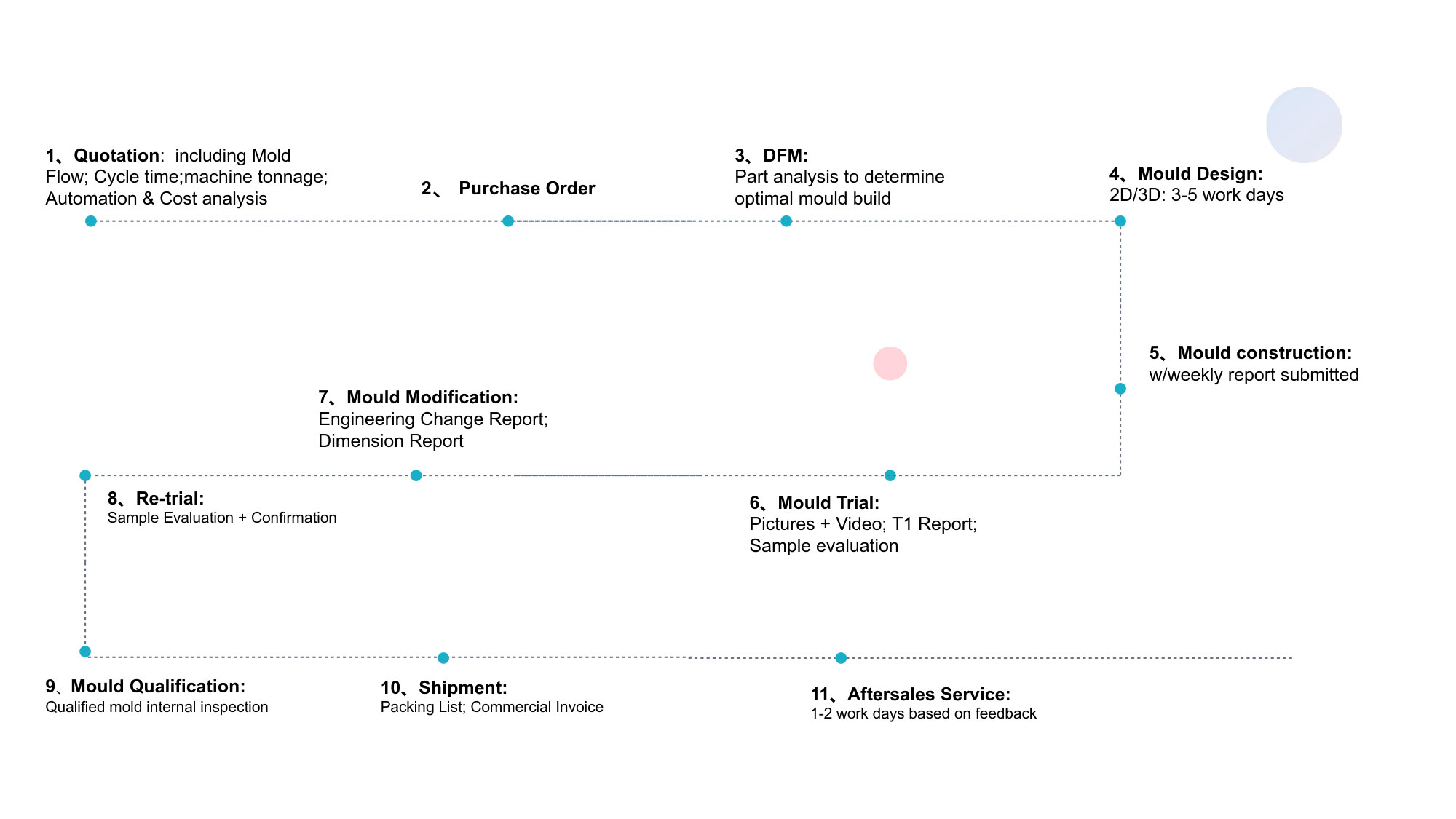
- The mold manufacturing process and product material selection
Low coefficient of thermal expansion (0.5-2.7 ×10⁻5 /K) Parts maintain critical dimensions across temperature extremes — reliable mating interfaces, consistent electrical contact pressure. The flow-direction CTE is comparable to metals.
Fast crystallization and rapid solidification Shorter cycle times — more parts per hour, lower per-part cost, faster inventory turns.
Excellent chemical resistance Parts perform in harsh environments — automotive fluids, medical sterilization, industrial chemicals — without degradation or dimensional change.
Specific LCP Grades Ansix Tech Processes
We work with all major LCP resin systems from leading suppliers, selecting the optimal grade based on your application requirements. Common grades include:
SUMIKASUPER SR2507 (Sumitomo Chemical): 35% mineral-reinforced grade exhibiting super-high fluidity, thin-wall high flowability with 84mm flow length at 0.30mm thickness. Features SMT heat resistance, low warpage, surface smoothness, and V-0 flame retardancy. Ideal for micro connectors, board-to-board connectors, FPC connectors, and high-speed transmission components.
ZENITE 7244 (Celanese): 40% glass/mineral-reinforced grade achieving tolerance class T6, with HDT of 295°C. Features flash-free injection molding capability, very low heat of fusion enabling short cycle times, and coefficient of thermal expansion comparable to steel and ceramics.
Vectra MT Series (Celanese): Specifically designed for thin-wall medical device components with nominal walls as low as 0.3mm, enabling micro-molding and replication of intricate details such as microneedle arrays. Processing benefits allow for rapid cycle times while maintaining mechanical stiffness and strength that exceeds many other thermoplastics.
Toray SIVERAS LX70T45: 45% glass/mineral-reinforced grade offering high strength, high modulus, dimensional stability, good vibration absorption, and fast crystallization speeds that eliminate formation of flash. Can be molded at mold temperatures of 100°C or less.
Industry-Specific Advantages: In telecommunications, LCPs enable antenna miniaturization with adjustable dielectric constants (Dk) and low dissipation factors (Df) for signal integrity. In automotive, they withstand under-hood temperatures and chemical exposure for sensor housings and connectors. In medical devices, they provide sterilization resistance and biocompatibility for surgical instruments and drug delivery systems.
-
Hard Power Infrastructure — The Equipment Foundation
Before we discuss capabilities, let us show you the machines that deliver customer value. This is not about technology for technology‘s sake — every piece of equipment we invest in solves a specific customer problem.
2.1 Mold Manufacturing Equipment — Precision That Saves You Money
Equipment Technical Specification Customer Value Delivered
5-Axis High-Speed Machining Centers +0.002mm positioning accuracy; complex 3D contour machining capability Your product‘s parting lines are smooth and flash-free — no manual deburring, no secondary finishing operations. Complex geometries that competitors reject become manufacturable at standard cost.
High-Precision CNC EDM & Micro-EDM +0.001mm repeatability; 0.03mm diameter wire cutting for hardened steel; micro-EDM for features as small as 50μm Micro slots, fine ribs, and intricate details are machined directly into hardened steel — no deformation during EDM. Thin-walled features remain structurally sound. You get complex micro-features without progressive tool wear concerns.
CNC Micro-Milling 55,000 RPM spindle speed; cutters as small as 50μm diameter; <0.5μm repeatability; <10nm Ra surface finish Achieve mirror finishes directly in hardened steel without secondary operations. Optical-grade surfaces for light-guiding or high-cosmetic applications — ready for use straight from the mold.
Coordinate Measuring Machines (CMM) +0.0015μm measurement accuracy; full 3D dimensional inspection Every mold cavity is verified before shipment — your production runs start on time, without surprises. Full dimensional reports with CPK ≥1.33 for critical features.
Optical Measurement & Vision Systems Sub-micron resolution; automated measurement of micro-features Validate micro-scale features that traditional contact measurement cannot access — confidence that every critical dimension meets print.
Surface Roughness Testers Ra measurement down to 0.01μm Quantify and certify surface finish — no guesswork about cosmetic quality or functional surface performance.
The Value Equation: When your mold is machined on micron-precision equipment, every downstream challenge — flash, dimensional variation, short tool life — is minimized before production begins. We build molds right the first time, so you do not pay for expensive rework or production delays.
2.2 Injection Press Fleet — Process Stability That Ensures Consistency
Ansix Tech operates a fleet of 260 injection molding machines ranging from 30 tons to 2,800 tons of clamping force, providing unmatched production flexibility.
Machine Class Tonnage Range Application Scope Customer Value
Micro-Precision Electric Servo Presses 30–150T Components <1g; micro connectors, medical parts, optical elements Shot-to-shot repeatability of +0.1%; each of millions of parts matches the first. No drift, no tuning shift — consistent quality from start to finish.
Mid-Range All-Electric Presses 150–500T Medium precision components; electronic housings, automotive sensors Energy-efficient operation reduces your per-part carbon footprint and cost. Closed-loop control eliminates variability from hydraulic fluctuations.
Large-Format High-Precision Presses 500–2,800T Large structural components; medical device chassis, telecom infrastructure Consistent pressure distribution across large cavities — no differential shrinkage, no warp. Complex large parts with the same dimensional stability as micro parts.
Why All-Electric? Our machines use full servo-electric drive systems, eliminating hydraulic variability. This translates directly to customer value:
+0.1% shot weight repeatability: Every part dimensions identically — your assembly line never rejects incoming parts for dimensional variation.
No thermal drift: Electric drives do not warm up or cool down, so morning-to-afternoon consistency is inherent.
Lower energy consumption: Reduced operating cost passed through to competitive pricing.
Cleanroom readiness: No hydraulic fluid means no contamination risk — critical for medical and electronics applications.
2.3 Inspection and Quality Equipment — Evidence, Not Promises
Equipment Capability Customer Value
CMM (Coordinate Measuring Machine) Full 3D dimensional inspection; +1.5μm accuracy You receive a complete dimensional report with every mold shipment. Every critical dimension tracked; CPK ≥1.33 means your process is statistically capable — not just “usually okay”.
Optical Measurement System Sub-micron vision measurement; automated feature detection Micro features measured with non-contact precision — no risk of damaging delicate features during inspection.
Vision Inspection Systems Integrated inline or offline inspection 100% inspection of critical features available — your customers receive zero defects, guaranteed.
SPC Data Collection System Real-time process monitoring; statistical process control charts We catch trends before they become defects. Your batch-to-batch consistency is maintained through data, not luck.
Section III: Mold Manufacturing Core Competency — Capabilities That Lower Your Total Cost of Ownership
A mold is not an expense — it is an investment. Ansix Tech designs and builds molds that deliver the lowest total cost over the entire production lifecycle, not the lowest upfront price.
3.1 Tool Steel Selection — Matching Material to Application
The right steel selection extends tool life, maintains precision, and prevents unplanned downtime. We select from proven grades based on your specific production requirements, each with measurable customer value.
Steel Grade Hardness (HRC) Best Application Customer Value Delivered
S136 / 420 / 2316 50±2 High-cosmetic surfaces; medical devices; transparent components; corrosive polymers Mold surfaces maintain mirror finishes for millions of cycles — your parts stay cosmetically perfect, no polishing rework needed. Excellent corrosion resistance when molding flame-retardant or medical-grade materials.
8407 / H13 / 1.2344 / SKD61 50–54 General-purpose high-performance molds; glass-fiber reinforced materials; high-cavitation tools Superior toughness resists cracking under high-pressure injection — your tool stays in production longer between maintenance intervals. Ideal for LCP and other heat-stabilized polymers.
2344 / DAC 51–53 High-cycle hot runner systems; demanding high-temperature applications Thermal fatigue resistance prevents heat-checking — consistent gate and runner function for millions of cycles.
DC53 60±2 High-wear applications; abrasive glass-filled materials; extremely high-volume production Exceptional wear resistance at high hardness — your tool produces more parts before edge wear affects part quality.
NAK80 40±2 Prototype and low-volume production; pre-hardened applications Faster mold fabrication — compress your development timeline. No post-machining heat treatment required.
Deliverables We Provide:
Full material certification reports (mill certificates)
Heat treatment process documentation (time-temperature curves)
Hardness verification at multiple mold locations
Surface finish measurement reports (Ra values)
3.2 Mold Performance Guarantees — Predictable Tool Life = Predictable Production Costs
Dimension Standard Achievement Customer Value
General structural components tolerance +0.05mm Standard precision for housing, brackets, enclosures — no unnecessary cost for over-specification.
Precision gear / medical component tolerance +0.005mm Micro-precision that eliminates functional rejects — gears mesh smoothly, medical components seal reliably.
Micro-feature tolerance +0.002mm The features that make your product work stay in spec — no “close enough” compromises.
Mold life — standard materials (unfilled) 1,000,000+ cycles One mold investment supports your entire product lifecycle — no dormant tooling replacement costs.
Mold life — glass/mineral-filled materials 500,000+ cycles Reinforced compounds no longer mean short tool life — we select steels and coatings that withstand abrasive fillers.
Mold life — PEEK / carbon-filled grades 300,000+ cycles Even the most demanding engineering resins are economically viable for high-volume production.
Surface finish capability Ra <0.05μm Optical-grade surfaces from the mold — no polishing or coating required for cosmetic or optical applications.
The Value Promise: We deliver every mold with a full dimensional inspection report (FAI), material certifications, and heat treatment records. You know exactly what you are getting — no surprises, no “factory seconds.”
3.3 Mold Type and Configuration — Engineered for Your Production Economics
Mold Type Technical Description Customer Value
Hot Runner Systems Heated manifold and nozzles eliminate cold runner waste; valve-gate control available Zero runner scrap — 15–30% material savings on every shot. Consistent melt temperature improves part quality. Valve gates eliminate gate vestige for cosmetic applications.
Cold Runner Systems Traditional runner and gate design; suitable for prototyping or less-critical applications Lower initial tooling cost for development phases; simplifies mold maintenance.
Stack Molds Two parting lines; double cavity count in same press footprint Double the output per machine cycle — 100% production increase without additional press investment. Same labor, same floor space, twice the parts.
Two-Shot / Multi-Material Molds Sequential injection of two materials or colors in one cycle Integrated overmolding eliminates assembly operations — lower labor cost, higher bond strength, no secondary handling.
High-Mirror Finish Molds Ra <0.05μm polished cavity surfaces Transparent parts emerge clear, not hazy. Light-guiding components perform optically from first shot.
Insert Molding / Overmolding Tools Precision inserts loaded into cavity; metal, ceramic, or other substrate Consolidate multiple components into one manufacturing step — eliminate assembly, reduce supply chain complexity, improve mechanical retention.
3.4 Gate Design and Runner Optimization — The Hidden Cost Saver
Gate design profoundly affects part quality, cycle time, and material efficiency. Ansix Tech uses advanced mold flow analysis to determine optimal gate strategies before steel is cut.
Gate Type Application Customer Value
Submarine / Tunnel Gate Cosmetic surfaces where gate vestige must be hidden Automatic degating during ejection — no secondary trimming operation required.
Edge Gate Simple geometries; prototyping Straightforward mold construction — lower tooling cost for development.
Fan Gate Thin-wall parts requiring uniform flow front Eliminates flow marks and jetting — better surface appearance, fewer cosmetic rejects.
Pinpoint Gate Micro components with extremely small shot sizes Minimal gate residue — precision parts come out finished, no post-processing.
Valve Gate (Hot Runner) Multi-cavity tools; cosmetic-critical applications Individual cavity control — one cavity‘s fill issues can be tuned without affecting others. No gate vestige on part surface.
The Value of Mold Flow Analysis: Before we cut a single piece of steel, we simulate the entire injection process — filling, packing, cooling, and warpage. Using advanced simulation tools with enhanced 3D Flow and 3D Warp solvers specifically optimized for fiber-reinforced polymers and LCP materials, we accurately predict residual stress and warpage. This enables us to:
Eliminate weld lines by optimizing gate location and fill pattern — no structural weakness, no cosmetic defects.
Prevent gas trap defects by identifying and venting entrapment zones — no burn marks, no porosity.
Balance cavity filling across multi-cavity tools — every part identical, no “good cavity / bad cavity” variation.
Optimize gate size for LCP‘s non-Newtonian flow behavior — LCP‘s viscosity decreases with increasing shear, which we leverage to achieve rapid filling and minimal to zero flash.
3.5 Cooling System Design — The Cycle Time Multiplier
Cooling accounts for up to 70% of the injection molding cycle. Conformal cooling channels — CNC-machined to follow part contours — dramatically reduce cooling time while improving temperature uniformity. Ansix Tech designs cooling systems that maximize productivity while ensuring dimensional stability.
Cooling Feature Technical Implementation Customer Value
Conformal Cooling 3D-machined channels following part geometry Reduce cooling time by 30–50% — more parts per hour, lower per-part cost. For example, one customer‘s cycle time dropped from 6.5 seconds to 3.5 seconds — a 46% productivity gain.
Zoned Temperature Control Independent thermolator circuits for core, cavity, and slides Core-to-cavity temperature differential held within 2°C — minimal warpage, consistent shrinkage, no differential cooling distortion.
Baffle / Bubbler Circuits Precision-machined internal cooling for deep-core features Long, thin cores cool efficiently — no hot spots, no core-side sticking, no deformation of delicate features.
Rapid-Connect Manifolds Standardized quick-connect water fittings Faster mold changes on the production floor — less machine downtime, more productive uptime.
3.6 Mold Delivery Lead Times — Predictability You Can Build A Launch Plan Around
Project Complexity Standard Lead Time Expedited Option Value Statement
Simple prototype / bridge tool 10–15 days 7 days Validate design concepts before full production tooling investment — de-risk your project at minimal cost.
Medium-complexity production mold (single cavity) 25–35 days 20 days Production-ready tooling in under 5 weeks — compress your product launch timeline without compromising quality.
Complex production mold (multi-cavity, hot runner) 35–45 days 28–30 days Full-scale production capability with all advanced features — planned maintenance, spare parts package, validation support.
The Expedite Promise: Even under accelerated delivery, we do not skip validation steps. The accelerated timeline comes from dedicated machining resources and priority engineering support — never from compromising quality control.
Section IV: Injection Molding Process Control — Elimination of Customer Quality Anxiety
Customers worry about sink marks, flash, dimensional drift, and batch-to-batch color variation. Below, we explain exactly how Ansix Tech addresses each of these concerns, turning uncertainty into reliability.
4.1 Process Standardization and Traceability — No “Secret Sauce,” No Surprises
What We Do: All of our injection molding machines are networked and integrated with our MES (Manufacturing Execution System). Process parameters — temperature (barrel zones, melt, mold), pressure (injection, packing, back pressure), speed (injection, screw rotation, clamping), and timing — are locked within the MES and can only be modified with engineering authorization.
Customer Value: When your process is validated, it stays validated. No unauthorized operator adjustments, no undocumented “improvements” that cause variation. Every batch is traceable to the exact parameters used. If an issue arises, we have complete forensic data to identify root cause.
Additional Assurance: Every batch undergoes first-article and last-article inspection. Visual, dimensional, and functional checks compare the first part to the last part produced. If the first part and last part match, the entire batch is validated — no sampling uncertainty.
4.2 Dimensional Stability — Eliminating “Every Lot Is Different” Anxiety
Control Method Technical Implementation Customer Value
Ultrasonic wall-thickness sensors In-mold sensors measure actual wall thickness during each injection cycle Real-time feedback ensures every part meets wall thickness specifications — no “short shots” reaching your assembly line.
In-mold pressure/temperature sensors Cavity pressure sensors provide closed-loop process control Automatic compensation for material viscosity variation — shot-to-shot consistency even when resin batches differ
Automated mold-temperature regulation Independent zone control; core/cavity delta temperature ≤2°C Uniform cooling eliminates differential shrinkage — your critical dimensions hold batch after batch, week after week
Statistical Process Control (SPC) Control charts for key dimensions; real-time trend identification We detect the trend before it becomes a defect — proactive quality, not reactive inspection
Real-World Data: In a recent production program for a precision bracket assembly, three successive production batches run over seven days showed critical hole-to-hole spacing variation of less than 0.02mm (20 microns). That is consistency you can bank on — no assembly line adjustments between batches, no scrapped assemblies due to mismated parts.
4.3 Cosmetic Quality Standard — From the Mold to Your Customer, Perfect
Requirement Achievable Standard Customer Value
Transparent components No bubbles, no flow lines, no haziness Clear optical paths for light-guiding or viewing applications — no quality complaints from your end users.
Platable components No gas marks, no surface contamination Adhesion-ready surfaces straight from the mold — no pre-plate cleaning or etching required.
High-gloss / cosmetic surfaces Ra ≤0.2μm surface finish Class-A surfaces emerge Cosmetically complete — no painting, no texture application, no secondary finishing.
Printed / decorated components Print registration accuracy of ±0.1mm (with compensation allowances) Graphics, logos, and markings align correctly every time — no rejections due to misregistration.
UL94 V-0 flame-rated components Meets UL94 V-0 at minimum wall thickness Your product passes safety certification — we provide material documentation and test validation.
4.4 LCP-Specific Molding Challenges — Solved
LCP presents unique processing challenges due to its anisotropic melt behavior, rapid solidification, and sensitivity to shear. Ansix Tech has developed specific strategies to address these challenges:
Challenge Ansix Technical Solution Customer Value
Weld line weakness Optimize gate location and fill pattern using mold flow analysis to minimize weld lines; position weld lines in non-structural areas where unavoidable Components maintain structural integrity where it matters — no field failures due to knit-line weakness. Experiments have demonstrated weld line depth and width reduction of at least 35% through optimized parameters
Flash formation Maintain vent depth at 0.0002–0.0004 inches for LCP; precise parting line fit; self-locking clamp force compensation Flash-free parts straight from the mold — zero manual trimming, zero deburring labor cost. Minimal to zero flash is an inherent characteristic of properly processed LCP
Warpage • dimensional instability Mold temperature control within ±2°C zone-to-zone; lower mold temperature for cycle-time-critical applications; higher mold temperature when dimensional stability under high-temperature conditions is required Parts are flat and dimensionally correct — no assembly fit issues, no secondary straightening operations
Thin-wall filling High injection speeds capitalize on LCP‘s shear-thinning behavior (viscosity decreases with increasing shear — a non-Newtonian characteristic unique to LCP) Fill walls as thin as 0.3mm without short shots — design freedom to miniaturize without sacrificing structural integrity
Gate vestige Pinpoint or valve-gate hot runner systems sized appropriately for small shot volumes No gate protrusion — parts feed directly into assembly without degating operations
Material degradation Precise barrel temperature control (LCP melting points typically 280–355°C); minimized residence time No black specks, no splay, no brittleness — every part‘s material properties match the datasheet. Grade-specific processing ensures no thermal over-exposure
4.5 Advanced Material Processing Capabilities
Ansix Tech‘s material processing expertise spans the full range of engineering thermoplastics, with particular depth in high-performance and specialty materials:
Material Category Specific Grades Application Area Customer Value
Liquid Crystal Polymers Sumitomo (SR, E series), Celanese (Zenite, Vectra), Toray (SIVERAS) Micro connectors, 5G antenna components, thin-wall medical devices, high-frequency electronics Full LCP processing expertise — no trial-and-error learning curve; optimal properties realized from first production run
High-Temperature Engineering PEEK, PEI (Ultem), PPS, PPA High-heat applications; sterilization-resistant medical devices; under-hood automotive Process components at up to 400°C melt temperatures — materials that other molders cannot handle are routine for us
Glass/Mineral Reinforced PC/ABS, PA6+GF30, PA66+GF33, PBT+GF30, PPS+40%GF Structural components requiring strength and dimensional stability Reinforced compounds processed without fiber breakage — maximum reinforcement benefit realized
Specialty / High-Flow LSR (liquid silicone rubber), TPU, PTFE/PFA Seals; gaskets; flexible medical components; high-purity applications Liquid injection molding and fluoropolymer expertise — your specialty material project is in capable hands
Flame-Retardant Grades V-0 rated formulations across multiple resin families Electronic enclosures; battery components; safety-critical housings FR properties without processing trade-offs — safety compliance without yield loss
Section V: Full-Process Service — Reducing Customer Management Cost
Many molders build what you specify, then walk away. Ansix Tech partners with you from concept through production — reducing your management burden at every stage.
5.1 Early Engagement (DFM and Moldability Analysis) — De-risk Before You Invest
The Offering: Before we accept orders or cut steel, Ansix Tech provides a comprehensive Design for Manufacturability (DFM) report. This document analyzes every aspect of your part design and identifies potential manufacturing issues — before they become expensive mold modifications.
What the DFM Report Includes:
Analysis Element Technical Detail Customer Value
Proposed gate locations Optimal gate position based on LCP flow characteristics; weld line prediction; fill pattern simulation We identify where weld lines will occur before building the mold — you decide whether the location is acceptable or adjust design to relocate them
Trap gas / venting requirements Gas entrapment zones identified; vent depth and placement specified No burn marks, no surface defects — your parts are cosmetically perfect from first shot
Wall thickness uniformity assessment Nominal wall analysis; thick-to-thin transition recommendations Uniform fill and cooling — consistent shrinkage, no sink marks, no warp
Draft angle recommendations Minimum draft required for each feature; surface finish-based draft adjustments Parts eject cleanly — no sticking, no ejection pin marks where they shouldn‘t be
Sink mark risk evaluation Thick-section identification; rib-to-wall ratio optimization Cosmetically acceptable surfaces — no visual defects from internal geometry
Ejector pin location planning Pin placement strategy to avoid functional surfaces; pin diameter optimization down to 0.25mm No unwanted witness marks on cosmetic or sealing surfaces — your product looks exactly as designed
The Value of Early Engagement: The earlier we are involved in your product development conversation, the better the result. Designs that seem unmoldable can often become manufacturable with subtle changes to wall thickness, draft, or gating — changes that cost nothing in CAD but save thousands in mold rework. Conversely, when features are truly impossible to mold or measure, early engagement allows us to recommend changes before they cascade into tooling rework or program delays.
5.2 Mold Flow Simulation — See Your Part Be Molded Before Steel Is Cut
Advanced flow simulation is not just software — it is a risk mitigation tool. Ansix Tech uses industry-leading simulation platforms to model your entire injection process, optimizing for LCP‘s unique non-Newtonian rheology. Our simulation provides:
Simulation Output How It Creates Customer Value
Flow front advancement visualization Identify jetting, hesitation, or unbalanced filling before cutting steel — modify gate design in simulation, not after toolmaking
Weld line location and strength prediction Know where weld lines will form — if they are in critical structural areas, we can adjust gate location to reposition them
Air trap identification See where gas will be trapped — add vents exactly where needed, no “trial and error” venting
Pressure drop and clamp force prediction Verify your mold will run on the intended machine — no “mold is built but doesn‘t fit the press” surprises
Cooling analysis Identify hot spots and cooling inefficiencies — optimize conformal cooling channels for uniform temperature distribution
Warpage simulation Predict post-cooling distortion — incorporate compensation allowances into mold geometry so your parts come out flat
5.3 Prototyping and Sampling — Validate Before Production Investment
T0 to T3 Sample Plan:
Sample Stage Purpose Deliverable to Customer
T0 (First Shot) Initial mold validation; confirm basic function Dimensional measurements; visual inspection report; photos of molded parts
T1 (First Optimization) Address T0 findings; gate and vent adjustments; process parameter optimization Full dimensional report; recommended process parameters; cosmetic qualification
T2 (Second Optimization) Fine-tune any remaining issues; optimize cycle time; balance multi-cavity tools Production-ready process parameters; CPK analysis for critical dimensions; cycle time validation
T3 (Production Qualification) Full capability demonstration; 200+ shot continuous run Production trial report; capability metrics; QA-approved sample parts
The Fast-Change Advantage: Our modular mold designs allow us to swap cavity inserts without rebuilding entire tools. When a design requires iteration, we replace only the affected insert — not the entire mold assembly. This approach dramatically reduces both cost and timeline for design changes.
5.4 Small-Batch Pre-Production — Prove the Process Before Ramping Up
Before committing to full production volume, Ansix Tech can run low-volume (100–500 shots) validation runs. These runs provide:
Yield and CPK statistics on actual production-scale equipment
Process window qualification — not just “this can be made,” but “this can be made consistently”
Assembly and secondary operation fit testing using sample quantities
Customer Approval Samples for regulatory or customer submission (e.g., PPAP in automotive, EU MDR Technical File for medical devices)
Customer Value: You approve mass production based on data, not promises. No expensive production runs of non-conforming parts, no last-minute surprises.
5.5 Mold Maintenance and Spare Parts — Protecting Your Investment
Service Component What We Provide Customer Value
Spare parts package Critical wear components (ejector pins, core inserts, gate inserts, seals) delivered with mold When wear occurs, the replacement part is already in your drawer — no waiting for vendor lead times, no production stoppage
Scheduled preventive maintenance Detailed maintenance schedule; at 200,000 cycle intervals Tool life extended beyond 1 million cycles — predictable maintenance costs, no surprise breakdowns
Emergency repair service In-house EDM, electrode manufacturing, and welding facilities; 24-hour emergency response Most mold repairs (welding, insert replacement, minor modifications) performed within 24 hours — your production line stays running
Lifetime service commitment Repairs and modifications at cost after warranty period Your tool investment is protected for the life of the product — no “orphaned” tools with no support
5.6 Quality Verification and Certification — Evidence That Satisfies Regulators
For regulated industries (medical, automotive, aerospace), documentation is as important as the part itself. Ansix Tech provides:
Documentation Type Use Case Customer Value
First Article Inspection (FAI) Report AS9102 / PPAP Level 3 / FDA Design History File submission Complete dimensional verification — every print dimension measured, not just “critical” ones
Material Certification COA (Certificate of Analysis) from resin supplier; traceability to production batch Full material provenance — meets ISO 13485, IATF 16949, and regulatory requirements
Process Validation Documentation IQ/OQ/PQ protocols and reports for medical devices FDA / EU MDR compliance-ready documentation — reduces your regulatory burden
Measurement System Analysis (MSA) Gage R&R studies for inspection equipment Prove your measurements are trustworthy — defendable data for quality audits
Capability Studies (CP/CPK) Statistical process capability for all critical dimensions “Good” is not a feeling — it is a number. CPK ≥1.33 proves your process is capable
Section VI: Cost Reduction — Where Ansix Tech Delivers Measurable Savings
The question every customer asks: “How are you going to save me money?” Below is a quantified answer.
6.1 Material Cost Reduction
Strategy Method Typical Savings
Hot runner elimination of cold runner waste Instead of discarding 15–30% of your material as runner scrap, hot runners inject only the part 15–30% material cost savings — actual part weight / shot weight ratio significantly higher
Multi-cavity tools Running 4, 8, 16, or 32 cavities in one machine cycle dramatically reduces machine time per part 50–80% reduction in machine cost per part — same cycle time, 4 to 32 times the output
Stack molds Two parting lines doubles cavity count in same press tonnage ~50% reduction in machine cost per part — double output for nearly the same press time
Material selection optimization Recommend cost-effective grade modifications after understanding actual application requirements 10–40% raw material cost reduction — the optimal grade for performance, not the over-specified initial choice
6.2 Cycle Time Reduction — More Parts Per Hour
Strategy Method Typical Savings
Conformal cooling Cooling channels machined to follow part contours vs. straight-line drilled channels 30–50% cycle time reduction — documented case: 6.5s → 3.5s for a medical packaging component
LCP rapid crystallization Leverage LCP‘s fast solidification for immediate ejection 10–20% cycle time advantage over PPA, PPS, or other high-temperature resins when processing comparable parts
Automated part handling Robots extract parts immediately; no waiting for operator 10–15% throughput increase — machine never waits for human
Optimized mold temperature Lower mold temperature when dimensional stability under high-temperature conditions is not required 5–15% cycle time reduction — faster cooling for appropriate applications
6.3 Secondary Operation Elimination
Defect Eliminated Method Customer Savings
Flash removal Precision parting line machining (0.005mm fit); maintained clamp force
0.02
–
0.02–0.50/part savings — no manual trimming operators, no tumbling, no capital equipment
Gate degating Submarine gates or automatic degating systems
0.01
–
0.01–0.15/part savings — parts drop finished, no secondary cutting station
Cosmetic finishing Mirror-finish mold surfaces (Ra <0.05μm)
0.02
–
0.02–0.30/part savings — no sanding, no polishing, no buffing
Deburring Proper vent depths and parting line maintenance
0.01
–
0.01–0.25/part savings — no edge finishing, no operator handwork
Cleaning No flow marks, burn marks, or surface defects Zero cleaning cost — parts are production-ready from the mold
The Big Picture: A combination of optimized material usage, cycle time reduction, and elimination of secondary operations typically reduces total part cost by 20–40% compared to less optimized or less experienced suppliers.
6.4 Energy Efficiency — Lower Operating Cost, Lower Carbon Footprint
All-electric injection molding machines consume significantly less energy than hydraulic alternatives. For high-volume production, the difference adds up:
Estimated energy savings: 40–70% vs. comparable hydraulic machines
No hydraulic oil: Elimination of oil purchase, storage, disposal, and leak risks — particularly critical for cleanroom applications
Lower HVAC load: Heat dissipation from all-electric machines is dramatically reduced — less air conditioning required, lower facility energy costs
Section VII: Production Capacity and Delivery Assurance — When You Need It, We Deliver It
7.1 Capacity Overview
Capacity Metric Ansix Tech Capability
Total injection molding machines 260 machines
Clamping force range 30–2,800 tons
Annual production capacity Hundreds of millions of precision components
Machine types All-electric servo, hydraulic, hybrid (selected for application)
Secondary operations Automated assembly, packaging, custom kitting
Manufacturing footprint Dedicated facilities for mold build, molding, and assembly
7.2 Delivery Commitments — What You Can Expect
Project Phase Standard Timeline Value Statement
DFM report delivery 3–7 days after receiving CAD files Rapid early engagement — de-risking starts quickly
Sampling (T0) 2–4 weeks after mold completion Immediate feedback on mold performance
Sampling (T1–T3) 1–3 weeks per iteration Fast iterations — design changes validated quickly
Full production ramp Within 2 weeks of customer approval Efficient production start — no delays between approval and delivery
Repeat orders / replenishment 2–4 weeks (depending on volume) Reliable replenishment — manage your inventory confidently
7.3 Risk Mitigation for Delivery
Risk Mitigation Strategy
Machine downtime 260-machine fleet provides built-in redundancy; any machine can be swapped without requalification (process parameters stored in MES)
Material supply disruption Multi-supplier qualification for all critical resins; safety stock maintained for high-volume programs
Tooling wear Preventive maintenance schedule with documented wear limits; spare parts package included with each mold
Quality excursion In-line SPC with real-time alerts; dedicated quality hold area for non-conforming material
Section VIII: Ansix Tech‘s 28-Year Industry Legacy — Experience You Can Verify
For over 28 years, Ansix Tech has served as a global leader in injection molding solutions, providing end-to-end integration from product design and prototyping through mold manufacturing, high-volume production, and assembly. Our experience spans dual-shot molding, micro-precision parts, and complex structural components across electronics, medical device, automotive, telecommunications, and industrial markets.
How Our Experience Creates Customer Value:
Proven success with LCP — Recent flagship projects include LCP annular belt base molds and ultra-thin-walled staple cartridges for minimally invasive surgical devices, with wall thicknesses below 0.5mm. This material offers necessary sterilization resistance, dimensional stability, and strength — but molding it at these thin walls is a challenge that traditional methods struggle to overcome.
Proven reliability — An investment in an Ansix Tech tool is an investment in predictable production. Our molds deliver the reliability your customers expect.
Proven responsiveness — Global manufacturing footprint combined with local engineering support — your project receives dedicated attention regardless of location.
Section IX: Transparent Cost and Timeline Breakdown
Project Component Estimated Allocation What This Covers Customer Value
DFM and engineering 5–10% Mold flow simulation, gate and runner design, cooling optimization, draft analysis Identifies and resolves issues before cutting steel — lower risk, lower total cost
Mold materials (steel) 15–25% Premium tool steel (S136, H13, 8407, DC53, etc.), heat treatment, certification Delivers mold life of 500k–1M+ cycles — no “mold wore out after 100k parts” surprises
Mold machining 30–40% 5-axis CNC, CNC EDM, micro-milling, surface finishing, polishing Precision starts here — ±0.002mm capability reduces downstream rework
Mold assembly and validation 15–20% Mechanical assembly, hot runner integration, cooling system testing, first shots Confidence that the mold works as intended before shipment
Project management and quality 10–15% Documentation (FAI, material certs, CPK data), customer communication, scheduling You manage one supplier, not ten — reduced administrative burden
Sample Project Timeline (Medium-Complexity LCP Connector Mold)
Week Activity Customer Deliverable
Week 1–2 DFM analysis; simulation; design review DFM report with gate location, weld line prediction, cooling layout
Week 3–5 Steel ordering; rough machining; heat treatment Weekly progress report
Week 6–9 Finish machining; EDM; surface finishing In-process inspection data
Week 10–11 Mold assembly; cooling system verification; hot runner integration Assembly completion confirmation
Week 12 T0 sampling; dimensional report submission Sample parts; FAIR
Week 13 T1 optimization (if required) Updated sample parts; optimized process parameters
Week 14–15 Small-batch validation (100–500 shots); CPK analysis Validation report; CPK data
Week 16 Production readiness review; spare parts delivery Production-ready mold + spare parts
Section X: Comparative Advantage — Direct Answers to Common Industry Pain Points
Common Customer Complaint Ansix Tech‘s Direct Commitment Evidence We Provide
“My molds need frequent repair — production keeps stopping.” We perform 2,000-shot wear testing before delivery and provide a written wear report. We offer a 3-year mold structure warranty (excluding normal consumable wear). Wear test report; warranty documentation
“Flash is constant — we pay operators to manually trim every part.” We machine parting lines to 0.005mm fit accuracy. We use self-locking clamp force compensation. We guarantee flash ≤0.03mm per shot. CPK data for flash dimension; visual inspection reports
“Dimensions drift between batches — assemblies don‘t fit.” All machines are MES-networked with locked parameters. We use ultrasonic wall-thickness sensors and in-mold cavity pressure transducers for closed-loop control. SPC control charts; batch-to-batch Cp/Cpk trend data
“Mold repairs take weeks — we lose production waiting for fixes.” Our 5,000-square-foot in-house EDM and electrode manufacturing facility performs most repairs in less than 24 hours. Welding, insert replacement, and modifications are completed on-site — no out-of-plant delays. Emergency response SLA; in-house repair capability documentation
“Nobody warned me my design had moldability problems until after the mold was built.” We provide a comprehensive DFM report before accepting orders. We identify gate placement, weld lines, venting needs, draft requirements, and ejection strategy — upfront. DFM report sample; early engagement case studies
Conclusion: A Partnership, Not a Transaction
At Ansix Tech, we do not just build molds and run parts. We partner with your design team from concept through validation, guiding you through the micro manufacturing process with expertise built over 28 years. A well-designed mold is not just a block of steel with cavities — it is engineered with controlled rheology for LCP‘s shear-thinning behavior, strategic venting to prevent flash, and precise thermal balance to eliminate warpage. It is designed to arrive at your production line requiring no tuning, producing no flash, and delivering consistent quality for over a million cycles.
The final value proposition, restated:
Less risk — DFM analysis identifies issues before you invest in tooling. Process validation proves capability before you commit to volume.
Lower cost — Hot runners eliminate waste. Conformal cooling accelerates cycles. In-house machining accelerates repairs. All-electric machines reduce energy consumption.
Greater reliability — Premium tool steels deliver predictable tool life. MES-locked process parameters deliver predictable quality. SPC tracking delivers predictable production.
Faster time to market — Expedited tooling schedules compress launch timelines. DFM-optimized designs reduce iterations. In-house emergency repairs minimize downtime.
We invite you to put our capabilities to the test: Provide us with an existing component drawing. We will return a comprehensive DFM report, complete with mold flow analysis results, gate location recommendations, weld line predictions, and risk assessment — no cost, no obligation. Seeing is believing. And when you see the level of detail we bring to early engagement, you will understand why leading manufacturers choose Ansix Tech.
Ansix Tech — Molding Micro-Precision Structural Components with LCP. Engineering Trust into Every Micron.
Ansix Tech Co Ltd
If you have any plans related to Molding of Micro-Precision Structural Components using LCP Materials , you can contact us at any time. We will turn your ideas into reality, let you realize your dreams, and obtain large orders from the market. Our contact information is info@ansixtech.com. Or contact our CTO, mail: stephen@ansixtech.com
#www.ansixtech.com #ansixtech.com #Molding of Micro-Precision Structural Components using LCP Materials #Molding of Micro-Precision Structural Components using LCP Materials moulds #Molding of Micro-Precision Structural Components using LCP Materials injection molding companies #Molding of Micro-Precision Structural Components using LCP Materials Canopy Mold injection mold companies #Ansix #Ansix moulds #Ansix china #Ansix tech china #Ansix tech company #Ansix facotry #Molding of Micro-Precision Structural Components using LCP Materials injection molding #Molding of Micro-Precision Structural Components using LCP Materials injection tools #Molding of Micro-Precision Structural Components using LCP Materials injection moulds #Molding of Micro-Precision Structural Components using LCP Materials plastic mould #Molding of Micro-Precision Structural Components using LCP Materials plastic tools #Ansix Tech #Ansix molds #Ansix injection molding #Ansix mold factory #injection molding Molding of Micro-Precision Structural Components using LCP Materials #Ansix mold factory #Molding of Micro-Precision Structural Components using LCP Materials china #Molding of Micro-Precision Structural Components using LCP Materials molds #injection factory #Molding of Micro-Precision Structural Components using LCP Materials injection molding #Molding of Micro-Precision Structural Components using LCP Materials injection molding factory #injection molding company #Molding of Micro-Precision Structural Components using LCP Materials injection mold companies #Molding of Micro-Precision Structural Components using LCP Materials#Molding of Micro-Precision Structural Components using LCP Materials mold limited #Ansix mold china #Ansix companies #Ansix company China #Molding of Micro-Precision Structural Components using LCP Materials facotry #Ansix Tech #Ansix Tech mould #Molding of Micro-Precision Structural Components using LCP Materials injection moulding #injection moulding company #Ansix Molding of Micro-Precision Structural Components using LCP Materials parts injection mold companies #medical injection molding companieschina #Molding of Micro-Precision Structural Components using LCP Materials china factory #Ansix moulding companies #Ansix molding company #Molding of Micro-Precision Structural Components using LCP Materials injection moulding facotry #Ansix Tech mold #Molding of Micro-Precision Structural Components using LCP Materials mould #Molding of Micro-Precision Structural Components using LCP Materials plastic injection molding #ansix plastic mold #Mold manufacturing #Molding of Micro-Precision Structural Components using LCP Materials parts manufacturing #Molding of Micro-Precision Structural Components using LCP Materials plastic parts factory #Molding of Micro-Precision Structural Components using LCP Materials injection parts mold #Molding of Micro-Precision Structural Components using LCP Materials PRECISION MANUFACTURING #Molding of Micro-Precision Structural Components using LCP Materials #China mold #Molding of Micro-Precision Structural Components using LCP Materials injection moulding china #Molding of Micro-Precision Structural Components using LCP Materials mould china #china precision mold #mold in china #Molding of Micro-Precision Structural Components using LCP Materials mold china #Precision molds #High-precision molds #Molding of Micro-Precision Structural Components using LCP Materials #Injection molds #Molding of Micro-Precision Structural Components using LCP Materials Factory #Molding of Micro-Precision Structural Components using LCP Materials Company #Super Large Injection Mold Factory #Large Tonnage Injection Molding Factory #Molding of Micro-Precision Structural Components using LCP Materials Company #Molding of Micro-Precision Structural Components using LCP Materials Factory #2800T Injection Molding Factory #3000 Ton Injection Molding #4500 Ton Injection Molding Factory #Large Mold Injection Molding #Large Plastic Mold Injection Molding Factory #Large Injection Mold Manufacturer #Plastic Mold Factory #Injection Mold #Plastic Mold