



LSR Liquid Silicone Micro-Precision Part Molding
FEATURES
Mold Manufacturing Equipment: Where Precision Begins
LSR is a uniquely challenging material. Unlike thermoplastics that can tolerate minor flash with fit specifications of 0.0002 inch, LSR will often flash even with fit requirements as tight as 0.0001 inch or less. This reality dictates the level of machining precision required.
Ansix Tech operates a fleet of advanced five-axis high-speed machining centers capable of processing complex 3D core and cavity geometries with positioning accuracy that surpasses conventional three-axis systems. Traditional three-axis machining often requires multiple setups—sometimes as many as five—for complex geometries, each setup introducing errors and compromising accuracy. Our five-axis simultaneous machining eliminates multiple setups, achieving surface finishes down to Ra < 0.05 μm and cavity tolerances within ±0.002 mm. What this means for your product: cleaner parting lines, zero visible flash, and parts that require no secondary trimming. Flashless molding eliminates post-process material removal, reduces contamination risk, minimizes waste, and lowers overall product costs.
-
Mold Description
Product Materials:
LSR SILICONE
Soft rubber: LSR
Mold Material:
S136ESR
Number of Cavities:
8
Glue Feeding Method:
Hot runner
Cooling Method:
Water cooling
Molding Cycle
22.5s
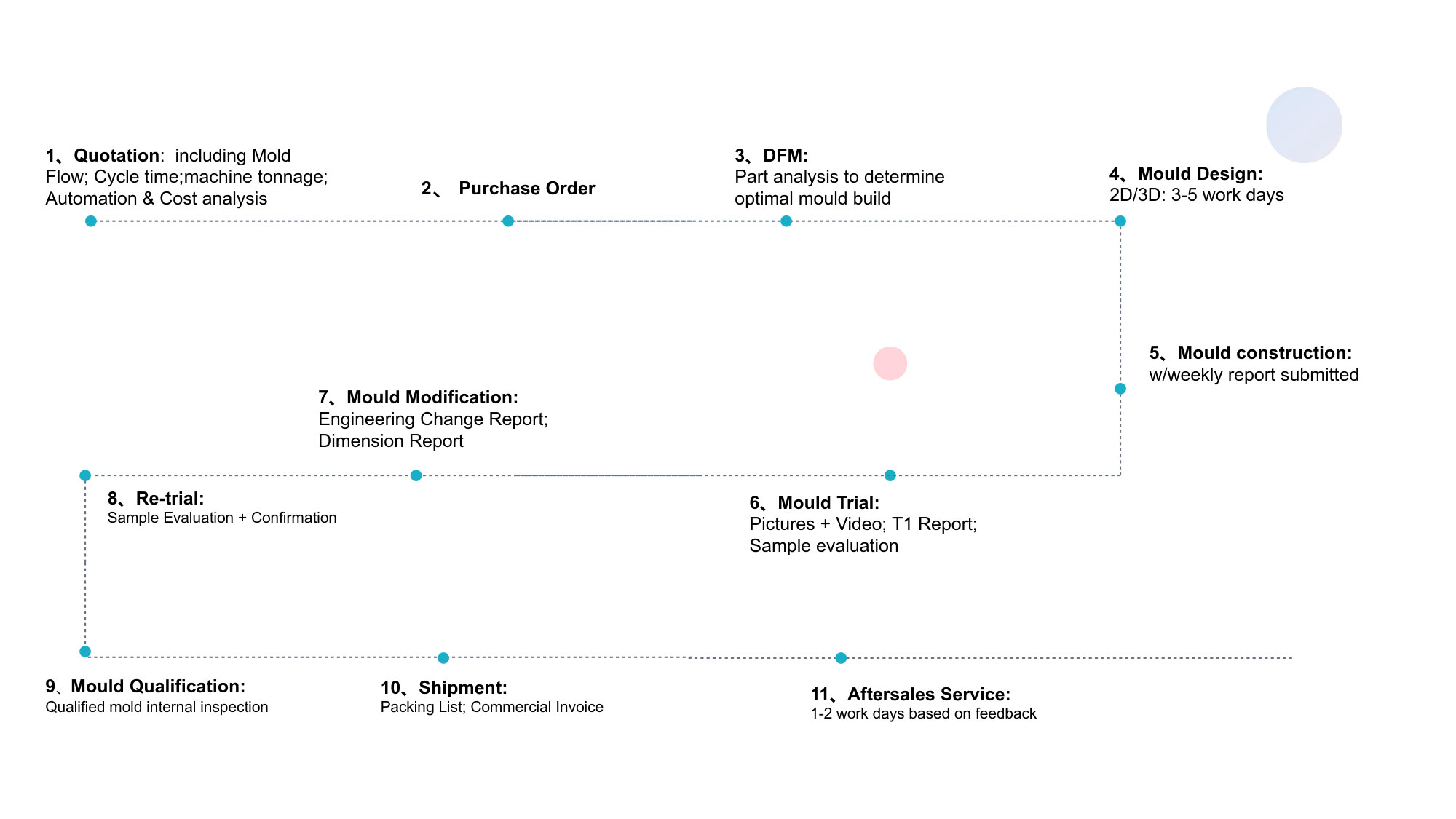
- The mold manufacturing process and product material selection
Our wire EDM capabilities complement five-axis machining for features that conventional tools cannot reach. For micro-precision parts requiring fine holes down to 0.03 mm diameter or narrow slots with high aspect ratios, wire EDM and micro-EDM technologies deliver the necessary precision without causing thin-wall deformation. Every mold component is machined with a level of detail that respects the fluid nature of LSR—a material that flows into every microscopic gap, making tight shutoffs and precise venting paramount.
Injection Molding Machine Fleet: Scale and Consistency
Our LSR injection molding press range spans from 30 tons to 400 tons, covering micro-precision parts weighing fractions of a gram up to larger sealing components. All machines feature all-electric servo drive systems with closed-loop feedback control, delivering shot repeatability sustained within ±0.1%. When production runs extend into the hundreds of thousands or millions of cycles, this repeatability means every part looks and measures exactly like the first part.
-
The injection units employ dual-cylinder metering systems that maintain A:B mixing ratio accuracy within ±0.5%, integrated temperature control zones regulating material from hopper to nozzle to prevent premature cross-linking. Integrated temperature control across eight heating zones maintains ±1°C precision—critical for LSR, where premature curing during filling can result in incompletely filled parts if mold surface temperatures are not properly managed.
Inspection and Metrology: Validation You Can Trust
A mold is only as good as the data that proves its quality. Ansix Tech operates coordinate measuring machines (CMM) and optical imaging inspection systems that perform full dimensional reporting on every mold before it leaves our facility. For critical part dimensions, we validate CPK ≥ 1.33—a statistical measure of process capability that means at least 99.993% of production falls within specification limits.
This is not a checkbox exercise. Each mold undergoes:
Measurement Type Method Acceptance Criteria
Cavity dimensions CMM with touch-trigger probing ±0.005 mm
Surface finish Optical profilometry Ra ≤ 0.05 μm
Gate/runner geometry Vision measurement system 100% inspection
Parting line fit Feeler gauge verification ≤0.01 mm clearance
Customer value translation: When we hand you a mold, you receive a full dimensional report comparing every critical feature against your CAD model. No guesswork. No “let’s run a few hundred shots and see.” Just data-driven confidence that the mold will perform as engineered.
II. Mold Manufacturing Core Competencies: Spec-Driven Performance
The mold is not a block of metal—it is the heart of your production line. Customers care about four things: life span, precision, lead time, and maintenance cost. Here is how Ansix Tech delivers on each.
Mold Life: Engineered for Longevity
Mold material selection directly determines how many parts you can produce before requiring maintenance or replacement. We choose materials based on your production volume, material characteristics, and application requirements:
Material Grade Typical Application Expected Life (LSR)
S136 / 4Cr13 Medical-grade, optical components 500,000+ cycles
H13 / 8407 High-temperature, high-wear applications 300,000+ cycles
NAK80 High-gloss, cosmetic parts 400,000+ cycles
2344 / SKD61 General-purpose, cost-optimized 250,000+ cycles
M340 Corrosion-resistant medical applications 500,000+ cycles
P20 (mold base) Structural support components Maintenance-free for mold life
Each material is supplied with a certified material test report and documented heat treatment curve, ensuring consistent hardness and microstructure throughout the mold. What this means for you: predictable mold life, scheduled maintenance that does not disrupt your production, and no surprise downtime due to premature wear.
Achievable Tolerances: Precision by Design
For LSR micro-precision parts, tolerance capability is not just a specification—it is a competitive advantage. Conventional structural parts are held to ±0.05 mm. For precision gears, medical valve components, and optical-grade parts, we achieve ±0.005 mm on critical features. Part-to-part repeatability across production runs is maintained at ±0.10 mm with CPK ≥ 1.33 verified on critical dimensions.
Translation: Your assembly process does not have to compensate for dimensional variation. Parts fit the first time, every time. Scrap due to out-of-tolerance conditions becomes statistically negligible.
Mold Types and Gate Strategies
Different applications demand different mold architectures:
Cold runner / valve gate systems — Eliminate runner waste entirely. For LSR, cold runners are essential to prevent premature curing before material enters the heated cavity. Valve gates provide individual cavity control for multi-cavity molds, ensuring balanced filling across all cavities.
Multi-cavity molds — Optimized for high-volume production, with cavity-to-cavity variation controlled through flow simulation and balanced runner design.
Overmolding molds — LSR-to-thermoplastic overmolding for soft-touch grips, seals molded directly onto plastic substrates, and two-shot assemblies produced in a single cycle.
High-gloss molds — Surface finishes achieving Ra ≤ 0.05 μm for optical-grade transparent parts, eliminating visible tool marks or flow lines.
Before any metal is cut, we perform mold flow analysis to predict fill patterns, identify air trap locations, and optimize gate placement. Simulation allows us to evaluate pressure drop, fill time, cure percentage, shear rate, and material viscosity—critical parameters that determine part quality. A wrong decision on gate location can prove extremely expensive to fix and may require building a new tool entirely. With simulation, we get it right before the first machining operation.
Cooling and Ejection Systems
LSR molding differs fundamentally from thermoplastics. There is no cooling phase—instead, mold temperature and cure time are the critical parameters. LSR requires a cold runner system (maintaining the material below curing temperature until injection) paired with a hot mold cavity (typically 120°C to 200°C) where crosslinking occurs.
Our cooling channel design is optimized through thermal simulation:
Conformal cooling channels follow the contour of complex parts, reducing cycle times by 15-25% compared to conventional straight-drilled channels.
Zone temperature control maintains the mold cavity within ±2°C temperature variation across the entire cavity surface, minimizing warpage and ensuring consistent cure.
Ejector pin placement is strategically positioned to avoid cosmetic surfaces, with pin diameters sized appropriately for micro-precision parts where ejector marks cannot be tolerated.
Lead Time Standards: Predictable Delivery
Mold Complexity Standard Lead Time Fast-Track
Simple molds (low cavity count, basic geometry) 10–15 days 7–10 days
Moderate complexity (multi-cavity, medium features) 25–35 days 20–25 days
High precision / complex geometry 35–45 days 28–35 days
Micro-precision with fine features (<0.1 mm) 45–60 days 35–45 days
Fast-track delivery does not bypass validation. Every mold, regardless of timeline, undergoes the same rigorous inspection protocol. The accelerated timeline comes from prioritized machine scheduling and parallel workflow, not from skipping steps.
III. Injection Molding Process Control: Eliminating Quality Uncertainty
Customers fear production variability. Shrinkage. Flash. Dimensional drift. Batch-to-batch color differences. Here is how Ansix Tech eliminates those fears.
Standardized Process Control
Every injection molding machine is connected to our Manufacturing Execution System (MES), which locks all process parameters—temperature, injection pressure, injection speed, cure time, screw position—with engineer-only access permissions. No operator can “tweak” a setting without documented authorization and validation. Every parameter adjustment is logged with time, date, operator ID, and justification.
What this means for you: Your parts are produced exactly the same way on Friday night shift as on Monday day shift. No mysterious quality problems that appear and disappear without explanation.
Dimensional Stability Management
LSR’s high flowability enables thin-wall parts down to 0.2 mm wall thickness, but this same flowability makes dimensional control challenging. We address this through:
Multi-zone mold temperature control — Independent heating zones maintain core and cavity temperatures within 2°C of each other, eliminating thermal-gradient-induced warpage.
Real-time cavity pressure sensors — Installed directly in the mold, these sensors detect fill variations at the cavity level and trigger closed-loop adjustments to injection pressure and pack time on subsequent cycles.
Automated part segregation — If validated process limits are exceeded, the system automatically segregates non-conforming parts, protecting quality and maintaining consistency shot after shot.
Data from production validation demonstrates capability: for a typical multi-cavity seal component, critical hole-to-hole spacing variation across three production runs over a one-week period is maintained at ≤0.02 mm.
Appearance Standards
LSR part appearance requirements vary by application:
Application Surface Finish Requirement Acceptance Method
Optical / lens components No bubbles, flow lines, or inclusions 100% vision inspection, Ra ≤ 0.05 μm
Medical contact surfaces Flash-free, smooth, no contamination ISO Class 8 cleanroom inspection
Cosmetic / consumer facing No visible gate marks or ejector marks Visual against gold sample
Overmolded soft-touch Consistent texture, no bleed-through Dimensional + visual validation
For transparent or translucent LSR parts, we achieve optical-grade clarity through polished cavity surfaces and optimized gate design that eliminates flow hesitation, jetting, and air entrapment.
Material Capability Matrix
Ansix Tech has production experience across the full spectrum of LSR and engineering materials:
LSR Grades:
General-purpose LSR (Shore A 20–80) — Standard seals, gaskets, keypads
Medical-grade LSR — ISO 10993, USP Class VI, FDA 21 CFR 177.2600 certified
Optical-grade LSR — High transparency, light transmission for lenses and light guides
Flame-retardant LSR — UL94 V-0 rated for electronics enclosures
Conductive LSR — For EMI shielding and conductive button applications
Shore A Hardness Range: 10 to 80, covering applications from ultra-soft baby care products to durable automotive seals
Thermoplastic Engineering Materials (for overmolding and two-shot applications):
PC, ABS, PC/ABS, PA6+GF30, PA66, PBT, PPS+40%GF, PEEK, PEI, PTFE/PFA, LCP
Translating material complexity to customer value: When your application requires UL94 V-0 flame resistance for an EV battery seal or USP Class VI certification for a medical implant, we do not ask you to “specify a material and hope it works.” We provide documented material certification, lot traceability from raw material receipt to finished part, and test results confirming compliance before production begins.
IV. End-to-End Service: Reducing Your Management Burden
Many molders offer “full service” as a marketing slogan. Ansix Tech delivers it as an operational model.
Early Engagement: DFM Before You Commit
Before a single dollar is spent on tooling, our engineering team delivers a comprehensive Design for Manufacturability (DFM) report that includes:
Draft angle recommendations — Identifying undercuts and providing optimal draft to ensure clean part ejection without deformation
Wall thickness optimization — Suggesting uniform wall profiles where possible and recognizing thick-section areas that risk sink marks or extended cure cycles
Gate location strategy — Multiple options with simulation results comparing fill patterns, pressure requirements, and air trap locations
Ejector pin placement — Marking allowable ejector pin locations and identifying zones where ejector marks are unacceptable
Tolerance analysis — Reviewing every dimension on your drawing and flagging specifications that may require process validation or material-specific considerations
Risk assessment — Identifying potential molding defects (weld lines, air entrapment, incomplete fill) before tool construction begins
Customer value: DFM finds problems on paper, not in steel. A change to a CAD file costs nothing. A change to a finished mold costs thousands. Our DFM process protects your development budget.
T0 Through T3 Sampling
We do not claim perfection on the first shot. Instead, we plan for a structured validation sequence:
Sample Stage Activity Deliverable to Customer
T0 — First shot Functionally validate that the mold builds a complete part Sample parts + visual inspection report
T1 — Dimension validation Measure all critical and non-critical dimensions Full dimensional report + deviation analysis
T2 — Process window optimization Run parameter sweeps to establish optimal process setpoints Process specification + CPK study
T3 — Production validation Run pilot batch, typically 100–500 shots Yield report + capability confirmation
Each sample stage is accompanied by an improvement report documenting what changed and why. For complex geometries requiring multiple design iterations, we can exchange mold inserts rather than rebuilding entire molds, significantly reducing iteration time and cost.
Pilot Production and Ramp-Up
Many customers are caught off guard when a prototype that works perfectly fails in volume production. We prevent this by requiring pilot production validation before full-scale ramp-up:
100 to 500 parts produced at target cycle time
Statistical process control (SPC) applied to every critical dimension
First Article Inspection (FAI) reports comparing production parts against drawing specifications
CPK ≥ 1.33 confirmed on all critical-to-quality (CTQ) features
Only when pilot production achieves the required capability do we proceed to full production. What this prevents: discovering process instability only after you have accepted shipment of 50,000 parts.
Maintenance, Spares, and Long-Term Support
A mold is a production asset, not a one-time purchase. Ansix Tech provides:
Spare parts kit — Ejector pins, core pins, and high-wear inserts delivered with the mold, enabling immediate in-house replacement when minor wear occurs
Scheduled maintenance schedule — Every 200,000 cycles, comprehensive mold cleaning, component wear inspection, and preventive replacement of wear items
Lifetime repair support — Repairs performed at cost, with no markup on service labor
Warranty coverage — Three-year mold structural warranty (excluding normal wear items)
Translation: Your mold is not a black box that fails and leaves you stranded. It is a transparent, maintainable asset with predictable costs and support.
V. Differentiated Commitments: Solving the Pain Points Customers Actually Have
Marketing language is easy. Concrete promises backed by engineering capability are hard. Below is a direct mapping of common customer complaints to Ansix Tech’s documented solutions.
Customer Complaint Ansix Tech Solution Quantified Customer Benefit
“Mold keeps breaking down — I’m always shutting down production for repairs.” Pre-delivery 2,000-cycle burn-in test with wear report; documented maintenance intervals; three-year structural warranty. Zero unscheduled downtime in first year of production for standard applications.
“Parts have flash everywhere — our assembly team spends hours trimming.” Parting lines machined to ≤0.005 mm fit precision; five-axis machining eliminates mismatch from multiple setups; cold runner design minimizes injection pressure variation. No secondary trimming required on typical parts; direct-to-assembly parts.
“Every batch has different dimensions — I can’t trust incoming inspection.” All machines MES-locked to validated parameters; real-time cavity pressure sensors with closed-loop control; automated part segregation when limits exceeded. Part-to-part variation maintained within ±0.10 mm; CPK ≥ 1.33 on CTQ features.
“Mold repair takes weeks — my customer is threatening to switch suppliers.” In-house electrode manufacturing and EDM workshop; standard repairs (weld + insert replacement) completed within 24 hours; mold repair does not leave the facility. Same-day emergency repair; 24-hour standard turnaround.
“I don’t know if my design can even be molded before I build tooling.” DFM report delivered before tooling commitment; mold flow simulation with material-specific properties; risk assessment and countermeasure recommendations. No “surprise” design changes after tooling is built.
“The mold works fine on my supplier’s press but not on mine.” Process optimization performed on Ansix Tech machines; process specification documents optimized parameters for transfer; operational training for your team. Plug-and-play mold startup at your facility.
VI. The Ansix Tech Difference: How We Reduce Total Cost and Deliver Value
LSR micro-precision molding is not the cheapest process on a piece-part basis—LSR equipment and precision mold investments are typically 30-50% higher than traditional injection molding. However, total system cost tells a different story. Ansix Tech drives cost reduction through four specific strategies:
Material Cost Optimization
LSR material costs range from USD
30
t
o
30to80 per kilogram—substantially higher than commodity thermoplastics. Every gram wasted is money lost. Our approach:
Cold runner systems eliminate sprue and runner waste entirely, directing 100% of purchased material into finished parts
Optimized part weights through DFM review and wall-thickness reduction achieve material savings of 5-15% without compromising functionality
Material lot consolidation — we purchase LSR in bulk, qualifying single lots for your entire production run to ensure consistent properties from first shipment to last
Process Efficiency Gains
Cycle time dominates production cost for LSR. Cure time is the longest portion of the cycle and is influenced by material properties, part thickness, and gate location. Ansix Tech optimization includes:
Simulation-driven cycle time prediction — we determine required cure time through filling and curing analysis before building the mold, not after
Conformal cooling reduces cycle times by 15-25% compared to conventional cooling channel designs
Automated part handling — servo-driven robotics remove parts directly from the mold and perform downstream operations, eliminating manual handling bottlenecks
Typical LSR cycle times achieve 30 seconds or less for many precision parts, compared to minutes for compression molding of equivalent parts
Energy and Scrap Reduction
All-electric servo-driven machines consume 50-70% less energy than hydraulic equivalents
Closed-loop process control reduces scrap rates to <2% on validated processes, compared to industry averages of 5-8%
Flashless mold design eliminates post-process material removal, reducing both labor cost and scrap
Manufacturing Execution System (MES) Integration
Our MES system provides real-time connection between inspection data and production execution, establishing a full-process quality control loop of “intelligent inspection → data upload → precise traceability”. This delivers:
Real-time quality monitoring — defects are detected and segregated at the moment of production, not at final inspection
Complete traceability — every part lot is linked to raw material batch, production parameters, inspection results, and operator
Predictive maintenance alerts — sensor data analysis identifies mold wear patterns before they affect part quality
Continuous process optimization — historical data analysis identifies opportunities for cycle time reduction and yield improvement
Conclusion: From Technical Capability to Business Value
Ansix Tech has accumulated over 28 years of production experience in LSR and precision molding. We do not claim to be the largest molder, but we are among the most technically capable when micro-precision, zero-flash, and high-cavity-count production are required.
The table below summarizes what Ansix Tech delivers—not as capabilities for their own sake, but as specific, measurable benefits to your business:
What We Do How It Benefits You
0.002 mm cavity tolerance Parts fit assembly without rework
CPK ≥ 1.33 process capability 99.993% of parts are within spec
DFM before tooling Problems solved on paper, not in steel
Flashless mold design No secondary trimming required
MES-locked process parameters Every batch identical to the last
In-house mold repair, 24-hour turnaround Production does not stop waiting for repairs
Three-year structural warranty Predictable long-term tooling costs
Cold runner systems Zero material waste — 100% of LSR becomes finished parts
Automated, all-electric presses Lower energy cost, consistent production
We invite you to experience this difference firsthand. Provide us with a part drawing, and we will return a DFM report that walks you through every risk — weld lines, air traps, sink marks, dimensional challenges — and our proposed solutions. No obligation. No cost. Just engineering transparency.
Because at Ansix Tech, we do not believe a mold is just a block of metal. We believe a precision mold is a revenue-generating asset — designed for producibility, validated for consistency, and supported for longevity. Your success is not an outcome of our capabilities. It is the entire purpose of them.
Ansix Tech Co Ltd
If you have any plans related to LSR Liquid Silicone Micro-Precision Part Molding , you can contact us at any time. We will turn your ideas into reality, let you realize your dreams, and obtain large orders from the market. Our contact information is info@ansixtech.com. Or contact our CTO, mail: stephen@ansixtech.com
#www.ansixtech.com #ansixtech.com #LSR Liquid Silicone Micro-Precision Part Molding #LSR Liquid Silicone Micro-Precision Part Molding injection molding companies #LSR Liquid Silicone Micro-Precision Part Molding Canopy Mold injection mold companies #Ansix #Ansix moulds #Ansix china #Ansix tech china #Ansix tech company #Ansix facotry #LSR Liquid Silicone Micro-Precision Part Molding injection molding #LSR Liquid Silicone Micro-Precision Part Molding injection tools #LSR Liquid Silicone Micro-Precision Part Molding injection moulds #LSR Liquid Silicone Micro-Precision Part Molding plastic mould #LSR Liquid Silicone Micro-Precision Part Molding plastic tools #Ansix Tech #Ansix molds #Ansix injection molding #Ansix mold factory #injection molding LSR Liquid Silicone Micro-Precision Part Molding#Ansix mold factory #LSR Liquid Silicone Micro-Precision Part Molding china #LSR Liquid Silicone Micro-Precision Part Molding molds #injection factory #LSR Liquid Silicone Micro-Precision Part Molding injection molding #LSR Liquid Silicone Micro-Precision Part Molding injection molding factory #injection molding company #LSR Liquid Silicone Micro-Precision Part Molding injection mold companies #LSR Liquid Silicone Micro-Precision Part Molding Tooling #LSR Liquid Silicone Micro-Precision Part Molding mold limited #Ansix mold china #Ansix companies #Ansix company China #LSR Liquid Silicone Micro-Precision Part Molding facotry #Ansix Tech #Ansix Tech mould #LSR Liquid Silicone Micro-Precision Part Molding injection moulding #injection moulding company #Ansix LSR Liquid Silicone Micro-Precision Part Molding parts injection mold companies #medical injection molding companieschina #LSR Liquid Silicone Micro-Precision Part Molding china factory #Ansix moulding companies #Ansix molding company #LSR Liquid Silicone Micro-Precision Part Molding injection moulding facotry #Ansix Tech mold #LSR Liquid Silicone Micro-Precision Part Molding mould #LSR Liquid Silicone Micro-Precision Part Molding plastic injection molding #ansix plastic mold #Mold manufacturing #LSR Liquid Silicone Micro-Precision Part Molding parts manufacturing #LSR Liquid Silicone Micro-Precision Part Molding plastic parts factory #LSR Liquid Silicone Micro-Precision Part Molding injection parts mold #LSR Liquid Silicone Micro-Precision Part Molding PRECISION MANUFACTURING #LSR Liquid Silicone Micro-Precision Part Molding #China mold #LSR Liquid Silicone Micro-Precision Part Molding injection moulding china #LSR Liquid Silicone Micro-Precision Part Molding mould china #china precision mold #mold in china #LSR Liquid Silicone Micro-Precision Part Molding mold china #Precision molds #High-precision molds #LSR Liquid Silicone Micro-Precision Part Molding #Injection molds #LSR Liquid Silicone Micro-Precision Part Molding Factory #LSR Liquid Silicone Micro-Precision Part Molding Company #Super Large Injection Mold Factory #Large Tonnage Injection Molding Factory #LSR Liquid Silicone Micro-Precision Part Molding Company #LSR Liquid Silicone Micro-Precision Part Molding Factory #2800T Injection Molding Factory #3000 Ton Injection Molding #4500 Ton Injection Molding Factory #Large Mold Injection Molding #Large Plastic Mold Injection Molding Factory #Large Injection Mold Manufacturer #Plastic Mold Factory #Injection Mold #Plastic Mold