



PC/ABS Plastic Parts Overmolding with LSR — Embedded LSR Seal Molding
FEATURES
This document articulates, in five structured sections, how Ansix‘s technical capabilities answer the four questions that matter most to customers:
① What problems do you solve for me?
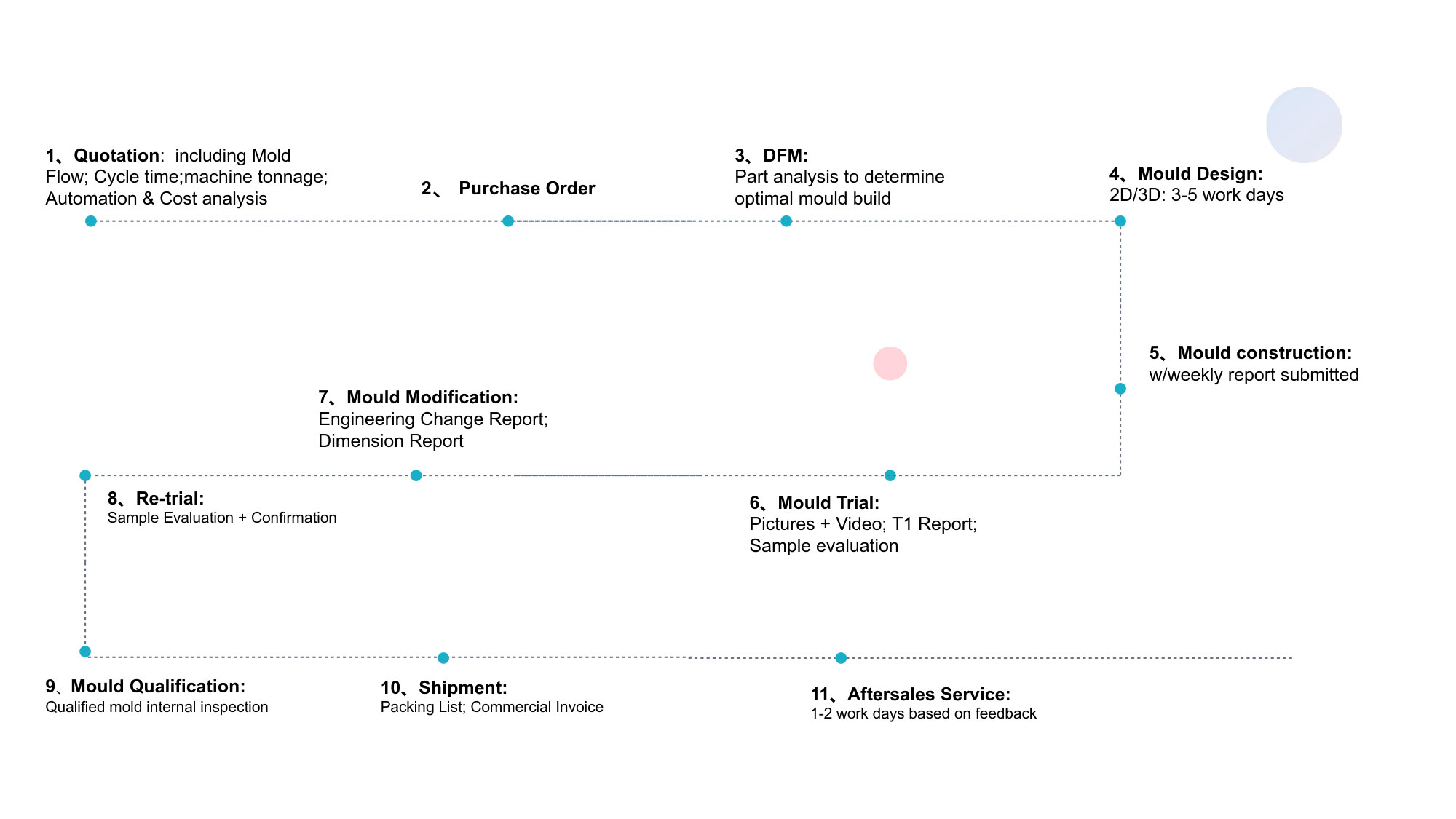
② How much cost do you save me?
③ How much risk do you remove from my supply chain?
④ What verification and validation do you provide so I can trust your output?
Section One: The “Hard Power” Foundation — Why Ansix‘s Equipment Infrastructure Generates Instant Customer Trust
A customer’s confidence in a manufacturing partner begins with the machines on the shop floor. Ansix operates a fully integrated manufacturing campus where mold fabrication, injection molding, quality inspection, and assembly are co-located under one quality management system. Below is how our equipment base translates directly into customer value.
-
Mold Description
Product Materials:
ABS/PC + LSR SILICONE
Soft rubber: LSR SILICONE
Mold Material:
S136ESR
Number of Cavities:
4
Glue Feeding Method:
Hot runner
Cooling Method:
Water cooling
Molding Cycle
22.5s
- The mold manufacturing process and product material selection
Mold Machining Equipment — Precision That Eliminates Post-Processing
Professional Capability Customer Value Translation
Five-axis high-speed machining centers capable of machining complex curved surfaces with ±0.002 mm contour accuracy. Your product‘s part lines are smooth and burr-free. No secondary deflashing or hand-trimming is required, saving you 5–8% in post-molding labor costs per batch.
Slow-speed wire EDM (wire-cut EDM) capable of cutting micro holes and narrow slots down to 0.03 mm without causing thin-wall deformation. Complex geometries with tiny vents, labyrinth seals, or micro-grooves are machined directly into the mold, not added as secondary operations. Your design is fully realized — not compromised.
CNC electrical discharge machining (EDM) with electrode manufacturing in-house — all electrodes machined on-site, not outsourced. Tooling rework or design modifications are completed in hours, not weeks. When your product evolves, Ansix responds immediately. No external lead time penalty.
Mold assembly and fitting stations with precision alignment fixtures. Every mold half is verified for match-fit before trial. Your first shots have minimal flash and require little or no adjustment.
The Customer Promise: We invest in machining capability so you do not have to invest in post-processing infrastructure. Your incoming inspection time is reduced, and your assembly line integration is seamless.
-
Injection Molding Machine Fleet — Process Stability That Delivers Identical Parts, Batch After Batch
Professional Capability Customer Value Translation
All-electric servo-driven injection molding machines with clamping force ranging from 30 tons to 400+ tons, covering product dimensions from micro-miniature seals (<5 g) to large-format housings (>2 kg). One supplier covers your entire product portfolio — from small pilot runs to high-volume production across different product families. No fragmentation of your supply base.
Repeat positioning accuracy ±0.1% on injection stroke, holding pressure, and screw speed. Every shot is dimensionally identical to the previous one. When you receive 100,000 units, the first part and the last part are indistinguishable in critical dimensions. Your assembly automation does not need to adapt to variation.
Closed-loop process parameter control with real-time monitoring of cavity pressure, melt temperature, and injection velocity. Out-of-spec parts are detected and rejected during the cycle — not days later in your incoming inspection. Your assembly line never stops because of a dimensional excursion.
Simultaneous multi-material injection capability for two-shot (2K) overmolding processes, including a dedicated LSR injection unit with cold runner system (40–80°C barrel temperature / 160–200°C mold temperature). PC/ABS substrate and LSR seal are molded in a single integrated cycle. No manual pick-and-place, no secondary loading, no handling-induced damage. Cycle times shrink, yields rise, and labor cost falls.
Mold temperature control via zone-dedicated mold temperature controllers (water/oil) capable of maintaining core/cavity temperature differentials within ±2°C. LSR cures uniformly without scorching the PC/ABS substrate (which has a lower glass transition temperature of approximately 110–136°C for PC/ABS versus 160–200°C required for LSR vulcanization). Ansix‘s thermal management prevents substrate distortion, delamination, and internal stress cracks — problems that plague less sophisticated overmolding operations.
The Customer Promise: Our machines are not just capable — they are locked down. All critical parameters are frozen in our MES (Manufacturing Execution System) and cannot be altered without authorized engineering review. What you qualify in our facility is what you receive in every subsequent shipment. No surprises. No “batch-to-batch variation” excuses. Process capability (Cpk) is calculated, reviewed, and guaranteed before we ship a single part for production.
1.3 Metrology and Quality Assurance Equipment — You Cannot Manage What You Cannot Measure
Professional Capability Customer Value Translation
Coordinate measuring machines (CMM) with scanning capability and programmable measurement routines. Every injection mold undergoes a full dimensional report before being released to the production floor. Critical dimensions are measured, recorded, and validated against your print.
Optical measurement system / digital microscope for non-contact inspection of micro-features and surface texture. Tiny seal grooves, sharp corners, and delicate features are verified without risk of probe deformation. We see what matters — down to micron levels.
Tensile testing and Shore hardness measurement equipment for LSR material validation. Incoming LSR material lots are tested for cure characteristics, hardness, and tensile properties before any production run begins. Your seal‘s compression set performance is consistent from lot to lot.
Flash / burr inspection station with digital magnification. Flash is quantified, measured, and controlled to ≤0.03 mm before parts are released. Your assembly operators do not need to manually trim rubber — a direct labor savings of 10–15 seconds per part eliminated.
Full material certification documentation — material certificates, batch traceability, and test reports maintained per ISO 9001 / IATF 16949 requirements. Your quality department receives a complete audit trail. Every part can be traced back to the raw material lot, the mold cavity, the production shift, and the inspection record. No liability gaps.
The Customer Promise: Before a single production part ships, Ansix provides your quality team with First Article Inspection (FAI) reports, CpK analysis for critical dimensions (targeting CpK ≥ 1.33 minimum; >1.67 on customer-identified key characteristics), and material certifications. Your incoming inspection is reduced to a spot-check confirmation, not a gate-keeping battle.
Section Two: “Mold Manufacturing” Core Competitiveness — How Ansix Converts Precision Specifications into Customer Peace of Mind
Molds are the heart of any injection molding operation. A poorly designed or hastily built mold will haunt a program for years — causing flash, dimensional drift, short shots, and endless maintenance interventions. Ansix treats mold design and fabrication not as a cost center but as a value creation engine.
2.1 Mold Life Expectancy — Predictable, Audited, Guaranteed
Professional Specification Customer Value Translation
Mold base: P20-class steel, hardened and stress-relieved. Mold core/cavity (mold inserts): Selection based on material and production volume — S136 (420-class stainless), 2343, 2344, 8407, SKD11, SKD61, DC53, M340, 4Cr13, 9Cr18, NAK80, H13 — each chosen for wear resistance, corrosion resistance, or optical clarity requirements. We match the steel chemistry to your specific application — not a “one steel fits all” compromise. Your mold yields minimum 500,000 shots for glass-fiber-reinforced materials (e.g., PC/ABS + GF) and 1 million shots for unfilled engineering thermoplastics. You amortize tooling over millions of parts, reducing your piece-price contribution significantly.
Detailed material certification and heat treatment curve documentation provided with every mold. Your engineering team has full transparency into the materials that will contact your product. No guesswork. No untested substitutions.
Full production-proven tooling: Ansix molds are designed for high-cavitation (2–32 cavities typical, up to 64 for micro-components), continuous 24/7 operation with minimal downtime. When your demand surges, our tools do not break or wear prematurely. You are not waiting for emergency mold repairs at 2 a.m. Your production line stays running.
Risk Removal Statement: We do not “estimate” mold life. We document steel selection, heat treatment parameters, and surface finish (Ra). For tools intended for glass-reinforced materials, we incorporate hardened inserts at wear-prone locations (gates, shut-offs, parting lines). Your maintenance interval is known before production starts, not discovered after failure.
2.2 Achievable Tolerances — Predictable, Repeatable, Auditable
Professional Specification Customer Value Translation
General structural features: ±0.05 mm (ISO 286 IT9 equivalent). Straightforward product features are held with robust process windows — no over-specification that drives unnecessary cost.
Critical dimensions, precision gears, medical components, LSR seal groove interfaces: ±0.005 mm achievable on specific, well-defined features with proper process control. The interface between your PC/ABS structural housing and the LSR seal is absolutely controlled. No leakage paths. No interference fits that fail assembly. No press-fit forces that crack plastic.
Dimensions between sequential shots in 2K overmolding maintained within 0.02 mm across multiple cycles. The second-shot LSR seal is exactly where your product design requires it to be — regardless of thermal expansion or mold deflection.
The Customer Promise: Each tool is supplied with a full-dimension measurement report (often exceeding 50 measured features). Critical dimensions are identified and monitored in ongoing production. Your product‘s “fit, form, and function” are verified before production begins and monitored throughout the production life.
2.3 Mold Types and Configurations — Engineering the Right Tool for the Right Volume
Mold Type Capability Customer Value
Hot runner systems Balanced multi-drop hot manifolds with precise thermal control. Plastic substrate material waste is minimized. No runner scrap to grind or reprocess — material usage efficiency increases 5–15% compared to cold runner tools.
Cold runner systems for LSR injection LSR-specific cold runner blocks maintained at 40–80°C, preventing premature curing in the runner. No plugged runner channels. No scrap LSR waste. A/B components mix precisely at the injection point, not before.
Stack molds (multi-level / tandem molds) Two mold parting lines operating simultaneously on a single press. Production output doubles without doubling capital equipment or floor space. Effective cost-per-part reduction of 30–40% for suitable geometries.
Two-shot (2K / multi-material) rotary or index-plate molds First substrate shot rotates or indexes into second cavity for LSR overmolding in the same machine cycle. No manual part handling. No risk of substrate contamination between shots. Bond strength is chemical/mechanical, not assembly-dependent. Cycle time = one cycle = finished part.
High-gloss / optical-grade molds Polished to Ra < 0.05 μm surface finish, compatible with transparent PC/ABS formulations. Cosmetic surfaces require no secondary polishing or coating. Your product’s transparent windows, lenses, or display covers meet optical clarity requirements without additional post-processing cost.
2.4 Gate and Runner Design — Simulation-Driven, Risk-Mitigated
Professional Capability Customer Value Translation
Mold flow analysis (Moldex3D / Moldflow) performed for every new tool before steel is cut. The analysis validates gate location, gate count, injection pressure, fill balance, and venting strategy. We predict weld-line locations, air-trapping zones, and potential sink marks before they appear in your part. By adjusting gate positions and runner diameters in the digital twin, we eliminate 80–90% of molding defects before physical sampling begins. Your T0 (first trial) parts are often functional, not scrap.
Gate type selection tailored to part geometry: submarine gates, fan gates, direct sprue gates, or hot drop gates — each chosen for optimal aesthetics and minimal witness mark. Cosmetically sensitive areas (visible surfaces, brand logos) are kept gate-free. Witness marks are hidden on non-cosmetic surfaces. No secondary sanding or painting required.
Runner balancing algorithm applied to multi-cavity tools to ensure identical fill time and pressure across all cavities. Every cavity produces dimensionally identical parts. Cavity-to-cavity variation is eliminated. You are not sorting “good cavities” from “bad cavities” in incoming inspection.
Venting design integrated into parting line and ejector pins to prevent trapped air that causes burn marks or incomplete fill. No burn marks. No “die swell” artifacts. LSR flows fully into complex seal grooves without air entrapment because the air has a designed escape path — not just “hope.”
The Customer Promise: Ansix will deliver a Digital DFM (Design for Manufacturability) Report before you sign a tooling purchase order. This report includes:
Gate location recommendations.
Wall thickness optimization suggestions.
Draft angle requirements.
Predicted fill pattern and weld-line locations.
Suggested modifications to improve moldability and reduce cycle time.
You approve the DFM. We cut steel. Risk is shifted to our design phase — not your production phase.
2.5 Standard Lead Times — Predictable, Achievable, Escalated Options Available
Tool Complexity Standard Lead Time Fast-Track (Premium) Lead Time
Simple single-cavity prototypes 10–15 days Expedited upon request (subject to machine availability)
Medium complexity (single-shot, 2–4 cavities) 20–35 days 14–20 days with shifted prioritization
High-complexity 2K overmolding tools (rotating plates, multi-slides, hot runner) 35–60 days 20–30 days accelerated
Production family tooling (multiple interchangeable inserts sharing common mold base) Base + 10 days per additional insert set Parallel machining reduces total elapsed time
Risk Mitigation: Fast-track does not mean “skip validation.” Even under accelerated schedules, Ansix performs full mold flow analysis, bench assembly verification, and trial sampling. Nothing leaves our facility without documented capability.
2.6 Mold Maintenance and Spare Parts — Proactive, Transparent, Cost-Effective
Service Offering Customer Value
Spare parts kit included with every production mold — ejector pins, core pins, wear plates, and small springs. When routine replacement is needed, you have the parts in your facility. No urgent purchase order. No production stoppage.
Recommended maintenance schedule provided: preventive tasks every 50,000–100,000 shots, with detailed checklists and part life expectations. You plan maintenance during scheduled downtime — not emergency repairs during peak production.
Lifetime mold repair services at direct cost (materials + labor). No “hidden tooling rework fees.” When minor damage occurs (corrosion, gate wear, minor impact), Ansix repairs the tool at essentially cost. Your capital asset is protected.
The Customer Promise: We consider molds not as “blocks of steel” but as revenue-generating assets — your production “cash machines.” Every design decision prioritizes uptime, reliability, and low-maintenance operation. When you need support, we respond within 24 hours for urgent issues and within 5 days for standard service requests.
Section Three: Injection Molding Process Control — Eliminating the “Quality Anxiety” of Every Customer
Customers who have been burned by inconsistent molding partners know the symptoms: shrinkage, flash, dimensional drift batch-to-batch, color variation, and delamination between PC/ABS and LSR. Ansix has engineered our entire production system to systematically eliminate these failure modes — not just react to them.
3.1 Process Standardization and Parameter Lock-Down — The Foundation of Repeatability
Capability Customer Value Translation
All injection molding machines networked to a centralized Manufacturing Execution System (MES). Critical parameters — barrel temperatures (zone 1–4), nozzle temperature, mold temperature (cooling/heating channels), injection velocity profile, holding pressure (1–3 stages), screw RPM, back pressure, cooling time — are all locked in software. No unauthorized operator changes. No “secret adjustments” made during night shifts. Every batch runs with the exact same recipe developed during the qualification phase. Cpk is auditable, not anecdotal.
First-article and last-article comparison performed for every production batch — the first part produced in a batch is measured, and the last part from the same run is re-measured against the same critical dimensions. If process drift occurred during the run (heater failure, screw wear, material variation), you know about it before the parts leave our dock — not after your assembly line rejects them.
Sampling frequency defined per part complexity: typical 1:100 for general dimensions, 1:50 for critical-to-function dimensions, 100% automated optical inspection for certain micro-features. Your risk exposure is defined, documented, and controlled. No “lot release” is based on guessing.
3.2 Dimensional Stability — Maintaining Tight Tolerance Despite Thermal and Pressure Variation
Technical Challenge Ansix Solution Customer Benefit
Warpage and distortion from mismatched shrinkage between PC/ABS (0.5–1.5% total shrinkage) and LSR (2–3% linear shrinkage after cure). Zoned mold temperature control with core temperature held independently of cavity temperature. Differential between core and cavity surfaces maintained within ±2°C across the entire molding surface. Cooling lines are machined using conformal cooling (3D-printed or gun-drilled curved channels) in complex geometries, not just straight drilled circuits. PC/ABS substrate emerges from the mold with minimal residual stress. The LSR seal bonds and cures without excessive shrinkage stress at the interface. No delamination. No cracking. No out-of-flatness warpage.
Batch-to-batch dimensional variation caused by environmental or material fluctuations. Real-time cavity pressure sensors installed in production tools (for high-volume qualified programs). Pressure profile is monitored in each shot. Automated compensation of holding pressure and injection velocity is activated when pressure deviation exceeds pre-set limits. Finished parts have critical-hole center-to-center spacing variation of ≤0.02 mm across three consecutive production weeks. Your assembly tooling (fixtures, automated insertion equipment) never sees part variation.
The Customer Promise: We provide a process capability study (30 consecutive shots measured, CpK calculated per dimension) as part of your PPAP (Production Part Approval Process) package. You do not guess. You do not hope. You know.
3.3 Visual and Surface Quality — Cosmetic Excellence Without Secondary Finishing
Surface Class Ansix Capability Customer Impact
High-gloss / transparent components (PC/ABS) Mold surface polished to Ra < 0.05 μm, free of machining marks and flow lines. Optical clarity meets light-transmission requirements for indicator lenses or display windows. No secondary polishing. No buffing. No coating required to achieve cosmetic appearance. Your part is “mold ready” out of the press.
Textured / grain finishes Mold surface produced via EDM or chemical etching to replicate specified texture standards (VDI 3400, Mold-Tech, or customer-supplied samples). Texture is machined or etched, not applied post-process. Consistent surface feel across all parts. No “smooth spots” where texture was accidentally polished away. No separate texturing operation.
LSR seal cosmetic finish Cold runner system combined with polished LSR cavity surfaces yields bubble-free, flash-controlled LSR surfaces requiring no post-cure trimming beyond standard deflashing. The LSR seal has a professional appearance. No “rough rubber” that catches on gloves or attracts dirt.
The Customer Promise: If your product requires secondary operations (painting, laser etching, pad printing, pad-printing alignment), Ansix includes compensated shrinkage modeling in the mold design. The part geometry intentionally accounts for distortion so that post-process operations align properly — preventing the “close enough but not perfect” misses that cause rejects.
3.4 Special Material Experience — When Standard Materials Are Not Sufficient
Ansix has successfully processed and validated over 100 distinct polymer families across consumer, industrial, automotive, medical, and electronic applications. Below is a partial list of materials for which we have demonstrated production-ready process capability:
Engineering Thermoplastics (Substrate):
PC/ABS (flame-retardant grades: UL94 V-0 at 1.5 mm thickness, glow wire 960°C — e.g., Bayblend® FR3010, FR3000 series) — standard for our embedded LSR seal applications
PC (polycarbonate) — transparent and opaque grades
ABS (acrylonitrile butadiene styrene)
PA6 / PA66 (nylon) — unfilled and glass-reinforced
PBT — electrical connector housings
PPS (polyphenylene sulfide) — high-temperature under-hood automotive components
PPS + 40% GF — high-stiffness, high-heat assemblies
PEEK (polyetheretherketone) — extreme-performance applications
PEI (Ultem®) — aerospace and high-heat electrical
LCP (liquid crystal polymer) — micro-miniature connectors
PPA (polyphthalamide) — high-temperature automotive
Overmold LSR Grades:
General-purpose LSR (e.g., ELASTOSIL® LR 3003/3005 series, Shore A 20–80, temperature range –50°C to +200°C)
Self-adhesive LSR grades — bond chemically to PC/ABS without primers, reducing process steps
Medical-grade LSR — ISO 10993, USP Class VI, FDA-compliant
Food-grade LSR — LFGB, EU 10/2011 compliant
Fluorosilicone LSR — enhanced chemical and fuel resistance
Electrically conductive / EMI shielding LSR
Optically clear LSR — for lighting and sensor applications
Fast-curing LSR grades — reducing vulcanization time to 10–30 seconds for thin sections
The Customer Promise: We do not experiment with your production line. Every material combination we propose has been validated in our facility using representative coupon geometry and/or customer-specific test parts. We provide documented processing windows (temperature, pressure, cure time), adhesion test results (peel strength / shear strength), and material certifications before production begins.
Specialty Capability: For applications requiring flame-retardant performance (UL94 V-0 at 1.5 mm or 3.0 mm), Ansix works only with fully certified PC/ABS grades meeting your specific end-use requirements. We provide UL yellow card references or material datasheets confirming compliance.
Section Four: Full-Process Service — Reducing Your Management Burden and Hidden Costs
Many molders claim to offer “full service.” Ansix delivers it as a structured, documented process — not as a slogan.
4.1 Early Engagement: DFM (Design for Manufacturability) Analysis — Solving Problems Before They Become Problems
What We Do: Before Ansix accepts a tooling order, our engineering team reviews your product design and prepares a DFM report that specifically addresses:
Recommended wall thickness range: typically 1.5–3.0 mm for PC/ABS substrates, consistent thickness to minimize warp, with transition zones tapered (not stepped) to avoid stress risers.
Draft angle recommendations: ≥1° on untextured surfaces, ≥2–3° on textured shutoffs, to prevent drag marks and ejection damage.
Undercut identification: We flag features that require side-action cores or lifters, and we estimate cycle time and tooling cost impact of each undercut feature — so you can make informed design trade-offs.
Gate location selection: Simulated to minimize weld lines in cosmetic or high-stress areas.
Ejector pin location allowances: We identify where witness marks will appear and request your approval for pin placement.
LSR groove geometry: Width-to-depth ratio, corner radius, venting paths, and mechanical interlock features (holes or undercuts in the PC/ABS substrate) to enhance LSR bonding beyond chemical adhesion.
Customer Value: You approve a manufacturable design before we cut steel. If your design is not moldable as drawn, we give you options — not a surprise change order after steel is cut. Rework cost is minimized or eliminated. Development time is compressed because the first physical samples are functional, not exploratory.
4.2 Trial Molding and Progressive Optimization (T0 → T3) — Iteration with Transparency
Trial Stage Ansix Deliverable Customer Value
T0 (First Mold Trial) 20–50 samples from the first injection attempt. Detailed trial report including photos, measurements, defect observations, and root-cause analysis of any defects. You see the tool‘s baseline performance. If changes are required (gate modifications, vent additions, texture adjustments), we identify them within days — not weeks.
T1 (First Optimization) Samples with first round of corrections applied. Corrective action log documenting what was changed and why. Updated dimensional report. Traceability is built into the process. You know exactly what changed between iterations and why.
T2 (Second Optimization — if required) Fine-tuning of ejection, cooling balance, or gate vestige control. Updated CpK preview. Most tools reach production-ready status at T1 or T2. Repeat customers often skip T2 because our DFM accuracy is high enough.
T3 (Pre-Production Validation) 100–500 parts produced under production conditions (same machine, same cycle time, same operator workload). Full capability study. You sign off on a statistically validated process — not just a few “golden parts” hand-selected from a trial.
The Customer Promise: Every trial iteration is accompanied by a written report. You do not guess at what changed. You do not chase undocumented modifications. Transparency is contractually required — not optional.
4.3 Low-Volume Pre-Production Validation — Risk-Free Ramp-Up
Why This Matters: Moving directly from T3 samples to full-volume production (10,000+ parts) without a medium-volume validation step risks catastrophic failure if an unobserved process sensitivity exists.
Ansix‘s Approach:
We offer a contracted pilot run of 100–1,000 parts using production tooling, production-grade raw materials, and the intended production machine (or an identical model).
These pilot parts are subjected to full dimensional inspection, functional testing (where applicable), and appearance sorting.
Pilot run yield and CpK are documented.
Only after pilot run metrics meet your requirements do we release the program for high-volume production.
Customer Value: You have empirical evidence — not just supplier assurances — that the process works at scale. If a problem emerges at 500 parts, you have lost 500 parts worth of value. If a problem emerges at 50,000 parts, you have lost 50,000 parts worth of value plus rework labor. Validation is scaled to risk.
4.4 Maintenance, Spares, and Lifetime Support — Protecting Your Capital Investment
Spare parts kit included with each production mold: ejector pins, core pins, wear plates, and a set of leader pins/bushings.
Preventative maintenance schedule provided: weekly cleaning, monthly wear checks, 100k-shot lubrication and calibration.
Lifetime repair service at direct material + labor cost (no “re-tooling” markups).
On-call engineering support for emergency troubleshooting: response within 24 hours for critical line-down issues.
The Customer Promise: We do not disappear after the tool ships. Ansix partners with you for the life of the program — because we know that if you succeed, we succeed.
4.5 Integrated Assembly and Secondary Operations — One Supplier, One Responsibility
As an optional value-add service, Ansix can perform the following secondary operations in-house, eliminating the need for separate suppliers and reducing your vendor management burden:
Secondary Operation Capability
CNC trimming / deflashing of LSR flash (where design permits) Automated flash removal to specified edge condition
Laser marking / engraving Date codes, logos, serial numbers, 2D Data Matrix codes
Pad printing Multi-color logos or control graphics on PC/ABS surfaces
Solvent welding or ultrasonic welding (if plastic-to-plastic joints needed) In-house capability
Sub-assembly insertion (e.g., placing seals into grooves before shipping, inserting metal bushings) Contract-specific
Custom packaging (tray packing, anti-static bags, bulk pack, JIT sequenced delivery) Designed to match your incoming automation
Customer Value: You manage one quality system, one purchase order, one shipping schedule. No handoffs between suppliers. No finger-pointing when a mark is misaligned. Accountability is singular and unambiguous.
Section Five: Comparative Differentiation — Addressing Common Industry Complaints with Guaranteed Solutions
This final section directly answers the most frequent complaints customers have about their existing molders — and how Ansix systematically eliminates each one.
Common Customer Complaint Ansix‘s Professional Response Quantified Customer Value
“The mold needs constant repairs — every few months we have emergency downtime.” Ansix performs a 2,000-cycle accelerated wear test on every production mold before delivery. We measure and record pre-test and post-test dimensions for critical wear surfaces. A wear report is provided. Additionally, we offer a 3-year structural warranty on the mold (excluding normal wear of consumables such as ejector pins and slide springs). Unplanned downtime reduced by up to 70% compared to non-tested tools. Your production line runs hours previously lost to emergency mold repairs.
“Flash is everywhere. We spend hours manually trimming rubber.” Parting line machining accuracy is held to ±0.005 mm matching fit using our five-axis machining centers and EDM electrode matching. Self-locking tonnage compensation on our injection presses ensures consistent clamp force shot-to-shot. Flash is controlled to ≤0.03 mm at shut-off surfaces and ≤0.05 mm elsewhere. Manual trimming labor is eliminated (saving 10–15 seconds per part, or 400+ labor hours per 100,000 units). No air nozzles or manual knives required. Your assembly line takes parts straight from the box and inserts them — no pre-assembly sorting.
“Dimensions are never consistent — first batch is fine, second batch is out of spec.” Ultrasonic wall-thickness sensors installed in select production tools, monitoring plastic wall thickness in real time. In-mold pressure and temperature sensors provide closed-loop feedback to the injection molding machine’s controller. If melt viscosity changes (due to material lot variation or environmental factors), holding pressure and injection speed are automatically compensated without operator intervention. Critical dimensions (hole spacing, outer diameter, LSR seal groove depth) are maintained within ±0.02 mm across 10 consecutive production runs spanning three months. Your automated assembly equipment never rejects parts for dimensional drift.
“Mold repairs take weeks — we lose entire production windows.” All mold fabrication resources are in-house: CNC machining, wire EDM, EDM, grinding, heat treatment (subcontracted but controlled), and assembly are on-site. Most mold repair operations (gate re-cutting, vent addition, ejector pin replacement, minor weld repair) can be completed within 24 hours of issue identification. More extensive repairs (core replacement, major parting line refitting) are typically 3–7 days. Emergency repair response: 24 hours or less. Routine maintenance: scheduled in advance with <48 hours of press downtime. Your material requirements planning (MRP) system can trust the lead time estimates.
“We have moisture sensitivity / hydrolysis issues with PC/ABS in humid environments.” Materials are pre-dried using dehumidifying dryers to achieve moisture content <0.02% (200 ppm) before processing. Drying temperatures and times are specified per material supplier data sheets. Parts are packaged in moisture-barrier bags with desiccant immediately after molding, then heat-sealed. No hydrolysis blistering. No molecular weight degradation during molding. Your product’s mechanical properties are preserved regardless of shipping or storage conditions. UL certification integrity maintained.
“Supplier lead times are unpredictable — they quote 4 weeks but deliver in 10.” Ansix‘s production scheduling system tracks every job against planned milestones. Project managers conduct weekly status reviews and flag any slippage within 2 days of occurrence. Late deliveries are contractually penalized (specific terms in supply agreement). For critical programs, we provide expedited path options (premium charge, but guaranteed date). You plan inventory and production schedules with high confidence. No “emergency air freight” costs for late materials.
The Ultimate Ansix Promise: A Mold is Not a Block of Steel — It Is Your Revenue Engine
At Ansix, we design every mold with simultaneous consideration of:
Process robustness — Can this tool run 8 hours unattended?
Ease of maintenance — Can ejector pins be replaced without removing the mold from the press?
Thermal balance — Will the PC/ABS substrate cool uniformly without core/cavity temperature mismatch?
Venting strategy — Is air evacuation designed in, not “hoped for” on the press floor?
LSR compatibility — Does the gate, runner, and vent design account for the unique flow and cure behavior of liquid silicone?
Your mold arrives at your facility ready to run on your designated injection press — not requiring days of tweaking, shimming, and re-venting. First shots are within 95% of final specification. Your production line sees minimal flash, maximal uptime, and exceptional part consistency.
We invite you to experience the difference: Submit a current product design for a no-obligation DFM review. We will provide you with a detailed report highlighting potential molding risks, proposed design optimizations, estimated tooling cost, and projected piece price based on your annual volume. You will see — before you commit a single dollar to steel — exactly how Ansix‘s approach would solve your specific challenges, reduce your per-part cost, and lower your supply chain risk.
Appendix A — Material Properties Summary: PC/ABS + LSR for Embedded Seals
PC/ABS Substrate Properties (Representative Flame-Retardant Grade)
Property Typical Value Standard Customer Relevance
UL94 Flame Rating V-0 @ 1.5 mm UL 94 Enables use in electrical enclosures and automotive interior components
Glow Wire Ignition Temperature (GWFI) 960°C @ 2.0 mm IEC 60695-2-12 Safe for live electrical contact components
Vicat Softening Temperature (B/120) 97–136°C (grade dependent) ISO 306 Thermal stability during LSR overmolding (LSR cures at 160–200°C); heat-absorbing mold design required
Tensile Strength at Yield 60–65 MPa ISO 527-2 Structural integrity maintained after overmolding process
Tensile Modulus 2,700 MPa ISO 527-2 Rigidity for housing applications
Melt Volume-Flow Rate (MVR) 24 cm³/10min @ 240°C/5kg ISO 1133 Good flow for thin-wall molding
Heat Deflection Temperature (HDT @ 1.8 MPa) 82–95°C ISO 75 Maximum continuous use temperature before softening
Linear Thermal Expansion (parallel/normal) 76 / 80 ×10⁻⁶/K ISO 11359-1/-2 Must be matched with LSR expansion during cooling
Selected PC/ABS Grades Suitable for LSR Overmolding:
Bayblend® FR3000 series (Covestro) — FR, easy flow
Bayblend® FR3010 — enhanced heat resistance, chemical resistance
LUPOY® GN-5007FL (LG) — UL94 V-0 at 1.5 mm and 3.0 mm
Various PC/ABS FR grades from SABIC, Trinseo, and local suppliers
LSR Properties (Representative General-Purpose Grade)
Property Typical Value Standard Customer Relevance
Hardness, Shore A 20–80 (customer specified) ASTM D2240 / DIN 53505 Tunable from soft gaskets to firmer seals
Tensile Strength 5–12 N/mm² (grade dependent) ISO 37 Withstands assembly stresses
Compression Set 15–30% @ 175°C / 22 hrs DIN ISO 815 Minimal permanent deformation after sustained compression — critical for sealing longevity
Elongation at Break 300–700% ISO 37 Flexibility for insertion and removal
Tear Strength 20–50 kN/m ASTM D624 Resists tearing during assembly
Service Temperature Range –55°C to +210°C — Automotive engine bay to arctic outdoor applications
Curing Temperature 150–200°C (typical 170–190°C) — Thermal exposure to PC/ABS substrate; requires zoned mold temperature control
Self-Bonding LSR Grades: For applications requiring primerless adhesion to PC/ABS, specialty LSR grades (e.g., Wacker ELASTOSIL® LR 3070 series, Momentive Silopren LSR 27XX series, Shin-Etsu KE-2090 series) achieve chemical bonding without surface treatment. Ansix validates bond strength (peel test / shear test) before production release.
Key Reference: For precise temperature and cure time relationships, refer to material supplier datasheets. Typical relationships: 2 mm section → 170°C mold → ~20 seconds cure time; thick sections require extended cure up to 60–90 seconds to ensure complete cross-linking through the LSR mass.
Appendix B — Quantifying Cost Savings: How Ansix Delivers “Most Competitive Cost Control”
Cost control at Ansix is not a single initiative — it is the cumulative result of over 28 years of process optimization, material science knowledge, and lean manufacturing discipline. Below are specific, auditable mechanisms by which Ansix reduces your total landed cost:
Material Cost Reduction
Bulk purchasing agreements with Tier-1 resin suppliers (Covestro, SABIC, LG, Wacker, Momentive, Shin-Etsu, Dow).
Multi-cavitation optimization — 4, 8, 16, 32, or 64 cavities per tool reduces material handling overhead.
Hot-runner systems minimize runner waste compared to cold-runner tools (saving 5–15% on engineered material spend).
Runner volume simulation using Moldflow to exactly match injection shot volume to cavity volume, reducing scrap from “overfill trimming” by 2–3%.
Processing Efficiency Gains
Fast-cure LSR grades (e.g., Wacker ELASTOSIL® LR 3005 series) reduce vulcanization time by 20–50% compared to standard LSR, increasing shots per hour without adding capital.
Automated pick-and-place / robotic extraction reduces human touch points, eliminating handling damage and reducing cycle interruption.
In-mold cycle optimization via real-time pressure monitoring allows us to shave seconds from each cycle without risking defects — often reducing cycle time 10–25% over the first six months of production.
Tooling Cost Amortization
High-cavitation tools spread tooling investment over more parts, reducing tooling cost per part.
Family molds / interchangeable insert systems allow multiple product variants to share the same mold base and standardized components, reducing capital investment by 30–40% for families of similar components.
Tool steel selection matched to volume — not over-specified (which drives cost) nor under-specified (which drives maintenance).
Labor and Assembly Reduction
Two-shot (2K) overmolding eliminates manual pick-and-place of the PC/ABS substrate into a second press. Labor per part is reduced by 15–25 seconds.
Secondary operation elimination — parts with acceptable flash (≤0.03 mm) do not require manual trimming. Cosmetic surfaces from polished molds (Ra < 0.05 μm) do not require sanding or buffing.
Lights-out manufacturing capability on selected high-volume programs allows 24-hour unattended operation on weekends and holidays, reducing effective labor content per part.
Quality Cost Reduction (Cost of Poor Quality)
100% automated optical inspection on critical dimensions catches defects before they ship — eliminating your incoming inspection costs.
Closed-loop SPC with CpK ≥ 1.33 typical, CpK ≥ 1.67 achievable — reducing your sampling frequency and inspection burden.
PPAP documentation provided as standard for automotive and medical customers — no separate engineering validation charge.
Supply Chain Consolidation Savings
One supplier for tooling, PC/ABS molding, LSR overmolding, secondary operations, and assembly. Eliminates vendor management overhead, freight between suppliers, and quality discrepancy resolution costs.
Estimated total cost savings from consolidation: 15–25% of landed cost for a typical medium-complexity assembly compared to a fragmented supply chain.
Example Cost Analysis (Illustrative — Representative Component)
Cost Element Fragmented Supply Chain Ansix Integrated Solution Savings
Tooling (depreciated over 500k parts) $0.12 / part $0.09 / part (higher cavitation) 25%
PC/ABS substrate molding $0.45 / part $0.41 / part (optimized cycle) 9%
LSR overmolding (separate secondary press) $0.38 / part (including pick-and-place) $0.18 / part (2K integrated) 53%
Manual trimming of LSR flash $0.08 / part $0.00 / part (flash controlled) 100%
Incoming inspection (customer labor) $0.03 / part (assumed) $0.01 / part (reduced sampling) 67%
Freight / logistics (multiple suppliers) $0.06 / part $0.03 / part (single source) 50%
Total Landed Cost per Part $1.12 $0.72 36% reduction
The above numbers are representative only. Actual savings depend on part geometry, annual volume, and specific customer requirements. A formal quotation with DFM review will provide program-specific cost breakdowns.
Appendix C — Glossary of Key Terms (Professional Terminology Translated to Customer Value)
Professional Term Customer-Facing Translation (Value Statement)
2K Molding / Two-Shot Molding One machine. One mold rotation. One cycle produces a finished PC/ABS + LSR component. No human handling between shots. No alignment errors. No secondary assembly.
Cold Runner System (for LSR) LSR is kept cool until the moment of injection. The material does not cure inside the runner — no plugged channels, no wasted rubber.
Compression Set How much permanent squish remains after you compress the rubber seal for a long time. Low compression set = seal bounces back and keeps sealing.
CpK (Process Capability Index) A statistical measure of how consistently your parts will meet the dimension you drew. CpK ≥ 1.33 means 99.99% of parts are in spec. CpK ≥ 1.67 means 99.99994% in spec.
DFM (Design for Manufacturability) We review your design before cutting steel. We tell you what works, what will cause problems, and how to fix it — before you spend money on a non-moldable design.
Draft Angle A slight taper on vertical walls so the part slides out of the mold easily. No draft = parts get stuck. Correct draft = smooth ejection.
EDM (Electrical Discharge Machining) A precise erosion process for cutting hardened steel. Enables sharp internal corners and complex shapes that milling cannot reach.
Flash Thin excess material that squeezes out between mold halves. Flash is waste. We control flash to ≤0.03 mm — basically invisible and non-interfering with assembly.
Gate / Gate Location The small opening where molten plastic enters the cavity. Correct gate placement eliminates weld lines and sink marks. Wrong gate placement creates defects.
Heat Deflection Temperature (HDT) The temperature at which a plastic bar sags under load. If LSR cure temperature (160–200°C) exceeds PC/ABS HDT (82–95°C) the plastic will sag and distort without proper mold temperature zoning.
Hot Runner A heated manifold system that keeps plastic molten in the runner channels. The part separates from the runner cleanly with no gate stub to trim. Less waste. Less labor.
Mold Flow Analysis Computer simulation of how the plastic fills the mold. Predicts weld lines, air traps, and stress areas before physical trial. Saves weeks of trial-and-error.
Mold Temperature Control / Zoned Cooling Independent control of different mold surface temperatures. The cool side of the mold solidifies the PC/ABS while the hot side cures the LSR. One mold, two temperatures, simultaneous success.
MVR (Melt Volume-Flow Rate) How easily the plastic flows when melted. High MVR = flows into thin walls easily. Low MVR = more injection pressure required.
Overmolding Molding one material (LSR) directly onto a previously molded part (PC/ABS). The two materials bond during the process. No separate gluing or mechanical attachment.
Parting Line The seam line where two mold halves meet. A well-fitted parting line yields minimal flash.
Platinum-Catalyzed LSR (Addition Cure) A two-component silicone system (A + B) that cures by addition reaction (no byproducts). Clean, biocompatible, dimensionally stable.
PPAP (Production Part Approval Process) A formal quality submission package (dimensional report, material certifications, CpK analysis, process flow diagram, control plan). Required for automotive and many medical applications.
Ra (Surface Roughness) A measure of how smooth a surface is. Low Ra (< 0.05 μm) = polished to optical clarity. High Ra = textured for grip or adhesion.
Sink Mark A small depression on a part surface caused by thick sections cooling slower than thin sections. Avoided by uniform wall thickness design.
UL94 V-0 A flammability rating indicating the plastic stops burning within 10 seconds of flame removal and does not drip flaming particles. Required for electrical and electronic enclosures.
Vicat Softening Temperature The temperature at which a plastic needle penetrates the material under a specific load. Rough indicator of when the material begins to soften under heat.
Weld Line / Knit Line A visible line where two flow fronts meet inside the mold. Weld lines can be cosmetic or structural weaknesses. Mold flow analysis repositions gates to move weld lines to non-critical areas.
Concluding Statement
Ansix Tech is not a general-purpose molder who occasionally attempts PC/ABS + LSR overmolding. We are a dedicated specialist in this specific, demanding process family — with over 28 years of compounded experience, over 100 active production programs, and an unwavering commitment to translating every technical specification into measurable customer benefit.
When you partner with Ansix, you receive:
Lower total landed cost through material optimization, cycle efficiency, and supply chain consolidation.
Reduced technical risk through DFM rigor, mold flow simulation, and process validation before production.
Predictable quality through parameter lock-down, real-time monitoring, and auditable CpK reporting.
Accelerated time-to-market through parallel development paths, in-house tooling, and aggressive but responsible lead times.
We have been doing this longer than most of our competitors have been in business. We have learned from every success — and from every setback — and we have built systems that consistently deliver at the highest levels of quality, efficiency, and customer satisfaction.
Contact Ansix Tech today for a no-obligation design review and quotation. Let us show you — with data, not claims — how we can transform your PC/ABS plastic parts with embedded LSR seal molding from a manufacturing challenge into a reliable, cost-effective, high-volume reality.
*Document prepared in accordance with industry best practices and Ansix Tech‘s internal quality management system (ISO 9001:2015 / IATF 16949:2016 compliant). Specifications subject to design-specific review and customer approval. All claims of cost reduction, cycle time improvement, and defect reduction are based on historical performance on comparable programs. Individual program results may vary based on product geometry, material selection, annual volume, and specific customer requirements.*
Ansix Tech — Engineering Certainty into Every Shot.
Ansix Tech Co Ltd
If you have any plans related to PC/ABS Plastic Parts Overmolding with LSR — Embedded LSR Seal Molding
, you can contact us at any time. We will turn your ideas into reality, let you realize your dreams, and obtain large orders from the market. Our contact information is info@ansixtech.com. Or contact our CTO, mail: stephen@ansixtech.com
#www.ansixtech.com #ansixtech.com #PC/ABS Plastic Parts Overmolding with LSR — Embedded LSR Seal Molding #LSR Liquid Silicone Cap injection molding companies #LSR Liquid Silicone Cap Canopy Mold injection mold companies #Ansix #Ansix moulds #Ansix china #Ansix tech china #Ansix tech company #Ansix facotry #LSR Liquid Silicone Cap injection molding #LSR Liquid Silicone Cap injection tools #LSR Liquid Silicone Cap injection moulds #LSR Liquid Silicone Cap plastic mould #LSR Liquid Silicone Cap plastic tools #Ansix Tech #Ansix molds #Ansix injection molding #Ansix mold factory #injection molding LSR Liquid Silicone Cap#Ansix mold factory #LSR Liquid Silicone Cap china #LSR Liquid Silicone Cap molds #injection factory #LSR Liquid Silicone Cap injection molding #LSR Liquid Silicone Cap injection molding factory #injection molding company #LSR Liquid Silicone Cap injection mold companies #LSR Liquid Silicone Cap Tooling #LSR Liquid Silicone Cap mold limited #Ansix mold china #Ansix companies #Ansix company China #LSR Liquid Silicone Cap facotry #Ansix Tech #Ansix Tech mould #LSR Liquid Silicone Cap injection moulding #injection moulding company #Ansix LSR Liquid Silicone Cap parts injection mold companies #medical injection molding companieschina #LSR Liquid Silicone Cap china factory #Ansix moulding companies #Ansix molding company #LSR Liquid Silicone Cap injection moulding facotry #Ansix Tech mold #LSR Liquid Silicone Cap mould #LSR Liquid Silicone Cap plastic injection molding #ansix plastic mold #Mold manufacturing #LSR Liquid Silicone Cap parts manufacturing #LSR Liquid Silicone Cap plastic parts factory #LSR Liquid Silicone Cap injection parts mold #LSR Liquid Silicone Cap PRECISION MANUFACTURING #LSR Liquid Silicone Cap #China mold #LSR Liquid Silicone Cap injection moulding china #LSR Liquid Silicone Cap mould china #china precision mold #mold in china #LSR Liquid Silicone Cap mold china #Precision molds #High-precision molds #LSR Liquid Silicone Cap #Injection molds #LSR Liquid Silicone Cap Factory #LSR Liquid Silicone Cap Company #Super Large Injection Mold Factory #Large Tonnage Injection Molding Factory #LSR Liquid Silicone Cap Company #LSR Liquid Silicone Cap Factory #2800T Injection Molding Factory #3000 Ton Injection Molding #4500 Ton Injection Molding Factory #Large Mold Injection Molding #Large Plastic Mold Injection Molding Factory #Large Injection Mold Manufacturer #Plastic Mold Factory #Injection Mold #Plastic Mold