



Waterproof ring for mobile phone needle holder made of PA + 50% GF liquid silicone (LSR)
FEATURES
Equipment Category Capability Spectrum What This Delivers for Your Waterproof Ring
Injection Molding Machines 30T – 2,800T clamping force, all‑servo drives One‑cycle production of the PA+50%GF structural ring and the LSR integral seal—no secondary assembly
Two‑Shot (2K) Cells Engel & Arburg machines with independent thermoplastic + LSR injection units Eliminates secondary handling, manual gluing, and post‑molding placement errors
Ancillary Automation High‑speed pick‑and‑place robots, vision inspection Guards against defective parts from entering your supply chain
Our Mold Manufacturing Workshop — Building the Tools That Build Your Product
We are equipped with a complete in‑house mold shop that gives us end‑to‑end control over quality and timing: five‑axis high‑speed machining centers capable of machining complex parting lines with a mirror‑smooth finish (Ra ≤ 0.05 μm), CNC electrical discharge machining (EDM) centers for tight internal details, and slow‑wire electrical discharge machining (EDM) that can produce cooling channels with positioning accuracy of ±0.005 mm. By keeping every step of electrode manufacturing, EDM, and wire cutting inside our facility, we can complete most tool steel repairs and component modifications within 24 hours—eliminating the costly waiting periods associated with outsourcing.
-
Mold Description
Product Materials:
LSR
Soft rubber: LSR
Mold Material:
S136ESR
Number of Cavities:
4+4
Glue Feeding Method:
Hot runner
Cooling Method:
Water cooling
Molding Cycle
22.5s
- The mold manufacturing process and product material selection
Our Metrology Lab — Every Dimension Matters
Before any mold ships to production, it undergoes full inspection: coordinate measuring machines (CMM) verify all critical features to a tolerance of ±0.002 mm, and optical measurement systems capture non‑contact inspection of flexible LSR seal profiles. We provide a full dimensional report with every mold and require that all critical dimensions maintain a process capability index (Cpk) of at least 1.33 during the first production trial.
Core Competency: Mold Engineering That Protects Your Bottom Line
Mold Life and Materials — Engineered for Reinforced Materials
The combination of PA with 50% glass fiber filler is extremely abrasive on mold steel. Standard tool steels will show significant wear after just 50,000 cycles, leading to a gradual increase in flash, loss of dimensional control, and eventual mold failure. We address this by selecting premium materials for every functional component: our standard mold bases are manufactured from P20 class steel, while all cavity/core inserts in contact with the GF‑filled PA are machined from high‑wear materials such as S136, 2344, 8407, SKD61, or DC53. For the slide systems that handle the moving cores needed to form the LSR seal groove, we use specialty steels like M340 or 9Cr18. This material strategy guarantees 500,000 shots minimum before any significant wear is observed, even under continuous high‑volume production of glass‑filled engineering thermoplastic. The LSR side of the tool uses stainless steel surfaces polished to an SPI A‑1 mirror finish, ensuring easy silicone release and preventing adhesion‑related molding defects.
-
Part Tolerances — Predictability You Can Plan On
For the PA+50%GF outer structural ring, we can maintain general dimensions to ±0.05 mm for non‑critical features, with sealing groove dimensions and critical mating surfaces controlled to ±0.02 mm. The LSR seal itself is molded directly onto the PA substrate via the 2K process, so no additional tolerance stack‑up is introduced from a separate assembly step. We provide material certifications and heat‑treatment curves for every mold component to substantiate our claims.
Runner and Gate Design — Optimized for Flow Balance and Minimal Waste
Using advanced Computer‑Aided Engineering (CAE) mold flow analysis software, our engineers simulate the filling of both the PA+50%GF phase and the subsequent LSR phase long before any steel is cut. The PA phase is high‑viscosity with anisotropic shrinkage behavior due to the glass fiber orientation, while the LSR phase behaves like a low‑viscosity Newtonian fluid. Our flow analysis identifies optimal gate locations and runner layouts to achieve balanced filling with no short shots or trapped air in either material. We evaluate hot runner systems versus cold runners based on annual volume requirements; for high‑volume mobile phone applications, hot runner systems are preferred because they eliminate runner scrap, reduce cycle time, and provide more consistent cavity filling.
Tooling Lead Times — Certainty from Day One
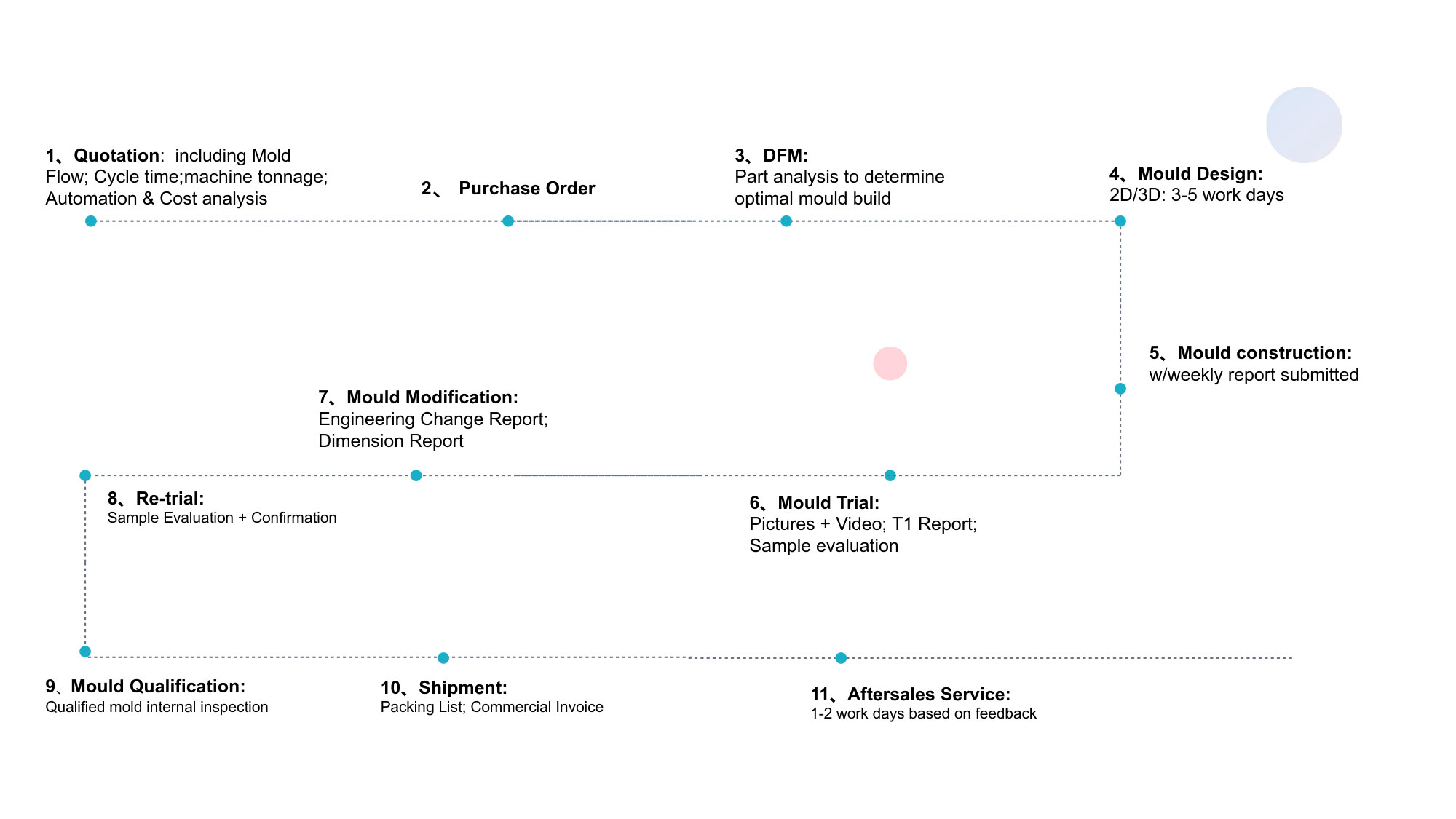
We operate with defined production schedules: simple single‑cavity molds are delivered in 10 days, moderately complex 2K waterproof ring molds are completed in 25‑45 days, and accelerated deliveries can be compressed to as few as 20 days with proper planning. For waterproof ring tooling, we front‑load the design validation work—including a full DFM (Design for Manufacturability) report with gate location recommendations and ejection system details—so that when machining begins, the design has already been proven in simulation.
3. Injection Molding Process Control: Eliminating Quality Anxiety
Process Standardization Through MES Integration
Every injection molding machine in our facility is connected to a centralized Manufacturing Execution System (MES). All critical process parameters—barrel temperatures (zoned for reinforced PA and LSR separately), injection velocity profiles, hold pressures, cooling times, and mold temperatures (controlled via thermolators)—are locked and can only be modified by authorized process engineers. Each production batch begins with a first‑article inspection and ends with a last‑article comparison to verify that no drift has occurred. This MES connectivity also enables real‑time statistical process control (SPC) charting.
Dimensional Stability — Preventing Warpage in Glass‑Filled PA
The most frequent quality issue with glass‑fiber‑reinforced components is anisotropic shrinkage: the part shrinks differently in the flow direction versus the transverse direction, leading to warpage and out‑of‑spec sealing surfaces. We address this by using zone‑controlled mold temperature regulation. The cavity and core are maintained within 2°C of each other using separate thermolator circuits, which minimizes thermal gradient–induced stresses. Additionally, by carefully controlling gate location and using conformal cooling channels machined directly into the mold inserts via our five‑axis CNC and wire EDM equipment, we produce a balanced cooling profile that reduces residual stress and eliminates warpage. For our waterproof ring components, we provide data showing that over three consecutive production runs one week apart, the positional variation of critical features is maintained within ±0.02 mm.
Surface Finish and Cosmetic Quality
The PA+50%GF substrate must be free of visible flow marks, sink marks, and burn marks for mobile phone applications where the component is visible. Our optimized gating and venting strategy prevents burn marks near the end of fill, while precise hold‑pressure management (automatically adjusted by machine cavity pressure sensors) eliminates sink at heavy cross‑sections. The LSR seal is molded with a smooth surface finish, free of air entrapment or incomplete fill, ensuring reliable sealing performance over the product lifetime. Parts that will undergo secondary painting or printing receive a molded‑in compensation for subsequent process shrinkage, maintaining printed feature registration to ±0.1 mm.
Specialty Material Experience — The List That Matters
Our process database includes thousands of proven molding parameters for engineering resins including PC/ABS, polycarbonate, PPS with 40% glass fiber, PEEK, PTFE/PFA, PA6 with 30% glass fiber, PBT, PEI, PPS, LCP, and numerous liquid silicone rubber compounds. For parts requiring flame retardancy, we produce UL94 V‑0 rated enclosures; for outdoor mobile phone components, we offer UV‑stabilized materials that pass 3,000 hours of accelerated weathering without visible yellowing or embrittlement.
4. Full‑Service Partnership: Lowering Your Total Cost of Ownership
Early Involvement and DFM — Finding Problems in Simulation, Not Steel
We provide a comprehensive Design for Manufacturability (DFM) report before any tooling contract is signed. This report evaluates:
Draft angles and wall thickness uniformity
Gate placement and number of drops
Ejector pin mark locations and allowable imprint areas
Material flow length and potential knit line locations
Heat removal efficiency of the planned cooling layout
This up‑front analysis prevents costly mold rework by identifying structural interferences or moldability issues before we cut the first block of steel.
Trial Samples and Improvement Cycles
We provide T1 (first trial), T2, and T3 sample parts, each accompanied by a detailed improvement report showing what was changed and how each change influenced part quality. Where multiple design alternatives are being considered, we can machine interchangeable inserts into the same mold base, allowing us to test different gate locations or seal geometries without building an entirely new tool. This approach dramatically reduces development time and cost for design verification.
Pilot Production Runs
Before we transition to full production volumes, we schedule a pilot run of 100 to 500 parts. During this trial, we run the mold under steady‑state production conditions, collect parts at regular intervals, measure every critical dimension, and compute the Cpk for each measured feature. Only when the Cpk values meet or exceed 1.33 for all critical dimensions do we sign off on quantity production.
Maintenance and Spare Parts
Every mold we deliver ships with a complete set of replacement wear components including spare ejector pins, core pins, and cavity inserts. We provide a structured maintenance schedule with recommended inspection intervals; at every 200,000 cycles we perform an in‑depth preventive maintenance service. For molds that require in‑field repair, we perform the work at cost with no markup on labor or materials, and we maintain a policy of responding to repair requests within 24 hours of receipt.
5. Differentiated Commitment: Solving Industry Pain Points
Common Industry Complaint Our Professional Response
“We spend too much downtime fixing mold issues.” Every tool undergoes a 2,000‑shot wear test before delivery, and we provide a full wear report. We offer a 3‑year structural warranty on all mold components (excluding naturally wearing consumables).
“Post‑molding flash removal adds significant labor cost.” We cut all parting lines to a class‑1 fit with a clearance of 0.005 mm. Our molds incorporate self‑locking tonnage compensation features that maintain clamp force as the mold expands during production, keeping flash below 0.03 mm in every shot.
“Part dimensions change from batch to batch.” Our machines are equipped with ultrasonic wall thickness sensors that provide real‑time feedback on part dimensions; when a drift is detected, the machine automatically adjusts hold pressure to compensate. We also embed in‑mold temperature and pressure sensors that close the loop between cavity conditions and injection parameters.
“Mold repairs take weeks to complete.” We maintain fully equipped electrode manufacturing and EDM departments on‑site. Most common repairs—small weld repairs or component replacement—are completed within 24 hours of diagnosis.
6. Conclusion
At Ansix Tech, we view molds not as blocks of steel but as production assets that generate revenue for our customers. Every design decision we make—steel selection, gate placement, cooling layout, ejection strategy—is evaluated against one simple question: does this reduce our customer's risk, lower their cost, or accelerate their time to market? Our 28 years of experience, 260 injection molding machines, four global production bases in China and Vietnam, and vertically integrated mold shop give us the scale to serve volume production while maintaining the responsiveness of a custom engineering partner. For a two‑component waterproof ring combining PA+50%GF hard substrate with integral LSR soft seal, we deliver a tool that arrives on your factory floor ready to run—no debugging, no flash, no unexpected maintenance. We would welcome the opportunity to walk you through a DFM analysis of one of your current components, demonstrating exactly how we would eliminate knit lines, trapped air, sink marks, and other moldability risks before we ever begin machining.
About Ansix Tech
Ansix Tech is a specialized manufacturer of waterproof seals and overmolded components for mobile phone and consumer electronics applications. With decades of experience in two‑shot and insert molding, and a proven track record of delivering high‑volume production solutions for demanding applications, we provide a complete turnkey solution from concept through delivery. Our customers consistently report significant reductions in total landed cost achieved through our emphasis on material selection optimization, process efficiency improvements, and early engineering involvement. For a detailed discussion of your waterproof ring requirements, including material selection guidance, DFM report, and prototyping options, please contact our engineering team.
Let us show you how a properly engineered mold can become a profitable production asset rather than a recurring maintenance headache.
Ansix Tech Co Ltd
If you have any plans related to Waterproof ring for mobile phone needle holder made of PA + 50% GF liquid silicone (LSR) , you can contact us at any time. We will turn your ideas into reality, let you realize your dreams, and obtain large orders from the market. Our contact information is info@ansixtech.com. Or contact our CTO, mail: stephen@ansixtech.com
#www.ansixtech.com #ansixtech.com #Waterproof ring for mobile phone needle holder made of PA + 50% GF #Waterproof ring for mobile phone needle holder made of PA + 50% GF injection molding companies #Waterproof ring for mobile phone needle holder made of PA + 50% GF Canopy Mold injection mold companies #Ansix #Ansix moulds #Ansix china #Ansix tech china #Ansix tech company #Ansix facotry #Waterproof ring for mobile phone needle holder made of PA + 50% GF injection molding #Waterproof ring for mobile phone needle holder made of PA + 50% GF injection tools #Waterproof ring for mobile phone needle holder made of PA + 50% GF injection moulds #Waterproof ring for mobile phone needle holder made of PA + 50% GF plastic mould #Waterproof ring for mobile phone needle holder made of PA + 50% GF plastic tools #Ansix Tech #Ansix molds #Ansix injection molding #Ansix mold factory #injection molding Waterproof ring for mobile phone needle holder made of PA + 50% GF#Ansix mold factory #Waterproof ring for mobile phone needle holder made of PA + 50% GF china #Waterproof ring for mobile phone needle holder made of PA + 50% GF molds #injection factory #Waterproof ring for mobile phone needle holder made of PA + 50% GF injection molding #Waterproof ring for mobile phone needle holder made of PA + 50% GF injection molding factory #injection molding company #Waterproof ring for mobile phone needle holder made of PA + 50% GF injection mold companies #Waterproof ring for mobile phone needle holder made of PA + 50% GF Tooling #Waterproof ring for mobile phone needle holder made of PA + 50% GF mold limited #Ansix mold china #Ansix companies #Ansix company China #Waterproof ring for mobile phone needle holder made of PA + 50% GF facotry #Ansix Tech #Ansix Tech mould #Waterproof ring for mobile phone needle holder made of PA + 50% GF injection moulding #injection moulding company #Ansix Waterproof ring for mobile phone needle holder made of PA + 50% GF parts injection mold companies #medical injection molding companieschina #Waterproof ring for mobile phone needle holder made of PA + 50% GF china factory #Ansix moulding companies #Ansix molding company #Waterproof ring for mobile phone needle holder made of PA + 50% GF injection moulding facotry #Ansix Tech mold #Waterproof ring for mobile phone needle holder made of PA + 50% GF mould #Waterproof ring for mobile phone needle holder made of PA + 50% GF plastic injection molding #ansix plastic mold #Mold manufacturing #Waterproof ring for mobile phone needle holder made of PA + 50% GF parts manufacturing #Waterproof ring for mobile phone needle holder made of PA + 50% GF plastic parts factory #Waterproof ring for mobile phone needle holder made of PA + 50% GF injection parts mold #Waterproof ring for mobile phone needle holder made of PA + 50% GF PRECISION MANUFACTURING #Waterproof ring for mobile phone needle holder made of PA + 50% GF #China mold #Waterproof ring for mobile phone needle holder made of PA + 50% GF injection moulding china #Waterproof ring for mobile phone needle holder made of PA + 50% GF mould china #china precision mold #mold in china #Waterproof ring for mobile phone needle holder made of PA + 50% GF mold china #Precision molds #High-precision molds #Waterproof ring for mobile phone needle holder made of PA + 50% GF #Injection molds #Waterproof ring for mobile phone needle holder made of PA + 50% GF Factory #Waterproof ring for mobile phone needle holder made of PA + 50% GF Company #Super Large Injection Mold Factory #Large Tonnage Injection Molding Factory #Waterproof ring for mobile phone needle holder made of PA + 50% GF Company #Waterproof ring for mobile phone needle holder made of PA + 50% GF Factory #2800T Injection Molding Factory #3000 Ton Injection Molding #4500 Ton Injection Molding Factory #Large Mold Injection Molding #Large Plastic Mold Injection Molding Factory #Large Injection Mold Manufacturer #Plastic Mold Factory #Injection Mold #Plastic Mold