



PMMA Light Guide Trim Strip
FEATURES
Comprehensive Manufacturing Proposal for PMMA Light Guide Trim Strip
Mold Manufacturing & Injection Molding Industry Production Solution
This 2000+ word technical proposal systematically presents how Ansix Tech Corporation transforms specialized PMMA light guide manufacturing expertise into measurable customer value—lower costs, reduced risks, and faster time-to-market. The company brings over 28 years of injection molding expertise and has successfully manufactured more than 30,000 sets of molds, maintaining a 70% automation processing rate.
-
Mold Description
Product Materials:
PMMA
Mold Material:
S136ESR
Number of Cavities:
2
Glue Feeding Method:
COLD runner
Cooling Method:
Water cooling
Molding Cycle
32.5s
- The mold manufacturing process and product material selection
Hardware Foundation: Building Customer Trust through Equipment Capabilities
Before discussing any specialized optical-grade manufacturing processes, customers need confidence in the fundamental production assets. Below is Ansix Tech‘s equipment infrastructure, presented with transparent technical specifications alongside the clear value each capability delivers.
1.1 Mold Processing Equipment
Equipment Type Technical Specification Customer Value
5-Axis High-Speed Machining Centers 0.0001° motion control resolution, precision control within 10μm, surface finish Ra<0.5μm Delivers complex 3D optical microstructures without manual polishing—achieves “assembly-only, no-rework” mold quality, eliminating costly post-processing
CNC Precision Milling Direct hard material cutting, significantly reduces EDM工序, ensures first-pass machining success Shorter lead times, reduced handwork cost,
-
consistent cavity geometry across every mold
Slow Wire EDM (Wire-Cut EDM) Achieves micro-pores and narrow slots down to 0.03mm; eliminates burrs and thin-wall deformation Enables precision features required for uniform light extraction; protects delicate mold features during processing
EDM (Electrical Discharge Machining) Self-built electrode machining center and EDM workshop keep mold repairs in-house On-site mold modification within 24 hours—cuts weeks from traditional repair cycles
1.2 Injection Molding Machine Fleet
Parameter Specification Customer Value
Clamping Force Range 30T – 4000T From micro-optics to large automotive light guides; one-stop solution for all product dimensions
Drive Technology Full-servo electric drive with closed-loop control Product weight repeatability ≤0.1%; consistent part quality cavity-to-cavity, batch-to-batch
Injection Speed Up to 500mm/s High-speed filling eliminates weld lines in optical-grade components
Positioning Repeatability ±0.01mm for mold opening position, screw runout ≤0.05mm (down to 0.03mm for optical-dedicated machines) Tight dimensional control ensures every molded light guide meets optical specifications
1.3 Inspection and Quality Equipment
Equipment Specification Customer Value
CMM (Coordinate Measuring Machine) Full dimensional reporting before mold shipment Complete traceability; no last-minute surprises during customer sampling
Optical Imaging System High-resolution defect detection on transparent and micro-structured surfaces Catches micro-cracks, bubbles, and surface defects invisible to the naked eye
Process Capability Critical dimension CPK ≥ 1.33 guaranteed Statistically validated process stability—customer can trust long-run production consistency
1.4 Quality Management System Certifications
Ansix Tech maintains ISO9001, ISO14001, IATF16949, and ISO13485 certifications, ensuring that every PMMA light guide trim strip meets the most rigorous industry standards.
II. Core Competency in Mold Manufacturing: Translating Metrics into Customer Confidence
Customer concerns for optical-grade PMMA mold manufacturing center on four pillars: lifetime, precision, delivery, and repair cost.
2.1 Mold Life Expectancy
Mold Component Material Grade Lifetime Guarantee (Customer Value)
Mold Base P20 (pre-hardened)
Cavity/Core Inserts S136, 2344, 2343, 8407, SKD11/61/DC53, M340/4Cr13/9Cr18, NAK80, H13
Performance Guarantee 500,000 shots for glass-reinforced materials; 1,000,000 shots for standard plastics Predictable tooling amortization cost; no unplanned replacements that disrupt customer production schedules
All mold steel comes with material certification reports and heat treatment curves—full material pedigree for customer QA records.
2.2 Achievable Tolerances
Part Type Tolerance Capability Customer Value
Standard structural components ±0.05mm
Precision gears / optical components ±0.005mm Enables high-accuracy light coupling interfaces; eliminates post-mold assembly issues
For PMMA light guide trim strips requiring optical-grade surface finish, Ansix Tech holds cavity surface roughness to Ra ≤ 0.05μm, essential for total internal reflection and uniform light transmission.
2.3 Mold Types and Configurations
Mold Type Application for Light Guides Customer Value
Hot runner systems Long thin-wall light guides, multi-cavity configurations Reduces sprue waste; shorter cycle times; consistent melt flow
Stack molds High-volume production Doubles output per machine cycle without additional floor space
Two-shot / multi-material molds Integrated optical and structural components Reduces secondary assembly steps
High-gloss mirror-finish molds Transparent PMMA optical surfaces (Ra≤0.05μm) Eliminates light scattering from surface defects
2.4 Gating and Runner Design
Using Moldflow CAE simulation, Ansix Tech pre-identifies weld line and air trap locations upfront, optimizing gate count and placement to ensure balanced filling.
For PMMA light guide strips specifically:
Fan gates or film gates positioned on non-optical edges to minimize shear whitening and eliminate visible gate marks
Valve gate hot runner injection eliminates weld lines and flow marks entirely
Micro-structure details (V-grooves, circular grooves, crescent-shaped dimples) achieve feature sizes below 10μm with position accuracy of ±1μm
2.5 Cooling System Design
Multi-zone independent temperature control with mold temperature controllers maintains core-cavity differential within 2°C. For continuous high-volume production of optical-grade parts, mold temperature is maintained between 70–90°C.
Customer benefit: Minimized residual stress and warpage—critical for long, slender light guides that must remain straight to maintain uniform light output over their entire length.
2.6 Standard Lead Times
Mold Complexity Standard Delivery Expedited Delivery
Simple molds 10 days
Medium complexity 25–45 days Down to 20 days
High-complexity optical molds 6–8 weeks Subject to feasibility review
Transparent note: Expedited delivery maintains all validation steps (T1–T3 sampling, dimensional reports). No shortcuts on quality.
2.7 Mold Flow Analysis (CAE Simulation) – Translating Technical into Benefits
Technical Activity Customer Benefit
Design for Manufacturability (DFM) report before mold build Prevents structural design flaws discovered only after steel is cut—saves months and thousands of dollars
Moldflow simulation of filling, packing, and cooling Optimizes gate location and process parameters virtually so physical trial shots succeed first time
Weld line and air trap prediction Eliminates optical defects before mold is machined—protects optical uniformity
Residual stress analysis Prevents light guide warpage that causes uneven illumination
DOE (Design of Experiments) for parameter optimization Identifies robust process window, ensuring consistent quality across shifts, seasons, and operators
III. Injection Molding Process Control: Eliminating Customer Quality Anxiety
Customers fear four specific defects: sink marks, flash, dimensional instability, and batch-to-batch color/shade variation.
3.1 Process Parameter Management
All machines are networked, with all molding parameters (temperature, pressure, speed, time) locked within the MES system. Only authorized engineers may adjust parameters. Every batch undergoes first-article and last-article comparison.
Customer value: No undocumented parameter changes—full traceability from raw material to finished part.
3.2 Dimensional Stability Control
For PMMA optical components, mold temperature directly impacts residual stress and replication fidelity.
Control Method Customer Benefit
Mold temperature zoning with independent controllers; core-cavity ΔT ≤ 2°C Minimizes warpage and maintains optical path straightness
In-mold temperature and pressure sensors for closed-loop control Real-time process adjustments without operator intervention
Automated part measurement with SPC charting Statistical proof of stability; customer QC can rely on consistent data
Demonstrated capability: For structural parts produced continuously over one week across three production runs, critical hole spacing variation ≤ 0.02mm.
3.3 Optical Quality Standards
Quality Attribute Achievable Standard Customer Value
Transparency ≥92% light transmission Maximum LED light extraction efficiency
Surface defects No bubbles, flow marks, or weld lines No post-inspection rejection for visible defects
Surface roughness Ra ≤ 0.2μm for standard finish; Ra ≤ 0.05μm for high-gloss Eliminates post-mold polishing
Texture / microstructure replication Feature sizes <10μm, positional accuracy ±1μm Superior light extraction uniformity and brightness
3.4 Material Selection Capability
Ansix Tech has proven experience with a wide range of engineering thermoplastics beyond standard PMMA:
Material Category Specific Grades and Characteristics
Optical-grade PMMA Röhm PLEXIGLAS® Optical POQ66 (transmittance 92%, 17 kJ/m² impact); Asahi Kasei 70NH; Kuraray PARAPET™ (HR-S, GH-S, GH-K); Mitsubishi Acrypet TF8/VH5; Sumitomo SUMIPEX® MHN/MG5
High-performance engineering resins PC, PC/ABS, PPS+40%GF, PEEK, PTFE/PFA, PA6+GF30, PBT, PEI, LCP, PVC
Flame-retardant grades UL94 V-0 rating for safety-critical housings
UV-stabilized compounds Pass 3,000-hour UV testing without yellowing
3.5 Essential PMMA Injection Molding Parameters
Parameter Optimal Range Rationale
Melt temperature 220–260°C (grade-specific) Prevents material degradation while maintaining flow
Mold temperature 70–90°C with precise water circuits Slows skin freeze, raises surface gloss, reduces residual stress
Injection speed High-speed (>500mm/s) filling Reduces weld lines; critical for thin-wall sections
Hold pressure & time High/long enough to pack out sink without excessive birefringence Maintains optical uniformity across part
Cooling time Optimized via thermal simulation Balances cycle time against residual stress
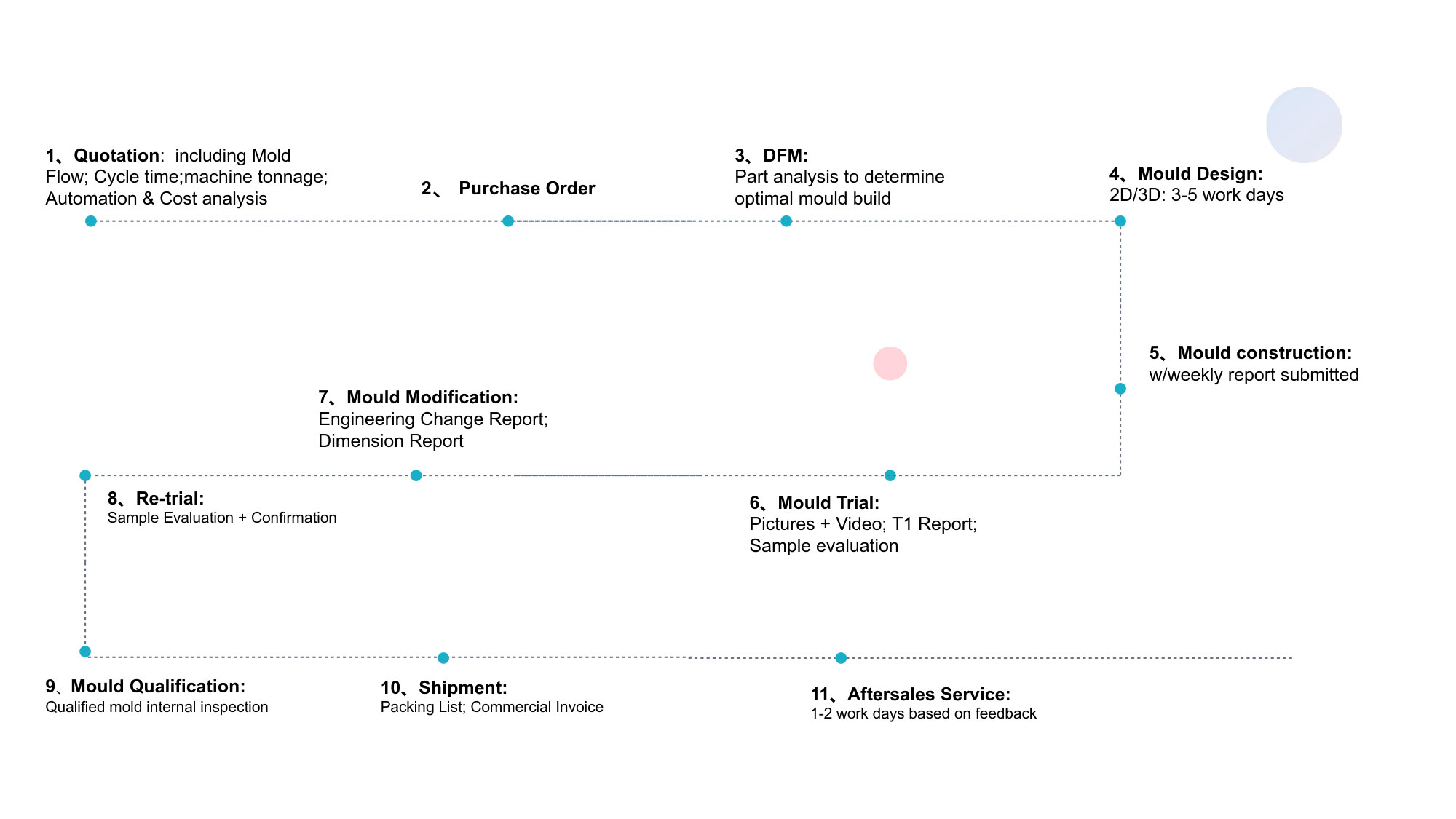
IV. Full-Process Service: Reducing Customer Management Cost
Many manufacturers focus only on making parts. Ansix Tech focuses on making parts right, on time, with minimal customer friction.
4.1 Early Intervention – DFM Report (Pre-Mold-Build Phase)
Before cutting any steel, Ansix Tech‘s engineering team provides a comprehensive Design for Manufacturability (DFM) report containing:
DFM Content Item Customer Benefit
Draft angle recommendations for damage-free demolding Eliminates drag marks on optical surfaces
Wall thickness balancing to prevent sink marks and warpage Ensures consistent light transmission without localized distortion
Gate location selection to preserve optical zones No visible gate marks in light output areas
Ejector pin imprint location boundaries Eliminates guesswork during tool design
4.2 Sampling and Verification (T1–T3)
Stage Deliverable Customer Benefit
T1 (First Shot) Measurement report; photograph of part orientation Immediate visual and dimensional confirmation of basic geometry
T2 (Optimized) Optimized part with process adjustments documented Engineering confidence before committing to full production
T3 (Pre-Production) Fully tuned parts at target cycle time Validation of full production setup before mass production
Throughout this process, Ansix Tech can quickly swap inserts to evaluate different design options without retooling the entire mold.
4.3 Small-Batch Validation
Before full production launch, Ansix Tech offers 100 to 500 shots of trial production covering:
Process capability (CPK) calculation on all critical dimensions
Yield rate statistical analysis
Dimensional stability verification across multiple consecutive shots
Customer value: Full confidence that the process is stable before volume production begins. Zero “hidden failures” discovered after production ramp-up.
4.4 Maintenance and Spare Parts
Service Commitment
Wear parts (ejector pins, core inserts) delivered with mold Immediate on-site replacement without ordering delays
Mold maintenance inspection every 200,000 shots Preventive rather than reactive
Lifetime repair at cost-recovery pricing No unexpected high repair bills for tools
4.5 Quality Control System
Ansix Tech maintains rigorous quality control at every stage:
Incoming material inspection – full material certification and visual inspection
In-process monitoring – automated SPC collection with real-time alerts
Final inspection – 100% dimensional verification for critical features
Optical testing – light transmission uniformity measurement on representative samples
V. Differentiated Comparison: Addressing Customer Pain Points with Specific Solutions
Instead of making generic claims, Ansix Tech responds to industry-wide complaints with concrete, verifiable solutions.
Customer Complaint #1: “Mold keeps needing repair, disrupting production.”
Industry Problem Ansix Tech Response
Frequent mold stops for unscheduled repairs Pre-delivery 2,000-shot aging test with wear report – We validate mold performance before shipment
Hidden tooling failures Three-year mold structure warranty (excluding normal wear parts) – Long-term protection on your capital investment
Translating specialized terms to customer value:
“2000-shot aging test“ means you won‘t discover a weak mold design on your factory floor
“Three-year structural warranty” means predictable maintenance costs and production uptime
Customer Complaint #2: “Flash on parts drives up post-molding finishing cost.”
Industry Problem Ansix Tech Response
Parts require manual de-flashing after molding 0.005mm parting line fitting precision – Flash ≤ 0.03mm per batch
Inconsistent flash from batch to batch Self-locking mold clamp force compensation system – Adaptive force maintains consistent clamp across thermal expansion
Translating specialized terms to customer value:
“0.005mm fitting precision” means rework labor may be eliminated
“Self-locking compensation” means every batch behaves consistently
Customer Complaint #3: “Dimensions drift between batches—parts don‘t fit consistently.”
Industry Problem Ansix Tech Response
Dimensional variation across production runs Ultrasonic wall thickness sensors with real-time feedback to holding pressure – Dynamic correction during molding
Uncontrolled process variables In-mold temperature and pressure sensors with closed-loop control – Process stays stable despite ambient changes
Insufficient control granularity Only engineer-authorized parameter changes via MES-locked controls – No undocumented “operator adjustments”
Translating specialized terms to customer value:
“Closed-loop control” means the machine corrects itself—no operator skill dependence
“MES-locked parameters” means you have full traceability for ISO/audit compliance
Customer Complaint #4: “Mold repair takes too long—weeks of downtime.”
Industry Problem Ansix Tech Response
Mold repair requires shipping to external shops Self-built electrode machining center and in-house EDM shop – Repairs never leave our facility
Long replacement part lead times Standard welding, insert replacement completed within 24 hours – Production restoration measured in hours, not weeks
Translating specialized terms to customer value:
“24-hour repair turnaround” means minimal production downtime
“In-house repair capability” means no logistics delays or external vendor qualification
VI. The Ansix Tech Promise
For Ansix Tech, a mold is not just a block of steel—it is a profit-generating asset.
When we design a mold for your PMMA light guide trim strip, we analyze every detail simultaneously:
Flow balance – Ensuring all cavities fill uniformly for consistent output
Stress distribution – Minimizing residual stress so long slender light guides stay straight
Vent paths – Eliminating air traps that would cause bubbles in transparent optical surfaces
Thermal balance – Even cooling for minimum warpage across all production cycles
The result: When the mold arrives at your facility, it is essentially ready-to-run—low flash, long tool life, minimal trial-and-error.
6.1 Cost Reduction Strategy
Ansix Tech reduces customer hard costs across three dimensions:
Cost Dimension Strategy Typical Savings
Material Process optimization to run at lower tolerance limits; hot runner systems eliminate sprue waste; precise process windows reduce scrap Reduces raw material consumption per good part
Process Optimized cycle time via thermal analysis; automated part handling reduces labor; multi-cavity molds maximize output per machine hour Reduced manufacturing cost per part
Efficiency 70% automation rate minimizes operator cost; 30,000+ mold sets of accumulated knowledge eliminates trial-and-error; preventive maintenance prevents downtime Lower overhead allocated per part
6.2 Capacity and Delivery Assurance
Capability Specification
Automation processing rate 70% maintained
Total molds manufactured Over 30,000 sets
Machine fleet 30T – 4000T covering all product sizes
Quality certifications ISO9001, ISO14001, IATF16949, ISO13485
VII. Customer Feedback and Continuous Improvement
Ansix Tech‘s manufacturing approach has been validated across multiple industries. The company’s engineering team works closely with customers throughout the entire project lifecycle—from initial concept and prototype development through validation and volume production.
A note to potential customers:
“We would like to walk you through a full-process DFM report using one of your existing products. You will see firsthand how we anticipate and resolve weld lines, air traps, sink marks, and other optical defects—before steel is cut. When you are ready, we can schedule a session to review a specific part and demonstrate the value we deliver.”
*Contact Ansix Tech to discuss your PMMA light guide trim strip project. With 28+ years of injection molding expertise, full design-for-manufacturing support, ISO-certified quality systems, and a proven 70%-automated manufacturing platform, Ansix Tech is positioned to deliver optical-grade light guide components that reduce your total cost and eliminate production risk.
Ansix Tech Co Ltd
If you have any plans related to PMMA Light Guide Trim Strip , you can contact us at any time. We will turn your ideas into reality, let you realize your dreams, and obtain large orders from the market. Our contact information is info@ansixtech.com. Or contact our CTO, mail: stephen@ansixtech.com
#www.ansixtech.com #ansixtech.com #PMMA Light Guide Trim Strip #PMMA Light Guide Trim Strip moulds #PMMA Light Guide Trim Strip injection molding companies #PMMA Light Guide Trim Strip Canopy Mold injection mold companies #Ansix #Ansix moulds #Ansix china #Ansix tech china #Ansix tech company #Ansix facotry #PMMA Light Guide Trim Strip injection molding #PMMA Light Guide Trim Strip injection tools #PMMA Light Guide Trim Strip injection moulds #PMMA Light Guide Trim Strip plastic mould #PMMA Light Guide Trim Strip plastic tools #Ansix Tech #Ansix molds #Ansix injection molding #Ansix mold factory #injection molding PMMA Light Guide Trim Strip #Ansix mold factory #PMMA Light Guide Trim Strip china #PMMA Light Guide Trim Strip molds #injection factory #PMMA Light Guide Trim Strip injection molding #PMMA Light Guide Trim Strip injection molding factory #injection molding company #PMMA Light Guide Trim Strip injection mold companies #PMMA Light Guide Trim Strip#PMMA Light Guide Trim Strip mold limited #Ansix mold china #Ansix companies #Ansix company China #PMMA Light Guide Trim Strip facotry #Ansix Tech #Ansix Tech mould #PMMA Light Guide Trim Strip injection moulding #injection moulding company #Ansix PMMA Light Guide Trim Strip parts injection mold companies #medical injection molding companieschina #PMMA Light Guide Trim Strip china factory #Ansix moulding companies #Ansix molding company #PMMA Light Guide Trim Strip injection moulding facotry #Ansix Tech mold #PMMA Light Guide Trim Strip mould #PMMA Light Guide Trim Strip plastic injection molding #ansix plastic mold #Mold manufacturing #PMMA Light Guide Trim Strip parts manufacturing #PMMA Light Guide Trim Strip plastic parts factory #PMMA Light Guide Trim Strip injection parts mold #PMMA Light Guide Trim Strip PRECISION MANUFACTURING #PMMA Light Guide Trim Strip #China mold #PMMA Light Guide Trim Strip injection moulding china #PMMA Light Guide Trim Strip mould china #china precision mold #mold in china #PMMA Light Guide Trim Strip mold china #Precision molds #High-precision molds #PMMA Light Guide Trim Strip #Injection molds #PMMA Light Guide Trim Strip Factory #PMMA Light Guide Trim Strip Company #Super Large Injection Mold Factory #Large Tonnage Injection Molding Factory #PMMA Light Guide Trim Strip Company #PMMA Light Guide Trim Strip Factory #2800T Injection Molding Factory #3000 Ton Injection Molding #4500 Ton Injection Molding Factory #Large Mold Injection Molding #Large Plastic Mold Injection Molding Factory #Large Injection Mold Manufacturer #Plastic Mold Factory #Injection Mold #Plastic Mold